FULL STORY:The HOA Queen Blamed My Pool for Turning Her Hair Green—My Lab Report Put Her Clubhouse on the Hook for a Six-Figure Disaster
FULL STORY CONTINUATION
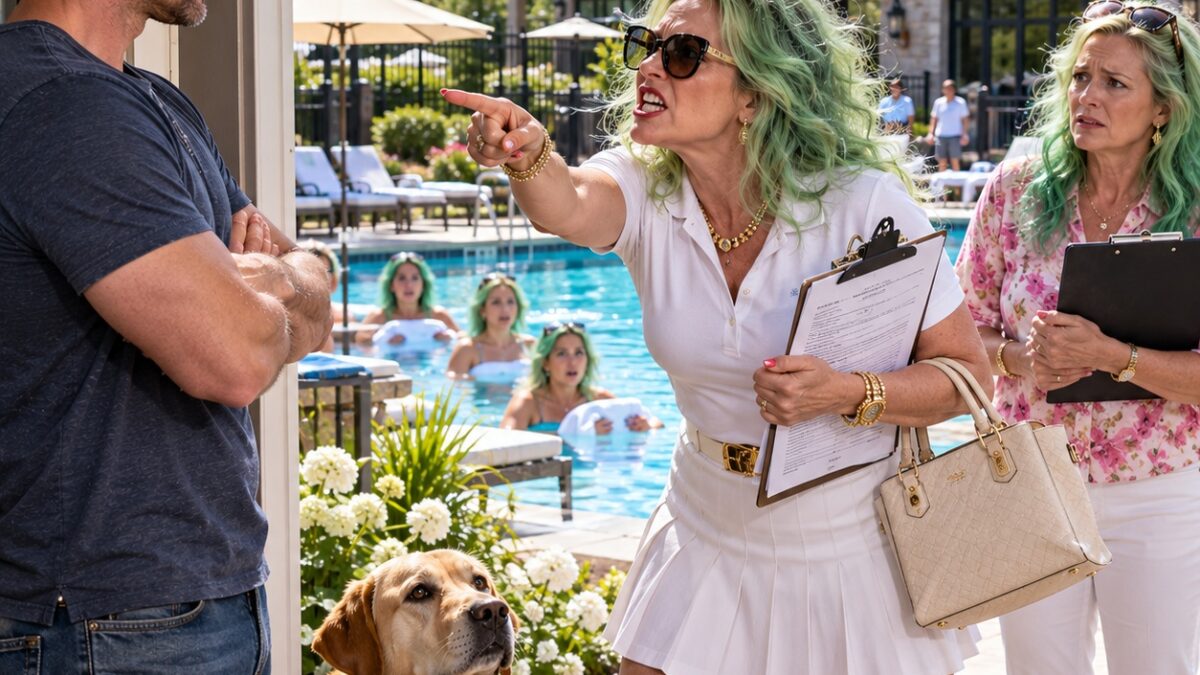
Karen recovered quickly.
People like her usually did.
Confidence was less a personality trait with Karen than a survival mechanism.
She adjusted her sunglasses and looked at me as if Pam hadn’t just handed me the first useful fact of the morning.
“You will receive the notice.”
“Send whatever you want.”
“You have forty-eight hours.”
“I heard you the first time.”
She turned.
Pam followed.
Halfway down the walk, Karen looked back.
“And stop running your filtration system at night.”
I frowned.
“Why?”
“Residents can hear it.”
“No, they can’t.”
“It creates a low-frequency hum.”
“My pump is variable-speed and quieter than your golf cart.”
“That attitude is exactly why we need compliance review.”
Then she left.
Margaret sat beside my ankle watching the two of them cross the street.
I looked down at her.
“She blamed the cat next, I’m moving.”
Margaret yawned.
Two days later, the HOA notice arrived.
Of course it did.
Official seal.
Heavy paper.
Bold type.
FORMAL WATER SAFETY DISCLOSURE DEMAND.
I laughed before I finished the first paragraph.
The board wanted free chlorine, total chlorine, pH, alkalinity, calcium hardness, stabilizer concentration, dissolved metal screening, filtration schedule, chemical inventory, maintenance log, and “any documentation reasonably related to unusual optical clarity.”
That phrase deserved an award.
Unusual optical clarity.
Apparently clean water had become probable cause.
There was also a warning.
Failure to provide the requested information could result in disciplinary review and fines of up to five hundred dollars per day.
I photographed everything.
Then I did what Karen asked.
Thoroughly.
People sometimes assume technical professionals hate paperwork.
That depends.
Pointless paperwork?
Absolutely.
Paperwork requested by someone who has dramatically underestimated you?
That can be therapeutic.
I tested my pool.
Then tested it again.
Free chlorine: normal.
Combined chlorine: negligible.
pH: 7.5.
Total alkalinity: balanced.
Calcium hardness: appropriate.
Cyanuric acid: within range.
Copper: below meaningful detection.
Iron: minimal.
Saturation index: stable.
No unusual oxidizer.
No mystery compound.
No radioactive suburban revenge serum.
Just very clean pool water.
I compiled thirty days of logs.
Added equipment specifications.
Calibration records.
A simple explanation of each parameter.
Then, because Karen had asked for a “full chemical breakdown,” I included the actual laboratory sheet from an independent sample I sent to a certified commercial lab.
Ten pages.
Charts.
Tables.
Plain-English summary.
Conclusion:
No evidence that Lot 17’s pool presented a contamination hazard or any plausible pathway for affecting swimmers using the separate HOA community pool.
I delivered it personally.
Karen looked at the binder.
“What is this?”
“The report you ordered.”
“It’s enormous.”
“You requested a complete chemical breakdown.”
“I meant a simple summary.”
“There is one on page two.”
She opened randomly to the metal analysis.
Her face tightened.
“This is too technical.”
“You asked a chemist for chemistry.”
“Normal homeowners don’t use terms like saturation index.”
“Normal homeowners also don’t receive five-hundred-dollar-a-day threats over water clarity.”
Phil Benson, one of the quieter board members, was sitting at the far end of the HOA office.
He tried unsuccessfully to hide a smile.
Karen saw him.
“Phil?”
He straightened.
“Nothing.”
I tapped the report.
“There’s something else you should know.”
Karen stopped flipping pages.
“What?”
“Green hair after swimming is usually associated with copper deposition on porous hair, especially lightened or bleached hair.”
“I told you.”
“You told me my pool caused it.”
“Yes.”
“No one complaining swam in my pool.”
Silence.
Phil looked up.
I continued.
“If multiple people experienced the same discoloration after using the clubhouse pool, you should test that water.”
Karen crossed her arms.
“It has been tested.”
“Can I see the results?”
“No.”
“Why not?”
“Those are association maintenance documents.”
“I’m an association member.”
“They’re internal.”
“That’s interesting.”
Her eyes narrowed.
“What is?”
“You demand my private maintenance records but won’t show homeowners records for the pool their dues pay for.”
Phil looked down again.
This time he wasn’t smiling.
He was thinking.
Karen handed the binder back.
“We’ll review your submission.”
“You keep it.”
“I don’t need—”
“You asked for it.”
She stared at the report like I had handed her a live animal.
I smiled.
“Page seven has pictures.”
Then I left.
The neighborhood rumors started by Wednesday.
Karen had apparently told several people that my pool might be “contributing airborne particulates.”
A neighbor named Dennis stopped me while I was bringing groceries inside.
“Hey.”
“Hey.”
He lowered his voice.
“Is your filter releasing copper mist?”
I stared at him.
“What?”
“Karen said maybe the wind is carrying something.”
“My pool is forty yards from the street.”
“I thought it sounded weird.”
“It is weird.”
He looked relieved.
“So we’re safe?”
“From my pool?”
“Yeah.”
“Extremely.”
He nodded.
Then looked toward Karen’s house.
“She’s really upset about the hair.”
“I noticed.”
Saturday morning, the clubhouse pool opened at ten.
By ten-thirty, three women were complaining again.
By eleven, somebody posted a photograph in the neighborhood group.
Pam.
Wet hair.
Green streaks brighter than before.
The caption read:
THIS IS GETTING WORSE.
I was trimming a hedge when shouting started near the clubhouse.
Karen marched toward me across the grass.
She was wearing flip-flops, a cover-up, and a towel around her shoulders.
Her hair was wet.
And greener.
I set down the trimmer.
“You.”
“Again?”
“You’re enjoying this.”
“I’m enjoying hedge maintenance.”
“You know exactly what’s happening.”
“Yes.”
She stopped.
That answer surprised her.
“You admit it?”
“I admit I understand copper chemistry.”
Her face went red.
“You poisoned the community pool.”
“No.”
“Then explain this.”
She grabbed a strand of hair.
I looked at it.
“You swam in the clubhouse pool?”
“Yes.”
“After your first incident?”
“It was supposed to be corrected.”
“By whom?”
Karen’s face changed.
Small change.
Important change.
“Maintenance.”
“Which maintenance company?”
“That is none of your concern.”
“It became my concern when you threatened me with five-hundred-dollar daily fines and told neighbors my backyard was emitting metal fog.”
Several people nearby laughed.
Karen turned toward them.
They immediately became interested in their phones.
Then I said, “Test the community pool.”
“We have.”
“Independent laboratory.”
“We have test strips.”
“Test strips don’t quantify dissolved copper reliably.”
Pam approached.
“Can you test it?”
Karen spun.
“No.”
Pam stopped.
“Why?”
“Because he’s not touching HOA property.”
“I don’t need to.”
They both looked at me.
I pointed toward the public health department number posted on the clubhouse wall.
“Call the county.”
Karen’s mouth tightened.
“We do not need government interference.”
That sentence traveled farther than she intended.
Sandy Alvarez, another board member, was standing by a lounge chair.
She looked at Karen.
“If people are having a reaction, why wouldn’t we test?”
“Nobody is having a reaction.”
Pam lifted her green hair.
“What do you call this?”
Karen looked furious.
I almost felt sorry for her.
Almost.
“This meeting is over,” she said.
“We’re not in a meeting,” Sandy replied.
Phil laughed.
Karen stormed inside.
That afternoon, my doorbell camera caught Pam crouching near my side fence holding what looked like a turkey baster.
I opened the back gate.
She jumped.
“Pam.”
She hid the baster behind her back.
“What are you doing?”
“Collecting a sample.”
“With kitchen equipment?”
“It’s clean.”
“That is not how sampling works.”
She looked embarrassed.
“I was told—”
“Karen?”
Pam sighed.
“She says if your water has copper, that proves migration.”
“Migration through what?”
She looked toward my yard.
“Groundwater?”
“My pool has a vinyl-lined shell.”
She stared.
“Air?”
“No.”
“Sprinklers?”
“No.”
She lowered the baster.
“So none of that makes sense.”
“No.”
Pam rubbed her forehead.
“I used to sell real estate.”
“That tracks.”
She looked offended.
“I was very good.”
“I believe you.”
I took a sterile sample bottle from my garage.
“If the board wants my water independently sampled, do it correctly.”
I handed it to her.
“Wear gloves. Rinse according to protocol. Label time and location. Chain of custody if you intend to use the result officially.”
Pam stared at the bottle.
“Karen said you were hiding something.”
“I’m hiding the good coffee from HOA officers.”
That got a reluctant smile.
Pam left.
The official inspection came Monday.
Karen.
Pam.
Phil.
A contracted pool technician named Wade.
And, to my surprise, Sandy.
I greeted them wearing a lab coat.
Not because I needed one.
Because I’m human.
Karen looked at me.
“Seriously?”
“Safety culture.”
Phil coughed suspiciously.
On the patio I had arranged my testing equipment.
Digital pH meter.
Photometer.
Sample bottles.
Calibration solutions.
Maintenance logs.
And a plate of lemon bars.
Sandy looked at the tray.
“Are those part of the test?”
“Critical.”
Karen refused one.
Phil took two.
We sampled the pool together.
Wade ran his own kit.
Everything came back normal.
He frowned at the copper screen.
“Essentially nothing.”
Karen leaned toward him.
“What does essentially mean?”
“Below actionable level.”
“Could wind concentrate it?”
Wade looked at me.
Then at Karen.
“No.”
“Could sunlight change it?”
“No.”
“Could mist carry it?”
“Not like what you’re describing.”
Phil ate another lemon bar.
Karen folded her arms.
“You’re hiding something.”
I smiled.
“Knowledge?”
Phil nearly inhaled powdered sugar.
Karen glared at him.
The inspection ended with no violation.
I asked for a signed copy.
Karen did not want to give me one.
I insisted.
That turned out to matter later.
Because two days afterward, the HOA sent me another violation notice claiming my pool “continued to present unresolved chemical concerns.”
I attached the inspection report to my appeal.
Then requested community pool records.
Chemical purchase logs.
Maintenance invoices.
Daily chemistry sheets.
Equipment repair reports.
Vendor contracts.
Minutes from any board discussions about water quality.
Karen denied the request.
I submitted it again under the association’s records procedure.
She denied it again.
Phil called me privately that night.
“I probably shouldn’t be doing this.”
“Then don’t.”
“That somehow made it worse.”
“What do you need?”
He lowered his voice.
“You were right.”
“About?”
“There was a treatment Wednesday.”
“The one before Karen’s hair changed?”
“Yes.”
“What happened?”
“Pool got cloudy.”
“Why?”
“No idea.”
“What did maintenance add?”
“Copper algaecide.”
I closed my eyes.
“How much?”
“I don’t know.”
“Who authorized it?”
Silence.
“Phil?”
“Karen.”
There it was.
“Was the pH low?”
“I don’t know what that means.”
“Do you have the log?”
“No.”
“Then don’t speculate.”
He sighed.
“You really are an accountant with chemicals.”
“Chemist.”
“Same personality.”
“Good night, Phil.”
The next morning, I called the county recreational-water office.
I did not accuse anybody.
I said multiple swimmers had reported hair discoloration after using the same community pool.
I explained that the HOA had declined to provide maintenance records.
I asked whether the county could inspect.
They could.
Two days later, a county environmental health specialist named Marcus Reed arrived.
Karen hated him immediately.
I knew because she smiled too hard.
“This seems unnecessary.”
Marcus wore a county polo and carried a professional sampling kit.
“If multiple patrons report the same condition, we document.”
“Green hair is cosmetic.”
“Sometimes.”
He sampled water.
Took readings.
Inspected equipment.
Looked at the chemical storage room.
Then asked for logs.
Karen tried to explain that certain records were with the maintenance vendor.
Marcus waited.
Wade, the contractor, arrived twenty minutes later carrying a folder.
That was the beginning of the end.
The clubhouse pool’s pH had been unstable for weeks.
Not catastrophically unsafe.
But repeatedly low enough to increase corrosion risk.
There had also been a high copper reading twelve days earlier.
Then another.
Then Karen authorized a copper-based algaecide treatment after cloudy water developed.
Wade had written a warning on the work order.
MONITOR COPPER. DO NOT OVERDOSE. INVESTIGATE METAL SOURCE.
Underneath it was Karen’s signature.
I didn’t touch the document.
Marcus did.
“What was the follow-up reading?”
Wade shifted.
“We didn’t get one.”
“Why?”
Karen interrupted.
“The pool looked clear.”
Marcus stared at her.
I looked away because my face was about to betray me.
Pool chemistry does not care whether water looks pretty.
Clear water can be unbalanced.
Cloudy water can come from multiple causes.
Color is not a laboratory instrument.
Marcus took more samples.
Then inspected the mechanical room.
He found older copper-containing heat exchanger components showing visible corrosion.
Low pH.
Copper equipment.
Additional copper algaecide.
Bleached blonde hair.
The chemistry was no longer mysterious.
It was practically introducing itself.
Karen crossed her arms.
“So his pool had nothing to do with it?”
Marcus looked at her.
“I haven’t completed the report.”
“But preliminary?”
“The private pool across the street is not connected to this circulation system.”
I thought that was beautifully diplomatic.
Karen’s face darkened.
Three days later, the county report arrived.
Elevated copper.
Corrosion indicators.
History of pH excursions.
Recommendation for immediate corrective maintenance.
Temporary pool closure pending stabilization and equipment evaluation.
The HOA message board exploded.
My favorite post came from Dennis.
SO IT WASN’T AIRBORNE?
Phil replied with a single word.
No.
Karen tried to control the story.
She sent a newsletter titled COMMUNITY POOL QUALITY UPDATE.
It blamed “complex environmental variables.”
No mention of copper algaecide.
No mention of her signature.
No mention of the contractor warning.
Then something else happened.
Homeowners started asking questions.
Not about hair.
Money.
How much would repairs cost?
Why had the pool chemistry been allowed to drift?
Why had Karen refused independent testing?
Why were private homeowners threatened while community records were withheld?
Sandy submitted a formal request for the maintenance contract.
Phil requested the last twelve months of invoices.
Pam asked for chemical purchase records.
Karen started losing control of her own board.
That was when she went after me harder.
I received notice of an emergency disciplinary hearing.
Allegations:
Harassment of HOA officers.
Unauthorized public statements.
Interference with contracted maintenance.
Community destabilization.
I read that phrase twice.
Community destabilization.
I printed it.
Framed it.
Put it beside my pool equipment.
Margaret knocked it over.
Even she had standards.
At the hearing, Karen sat at the front with a binder labeled EVIDENCE.
I brought one folder.
She spoke for twenty minutes.
Photos of my pool.
Screenshots of neighborhood jokes.
A picture of my lab coat.
A still frame from the day I handed Pam a sterile sample bottle.
Then she displayed a photograph of harmless condensation rising from my backyard spa on a cool morning.
“Visible vapor discharge,” she said.
Phil rubbed his face.
Sandy raised a hand.
“Karen.”
“Yes?”
“That’s steam.”
“Water vapor.”
“Yes.”
“Which can carry contaminants.”
I finally spoke.
“Not copper ions from forty yards away in concentrations sufficient to selectively turn swimmers’ hair green at a separate pool.”
Karen pointed at me.
“This is exactly the condescending behavior I’m talking about.”
“I’m answering the allegation.”
She slapped the binder shut.
“I propose a suspension of his private pool privileges pending ongoing investigation.”
I blinked.
“My private pool privileges?”
“Yes.”
“You mean the pool I own?”
“HOA covenants allow safety intervention.”
“Show me the section.”
She hesitated.
I opened my folder.
“I checked.”
Then I looked at the board.
“There is no provision authorizing the HOA to prohibit a homeowner from using a code-compliant private swimming pool based on an allegation already contradicted by an on-site inspection.”
Sandy nodded.
Phil spoke.
“I agree.”
Karen turned toward him.
“You agree?”
“Yes.”
Pam slowly raised her hand.
“So do I.”
Karen stared at her.
“You were at his fence with a turkey baster three weeks ago.”
Pam looked embarrassed.
“Yes.”
Then she straightened.
“That was not my best moment.”
A few people laughed.
Karen didn’t.
The motion failed.
Four to one.
The neighborhood changed after that.
Not overnight.
But visibly.
Karen had spent years making everyone feel that HOA authority was something mysterious.
Complicated.
Official.
Unchallengeable.
Once people saw the board tell her no, the spell weakened.
Somebody put a green plastic frog beside the clubhouse entrance.
Someone else left a bottle of clarifying shampoo on the community notice board.
A teenager walked past Karen one morning wearing a shower cap.
His mother made him apologize.
I respected that.
I didn’t want cruelty.
I wanted facts.
So I offered something constructive.
Pool Chemistry 101.
Free workshop.
Homeowners welcome.
Board members welcome.
Lemon bars included.
Sandy came.
Phil came.
Pam came fifteen minutes late wearing a baseball cap.
Karen did not come.
I explained how pool chemistry actually worked.
Free chlorine versus combined chlorine.
Why pH mattered.
Why low pH could accelerate corrosion.
Why metals could discolor hair.
Why blonde or treated hair was more vulnerable.
Why chlorine itself was often blamed incorrectly.
Why clear water did not automatically mean balanced water.
I used synthetic hair swatches for a simple demonstration.
No tricks.
Controlled samples.
Different copper concentrations.
Same exposure time.
The high-copper sample developed the faint greenish tint everyone now recognized.
Pam stared.
“So that’s what happened?”
“Probably a version of it.”
“Not chlorine?”
“Chlorine can influence oxidation, but the green color is associated with metal deposition, especially copper.”
Phil leaned back.
“I have been blaming chlorine since 1987.”
“It has a bad publicist.”
Sandy laughed.
By the end, they were asking good questions.
Real questions.
Filtration.
Testing frequency.
Vendor accountability.
Recordkeeping.
Phil said, “You should run the HOA.”
“No.”
Everyone laughed.
“I enjoy sleeping.”
The county’s final report came a week later.
The recommended repair was bigger than anyone expected.
Corroded components needed replacement.
The pool surface required professional treatment to address metal staining.
Water had to be partially drained and rebalanced under controlled conditions.
Piping needed inspection.
The maintenance contract had to be revised.
Initial estimate:
$68,000.
Then engineers found additional deterioration.
New estimate:
$112,000 to $145,000 depending on equipment replacement.
That was when the entire conflict stopped being funny.
Homeowners were furious.
Not because repairs cost money.
Pools cost money.
Infrastructure costs money.
They were angry because the problem had been detectable.
Maintenance warnings existed.
The board had received them.
And rather than investigating, Karen had spent weeks blaming me.
Sandy found the work order.
Copper warning.
Karen’s signature.
Phil found invoices showing repeated emergency chemical purchases without board review.
Pam found email messages where Wade had asked permission to conduct a deeper corrosion inspection.
Karen’s response:
Not necessary. Water appearance acceptable. Proceed with treatment.
That sentence cost her.
The emergency HOA meeting had standing-room-only attendance.
I went in jeans and a plain polo.
No joke shirt.
No lab coat.
This was not entertainment anymore.
Karen arrived carrying two binders.
She still looked determined.
The green had mostly disappeared from her hair.
But the story hadn’t.
Greg Sullivan, a retired operations manager who had become increasingly vocal during the controversy, sat in the second row.
Karen opened.
“We are here to address a temporary facilities issue that has unfortunately been exaggerated by misinformation.”
Murmurs.
She kept going.
“The pool repair may require a special assessment.”
That got louder.
“Approximately fifteen hundred dollars per household.”
Someone shouted.
“Why?”
Karen raised her hand.
“Please.”
Another homeowner called out.
“How did it get this bad?”
“We had unexpected equipment failure.”
Sandy stood.
“No.”
Karen froze.
Sandy carried a folder.
“We had documented chemistry instability.”
Karen’s face hardened.
“This is board discussion.”
Sandy walked forward.
“I am on the board.”
She displayed the maintenance warning.
“We were advised to investigate copper twelve days before the first hair complaints.”
People started talking.
Karen interrupted.
“That did not establish causation.”
“No.”
I spoke from my seat.
“Which is why you test.”
Karen turned.
“You are not recognized.”
Greg stood.
“Recognize him.”
More voices.
“Let him speak.”
“Let him explain.”
Karen looked around.
For the first time since I had known her, she couldn’t control the room by volume.
Phil stood next.
He held invoices.
“We also spent over twenty-eight thousand dollars on emergency chemical treatment in fourteen months.”
Homeowners went silent.
Phil continued.
“Several purchases were outside the normal maintenance schedule.”
Karen pointed.
“Because the pool required them.”
“Why?”
No answer.
Pam stood.
“I found emails.”
Karen looked at her.
“You went through my email?”
“HOA email.”
Pam looked almost proud of the distinction.
“The maintenance vendor asked three times to inspect the heater and metal components.”
She lifted printed pages.
“Karen denied two requests and postponed the third.”
Gasps.
Karen finally lost patience.
“Because every contractor wants to sell expensive repairs!”
Wade, sitting near the back, spoke.
“I wasn’t selling anything.”
Everyone turned.
Karen stared.
Wade stood.
“My company warned the board that recurring low pH and metal readings could indicate equipment corrosion.”
Karen shook her head.
“You recommended algaecide.”
“After the board requested a quick cosmetic correction before Memorial Day.”
“Cosmetic?”
He nodded.
“The water was cloudy.”
Karen’s face changed.
Wade continued.
“I wrote on the work order that copper had to be monitored.”
“You signed it.”
Sandy placed the page on the projector.
There it was.
The entire room could see it.
Monitor copper.
Investigate metal source.
Authorized by: Karen Whitmore.
Karen’s signature.
Greg stood.
“How much of the repair could have been avoided?”
The county specialist wasn’t there, but the independent engineer’s written opinion was.
Sandy read it.
“Early equipment inspection and correction of corrosive water balance would likely have reduced the extent of damage.”
Someone behind me whispered, “Unbelievable.”
Karen turned toward me.
“This entire circus started because he chose to provoke the board rather than cooperate.”
I stared at her.
“You came to my house with green hair and accused my private pool of contaminating people who had never been in it.”
“You mocked me.”
“I tested my water.”
“You encouraged people to undermine me.”
“I taught them what copper is.”
Laughter broke out.
Karen slammed her binder.
“This is exactly the disrespect that has destroyed community standards.”
Greg’s expression changed.
“Destroyed?”
“Yes.”
She looked around the room.
“For years, I maintained order.”
Nobody responded.
“I enforced appearances.”
Silence.
“I prevented this neighborhood from becoming chaotic.”
Phil stood.
“I move for a vote of no confidence.”
Karen looked at him.
“What?”
“As HOA president.”
Her mouth opened.
“You can’t do that.”
Sandy was already checking the bylaws.
“Yes, we can.”
Karen pointed toward me.
“This is his revenge.”
“No,” I said.
She snapped her head toward me.
“This is chemistry.”
A few people laughed.
Then I added, “And governance.”
That stopped the laughter.
“You could have tested the community pool on day one.”
Karen stared at me.
“You could have released the records.”
“You could have listened to the maintenance company.”
“You could have corrected the problem before it became a six-figure repair.”
I paused.
“Instead, you needed someone else to be wrong.”
That landed.
The board voted.
Phil: remove.
Sandy: remove.
Pam hesitated longest.
Then quietly said, “Remove.”
Two others followed.
Not unanimous.
But overwhelming.
Karen sat perfectly still.
Greg was appointed interim president until a formal election.
Nobody cheered.
I was glad.
Public humiliation would have turned the meeting into exactly what Karen always believed it was.
A contest for dominance.
It wasn’t.
It was a correction.
Afterward, homeowners stayed.
Not to celebrate Karen losing power.
To figure out the pool.
The repair.
Insurance.
Vendor negotiations.
Payment options.
Transparency.
Greg formed a temporary facilities committee.
He asked me to advise.
“I don’t want an HOA job.”
“You don’t need one.”
“Good.”
“I want you to tell us when water numbers are stupid.”
“That I can do.”
The final repair plan came in below the worst estimate.
Insurance covered part of the equipment failure.
The vendor reduced several charges because warnings had not been acted on.
The HOA used reserve funds.
Homeowners still paid a modest assessment.
People weren’t happy.
But at least they understood why.
That mattered.
Greg posted every invoice online.
Every weekly chemistry log.
Every repair update.
Every test result.
The pool reopened seven weeks later.
Before opening day, Greg asked me to inspect the chemistry with Wade.
I brought my own instruments.
Wade brought his.
We tested independently.
Compared results.
Balanced.
Stable.
Copper extremely low.
pH exactly where it needed to be.
Greg stood beside us.
“So?”
“Safe.”
He looked relieved.
Then suspicious.
“Any chance my hair turns green?”
“You don’t have enough hair.”
Wade laughed.
Greg pointed at me.
“You’re lucky you work free.”
The reopening party was the first neighborhood event in months that didn’t feel tense.
Kids jumped into the pool.
Parents grilled burgers.
Phil brought lemonade.
Pam arrived wearing a hat.
I looked at it.
She pointed.
“Sun protection.”
“Of course.”
Sandy set down a plate of cookies.
“Karen might come.”
I looked toward the entrance.
“Okay.”
“You’re okay with that?”
“It’s her community too.”
Sandy studied me.
“You’re less petty than people think.”
“Don’t ruin my reputation.”
Karen arrived twenty minutes later.
No clipboard.
No binder.
No entourage.
She stood near the gate uncertainly.
People noticed.
Nobody said anything.
Greg walked over.
Spoke with her briefly.
Then she came inside.
I was sitting near the testing table when she approached.
For a moment, I thought she might start again.
Instead, she looked at the test kit.
“Copper?”
“Low.”
“pH?”
“7.5.”
She nodded.
I waited.
Then she said, “My stylist charged me four hundred dollars to fix it.”
I tried very hard not to smile.
“I’m sorry.”
“You’re not.”
“I’m sorry it cost four hundred dollars.”
That almost got a smile out of her.
Almost.
She looked toward the pool.
“I should have tested it.”
“Yes.”
“I thought you were trying to embarrass me.”
“I was drinking coffee.”
“You were smug.”
“That is possible.”
She sighed.
“I still think your report was excessive.”
“You requested a full chemical breakdown.”
“Ten pages.”
“Nine and a half.”
She looked at me.
Then actually laughed once.
Small.
Quick.
Gone immediately.
A week later, I found an envelope taped to my mailbox.
No HOA seal.
One word.
TRUCE.
Inside:
Science wins.
Don’t become unbearable about it.
No signature.
I pinned it beside the framed “community destabilization” notice.
Margaret knocked that one down too.
The neighborhood slowly became normal.
Then better than normal.
People stopped treating the HOA office like a courthouse.
Greg held meetings outside when the weather was good.
Residents came in sandals.
Financial reports were boring.
Boring financial reports are healthy.
Phil proposed an annual pool-maintenance review.
Sandy added independent laboratory testing twice each summer.
Pam insisted sampling equipment had to be professional.
Someone asked why.
The room laughed so hard she threatened to resign.
She didn’t.
I hosted another chemistry workshop.
This time more than thirty people attended.
Parents brought children.
We did safe demonstrations.
pH indicators.
Hardness testing.
Simple filtration.
Synthetic hair and controlled copper solutions.
No mystery.
No fear.
Just cause and effect.
One little girl raised her hand.
“Is chlorine dangerous?”
“It can be if handled wrong.”
“Is water dangerous?”
“Yes.”
She looked confused.
“Everything?”
“Almost everything can be dangerous in the wrong amount or the wrong situation.”
She thought about that.
Then pointed toward Karen, who had quietly arrived and was standing near the back.
“Was her hair dangerous?”
The entire crowd froze.
Karen closed her eyes.
I answered carefully.
“No.”
The girl nodded.
“Just green?”
“Just green.”
Karen opened her eyes.
“Very green.”
Everyone laughed.
Including her.
That was probably the moment the war actually ended.
Months passed.
The story became neighborhood legend.
Someone made a lime-green punch at the summer block party and called it Karenade.
I told them not to.
Karen drank it anyway.
Phil printed a mug for me.
NEIGHBORHOOD ALCHEMIST.
Greg gave me another.
NEUTRAL pH. HIGH DRAMA.
Margaret knocked both off my desk eventually.
Karen started gardening.
Succulents mostly.
Low maintenance.
Appropriate.
One morning she stopped at my gate.
I raised my coffee.
She looked toward my pool.
“Can I ask you something?”
“Depends.”
“My birdbath gets a green film.”
“That is probably algae.”
“Not copper?”
“Probably not.”
“Can you test it?”
I stared at her.
“You want me to test your birdbath?”
“Forget it.”
“No.”
I laughed.
“Bring a sample.”
She came back twenty minutes later with water in a glass jar.
Proper jar.
No turkey baster.
Progress.
I tested it.
Nothing interesting.
Nutrients.
Sunlight.
Normal biological growth.
I explained how to clean it safely.
She actually listened.
Two weeks later, she left a small ceramic frog at my door.
The frog held a sign.
LET IT FLOW.
No note.
I kept it.
People sometimes asked whether I had “beaten” Karen.
I never liked that phrasing.
The chemistry didn’t beat her.
I didn’t beat her.
Karen lost power because facts eventually became easier for people to trust than fear.
That was the whole story.
At first, everyone assumed HOA authority meant Karen must know something they didn’t.
She had the title.
The clipboard.
The notices.
The confidence.
I had a backyard pool and a coffee mug.
Then the measurements came in.
Numbers have a wonderful lack of respect for hierarchy.
A pH of 6.8 does not become 7.5 because the HOA president prefers it.
Copper does not disappear because a newsletter calls it an environmental variable.
A signed work order does not forget who signed it.
Records are patient.
Science is patient.
Eventually, both start telling the same story.
One evening near the end of summer, I sat beside my pool with Margaret asleep under the chair.
The water was perfectly still.
The lights came on automatically.
Across the street, kids were walking toward the clubhouse with towels over their shoulders.
Greg waved.
Phil carried a cooler.
Pam was explaining something to Sandy with enough hand gestures to qualify as emergency choreography.
Then Karen appeared.
No clipboard.
She was carrying sparkling water.
She looked toward my yard.
Raised the bottle.
I raised my coffee.
That was all.
Once, she had stood at my front door blaming me for something she had never bothered to investigate.
Now she knew better.
So did the board.
So did the neighborhood.
And, if I’m being fair, so did I.
I had spent weeks enjoying being the person who knew more.
That can become its own kind of arrogance if you let it.
The best ending wasn’t Karen losing.
It was everyone learning.
Test before accusing.
Read before signing.
Ask for records.
Question expensive repairs.
Don’t confuse authority with expertise.
And for the love of every blonde head in America, if multiple swimmers suddenly come out of one pool with green hair, test the pool they actually swam in.
I still check my water every other day.
Free chlorine.
pH.
Alkalinity.
Calcium.
Stabilizer.
Metals when appropriate.
Numbers lined neatly in a logbook.
Nothing exciting.
Nothing dramatic.
Exactly how pool chemistry should be.
Because balance is boring when it works.
And after one summer of green hair, five-hundred-dollar threats, board hearings, county inspections, a six-figure repair scare, and the strangest HOA political collapse I hope I ever witness, boring water felt like victory.