FULL STORY:The HOA President’s Daughter Stole My Late Wife’s ATV—She Had No Idea What I’d Find Trying to Get It Back
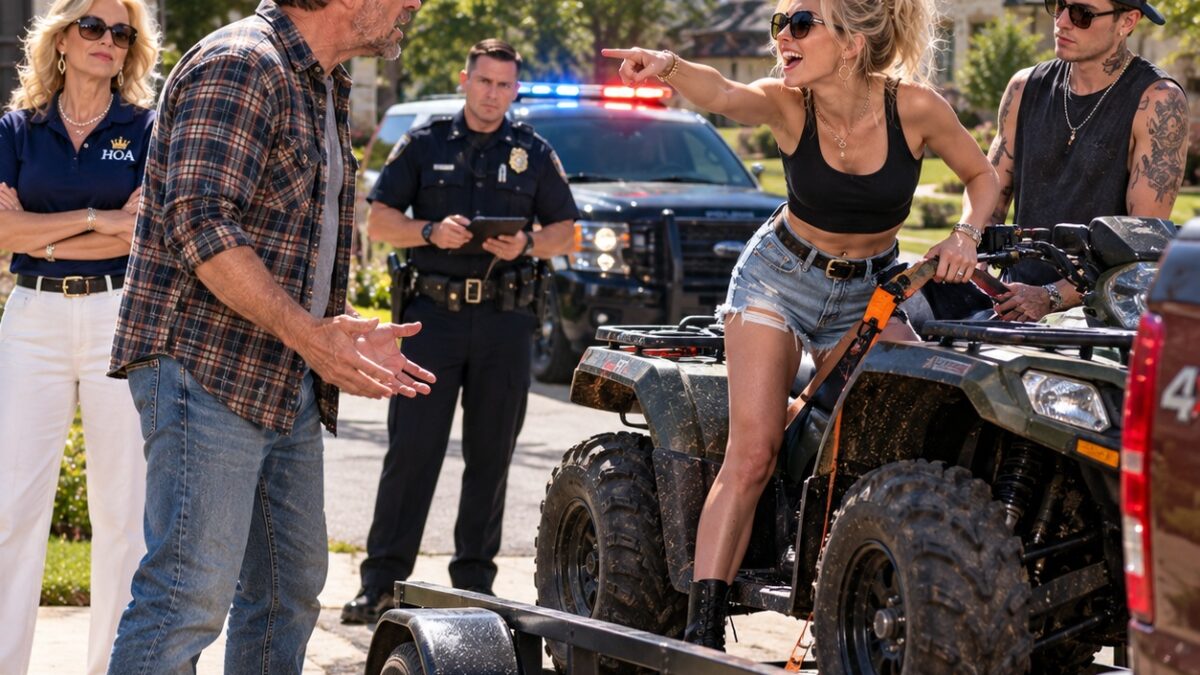
FULL STORY CONTINUATION
Officer Davidson stepped out of his cruiser slowly.
Too slowly.
He was maybe twenty-eight.
Clean uniform.
Carefully shaped mustache.
The kind of young officer who had already learned how exhausting neighborhood disputes could be and wanted no part of another one.
“Mr. Webb?”
“Yes.”
“Got a call about a property dispute.”
“The property dispute is that somebody stole my four-wheeler.”
He took out a notebook.
“Who?”
“Kaye Hutchinson.”
His expression barely changed.
That caught my attention.
“You know her?”
“I know the family.”
Of course he did.
I explained everything.
Trailer.
Chain.
Boyfriend.
Her statement.
The fact that I told her explicitly not to take it.
Davidson asked whether I had registration documents.
“Inside.”
I brought them out.
Then he asked whether anyone else saw Kaye take it.
Several curtains moved along the street.
Nobody came outside.
I pointed.
“Half the block saw it.”
Davidson glanced around.
“Nobody has made a statement.”
“So?”
“So she may say you authorized removal.”
“I called 911 while they were taking it.”
“That helps.”
“Helps?”
He sighed.
“Mr. Webb, I’m trying to figure out the cleanest way to document this.”
I knew that phrase.
Cleanest way.
Meaning easiest way.
Then Brenda arrived.
White Mercedes.
Tennis clothes.
Oversized purse.
Vanilla perfume strong enough to qualify as environmental impact.
“Officer Davidson.”
She smiled at him like an aunt greeting a favorite nephew.
“Thank you for coming.”
I looked between them.
Davidson said, “Mrs. Hutchinson.”
Brenda pulled a manila folder from her purse.
Naturally.
“Mr. Webb has had difficulty understanding updated community regulations.”
She produced a document.
RECREATIONAL VEHICLE AMENDMENT.
Effective the previous week.
I stared at it.
“I never received this.”
“All homeowners were notified electronically.”
“No, we weren’t.”
She looked at Davidson.
“This is exactly what we’ve been dealing with.”
I wanted to grab the paper.
Instead I took a photo.
Davidson read it.
Then looked at me.
“This may be something you need to resolve through the HOA or civil process.”
“She took my vehicle.”
“Her daughter says she understood they were relocating an HOA violation.”
“She understood me saying don’t take it?”
Brenda sighed dramatically.
“Marcus.”
She only used my first name when she wanted witnesses to think we had a relationship.
“We’ve been patient.”
I turned toward her.
“Where is my ATV?”
“Safe.”
“Where?”
“You have seventy-two hours to arrange compliant storage.”
“It was on my property.”
“Part of your driveway extends into association-controlled frontage.”
I actually laughed.
“What?”
She pointed toward a crack in the sidewalk.
“That line.”
I had lived there for years.
Never once heard this theory.
“Read your deed restrictions.”
After Davidson left, Brenda remained.
The smile disappeared.
“Seventy-two hours.”
“You fabricated that amendment.”
Her eyes sharpened.
“Careful.”
“You didn’t notify anybody.”
“Careful, Mr. Webb.”
Then she got into her Mercedes.
I watched her drive away.
That night, I went to the county records office.
Electricians troubleshoot by tracing.
You don’t stand in front of a dead outlet screaming about electricity.
You trace the circuit.
Breaker.
Junction.
Connection.
Source.
Brenda’s story had too many bad connections.
The amendment was first.
I searched HOA filings.
Nothing.
No properly recorded amendment.
No evidence of the required homeowner vote.
No notice package.
No filing matching the document she showed Davidson.
That meant either she had badly misunderstood procedure or she had knowingly produced something that looked official but wasn’t.
I kept looking.
That was when I found Hutchinson Services LLC.
Pinewood Estates paid it for landscaping.
Maintenance.
Equipment.
Miscellaneous support.
I’d assumed, from neighborhood gossip, that the company belonged to Brenda’s brother-in-law.
It didn’t.
Corporate records tied it directly to Rick Hutchinson.
Brenda’s husband.
The man supposedly traveling constantly for pharmaceutical business.
Our HOA was paying his company.
A lot.
Landscaping: $800 a month.
I had hired landscaping crews before.
The work we received was nowhere near $800 quality.
I wrote down the company information.
Then kept going.
By the time I left, I had photographs of records, copies of filings, and the distinct feeling that I had opened the wrong wall and found burned wiring behind it.
Sunday morning, I recorded myself moving the ATV back into my driveway after recovering it through a combination of registration proof, formal demand, and suddenly increased police interest once I produced actual ownership documentation.
I posted the video in the neighborhood Facebook group.
Caption:
Interesting how rules can appear overnight without a vote or official filing.
Twenty-three comments appeared within an hour.
Mrs. Patterson said Brenda had fined her for Christmas decorations under a rule nobody could locate.
Harold Chen commented:
Financial records have irregularities too.
Rita Gonzalez added a thumbs-up.
Then I was removed from the group.
Administrator action.
Brenda.
That afternoon, somebody placed a note under my windshield wiper.
DROP THIS OR THINGS GET MUCH WORSE.
No signature.
I photographed it.
Bagged it.
Put it in a drawer.
Then I sat at my workbench with Sarah’s picture beside me.
She was smiling in mud-covered jeans beside the ATV.
I could almost hear her.
You going to be stupid?
“Probably.”
At least be organized.
That sounded like her too.
The harassment began seventy-two hours after my Facebook post.
Exactly.
Monday:
EXCESSIVE GRASS HEIGHT.
$150.
My lawn was freshly cut.
Tuesday:
MAILBOX COLOR.
$100.
The mailbox was the same color it had been for years.
Wednesday:
EXCESSIVE NOISE DURING QUIET HOURS.
$200.
The alleged incident occurred at two in the afternoon while I used a table saw inside my garage.
Thursday:
UNAUTHORIZED SIGNAGE.
$75.
The signage was my brass street number.
Identical to half the neighborhood.
I laid the notices across the kitchen table.
Brenda’s signature appeared on every one.
Perfect cursive.
I began taking photographs.
Tape measure beside grass.
Decibel readings while tools ran.
Time stamps.
Neighboring properties with identical mailboxes.
Same brass numbers.
Everything.
Harold Chen walked over one afternoon carrying green tea.
Harold was seventy-one, retired accountant, and incapable of discussing numbers without becoming cheerful.
He examined the fines.
“These amounts are ridiculous.”
“Tell Brenda.”
“I tried.”
He tapped one notice.
“She is treating fines like revenue.”
I looked at him.
“What do you mean?”
“Rita asked the same question when she was treasurer.”
That evening, Rita knocked on my door.
She held a thick envelope.
“I heard Harold visited.”
“He did.”
She checked over her shoulder.
“You need this.”
Inside were copies of financial statements from her final year as HOA treasurer.
Pool maintenance.
Landscaping.
Security patrol.
Administrative fees.
Equipment rental.
Numbers everywhere.
“I started questioning these.”
“Why?”
“Because they don’t match reality.”
Pool maintenance cost $800 monthly.
Rita had called three companies after resigning.
Quotes ranged from $250 to $350 for equivalent service.
Security patrol cost $400 a month.
I had seen the security truck maybe twice.
Landscaping was $800.
Actual visible work suggested half that at best.
Then there were administrative charges.
No receipts.
No clear descriptions.
“I asked Brenda for backup,” Rita said.
“What happened?”
“She told me I was creating hostility.”
“That sounds like her.”
“She started accusing me of mishandling records.”
Rita looked angry even months later.
“Then she made every board meeting miserable until I resigned.”
I studied the paperwork.
“Why keep copies?”
“Because I was treasurer.”
She stared at me.
“And because numbers don’t stop being true just because somebody tells you not to look at them.”
That sentence could have come from Harold.
The next morning, Kaye spray-painted SNITCH across my garage door.
Bright red.
She did it at 5:42 a.m.
Directly in front of a security camera.
For the first time, I felt grateful for modern technology and teenage arrogance.
Officer Davidson returned.
I played the video.
Kaye’s face was clear.
Butterfly tattoo visible.
License plate visible.
Everything.
Davidson straightened.
“That’s criminal mischief.”
“Good.”
“I’ll file it.”
“Arrest?”
“We’ll contact her.”
Twenty minutes later, Brenda arrived with a lawyer.
Suddenly phrases like chain of custody and digital manipulation entered the conversation.
Kaye received a warning while the matter was “reviewed.”
I watched her leave smiling.
That night, my workshop smelled like sawdust and paint thinner from cleaning the garage door.
I spread Rita’s records beside the HOA fines.
The ATV theft.
Fake amendment.
Inflated invoices.
Retaliation.
Favoritism.
This wasn’t one problem anymore.
Something larger connected all of it.
Harold confirmed that three days later.
His dining room looked like a forensic accounting office run by somebody’s grandfather.
Spreadsheets covered the table.
Colored markers.
Receipts.
Invoices.
Calculators.
Tea.
Harold adjusted his glasses.
“I have been doing accounting forty-three years.”
“Congratulations?”
“This bookkeeping is offensive.”
Rita laughed despite herself.
Harold pointed to a row.
“Pool chemicals.”
Four hundred dollars monthly.
He had called the listed supplier.
Actual delivery cost averaged eighty-nine.
“Where does the difference go?”
“Hutchinson Services.”
Landscaping.
Same thing.
Equipment rental.
Same.
Security.
Same.
“What are you saying?”
He leaned back.
“At minimum, self-dealing and embezzlement need to be investigated.”
“At minimum?”
“I don’t like the cash patterns.”
Rick’s travel lined up with several unusual financial spikes.
Mexico conferences.
Large payments.
Cash-heavy transactions.
Corporate transfers.
I cautioned Harold.
“Correlation isn’t proof.”
He smiled.
“Good.”
“What?”
“You’re thinking correctly.”
He closed the folder.
“We do not accuse people of cartel money laundering because a spreadsheet feels funny.”
That mattered.
Because the original version of my anger wanted the biggest possible explanation.
The disciplined version wanted facts.
We had suspicious HOA finances.
Nothing more.
Then Jake Morrison got arrested.
Kaye’s boyfriend.
Traffic stop.
Controlled substances.
A large amount of cash.
Federal charges.
He started cooperating.
I did not obtain secret testimony from “a courthouse contact.”
That is the kind of thing people add when telling stories years later to make themselves sound connected.
What actually happened was simpler.
Federal investigators were already looking at people around Jake.
Our financial records became relevant because Rita had kept them and Harold had organized them.
When I learned there might be a connection, I called a federal tip line.
Agent Elena Rodriguez returned my call.
We met in a coffee shop downtown.
I brought copies.
Not originals.
Always keep originals.
Rodriguez spent nearly forty minutes reading.
She asked specific questions.
Where did this invoice come from?
Who had access?
Was this a certified copy?
Did Rita retain these lawfully?
Who prepared the analysis?
Had we altered anything?
No drama.
Just verification.
Finally she looked at me.
“Mr. Webb, how did you find this?”
“Somebody stole my ATV.”
She blinked.
I explained.
For the first time, she almost smiled.
Then she became serious.
“Some of these names overlap an existing investigation.”
My stomach tightened.
“What investigation?”
“I can’t discuss that.”
“Drug trafficking?”
She didn’t answer.
That answered enough.
“Do not confront the Hutchinsons about these records.”
“I wasn’t planning to.”
“Good.”
She slid her card toward me.
“If anything changes, call.”
Something changed immediately.
A city inspector appeared after an anonymous complaint accusing me of operating an illegal electrical business.
Inspector Martinez walked through my workshop.
Checked permits.
Storage.
Panel.
Everything.
Finally he said:
“You know your work is cleaner than most licensed shops I inspect.”
“I am licensed.”
“I know.”
He looked toward the street.
“Somebody is wasting everyone’s time.”
A white Mercedes sat at the corner.
Brenda.
Then an unmarked pickup with PINEWOOD SECURITY magnets started appearing outside my house.
Hours at a time.
Engine running.
Driver watching.
I searched the contractor.
No normal licensing footprint.
No clear office.
Yet HOA statements showed payments.
Another thread.
Then somebody broke my workshop window.
Power tools disappeared.
Security footage caught Kaye again.
Tattoo.
Face.
Bag.
This time I called Davidson and Rodriguez.
The atmosphere changed immediately.
Federal interest has a way of making local reluctance disappear.
Rodriguez came to my house with another agent.
They reviewed the footage.
Then Rita’s records.
Then Harold’s work.
I expected praise.
Instead Rodriguez said:
“From now on, stop investigating people.”
I looked at her.
“We have enough.”
Harold asked, “Enough for what?”
“To let trained investigators do trained investigation.”
Fair.
Our role became preservation.
Documents.
Witness statements.
Original records.
Nothing else.
Weeks later, Rodriguez told us what she legally could.
Rick Hutchinson’s pharmaceutical activity was already under federal scrutiny.
Some business entities appeared to be shells.
Financial transfers connected to known targets.
The HOA records created another path investigators had not fully understood.
Inflated contracts could potentially have served multiple purposes.
Skimming neighborhood money.
Moving funds.
Creating legitimate-looking invoices.
We had not solved a cartel case.
We had supplied records that connected an existing federal case to Pinewood Estates.
That distinction mattered.
Harold was thrilled anyway.
“Still counts.”
Rita looked sick.
“Our dues.”
I understood.
Imagine discovering the money you paid for lawn mowing may have been part of something criminal.
It contaminates ordinary life.
Every invoice becomes suspicious.
Every board meeting.
Every favor.
Every waived fee.
Brenda’s allies began looking different too.
The Hendersons paid reduced dues.
Why?
No clear board authorization.
Other residents had unexplained discounts.
Selective generosity.
Brenda wasn’t just punishing enemies.
She was buying silence cheaply.
I remembered every meeting.
People looking down.
People staying quiet.
Maybe some feared fines.
Maybe others enjoyed benefits.
Corrupt systems rarely survive because everyone is evil.
They survive because enough people find private reasons not to ask public questions.
The federal investigation expanded.
We didn’t know details.
Then Rodriguez called me in.
She showed me a chart.
Rick.
Meridian Pharmaceutical Solutions.
Hutchinson Services.
Additional entities.
Transfers.
“Meridian Pharmaceutical has no meaningful legitimate operating footprint consistent with its claimed scale.”
“Meaning?”
“Meaning the business story doesn’t match the money.”
Harold had already found the registered address.
A commercial mailbox in a strip mall.
Rita had laughed when she saw it.
“Pharmaceutical empire between a nail salon and payday loans.”
Not proof by itself.
But combined with everything else, it mattered.
Investigators traced deeper.
I did not.
That was their job.
The amount connected to our HOA grew.
First tens of thousands.
Then hundreds.
Eventually investigators told us the government believed millions had moved through the broader network, with a significant portion touching entities related to our neighborhood contracts.
That was the moment the situation stopped feeling exciting.
At first, uncovering Brenda’s hypocrisy had been satisfying.
Finding fake fines was almost funny.
This wasn’t.
Drug trafficking destroys people.
Families.
Communities.
I thought about Sarah.
Cancer took her slowly.
Nothing anyone did caused it.
There was no person to hate.
Now I was hearing about pills and fentanyl and corrupt distribution channels that had real victims.
Suddenly an HOA landscaping invoice felt filthy.
Rodriguez warned me directly.
“Do not underestimate people protecting large criminal proceeds.”
I listened.
I moved expensive tools.
Improved lighting.
Shared schedules with investigators.
My daughters—both living outside Austin—were told enough to take precautions without being dragged into details.
I stopped riding the ATV alone.
That bothered me.
Sarah had bought it so I would keep living.
Now fear had parked it again.
One night, I sat in the garage staring at it.
“Wonderful gift,” I told her photograph.
No answer.
“You couldn’t buy me golf clubs?”
Still nothing.
I smiled anyway.
Brenda’s behavior grew more erratic.
Emergency HOA meeting.
Sudden proposal to ban private security cameras.
That one nearly caused open revolt.
Thirty-four residents voted against.
Thirteen supported.
Harold raised his hand.
“Why have landscaping costs tripled while landscaping quality declined?”
Brenda’s face tightened.
“Complex administrative matter.”
“Then explain it simply.”
“I don’t have to justify every line item to individual residents.”
Rita spoke from the back.
“As president, actually, you do have to account for association spending.”
The room changed.
Months earlier, nobody challenged Brenda.
Now two people had.
Then six.
Then twelve.
Her meeting ended abruptly.
The next morning, Rick came home early.
Black Escalade.
Two men with him.
Federal agents were watching by then.
I wasn’t.
That was one of the strangest parts.
Once real law enforcement took over, I knew less.
Which was appropriate.
The neighborhood looked normal.
Dogs.
Trash collection.
Mowers.
Children on bikes.
Behind that, people were moving money, seeking warrants, monitoring travel, coordinating cases across cities.
Then three men came to my house.
Expensive suits.
No appointment.
One spoke politely.
“Mr. Webb, our clients prefer resolving disputes privately.”
“What dispute?”
“You have documents.”
“So?”
“Documents can be misunderstood.”
“I’ve already given them to investigators.”
His smile weakened.
“There may still be compensation available.”
I felt my pulse increase.
“Leave.”
“Substantial compensation.”
“Leave.”
He lowered his voice.
“Some problems have permanent solutions.”
That was enough.
I closed the door.
Called Rodriguez.
My door camera had recorded everything.
Twenty minutes later, federal marshals were in the neighborhood.
The visit frightened me more than I admitted.
Threats in television shows sound dramatic.
In real life, they make you check windows twice.
They make coffee taste different.
They make every unfamiliar car matter.
I barely slept.
Then Rodriguez called.
Rick had been arrested trying to leave Texas through a private aviation terminal with cash and documents investigators considered evidence of flight intent.
That accelerated everything.
Brenda and Kaye remained targets.
The annual Pinewood Estates barbecue was scheduled for Sunday.
The source of the story people tell now makes it sound like federal agents chose the barbecue because arresting Brenda publicly would be funny.
That’s not how professionals work.
The gathering simply created a predictable location where key people were expected to appear.
Visibility was a side effect.
Not the mission.
Still, from where I stood, it became the most surreal Sunday Pinewood Estates ever had.
Neighbors set out folding tables.
Smoke rose from grills.
Kids chased each other across the grass.
Harold brought tea even though it was ninety degrees.
Rita smoked behind the pavilion and kept telling everyone she was quitting.
Federal agents were there too.
Some visible.
Others not.
I had been instructed to behave normally.
Normal is difficult when you know the HOA president may be arrested beside the potato salad.
Brenda arrived at eleven-thirty.
Summer dress.
Oversized purse.
Smile.
She greeted people as if the emergency meeting had never happened.
Kaye arrived twenty minutes later.
Sunglasses.
Two friends.
No sign she understood how serious things had become.
Harold had planned to give a financial transparency update because homeowners deserved to know the association was under review.
He approached the microphone.
His hands shook.
Then stopped.
“Neighbors.”
Conversation faded.
“For several months, some of us have been reviewing irregularities in Pinewood Estates financial records.”
Brenda started walking toward him.
“Harold, this is not on the agenda.”
He continued.
“Those irregularities have been provided to law enforcement.”
Brenda stopped.
The park became silent.
“Federal authorities have advised the board that some HOA-related financial transactions are connected to a broader investigation.”
Then Agent Rodriguez stepped into view.
Badge.
Professional.
Calm.
Other agents moved into position.
I remember the sound more than anything.
No music.
No birds.
Just people suddenly realizing something enormous was happening.
Rodriguez approached Brenda.
“Brenda Hutchinson?”
Brenda stared.
“Yes?”
“You are under arrest pursuant to federal warrants.”
For once, Brenda had no prepared folder.
Kaye backed away.
Another team moved toward her.
“This is ridiculous,” Brenda said.
Then louder:
“This is a community event.”
Rodriguez did not care.
Brenda began talking about harassment.
Political retaliation.
Her husband’s respectable business.
Rodriguez finally said:
“Your husband was arrested yesterday.”
That broke her expression.
Kaye shouted:
“You can’t do this to us.”
Nobody answered.
She looked around wildly.
“My family runs this place.”
I remembered my driveway.
My ATV chained to a trailer.
Her laugh.
We’re untouchable.
Now she looked very touchable.
Very young.
Very frightened.
That gave me less satisfaction than I expected.
Maybe because consequences look different when they finally arrive.
Brenda saw me near the pavilion.
Her face changed.
“This is him.”
Rodriguez looked at me.
Brenda pointed.
“He has been harassing us for months.”
The old Brenda returned for one last moment.
Certain she could redirect authority if she spoke confidently enough.
I stepped forward.
Not to grandstand.
Just because she had accused me publicly.
“Your daughter took my ATV from my driveway.”
Kaye shouted:
“You destroyed our family!”
I looked at her.
“No.”
My voice surprised me by staying calm.
“You took something that wasn’t yours because you thought nobody could stop you.”
Agents moved closer.
“Everything after that came from records your family created.”
Kaye lunged forward a step.
Agents intercepted her.
Rodriguez spoke quietly but firmly.
“Miss Hutchinson, step back.”
Handcuffs clicked.
That sound stayed with me.
Brenda kept talking as she was read her rights.
Threatening lawsuits.
Lawyers.
Connections.
Then federal vehicles took her away.
The white Mercedes was later seized as part of asset proceedings.
The Escalade too.
The barbecue did not become a celebration immediately.
For several minutes, nobody knew what to do.
Mrs. Patterson stood holding a paper plate.
Harold sat down.
Rita cried.
Dave Henderson looked like somebody had removed gravity.
Then people started asking questions.
“Was our money stolen?”
“How much?”
“Who knew?”
“What happens to the HOA?”
Federal representatives gave limited answers.
The board would continue under oversight.
Financial records would be secured.
Residents would be notified.
No, everybody was not a suspect.
No, people were not losing their houses because they paid HOA dues.
That last question came up several times.
Fear spreads faster than facts.
I stood near the grill alone.
Mrs. Patterson approached Harold.
She touched his arm.
“Thank you.”
“For what?”
“I was tired of being scared in my own neighborhood.”
That sentence mattered more to me than the arrest.
Because the criminal case was bigger than Pinewood Estates.
But Brenda’s daily power had been local.
She had made people afraid over mailboxes.
Grass.
Decorations.
Dues.
Questions.
The federal investigation ended that power in minutes.
The community still had to rebuild itself afterward.
That took longer.
Trials came later.
Plea agreements.
Sentencing.
Asset forfeiture.
Testimony.
Federal cases never move as quickly as stories make them sound.
Rick ultimately received a long federal sentence related to trafficking and money laundering.
Brenda was convicted on conspiracy and financial-crime charges tied to the operation and the misuse of HOA-related entities.
Kaye faced separate consequences for theft, vandalism, threats, and her participation in parts of the broader scheme.
Jake cooperated with prosecutors and received a reduced but still substantial sentence.
His information helped investigators pursue additional defendants in Texas.
I didn’t attend every hearing.
I did not need every detail.
At some point, the system belonged to prosecutors and judges.
What mattered to Pinewood Estates was simpler.
We got our HOA back.
Federal asset recovery and civil proceedings returned a significant amount of money connected to improper association transactions.
Audits identified overcharges.
Unauthorized payments.
Inflated contracts.
Unfair fines.
Our monthly dues dropped dramatically once legitimate vendors replaced Hutchinson-connected companies.
That might have been the funniest revelation of all.
Honest landscaping was cheaper.
Honest pool service was cheaper.
Honest administration was cheaper.
Corruption has overhead.
Harold became treasurer.
Unanimously.
He pretended to be reluctant for almost nine seconds.
Rita became president.
Her campaign platform consisted mostly of:
“Never again.”
Good enough.
She implemented quarterly financial reporting.
Open invoices.
Competitive bids.
Conflict-of-interest disclosure.
Resident access to meeting minutes.
Independent annual review.
No president could sign major contracts alone.
No fines without documented authority.
No overnight “evolving community standards.”
The first meeting under Rita lasted fifty-eight minutes.
Nobody was threatened.
Nobody stormed out.
Nobody got fined for mailbox color.
I considered it a miracle.
The Hutchinson property eventually changed hands through the legal process.
Part of the open area associated with it became a community garden.
The board asked what to call it.
I said no name was necessary.
Harold disagreed.
Rita agreed with Harold.
I lost.
They called it Sarah’s Trail Garden.
Not because Sarah had anything to do with the investigation.
She didn’t.
Because the whole chain of events began with her gift.
The ATV.
The promise.
Keep living.
We planted tomatoes.
Peppers.
Herbs.
Mrs. Patterson took responsibility for the tomatoes and immediately became territorial.
“Don’t touch the red ones until Saturday.”
“They’re tomatoes.”
“They are my tomatoes.”
“Community tomatoes.”
She stared at me.
I backed away.
Some systems need dictators.
Apparently tomato gardens are one.
The ATV stayed in my driveway.
Exactly where Brenda hated it.
But it stopped being something I protected like a museum object.
That was important.
After Sarah died, I had turned certain things into shrines.
Her mug.
Her jacket.
The ATV.
I told myself preserving them preserved her.
It didn’t.
Memory isn’t storage.
Memory is movement.
So I started riding more.
Harold bought a used ATV despite being seventy-two and having knees that sounded like popcorn.
Rita joined with a side-by-side.
Soon Saturday trail rides became neighborhood tradition.
Coffee at seven.
Engines at eight.
Texas Hill Country.
Dust.
Bad jokes.
People who had barely spoken under Brenda now spent half a day together.
The first time we finished a long ride, I parked in the driveway and touched the handlebar.
“I kept going.”
Sarah’s photo sat in the garage window.
She still looked muddy.
Still smiling.
For once, remembering her didn’t hurt first.
It felt warm first.
That surprised me.
The neighborhood changed in little ways.
People knew each other’s names.
Actual names.
Not lot numbers.
Harold helped younger families understand property tax notices.
Rita organized emergency contact lists.
Someone repaired Mrs. Patterson’s fence without charging her.
Teenagers mowed Betty’s yard when she had knee surgery.
The HOA still existed.
Rules still existed.
We still argued.
One family wanted chickens.
Rita said no.
They appealed.
Harold produced a county zoning map.
Three meetings later, compromise.
No federal agents required.
Progress.
Local real estate agents started describing Pinewood Estates as “community-focused.”
I laughed the first time I heard it.
Sarah had chosen the neighborhood for exactly that promise.
It took corruption nearly destroying us before we actually became one.
One afternoon, an eight-year-old girl from a new family came into the garden.
She pointed toward Sarah’s name.
“Who was she?”
“My wife.”
“Did she like tomatoes?”
“She liked growing them.”
“Was she the lady who caught the bad people?”
I laughed.
“No.”
“Did you?”
“Not really.”
She frowned.
“Who did?”
I looked around.
Harold was arguing about irrigation pressure.
Rita was carrying mulch.
Mrs. Patterson was inspecting tomatoes.
“Lots of people.”
The girl considered that.
“That’s boring.”
“Usually the truth is.”
She accepted a cherry tomato and ran away.
Kids.
The media told the story differently.
One stolen ATV exposes drug network.
Widower brings down criminal HOA.
Electrician defeats cartel.
Headlines need heroes.
Reality needs teams.
Rita kept records.
Harold analyzed numbers.
Neighbors documented abuse.
Federal investigators had already been watching Rick’s network.
Jake cooperated.
Prosecutors built cases.
Agents executed warrants.
I did one thing well.
I refused to accept Brenda’s version of events just because she sounded confident.
That was enough to begin.
People later asked why I didn’t stop once the ATV came back.
Because by then it wasn’t about the ATV.
That answer sounds noble.
It wasn’t entirely.
Part of me was angry.
I wanted Brenda exposed.
I wanted Kaye embarrassed.
I wanted Officer Davidson to admit he’d dismissed me too quickly.
Human motives are messy.
But anger can start work that discipline finishes.
The discipline mattered.
Records.
Dates.
Copies.
No threats.
No trespassing.
No hacking.
No pretending I was law enforcement.
Whenever the situation moved beyond what ordinary citizens should handle, I handed it over.
That probably saved my life.
And possibly the case.
Harold loved investigating so much that I once caught him suggesting we check another board member’s personal bank records.
“No.”
“But—”
“No.”
“It would clarify—”
“No.”
He sighed.
“Rules ruin everything.”
“Correct.”
Even truth has to be obtained properly.
Especially truth.
Six months after the arrests, Officer Davidson came to my house.
Not official.
No patrol car.
He stood awkwardly on the porch.
“Mr. Webb.”
“Officer.”
“I wanted to apologize.”
I waited.
“I treated the ATV call like HOA nonsense.”
“It was HOA nonsense.”
“It was also theft.”
“Yes.”
“I should have handled it differently.”
I nodded.
“That would have helped.”
He looked toward the driveway.
“Glad you got it back.”
“Me too.”
Then he asked:
“Did you really uncover all that because of a four-wheeler?”
“No.”
He looked confused.
“I uncovered fake HOA paperwork because of a four-wheeler.”
“And the rest?”
“Everybody else did their jobs.”
He smiled slightly.
“Fair.”
I respected him more after that.
People make mistakes.
Systems improve when mistakes can be admitted.
Brenda had never learned that.
Every challenge became a threat.
Every question became disloyalty.
Every correction became war.
That is how small corruption protects bigger corruption.
Not always because the small issue causes the big crime.
Because the habit is the same.
Never admit.
Never disclose.
Never let people inspect.
Never let anyone say no.
Pinewood Estates now had the opposite rule.
Inspection encouraged.
Questions allowed.
Receipts public.
Votes recorded.
Boring.
Beautiful.
The final federal sentencing made national news for about a day.
Then the country moved on.
It always does.
Rick received years in prison.
Brenda too.
Kaye’s sentence was shorter but real.
She had entered the story laughing.
By the end, nobody was laughing.
I didn’t celebrate her incarceration.
She was nineteen when she took my ATV.
Old enough to know better.
Young enough that I hoped prison wasn’t the only thing she learned from.
“Untouchable” is a dangerous thing to teach a child.
Because sooner or later, reality touches everyone.
The financial recovery helped residents.
Refunds.
Lower dues.
Legal costs.
Reserves rebuilt.
Some homeowners who had paid obviously improper fines received credits.
One check arrived at my house.
$200.
Unauthorized recreational vehicle storage refund.
I framed that one.
Sarah would have approved.
Or mocked me.
Probably both.
The community garden grew where the Hutchinson property once symbolized fear.
Tomatoes came first.
Then squash.
Peppers.
Herbs.
One corner had wildflowers.
I put a small cedar bench beside them.
Same design as the bench I built Sarah years earlier.
Not identical.
I didn’t want identical.
One evening, I sat there after everybody left.
The sun dropped behind the roofs.
The ATV was visible across the street in my driveway.
I thought about the morning Kaye chained it to the trailer.
The rage.
How personal it felt.
How small that moment looked compared to everything that followed.
Then I realized it wasn’t small.
Not to me.
Sarah’s last gift mattered.
It didn’t matter less because larger crimes existed.
That’s another mistake people make.
They tell you your pain is insignificant because somebody else’s problem is bigger.
The ATV mattered because love gave it meaning.
The financial crimes mattered because people trusted the HOA.
The drug case mattered because people were harmed far beyond Pinewood Estates.
Different scales.
All real.
I touched the bench.
“Still living,” I said.
A breeze moved through the tomato plants.
“Turns out you’re expensive.”
No answer.
I smiled.
Saturday morning, twelve neighbors gathered in my driveway.
Harold wore riding gear that made him look like an astronaut.
Rita brought breakfast tacos.
Mrs. Patterson yelled from the garden that we were too loud.
I reminded her quiet hours no longer included Saturday morning.
She told me she was not speaking as HOA authority.
Only tomato authority.
Fair.
I climbed onto the Polaris.
The seat was worn now.
Small scratches along the body.
Mud stains around the wheel wells.
It no longer looked like something preserved from the past.
It looked used.
Alive.
That was better.
Harold started his engine.
“Where to?”
“Hill Country.”
“How far?”
“Far enough.”
Rita shouted:
“Don’t kill Harold.”
Harold yelled back:
“My accountant says mortality is deductible.”
Nobody understood that joke.
We left anyway.
Dust rose behind us.
I thought of Sarah handing me the keys.
Don’t let my leaving stop you from living.
For years I had interpreted that as instruction to survive.
Wake up.
Work.
Eat.
Pay bills.
Keep moving.
Now I understood she meant something larger.
Living requires risk.
People.
Noise.
New memories.
Things getting scratched.
Possessions leaving the garage.
A community becoming complicated.
You cannot honor someone by freezing the world at the moment they left it.
You honor them by carrying forward what they loved.
Sarah loved people.
Gardens.
Trails.
Neighbors helping neighbors.
She would have hated Brenda.
But she would have loved what Pinewood Estates became after Brenda.
That irony pleased me.
One bad system collapsed.
Something healthier grew in the space.
Not perfect.
Healthy things aren’t perfect.
They’re responsive.
They adapt.
They repair damage instead of hiding it.
One year after the arrests, Rita held the annual meeting in the community center.
Every expense projected on a screen.
Landscaping contract.
Pool service.
Insurance.
Garden water.
Security.
Somebody asked why mulch cost more than last year.
Rita answered.
Somebody asked whether we needed security at all.
Discussion.
Vote.
No intimidation.
Harold presented the audit.
“Clean.”
People applauded.
He looked offended.
“Accounting should not receive applause.”
“Take it,” I said.
He bowed.
Afterward, Rita stopped me.
“I have a question.”
“No.”
“I haven’t asked it.”
“If it involves the board, no.”
“Would you serve one term?”
“No.”
“You’d be useful.”
“Exactly why I refuse.”
She laughed.
“What do you want instead?”
“Keep showing receipts.”
“That simple?”
“Yes.”
Transparency had become my favorite neighborhood amenity.
More than the pool.
More than the garden.
Possibly more than sidewalks.
People behave differently when they know somebody can look.
Brenda had understood that too.
That’s why she controlled information.
Once documents circulated, power shifted.
That lesson followed me outside Pinewood Estates.
People from other neighborhoods started calling.
HOA disputes.
Special assessments.
Missing invoices.
Strange vendor relationships.
I helped when I could.
Mostly by telling them what I wished someone had told us earlier.
Read your documents.
Attend meetings.
Request records through proper channels.
Do not assume irregular means criminal.
Do not accuse without evidence.
Document retaliation.
Use lawyers and regulators when appropriate.
And if somebody tells you they are untouchable?
They’re probably counting on you believing them.
One man called from Oregon about an unexplained $500 monthly assessment.
The old version of me might have gotten excited.
Another Brenda.
Another conspiracy.
Instead I asked:
“Have you requested the budget?”
“No.”
“Start there.”
“Do you think it’s money laundering?”
“I think you have a question.”
People don’t like that answer.
But questions are where evidence begins.
Not conclusions.
Brenda taught me that accidentally too.
She always started with conclusions.
Marcus is difficult.
The ATV is illegal.
Neighbors questioning me are disloyal.
Fines are justified.
Records are private.
People who resist are enemies.
Once she believed those conclusions, everything became permission.
I tried to do the opposite.
Question first.
Trace.
Verify.
Then act.
Electrical work teaches humility.
You cannot bully current.
You cannot persuade a short circuit to behave.
You measure.
Test.
Isolate.
Respect what can hurt you.
I wish more people treated authority that way.
The last official connection I had to the Hutchinson case came in a letter from Agent Rodriguez.
Short.
Professional.
She thanked me for preserving records and cooperating.
One sentence stood out.
Citizen evidence is most useful when citizens know when to stop gathering and start reporting.
I framed that beside the $200 HOA refund.
Sarah’s picture sits between them.
One side reminds me not to let bullies invent rules.
The other reminds me not to become a vigilante just because I’m angry.
Good balance.
My workshop filled back up with tools after the investigation ended.
Cedar.
WD-40.
Sawdust.
Coffee.
I replaced the stolen drill.
Built more birdhouses than any reasonable man needs.
Neighbors kept bringing broken appliances.
Harold once dropped off a toaster and said:
“You exposed federal crime. Surely you can fix this.”
“It costs nineteen dollars.”
“Fix it.”
I did.
That was life after justice.
Not constant triumph.
Toasters.
Tomatoes.
Trail rides.
HOA budgets.
Back pain.
Ordinary things.
Exactly what corruption had interrupted.
One crisp October morning, I sat in the workshop doorway drinking coffee.
The garden across the street was green.
Mrs. Patterson picked tomatoes.
Harold argued with Rita about irrigation.
Children rode bikes.
The Polaris sat in the driveway.
Exactly where Kaye found it.
A little girl from the new family across the street came over.
“Mr. Marcus?”
“Yes?”
“Is that the famous ATV?”
I sighed.
“Apparently.”
“My dad said somebody stole it and then the FBI came.”
“Your dad skipped some steps.”
She touched the handlebar.
“Was it your wife’s?”
“Yes.”
“Where is she?”
“She died.”
The girl looked horrified.
Children forget death is a word adults survive hearing.
“I’m sorry.”
“Thank you.”
She looked toward Sarah’s garden.
“Was that hers too?”
“In a way.”
“She must have liked plants.”
“She did.”
The girl picked a cherry tomato.
I pointed.
“Mrs. Patterson will arrest you.”
Her eyes widened.
I laughed.
“I’m kidding.”
Mostly.
She ran home.
I looked at Sarah’s photo.
The one with mud on her cheek.
Thumbs up.
Twenty-five years of marriage reduced by cancer to photographs, tools she bought me, recipes I still couldn’t make right, and memories that arrived without warning.
But she was also in things she never touched.
The garden.
Saturday rides.
The way I stayed when it would have been easier to sell the house and leave.
The way I stopped allowing Brenda to define community for everyone else.
That mattered.
People tell me the story began when Kaye stole the ATV.
Maybe.
I think it began earlier.
At that HOA meeting.
When Brenda told me rules evolve.
When everybody looked down.
When I realized fear had become normal.
The ATV theft simply made normal impossible to tolerate anymore.
That is how abuse often works.
It grows gradually.
A fine.
A favor.
A selective exception.
A threat.
A document nobody checks.
A contract nobody reads.
One person tells herself she deserves control because nobody stopped her last time.
Then another person inherits the arrogance.
“My mom runs this neighborhood.”
“We’re untouchable.”
No one is.
Not presidents.
Not CEOs.
Not police officers.
Not federal agents.
Not grieving electricians.
Everybody needs limits.
Good systems create them before disaster does.
Pinewood Estates learned late.
But we learned.
I still ride most Saturdays.
Sometimes alone.
When I do, I take the same trail Sarah and I planned to ride together.
There is a ridge outside town where you can see miles of Texas sky.
I stop there.
Turn off the engine.
Listen.
Wind.
Birds.
No HOA notices.
No agents.
No Brenda.
No case.
Just quiet.
I once thought peace meant nothing bad happening.
Now I think peace is knowing bad things can happen without owning the rest of your life.
Brenda stole my peace for a while.
Kaye stole my ATV for a day.
The Hutchinsons stole money from people who trusted them.
But none of them got the final word.
The ATV came home.
The money was traced.
The records opened.
The neighborhood changed.
And where a family once used fear to keep everyone separated, tomatoes now grow between houses full of people who know each other’s names.
I can’t think of a better ending than that.
One evening, I parked after a ride and left the Polaris dusty.
Very dusty.
Sarah would have approved.
Harold walked by.
“You washing that?”
“Tomorrow.”
“HOA vehicle appearance standards?”
“Don’t.”
He laughed.
Then pointed toward the garden.
“Rita wants you at the budget meeting.”
“No.”
“She says it’s important.”
“No.”
“She has pie.”
I stopped.
“What kind?”
“Pecan.”
I sighed.
“Fine.”
Harold grinned.
That is how Pinewood Estates controls me now.
Pie.
Better system.
Before going inside, I rested my hand on the ATV seat.
For years I had thought of it as Sarah’s last gift.
Now I realized the gift wasn’t really the machine.
It was what she told me while handing over the keys.
Keep living.
The ATV just made the instruction harder to ignore.
Kaye thought taking it would make me submit.
Instead it forced me to move.
I followed one fake rule to one fake filing.
One inflated invoice to one shell company.
One frightened treasurer to one stubborn accountant.
One packet of records to investigators already looking for the missing link.
And eventually, the family that had spent years telling Pinewood Estates they were untouchable discovered what everybody discovers sooner or later.
Rules matter most when they apply to the people who think they wrote them.
I looked across the street at Sarah’s garden.
Then at the ATV.
Then at the house we chose together.
“I’m still living,” I said quietly.
The evening wind moved through the tomato vines.
For once, that was enough.