FULL STORY:The Golden Retriever Barked at Traffic in a Flooding Storm—She Wasn’t Asking Anyone to Save Her
FULL STORY CONTINUATION
There are moments when ordinary life stops without asking permission.
One minute I was a trucker worried about a delivery window.
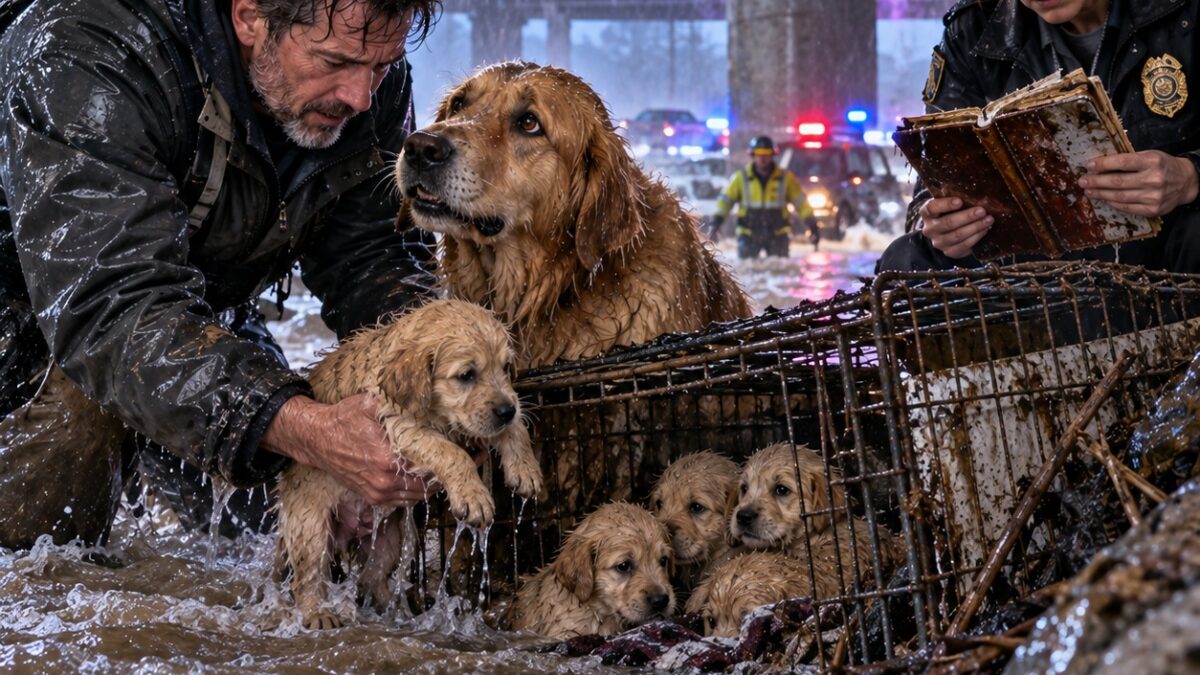
The next I was standing beneath an interstate bridge in soaked boots while police photographed a cage that somebody had deliberately left in rising water.
Detective Miller asked questions.
When did I first see the dog?
Which direction had she come from?
Did I see another vehicle?
People?
Lights?
Anything parked nearby?
I answered carefully.
“No.”
“You’re sure?”
“I was watching the road.”
“Did the dog have a collar?”
“No.”
“Tags?”
“No.”
“Anything around the cage besides the notebook?”
“Not that I saw.”
Miller wrote.
The mother pressed closer to my leg.
One of the animal control workers approached slowly.
“We need to transport her.”
I nodded.
Then realized my hand was resting on the dog’s head.
I removed it.
“Yeah.”
The worker clipped a temporary lead onto her.
The Golden Retriever immediately resisted.
Not aggressively.
She simply planted all four feet.
Looked at me.
I laughed awkwardly.
“I’m not going anywhere.”
That was technically a lie.
I had a truck on the interstate.
A delivery.
A dispatcher already sending messages asking why the vehicle had stopped.
The dog did not understand freight schedules.
She understood that I had followed her.
I walked beside her to the rescue vehicle.
That solved it.
The five puppies were loaded first.
Wrapped.
Warm packs.
Oxygen for the weakest.
The mother climbed in only after she saw them.
Then she turned around.
Looked through the open doors.
At me.
I don’t romanticize animals as if every glance contains a human sentence.
But I knew gratitude when I saw it.
Or perhaps recognition.
You stopped.
That was enough.
The doors closed.
The vehicle left.
I stood in the rain long after everybody else began moving.
Miller approached.
“You okay?”
“Fine.”
“You’re bleeding.”
I looked at my hand.
Wire had cut my palm.
Hadn’t noticed.
“Occupational hazard.”
“You cut animal cages for a living?”
“Only Thursdays.”
He smiled slightly.
Then handed me a card.
“We may need to contact you.”
“What exactly is in that notebook?”
“Too early.”
“You have a theory.”
“I have addresses.”
“Dog breeders?”
“Possibly.”
“Illegal?”
Miller looked toward the flooded area.
“Legitimate breeders don’t usually leave inventory chained under bridges.”
Fair.
I climbed back to the highway.
My truck remained on the shoulder.
Hazards flashing.
Inside, there were eleven missed messages.
My dispatcher, Lena, answered on the first ring.
“Please tell me you’re not dead.”
“Not dead.”
“Your GPS has not moved for ninety-three minutes.”
“There was a dog.”
Silence.
“A dog.”
“Five puppies.”
Longer silence.
“Sam.”
“They were in a cage.”
“What?”
I explained.
For once, Lena did not interrupt.
When I finished, she sighed.
“Are you injured?”
“Small cut.”
“Truck okay?”
“Yes.”
“Freight okay?”
“Yes.”
“Then the customer can survive being late.”
That surprised me.
“I thought you’d scream.”
“I was going to.”
“Appreciate the restraint.”
“Go get your hand checked.”
“I’m fine.”
“You are the only driver I know who thinks bleeding counts as a scheduling issue.”
The delivery arrived four hours late.
Nobody died.
That was my first lesson.
The world can sometimes tolerate you stopping.
I had spent years behaving as though every mile was urgent.
That night I parked at a truck stop but could not sleep.
Rain drummed lightly against the roof.
Every time I closed my eyes, I saw the cage.
Five puppies.
Water.
The mother running beside traffic.
I wondered how she got out.
Maybe whoever left them there failed to secure her.
Maybe she escaped during transport.
Maybe she had been outside the cage intentionally.
I hated every possibility.
At two in the morning, I searched local animal shelter numbers.
Found one connected to the rescue.
Called at eight.
A woman answered.
“County Animal Care.”
“Hi. My name’s Sam Carter.”
Pause.
“The truck driver?”
Apparently news travels.
“Yes.”
“Oh.”
Her tone warmed immediately.
“You found Faith.”
“Faith?”
“The mother.”
“You named her already?”
“One of the techs did.”
I smiled.
“How are they?”
“The puppies are alive.”
All five.
One had severe hypothermia.
Two were dehydrated.
All underweight.
But alive.
“And the mother?”
“Exhausted. Some infection. She’s eating.”
Relief hit harder than expected.
“Can I visit?”
The question left before I decided to ask it.
“Sure.”
I looked at my route schedule.
I was two hundred miles away.
“When?”
“Whenever you’re back.”
That became the problem.
Long-haul trucking teaches you that geography is cruel.
You can care deeply about something and still wake up three states away.
For the next three weeks, I worked.
Ohio.
Kentucky.
Missouri.
Back south.
I called the shelter more often than I called anyone in my family.
At first I pretended I wanted updates on the investigation.
The shelter staff saw through that quickly.
“Faith ate breakfast.”
“Okay.”
“Three puppies gained weight.”
“Good.”
“Faith looked at the door when a diesel truck went by.”
I stopped.
“What?”
The woman laughed.
“Just reporting.”
Detective Miller called too.
The notebook had yielded enough usable information to justify further investigation.
He was careful.
No dramatic claims.
No “massive criminal network” speech.
Just:
“We’ve identified locations.”
“What kind?”
“Properties associated with unlicensed breeding activity.”
“And?”
“Some appear linked.”
“To whoever left Faith?”
“Possibly.”
“What were the dollar amounts?”
“We’re still interpreting them.”
That was more believable than the rumors already circulating online.
Someone had posted about “a trucker finding trafficking records under a bridge.”
By the second week, social media had turned it into an international animal smuggling conspiracy involving three countries and a senator.
Miller hated that.
“None of that is confirmed.”
“Tell the internet.”
“I’d rather interrogate a brick.”
The real investigation moved slowly.
Search warrants.
Records.
Interviews.
License checks.
Veterinary documentation.
Phone numbers.
Financial transfers.
Police work is less cinematic than people want it to be.
Paper defeats criminals more often than car chases do.
The notebook contained repeated addresses.
Some were rural properties.
Several were storage facilities.
Others were ordinary houses.
The coded entries corresponded to litters, breeding females, transports, and payments.
Not everything was immediately understandable.
But enough patterns emerged to suggest an organized operation selling animals through multiple identities while avoiding inspections, veterinary rules, and taxes.
Then Miller called me late one afternoon.
“We executed three warrants.”
I pulled into a rest area before continuing.
“What did you find?”
“Dogs.”
“How many?”
He paused.
“Thirty-eight so far.”
I closed my eyes.
“What condition?”
“Varies.”
That answer told me enough.
“Any arrests?”
“Detentions. Interviews. I’m not giving names.”
“Was the bridge connected?”
“We believe one of the properties is.”
“What about Faith?”
“Her identification history matches a female listed in the records.”
I gripped the steering wheel.
“What did they call her?”
Miller did not answer immediately.
“Sam.”
“What?”
“You don’t need their name for her.”
I looked through the windshield.
Cars moving.
People eating.
Normal world.
“You’re right.”
Faith was better.
Over the following weeks, the investigation expanded.
Not because one notebook magically solved everything.
Because one notebook gave police questions they had not known to ask.
Those questions led to veterinary records.
Electronic messages.
Bank accounts.
Witnesses.
Properties.
Several people had already complained about suspicious breeding activity at different addresses but no one had connected the reports.
Now investigators could.
More warrants followed.
Dogs were removed from overcrowded sheds and improvised kennels.
Some were sick.
Some terrified.
Some pregnant.
Others puppies too young to have been separated.
Every update made me angrier.
Not loud anger.
The kind that settles behind your ribs.
People like to imagine animal cruelty as something committed by obvious monsters.
The truth is less convenient.
Often it looks like businesses.
Invoices.
Clean websites.
Friendly advertisements.
Puppy photographs.
Money changes hands.
Nobody asks enough questions.
Miller eventually told me more than twenty people were being investigated across different levels of the operation.
Not all were equally involved.
Some owned properties.
Some transported animals.
Some handled money.
Several became cooperating witnesses.
Over one hundred animals ultimately passed through protective custody during the investigation.
Some came directly from the network.
Others from related neglect cases uncovered while investigators followed leads.
That number became a headline.
For me, it remained animals.
Individual animals.
One frightened dog at a time.
Faith’s puppies recovered faster than she did.
Young bodies forgive more easily.
Within weeks they were tumbling over one another in the shelter play area.
Five golden bundles of chaos.
When my route finally brought me back through the county, I parked my tractor across two spaces behind the shelter because whoever designed the parking lot had never imagined a forty-foot truck.
A volunteer met me.
“You’re Sam.”
“Apparently.”
She grinned.
“We’ve heard about you.”
“That sounds dangerous.”
She brought me to the puppies first.
I expected something emotional.
What I got was attacked by five sets of muddy paws.
One chewed my bootlace.
Another climbed between my legs.
A third stole a glove.
I laughed.
Actually laughed.
A full sound I had not made in a long time.
“They’re monsters.”
“Healthy monsters.”
“Good.”
The weakest puppy from the bridge was now the most aggressive about climbing into my lap.
I held him.
He smelled like shampoo.
His body was warm.
I thought about that night.
Brown water.
Stillness.
The possibility of arriving five minutes later.
I stopped thinking about it.
“They have homes?”
“Applications.”
Eventually all five were adopted.
Good families.
Background checks.
Fenced yards.
Veterinary references where appropriate.
The shelter was careful.
A few months later, they mailed me a photo of one.
Bigger.
Golden coat.
Running through grass with two children.
I taped it inside my truck cab.
Faith was different.
When I finally saw her again, she was in a quiet kennel.
Healthier.
Coat brushed.
Weight returning.
Still.
She heard my footsteps before she saw me.
I know because her head rose.
The shelter manager, Grace, looked at me.
“Watch.”
I rounded the corner.
Faith stood.
No hesitation.
Her tail moved.
Once.
Then rapidly.
She walked toward the kennel door.
Not frantic.
Certain.
My throat tightened.
“Hey, girl.”
Grace opened the enclosure.
Faith came straight to me.
Pressed her body against my legs.
Then lowered her head onto my knees as I crouched.
Exactly what she had done beneath the bridge after the puppies were safe.
I buried my hands in her wet-gold fur.
She sighed.
Grace leaned against the wall.
“Well.”
“What?”
“I think we’re wasting time showing her to adopters.”
I looked up.
“What do you mean?”
“She is polite with everyone.”
“That’s good.”
“She waits for you.”
I laughed because the alternative was crying.
“You don’t know that.”
Grace raised one eyebrow.
“For three weeks, every time the front door opens she checks the hallway.”
I looked down.
Faith stared at me.
“She’s a dog.”
“Yes.”
“She doesn’t know truck schedules.”
“No.”
“She can’t live in a semi.”
Grace crossed her arms.
“Why not?”
I had a list.
Long hours.
Small cab.
Unpredictable schedule.
Weather.
Truck stops.
Safety regulations.
Company policy.
No yard.
No stable routine.
Then Faith placed one paw on my boot.
My list became less convincing.
“I’ve never owned a dog.”
“You’ve already rescued six.”
“That is not ownership.”
“True.”
Grace smiled.
“Ownership is more paperwork.”
I sat with Faith for almost an hour.
Every time I stood, she stood.
When I sat, she lay beside me.
I had spent twelve years building a life designed around not being needed.
Faith had apparently missed that policy.
I drove away alone.
That was one of the hardest things I had done.
Faith stood behind the shelter window.
I could see her in the mirror until I turned the corner.
That night, I called Lena.
“My dispatcher.”
“I know my job title.”
“Company dog policy?”
Silence.
“No.”
“No what?”
“No, you are not buying a dog while on my board.”
“I’m not buying.”
“Worse.”
“Rescue.”
Lena sighed like a woman who already knew the outcome.
“What size?”
“Golden Retriever.”
“Absolutely not.”
“Why?”
“Hair.”
“That is your objection?”
“You live in a fabric box.”
“I can vacuum.”
“You have not cleaned your dashboard since Nebraska.”
“Unrelated.”
There were actual company considerations.
Vaccination records.
Pet deposit.
Liability form.
Restrictions around certain customer sites.
But not a prohibition.
Three days later, Lena called.
“If you bring that dog into one of our food-grade facilities, I will personally leave you in Ohio.”
“So yes?”
“I hate you.”
That meant yes.
I had two days off between loads.
I drove back.
Grace saw the truck enter.
She did not wait for me to reach the building.
She came outside smiling.
“You look worried.”
“I am.”
“Good.”
“Why good?”
“People who aren’t worried before adopting a traumatized dog usually worry me.”
Fair.
Paperwork took forty minutes.
Faith’s possessions took four boxes because shelter volunteers had apparently decided she was moving into a mansion.
Blankets.
Bowls.
Toys.
Harness.
Treats.
A ridiculous stuffed duck.
“She doesn’t need all this.”
“She survived a flood.”
“So she needs six toys?”
“Yes.”
Cannot argue with shelter logic.
Faith approached the truck cautiously.
Big diesel engine.
Metal steps.
High cab.
Noise.
I expected resistance.
She sniffed the tire.
Looked at me.
I climbed up.
She stared.
“Come on.”
She placed front paws on the step.
Stopped.
I climbed back down.
We tried again.
No pulling.
No forcing.
Eventually, I lifted her only after she leaned toward me.
Inside the cab, she stood frozen.
Then sniffed.
Seat.
Floor.
Bunk.
Blanket.
Window.
I had cleared the passenger side and built a padded platform beside the seat with a safety harness attachment.
Faith circled once.
Lay down.
I stared at her.
“That easy?”
She sighed.
Apparently.
We drove only fifteen miles that first day.
Then thirty.
Then parked.
The engine shut off.
Faith looked around.
I opened the door.
She hesitated.
Then climbed down carefully.
We walked around a quiet field behind a rest area.
She stayed close.
Too close.
Every truck air brake made her flinch.
Each time, I stopped.
Let her look.
Nothing bad happened.
By sunset, she was sleeping on the passenger platform.
I sat on the driver’s side eating a terrible sandwich.
For years, I had eaten thousands of meals in silence.
That evening, I said:
“This is turkey.”
Faith opened one eye.
“You already ate.”
Tail thump.
“You’re manipulative.”
Another thump.
I gave her a small piece.
That was how the rest of my life began.
Not dramatically.
Turkey sandwich.
Truck cab.
Dog hair.
The first weeks were difficult.
Faith didn’t understand truck stops.
Automatic doors scared her.
Air brakes frightened her.
Some strangers approached too fast because apparently seeing a Golden Retriever disables adult judgment.
“Can I pet her?”
Sometimes yes.
Sometimes no.
I learned to answer for Faith rather than for the stranger’s feelings.
“No, not today.”
She needed control.
The truck became her safest place.
At first, she slept pressed against the far wall of the bunk.
Then near my feet.
Eventually she decided my pillow belonged partly to her.
We negotiated unsuccessfully.
She won.
Driving changed.
Before Faith, I measured days by distance.
Six hundred twelve miles.
Five hundred eighty.
Delivery at four.
Fuel at seven.
Now I noticed stops.
Grass.
Walking paths.
Weather safe enough for ten extra minutes outside.
I learned which truck plazas had fenced pet areas.
Which clerks kept dog treats behind counters.
Which rest areas had quiet corners away from engines.
Other drivers noticed her.
One guy named Ellis leaned out of his cab at a fuel island.
“That the highway dog?”
Faith lifted her head.
“How do you know?”
“Everybody knows.”
“I was afraid of that.”
He honked twice.
Faith’s tail moved.
Within months, drivers on some of my regular routes recognized the truck.
More accurately, they recognized Faith.
At a Tennessee stop, a cashier yelled:
“Where’s my girl?”
I pointed at myself.
“No one has ever greeted me like that.”
She handed Faith a biscuit.
“Earn it.”
Faith became warmer with people as her confidence returned.
Not instantly.
But steadily.
I watched her learn that a hand could appear without taking puppies.
That doors could open into safe places.
That cars passing did not require barking until someone stopped.
The first heavy rainstorm we drove through frightened me more than her.
Water hammered the windshield.
Same sound as that night.
I looked over.
Faith was awake.
Ears slightly back.
I slowed.
“You okay?”
She stared through the windshield.
Then lay down.
I realized I was the one gripping the steering wheel too tightly.
“Right.”
Maybe we both had memories.
Detective Miller stayed in touch throughout the court process.
Cases separated.
Some defendants pleaded.
Others went to trial.
Charges included animal cruelty, unlicensed commercial breeding, fraud-related offenses, and other violations depending on what evidence tied each person to specific acts.
The notebook mattered.
But Miller corrected reporters every time they claimed it was “the entire case.”
“It was a starting point,” he told me.
That line stuck.
Faith had not somehow solved an investigation.
She had refused to leave her puppies.
I had stopped.
The notebook had survived.
Police followed evidence.
Hundreds of human decisions came afterward.
Justice is usually a chain.
One person does not pull the whole thing.
Months after the rescue, Miller met me for coffee at a truck stop.
Faith sat under the table.
He looked tired.
“You’re famous.”
“No.”
“The dog is.”
“Correct.”
He reached down.
Faith sniffed him.
Allowed one scratch beneath her chin.
Miller smiled.
“That is new.”
“She has standards.”
He handed me a photograph.
A rural kennel facility after animals had been removed.
Empty runs.
Sunlight.
“What am I looking at?”
“One of the larger locations.”
“How many dogs?”
“Twenty-six from there.”
I stared.
“Because of the notebook?”
“Because of everything after the notebook.”
He drank coffee.
“Your bridge call connected an address to a phone number. That phone number connected to financial records. Financial records connected to another person. A witness talked.”
He shrugged.
“Work.”
“Doesn’t sound like enough.”
“It never does.”
I looked at Faith.
She slept against my boot.
“Why did they leave her there?”
Miller’s expression changed.
“We believe people connected to the operation were moving animals before the storm.”
“Why cage them under the bridge?”
“Still partly disputed.”
I waited.
“The strongest theory is that Faith and that litter were considered liabilities.”
“Because?”
“She had medical problems after repeated breeding. Puppies were weak. Records connected the litter to an address investigators later searched.”
My hands tightened.
“They left them to drown.”
Miller did not soften it.
“Yes.”
I looked away.
Interstate visible through rain-streaked windows.
“Did anyone admit it?”
“One person described instructions to dispose of animals and records before law enforcement inspections.”
“The notebook?”
“Likely dropped or hidden during that process.”
Faith shifted beneath the table.
I reached down.
Her fur was warm.
Miller said:
“She wasn’t supposed to get out.”
I looked at him.
“How did she?”
“We don’t know.”
That somehow made the story better.
Not because mystery is beautiful.
Because Faith’s escape belonged entirely to her.
No report could explain it.
Somehow, a dog marked for death got free.
Then instead of running away, she returned for her puppies.
When she could not reach them, she climbed to an interstate.
She stood in a storm.
Barked at strangers.
Car after car passed.
Until one didn’t.
People later called me a hero.
I hated it.
I had driven past suffering before.
Everyone has.
Homeless people.
Broken-down cars.
Animals beside roads.
We tell ourselves someone else will stop.
That night, for reasons I still cannot fully explain, I did.
Faith did the heroic part.
She went back.
Years later, when reporters asked what made me stop, I usually said:
“She wouldn’t let me keep driving.”
That was closer to truth.
The puppies’ lives unfolded separately.
The shelter sent updates when adopters agreed.
One became Maple.
One Finn.
Another Daisy.
The weakest puppy became Ranger, which felt unfair to the others but fitting.
One family sent holiday cards.
Faith sniffed every photograph.
No dramatic reaction.
I don’t know what she understood.
But I kept the cards.
They lived inside a small cabinet above my bunk.
Dog paperwork had replaced half my road maps.
Technology replaced the other half.
Life changes.
The first time Faith met one of her grown puppies again happened almost a year later.
Ranger’s family lived near one of my routes.
We arranged a meeting in a fenced park.
I worried.
Would she recognize him?
Would he recognize her?
Would it upset her?
Grace told me:
“Stop scripting dogs.”
Fair.
Ranger entered.
Large.
Healthy.
Nearly Faith’s height.
He saw her.
Stopped.
Faith looked at him.
Then both approached carefully.
Sniffing.
Circling.
No dramatic music.
Then Ranger bounced.
Faith answered with a play bow.
I laughed.
They ran.
Maybe recognition.
Maybe simply two compatible dogs.
I didn’t need certainty.
Watching the puppy who nearly died in floodwater chase his mother across grass was enough.
That evening, Faith slept heavily in the truck.
I watched her.
“You did good.”
One eye opened.
“All five.”
Tail.
“You got them out.”
Technically I carried them.
She had gotten me there.
That distinction mattered.
My own life changed in ways I did not expect.
I started calling my sister again.
We had drifted.
No argument.
Just distance.
Faith somehow erased my excuses.
My sister asked:
“Why are you calling?”
“Can’t a brother call?”
“You haven’t in four months.”
“Faith wanted to.”
The dog became responsible for many things.
Eventually my sister visited.
She met Faith.
Then looked around my apartment during a rare week home.
“You have dog beds.”
“Yes.”
“Plural.”
“She moves.”
“You bought framed photos.”
“Those were gifts.”
“Sam.”
“What?”
“You live here now.”
That sentence stayed with me.
Before Faith, my apartment had been storage.
Mail.
Clothes.
A refrigerator.
A bed.
The truck felt equally temporary.
Every place existed until I left it.
Faith changed that.
Wherever she slept became somewhere I wanted to return.
The first time I understood what home meant again happened in Wyoming.
We had stopped at a quiet pullout miles from town.
Delivery wasn’t due until morning.
Stars covered the sky.
Faith sat beside me outside the truck.
No traffic.
No lights.
Just cold air and silence.
I poured coffee.
Faith leaned against my leg.
I thought:
Home.
That made no logical sense.
We were two thousand miles from my mailing address.
But I understood.
Home was not the building.
It was being expected.
Faith expected me.
I expected her.
For the first time in years, if I disappeared, another living creature would notice.
That thought used to terrify me.
Now it comforted me.
The network investigation eventually concluded most of its major cases.
More than one hundred animals had been rescued or transferred into legitimate care through linked enforcement actions.
Not all survived.
That deserves saying.
Stories like ours become dishonest when every animal gets a perfect ending.
Some arrived too sick.
Some carried disease too advanced.
Some had behavioral trauma requiring specialized long-term placement.
Rescue is not magic.
Faith herself required continued veterinary monitoring because repeated breeding had affected her body.
She tired faster than healthy dogs her age.
Her joints bothered her.
Certain scars never changed.
But she lived.
And not merely survived.
She stole socks.
Snored.
Disliked bananas.
Loved scrambled eggs.
Hated automatic car washes.
Barked at cows.
Once dragged an entire bag of hamburger buns off a truck-stop picnic table and behaved as though the evidence was inconclusive.
That mattered.
Victims deserve ordinary flaws after extraordinary suffering.
Faith did not spend her life symbolizing cruelty.
She became a dog.
My dog.
One evening, years after the bridge rescue, I drove through the same stretch of interstate.
Weather clear.
Road dry.
I knew the mile marker before I reached it.
I slowed slightly.
Faith was sleeping.
The bridge passed on my right.
For months after the rescue, I had imagined stopping there.
I never did.
That night I took the next exit.
Looped back along a service road.
Parked where it was safe.
Faith woke.
We walked toward a fenced overlook near the drainage area.
The river below was low.
Peaceful.
Nothing like that storm.
I stood with my hands in my pockets.
Faith sniffed grass.
No visible reaction.
Of course.
Maybe she didn’t recognize it.
Maybe she did.
Again, I stopped scripting.
I looked at the bridge.
“This is where you ruined my life.”
Faith looked up.
Tail wag.
“Completely.”
She leaned against me.
“Truck full of hair.”
Tail.
“Can’t eat alone.”
Tail.
“Everyone asks about you.”
Faster.
“No privacy.”
She sat on my boot.
I laughed.
“Best thing that ever happened.”
There.
I said it.
Faith looked toward the river.
I thought about five puppies.
The notebook.
Miller.
The shelter.
Hundreds of animals whose lives changed because one piece of evidence survived where someone wanted it destroyed.
But mostly I thought about one dog in the rain.
The courage it took for her to keep returning to traffic after car after car passed.
People tell the story as if Faith had faith in humanity.
That is why I named her that.
But perhaps I gave humans too much credit.
Maybe she simply had faith in persistence.
Try another car.
Another.
Another.
Someone eventually stops.
That lesson changed the way I lived.
Before Faith, if a relationship faded, I let it.
If a place felt lonely, I left.
If someone needed more than I knew how to give, I found work.
Motion had become my solution to everything.
Faith had survived by doing the opposite.
Stay with the problem.
Return.
Try again.
Bark at one more truck.
Now when my sister calls, I answer.
When a friend asks me to stop by on a day off, sometimes I do.
When Lena says there’s no bonus for accepting an extra run, I occasionally say no.
She nearly fainted the first time.
“Who are you?”
“Personal growth.”
“I preferred miserable Sam. He covered weekends.”
Faith approved.
We began taking longer breaks between certain runs.
Walks.
Parks.
One motel chain knew us by name.
Well.
Knew Faith’s name.
Mine remained uncertain.
She became a small legend among truckers.
CB radio messages sometimes reached me.
“Gold dog rolling east?”
“That us.”
“Tell Faith hello.”
“I’m here too.”
No response.
At a fuel island in Arkansas, a driver gave me a small sticker.
A Golden Retriever silhouette.
Below it:
SOMEONE STOPPED.
I stared at it.
“Made it myself.”
“Why?”
“My wife follows the shelter page.”
I stuck it inside the cab near Faith’s bed.
Not outside.
I did not need public branding.
But every time I saw those words, I remembered.
Someone stopped.
That is sometimes all rescue begins with.
Not expertise.
Not certainty.
Stopping long enough to discover what is actually happening.
Then calling people who know more.
I did not investigate a trafficking ring.
Detectives did.
I did not medically save five hypothermic puppies.
Veterinary teams did.
I did not rehabilitate over one hundred dogs.
Shelters and foster homes did.
I stopped a truck.
Followed Faith.
Cut a cage.
Called for help.
People underestimate how valuable the first small action can be.
They also overestimate it afterward.
Both mistakes matter.
Faith taught me the middle.
Do what is yours.
Then let others do what is theirs.
One winter, she became seriously ill.
Nothing related to the original rescue directly.
Age.
Complications.
Infection.
I spent two nights sleeping in the truck outside an emergency veterinary hospital because I could not imagine driving away.
That irony did not escape me.
Years earlier, Faith had waited for someone to stop.
Now I waited for a doctor to come through automatic doors.
At 3:12 a.m., a veterinarian walked outside.
“She is responding.”
My knees weakened.
“Can I see her?”
“For a few minutes.”
Faith lay beneath a blanket.
IV line.
Tired eyes.
When she saw me, her tail moved once.
I sat beside her.
“You scared me.”
Tail.
“Not funny.”
Another small movement.
I touched her head.
Then I understood what dependence really costs.
Love creates vulnerability.
That had been the reason I avoided it.
If nobody waits for you, nobody can lose you.
If you do not attach, nothing can be taken.
Faith had destroyed that philosophy completely.
Sitting beside her hospital cage, terrified, I knew I would still choose the fear.
Because fear meant there had been something worth losing.
She recovered.
Slower afterward.
No more marathon walks.
More naps.
I reduced routes when possible.
Lena helped.
“You know,” she said, “there was a time you accepted every load.”
“There was a time I was stupid.”
“You’re still stupid.”
“Less efficiently.”
Faith aged.
Gold turned pale around her face.
Her hips became stiff.
Jumping into the cab became difficult.
I installed a ramp.
First time she saw it, she refused.
Twenty minutes.
Treats.
Patience.
Eventually she used it.
Then acted as if it had always been her idea.
Golden Retriever dignity.
I retired from full-time long-haul sooner than planned.
Not entirely because of Faith.
Mostly because of Faith.
I took regional routes.
Home more nights.
Bought a small place with a fenced yard.
The first evening, I opened the back door.
Faith stepped outside.
She stood in grass.
No leash.
No traffic.
No storm.
Just yard.
She wandered to the fence.
Sniffed.
Found a patch of sun.
Lay down.
I watched from the doorway.
Twelve years on the road had taught me that property was an address.
Faith taught me land could become belonging.
I built her a shaded platform.
She ignored it.
Preferred dirt beside the porch.
Naturally.
My sister visited.
Lena visited once and complained I had become domestic.
“You own patio furniture.”
“Temporary.”
“You planted tomatoes.”
“Accident.”
“You have a welcome mat.”
“That was a gift.”
Faith slept on the porch.
Lena pointed.
“And a dog.”
“That one is permanent.”
She smiled.
“I know.”
Detective Miller retired a few years later.
He stopped by one afternoon.
Faith remembered him enough to allow immediate attention.
Or maybe he carried treats.
Likely both.
We sat outside.
He looked older.
So did I.
Faith rested between us.
“Ever think about that notebook?” I asked.
“Sometimes.”
“Where is it?”
“Evidence storage, probably.”
“That’s depressing.”
“Most important objects end up in boring rooms.”
We drank coffee.
“How many convictions?”
He gave me the final numbers he could discuss.
Several major defendants.
Multiple lesser cases.
Civil penalties.
License actions.
Seizures.
“Worth it?”
He looked at Faith.
“You tell me.”
She was asleep.
I nodded.
“Yes.”
Miller smiled.
“The funny thing is, the notebook could have washed away.”
“Or I could have kept driving.”
“Or she could’ve stayed under the bridge.”
We both went quiet.
Lives turn on small hinges.
One minute.
One choice.
One dog deciding not to quit.
That is uncomfortable because it makes life feel fragile.
It is also hopeful.
Small choices can save things.
Today, Faith is older than anyone expected her to become when she was found.
She no longer rides every route.
Mostly regional runs.
Shorter.
She sleeps more.
At home, she has a favorite spot beside the living room window.
When truck engines pass on the county road, one ear moves.
Sometimes she lifts her head.
I wonder what she remembers.
Maybe nothing specific.
Maybe everything.
We will never know.
She still follows me room to room when she feels like it.
Still loves eggs.
Still rejects bananas.
Still owns the passenger side of any vehicle we enter.
The five puppies are grown.
Families occasionally send updates.
One lives near Denver.
One in Missouri.
Two remained in-state.
Ranger moved when his family relocated.
Photographs show gray beginning around some of their faces now too.
Time is rude.
But it is also a gift.
They got enough of it to become old.
That is all anyone rescued young can ask.
The last time I drove the old interstate route in heavy rain, I pulled into a rest area before dark.
Faith lay beside me.
Storm across the windshield.
I looked at her.
“You know what I used to think?”
No response.
“That freedom meant nobody waiting.”
Her eyes opened.
“I had it backward.”
She lifted her head.
“Freedom is having somewhere you want to return.”
Faith stood.
Turned once.
Lay closer.
I rested my hand against her side.
The truck cab smelled like coffee, dog hair, road dust, and home.
Yes.
Home.
I had spent half my adult life believing home was incompatible with movement.
Faith proved you could carry it.
Sometimes home is a farmhouse.
Sometimes an apartment.
Sometimes a fifty-three-foot rig parked beneath a sky full of stars.
Sometimes home is simply the living thing beside you that notices when you are gone.
On the day I met Faith, I believed stopping was a five-minute inconvenience.
Help the dog.
Call someone.
Return to work.
Instead, stopping changed the direction of everything.
Her puppies lived.
Evidence survived.
Investigators found animals no one knew needed rescuing.
Families received dogs who otherwise might never have reached them.
And I—though I resisted admitting it longest—was pulled out of a life that had become motion without destination.
Faith didn’t save me by needing rescue.
She saved me by refusing to let me remain detached afterward.
She expected me to return.
So I did.
Again.
Again.
Again.
That expectation rebuilt something in me.
I became a person with a dog waiting.
Then a person with a sister waiting for calls.
Friends.
A dispatcher who complained when I disappeared.
A yard.
A porch.
Neighbors.
A place where people knew when my truck was gone and waved when it came back.
Belonging happened quietly.
The same way loneliness had.
One day I looked around and realized my life contained people.
Faith lay beside my feet.
Of course she did.
I sometimes think about those cars that passed her.
I do not judge them.
Maybe they did not see.
Maybe stopping was unsafe.
Maybe they called for help later.
Life is too complicated for simple villains.
The real villains in Faith’s story were people who treated living animals as inventory and suffering as an expense.
Everyone else had choices of varying size.
Mine happened to be available at the right moment.
I am grateful I made the right one.
Not proud exactly.
Grateful.
Because there are choices we understand only after they change us.
If I had kept driving, I probably would have delivered those pumps on time.
I might have slept better that night.
Next load.
Next state.
Next year.
Maybe I would still be running full-time.
Same coffee.
Same parking lots.
Same belief that dependence was weakness.
Then I look at Faith.
Old dog.
White face.
Scar near one ear.
Five puppies somewhere in the world because she refused to quit.
And I know the cost of arriving on time would have been far too high.
A few months ago, one of the puppy families sent me another photograph.
Ranger.
Older now.
Gray muzzle.
Lying beside a little boy reading a book.
I put it next to the first photo.
Tiny rescued puppy.
Then grown dog.
Then old dog.
A whole life represented in three pieces of paper.
Faith sniffed them.
Then rested her head on my knee.
“You did that.”
Her tail moved.
“Not me.”
Another movement.
“You.”
I know she doesn’t understand.
I say it anyway.
Some truths deserve to be spoken even if only one person in the room understands the language.
Tonight, rain is tapping against my windows.
Not heavy.
Nothing dangerous.
Faith sleeps beside the couch.
Her breathing is slow.
Outside, my truck sits in the driveway instead of a truck stop three states away.
For twelve years, that would have made me restless.
Now it doesn’t.
Tomorrow, we may take a regional load.
Maybe not.
There is time.
That is another idea I learned late.
Not every day must be converted into miles.
Sometimes a day can simply be lived.
Faith stretches.
Opens one eye.
“You good?”
Tail taps once.
“Me too.”
I turn off the lamp.
The room becomes dark.
Rain continues.
Years ago, beneath a highway in weather just like this, Faith stood beside a cage while water climbed around her puppies.
She had every reason to run.
She went toward traffic instead.
Every person who passed represented another failed attempt.
Still she barked.
Again.
Again.
Again.
Until headlights slowed.
Brakes came on.
A door opened.
And someone finally followed her.
People say I saved Faith that night.
They usually mean it kindly.
But that isn’t how I remember it.
Faith knew exactly what needed saving.
I was simply the first driver stubborn enough—or lucky enough—to listen.
She led me beneath that bridge.
She led rescuers to five puppies.
Her determination preserved evidence people had tried to wash away.
And years later, she led a man who thought he belonged nowhere toward a life where somebody expected him home.
The cage was hers.
The loneliness was mine.
We both got out.
Sometimes rescue looks like pulling an animal from floodwater.
Sometimes it looks like an animal climbing onto the passenger seat of your truck and refusing to let your life stay empty.
Faith did both.
And every time I hear rain against the roof, I remember those headlights, the shoulder, and one soaked Golden Retriever standing beside an interstate asking the world for one simple thing.
Not a hero.
Not a miracle.
Just someone willing to stop.