FULL STORY:The Dog Who Stayed Beside My Daughter Knew the System Was Lying Before I Did
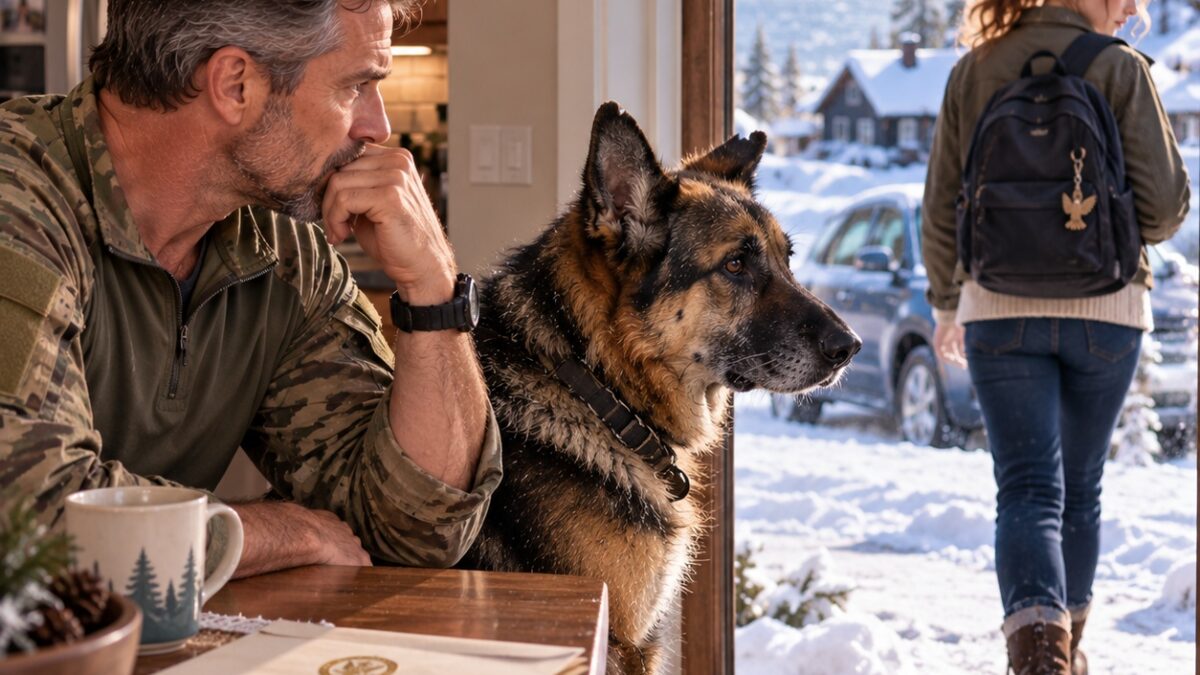
FULL STORY CONTINUATION
Aurora Ridge University stood fifteen miles north of Brightwater, where the land rose above the lake into wooded hills. The private nonprofit school was best known for its winter emergency response program, funded partly through state grants. Students trained in simulated blackouts, frozen road evacuations, communication failures, and large-scale shelter operations.
Brinn loved the work because emergencies made hidden priorities visible.
When systems failed, someone had to decide who received heat first, which roads stayed open, and whose safety mattered when resources ran short.
Dr. Laurel Isabelle Wescott had noticed that instinct during Brinn’s first month. Laurel was forty-four, compact and quick-moving, with a weather-reddened face, pale blue eyes behind tortoiseshell glasses, and short sandy hair streaked with early silver. She taught emergency logistics and supervised the simulation facility, where she often moved between computer stations with a pencil tucked behind her right ear.
That morning, she handed Brinn a digital inventory list.
“Verify the portable sensors before the afternoon exercise,” Laurel said. “Half the class believes technology becomes more reliable when nobody checks it.”
Brinn took the tablet. “And the other half?”
“They’ll become administrators.”
The simulation room resembled a small emergency operations center. Wall screens displayed maps, mock weather alerts, and resource schedules. Hard plastic radios sat in charging racks beside crates of labeled equipment.
Brinn began with the communication section.
The first discrepancy seemed minor.
The list showed twelve cold-weather relay sensors.
She counted eight.
Then she found six satellite communicators recorded as delivered, though only four occupied the secured cabinet. Two thermal mapping units listed by serial number were not present at all.
She checked another storage room.
Nothing.
The invoices all named the same supplier.
Keredine Systems.
Brinn knew the company. Everyone at Aurora Ridge did. Keredine had installed the campus access controls, security cameras, and much of the emergency network. Its name appeared on donor plaques, scholarship announcements, and the polished glass entrance of the technology wing.
She did not assume fraud.
Equipment could be reassigned, retired, repaired, mislabeled, or entered incorrectly.
Brinn sent Laurel a short email.
The asset list does not match the equipment currently in the simulation center. Several items billed through Keredine Systems are missing. Could this be a transfer or inventory error? I can prepare a full comparison if needed.
She attached photographs of the shelves and highlighted the questionable entries.
What Brinn did not know was that Aurora Ridge’s contract management system automatically notified vendors when staff flagged a delivered asset for verification. The feature had been added years earlier to speed up warranty claims.
At Keredine Systems headquarters, the notification appeared on an executive compliance dashboard.
Everard Beexley Keredine read it before noon.
At fifty-seven, Everard was tall and narrow, with steel-silver hair combed straight back and a rectangular face that seemed designed to reveal nothing. His charcoal suit was immaculate. A platinum signet ring rested on his right hand.
He read Brinn’s email twice.
Then he opened the personnel connection attached to her name.
Student assistant. First year. Daughter of Alden Knox Redfern.
Everard slowly turned the signet ring with his thumb.
Across campus, his daughter Saskia was finishing her own morning class.
Saskia Belle Keredine, twenty, had her father’s control but not yet his patience. She was tall and slender, with a blunt beige-blond bob, cold blue eyes, and a silver double-bar hair clip above one ear. She studied institutional management and worked part-time at Keredine Systems under the convenient title of systems testing intern.
Her test account should have been limited to a closed training environment.
Due to an unresolved permissions error, it still retained access to portions of Aurora Ridge’s live administrative network.
Two days after Brinn sent the email, Saskia appeared at the simulation center during an afternoon exercise.
Brinn was checking evacuation route data at a side terminal when Saskia stopped beside her.
“You flagged Keredine equipment.”
Brinn looked up. “I asked about an inventory mismatch.”
“You sent photographs to my supervisor.”
“I sent photographs to my academic adviser.”
“Delete the email.”
Brinn stared at her. “No.”
Students moved between stations behind them, focused on a simulated ice storm blackout. Electronic maps pulsed across the main wall. Laurel was helping a group in the adjoining control booth.
Saskia leaned closer.
“You are a first-year assistant counting boxes. You don’t understand how procurement works.”
“Then someone can explain why equipment was billed but isn’t here.”
Saskia’s expression hardened.
“People like you always mistake access for authority.”
Brinn turned back toward the terminal, but a small account panel remained open in the corner of the screen. The username displayed administrative privileges connected to Saskia’s internship credentials.
Brinn reached for her phone.
Saskia caught it first.
“Give it back.”
“You’re not photographing my account.”
“It’s active in a university system.”
Saskia pulled the phone away.
Brinn grabbed for it.
Saskia’s fingers closed around her wrist.
The grip tightened.
Then Saskia said quietly, “Maybe your father never taught you when to stop asking questions.”
Brinn froze.
Saskia saw the reaction and continued.
“He was too busy leaving, wasn’t he? Your mother died, and he still found reasons to be somewhere else. Now he comes home because the Army finally stopped needing him, and you call that loyalty?”
Brinn tore her wrist free.
Saskia stepped toward her again, still holding the phone.
Brinn pushed her.
It was one sharp movement born less from force than from a year’s worth of words compressed into a single second.
Saskia stumbled backward into a padded table used for casualty response drills. The table shifted against the floor.
Nothing broke.
No one was injured.
But several students turned at the sound.
They saw Saskia against the table.
They saw Brinn standing in front of her.
They did not see the hand around Brinn’s wrist.
They did not hear what had been said before.
Jonah Ephraim Talbot stood nearest the doorway. At twenty-three, he was a quiet final-year student with round black glasses, a navy jacket, and a Keredine scholarship that covered almost everything his family could not.
He had witnessed the phone being taken.
He had seen Saskia grip Brinn’s arm.
When campus staff asked what happened, Jonah looked across the room at a donor plaque bearing the Keredine name.
“I saw Brinn push her,” he said.
“That was all.”
By the time Brinn returned home, dusk had turned the snow outside Brightwater blue.
I was at the kitchen counter reading the governor’s letter again. Kestrel rose before the front door opened.
Brinn entered without removing her backpack.
“The university wants a voluntary mediation meeting before they decide whether to send it to formal discipline,” she said.
I folded the letter.
Only then did I notice the red marks around her wrist.
My eyes stayed there for one second too long.
Brinn pulled her sleeve lower.
I wanted to ask who had done it.
I wanted every word.
Every movement.
Every witness.
The investigator in me began arranging questions.
The father in me hesitated, afraid that asking too much would sound like doubt.
“We’ll go to the meeting,” I said. “They’ll review what happened.”
Brinn looked at me for a long second.
Kestrel moved between us and rested his shoulder against her leg.
I believed a fair process would uncover the truth.
I did not yet understand that a process could only be fair when the people controlling it wanted the truth found.
That belief was my first mistake.
The chairs in the mediation room had been arranged in a circle, but no one sat as though they were equals.
Beyond broad windows, sunlight spread across the snow-covered quadrangle of Aurora Ridge. Students crossed between buildings in dark coats, their movements small and orderly against the white ground.
Inside, the Keredine family occupied one side of the room with the quiet assurance of people accustomed to having space prepared for them.
Brinn sat beside me.
She had invited me to attend as her support person, a decision she had begun regretting before the meeting even started.
Across from us, Saskia wore a pale cream turtleneck beneath a tailored camel coat. The silver clip above her right ear held every strand of blunt blond hair in place. There was no visible mark from the incident.
She kept both hands folded over one knee and looked past Brinn rather than at her.
Everard Keredine sat to his daughter’s right, tall and narrow in a charcoal suit. His steel-colored hair was combed away from his face, and the platinum signet ring on his right hand caught the winter light whenever he moved his fingers.
The woman beside him required no introduction.
Gwendalyn Fay Keredine had spent more than twenty years turning legal pressure into respectable conversation. At fifty-two, she carried herself with the stillness of someone who never needed to compete for attention. Her dark chestnut hair ended neatly at her jaw, marked by a single silver streak near the right temple.
She wore a long black blazer over an ivory blouse, with a fountain pen placed precisely across the folder on her lap.
The Keredines had also brought outside counsel and a representative from their family foundation.
Dr. Laurel Wescott sat near Brinn with a pencil tucked behind her ear. She had agreed to attend as Brinn’s academic adviser, though her presence offered less protection than Brinn had hoped.
Laurel was an employee of the university.
Everyone in the room understood where the walls around her were located.
The mediator, an associate director from Student Resolution Services, reviewed the purpose of the meeting.
“This is voluntary,” she said. “It is not a disciplinary hearing, and no finding of responsibility will be made today. We are here to determine whether temporary terms can prevent further conflict while the university decides what process, if any, should follow.”
I listened carefully.
Temporary terms.
No finding.
Voluntary.
The language was designed to lower the temperature, but I had spent too many years reading reports shaped by careful words. Neutral language could protect fairness. It could also disguise an imbalance everyone was expected to pretend did not exist.
The mediator turned to Saskia.
“Would you like to begin?”
Saskia took a slow breath.
“I was reviewing material for the afternoon exercise when Brinn approached me. She said she was angry about my family’s relationship with the university. She accused our company of falsifying records and said people like us always got away with things.”
Brinn shifted in her chair. “That isn’t what happened.”
“Please let her finish,” the mediator said gently.
Saskia continued without looking at Brinn.
“I tried to leave. She followed me, became aggressive, and pushed me into a table in front of several students. I don’t feel comfortable sharing classrooms or facilities with her.”
The account was clean, brief, and almost entirely stripped of the moments that led to the push.
Everard leaned forward.
“My daughter should not be required to continue her education beside someone who has shown open hostility toward her family,” he said, “particularly when that hostility appears connected to business matters this student does not understand.”
Brinn looked directly at him.
“I understand that the university paid for equipment that isn’t in the room.”
I felt the meeting change.
It was subtle.
Gwendalyn did not move, but the foundation representative glanced toward Everard. Their counsel lowered his pen to the page.
The mediator raised one hand.
“We will come to the broader concern. First, we need to address the interpersonal incident.”
“The two are connected,” Brinn said.
Gwendalyn opened her folder.
“Then perhaps a complete resolution is possible.”
Her voice was soft, almost sympathetic.
She placed a single page on the low table between us.
The proposed agreement required Brinn to acknowledge that she had initiated the confrontation, provide Saskia with a written apology, withdraw from her position at the simulation center, and refrain from making further unsupported allegations about Keredine Systems.
In exchange, the Keredine family would not request a formal disciplinary hearing or pursue additional remedies.
I read the wording twice.
Additional remedies could mean many things.
A civil complaint.
A request to preserve records.
A demand that the university remove Brinn from shared courses.
The phrase was broad because it was meant to remain broad.
Brinn did not touch the paper.
“You want me to say none of it happened.”
“We want you to accept responsibility for what you did,” Gwendalyn replied.
“You took everything before the last five seconds and erased it.”
Saskia finally looked at her.
“I didn’t erase anything.”
“You took my phone.”
“No. You tried to photograph private login information.”
“That account had administrative access.”
“It was a testing account.”
“It was open in the live system.”
A brief silence followed.
I noticed Everard’s thumb move against the edge of his signet ring.
Brinn pulled back the sleeve of her sweater. The marks on her wrist had faded into a dull yellow-red band, but they remained visible.
“Saskia held me there,” she said. “When I pulled away, she still had my phone. Then she spoke about my mother.”
Saskia’s expression changed by less than a degree.
The mediator asked what was said.
Brinn’s voice became quieter.
“She said my father kept leaving after my mother died because being somewhere else mattered more to him than raising me.”
I kept my face still, but the words entered me with the precision of a blade.
Brinn continued.
“She said he only came home because the Army stopped needing him.”
Laurel lowered her eyes.
The Keredines did not appear embarrassed.
Everard looked impatient, as if grief were an irrelevant attachment to the facts.
Saskia said, “I may have said something personal after she accused my family of stealing.”
“You said it before I pushed you.”
“I don’t remember the exact order.”
“I do.”
The mediator turned toward Jonah’s preliminary statement, summarized in the file.
“A witness reported seeing Brinn push Saskia.”
“He arrived before that,” Brinn said. “He saw her take the phone.”
“But that is not what he included in his statement,” Gwendalyn replied.
I heard the trap close around the conversation.
If I challenged the witness, the Keredines would accuse Brinn of changing her account.
If I ignored Brinn’s admission that she had pushed Saskia, the university might view every other claim as an attempt to avoid responsibility.
I leaned forward, resting my forearms on my knees.
“These are two separate matters,” I said. “Brinn acknowledges that she pushed Saskia. That response was wrong, regardless of what was said beforehand.”
Brinn turned toward me.
I continued before I allowed myself to see her expression.
“That does not establish that she initiated the confrontation. It does not resolve the taking of her phone, the contact with her wrist, or the concerns she raised about equipment records.”
Gwendalyn watched me with new interest.
I addressed the mediator.
“Brinn is prepared to apologize for the physical response. She is not prepared to sign a statement that misrepresents the entire incident. I recommend a standard conduct review and a separate technical examination of the procurement records. Neither process should influence the other.”
The room remained silent.
I believed I had protected the essential distinction. I had refused the Keredines’ agreement, preserved Brinn’s complaint, and acknowledged only the action she had admitted.
Yet beside me, Brinn had stopped hearing the qualifications.
She had heard her father say that her response was wrong.
She had heard me offer an apology before anyone in that room condemned what Saskia said about her mother.
I had spoken like an investigator building a record.
Brinn had needed me to speak like her father.
Gwendalyn capped her fountain pen.
“That is not an acceptable resolution.”
Everard rose slightly in his chair, though he did not stand.
“If Ms. Redfern refuses to take responsibility, we will request a formal disciplinary proceeding. We will also review every legal option available to protect Saskia and our company from further unsupported accusations.”
Laurel looked toward the mediator.
“The inventory question existed before the confrontation. I received Brinn’s email that morning.”
“Then the university may review it through the proper channel,” Gwendalyn said. “It does not belong in an agreement concerning my daughter’s safety.”
The meeting ended without resolution.
In the parking lot, snow had begun to drift across the cleared pavement. I opened the passenger door of my truck for Brinn, but she walked around me and opened it herself.
We drove back toward Brightwater without speaking.
The heater pushed warm air into the cab. Pine forests passed on either side of the road, branches bright under the afternoon sun.
I considered several ways to explain what I had done.
I rejected each one.
Anything I said would sound like an argument for why she should not feel what she felt.
Brinn kept her face turned toward the window.
At home, Kestrel met us in the mudroom. The dog approached Brinn first, then looked toward me as though waiting for a signal that never came.
Brinn went upstairs.
The distance she left behind felt more deliberate than anger.
Three days later, Aurora Ridge contacted her before breakfast.
A request to alter the recipient of a winter assistance grant had been submitted using the credentials of an administrative employee. The transaction had been blocked automatically, but access logs indicated Brinn’s student card had entered the restricted technology corridor during the same period.
A security video showed a figure in a blue-gray winter parka walking past the server room entrance.
Brinn owned an almost identical coat.
An anonymous audio file had also been forwarded to the university. In it, a voice sounding like Brinn said the Keredines would pay for what they had done.
Brinn listened once and removed the headphones.
“That isn’t me.”
Laurel confirmed that Brinn had been helping her review exercise schedules in a windowless records room at the reported time. But there were no cameras inside that room, and Laurel had stepped away briefly to take a call.
Electronic records appeared more precise than human memory.
The university issued an interim suspension while the matter was reviewed. Brinn’s scholarship was frozen, her campus access disabled, and she was instructed not to contact Saskia or enter university property.
I read every page of the notice.
Brinn watched me reading.
“Do you believe me now?”
“I believed you were telling me what you remembered before.”
“That isn’t what I asked.”
I looked up.
“Yes,” I said. “I believe you didn’t do this.”
She gave a small humorless laugh.
“It took a fabricated crime.”
Before I could answer, her phone vibrated.
Then again.
Private notes from Brinn’s university counseling sessions had appeared on an anonymous student forum. Lines she had written about missing her mother and resenting my absences were being reposted without context. Strangers debated whether she was unstable, dishonest, or desperate for attention.
Brinn turned off the phone.
Over the next two days, she stopped coming downstairs for meals. She closed her curtains despite the bright snow outside and refused Laurel’s calls. Each new notification made her shoulders tighten, even after the phone had been placed face down in a drawer.
On the third morning, I woke to find the back door unlocked.
Kestrel was gone.
Beyond the porch, two sets of tracks crossed the yard toward the frozen lake path.
Brinn’s narrow boot prints.
Kestrel’s uneven stride, his left hind paw pressing more lightly into the snow.
I followed.
The tracks led to the community greenhouse near the eastern shore, a glass structure used to grow herbs and winter vegetables for Brightwater’s food pantry.
Inside, the benches were mostly empty, and pale sunlight gathered in misted windows.
Brinn sat on the floor between two planting tables. Her breathing came in shallow, uneven pulls.
Kestrel lay against her legs, his wheat-gold body curved around her knees. His dark head rested across her boot, steady and warm.
I stopped several feet away.
The investigator in me counted details automatically.
No visible injury.
Door unlocked.
Coat dry across the shoulders.
Phone absent.
I let the observations pass without turning them into questions.
Then I sat down on the cold floor.
“I thought being careful with the truth would protect you,” I said.
Brinn stared at condensation sliding down the glass.
“I thought if I separated what could be proven from what couldn’t, no one could use your anger against you.”
Her breathing slowed slightly beneath Kestrel’s weight.
I looked at my daughter, not at the marks on her wrist or the imagined evidence waiting somewhere beyond the greenhouse.
“I was so focused on the process that I didn’t listen to what it cost you to sit in that room.”
Brinn said nothing.
“I am sorry.”
It was not a legal apology.
It did not define limits or preserve options.
It was incomplete because I still did not fully understand the damage.
But it was the first sentence I had spoken without trying to control what followed.
Brinn did not forgive me.
After a long while, she placed one hand on Kestrel’s neck and pushed herself to her feet.
When I held the greenhouse door open, she walked through it.
Kestrel moved between us on the snowy path home.
Neither father nor daughter spoke.
But Brinn did not walk away alone.
My first instinct was to build a case.
My second was to remind myself I no longer had the authority to do so.
For almost thirty years, a title had opened doors before I reached them. It allowed me to request records, secure devices, interview witnesses, and preserve evidence before anyone had time to reshape it.
Now I was a retired officer sitting at my dining table with a suspended university student upstairs and a German Shepherd asleep beneath the window.
The difference between experience and authority had never felt so sharp.
I wrote down what I could legally do.
I could hire an independent examiner.
I could request that records be preserved.
I could search public contracts, court filings, and archived news reports.
I could speak to people who agreed to speak with me.
I could not compel anyone.
I could not present myself as an investigator acting on behalf of the state.
Most importantly, I could not treat Brinn’s innocence as a conclusion and force every fact to fit around it.
The list irritated me because it was necessary.
Two days after the greenhouse, an independent digital forensics consultant examined Brinn’s laptop and phone at our house. I stayed in the kitchen while the devices were imaged in the dining room. I did not hover over the consultant’s shoulder or ask for preliminary impressions. Brinn remained upstairs until the work was finished.
The report arrived the next afternoon.
Neither device showed any sign of being used to access Aurora Ridge’s grant system during the disputed period. Browser histories, system logs, network records, and cached credentials did not support the university’s allegation.
It was useful.
It was not enough.
Someone could have used Brinn’s password from another machine. Her card could have been copied. A device could have been wiped. The absence of evidence on her personal electronics did not prove every record held by the university was false.
I explained that carefully.
Brinn stood on the opposite side of the kitchen island wearing her mother’s old honey-brown cardigan over a gray sweatshirt.
“So the first good news we get, and you’re already explaining why it doesn’t clear me.”
“I’m explaining what it establishes.”
“You always do that.”
I stopped.
Brinn looked toward the frozen lake beyond the window.
“I know you’re trying to help,” she said. “But every time you reduce something to what can be established, it feels like you’re making room for everyone who says I’m lying.”
“I don’t think you’re lying.”
“That still isn’t the same as believing I know what happened.”
She left the kitchen before I found an answer that would not sound like another distinction.
The next morning, I sent formal preservation notices to Aurora Ridge, Keredine Systems, and the independent cloud provider that hosted portions of the university network. The letters requested that access records, security video, administrative changes, backup logs, and communications connected to Brinn’s case be retained.
I made no accusations.
I stated only that litigation and administrative review were reasonably foreseeable and relevant information should not be altered or destroyed.
Laurel Wescott provided a copy of Brinn’s original email concerning the missing equipment. The message had been sent before the confrontation with Saskia and before any allegation against Brinn existed.
That timing mattered.
It established that Brinn’s concerns had not been invented afterward to excuse the push.
She had noticed the equipment discrepancy first.
Everything else followed.
I began reviewing publicly available procurement records from Aurora Ridge’s emergency response program. Most were ordinary.
Winter vehicle leases.
Fuel contracts.
Radio maintenance.
Temporary shelter supplies.
Keredine Systems appeared repeatedly. The amounts were not remarkable in isolation. The pattern was.
Certain equipment categories appeared year after year under slightly altered descriptions. Maintenance charges continued for devices whose serial numbers no longer appeared in public inventory summaries. Several contracts had been approved under emergency exceptions that reduced competitive bidding requirements.
Late one night, I found a name buried inside an old appellate filing.
Dorian Fell.
Seven years earlier, after a major ice storm, money had been redirected from an emergency student assistance fund. Dorian, then a technical assistant at Aurora Ridge, had been accused of using an employee account to alter payment instructions.
The evidence listed in the court record was uncomfortably familiar.
Electronic access logs.
A security report.
Card reader data.
A technical affidavit prepared by Keredine Systems.
Dorian had not gone through a full trial. Facing a much longer sentence if convicted and unable to afford an independent technical expert, he accepted a plea agreement.
He served three years and emerged with a record that kept him from returning to most technology jobs.
I found him working at a community housing complex on the edge of Brightwater.
Dorian was repairing a failing boiler in the basement when I arrived. At twenty-seven, he looked older around the eyes than the rest of his face. Thick dark hair curled past his ears, and an uneven short beard softened a narrow jaw. He wore a tobacco-brown work jacket over a gray thermal shirt with a flathead screwdriver tucked into the chest pocket.
“You’re Redfern,” Dorian said after I introduced myself.
“Yes.”
“The girl from Aurora Ridge is your daughter.”
“Yes.”
Dorian returned his attention to the open boiler panel.
“And you used to investigate people for the Army.”
“I investigated systems and the people who misused them.”
“That sounds better.”
“It usually did.”
Dorian tightened a fitting.
“So now your family has a problem, and suddenly my old case matters.”
I did not deny it.
“I found similarities.”
“You found a useful story.”
“I found a case that may have relied on the same kind of evidence.”
Dorian stood and wiped his hands on a cloth.
“People with titles come back for men like me when they need proof the system can learn. They put us in front of a camera, say our names carefully, and promise the next person will be treated better.”
His eyes were brown-gold and guarded, but his anger had cooled into something more durable.
“Then the cameras leave,” Dorian said, “and we’re still the ones carrying what happened.”
I felt the old reflex to reassure him.
I resisted it.
“You don’t owe me anything,” I said.
Dorian seemed almost disappointed by the answer.
I gave him a card with only my name and personal number, then left the basement.
Several days later, a winter volunteer crew gathered at the same community complex to repair fencing around a small dog exercise yard. I had signed up before meeting Dorian, but I almost withdrew to avoid appearing manipulative.
Instead, I went and said nothing about the case.
Kestrel came with me.
Snow had gathered inside the damaged fence line. I spent the morning replacing warped boards while Kestrel moved slowly around the yard, inspecting the work with the seriousness of a retired foreman. His stiff hind leg caused a slight unevenness in deep snow, but he refused to remain on the cleared path.
Dorian was repairing an outdoor heating connection near the kennel shelter.
He noticed Kestrel’s damaged ear first.
“Working dog?”
“Retired search and rescue.”
Dorian crouched but did not call him.
Kestrel watched from several feet away.
During Dorian’s incarceration, he had participated in a rescue dog care program. He had cleaned kennels, practiced basic handling, and helped frightened dogs become comfortable around people again. The work had been one of the few parts of those years that did not reduce him to a case number.
Kestrel eventually crossed the snow and sat beside him.
Dorian rested one hand near the dog’s shoulder without touching.
“He chooses slowly,” I said.
“He should.”
That was the only conversation we had.
Three days later, Dorian called.
We met in a public library conference room.
He arrived carrying a taped cardboard box.
“My mother kept this,” he said. “She thought paper was harder to change than a computer.”
Inside were printed emails, maintenance reports, old pay records, and a small storage drive wrapped in cloth.
Before his arrest, Dorian had questioned invoices for emergency communications equipment he could not locate on campus. He had sent concerns to a supervisor and copied Keredine Systems.
One week later, an employee account assigned to him was used in the fund transfer incident.
Dorian opened one old technical report and placed it beside a printed summary from Brinn’s case.
The two records used the same strange structure.
Identical time formatting.
Repeated session labels.
A missing layer of authentication history that should have shown how the account entered the system.
I saw the resemblance.
I did not call it proof.
But it was enough to justify another set of eyes.
While I worked through Dorian’s documents, Brinn began meeting with Dr. Corali Jun Merritt, an independent therapist in Brightwater. Corali was forty-eight, with warm amber-brown eyes and silver-brown hair resting at her shoulders. Her office contained no university insignia, no institutional forms visible on the walls, and no computer positioned between her chair and Brinn.
During their first session, Brinn asked whether everything she said would become another record someone could steal.
Corali answered without offering false certainty.
“I keep records because continuity matters,” she said. “But we decide together what belongs in them, where they are stored, and who can request access.”
Brinn remained near the door for the first twenty minutes.
Corali did not ask her to move closer.
Over several sessions, she helped Brinn separate accepting help from surrendering control.
I could support her without directing every decision.
Laurel could confirm facts without becoming her rescuer.
Kestrel could calm her breathing without carrying the whole burden of recovery.
At Aurora Ridge, Jonah Talbot began avoiding Laurel.
She found him one evening outside the simulation wing, standing beneath a campus light while snow collected on his navy jacket.
“You’ve stopped answering my messages,” Laurel said.
“I already gave a statement.”
“You gave part of one.”
Jonah gripped the strap of his burgundy backpack.
“If I change it now, no one will believe me.”
“That may be true.”
He looked at her, startled by the absence of reassurance.
Laurel adjusted her glasses.
“But silence does not remain empty, Jonah. It becomes part of the record too.”
She left him there with the choice.
I organized materials from Dorian, Brinn, Laurel, and the independent examiner. I included gaps, uncertainties, and facts that did not fully support my preferred conclusion.
Then I sent the package to the Minnesota Attorney General’s Office.
I did not demand charges.
I requested independent review and immediate preservation of technical records before routine retention schedules could erase them.
Four days later, I was asked to attend a meeting in St. Paul.
The woman waiting for me was Simone Kepler, a former federal prosecutor appointed as special counsel for the preliminary inquiry. She was forty-six, tall and composed, with small braids gathered into a low knot and narrow reading glasses resting beside a stack of unmarked folders.
She did not invite me to tell Brinn’s story from the beginning.
Instead, she asked how I had obtained each document. She asked whether Dorian had been promised anything. She asked whether Brinn had ever shared her password. She asked what evidence might support the university’s position.
I answered each question.
When I finished, Simone closed the folder.
“I will review the possibility that your daughter was framed,” she said. “I will also review the possibility that she was involved, acted with someone else, or is mistaken about facts she believes she remembers correctly.”
I felt my jaw tighten.
Simone noticed.
“If you want someone to prove your daughter innocent, hire an advocate,” she continued. “If you want an independent investigation, accept that I do not work for your conclusion.”
“What do you need from me?”
“No private contact with witnesses. No additional interviews. No public statements about the evidence. Anything new comes through counsel and is logged.”
I looked at the folders between us.
For most of my life, protecting someone had meant taking responsibility, gathering control, and placing myself between the threat and the person at risk.
Now, protecting Brinn required the opposite.
I stood.
“You’ll have no interference from me.”
Simone held my gaze for a moment, deciding whether she believed me.
Then she extended her hand.
When I left the building, snow was falling over St. Paul in small, dry grains. I reached into my coat and closed my fingers around the old brass compass in my pocket.
For the first time since Brinn’s suspension, I had placed the truth in someone else’s hands.
I could no longer direct where it would lead.
Simone Kepler did not begin with the evidence Aurora Ridge had chosen to present.
She began with what the university had failed to control.
The first source was a hallway camera mounted above a fire door in the older technology wing. Unlike most of the campus system, the unit retained several hours of footage locally before transmitting to Keredine Systems’ central server. A synchronization failure on the night of the alleged intrusion had left the original file stored inside the camera.
Aurora Ridge’s internal review had never requested it.
Simone’s technical team did.
On a gray Monday morning, she watched the footage in a secure conference room with two independent analysts.
The image was imperfect, softened by low corridor lighting, but the differences were clear.
The person in the blue-gray parka was taller than Brinn.
The stride was longer.
The shoulders were broader.
Most importantly, the figure did not pause to swipe a student card at the corridor entrance.
The door opened through an administrative override.
The version submitted to Aurora Ridge’s disciplinary office began later.
Those twelve seconds had removed the moment the override appeared on the reader.
The second source belonged to the university’s insurance carrier. Because the insurer covered several technology-related risks, Aurora Ridge was required to send periodic security footage and incident records to an external archive. That archive contained a longer copy of the same hallway video.
The third source was the cloud provider hosting portions of Aurora Ridge’s access management system.
Its records operated on an independent clock that Keredine Systems could not adjust.
When analysts compared the cloud logs with the technical report used against Brinn, they found a discrepancy of nearly four minutes.
Four minutes was not dramatic.
It was enough.
The report claimed Brinn’s student card opened the corridor before the grant account was accessed.
The independent clock showed the card entry had been inserted after the administrative session was already active.
Someone had not misunderstood the evidence.
Someone had rearranged its order.
Simone kept the findings within her investigative team. I received no update beyond confirmation that the review was active. That boundary had been established in our first meeting, and Simone enforced it without exception.
When I called once to ask whether the preservation notices had been honored, she answered only that all appropriate legal steps had been taken.
“Is there anything else I should provide?” I asked.
“If there is, I will request it.”
Then she ended the call.
I stared at my silent phone for several seconds.
In another life, being excluded from an investigation would have felt like a professional insult. Now it felt like standing outside a locked room while my daughter’s future was being discussed inside.
I reminded myself the locked door was there for a reason.
At Aurora Ridge, the anonymous audio file was sent to a specialist in synthetic speech. The expert compared it with Brinn’s recorded class presentations, a student orientation video, and several voice messages circulated among project groups.
The disputed sentence contained Brinn’s tone and rhythm, but not her breathing patterns.
Certain consonants repeated with identical acoustic shapes, something natural speech rarely produced. Background noise shifted between words as though the sentence had been assembled from multiple sources.
The specialist’s conclusion was cautious but direct.
The recording was highly consistent with generated or reconstructed speech.
It had not come from Brinn.
The leaked counseling notes were a separate problem.
Investigators traced the access path through an encrypted backup directory managed by Aurora Ridge’s information technology department. The account used to copy the directory belonged to Malcolm Vinn, the university’s deputy director of infrastructure.
Malcolm arrived for his interview carrying three devices, a leather portfolio, and an expression suggesting he had slept very little. At thirty-nine, he had the folded posture of a man who spent most of his life leaning toward screens. Light brown hair thinned at the crown, and a short, carefully maintained goatee framed a face drained of color.
A set of hardware security keys hung from an orange cord at his belt.
He checked them twice before sitting down.
Simone placed a printed access log on the table.
“Is this your administrative credential?”
Malcolm studied it. “Yes.”
“Did you use it to enter the counseling backup directory?”
“I gave temporary access to a Keredine engineer.”
“That was not my question.”
His fingers began tapping against the leather portfolio.
“Yes,” he said. “I opened the directory.”
“Why?”
“They said they needed a copy of a coded folder for a system integrity review.”
“Who said that?”
Malcolm hesitated.
Simone waited.
“Everard Keredine’s operations office contacted me first. Then one of their senior engineers sent the folder identifier.”
“And you did not verify what the folder contained.”
“It was labeled with an internal code.”
“You had sufficient access to determine its contents.”
Malcolm’s tapping stopped.
Several months earlier, Keredine Systems had informally discussed offering him an executive infrastructure position once the company expanded its state contracts. There had been no written promise, only private dinners, flattering conversations, and repeated suggestions that he was underused at Aurora Ridge.
Malcolm had wanted to believe he was being recruited because of his talent.
He had therefore treated every request from Keredine as an opportunity to demonstrate cooperation.
“I didn’t know they were Brinn Redfern’s notes,” he said.
“When did you learn?”
“After they appeared online.”
“And what did you do then?”
Malcolm looked toward the blank wall.
“I copied the access logs.”
“Why?”
“To protect myself.”
The honesty did not help him as much as he hoped.
Simone leaned back.
“You did not preserve those logs to protect Ms. Redfern. You preserved them because you understood you might be blamed.”
“Yes.”
“You provided outside access to restricted information without authorization.”
“Yes.”
“You failed to report it after private material was released.”
Malcolm closed his eyes briefly.
“Yes.”
Simone did not threaten him or offer protection. She explained that cooperation could be considered by prosecutors, but it would not erase his decisions. If he chose to assist, he would surrender the copied logs, identify every person involved, preserve communications, and accept that he might face charges or professional sanctions.
Malcolm looked down at the orange cord of security keys.
For years, those small devices had represented access.
Now each one seemed to mark a door he should never have opened.
“I’ll cooperate,” he said.
Across campus, Jonah carried his own silence for another week.
He stopped passing the simulation wing. He chose longer routes between classes and ate lunch in the library basement, where few students recognized him. The Keredine Foundation had not contacted him directly. Yet he checked his scholarship account every morning as though expecting the balance to disappear.
Laurel found him after an evening seminar.
She did not ask whether he had reconsidered.
She handed him a copy of his original witness statement.
Only one sentence appeared beneath his name.
I saw Brinn Redfern push Saskia Keredine into the training table.
“It’s true,” Jonah said.
“It is.”
He looked at her.
Laurel’s pale eyes remained steady behind her tortoiseshell glasses.
“A sentence can be true and still be used to create a lie.”
Jonah lowered his gaze to the page.
He had seen Saskia take the phone.
He had seen her fingers around Brinn’s wrist.
He had heard enough to know the confrontation had not begun with the push.
“I’ll lose everything,” he said.
“You may lose the scholarship and the internship. Possibly.”
“You say that like it’s easy.”
“No.” Laurel removed the pencil from behind her ear. “I say it because pretending there is no cost would be another kind of dishonesty.”
Jonah submitted an amended statement the following morning.
The Keredine Foundation suspended his scholarship review before the end of the day. His promised internship placement was withdrawn without explanation. Laurel helped him apply to an independent emergency support fund that covered tuition and housing for students facing sudden financial hardship.
The assistance was temporary and smaller than his original award, but it kept him enrolled.
Jonah did not feel brave.
He felt frightened, embarrassed, and late.
For the first time, however, the official record contained what he had actually seen.
Saskia learned about the revised statement through her mother.
Gwendalyn placed the document on the dining table at the Keredine home and described Jonah as unreliable. Everard said the student had probably been pressured by Alden Redfern.
Neither parent asked Saskia whether Jonah’s new account was true.
That omission unsettled her more than an accusation would have.
The family had originally described their actions as protection.
The modified video, the access reports, and the proposed agreement were supposed to prevent Brinn from turning a minor confrontation into an attack on the company.
Now Saskia understood the equipment questions had existed before the confrontation.
She also knew her father’s staff had been discussing invoices long before Brinn entered Aurora Ridge.
When she asked why an ordinary inventory email required so much intervention, Everard told her she lacked the experience to understand institutional risk.
When she asked who had accessed the counseling records, Gwendalyn said speculation would only complicate her legal position.
The answers were not answers.
Saskia began to suspect her parents were not protecting her from Brinn.
They were placing her between Brinn and something much larger.
During one of her sessions with Corali, Brinn remembered another part of the confrontation. She had been so focused on the insult about her mother that the earlier exchange had blurred.
Saskia had warned her not to continue asking about the equipment.
Then she had said, “You don’t know how many people lose everything if you keep pulling at this.”
Corali did not decide what the statement meant. She asked Brinn how certain she was of the wording, whether anyone else had been close enough to hear it, and what had been happening immediately beforehand.
Brinn wrote the memory down in her own words.
Through her attorney, it went to Simone as a supplemental statement.
Simone compared it with the Keredine contracts, Dorian’s old records, Malcolm’s logs, and Jonah’s amended testimony.
The pattern expanded beyond Aurora Ridge.
Keredine Systems had built multiple public programs for communications equipment that could not be matched to independent inventories. Some contracts had been renewed under emergency exceptions. Certain students, employees, and board members who defended those contracts had received foundation support, paid consulting work, or unusually favorable grants.
No single payment proved corruption.
Together, they showed a network of dependency.
Then came the first public attack.
It did not arrive through a courtroom or official complaint.
It arrived on a Sunday morning beneath a photograph of me in uniform.
The article described me as a decorated former Army investigator who had accepted leadership of a new state integrity office while my daughter remained under investigation at Aurora Ridge. It questioned whether my appointment represented public service or personal retaliation.
The writer had obtained pieces of Brinn’s counseling notes, fragments already stripped of context and circulated online. Her grief over her mother became emotional instability. Her anger over my absences became evidence of a troubled home.
The article suggested I had spent decades neglecting my family and was now using state authority to repair my image.
Gwendalyn Keredine’s name did not appear anywhere.
Her language did.
The phrases were too careful to be accidental.
Conflict of interest.
Weaponized oversight.
Politically motivated review.
Each accusation was framed as a question, allowing the article to wound without ever making a claim direct enough to challenge.
I read it once at the kitchen table.
Brinn stood by the counter, watching my face.
“You don’t have to pretend it doesn’t bother you.”
“I’m not pretending.”
“You’ve been holding the same page for five minutes.”
I folded the newspaper and set it aside. The brass compass in my shirt pocket pressed against my chest when I leaned forward.
“The article is designed to make any response look defensive,” I said. “If I discuss the investigation, I violate the recusal. If I discuss you, I use your life to protect my reputation.”
Brinn’s expression tightened.
“There it is again.”
“What?”
“The correct answer.”
I almost replied too quickly.
Then I stopped.
I had promised not to turn every conversation into an explanation.
“The article makes me angry,” I said. “It also makes me ashamed that some of what it says about my absence is true.”
Brinn looked down at the mug between her hands.
That was not comfort.
It was not enough to undo what strangers had read about her.
But it was an answer that did not hide behind procedure.
Across town, Everard Keredine applied pressure where public embarrassment could not reach.
Keredine Systems maintained Aurora Ridge’s integrated access network, several emergency communication systems, and portions of the heating control infrastructure in newer campus buildings. The university could not replace the company quickly in the middle of a Minnesota winter.
Everard did not threaten to turn off the heat.
He was too disciplined for anything so obvious.
Instead, his office notified the board that ongoing cooperation with an investigation hostile to Keredine Systems might affect the company’s willingness to provide services beyond the strict minimum required by contract.
Planned upgrades could be postponed.
Emergency technicians might no longer be available outside guaranteed response periods.
Temporary support provided as a donor benefit could end immediately.
The message was clear.
Aurora Ridge would remain technically operational, but one serious cold-weather failure could close half the campus.
The board convened an emergency session. Several members argued that the university had to protect students from disruption. Others feared state funding would be suspended if they appeared to obstruct Simone’s inquiry.
Between those positions, a confidential settlement began to take shape.
Brinn would receive part of her scholarship again.
Her disciplinary record would be sealed rather than publicly cleared.
The university would remove the ban preventing her from completing coursework remotely.
In exchange, she would release Aurora Ridge from civil claims, withdraw her demand for an independent procurement review, and agree not to discuss internal records.
The proposal reached Brinn through her attorney.
I sat with her and Corali while she read it. Kestrel lay near the office window, his right ear angled toward street sounds outside.
“It gives you a path back,” I said carefully.
Brinn looked at me.
I heard how the sentence sounded and continued.
“I am not telling you to take it.”
“But part of you wants me to.”
“Yes.”
Corali sat across from us, silver-brown hair resting against the collar of a plum sweater. She did not interrupt.
I placed both hands on my knees.
“I want the pressure to stop. I want your name cleared publicly. But if that is not available now, part of me wants to accept anything that gives you room to recover.”
“And Dorian?”
I did not answer immediately.
Brinn lifted the proposed agreement.
“This fixes my scholarship. It does nothing about the evidence they used against him.”
“No.”
“It also lets the university say no one proved I was innocent.”
“Yes.”
Brinn turned to Corali.
“Am I refusing because I’m angry?”
“Probably in part,” Corali said.
Brinn waited.
“That does not make the decision wrong. Anger can identify a boundary. It should not be the only thing making the decision, but it does not have to be removed before you’re allowed to choose.”
I looked at the document again.
My old instincts told me to calculate risk, preserve options, protect Brinn from another public fight.
Corali’s attention shifted toward me.
“Protection is not the same as control,” she said.
I nodded once.
Brinn rejected the offer.
Her written response was brief.
She would participate in a fair disciplinary review, but she would not sign an agreement requiring silence about records that might have affected other people.
The board’s reaction was divided.
That division widened when Laurel Wescott requested permission to address them directly.
Laurel entered the board meeting carrying no attorney and no prepared statement beyond a folder of printed emails. She wore a brick-red parka over a dark teal sweater, and the familiar wooden pencil remained behind her right ear.
She began by acknowledging her own hesitation.
“When Brinn first reported the inventory discrepancy, I treated it as a technical question,” Laurel said. “After the confrontation, I allowed the conduct process to move forward without insisting her earlier report be examined separately.”
One board member asked whether she was accusing the university of deliberate wrongdoing.
“I am describing my own failure to act quickly,” Laurel replied. “I was careful because I was afraid of losing my position. Carefulness is useful in academic work. It is not always courage.”
She placed Brinn’s original email on the table.
The timestamp showed it had been sent before the dispute with Saskia, before mediation, and before any allegation that Brinn entered the grant system.
“This student did not invent an equipment concern after she was accused,” Laurel said. “The concern came first.”
The board counsel reminded her that public discussion could expose the university to liability.
Laurel adjusted her glasses.
“A student’s future is already exposed.”
Her statement entered the official record.
So did Jonah Talbot’s amended account.
Jonah agreed to appear before an independent review panel. Though no hearing date had yet been set, he sat with Brinn and her attorney in a small conference room beforehand, unable to keep his hands still around the spiral notebook he carried.
“I wrote down what happened that night,” he said. “Not everything. Just what I remembered when I got home.”
He opened the notebook.
The page described Saskia taking Brinn’s phone and gripping her wrist. It also recorded the moment Jonah looked toward the Keredine donor plaque before giving his first statement.
Brinn read the lines without speaking.
“I kept telling myself I hadn’t lied,” Jonah said. “You did push her. That part was true.”
“You let them use the smallest true piece to replace everything around it.”
“Yes.”
He did not ask her to forgive him.
“I chose my scholarship,” he said. “You carried the consequence.”
Brinn closed the notebook and returned it.
“I believe you’re sorry.”
Jonah looked up.
“That doesn’t mean I trust you yet.”
“I know.”
It was the first honest exchange between them.
Malcolm Vinn’s cooperation created a different kind of opening.
An older Aurora Ridge archive had been encrypted with a legacy system no longer in regular use. Malcolm possessed the hardware key needed to access it. Under Simone’s supervision, he surrendered the key and provided the original recovery procedure.
The archive contained internal communications that had never been transferred to the university’s newer servers.
Among them was an email from Everard’s office instructing technical staff to create a sufficiently documented pattern of behavioral and access concerns so Brinn could be permanently excluded from secured university spaces.
Another message referenced Dorian Fell’s case.
The wording was short and clinical.
Used the prior resolution as a successful precedent.
Simone read the line twice.
It did not prove every detail of Dorian’s account.
It showed that someone inside Keredine Systems had viewed the old case not as a tragedy or even a legal event, but as a method that could be repeated.
At the Keredine home, Saskia received a lesson in how responsibility could be transferred.
Everard and Gwendalyn asked her to sign a statement claiming she had independently used the test account, arranged the corridor video, and exaggerated Brinn’s behavior because she feared disciplinary consequences.
Their lawyers would describe her as an inexperienced intern who had made poor decisions.
The company, they promised, would protect her.
Saskia read the draft alone that night.
Attached was an internal memorandum she had not been meant to see. It described her actions as unauthorized and recommended terminating her internship immediately if investigators approached the company.
The document had been prepared two days before her parents promised to defend her.
Saskia took the silver clip from her hair and set it on the desk.
For most of her life, protection had meant consequences disappeared before reaching her.
She had mistaken that privilege for love.
Now she understood the condition beneath it.
Her family would protect her only while she protected the company.
The next morning, Saskia contacted an attorney who had never represented Keredine Systems. Through that attorney, she requested a meeting with Simone.
She arrived in a cold gray suit, blond hair pinned behind both ears without the silver clip.
She looked younger without it.
Not more innocent.
Saskia admitted pressuring Brinn to delete the email.
She admitted using a test account with permissions she knew were inappropriate.
She had given a similar blue-gray parka to a Keredine intern and told him to walk through the corridor using an administrative credential. She had expected the image to create doubt about Brinn’s location.
She had not expected Keredine technicians to alter the access sequence.
She denied knowing Brinn’s counseling notes would be taken or synthetic speech used.
She also denied knowing the full history of Dorian’s case.
Simone listened without reassurance.
“Cooperation will be documented,” she said. “It is not immunity.”
“My parents said I would be protected if I took responsibility.”
“Your parents do not decide what responsibility means.”
Saskia looked down at her hands.
“Will this help Brinn?”
“It may help establish what happened.”
“That isn’t what I asked.”
“It is the only answer I can give you.”
Saskia signed the cooperation agreement with her own attorney present at the state office.
I began my new role under constant scrutiny.
Reporters waited outside the building on my first morning. One asked whether I planned to use taxpayer resources to destroy Keredine Systems. Another asked whether I had failed as a father and was now compensating through public office.
I stopped before entering.
“The investigation involving my daughter is independent,” I said. “I receive no confidential reports and exercise no authority over its direction. No title permits me to interfere merely because the outcome matters to my family.”
A reporter shouted that my refusal to defend Brinn made me look weak.
I did not turn around.
That Thursday, I left the office at five despite an unfinished briefing and drove back to Brightwater through steady snow.
I arrived at Corali’s office seven minutes early.
Brinn was already there with Kestrel.
She glanced at the clock, then at me.
The newspaper attacks had continued.
The investigation remained unfinished.
Her future at Aurora Ridge remained uncertain.
Nothing had been solved.
But I had kept the first promise that could not be defended with words.
During mediation, my silence had left Brinn alone before people trying to define her.
Now my silence had a different shape.
I was refusing to use authority to force an outcome, even while accepting the damage that restraint did to my reputation.
Brinn did not tell me she understood.
She moved her coat from the chair beside her.
I sat down.
Kestrel settled between us.
Four months after Brinn’s suspension, Aurora Ridge convened an independent administrative hearing in a municipal conference center fifteen miles from campus.
The location mattered.
No Keredine name appeared on the walls.
No donor plaques.
No university banners.
No windows overlooking buildings where Brinn had once studied.
The room contained only a long table, a raised desk for the three-member review panel, several rows of chairs, and a clock whose second hand sounded louder whenever no one spoke.
This was not a criminal trial. The panel could not convict Everard Keredine, impose penalties on Gwendalyn, or reopen Dorian Fell’s case.
Its authority was narrower.
Still significant.
It would determine whether Aurora Ridge had sufficient grounds to discipline Brinn, whether the evidence against her was reliable, and whether she could return as a student without a false finding attached to her name.
Brinn arrived early with her attorney, Corali Merritt, and Kestrel.
An independent trainer had evaluated Kestrel several weeks earlier. The assessment confirmed he could remain quiet in a crowded room, ignore unfamiliar people, and respond to Brinn’s distress without interfering with testimony.
The panel chair permitted him to stay as a support accommodation.
He wore only his dark forest-green harness and brown leather collar. No military patches. No dramatic markings. Nothing that turned him into a symbol of authority.
Kestrel settled beneath Brinn’s table. His wheat-gold body curved near her boots. The broken V of his black saddle disappeared beneath the table edge, while his damaged right ear remained visible whenever it turned toward a new voice.
I did not sit beside Brinn.
Under the recusal agreement, I had avoided all confidential preparation for the hearing. I attended only as her father and sat in the public section at the rear of the room.
I wore a navy suit without military insignia, my brass compass hidden in an inside pocket.
Brinn looked back once before the panel entered.
I did not nod as though issuing encouragement before an operation.
I simply met her eyes and remained still.
The panel chair opened proceedings by explaining that the university carried the burden of supporting its disciplinary action with credible evidence. Brinn’s conduct during the original confrontation would be considered separately from later allegations involving unauthorized access and grant manipulation.
That separation had taken four months to secure.
Brinn’s attorney called her first.
She walked to the witness table with Kestrel beside her.
After she sat, the dog returned beneath the table and rested his head near her left foot.
Brinn began with the equipment inventory. She described counting missing sensors, checking storage rooms, and sending Laurel a restrained email rather than accusing anyone publicly. She explained why Saskia’s administrative account caught her attention and how the argument in the simulation center escalated.
When she reached the insult about her mother, her voice tightened.
Kestrel lifted his head and pressed his muzzle lightly against the side of her boot.
Brinn paused, took one full breath, and continued.
“Saskia took my phone and held my wrist. I pulled away. Then I pushed her.”
Her attorney did not ask whether she regretted it.
Brinn offered the answer herself.
“I should not have pushed her. What she said was cruel, but I still made that choice. I accept responsibility for that moment.”
The university’s counsel watched her carefully.
Brinn placed both hands on the table.
“But that moment did not give anyone permission to create another version of me. It did not give anyone permission to use my name in a system I never entered, construct a recording I never made, or distribute things I said in counseling.”
She looked toward the panel rather than toward Saskia.
“I reacted badly once. That does not make every later accusation true.”
The distinction landed more forcefully than a declaration of perfect innocence would have.
Brinn was not asking the panel to believe she had never made a mistake.
She was asking them not to let one mistake become a container into which others could place anything they wished.
Jonah Talbot testified next.
He brought the spiral notebook in which he had recorded his memory after the confrontation. His hands shook slightly when he opened it, but he did not try to hide that.
“I saw Saskia take Brinn’s phone,” he said. “I saw her hold Brinn’s wrist. I heard part of the argument, though not every word.”
“Why did your first statement mention only the push?” the panel chair asked.
Jonah looked briefly toward the floor.
“Because the Keredine Foundation paid my tuition and had arranged an internship for me. I told myself I was reporting the part I knew for certain. The truth is that I chose the part least dangerous to me.”
The university’s counsel asked whether anyone had pressured him to change his account.
“No.”
“Did Dr. Wescott promise financial support?”
“No.”
“She told you changing your statement might cost you your scholarship.”
“Yes.”
“And it did.”
“Yes.”
Jonah did not look toward Brinn when he finished.
His testimony was not offered as a request for forgiveness.
Laurel followed.
She presented the original email Brinn had sent before the confrontation, along with the equipment list and photographs attached to it. The timestamps had been verified through an independent mail archive.
“The concern about the missing devices existed first,” Laurel said. “The disciplinary incident came later.”
One panel member asked why she had not demanded an immediate procurement review.
Laurel removed her glasses and folded them in both hands.
“I thought caution would protect my position and allow me to help Brinn quietly,” she said. “Instead, my caution gave more powerful people time to define what happened.”
She did not describe herself as brave for appearing now.
She described herself as late.
The technical evidence consumed most of the afternoon.
An independent analyst displayed the longer insurance archive beside the version submitted to Aurora Ridge.
The difference was twelve seconds.
In those missing seconds, the figure wearing a coat like Brinn’s entered the corridor through an administrative override rather than a student card swipe.
The analyst then compared the access report with the cloud provider’s independent time records.
“The sequence in the university report cannot be accurate,” she explained. “The administrative session was active before the student card event attributed to Ms. Redfern.”
The panel chair asked whether this could result from ordinary synchronization error.
“A synchronization error could shift records,” the analyst said. “It would not account for a later report placing the events in a different order while omitting the administrative override.”
A second specialist explained the audio file.
He avoided technical performance. Instead, he played several short waveform comparisons and described how identical sound patterns repeated across separate words.
“The voice resembles Ms. Redfern,” he said. “But the sentence is not consistent with uninterrupted natural speech. It was assembled or generated from existing recordings.”
No one gasped.
The evidence became more disturbing because it was explained without drama.
Malcolm Vinn testified under an agreement requiring complete cooperation.
He wore a plain blue-gray shirt without his university identification badge. The absence of the orange security key cord at his waist made him appear strangely unfinished.
He admitted opening the protected backup directory and providing Keredine personnel with access.
“Did Everard Keredine threaten you?” Brinn’s attorney asked.
“No.”
“Did he force you?”
“No.”
“Why did you cooperate?”
Malcolm swallowed.
“I believed Keredine Systems might offer me an executive position. I wanted them to see me as useful.”
“When you discovered the copied folder contained counseling records, what did you do?”
“I preserved the logs.”
“For Brinn?”
“No. For myself.”
The answer caused a quiet movement among the panel members.
Malcolm did not present himself as another victim of Everard’s influence.
“I chose advancement over my responsibility to protect the data,” he said. “Ms. Redfern lived with the consequences of that choice before I did.”
Saskia entered after a brief recess.
She arrived with her own attorney and no member of her family. Her blunt blond hair was tucked behind both ears, and the silver clip she had worn throughout the semester was absent.
Saskia admitted using the improperly authorized test account. She admitted confronting Brinn and pressuring her to delete the inventory email. She also acknowledged giving a blue-gray parka to a Keredine intern and instructing him to pass through the secured corridor using an administrative credential.
Her intention, she claimed, had been to create uncertainty around Brinn’s movements.
“Did you know the video would be shortened?” the panel chair asked.
“No.”
“Did you know access records would be rearranged?”
“No.”
“Did you authorize the release of counseling notes?”
“No.”
“Why should this panel believe you now?”
Saskia’s face remained composed, but her hands tightened around each other.
“You should not believe me because I am sorry,” she said. “You should compare what I say with the messages and emails I provided.”
Those messages showed Everard’s staff discussing how the corridor image could support a larger behavioral record. Other communications showed Gwendalyn coordinating language for the proposed mediation agreement after learning Brinn had reported the equipment discrepancies.
Saskia did not apologize directly to Brinn during her testimony.
Perhaps she understood that an apology offered while protecting herself would ask too much of the person receiving it.
The hearing ended shortly before sunset.
The panel took two hours to issue its preliminary determination, then returned to a room where no one looked victorious.
The chair read the decision.
The evidence used to accuse Brinn of unauthorized system access and attempted grant manipulation had been materially altered and could not support disciplinary action.
Her interim suspension was lifted.
The findings related to data access were removed from her record.
Her scholarship was restored in full.
Aurora Ridge was ordered to provide written confirmation that Brinn had not been found responsible for the digital allegations.
The panel then addressed the original confrontation.
Brinn had acknowledged pushing Saskia.
The panel treated that act as a separate conduct issue and assigned a conflict management program rather than suspension or expulsion. It also recorded that the incident occurred after Saskia took Brinn’s phone, held her wrist, and made personal remarks intended to provoke her.
Brinn had been cleared of the fabricated accusations.
Relief did not describe what she felt.
Relief suggested a weight had been lifted cleanly.
This weight had left impressions behind.
Her private thoughts still existed in places she could not retrieve them from. Students who had never met her had already decided what kind of person she was. Four months of isolation could not be returned like scholarship money.
Outside the hearing room, a university administrator asked when she planned to resume classes.
“I don’t,” Brinn said.
The administrator looked confused.
“Not yet,” she added.
That distinction belonged to her.
No one else would choose the timing.
The hearing record soon affected matters beyond Brinn’s education.
With court authorization, an independent expert compared administrative credentials in Brinn’s case with archived records from Dorian Fell’s prosecution.
The same legacy account identifier appeared in both systems.
Despite the seven-year gap, the discovery did not automatically erase Dorian’s conviction. It provided enough cause for a judge to permit formal review of the old evidence and consider his petition to withdraw the plea.
When Dorian received the decision, he sat alone in his work van outside the community housing complex.
He read the order three times before calling his mother.
He did not celebrate.
He said only, “They have to look again.”
Several months later, after additional records and witness statements were presented, a grand jury returned indictments connected to the broader scheme.
Everard Keredine faced charges related to public contract fraud, evidence manipulation, and obstruction.
Gwendalyn faced separate charges involving witness pressure, restricted personal data, and concealment efforts.
Malcolm and several Keredine employees were charged according to their individual roles. His cooperation was noted, but it did not erase his conduct.
Saskia was charged separately for the acts she admitted, with prosecutors formally acknowledging her assistance.
I did not attend the announcement.
My recusal remained in effect, and I refused requests to stand before cameras as either a state official or a triumphant father.
By then, victory had become a word none of us trusted.
When Brinn left the conference center after the administrative decision, daylight had faded into the blue stillness of a Minnesota evening.
I waited at the far end of the corridor.
Kestrel stood beside me, tail moving once when he saw Brinn.
I did not ask whether she was ready to return to Aurora Ridge.
I did not ask how she felt, as though one word could hold it.
I picked up her winter coat and said, “Do you want to go home by the lake road or through the pines?”
The lake road was shorter.
Brinn looked down at Kestrel.
“Through the pines.”
Outside, fresh snow had softened the path between the trees. Kestrel walked in the middle, leaving a steady line of paw prints beside two sets of boots.
The route home took nearly an hour longer.
None of us suggested turning back.
By the time the legal proceedings ended, Brightwater had passed through two springs, two brief northern summers, and nearly three full winters.
The public had stopped treating the Keredine case as a daily spectacle long before final decisions arrived. News vans disappeared from Aurora Ridge. Comment sections moved on to newer scandals.
The people whose lives had been altered did not have that luxury.
For them, time had not erased anything.
It had only changed the shape of what remained.
Everard Beexley Keredine was convicted after a lengthy trial involving public contract fraud, evidence manipulation, obstruction, and interference with witnesses. Internal messages recovered from the old archive showed his actions went far beyond protecting Saskia from a university conduct complaint. He had used Brinn’s confrontation as an opportunity.
Once he learned she had noticed missing equipment, he authorized a strategy meant to discredit her before anyone took the inventory questions seriously.
Other records showed the same approach had been used to protect a network of inflated invoices and nonexistent devices across several publicly funded programs.
Everard listened to the verdict without turning toward his family.
The platinum signet ring he had once rotated whenever he controlled a room had been removed before he entered the courthouse. Without it, his right hand looked strangely ordinary.
Gwendalyn Keredine did not go through the same trial.
She entered a negotiated plea after prosecutors presented evidence linking her to restricted records, witness pressure, and agreements designed to silence Brinn and others. She acknowledged enough responsibility to avoid a longer proceeding, though she never described her decisions in emotional terms.
Her sentence included confinement, financial penalties, and a permanent prohibition against directing educational foundations or organizations receiving public funds.
The black fountain pen she had once aligned so precisely beside every agreement became part of an evidence photograph.
Saskia’s outcome was different.
Her cooperation had helped investigators separate what she had done from the larger actions of her parents, but it did not remove her responsibility. She received supervised probation, extensive community service, restitution obligations, and a multi-year ban on serving in leadership of educational institutions or scholarship organizations. She was required to meet with an ethics monitoring officer, maintain employment outside the Keredine network, and comply with restrictions on access to institutional technology systems.
Saskia did not become a public advocate.
She did not offer a carefully staged redemption story.
She completed her obligations quietly.
Some people considered the outcome too lenient. Others believed her cooperation had prevented further harm.
Brinn refused to make Saskia’s future another question she was expected to answer.
What mattered was that Saskia could no longer pretend she had merely been following a family expectation.
She had started the harassment, misused the account, and helped create the image that placed Brinn near the restricted corridor.
The larger plan belonged to others.
The first choices belonged to her.
Malcolm lost his position at Aurora Ridge and the professional credentials that had given him administrative access to protected systems. His cooperation reduced the penalty he faced, but it did not preserve the career he had tried to advance. He later found work repairing network equipment for small businesses under strict supervision.
The job carried less status and fewer privileges.
For the first time, that seemed appropriate to him.
Several Aurora Ridge board members resigned or were removed after reviews showed they had ignored conflict-of-interest warnings, delayed scrutiny of Keredine contracts, or supported the confidential settlement offered to Brinn.
None had personally altered video or copied counseling records.
Their failure had been quieter.
They had repeatedly chosen institutional comfort over questions that might threaten funding.
The Keredine Foundation was dissolved by court order. After penalties and verified claims were resolved, its remaining assets were transferred into an independently administered restitution fund.
The fund did not bear Brinn’s name.
She refused that suggestion.
It was created for students, employees, and community members harmed by corrupted disciplinary procedures, manipulated technical evidence, or retaliatory contract practices. Decisions about payments were made by a board that included legal experts, data specialists, and people with direct experience of institutional retaliation.
No donor was allowed to sit on it.
Dorian Fell’s case required its own process.
The appearance of the same legacy administrative identifier in two investigations persuaded the court to reopen his plea, but that discovery alone did not clear him. Independent experts reconstructed old logs, compared archived financial records, and reviewed the affidavit Keredine Systems had supplied seven years earlier.
The prosecution eventually acknowledged that the core technical evidence could not be trusted.
Dorian’s conviction was vacated.
The legal language was clean.
The judgment was set aside.
The plea withdrawn.
The case dismissed.
Nothing about the language accounted for the three years he had lost or the years afterward when employers saw a record before they saw a person.
The state approved financial compensation. Aurora Ridge offered him a formal apology and an advisory position in its technology department.
Dorian accepted the apology in writing.
He declined the position.
Instead, he joined a nonprofit organization that reviewed cases involving digital evidence gathered or interpreted by interested private contractors. He did not present himself as a lawyer or forensic scientist. His role was to help people understand which questions they should ask before accepting a technical report as neutral truth.
He kept repairing heating systems part-time.
Machines, he often said, were easier to trust after someone admitted who had maintained them.
Jonah Talbot finished his degree one semester later than planned. Losing the Keredine scholarship forced him to reduce his course load and work evenings at the Brightwater Community Center. Laurel helped him secure the position, but she did not erase the consequences of his first statement.
Jonah and Brinn remained polite without becoming close.
One afternoon after graduation, he found her outside the community center and apologized again. This time, he did not explain his fear or mention what the scholarship had meant to his family.
“I let the truth become smaller because a smaller truth protected me,” he said.
Brinn accepted the apology.
She did not tell him everything was fine.
Their relationship remained proof that forgiveness and restored trust were not the same thing.
Aurora Ridge changed because it had no choice.
The university separated physical security, academic information, counseling records, and disciplinary evidence into systems managed by different vendors and administrators. Independent copies of incident data were stored outside the control of primary contractors. Donors were prohibited from participating in conduct proceedings involving students or employees connected to their organizations.
A whistleblower office was created with authority to receive reports outside ordinary supervisory chains.
Laurel became one of its faculty advisers.
She kept the same pencil behind her ear.
Brinn did not immediately return to the emergency management program.
For one semester, she worked at a training center that prepared calm, well-suited dogs to assist people with mobility, anxiety, and other daily challenges. The work did not ask her to explain the Keredine case.
Dogs responded to what she did in the present, not to the version of her that had circulated online.
She continued meeting with Corali.
Some weeks, they discussed the hearing and the stolen notes. Other weeks, they talked about ordinary things.
Sleep.
Deadlines.
Irritation with me.
The guilt Brinn felt whenever a day passed without her thinking about the case.
Corali helped her understand that healing did not require constant attention to the injury.
When Brinn returned to school, she chose a revised program combining emergency management, data ethics, and whistleblower protection.
She wanted to understand not only how institutions responded when roads closed or power failed, but how they failed when information was controlled by people with something to protect.
She still avoided certain corridors at Aurora Ridge.
A notification from an unknown university address could make her pause before opening it.
Crowded rooms sometimes caused her to identify exits before she noticed the people inside.
These responses became less frequent.
They did not disappear because a court ruled in her favor.
Kestrel was ten by the third winter.
White hairs appeared around his black muzzle. His left hind leg stiffened more quickly in cold weather, and he no longer crossed deep snow simply because I had chosen the shortest path. He stopped at the edge and waited until someone cleared a better route.
At night, he still lay outside Brinn’s room when she had difficulty sleeping.
When I returned from St. Paul, Kestrel waited near the front window long before the truck appeared. The dog had never stopped expecting me.
The difference was that I now returned when I said I would.
At the Office of Institutional Integrity, I completed my first full term. Under my leadership, state contractors could no longer maintain exclusive control over evidence used to investigate their own performance. Critical records had to be preserved through independent sources, and investigative systems were required to maintain auditable histories of administrative changes.
A permanent oversight council was created with legal experts, technical specialists, and community representatives.
I was offered a longer term on the condition that I relocate to St. Paul and expand the position into a full-time executive appointment.
Years earlier, I would have accepted before finishing the letter.
This time, I declined the relocation.
I agreed to remain as a limited-term adviser, traveling only on designated days and surrendering daily management to a successor chosen through an independent process.
The decision was not a sacrifice offered to Brinn.
I did not announce that I was finally choosing my daughter over service.
Such a statement would have turned my presence into another heroic act.
I understood now that staying was also work.
It required repetition, patience, and the willingness to be available on days when nothing dramatic happened.
On Saturday mornings, Brinn and I ate breakfast together.
Sometimes we spoke about school or my office.
Sometimes Brinn corrected the way I cut fruit, and I pretended there was a military standard for grapefruit sections.
We walked Kestrel beside the lake whenever weather allowed.
When I tried to solve a problem Brinn had only wanted to describe, she told me.
When she withdrew without explanation, I asked whether she needed space or company instead of assuming I knew.
We still failed at this.
The difference was that neither of us allowed failure to become another locked door.
The first snow of the third winter arrived in late afternoon.
Brinn was finishing a shift at the dog training center when she opened the side door and found me waiting near the path.
I wore my olive drab combat shirt beneath a dark forest coat, silver now more visible at my temples.
Kestrel stepped outside slowly. The old German Shepherd paused between us, his broken black saddle dusted with snow, damaged right ear tilted toward Brinn while his amber eyes moved to me.
I did not call him.
Brinn did not pat her leg or ask him to choose.
For years, Kestrel had lived in doorways, waiting for people who loved each other to cross the distance between them.
Now I stepped forward.
Brinn did the same.
Kestrel turned toward the lake path and walked between us.
The snow ahead was bright and unmarked.
I shortened my stride to match the dog’s slower pace.
Brinn kept one hand near Kestrel’s shoulder without using it to guide him.
Behind us, the training center door remained open for a few seconds before closing gently on its own.
There would always be parts of Brinn’s childhood I could not return to.
There would always be memories she carried differently than I did.
The door between us had never vanished.
What changed was that neither of us closed it simply because stepping through might hurt.
Real integrity is not proven when we have the power to win.
It is proven when we have the power to control the outcome and choose not to misuse it.
I could not undo the years I had missed.
Brinn could not erase what had been taken from her.
But we learned that healing begins when people stop defending their intentions and start taking responsibility for their choices.
Sometimes the quietest grace is simply staying, listening, and leaving the door open long enough for trust to return.