FULL STORY:My Husband’s German Shepherd Refused to Leave His Fire Truck for 13 Days—Then My Son Found the Key Rex Had Been Guarding
FULL STORY CONTINUATION
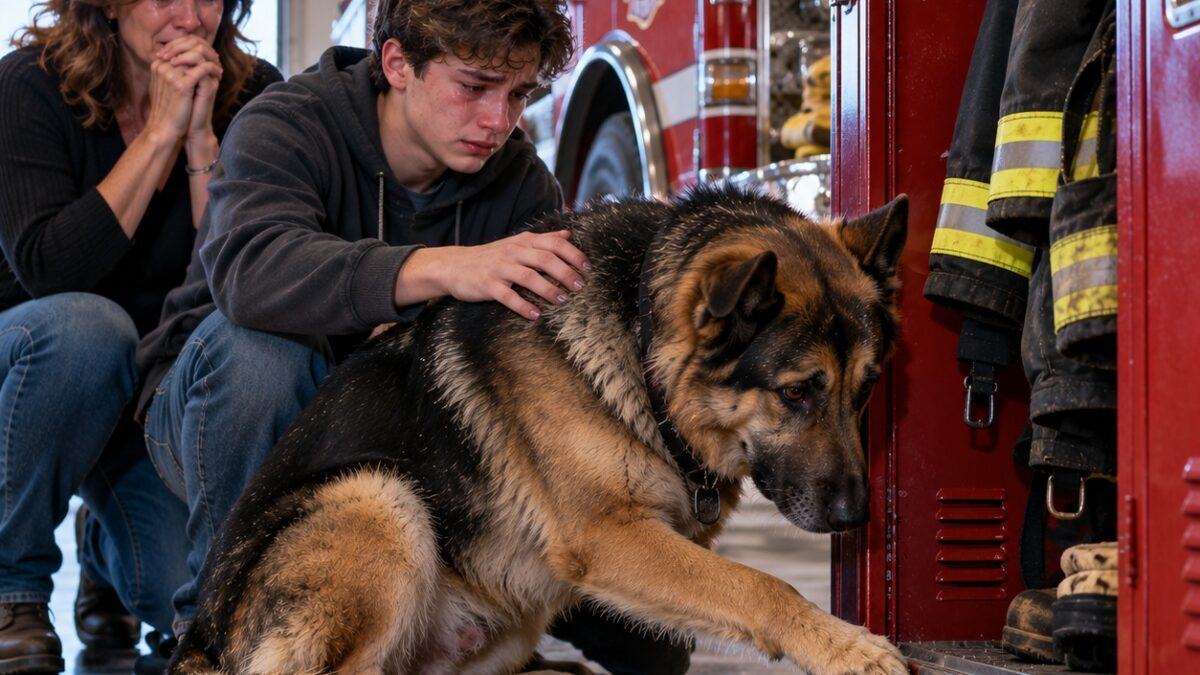
Thomas moved first.
“What’s under there?”
“I don’t know.”
James’s locker had been part of the garage for years.
Tall.
Steel.
Dark gray.
Inside hung his retired turnout coat, an older helmet, work gloves, belts, flashlights, hand tools, and a dozen small things only he could identify.
The area beneath it was almost completely hidden by shop rags, dust, a box of bolts, and whatever else had migrated there over a decade.
Thomas stretched flat on the cold concrete.
“Careful.”
“I’m fine.”
He pushed the rags aside.
Rex stood over him.
Not excited.
Focused.
Thomas slid one arm beneath the narrow gap.
For several seconds, we heard only his fingers scraping against concrete.
“Nothing.”
Rex whined.
“Wait.”
Thomas reached farther.
Then his body went still.
“Mom.”
My heart started pounding.
“What?”
“I feel something.”
He pulled his hand back.
Between his fingers was a small rust-darkened key.
Maybe three inches long.
Old-fashioned.
Too small for a house door.
Too delicate for the garage padlocks.
Rex’s reaction was immediate.
His ears lowered.
His tail moved.
Once.
Barely.
But after thirteen days without a single real wag, that tiny movement felt like somebody opening a window in a sealed room.
Thomas sat up.
“What does this open?”
I took the key.
Cold metal.
A little oil on it.
I turned it over in my palm.
Then a memory surfaced.
“Your father had a green metal box.”
Thomas looked at me.
“What box?”
“I haven’t seen it in years.”
“Where?”
“I don’t know.”
I closed my eyes.
James teasing me after I found him wrapping Christmas presents in the garage.
A small green metal document box behind him.
I had asked what was inside.
He covered it with both hands and said, “Trade secrets.”
I rolled my eyes.
Later he claimed it held insurance papers.
I had forgotten about it.
Until that moment.
“There’s a box somewhere in here.”
Thomas was already standing.
We searched.
Behind paint cans.
Inside cabinets.
Above the workbench.
On the shelves.
James kept everything because he believed every screw, hinge, piece of wire, scrap of wood, and rusted bracket would eventually become useful.
“Your father was a hoarder.”
“He called it inventory.”
“He was wrong.”
For the first time since the funeral, Thomas almost smiled.
Rex followed us.
That mattered too.
For thirteen days he had occupied the same few feet of concrete.
Now he moved from shelf to shelf, nose working.
We reached the rear wall.
Thomas climbed onto a small stepladder.
“Anything?”
“Oil.”
“Anything useful?”
“A dead spider.”
“Wonderful.”
Then he stopped.
“Wait.”
“What?”
“I see green.”
Behind an old container and several boards sat a rectangular metal box.
Thomas pulled it down.
Dust fell everywhere.
He carried it to the workbench.
Green paint.
Small built-in lock.
I held up the key.
Thomas stared at me.
“No way.”
My hand shook as I pushed it into the lock.
Perfect fit.
I turned.
Click.
It was such a small sound.
But in that garage, it felt enormous.
Thomas stood beside me.
Rex sat near our legs.
I lifted the lid.
Inside were envelopes.
Not bills.
Not insurance documents.
Letters.
James’s handwriting covered the front of each one.
For Thomas — when you turn eighteen.
For my little Lily — when you start middle school.
For Sarah — when missing me feels too heavy.
I stopped breathing.
Thomas made a sound somewhere between a gasp and a sob.
Beneath the envelopes lay a leather notebook.
And a black USB drive tied with a red ribbon.
My husband had tied ribbon around a flash drive.
That was exactly the kind of ridiculous sentimental thing he would do while pretending not to be sentimental.
Thomas picked it up.
“There’s probably video.”
I looked at Rex.
He stared at the box.
For thirteen days he had not been guarding the key in any magical, human sense.
I understand that now.
He could not have known what a USB drive meant.
He could not have understood future birthdays or letters.
But James had spent years moving between that locker and the box.
Handling those things.
Speaking to Rex.
Leaving scent.
Routine.
Association.
The key had likely fallen or been intentionally tucked beneath the cabinet at some point James remembered.
Rex knew that space mattered to James.
And after James disappeared, Rex had anchored himself to the strongest remaining concentration of his world.
The truck.
The locker.
The smell of oil, leather, smoke, and the man he loved.
Maybe he had seen James hide the key.
Maybe he simply remembered him reaching beneath there.
Dogs do not need to understand a secret the way humans do to remember where their person kept returning.
At that moment, though, none of those explanations mattered.
Thomas and I both felt the same thing.
James had left something.
And Rex had brought us to it.
“We need Lily.”
Thomas nodded.
We carried the box inside.
Rex crossed the threshold with us.
That alone made me stop.
Thirteen days.
He had slept in the garage for thirteen nights.
Now he entered the house without hesitation.
His nails clicked over the hardwood.
A sound I had not realized I missed.
Lily sat cross-legged in the living room surrounded by markers and paper.
She had been drawing the same picture over and over since the funeral.
Red truck.
Garage.
Brown house.
A black-and-tan dog lying beside it.
Sometimes she drew James standing beside the truck.
Sometimes she did not.
That morning, James was there.
“Sweetheart.”
She looked up.
“What?”
“Thomas and I found something Daddy left us.”
She dropped the marker.
“What?”
I sat on the sofa.
She climbed immediately into my lap even though she was getting too big for it.
Thomas opened my laptop.
Rex lowered himself on the rug.
Not by the door.
At our feet.
Thomas connected the flash drive.
One video file appeared.
No complicated folders.
No password.
Just:
FOR MY FAMILY.
Thomas clicked.
The screen went black.
Then James appeared.
For one second, my brain refused the image.
There he was.
Alive.
Sitting inside the garage.
The restored truck gleaming behind him.
His favorite denim shirt.
Hair untidy.
Wedding ring visible when he adjusted the camera.
I grabbed Thomas’s arm.
Lily whispered, “Daddy.”
James smiled.
Not at us.
At the camera.
But it felt like he could see us.
“Hey, my loves.”
His voice filled the room.
I broke.
There is no elegant word for what happened.
A sound came out of me.
Lily pressed closer.
Thomas covered his mouth.
Rex raised his head.
James continued.
“If you’re watching this, then something happened before I got around to becoming a very annoying old man.”
Even Thomas laughed through tears.
“That was the plan, by the way.”
James smiled.
“Eighty-five. Minimum.”
He looked down for a second.
When he raised his eyes again, the joking softened.
“I started making these because of the job.”
I remembered nights he came home quieter than usual.
Calls he would not discuss.
Children.
Firefighters injured.
People who went to work and never returned.
“I’ve watched families get blindsided by things nobody thinks will happen to them.”
He paused.
“So I decided there were a few things I wanted to say while I still had the chance to choose the words.”
My chest hurt.
Lily reached toward the screen.
James looked straight into the camera.
“First, nobody is allowed to make this house sad forever.”
I closed my eyes.
“That means you, Sarah.”
I opened them immediately.
He grinned.
“You are allowed to be angry at me for dying.”
I sobbed and laughed at the same time.
“But don’t turn grief into a job.”
His face became serious.
“You’ve spent our entire marriage carrying everybody. Me. The kids. Your parents when they were sick. Every neighbor who needed food. Every friend whose life fell apart.”
His voice softened.
“Let people carry you for a while.”
I bent over Lily.
My daughter wrapped both arms around my neck.
James continued.
“Thomas.”
My son straightened.
“I don’t know when you’ll see this.”
“But if you’re still doing that thing where you pretend nothing scares you, knock it off.”
Thomas cried silently.
“You don’t have to become me.”
That sentence hit him harder than anything else.
I knew because his whole face changed.
James had been Thomas’s hero since childhood.
Firefighter.
Fixer.
Strong.
Reliable.
Everything Thomas believed a man was supposed to be.
“I mean that,” James said.
“Don’t choose my job because it was mine.”
“Don’t choose my opinions because they were mine.”
“Don’t carry my unfinished plans because you think that proves you loved me.”
He leaned closer.
“Become a good man your own way.”
Thomas nodded at the screen as if James could see.
“I’m already proud of you.”
My son lowered his head.
Then James smiled.
“Lily.”
She gasped.
“My little tornado.”
“I am not,” she whispered.
James on the screen said, “Yes, you are.”
Lily stared.
For one impossible second, it felt like a conversation.
“Keep drawing.”
Her face changed.
James knew.
Of course he knew.
“Draw ugly pictures.”
“Beautiful pictures.”
“Weird pictures.”
“Draw dragons with firefighter helmets if you want.”
“Do not let anybody convince you that making things is a waste of time.”
Lily began crying openly.
“And if some boy breaks your heart someday, tell Thomas.”
Thomas snorted.
James grinned.
“He’ll overreact.”
For a few moments, laughter entered our living room.
Real laughter.
Thirteen days after burying my husband.
Then James grew quiet again.
“And Sarah.”
I froze.
“My best friend.”
I whispered, “Don’t.”
The recording continued.
“You were the place I came home to.”
Not the house.
Not the garage.
“You.”
I covered my mouth.
“There were nights after bad calls when I would sit in my truck two streets away because I didn’t want to bring the darkness inside.”
I never knew that.
“Then I’d come through the door and hear you yelling at somebody about shoes in the hallway, or Lily laughing, or Thomas raiding the refrigerator, and the world would feel normal again.”
James smiled faintly.
“You saved me more times than any crew ever did.”
My tears fell onto Lily’s hair.
“And if I go first, which I probably will because you have always been smarter than me…”
I laughed helplessly.
“Live.”
One word.
Then again.
“Live.”
He pointed toward the camera.
“Not survive.”
“Not maintain.”
“Not keep everything exactly the way I left it.”
“Live.”
I looked toward the garage.
His boots were still beside the door.
His mug remained in the cabinet.
I had not moved his jacket from our bedroom.
He knew me too well.
“You are allowed to change things.”
“You are allowed to laugh.”
“You are allowed to get mad.”
“You’re even allowed to eventually love a life that doesn’t have me physically standing inside it.”
I could barely see the screen.
Then James shifted in his chair.
“And finally…”
His expression brightened.
“We need to discuss the real head of this household.”
Rex stood.
I swear he did.
The moment James said it, Rex rose from the rug and stared at the screen.
James laughed.
“Rex.”
The dog took one step toward the laptop.
“You giant freeloading beast.”
Rex whined.
Lily cried harder.
James’s smile changed into something deeply tender.
“I don’t know if dogs understand death.”
“I hope they don’t.”
His voice cracked slightly.
“But I know that dog understands loyalty.”
Rex moved closer.
James continued.
“He spent more nights with me in that garage than anybody.”
“Sorry, Sarah.”
I almost laughed.
“He knows when I’m upset before I do.”
“He knows when Thomas sneaks out the side gate.”
Thomas looked guilty.
“And he knows Lily drops food under the table on purpose.”
Lily whispered, “No I don’t.”
James smiled.
“So take care of him.”
“He may look for me.”
That sentence shattered what remained of my composure.
“He may wait.”
“He may get confused.”
“Don’t punish him for that.”
“Stay with him.”
“Let him stay with you.”
James looked away briefly.
Then back.
“And if he keeps hanging around my truck or my locker, pay attention.”
Thomas and I looked at each other.
My heart stopped.
James smiled slightly.
“I’ve hidden a few things over the years.”
“Rex has watched me hide most of them.”
“He’s nosy.”
Rex whined at the screen again.
“So if the big idiot keeps insisting on something, maybe humor him.”
That was all.
Not a magical mission.
Not an explicit instruction that the dog knew the location of a secret inheritance.
Just James knowing his dog.
Knowing the routines they had shared.
Knowing that Rex noticed everything he did in that garage.
Then he said something I will remember for the rest of my life.
“Courage isn’t running into burning buildings.”
He shook his head.
“That’s training.”
“Real courage is waking up after the worst thing happens and deciding the people still here are worth loving.”
His eyes glistened.
“You three were my greatest rescue.”
“And I hope, if I’m gone, you rescue each other.”
He smiled.
“Okay.”
A breath.
“I love you.”
The screen went black.
Nobody moved.
For several seconds, the room contained only breathing.
Mine.
Thomas’s.
Lily’s.
Rex’s.
Then Lily whispered, “Play it again.”
We did.
Not immediately.
We sat first.
Rex walked toward Lily.
She dropped from my lap to the rug.
He licked her hand.
She wrapped her arms around his neck.
“Daddy said you were nosy.”
Rex tolerated this accusation.
Then he went to Thomas.
Pressed his muzzle against my son’s knee.
Thomas put both hands around his head.
Finally Rex came to me.
He sat.
Rested his head across my thighs.
Exactly as he had done countless evenings when James was alive.
I buried my fingers in the fur behind his ears.
“You waited for him.”
His eyes closed.
“You really thought he was coming back.”
That was what I believed those thirteen days meant.
Not that Rex understood the box.
Not that James had somehow trained him to deliver a posthumous message.
He had waited because dogs do not understand funerals.
He remembered James leaving.
Remembered him coming home.
Remembered the truck.
The equipment.
The locker.
The scent.
And when Thomas finally interrupted that waiting strongly enough to pull his attention elsewhere, Rex returned to something associated with James.
The bottom of the locker.
The old key.
A routine stored somewhere inside an animal brain that does not explain itself with words.
And somehow, that was enough.
The box did not cure us.
I want to make that clear.
Grief did not disappear because my dead husband had prepared a beautiful video.
If anything, the first few days afterward became more complicated.
Hearing James’s voice made absence sharper.
Lily wanted the video constantly.
Thomas refused to watch it again for nearly a week.
I could not bring myself to open my envelope.
The one labeled:
For Sarah — when missing me feels too heavy.
It stayed inside my nightstand drawer.
At first, I felt guilty.
James had written it for me.
Shouldn’t I read it?
Then I remembered the wording.
When missing me feels too heavy.
It was already heavy.
But something in me knew he meant another day.
A future day.
A day when grief changed from emergency into something quieter.
So I waited.
Thomas did the same.
His envelope said eighteen.
He was sixteen.
“Are you really going to wait?” I asked.
He held it in both hands.
“Dad told me to.”
“He also used to eat ice cream directly from the carton.”
“That’s different.”
“Is it?”
“Yes.”
He put the letter back inside the box.
Lily’s envelope had its own future date.
She did not like that.
“What if I want it now?”
“I know.”
“He’s my dad.”
“I know.”
“What if I forget his voice?”
“We have the video.”
“What if I forget his face?”
“We have pictures.”
“What if I forget him?”
That question nearly destroyed me.
I pulled her close.
“You won’t.”
“How do you know?”
“Because forgetting doesn’t happen the way you think.”
She looked at me.
“You may forget a shirt.”
“A particular dinner.”
“Exactly what he said on some Tuesday.”
“But you won’t forget what it felt like when he carried you upstairs after you fell asleep.”
Her mouth trembled.
“You won’t forget the way he laughed.”
“Or how he smelled after working in the garage.”
She made a face.
“Bad.”
“Very bad.”
She smiled through tears.
“And if you forget something, Thomas remembers another part.”
“I remember another.”
“Grandma remembers another.”
“His firefighters remember things we never knew.”
I touched her cheek.
“Nobody has to remember James alone.”
That became true faster than I expected.
The firehouse stayed close.
Captain Reed came by every week.
Sometimes with food.
Sometimes with no reason.
James’s partner Miguel helped Thomas finish a project they had been building together.
A wooden bench.
James had cut the lumber but never assembled it.
Thomas insisted on completing it exactly from his father’s measurements.
Halfway through, he stopped.
“I hate this.”
I sat beside him in the garage.
“What?”
“Everybody keeps acting like I’m supposed to love doing his stuff.”
“You don’t.”
“I don’t even like woodworking.”
I almost laughed.
James had been terrible at woodworking.
“What do you like?”
Thomas stared at the half-built bench.
“Computers.”
“Then do computers.”
“Dad wouldn’t care?”
I thought about the video.
Become a good man your own way.
“He would care if you spent your life pretending to be him.”
Thomas looked down.
Then nodded.
We finished the bench anyway.
Not because Thomas needed to inherit James’s hobbies.
Because unfinished things sometimes deserve an ending.
After that, Thomas spent more time with his laptop than with the tools.
James would have complained about screen time.
Then bragged to everyone about whatever Thomas built.
I knew it.
Rex changed slowly.
The morning after we watched the video, I woke before sunrise.
For thirteen mornings, I had gone directly to the garage with dread in my chest.
That morning, Rex was standing in the kitchen.
Beside his bowl.
I stopped.
“Hungry?”
His tail wagged.
Not one weak movement.
A real wag.
I filled the bowl.
He ate everything.
Then drank.
Then walked to the back door.
I opened it.
He stepped into the damp morning grass.
I followed.
The sky was pale gold.
Dew covered the yard.
Rex sat near the fence.
For the first time since James died, he was looking away from the garage.
Toward the sunrise.
I sat beside him.
“You know he’s gone.”
Rex watched a bird.
“I’m starting to understand too.”
We stayed there a long time.
That day he slept inside the house.
In the hallway.
Exactly in the center where he could see all three bedroom doors.
It became his place.
At night, after Lily went to bed and Thomas disappeared into his room, Rex settled there.
Facing our doors.
Guarding what remained.
James had once joked that Rex considered himself security.
Now it felt different.
He was not protecting a secret.
He was protecting routine.
Family.
Movement.
The house continuing.
The garage door remained open during the day.
I couldn’t close it for weeks.
James’s truck stayed exactly where it had always been.
Red paint polished.
Chrome bright.
At sunset, light entered through the west windows and struck the side of the truck.
Sometimes, for one terrible hopeful instant, I expected to see James crouched beside it.
Rex occasionally wandered out.
He sniffed the locker.
Lay by the truck for twenty minutes.
Then returned.
He stopped waiting all night.
That mattered.
The first person to notice was Lily.
“Rex knows Daddy isn’t coming back.”
I looked at her.
“What makes you think that?”
“He doesn’t sleep out there anymore.”
Children say things adults spend months avoiding.
“Maybe.”
She scratched Rex under the chin.
“He was sad.”
“He still is.”
“So are we.”
“Yes.”
“But we sleep inside.”
I smiled painfully.
“Yes, baby.”
“We can be sad inside.”
That became our family’s unofficial rule.
We can be sad inside.
We can be sad at dinner.
Sad at school.
Sad while laughing.
Sad while celebrating.
Grief did not require us to stand outside the rest of life.
The first Christmas without James was unbearable in advance.
Every decoration carried memory.
The plastic firefighter ornament Thomas had made when he was six.
The angel Lily once insisted belonged crooked.
James’s stocking.
I almost left everything in boxes.
Then Lily asked, “Would Daddy be mad?”
“At what?”
“If we don’t do Christmas?”
I pictured James on the video.
Don’t make this house sad forever.
“He’d probably haunt us.”
Lily’s eyes widened.
“Really?”
“No.”
Thomas walked through.
“He’d definitely haunt Mom.”
“Thank you.”
So we decorated.
We cried.
We laughed.
Rex stole wrapping paper.
That helped.
At midnight on Christmas Eve, I stood alone beside the tree.
James had always been the last one awake.
He would check locks.
Move gifts.
Eat whatever cookies Lily left for Santa.
I felt the old instinct to go to the garage.
Instead, Rex came to me.
He pressed against my leg.
I sat on the floor.
“I miss him.”
Rex lowered his head into my lap.
“I know you do.”
We stayed there until I could breathe again.
Weeks became months.
People stopped calling every day.
That happens.
Not because they stop caring.
Because their lives resume.
Ours had to as well.
I went back to work part-time.
Thomas returned fully to school.
Lily stopped checking the driveway every time she heard a diesel engine.
Rex gained back the weight he lost during those thirteen days.
His coat improved.
His eyes looked alert again.
But certain sounds still changed him.
A fire engine passing nearby.
James’s old ringtone when somebody accidentally triggered it on my phone.
Heavy boots on the porch.
He would freeze.
Listen.
Then look at me.
Not the garage anymore.
Me.
One evening, Miguel came over wearing his station jacket.
Rex rushed to the door.
For half a second, joy exploded through him.
Tail.
Ears.
Body forward.
Then he smelled Miguel.
Stopped.
His tail slowed.
Miguel knelt.
“I know, buddy.”
Rex walked toward him.
Miguel buried his face in the dog’s neck.
I turned away.
Some grief belongs between a firefighter and his partner’s dog.
Thomas turned eighteen a year and a half later.
The green metal box still sat in my bedroom closet.
James’s notebook remained unread by everyone except me in small portions.
It contained ordinary things.
Maintenance notes.
Ideas.
Names.
Stories from the firehouse.
Measurements for projects.
Thoughts about our children.
Pages about Rex.
Nothing revolutionary.
That made it precious.
On Thomas’s birthday, after dinner, I brought out his envelope.
He stared at it.
“You kept it sealed?”
“I promised.”
His hands trembled.
“Want me here?”
He thought.
“No.”
That hurt.
Then I understood.
“Okay.”
He took the letter upstairs.
Forty minutes passed.
Then an hour.
Finally, his door opened.
He came downstairs.
His face was red.
But something about his posture had changed.
He sat beside me.
“What did he say?”
Thomas looked toward the hallway where Rex slept.
“A lot.”
I waited.
“He said he knew I always thought he was fearless.”
Thomas smiled faintly.
“He said he was scared all the time.”
That surprised me.
“He wrote that?”
“Yeah.”
“What else?”
“He said courage is doing the next right thing while being scared.”
That sounded like James.
Thomas rubbed his hands together.
“And he told me something about the night I was born.”
“What?”
“He said he sat in the hospital parking lot for twenty minutes because he was terrified to drive me home.”
I laughed.
“He never told me that.”
“He said I was so small he thought he would break me.”
“That part sounds right.”
Thomas’s expression softened.
“He said I don’t owe him a life.”
I knew exactly what that meant.
Thomas had talked about becoming a firefighter after James died.
Not because he had always wanted it.
Because grief can turn inheritance into obligation.
“So?”
“I applied to a computer science program.”
I smiled.
“I know.”
“You do?”
“You left the university webpage open on the kitchen computer.”
He groaned.
“Mom.”
“I am still your mother.”
“Are you mad?”
“Your father literally told you not to become him.”
He laughed.
“No.”
I squeezed his hand.
“I’m proud of you.”
Rex woke and came over.
Thomas scratched his ears.
“Dad said you stole sandwiches.”
Rex stared innocently.
“That is absolutely true,” I said.
The years after James’s death did something strange to his absence.
At first, he was missing from everything.
Eventually, he became present differently.
Thomas graduated.
James was missing.
But we quoted what he would have said.
Lily entered middle school.
She opened her letter.
James had written several pages about her drawings.
He included a terrible sketch of Rex wearing a firefighter helmet.
She framed it.
When she won an art competition two years later, she placed the ribbon beside the drawing.
“Dad would brag so much.”
“Yes.”
“He’d tell strangers.”
“Absolutely.”
“He was embarrassing.”
“Professionally.”
We laughed.
That was how James stayed.
Not as a ghost trapped inside the garage.
As vocabulary.
Habits.
Stories.
Advice.
A recipe he ruined every Thanksgiving but insisted on making.
A song.
A scratched watch Thomas eventually wore.
Lily’s drawings.
My ability to hear his response before making certain decisions.
And Rex.
Especially Rex.
He grew older.
Gray appeared around his muzzle.
His hips stiffened.
But every night, he still chose the hallway.
Three bedroom doors had eventually become two after Thomas left for college.
Rex continued lying where he could see them.
When Thomas came home, Rex slept outside his old room again.
No command.
No training.
Just his place.
I finally opened my letter on the third anniversary of James’s death.
I had carried it unopened for three years.
People sometimes assumed I was afraid.
Maybe I was.
But mostly I didn’t want to spend the last new words my husband would ever give me.
As long as the envelope stayed closed, James still had something left to say.
That illusion became precious.
Then one night, missing him became different.
Not sharper.
Heavier.
Thomas was away.
Lily was at a friend’s house.
Rain hit the windows.
Rex slept beside the couch.
I found myself standing in our bedroom holding the envelope.
For Sarah — when missing me feels too heavy.
I opened it.
James’s handwriting filled four pages.
The first line made me laugh.
Sarah,
If you waited longer than six months to open this, I win twenty dollars.
“Idiot.”
Rex looked up.
I sat on the floor beside him.
James wrote about ordinary things.
How much he loved my terrible singing.
How he knew I pretended to hate his truck but secretly liked seeing him happy.
How scared he had been the first time Thomas got sick as a baby.
How Lily inherited my stubbornness.
Then he wrote about us.
Forty-one pages could not have contained what I wanted.
Four pages had to.
He told me not to make our marriage a prison after he died.
Those were his exact words.
What we had was real because it ended, not despite ending.
I read that sentence five times.
Then:
You do not honor me by refusing to live without me.
I cried harder than I had in months.
Not because I suddenly wanted another life.
Because he had given me permission for one.
Permission I did not know I was waiting for.
At the end, he wrote:
And when Rex gets old, don’t make him stay for us if staying hurts. He gave us everything he had. We owe him the same courage back.
I stopped.
Rex was nine then.
Still healthy.
But James had thought ahead.
Of course he had.
I placed my hand on Rex.
“Your dad worried about everybody.”
Tail thump.
“Even you.”
Another.
“I know.”
Years passed.
Not too many.
Enough.
The fire truck remained in the garage.
Eventually Thomas and I donated some of James’s department gear to a local firefighters’ museum.
I kept his helmet.
The turnout coat.
Gloves.
The green box.
And the truck.
People asked why I didn’t sell it.
I couldn’t.
Not because it trapped me.
Because by then it no longer did.
The truck became something the neighborhood children loved seeing.
Every summer, Miguel helped us take it to the department’s family day.
Lily once painted a small memorial plaque for the dashboard.
In Memory of James Bennett
Firefighter. Husband. Dad.
Professional Overpacker.
That last line was Thomas’s contribution.
James would have loved it.
Rex rode beside us the first few years.
Then his hips became too weak for climbing.
We built him a ramp.
He hated it for two days.
Then decided it had always been his idea.
One autumn morning, I found him lying beside the truck again.
My heart stopped.
The sight returned me instantly to those thirteen days.
“Rex?”
He lifted his head.
Tail wag.
I exhaled.
He wasn’t waiting.
Just resting.
I sat beside him.
His muzzle was almost white.
“You know, you scared me.”
He leaned against my leg.
I looked at James’s locker.
The bottom corner where the key had been.
For years, I had told the story as though Rex had guarded the secret.
That was the emotional truth.
But over time, I appreciated the simpler explanation more.
He had loved James.
He remembered James’s movements.
He knew where his scent was strongest.
He knew the locker mattered.
And on a morning when Thomas finally reached through the fog of his waiting, Rex showed us the place his memory kept returning to.
That was miraculous enough.
We do animals a strange disservice when we need their love to resemble human reasoning before we respect it.
Rex did not need to understand letters.
He understood James.
That was enough.
He understood us too.
He knew when Lily cried before school.
Knew Thomas’s car before it reached the driveway.
Knew which nights I needed him close.
Animals notice the rhythms we think we hide.
James knew that.
Maybe that was why he trusted Rex so deeply.
On the fifth anniversary of James’s death, the four of us went to the cemetery.
Thomas had finished university.
Lily was thirteen.
Rex moved slowly beside us.
We stood at James’s grave.
Thomas placed a small USB drive on top of the stone for a moment, then picked it back up.
“Symbolic,” he said.
“Good, because rain would destroy it.”
“Mom.”
James would have made the same joke.
Lily placed one of her drawings there.
Rex sniffed the grass.
Then lay down.
I expected some dramatic reaction.
There wasn’t one.
He rested in the sun.
We talked about James.
Not solemnly the whole time.
Thomas told the story about his father setting a kitchen towel on fire while demonstrating “proper extinguisher technique.”
Lily accused him of lying.
I confirmed it.
We laughed beside a grave.
Years earlier, I would have believed that disrespectful.
Now I understood.
Love wants laughter too.
When we returned home, Rex walked straight to the hallway.
His place.
That evening, as light moved through the garage windows and struck the side of the red truck, I saw James again.
Not literally.
Nothing supernatural.
Just memory so vivid it overlaid the present.
James polishing chrome.
Rex younger beside him.
Thomas standing in the doorway asking questions.
Lily running through with crayons.
Me shouting that dinner was getting cold.
For years I had thought grief meant that memory would eventually hurt less.
It doesn’t always.
Sometimes memory becomes warmer without becoming less painful.
The pain and gratitude begin sharing the same space.
That was what James’s video gave us.
Not closure.
I hate that word.
It gave us direction.
Thomas did not need to become his father.
Lily did not need to stop creating because her father wasn’t there to see it.
I did not need to preserve the house like a museum.
And Rex did not need to wait beside a truck forever.
We could love James and still move.
That was the final rescue.
Not the key.
Not the box.
Not even the video.
The permission to move.
Rex is old now.
Very old.
He still sleeps where he can see our doors, though Lily is almost grown and Thomas has his own apartment.
Some nights there is only one bedroom occupied.
Mine.
Rex guards it anyway.
His hearing isn’t what it was.
His legs shake when he first rises.
He eats slowly.
Sometimes I have to help him on slick floors.
But every morning, he finds me.
Every evening, he makes one slow circuit through the yard.
Then he checks the garage.
Not every day.
Enough.
The truck is still there.
James’s locker is still there.
The green box sits inside my house now.
Safe.
The tiny rusted key hangs on a hook beside James’s photograph.
People ask me why I kept it.
Because it opened more than a box.
It opened the first real conversation our family had with James after losing him.
It pulled Thomas away from the idea that grief meant becoming his father.
It gave Lily words she could carry into adolescence.
It gave me permission to imagine a future.
And it gave us a reason to finally understand what Rex had been doing.
Waiting.
Remembering.
Holding onto a place where James had existed most strongly.
Until we were ready to notice.
Sometimes I think back to that thirteenth morning.
Thomas kneeling on the concrete.
Rex turning his head.
That first trembling stand.
The paw against metal.
The key emerging from dust.
If Thomas had not gone into the garage then, perhaps we would have found the box months later.
Maybe during cleaning.
Maybe never.
There are thousands of tiny hinges in every life.
Moments that could easily go another way.
Ours turned on an old dog tapping a locker.
James spent his career entering other people’s worst days.
He pulled strangers from wreckage.
Carried children from smoky rooms.
Performed CPR in kitchens.
Sat with frightened people until ambulances arrived.
He believed rescue meant action.
Training.
Strength.
But in the video, he told us something different.
The hardest courage was waking up after disaster and continuing to love the people still there.
I did not understand that when he said it.
I understand now.
James performed his last rescue without being present for it.
Not because he predicted every detail.
Not because he somehow orchestrated Rex from beyond the grave.
Because he knew his family.
He knew Thomas needed permission to become his own man.
He knew Lily needed encouragement to stay joyful.
He knew I would turn memory into a locked room if he did not tell me otherwise.
And he knew Rex would remember the garage.
The dog did the rest in the only language he had.
Presence.
Waiting.
A paw against metal.
Then, when his waiting was finally understood, he followed us inside.
That image stays with me more than anything.
Rex crossing the garage threshold after thirteen days.
Not running.
Not celebrating.
Just walking beside us.
Ready to belong to the living again.
We had to learn the same thing.
Some losses never stop mattering.
Some absences never become small.
James is still missing from every important family photograph.
Every graduation.
Every birthday.
Every Christmas morning.
There will be future weddings where I will look at an empty chair no one else can see.
There may be grandchildren who know him only through stories and that old video.
That hurts.
It always will.
But our house is no longer silent.
Thomas calls.
Lily sings badly while she draws.
Friends come through the kitchen.
Firefighters still stop by.
Rex dreams in the hallway.
And some evenings, when sunset enters the garage and turns the restored truck almost orange, I stand there with my hand on the cold metal and remember the man who built our family around his belief that everybody deserved to make it home.
James didn’t make it home that night.
That truth will always break something in me.
But he left us enough of himself to find our way forward.
A box.
A few letters.
One video.
An old key.
And a German Shepherd who loved him too much to stop waiting until the rest of us finally understood where to look.
For thirteen days, I thought Rex was dying of grief beside my husband’s fire truck.
Maybe part of him was.
So were we.
What none of us understood was that grief had not driven him to a random corner.
It had taken him to the place where James still existed most strongly in his memory.
And when Rex finally led us to that hidden key, he did more than help us open a metal box.
He helped us open the door back into our own lives.