FULL STORY:My 82 Year Old Owner Lay Unconscious in a Blizzard — His Aging Golden Retriever Limped Toward Town, and What Happened Next Brought People to Tears
FULL STORY CONTINUATION
What happened after I fell had to be pieced together from tracks in the snow, security cameras in town, what neighbors saw, and what several people later told me.
I wish I could say Rusty immediately knew exactly what to do.
That makes a better story.
The truth is more believable.
At first, he panicked.
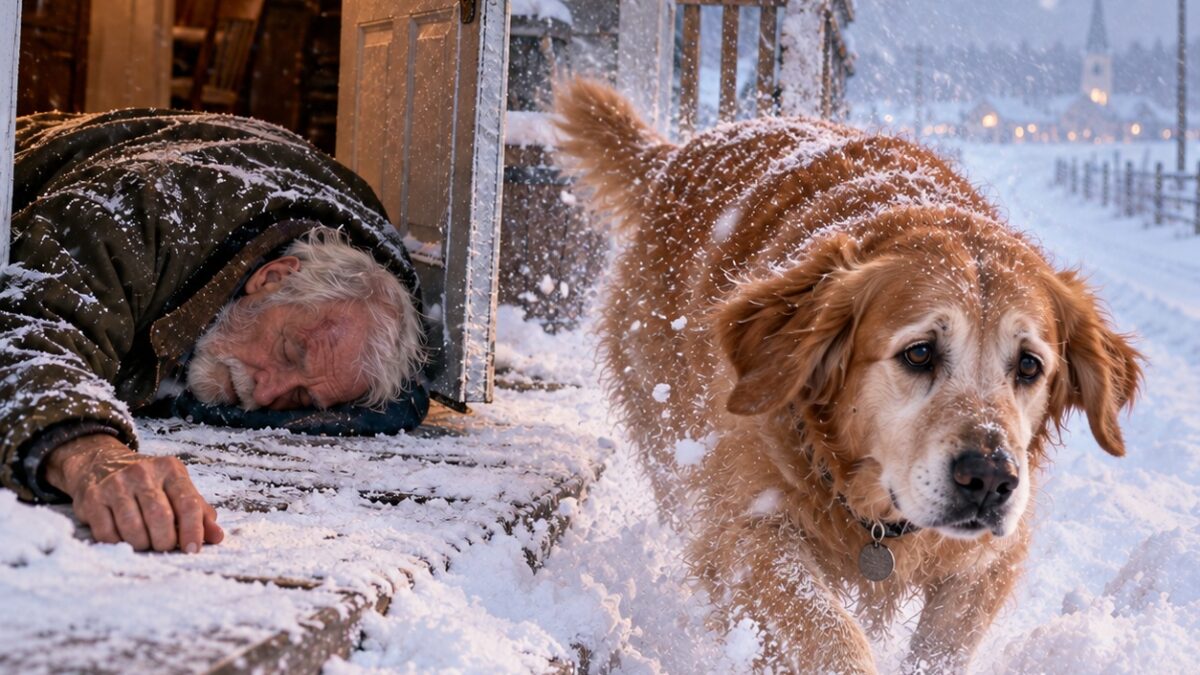
He stayed beside me.
That was obvious from the snow.
My body fell partly beneath the porch overhang, which protected me from some accumulation.
Rusty’s tracks circled me over and over.
He pawed at my coat.
Scratched near my shoulder.
Pushed his nose beneath my hand.
Barked.
Probably licked my face.
That was his first answer to every human problem.
Food.
Grief.
Sleep.
Poor judgment.
Apply nose.
When I did not move, he went to the back door.
Scratch marks appeared near the bottom panel.
He probably tried to get inside.
The door had swung shut behind me.
Not latched completely, but frozen snow packed along the threshold.
A younger dog might have forced it.
Rusty did not.
He was probably twelve or thirteen.
Nobody knew his exact age.
I found him as an adult.
His hind legs already weakened in deep snow.
His left hip carried arthritis from an old injury.
He came back to me.
More paw marks.
More circles.
Then a set of tracks led toward the driveway.
Stopped.
Returned.
He did this at least twice.
Leave.
Come back.
Leave.
Come back.
That part hurts me most to imagine.
Because Rusty had spent years refusing to let me out of sight.
He followed me into the bathroom if I did not close the door fast enough.
Waited outside the garage.
Slept in the hallway where he could watch both the bedroom and front entrance.
During thunderstorms he pressed his body against the side of my bed because he disliked thunder but apparently believed I required protection from it.
Leaving me would have gone against everything he understood.
But eventually staying became useless.
And somehow that old dog knew it.
Rusty had not always been mine.
I found him eight years earlier beside Highway 18.
Margaret had been dead less than a year.
That morning I had driven into Bellweather for furnace filters and coffee.
I almost passed him.
A dirty gold shape curled beside a drainage ditch near a culvert.
Temperature just above freezing.
Rain turning to sleet.
At first I thought it was a dead deer.
Then the head moved.
I pulled over.
He tried to stand when I approached.
Collapsed.
“Easy.”
He growled.
Weakly.
Not threatening.
Terrified.
His coat was filthy.
Ribs visible.
Left rear leg swollen.
There was an old rope tied around his neck, frayed at one end.
No collar.
No tags.
No houses nearby.
“You’re a mess.”
He stared at me.
“Don’t take it personally.”
I had an old army blanket behind the truck seat.
I laid it beside him.
He growled again when I touched his shoulder.
“Fair.”
It took twenty minutes to move him six feet.
I refused to drag him.
He refused to help.
That became the basis of our relationship.
Eventually I got him into the truck.
Dr. Harris examined him.
Dehydrated.
Underweight.
Old fracture near the hip that had healed badly.
Paw infection.
No microchip.
No owner responded to notices.
The sheriff found no useful information.
“Maybe dumped,” Harris said.
I hated the word.
Dumped.
Like garbage.
Like something that had stopped being useful.
“I’m not keeping him.”
Harris nodded.
Veterinarians hear that sentence the way priests hear promises made during emergencies.
Temporary became a week.
Then a month.
I named him Rusty because of the reddish gold around his ears.
Elaine said it was unimaginative.
I told her she had named a cat Muffin when she was eleven.
That ended that criticism.
Rusty’s hip never healed perfectly.
He always limped slightly after running.
Dr. Harris offered surgery.
I paid for it.
Elaine stared at the bill.
“You said you weren’t keeping him.”
“I’m not letting a temporary dog walk badly.”
She smiled.
“Sure.”
Margaret had always wanted a dog.
I had said dogs were too much trouble.
Too much dirt.
Too much expense.
Too much scheduling.
After she died, I spent a lot of time discovering how many arguments she had been right about.
Rusty slept at the foot of my bed the first night after surgery.
He whined every time he tried to shift.
I slept on the floor beside him.
That was when “temporary” ended, though neither of us filed paperwork about the emotional change.
He became part of every day.
Morning coffee.
Garden.
Truck rides.
Porch evenings.
When winter came, he lay beside the woodstove.
When summer came, he slept beneath the kitchen table on cool tile.
On the anniversary of Margaret’s death, I usually became quiet.
Rusty never bothered me.
He simply followed closer.
That dog understood silence better than most people.
Eight years later, on the morning of the blizzard, Rusty stood beside my unconscious body and had to make a decision I had never taught him.
My nearest neighbor, Ed Lawson, lived about three-quarters of a mile away.
But Ed and his wife were visiting family in Arizona.
The Henderson farm was more than a mile west.
Nobody there would have been outside looking toward my place in whiteout conditions.
Bellweather was almost three miles by road.
Closer to two and a half if you cut across the old Miller pasture, through the drainage corridor, and reached County 4 near the grain elevator.
Rusty knew that route.
We had driven it hundreds of times.
Whether he understood distance, I do not know.
Whether he deliberately chose town, I cannot prove.
But his tracks headed directly east.
The wind was coming from the northwest.
That meant part of the journey pushed snow across his path almost sideways.
Near the windbreak, the drifts reached his chest.
He worked through them.
Slowly.
Tracks showed places where he had climbed onto harder crust.
Then broken through.
Climbed again.
Near the frozen creek, he slipped down the bank.
Later, volunteers found disturbed snow and traces of fur caught on brush.
He got out.
Continued.
At some point he lost one of his booties.
Yes, Rusty owned winter booties.
He hated them.
I made him wear them after ice cracked his paw pads two years earlier.
That morning I had put all four on because he followed me outside.
Searchers later found one red rubber boot near the creek.
Another almost half a mile farther.
By the time he reached County Road 4, he had two left.
He was limping badly.
At 10:42, a county snowplow camera captured him standing near the shoulder.
The driver, Marcus Lee, slowed.
The footage later showed Rusty approach the truck.
That alone was strange.
Rusty liked people, but large machines bothered him.
Marcus opened his window.
“Hey, buddy!”
Rusty barked.
Turned east.
Walked several yards.
Stopped.
Looked back.
Marcus told me later he almost got out.
But visibility was deteriorating and he had a road crew behind schedule.
“I thought maybe he belonged to one of the houses,” he said.
He still blamed himself.
He should not.
None of us recognize every important moment while it is happening.
Marcus continued.
Rusty did too.
His next confirmed sighting came from the Anderson Feed & Hardware security camera at 11:18.
Bellweather had mostly shut down because of the storm.
The grocery store closed early.
Post office locked by ten.
Hardware stayed open because people suddenly remember generators, extension cords, and snow shovels approximately twelve minutes after weather becomes dangerous.
The camera showed Rusty emerging through blowing snow near Main Street.
He was moving slowly.
Head down.
Tail low.
One back leg barely touching the ground.
He reached the front door.
Stopped.
The automatic sensor detected him.
Door opened.
Rusty walked inside.
That moment is still on a flash drive in my desk.
I have watched it three times.
Never managed a fourth.
The store clerk that morning was sixteen-year-old Lily Carson.
She knew Rusty.
Everyone did, eventually.
Bellweather is small enough that a large golden retriever riding around with an eighty-two-year-old man becomes public information.
Lily looked up from behind the register.
“Rusty?”
He collapsed on the entry mat.
She ran to him.
He was soaked.
Ice stuck to his chest.
His paws were bleeding.
He was panting hard.
“Where’s Frank?”
Rusty barked.
Lily later said it sounded different.
Not greeting.
Not excitement.
Urgency.
She called her manager, Ron Beck.
Ron came from the back.
Rusty tried to stand.
Failed.
Ron crouched.
“Easy, boy.”
Rusty forced himself upright.
Walked toward the door.
Turned.
Barked.
Came back.
Lily understood before Ron.
“He wants us to go.”
Ron looked outside.
Snow blew horizontally.
“Go where?”
Lily pointed.
“Frank.”
That is how it started.
Not with some magical Lassie moment where everybody instantly decoded the dog.
With one teenage girl who knew an old man always traveled with an old golden retriever and realized that if the dog arrived alone during a blizzard, something was wrong.
Lily called 911.
The dispatcher contacted the sheriff.
Ron called me.
No answer.
Called Elaine using the number saved in the store account because I bought birdseed there.
Elaine answered.
“Mr. Miller isn’t here.”
That one sentence changed everything.
“What do you mean?”
“Rusty is.”
Silence.
“What?”
“He came into the hardware store.”
Elaine later told me her body went cold before her mind caught up.
“Where is my father?”
“We don’t know.”
“What happened to Rusty?”
“He’s exhausted.”
Elaine was already grabbing keys.
The dispatcher told her not to drive.
Roads were nearly impassable.
She argued.
Dispatcher won.
Barely.
Deputy Maria Sanchez arrived at the store eleven minutes later in a four-wheel-drive Tahoe.
She found Rusty standing again.
Lily had wrapped him in a blanket.
His body shook.
Maria knew me.
She had stopped by my property the previous summer when a teenager accidentally put his pickup into my ditch.
“Where is Frank?”
Rusty barked.
Went to the door.
Maria looked at Ron.
“He came from that direction?”
“East door. County Four side.”
She keyed her radio.
Possible medical emergency at Miller residence.
Unable to reach homeowner.
Dog arrived on foot.
Need welfare check.
Fire rescue prepared a snowmobile.
Road department opened part of County 4.
Maria drove as far as she could toward my lane.
Rusty rode in the back seat.
At first.
When Maria passed the old grain elevator, Rusty stood.
Paced.
Whined.
At the intersection nearest my property, he began barking.
She slowed.
Rusty pressed his nose against the glass.
Then came the part people later called unbelievable.
Maria opened the rear door.
Rusty jumped down.
Nearly collapsed.
She tried to catch him.
He limped toward the snow-covered field.
Not the driveway.
The field.
My property lay northwest beyond it.
Maria called the rescue snowmobile.
They followed Rusty.
Slowly.
He could not run anymore.
He moved maybe twenty yards.
Stopped.
Waited.
Moved again.
Maria and firefighter Tom Wilkes walked behind him while the snowmobile crawled beside them.
Rusty reached the first shelterbelt.
Lost the track briefly.
Circled.
Then found it again.
His own route in reverse.
That detail is important.
He was not relying on my scent alone.
He was retracing himself.
At least partly.
About half a mile from the house, Rusty stopped walking.
His back legs folded.
Tom lifted him.
Rusty struggled.
Maria said, “Let him see.”
So Tom carried him facing forward.
Rusty kept watching the field.
Turned his head left near the creek.
Tom adjusted direction.
Beyond the windbreak, they saw the farmhouse.
No smoke from the chimney.
Back door open a few inches.
Still no sign of me.
They reached the porch.
Tom put Rusty down.
The dog stumbled around the corner.
Barked.
That is where they found me.
I had been outside almost four hours.
My core temperature had fallen dangerously low.
I had a concussion.
The back of my head had bled into the snow beneath me.
My pulse was weak.
Breathing shallow.
Paramedics later said another hour might have changed the outcome.
Maybe less.
Rusty reached me.
Collapsed beside my shoulder.
When Maria tried to move him, he growled.
She left him there until the stretcher arrived.
I remember none of it.
My first memory after falling was fluorescent light.
Something beeping.
A dry throat.
A ceiling tile with a brown water stain shaped like Wisconsin.
I stared at it.
A woman’s voice said, “Dad?”
Elaine.
I turned.
Instant regret.
My head pounded.
Elaine sat beside the hospital bed.
Hair messy.
Eyes swollen from crying.
“You look terrible.”
She slapped my arm.
Not hard.
“Apparently near-death has not improved you.”
“What happened?”
“You fell.”
I looked around.
“Where?”
“Outside.”
Bits came back.
Shutter.
Ice.
Rusty.
I tried to sit.
“Rusty.”
Elaine put one hand on my chest.
“Stay down.”
“Where is he?”
“He’s alive.”
I stopped.
“Alive?”
“He’s at Dr. Harris’s.”
“What happened?”
Elaine stared at me.
“You don’t know?”
“No.”
She sat.
Then started crying again.
That frightened me more than anything.
“Elaine.”
“Rusty went to town.”
I thought I misheard.
“What?”
“He walked to Bellweather.”
“In this?”
“Yes.”
“How?”
“I don’t know.”
“How far?”
“Nearly three miles depending on his route.”
I stared.
“No.”
“They have camera footage.”
“No.”
“Lily Carson found him at Anderson’s. Rusty brought the sheriff back.”
The words did not fit together.
Not at first.
“He brought them?”
“They followed him.”
I looked toward the window.
Snow piled against the hospital sill.
My chest hurt.
Not medically.
Emotionally.
“He left me.”
Elaine nodded.
“He left because staying wasn’t helping.”
I closed my eyes.
The sentence hit somewhere deep.
For hours, I had never known.
Rusty had been moving through that storm while I lay unconscious.
Every step he took away from me had been an act of loyalty.
Dr. Harris called later.
Rusty was stable.
Severe exhaustion.
Mild hypothermia.
Damaged paw pads.
Muscle strain.
His arthritic hip badly inflamed.
No major organ damage.
“He should not have been able to make that trip, Frank.”
“That seems judgmental.”
“I’m serious.”
“So am I.”
“He’ll recover, but he may not regain the mobility he had.”
I swallowed.
“When can I see him?”
“When are they releasing you?”
“Tomorrow.”
“They’re not releasing you tomorrow.”
“Then bring him here.”
Silence.
“Frank.”
“He got me three miles through a blizzard and you’re worried about hospital rules?”
Another silence.
“I’ll make a call.”
Rusty came two days later.
The nurses arranged it.
Officially called therapeutic animal visitation.
Unofficially, the entire floor wanted to meet him.
I sat in a wheelchair near the end of the hallway.
My head bandaged.
Left shoulder bruised.
Three stitches behind one ear.
Pride destroyed.
The elevator doors opened.
Dr. Harris walked out with Rusty.
He wore bandages on all four paws.
Support sling around his back legs.
His golden coat had been cleaned.
Still thinner than before.
He looked tired.
Very old.
Then he saw me.
Everything changed.
His head came up.
Tail moved.
Once.
Twice.
He tried to hurry.
His rear leg failed.
Harris steadied him.
“Easy.”
I rolled forward.
“Rusty.”
He came directly between my knees.
Pressed his face into my lap.
I put both hands around his head.
For a long time, neither of us moved.
The hallway had gone quiet.
Nurses.
Patients.
Elaine.
Lily Carson and her mother, who had been invited.
Deputy Sanchez.
Tom from the fire department.
Everyone watched.
I did not care.
I leaned down.
“You stupid dog.”
His tail thumped.
“Three miles?”
Another thump.
“You can’t even make it around the mailbox without complaining.”
His nose pushed harder against my hand.
My vision blurred.
“You saved me.”
Rusty looked up.
Dogs do not understand sentences the way we do.
But he understood my voice.
Always had.
“Thank you.”
He licked my wrist.
That broke whatever remained.
I cried.
Not politely.
Not one dignified tear.
I cried into that old dog’s fur while half the hospital pretended not to.
Lily cried too.
Deputy Sanchez looked at the ceiling.
Firefighter Tom developed an urgent interest in the vending machine.
Elaine put one hand on my shoulder.
Rusty stood there until his legs shook.
Dr. Harris finally said, “He needs to lie down.”
I nodded.
Rusty lowered himself beside the wheelchair.
Placed his head over my shoe.
Exactly where he had slept for eight years.
News traveled faster than either of us recovered.
Local paper first.
Then television.
Then regional news.
The headline irritated me.
AGING DOG MAKES HEROIC BLIZZARD TREK TO SAVE ELDERLY OWNER.
I told Elaine I objected to elderly.
“You’re eighty-two.”
“Factually rude.”
Rusty received letters.
Dog treats.
A handmade red-and-blue blanket from an elementary school.
The mayor declared a Rusty Day.
I refused to attend unless Rusty received lunch.
They served hamburgers.
He attended.
The hardware store placed his security-camera photograph beside the register.
Rusty standing on the mat.
Snow crusted around him.
Eyes fixed toward the door.
Underneath, Lily wrote:
HE CAME BECAUSE FRANK COULDN’T.
I bought the frame.
The sheriff’s department gave Rusty a ceremonial collar tag shaped like a badge.
Dr. Harris called it unnecessary weight.
I put it on anyway for photographs, then took it off because Harris was right.
Attention faded.
That suited us.
I spent six weeks in rehabilitation.
Concussion healed.
Balance returned slowly.
A walker came home with me.
Elaine installed grab bars.
A medical-alert system.
Extra railings.
Two new cameras.
A phone holster that made me look like I was carrying military equipment.
“You’re treating me like a child.”
“No,” she said. “Children listen.”
Rusty came home the same afternoon.
Our lives became slower together.
He could no longer manage stairs easily.
Neither could I.
I moved my bedroom to the first-floor guest room.
Elaine asked if that embarrassed me.
“Why would it?”
“You fought me over the walker.”
“The stairs have not insulted my dignity yet.”
We became rehabilitation partners.
Morning walk to the mailbox.
At first, twenty yards.
Then forty.
Rusty moved beside me.
I used the walker.
Neither of us acknowledged the absurdity.
When he stopped, I stopped.
When I tired, he waited.
Some mornings, we did not reach the road.
That was fine.
The goal changed.
Before the fall, I treated every day as proof I could still do what I had always done.
Afterward, I began treating days as things I was allowed to experience rather than conquer.
That took longer to learn than walking again.
Rusty helped.
He did not resent slower walks.
Did not compare himself with the dog he had been five years earlier.
He simply lived where his body was.
I envied that.
Spring came.
Snow disappeared into black Iowa mud.
Crocuses appeared near Margaret’s flower bed.
Rusty lay on the porch while I drank coffee.
Elaine called.
“Still alive?”
“Against several people’s expectations.”
“Try tomorrow too.”
I looked at Rusty.
“Same schedule.”
Summer came.
He turned another estimated year older.
Dr. Harris said fifteen.
Maybe sixteen.
Hard to know.
We held a birthday party anyway.
Lily came.
Deputy Sanchez.
Tom.
Hendersons.
Ron from hardware.
Half the town apparently had no better social opportunities.
Someone brought a dog-safe cake.
Rusty ate enough to invalidate his cardiac diet.
Dr. Harris pretended not to see.
Lily gave me a small framed photograph.
Rusty’s tracks in the snow near the hardware entrance.
Someone had photographed them before the plow erased everything.
The path led toward the automatic doors.
I looked at it for a long time.
“You okay?” she asked.
“Yes.”
“You’re doing the face.”
“What face?”
“My mom says old men have one face for trying not to cry.”
“Your mother sounds disrespectful.”
Lily smiled.
I hung the picture above my desk.
That fall, Rusty slowed considerably.
Heart murmur.
Kidney values moving in the wrong direction.
Hip pain more frequent.
Dr. Harris adjusted medication.
I knew what was coming.
Knowing does not prepare you.
People say it does.
They are wrong.
Preparation helps with paperwork.
Nothing else.
One morning in November, Rusty did not get up when I poured coffee.
He lay near the woodstove.
Eyes open.
Watching.
I crouched beside him carefully.
My knee hated it.
“What?”
Tail moved.
He tried to rise.
Front legs worked.
Back did not.
I helped with the sling.
He stood.
Made it outside.
Urinated.
Turned toward the field.
For a second, I imagined that impossible journey.
Snow.
Wind.
Blood on his paws.
Three miles because I could not move.
I put my hand on his shoulder.
“You don’t have to prove anything anymore.”
He looked at me.
We returned inside.
Dr. Harris examined him that afternoon.
“His heart is weaker.”
“I know.”
“Kidneys too.”
“I know.”
“Pain?”
“Controlled?”
“Mostly.”
I heard the word.
Mostly.
That is where end-of-life decisions live.
Not in obvious suffering.
In mostly.
Eating mostly.
Sleeping mostly.
Comfortable mostly.
Still interested mostly.
You spend every day asking whether love means another day.
Or whether love means not asking for one.
Rusty gave me several more months.
Winter returned.
The first storm frightened Elaine.
She called three times before noon.
“I am inside.”
“Door locked?”
“Yes.”
“Phone?”
“Attached to my body like a parole monitor.”
“Rusty?”
I looked down.
Sleeping near the stove.
“Supervising.”
“Good.”
That winter, we did not walk outside during storms.
Lesson learned.
The blizzard anniversary came.
Bellweather planned another little ceremony.
I declined.
Instead, Lily visited.
She was seventeen now.
Applying to veterinary technician programs.
She sat on my kitchen floor beside Rusty.
“Do you think he remembers?”
“The storm?”
“Yes.”
“I don’t know.”
She scratched his chest.
“He still hates the hardware automatic door.”
“That existed before.”
She laughed.
Then became serious.
“Did you think he abandoned you?”
The question surprised me.
“Yes.”
“For how long?”
“Until I woke up in the hospital.”
“That must’ve hurt.”
I looked at Rusty.
“Yes.”
She waited.
“Then how did you feel when you found out?”
I thought.
“Ashamed.”
“Why?”
“Because I had spent eight years believing I understood him.”
Rusty sighed.
“And the moment he did something I didn’t understand, I assumed the worst.”
Lily stroked his ear.
“You were unconscious.”
“Before that.”
I remembered his tracks.
Leave.
Return.
Leave again.
“He must have been scared.”
“Probably.”
“And he still went.”
“Yes.”
She looked down.
“That’s what makes it brave, right?”
I nodded.
“Doing something when you aren’t scared isn’t bravery.”
“What is it?”
“Comfort.”
She smiled slightly.
“I’m stealing that.”
“Fine.”
By March, Rusty struggled even on good days.
He ate less.
Slept more.
Stopped following me from room to room.
Instead, he waited.
Knew I would return.
That hurt and comforted me at once.
One Sunday, he refused breakfast.
Chicken too.
Cheese.
Even peanut butter.
I knew.
Elaine arrived before noon.
She looked at me.
I nodded.
No discussion.
Some decisions have already been made by the body.
We laid Rusty on his red-and-blue blanket beside the woodstove.
The one the schoolchildren had sent after the rescue.
Sunlight came through the south window.
No storm.
No snow.
Nothing dramatic.
That felt right.
Dr. Harris arrived with her medical bag.
She had treated Rusty since the day I found him.
“I hate this part.”
“So do I.”
She sat beside him.
Listened to his heart.
“Are you sure?”
I almost became angry.
Not at her.
At the question.
Then I understood why she asked.
I looked at Rusty.
He lifted his head slightly.
His eyes found me.
That same look from beside Highway 18 eight years earlier.
Suspicious.
Tired.
Waiting to see what I would do.
“I’m sure.”
Elaine cried quietly.
I sat on the floor.
My body protested every joint.
I ignored it.
Rusty’s head rested across my boot.
I put my hand between his ears.
“Remember when I found you?”
His tail moved once.
“That wasn’t a question.”
Elaine laughed through tears.
I rubbed the white fur around his face.
“You were terrible.”
Tail again.
“Ungrateful.”
His eyes stayed on mine.
“Expensive.”
Elaine said, “Dad.”
“Very expensive.”
Then my voice failed.
I leaned closer.
“You never owed me anything.”
Rusty breathed slowly.
“You hear me?”
My hand trembled.
“You never owed me for that highway.”
The room blurred.
“And I never got to pay you back for the snow.”
Elaine put her hand on my shoulder.
Rusty exhaled.
I closed my eyes.
“So I guess we call it love.”
Dr. Harris gave the sedative.
His body relaxed.
I kept talking.
“You can stop working.”
I thought about those tracks.
The creek.
The road.
Hardware-store doors.
The way he had gone forward when every part of him had to be hurting.
“No more finding help.”
His breathing slowed.
“No more carrying me.”
One final tail movement.
Barely there.
“I’ve got it from here.”
The last injection was quiet.
His heart stopped beneath Dr. Harris’s fingers.
She nodded.
I leaned forward and placed my forehead against his.
For a long time, I stayed there.
Eight years earlier, I found a half-dead dog beside a highway.
I believed I was saving him.
That story was incomplete.
Rusty saved me long before the blizzard.
He saved me from a house made unbearable by grief.
From silence.
From the habit of pretending I needed nobody.
From living after Margaret without actually participating in life.
The storm only made his work visible to everybody else.
We buried him near the cottonwood windbreak.
The field he crossed began beyond it.
I chose a simple stone.
No heroic title.
No dramatic inscription.
Just:
RUSTY
GOOD DOG
FAITHFUL FRIEND
HE CAME BACK WITH HELP
Elaine thought GOOD DOG sounded too ordinary.
“That’s the highest compliment I know.”
She left it.
The town put another marker near the hardware store.
I complained.
They ignored me.
It shows Rusty’s route in a small bronze map.
About two and a half miles across farm roads and fields.
Children trace it with their fingers.
Every February, Bellweather Elementary runs a winter coat and animal-shelter supply drive called Rusty’s Run.
Lily Carson eventually became a veterinary technician at Dr. Harris’s clinic.
The first time she told me that, I accused Rusty of recruiting staff from beyond the grave.
She said that was not medically supported.
Young people ruin everything with science.
I am older now.
Eighty-five.
The farm is no longer mine.
I sold the acreage to the Henderson family but kept a life lease on the farmhouse.
Elaine approved only after reviewing the paperwork like a federal prosecutor.
The cottonwoods still stand.
The hardware store still has Rusty’s picture near the register.
I still stop there.
Automatic door opens.
Every single time, part of me expects an old golden retriever to walk through covered in snow.
People ask whether Rusty really knew what he was doing.
I have been asked that by reporters.
Children.
Dog trainers.
Veterinarians.
Strangers online.
My answer never changes.
I do not know what Rusty understood.
I know what he did.
He found me unconscious.
Stayed.
Tried to wake me.
Tried to enter the house.
Could not.
He left.
Crossed fields.
Fought through snow.
Reached town.
Ignored people who were not useful.
Found people who could help.
Then turned around and tried to lead them home.
You can call that instinct.
Training through routine.
Bonding behavior.
Chance.
I am comfortable with any explanation you choose.
None of them make the act smaller.
What matters is that an old dog with bad hips faced a storm that should have turned him back.
And he kept going.
For me.
People like the idea that Rusty saved me because I once saved him.
It makes the story balanced.
A circle.
Man saves dog.
Dog saves man.
I understand why people prefer that version.
But love is rarely so mathematical.
I never believed Rusty kept count of what I gave him.
A warm house.
Surgery.
Food.
A bed.
Eight years.
And I did not keep count of what he gave me.
Company.
Routine.
Purpose.
Laughter.
A reason to leave bed after Margaret died.
A reason to come home.
A second chance at being needed without feeling burdened by it.
A life does not become meaningful because debts eventually cancel.
It becomes meaningful because nobody is keeping score.
That is why, when I think about the blizzard, I do not picture Rusty reaching the hardware store.
I picture the tracks behind the farmhouse.
The ones investigators showed me later.
Circles around my body.
Then a line toward the road.
Then tracks returning.
Then leaving again.
That was the decision.
Not the three miles.
Not the automatic doors.
Not the rescue vehicles.
That first moment when Rusty understood that loving me required him to do the one thing he hated most.
Leave me alone.
He came back.
That is what I hold onto.
He always came back.
Until the one day I had to let him go.
And by then, after everything he had taught me, I finally understood the difference.
Leaving is not always abandonment.
Sometimes leaving is the bravest way love finds its way home.