FULL STORY:I Went to Buy Supplies for My Horses—Then I Saw the Old Hunting Dog Everyone Else Had Given Up On
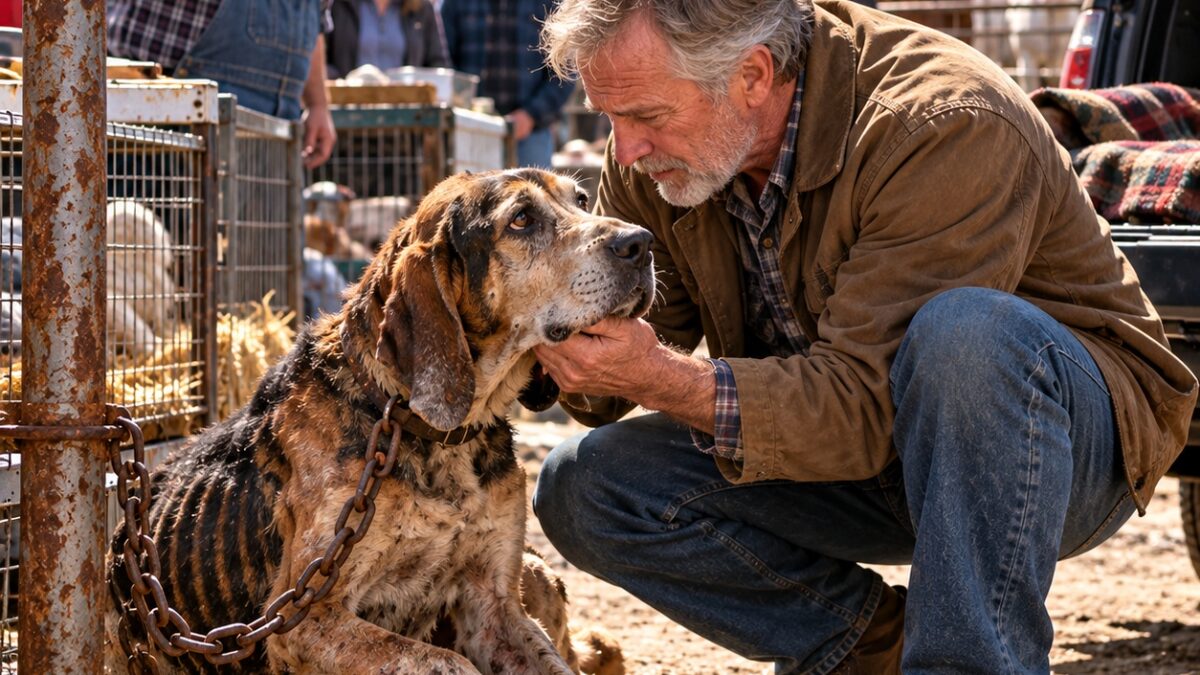
FULL STORY CONTINUATION
The drive back took forty minutes.
The dog stayed curled on the blanket.
At every stoplight, I checked him in the mirror.
His eyes remained open.
Watching.
Not relaxed.
Not frightened exactly.
Alert in the way animals become when they have learned that circumstances change without warning.
I turned the radio off.
The silence felt less empty with him there.
“You need a name.”
One ear moved.
“That is encouraging.”
I tried several.
Scout.
Hunter.
Red.
He responded to none.
Not surprising.
Maybe they were wrong.
Maybe he was simply too tired to care.
When we reached the farm, Jasper and Duke lifted their heads from the pasture.
The dog smelled them immediately.
His nose moved.
First real curiosity I had seen.
“Those two are trouble.”
The horses stared at the truck.
“They’ll tell you I’m the problem.”
I opened the rear door.
The dog tried to stand.
His legs folded.
I caught him.
“All right.”
I carried him inside.
The farmhouse felt unusually cold despite mild weather.
I had stopped lighting the fireplace often because heat for one person seemed wasteful.
That day I built a fire.
I laid an old wool rug in front of it and lowered the dog carefully onto the floor.
He trembled so badly his teeth clicked once.
“Stay.”
Ridiculous command.
He could barely move.
I brought water.
Set the bowl close.
At first he stared.
Then stretched his neck and drank.
Slowly.
A few laps.
Pause.
Look at me.
A few more.
Each time he stopped, his eyes rose as if he expected me to take the bowl away.
Something about that made my throat tighten.
“You can have all of it.”
He drank again.
I opened a can of dog food I kept in the barn for strays that occasionally wandered through.
He sniffed.
Turned his head.
I warmed broth.
No.
Cut a little cooked chicken.
No.
“Stubborn.”
He closed his eyes.
I sat on the floor beside him.
I had not sat on that floor since Margaret and I installed it fifteen years earlier.
Back then she accused me of making the boards too dark.
I told her she’d chosen the stain.
She denied it for the rest of her life.
The memory hurt.
The dog shifted.
I placed my hand on his shoulder.
He stiffened.
Then slowly relaxed.
We stayed like that until dark.
No television.
No radio.
No conversation.
Just fire.
A strange dog.
An old man.
Two creatures who had forgotten what to expect from the world.
That night I slept on the couch.
Not intentionally.
I had planned to check on him every hour.
At some point my eyes closed.
I woke before dawn.
The dog was exactly where I left him.
Alive.
Watching me.
“Morning.”
His tail didn’t move.
“Fair.”
At seven, I called Dr. Ellen Miller.
She had been our farm veterinarian for more than twenty years.
She treated horses, dogs, goats, chickens, and once a furious llama that hated men.
She arrived before nine.
The dog tried to move when she entered.
I rested a hand near him.
“It’s okay.”
Dr. Miller crouched several feet away.
“Where did you find this fellow?”
“Market.”
She looked at me.
“You went for horse supplies.”
“Yes.”
“And came home with this.”
“Yes.”
“That sounds like Margaret.”
I smiled despite myself.
“She would have bought three.”
“Probably.”
Dr. Miller moved slowly.
Let him smell her.
Touched his neck.
Listened to his heart.
Checked gums.
Eyes.
Ears.
Hips.
Abdomen.
She lifted one back leg gently.
The dog whimpered.
I felt anger rise.
“What?”
“Severe arthritis.”
She continued.
“Very underweight. Dehydrated. Internal parasites likely.”
She examined the sores.
“Skin infection.”
“How bad?”
She sat back.
“Treatable things individually.”
“And together?”
She looked toward him.
“He’s been neglected a long time.”
I knew.
“Will he live?”
“Walter.”
“I need the answer.”
“I can’t give you a number.”
“Try.”
She sighed.
“He’s old. His joints are bad. We don’t know what organs may have been affected by prolonged malnutrition.”
“So?”
“So he may have a year.”
She paused.
“Or several.”
“And he might die next week.”
“Yes.”
I looked at the dog.
His eyes were closed.
Dr. Miller lowered her voice.
“The bigger challenge may not be physical.”
“What does that mean?”
“He doesn’t trust good things.”
I frowned.
She explained.
Animals neglected for long periods often stop responding normally to opportunity.
Food appears, but experience taught them it might disappear.
A hand approaches, but hands may have hurt them before.
A door opens, but outside may mean abandonment.
“They learn not to hope,” she said.
I looked at her.
“Dogs don’t think like that.”
“Not in words.”
She touched his paw.
“But behavior can look very much like it.”
I understood more than I wanted to.
“What do I do?”
“Routine.”
“Medicine?”
“That too.”
She began writing instructions.
“Small meals. Frequent water. Parasite treatment. Antibiotic ointment. Pain management. Supplements once his stomach handles food better.”
“And the other part?”
“Be boring.”
I laughed.
“I am extremely qualified.”
“Same time every day.”
She stood.
“Same place. Same voice. No surprises.”
I looked down.
“Can he recover?”
Dr. Miller followed my gaze.
“His body can improve.”
“And the rest?”
“That depends on whether he decides this place is safe.”
After she left, I sat beside him.
“You hear that?”
His eyes opened.
“Apparently, you and I are afraid of hope.”
No response.
“We’ll work on it.”
I needed to call him something.
A name becomes important when you expect someone to stay.
Barnaby came to me for no logical reason.
Maybe I had heard it somewhere.
Maybe Margaret once mentioned it.
Old-fashioned.
Warm.
A name for something that belonged near fireplaces.
“Barnaby.”
The dog blinked.
“That’s you.”
One ear shifted.
“Good enough.”
For the first week, Barnaby ate only from my hand.
Not always.
Some meals he refused entirely.
Other times he accepted one small piece of chicken.
Then another.
Every bite felt absurdly important.
I would sit on the floor for an hour holding food.
“I’m not going anywhere.”
He’d sniff.
“Neither is the chicken.”
Eventually, he’d take it.
Chew slowly.
Wait.
Look at me.
Take another.
By the second week, he allowed me to mix soft food into a shallow bowl while I kept one hand beside it.
The first time he took three bites without looking at me, I nearly celebrated.
“That’s right.”
He froze.
I lowered my voice.
“Sorry.”
Progress could be frightened away.
So I learned quiet joy.
Dr. Miller returned twice a week at first.
The parasites responded to treatment.
His sores began healing.
Dehydration improved.
His hips remained painful.
Those would never become young joints.
“We’re managing, not reversing time,” she reminded me.
“I know.”
“You keep looking at me like I should invent a new spine.”
“You’re the doctor.”
“Veterinarian.”
“Details.”
She taught me gentle massage techniques.
Slow pressure around the hips.
Never forcing range of motion.
Short assisted walks inside.
One minute.
Then two.
Barnaby began standing without falling.
The first time he crossed the room by himself, he made it five steps before stopping.
I held my breath.
He looked at me.
“Take your time.”
One more step.
Then another.
He reached the kitchen threshold.
Sat down.
I clapped once.
He flinched.
I immediately regretted it.
“Right.”
I lowered my hands.
“Quiet joy.”
His tail moved.
I froze.
Barely an inch.
But it moved.
“Did you just—”
Nothing.
“Okay.”
I smiled.
“Didn’t see anything.”
At night, I read by the fire.
Before Barnaby, I often read the same page four times because my mind wandered toward Margaret.
Now I read aloud occasionally.
At first because silence made him restless.
Then because I liked hearing words again.
He didn’t care what I read.
Farm journals.
Westerns.
History.
Once I read him a tractor manual.
He fell asleep faster than usual.
“Critic.”
His breathing deepened.
The house began changing.
Not physically.
The rooms sounded different.
Water bowl moving.
Nails on wood.
A sigh near the fireplace.
Small things.
But loneliness feeds on silence.
Barnaby kept interrupting it.
Around the third week, he started watching the front door.
That worried me.
“Don’t get ideas.”
He stared outside.
“You can barely walk.”
Still staring.
“The world is overrated.”
He disagreed.
I knew it because the next morning he stood when I opened the door.
Sunlight crossed the floor.
Cool spring air entered.
Barnaby leaned forward.
Then stopped.
His body trembled.
Not from weakness this time.
Uncertainty.
I didn’t pull.
Didn’t call.
Just left the door open.
He stood there for several minutes.
Then returned to the rug.
The next day, same thing.
A week passed.
Then one morning, I was carrying feed toward the barn when I glanced back.
Barnaby stood in the doorway.
Front paws outside.
Back paws inside.
I stopped walking.
He looked at me.
I looked away immediately.
Pretended the feed sack required intense concentration.
A few seconds later, I heard nails touch porch boards.
Then grass.
I turned slowly.
Barnaby had stepped into the yard.
Sunlight caught his coat.
Still patchy.
Still thin.
But warmer-looking than when I found him.
He sniffed.
Wind.
Soil.
Horses.
Freedom.
He walked maybe twenty feet.
Then lowered himself into the grass.
Not collapsed.
Chose.
He rolled slightly onto one side.
Closed his eyes.
Let the sun touch him.
I stood beside the barn watching.
That moment mattered more than the first full meal.
The house had become safe enough to leave.
Because somewhere inside him, Barnaby had finally begun believing he could come back.
Jasper noticed him first.
The horse walked toward the fence.
Barnaby opened his eyes.
Immediately tense.
Jasper lowered his head.
Sniffed.
Barnaby tried to retreat.
His back leg slipped.
I stepped forward.
“Easy.”
Jasper stopped.
Duke joined him.
Two thousand pounds of curious horse facing one fragile dog.
Barnaby looked at me.
“Apparently, we’re making friends.”
Jasper blew air softly through his nose.
Barnaby flinched.
Then leaned forward.
One step.
Another.
He reached the fence.
Jasper lowered his muzzle.
They sniffed each other.
Barnaby sneezed.
I laughed.
The dog looked offended.
From then on, the barn became part of his world.
At first he waited near the door while I worked.
Then he followed me between stalls.
Duke tolerated him immediately.
Jasper occasionally tried to steal his attention.
Barnaby ignored both with the dignity of an old man at a children’s party.
Every morning, our routine expanded.
Coffee.
Medication.
Breakfast.
Barn.
Horses.
Short walk.
Rest.
Lunch.
More rest.
Evening fire.
Somewhere along the way, my routine expanded too.
Before Barnaby, I completed chores.
After Barnaby, I experienced mornings again.
That distinction embarrassed me.
I had believed I was living because I remained productive.
Feed horses.
Repair fences.
Pay taxes.
Sleep.
Repeat.
Barnaby cared about none of those accomplishments.
He cared whether I sat beside him.
Whether breakfast arrived.
Whether the door opened.
Whether I returned from the barn.
Dogs measure life more honestly than people do.
By the second month, Barnaby’s coat started growing.
Dr. Miller brushed a patch near his shoulder.
“Look.”
“What?”
“Undercoat.”
“Is that good?”
“Unless you enjoy vacuuming.”
I did not.
Still, I was delighted.
He gained weight.
Muscle returned slowly to his back legs.
Pain medication helped.
Supplements helped.
Movement helped.
But the largest change remained his eyes.
At the market, they had followed everything without expecting anything.
Now curiosity returned.
A truck passing.
Bird on the fence.
Barn cat moving suspiciously through hay.
Me opening a cabinet that might contain treats.
He began following me.
Everywhere.
Bathroom included.
“We need boundaries.”
Barnaby sat outside the door.
“Thank you.”
He lay down.
“That is still strange.”
At the barn, he found a favorite place on an old straw bale.
I’d work on tack or feed buckets and glance over.
There he was.
Head up.
Watching.
Margaret used to sit in the same area on an overturned bucket while I worked.
Not every memory hurt equally anymore.
Some began arriving with gratitude mixed into the grief.
That was new.
One afternoon I found Barnaby asleep beneath Margaret’s old barn jacket.
It hung from a peg low enough that the sleeve brushed his back.
For a second, I couldn’t breathe.
Then he opened one eye.
“You don’t know whose that was.”
Tail movement.
“She would’ve loved you.”
Another movement.
“She probably would’ve fed you bacon against veterinary advice.”
He stood.
“Don’t get excited.”
Too late.
Spring became summer.
Barnaby walked to the lower pasture.
Then the creek.
Not far.
We rested often.
I learned to read his hips.
When stiffness increased, we stopped.
When he was tired, he never admitted it until his pace slowed.
“You’re a terrible patient.”
Dr. Miller heard me say that once.
She laughed.
“Animals and men.”
“What?”
“Nothing.”
By autumn, Barnaby looked like a different dog.
Still old.
White muzzle.
Scar on one ear.
Slightly stiff gait.
But his coat shone.
His eyes were alive.
He ate enthusiastically.
He had preferences.
Chicken over beef.
Warm blankets over expensive orthopedic bed.
Left side of the fireplace.
Disliked rain.
Loved truck rides.
Hated vacuum cleaner.
Normal things.
Normal was miraculous.
Then came the afternoon he finally spoke.
We were in the far pasture checking fence posts before rain.
Clouds were building over the hills.
Leaves covered the ground.
Barnaby walked beside me.
Not behind anymore.
Beside.
I carried pliers and a small coil of wire.
One section near the back corner had sagged.
I repaired it.
We started home.
Then my boot caught a root hidden under leaves.
At sixty-seven, falling is different from falling at twenty.
You have enough time on the way down to consider several regrets.
My shoulder hit first.
Then hip.
Air left my lungs.
For a few seconds, I couldn’t breathe.
Barnaby stopped.
I saw his face above me.
Eyes wide.
“I’m okay.”
No air.
Bad lie.
Barnaby circled.
Touched my face with his nose.
I tried to sit.
Pain shot through my side.
“Easy.”
Barnaby suddenly ran several yards away.
I thought he was leaving.
Then he turned toward the farm.
Raised his head.
And barked.
The sound shocked me.
Deep.
Strong.
Nothing like the silent animal I had carried from the market.
One bark.
Then another.
Again.
The valley gave his voice back in echoes.
“Barnaby.”
He barked again.
Loud.
Urgent.
Protective.
I laughed.
Couldn’t help it.
Every bark seemed impossible.
For months, I had wondered whether his vocal cords were damaged.
Whether someone had punished barking out of him.
Whether silence had simply become survival.
Now he filled the pasture with sound.
“I hear you.”
Barnaby ran back.
Licked my face.
“Disgusting.”
More licking.
“I’m alive.”
He stayed pressed beside me while I sat up.
Nothing broken.
Bruised hip.
Scraped palm.
Pride damaged.
Barnaby watched every movement.
When I stood, he stood.
When I took one step, he took one.
“You’re dramatic.”
He looked unconvinced.
I started laughing again.
Not polite laughter.
Not amusement.
Something bigger.
It came from so deep inside me that it hurt.
Years of hospital rooms.
Empty dinners.
Unanswered conversations.
Cold mornings.
A house without Margaret.
All of it somehow released through one ridiculous image:
An ancient hunting dog barking like a siren because an old man tripped over a root.
I laughed until tears ran down my face.
Barnaby stared.
Then wagged his tail.
That was the first time I realized how long it had been since I laughed without guilt.
Grief does strange things.
For years, joy felt disloyal.
How could I laugh when Margaret was gone?
How could I enjoy something she couldn’t see?
No one told me to think that.
I just did.
Barnaby did not understand guilt.
He understood I fell.
He barked.
I stood.
We walked home.
Simple.
That night, I sat by the fire with an ice pack against my hip.
Barnaby lay across my feet.
“You know what you did?”
He slept.
“You scared half the county.”
Nothing.
“You have a voice.”
One eye opened.
“Use it responsibly.”
He closed it.
I smiled.
“You saved me.”
Technically, I hadn’t needed saving.
I would have stood eventually.
The house wasn’t miles away.
I wasn’t seriously injured.
But the sentence felt true anyway.
He had saved something.
Maybe not my body.
Something quieter.
The months continued.
Winter brought stiffness.
We adapted.
Rugs on slick floors.
Shorter walks.
Warm bedding.
Dr. Miller adjusted medication.
“You’re doing well,” she told him.
I nodded.
“We are.”
She looked at me.
“I was talking to Barnaby.”
“So was I.”
She smiled.
“You look better too.”
“I’m not your patient.”
“No.”
She packed her bag.
“But Margaret would be pleased.”
That caught me.
I looked away.
“Probably.”
Dr. Miller touched my shoulder.
“She worried about you.”
“How do you know?”
“She told me.”
“When?”
“During Jasper’s vaccination appointment.”
I laughed softly.
“Of course.”
“She said if anything happened to her, you’d turn into a hermit.”
“I did not.”
Dr. Miller looked around my farm.
“You adopted a dying dog because you went shopping alone at a livestock market.”
“That’s unrelated.”
“Completely.”
Barnaby wagged his tail.
Traitor.
The first anniversary of the market arrived quietly.
I remembered because the old hoof pick finally broke.
I stood in the barn holding it.
One year.
That was impossible.
Barnaby lay in a patch of sunlight outside.
His muzzle was whiter.
Everything else looked better.
I drove to the same livestock market.
This time Barnaby came with me.
He sat in the truck while I bought a new hoof pick.
And finally bought the grooming brush I had put back a year earlier.
When I returned to the parking lot, I looked toward the row where I found him.
Different cages.
Different animals.
Same smells.
Barnaby watched through the window.
“You remember?”
Maybe.
Maybe not.
Dogs do not owe us human versions of memory.
I opened the door.
He jumped down carefully.
We walked a short distance.
He sniffed the ground.
Then looked toward me.
No fear.
No hesitation.
Just a dog ready to follow his person back to the truck.
That was enough.
I bought him a piece of cooked chicken from a food stand.
“Anniversary dinner.”
He swallowed it in one bite.
“You could pretend to appreciate things.”
Tail wag.
“Fair.”
Back at the farm, Jasper greeted us.
Duke complained because dinner was four minutes late.
Barnaby went directly to his sunny place on the porch.
I sat beside him.
A year earlier, he had been too weak to stand.
Now his tail thumped whenever I touched his shoulder.
A year earlier, I had gone days without laughing.
Now I occasionally argued with a dog.
Improvement.
In the evening, I lit the fireplace.
Barnaby settled at my feet.
I picked up a book.
Read two pages.
Stopped.
His breathing had become deep.
Peaceful.
The house was quiet.
But not empty.
That difference still amazes me.
People asked whether I rescued Barnaby.
The story traveled because Dr. Miller told someone at the veterinary clinic, who told someone at church, who told half the county.
“Walter rescued an old hunting dog.”
People like stories with clear roles.
Rescuer.
Rescued.
Hero.
Victim.
Life wasn’t that clean.
I paid for a chain to be removed.
Drove him home.
Fed him.
Medicated him.
Sat beside him.
Yes.
I did those things.
But Barnaby gave me responsibilities I had forgotten how to want.
He needed breakfast.
Walks.
Medicine.
Warmth.
Presence.
He forced me to be needed again.
That was the part nobody understood.
After Margaret died, my children called.
Neighbors visited.
People cared.
But adults are polite about grief.
They ask whether you need anything.
You say no.
They accept the answer.
A dog does not.
Barnaby didn’t ask whether I felt like getting out of bed.
He needed the door opened.
He didn’t ask whether grief made cooking difficult.
He needed food prepared.
He didn’t care whether I wanted company.
He followed me anyway.
Need can be a gift.
He gave me mornings again.
Then afternoons.
Then laughter.
Eventually a future.
I began repairing things around the farmhouse I had ignored.
Painted the porch.
Fixed a loose shutter Margaret had complained about for years.
Cleaned the guest room.
Invited my daughter and grandchildren for Thanksgiving.
My daughter walked in and stopped.
“What happened?”
“What?”
“The house.”
“What about it?”
“It looks alive.”
I pretended to be offended.
“It was always alive.”
She looked at Barnaby.
He stood beside me.
Then she hugged me.
Too long.
“Dad.”
“What?”
“Nothing.”
Her children loved Barnaby.
He tolerated them with saintly patience.
The youngest tried to put a paper crown on his head.
Barnaby looked at me for rescue.
“Your turn.”
I abandoned him.
He survived.
That night after everyone left, the house felt quiet again.
For a moment, old loneliness approached.
Then Barnaby sighed beside the fire.
I looked down.
“Just us.”
Tail.
“That enough?”
Another thump.
“Yeah.”
It was.
Another year passed.
Barnaby slowed.
Age cannot be negotiated.
Dr. Miller reminded me regularly.
His hips became stiffer in winter.
Walks shortened.
He slept more.
But joy remained.
That was what mattered.
Old age and suffering are not the same thing.
I had confused them before.
At the market, Barnaby was old and suffering.
At my farm, he became old and loved.
Massive difference.
He still came to the barn every morning.
Some days I waited for him halfway.
“Hurry up.”
He gave me the offended look of a pensioner being rushed.
“Fine.”
I’d slow down.
At the straw bale, he’d settle.
Watch.
Duke died the following spring.
Twenty-eight years old.
Peaceful.
I found him lying beneath the oak near the pasture fence.
Barnaby stood beside me while I cried.
Loss returned.
Different.
Not easier.
But I wasn’t alone.
Barnaby pressed against my leg.
That night he slept beside my chair instead of his usual rug.
Animals understand absence in their own way.
Jasper wandered the pasture calling for Duke for several days.
Barnaby spent more time near him.
Two old animals standing quietly together.
I understood.
We brought a younger rescue mare onto the farm several months later.
I told myself she was for Jasper.
My daughter laughed.
“Sure.”
“What?”
“Nothing.”
The mare’s name was Rosie.
Barnaby hated her for approximately eleven minutes.
Then accepted her.
Life kept expanding.
That is what surprised me most.
After Margaret died, I believed my life would only narrow.
Fewer people.
Fewer experiences.
Fewer reasons.
Wait long enough.
Eventually finished.
Barnaby proved narrowing was not inevitable.
Even at sixty-seven.
Even after grief.
Even with an old dog whose best years supposedly belonged to somebody else.
New things could still begin late.
That became the lesson I carried most deeply.
One summer evening, I sat on the porch while Barnaby slept nearby.
Sunset colored the fields orange.
Jasper grazed.
Rosie followed him.
Swallows crossed the sky.
For years, sunsets had been dangerous.
Margaret loved them.
After she died, beauty felt like evidence of her absence.
That evening, beauty simply felt beautiful.
I whispered:
“You would’ve liked this.”
I meant Margaret.
Barnaby opened one eye.
“You too.”
He went back to sleep.
I thought about the seller at the market.
“A few months at best.”
Maybe Barnaby heard him.
Maybe animals do not understand numbers but understand tone.
People had looked at an old body and decided the story was almost over.
That happens to humans too.
Retired.
Widowed.
Old.
Past your useful years.
Waiting.
What a mistake.
Sometimes the final chapters contain everything the earlier ones were preparing you to understand.
Barnaby did not need to become young again.
He only needed enough time to discover safety.
I did not need Margaret returned.
Impossible.
I needed to learn loving what remained did not betray what I had lost.
That was harder.
Barnaby taught it without saying anything.
Except that one afternoon in the pasture.
Sometimes I asked him to bark again.
He rarely did.
“Come on.”
Stare.
“You clearly know how.”
Nothing.
“You almost shook the valley.”
Silence.
I eventually realized he had spoken because he had something important to say.
Walter is down.
Help.
After that, ordinary conversation apparently didn’t meet his standards.
Fair.
His voice remained rare.
But I no longer worried about silence.
Silence beside Barnaby was companionship.
Silence alone had been absence.
Another difference.
Dr. Miller visited one winter afternoon.
Barnaby was sleeping near the fireplace.
She examined him.
Heart.
Lungs.
Joints.
Eyes.
Then sat beside me at the kitchen table.
“He’s doing remarkably well.”
I studied her face.
“You’re preparing me.”
“Walter.”
“I know that tone.”
She exhaled.
“He’s very old.”
“I know.”
“We manage comfort.”
“I know.”
“There may come a day—”
“Not today.”
She nodded.
“Not today.”
That was enough.
After she left, I sat beside him.
His eyes opened.
“Don’t listen to doctors.”
Tail.
“They’re pessimists.”
Another thump.
“You’re staying forever.”
He put his head on my shoe.
I knew better.
But love is allowed one irrational sentence now and then.
I had learned that with Margaret.
The difference was I no longer let future loss prevent present joy.
That may have been Barnaby’s greatest gift.
When Margaret became sick, I lived months terrified of losing her.
Sometimes fear stole hours we still had.
I regretted that.
With Barnaby, I refused.
Each morning arrived.
We used it.
Barn.
Sun.
Food.
Nap.
Walk.
Fire.
Enough.
My neighbors occasionally stopped by.
Barnaby became popular.
A boy from the farm down the road brought treats.
An elderly woman knitted him a blanket.
He preferred my old wool rug.
She was insulted.
I placed the knitted blanket over the rug.
Diplomacy.
One Sunday, the pastor from town visited.
Not for spiritual reasons.
His wife wanted to see “the famous dog.”
Barnaby slept through the entire visit.
“Celebrity has changed him,” I said.
The pastor laughed.
Then looked around.
“You seem better, Walter.”
People kept telling me that.
Eventually, I stopped denying it.
“I am.”
It felt strange to say.
But true.
Good things do not cancel grief.
Barnaby didn’t replace Margaret.
Nobody could.
He changed the shape around the missing place.
That is what companionship does.
The hole remains.
Life grows around it.
Years later, I still use the same phrase when people ask about him.
Fear of hope.
Dr. Miller had said Barnaby’s greatest challenge was not arthritis or parasites.
It was the terror of trusting something good.
I think humans understand that better than we admit.
After loss, hope becomes dangerous.
If you love again, you can lose again.
If you trust, someone can leave.
If you expect joy, disappointment waits nearby.
The safest solution seems simple.
Expect nothing.
That was Barnaby at the market.
That was me before the market.
Then we took the same risk.
He accepted food from my hand.
I accepted needing him.
One bite.
One morning.
One step outside.
One walk to the barn.
Trust returned in increments.
Maybe all healing does.
Not miraculous transformation.
Repetition.
Today, Barnaby spends most afternoons asleep in the sun.
His white muzzle has spread almost to his eyes.
He rises slowly.
Sometimes I help him.
He hates that.
“Pride.”
He stares.
“Same.”
His hearing isn’t what it was.
But somehow he still hears the refrigerator open from three rooms away.
Medical mystery.
His tail moves when my boots cross the porch.
He still follows me to the barn when weather is good.
On cold mornings, I tell him to stay inside.
Sometimes he listens.
Mostly he doesn’t.
I turned seventy not long ago.
My daughter threw a party.
Too many people.
Barnaby received more attention than I did.
Appropriate.
Someone asked me what gift I wanted.
I said nothing.
They didn’t believe me.
But I meant it.
I had horses.
Family.
A farmhouse that sounded alive again.
An old dog sleeping near the fireplace.
At seventy, you begin understanding how few things are necessary.
One morning, I drove to the livestock market for horse supplies.
That was all.
A brush.
A hoof pick.
Maybe feed supplements if prices were good.
I came home with almost none of it.
Instead I brought home a dog everyone else had already written off.
A year later, I realized I had been written off too.
Mostly by myself.
Barnaby didn’t save me in one dramatic act.
Even the pasture fall wasn’t really it.
He saved me in small ways.
By needing water.
By refusing food until I sat close enough.
By taking five steps toward the kitchen.
By lying in sunlight.
By following me into the barn.
By trusting my hand.
By sleeping beside my chair.
By barking when I fell.
By making me laugh.
By still being there the next morning.
Life is often saved that way.
Quietly.
Repeatedly.
Without witnesses.
Tonight, as I write this, Barnaby is asleep across my feet.
Fire burning low.
Wind against the windows.
Jasper and Rosie settled in the barn.
The farmhouse is quiet.
But quiet no longer frightens me.
Barnaby’s breathing fills the room.
Slow.
Steady.
Old.
I look at Margaret’s photograph on the mantel.
For years I couldn’t look at it without feeling only absence.
Now I can smile.
“I think you’d approve.”
Barnaby shifts.
His paw lands against my boot.
“I know.”
I lean down and rest a hand against his side.
Warm.
Alive.
For however long we have.
That is enough.
People like to say I gave Barnaby a second chance.
Maybe.
I gave him food.
Medicine.
A roof.
A name.
A place beside the fire.
But he gave me something harder to find.
Permission to care again.
Permission to laugh.
Permission to need another living thing without apologizing for the risk.
Permission to believe that after losing the person I thought I would grow old beside, my life was not finished simply because the future looked different from the one we had planned.
I thought I rescued an old hunting dog from a rusted chain.
The truth is simpler.
We both had chains.
His was metal.
Mine was grief.
And somehow, one ordinary morning at a livestock market, two old creatures who had stopped expecting much from life found each other.
He learned a hand could offer food without taking it away.
I learned an empty house could become a home again.
He learned doors could open and still let him return.
I learned loving again did not mean leaving Margaret behind.
Barnaby never became young.
Neither did I.
That wasn’t the miracle.
The miracle was discovering we didn’t need to.
We only needed enough time to feel alive again.
And every evening, when he lays his white head across my boots and lets out one of those deep, peaceful sighs, I remember the dog chained behind the market cages who barely lifted his eyes when I approached.
Then I look at him now.
Safe.
Fed.
Loved.
Home.
And I understand something I wish I had known years earlier.
Sometimes the life you thought was over is only waiting for you to notice a pair of tired eyes asking whether you still have enough courage left to hope.