FULL STORY: My Wife Went Under the Ice to Save Our Dog—Three Months Later, They Found Them Still Together
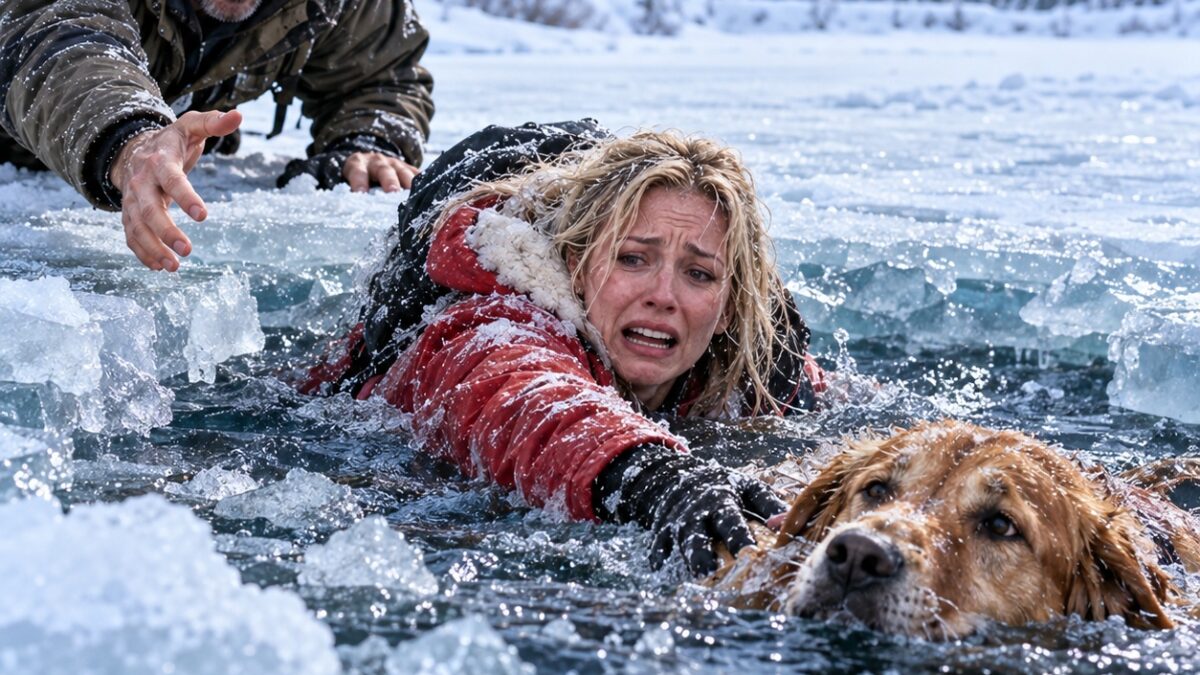
FULL STORY CONTINUATION
The search began with urgency because everyone understood what the cold meant.
Time mattered.
Every minute mattered.
Search teams faced conditions that were difficult even for people trained for exactly that kind of environment.
Temperatures were far below freezing.
Ice covered large portions of the river.
Water moved under surfaces that could look solid from above.
Divers could not simply enter wherever they wanted.
Every opening created risk.
Every section had to be approached carefully.
They used divers.
Search dogs.
Drones.
Helicopters.
Sonar.
Remotely operated equipment.
People searched from above the river and beneath it.
They examined accessible sections of water and ice.
They looked downstream.
They returned to places already searched because when someone you love is missing, the word “already” stops meaning very much.
You search again.
Then again.
Then somebody else looks because maybe their eyes will see what yours did not.
For me, time became disconnected from ordinary life.
There was December 23 before the river.
Then there was everything after.
Christmas decorations still existed.
Lights still glowed on houses.
Stores still played holiday music.
Families still drove with wrapped gifts in their cars.
But the calendar had become irrelevant.
My wife was missing.
That fact swallowed every other fact.
Amanda was forty-five.
A mother of four boys.
A nurse.
My wife.
My partner for eighteen years.
There are labels we use because they help explain people quickly, but they never come close to describing a life.
“Nurse” does not tell you how someone sounds laughing in the kitchen.
“Mother” does not explain the private language between a woman and her sons.
“Wife” does not contain eighteen years of arguments, jokes, apologies, routines, shared bills, half-finished conversations, road trips, illnesses, ordinary mornings, and all the small moments that eventually become a marriage.
And “missing” is a word too small for what happens to a family when nobody can tell you where someone is.
For four days, the active search continued.
Each update pulled me between hope and fear.
A new area being checked meant possibility.
Another area cleared meant possibility shrinking.
People around us wanted to help.
That is one of the strange things about tragedy.
Your private pain suddenly becomes public.
Officials need information.
Friends call.
Relatives arrive.
People ask what you need.
You don’t know.
What I needed was Amanda.
There was no practical substitute.
On December 28, active search operations were suspended.
That did not mean people stopped caring.
It did not mean Amanda was forgotten.
It meant the search teams had reached the limits of what could be safely and productively examined under those conditions.
There were no new accessible areas left to search.
I understood the words.
Understanding them emotionally was something else.
When an active search ends without finding the person you love, there is no clean transition.
Nobody hands you a different kind of grief and tells you what to do with it.
You exist between categories.
She was not with us.
But we did not have her.
We did not have an ending.
That became our family’s reality.
Waiting.
I had four sons who had lost access to their mother in the most brutal possible way.
They needed answers I didn’t have.
I needed answers too.
Amanda had spent her nursing career caring for people in medical crisis and families facing impossible circumstances.
Now we were one of those families.
I thought about that often.
How many times had she stood beside someone else when the phone call came?
How many times had she walked into an emergency department room knowing a family’s world had already changed before they realized it?
How many times had she cared for children receiving palliative care and still managed to bring gentleness into places defined by fear?
That was her gift.
She went toward people.
If someone hurt, Amanda moved closer.
Maybe that is why what happened with Groot was both impossible to understand and painfully easy to understand.
She saw someone she loved in danger.
She moved toward him.
No calculation.
No hierarchy that said human life mattered and animal life did not.
Love rarely behaves like a spreadsheet.
People later asked variations of the same question.
Why would she go in?
I understand why people ask.
From the outside, it seems like a question about risk.
From inside our family, it was a question about Amanda.
Groot was ours.
He belonged inside the circle.
Amanda loved our dogs fiercely.
She did not see them as disposable.
She did not believe loyalty only moved from animals toward humans.
To her, it moved both directions.
None of that makes the river less dangerous.
None of it changes the terrible cost.
If I could relive that moment, I would still try to stop her.
Of course I would.
I would give anything to change what happened.
Loving the reason someone acted does not mean you stop wishing they had made another choice.
That contradiction became part of my grief.
Pride and anger.
Love and helplessness.
Understanding and disbelief.
Sometimes all of them at once.
The weeks passed.
People gathered around us.
Friends.
Former colleagues.
Patients.
Family.
People Amanda had cared for years earlier remembered her.
That mattered.
When someone dies or disappears, stories become a kind of evidence.
Evidence that the person existed outside your own memory.
Someone tells you what she did for them.
Someone remembers a sentence you never heard.
Someone says she sat beside their child.
Someone remembers a shift at the hospital.
Someone remembers her kindness.
Each story returns a small piece of the person to you.
For our sons, those stories gave them versions of their mother they may never have seen.
Children know their parents intimately and incompletely.
At home, Amanda was Mom.
She had habits.
Opinions.
Bad days.
Favorite things.
At work, she was the nurse somebody remembered years later.
At the emergency department, she was the calm voice.
In pediatric palliative care, she was the person willing to remain present when there was nothing easy left to say.
Those people knew parts of her that belonged to them.
And in the weeks after December 23, many of those parts came back to our family.
Still, nothing replaced knowing where she was.
Winter continued.
The river changed gradually.
Conditions shifted.
Snow fell.
Temperatures moved.
The landscape that had taken Amanda did not look like an enemy.
That was almost insulting.
Nature does not carry guilt.
The Eagle River did not know my wife’s name.
The ice did not understand what it had done to four boys.
The current did not know we were waiting.
It simply continued being a river.
That indifference is one of the hardest things to accept after a sudden loss.
Your entire universe stops.
The physical world does not.
Morning still arrives.
People go to work.
Snow melts eventually.
Coffee cools in cups.
Dogs need feeding.
Bills remain due.
Your body gets hungry even when grief convinces you it shouldn’t.
I discovered that grief is not a constant scream.
Sometimes it is incredibly ordinary.
You are standing in a grocery store.
You see something she used to buy.
Your hand reaches automatically.
Then stops.
You hear a sound in the house that resembles her movement.
For half a second, your mind constructs the impossible.
She’s home.
Then reality corrects you.
Those corrections hurt.
There were also moments when I caught myself feeling normal.
That came with guilt.
You laugh at something one of the boys says.
Then remember.
How can I laugh?
You sleep four consecutive hours.
Then wake ashamed because part of you had temporarily escaped.
Eventually people who have lived through grief tell you something important.
Those moments are not betrayal.
Your nervous system cannot stay at maximum pain every second.
It gives you breaks because otherwise you could not survive.
Amanda would have understood that.
She had spent too much time caring for grieving families not to.
A memorial gathering was organized in March.
By then, nearly three months had passed.
There is something surreal about speaking about a person publicly while still carrying the uncertainty of not having recovered them.
Our sons spoke about their mother.
I watched them stand before people and try to compress a lifetime into words.
There is no speech long enough for that.
How do you explain the woman who knew which child needed to be left alone and which one needed to be hugged?
How do you describe the person who could work around emergencies and pediatric suffering, then come home and still care deeply about small things?
How do you explain eighteen years of marriage without turning it into a list?
You can’t.
You tell stories instead.
Amanda was generous.
That word came up again and again.
Not generous only in the sense of giving things.
Generous with attention.
Time.
Concern.
The willingness to inconvenience herself for someone else.
That was the trait beneath so many other parts of her.
It was what made her good at nursing.
Good with our sons.
Good with animals.
It was also the part of her that took her into the river.
I stood among people who loved her and felt two things at once.
Grateful that she had mattered to so many people.
Furious that she was not there to see it.
I imagine every memorial contains some version of that anger.
The person being honored should be in the room.
That is what the entire gathering proves.
Then came March 24.
A passerby near the North Fork Trailhead found a body.
Word moved through authorities.
Then to us.
After three months of waiting, the uncertainty ended.
It was Amanda.
People sometimes use the phrase “closure.”
I have never liked it.
There is no door that closes cleanly after news like that.
Finding Amanda did not end grief.
It changed it.
For months we had lived with absence and uncertainty.
Now absence had certainty attached.
That is not easier exactly.
But it is different.
Then we learned something else.
According to Amanda’s sister, Jennifer Richmond, Amanda had been found with Groot in her arms.
Even now, writing those words makes everything inside me tighten.
I cannot tell you exactly what happened under that ice.
Nobody can.
We were not there for the final moments.
I will not invent them.
I will not turn my wife’s death into a scene that exists only because it makes a better story.
But I can tell you what that image meant to us.
Amanda and Groot together.
After all those weeks.
After the river.
After the search.
After all our wondering.
Together.
Some people heard that and saw tragedy.
Of course it was tragedy.
There is no version of this where losing Amanda becomes something beautiful enough to erase the horror.
Four sons lost their mother.
I lost my wife.
Our family changed permanently.
But the fact that she was found with Groot gave us one thing the river had withheld for three months.
Meaning.
Not explanation.
Meaning.
Those are different.
Explanation asks how.
Meaning asks what something tells us about the person we lost.
Amanda had gone into that water because Groot mattered to her.
Being found together did not suddenly justify what happened.
It did not make me wish less fiercely that she had stayed out of the river.
But it told us that the bond she acted on had been real all the way to the end.
Her sister Jennifer said that for the boys, Amanda died a hero.
I understand why they feel that way.
Children need language large enough to hold unbearable things.
Hero is one such word.
And Amanda had spent much of her life helping people.
There was something consistent about the way she died and the way she lived.
She moved toward suffering.
She tried to protect.
She cared past the point of convenience.
Still, when people call her heroic, part of me remains simply her husband.
And husbands are selfish in grief.
I would rather have Amanda imperfect and alive.
I would rather have her annoyed at me for stopping her.
I would rather spend another eighteen anniversaries arguing about where to walk the dogs.
Heroism is a beautiful word.
I wanted my wife.
Both truths can exist together.
That became important for our sons too.
They did not have to turn their mother into a saint to love her.
She was already enough.
Amanda could be brave and stubborn.
Generous and human.
A nurse who knew risk and a woman who still entered dangerous water because someone she loved was beneath it.
Grief becomes dangerous when we flatten the dead into symbols.
Amanda was not a symbol to me.
She was the woman who shared eighteen years of my life.
She was the mother of our boys.
She was somebody whose absence had specific shapes.
An empty place at the table.
A number in my phone I could no longer call.
A side of the bed.
A voice missing from family conversations.
Certain dates.
Certain songs.
Christmas.
December 23 would never again be only our anniversary.
That was another cruelty.
A date that had marked the beginning of our marriage story now marked the day everything broke.
For a while, I hated that.
Then slowly, I began understanding that the date still belonged to both things.
We had eighteen years.
Eighteen.
That mattered.
The river could change the ending.
It could not erase what came before.
That became one of the lessons I held onto.
Loss is powerful, but it is not retroactive.
Death cannot go backward and cancel a marriage.
It cannot erase birthdays.
Ordinary dinners.
Children being born.
Arguments resolved.
Inside jokes.
Dogs adopted.
Christmas mornings.
A thousand boring Tuesdays.
Those things happened.
Amanda lived them.
We lived them together.
No ending can make that untrue.
The same was true of Groot.
To people reading a headline, he was “the dog.”
To Amanda, he had a name.
He had routines.
He belonged to our family.
That distinction explains more than any dramatic language ever could.
I sometimes worried that public attention on the way Amanda died would overshadow how she lived.
People are naturally drawn to extraordinary endings.
A woman entering frozen water.
A massive search.
Three months of uncertainty.
Amanda and Groot found together.
It is unforgettable.
But Amanda’s life was built mostly from ordinary acts.
Showing up for nursing shifts.
Listening.
Helping.
Raising four boys.
Being married.
Taking care of dogs.
Moving through the world with a heart that treated other lives as important.
If there is anything I want people to remember, it is that heroism is not always created in the final dramatic moment.
Sometimes the final moment only reveals a pattern that was already there.
Amanda had been moving toward people in pain for years.
The river was simply the last place that instinct carried her.
After she was found, the practical realities returned.
There are things families must do after loss that feel almost offensive in their ordinariness.
Documents.
Calls.
Arrangements.
People asking questions.
Forms.
Decisions.
Your mind wants to stay somewhere emotional and impossible.
The world asks for signatures.
Our boys grieved differently.
That should not have surprised me.
No two people lose the same person.
A son does not lose the woman his brother loses, even when she is their shared mother.
Each relationship contains private history.
Each person carries different moments.
One might remember being comforted after a bad day.
Another remembers an argument.
Another remembers something she cooked.
Another hears a phrase she used all the time.
Grief follows those different paths.
As their father, I learned not to demand that sorrow look the same.
There were days someone wanted to talk.
Days someone did not.
Days we talked about Amanda constantly.
Days nobody said her name for hours because saying it felt too heavy.
Sometimes we laughed about her.
Those moments became precious.
A funny memory is proof the dead still occupy more than tragic space.
Amanda’s life contained laughter.
So our memory of her had to contain it too.
People continued reaching out.
Former colleagues.
Friends.
Families touched by her nursing career.
Those messages became a kind of archive.
If grief makes the world feel smaller, memory can push back.
Amanda had existed in all these people’s lives.
A nurse remembers a shift.
A family remembers compassion.
A friend remembers a conversation.
A patient remembers kindness.
The more stories came in, the more clearly I understood something.
No person belongs entirely to one person.
I had been Amanda’s husband.
That gave me access to parts of her no colleague knew.
But coworkers had seen courage I hadn’t witnessed.
Patients had received kindness I was not there to see.
Our sons knew versions of her I could never fully know.
The whole person lived in the overlap.
That thought helped when public interest in the story grew.
I did not want the world owning Amanda.
But I understood why people cared.
The story touched something elemental.
What would you do for someone you love?
Where does family end?
What is an animal to us?
What does loyalty require?
Those questions do not have simple answers.
Amanda answered them one way in a single irreversible moment.
I would never tell someone else to make the same choice.
I would never romanticize entering unstable ice or freezing water.
The danger is real.
The consequences in our family prove how real.
If a dog or person falls through ice, emergency services and trained rescuers exist for a reason.
That truth has to sit beside the emotional truth.
Amanda acted from love.
Love does not make freezing rivers safe.
Remembering her honestly means holding both facts.
Over time, I started returning mentally to the beginning of that day.
Not the river.
Earlier.
Amanda walking beside me.
Dogs moving around us.
Our eighteenth anniversary.
The day before it became history.
That mattered because trauma tries to take over memory.
For a while, December 23 existed only as the moment she disappeared.
I had to consciously recover the hours before.
We had walked together.
We had been married eighteen years.
We had reached that anniversary.
We were still a family.
Groot was still with us.
Everything had not yet happened.
Those moments belong to me too.
When someone dies suddenly, the final minutes become loud.
You have to protect the quieter memories from them.
I worked at that.
I remembered Amanda at home.
Amanda tired after work.
Amanda with our sons.
Amanda with dogs.
Amanda annoyed.
Amanda laughing.
Amanda simply existing in a room.
Those are the memories I want aging to leave me longest.
Not ice.
Not sirens.
Not search crews.
Her.
There were nights I replayed the river anyway.
Of course there were.
Could I have stopped her?
Could I have done more?
Should I have gone back beneath the ice?
Grief asks questions the body could not safely answer in the moment.
I had gone into that water.
I knew the danger.
I had tried to find Groot.
I had survived.
Amanda entered after.
I tried to stop her.
Knowing that intellectually does not silence the part of a husband that wants to rewrite physics.
What if I had been stronger?
Faster?
Closer?
What if Groot had not gone through?
What if we had chosen another trail?
What if we had stayed home?
What if.
Two words capable of becoming a prison.
Eventually, I had to accept something Amanda had probably helped families accept many times during her nursing career.
You cannot negotiate backward with reality.
You can only decide what to carry forward.
So I carried her.
Not physically.
In decisions.
In the way I spoke about her to our sons.
In the way we remembered Groot.
In refusing to make her death the only important thing about her.
In allowing grief without letting it consume every remaining part of family life.
That is harder than it sounds.
There is no moment when you wake up healed.
Grief is not an illness with a discharge date.
It changes shape.
At first, it is everywhere.
Later, it becomes attached to places and dates.
A trailhead.
A holiday.
A river.
A dog’s name.
An anniversary.
A certain quality of winter light.
Then sometimes it surprises you somewhere completely unrelated.
Months after Amanda was found, I heard someone laugh in a store.
For half a second, it sounded like her.
I turned before thinking.
Nobody there looked like Amanda.
The pain was immediate.
Then something else happened.
I smiled.
Not because it was funny.
Because for one second my body had remembered her before my grief did.
I began to appreciate those moments.
The mind keeps people in unexpected places.
Our sons continued building their lives.
That was important.
Amanda would never have wanted loyalty to her to become an excuse for them to stop living.
Parents spend years pushing children toward independence.
It would have been a strange betrayal to let grief reverse that.
So milestones continued.
Work.
Relationships.
Family events.
Birthdays.
Somebody always missing.
That never stopped being true.
But missing someone does not mean joy must leave too.
Joy and grief learned to occupy the same room.
That may be one of the strangest lessons of loss.
You can be genuinely happy and still miss someone with your whole body.
One emotion does not invalidate the other.
I think Amanda knew that professionally long before I had to learn it personally.
Her work in pediatric palliative care had placed her around families experiencing pain no one should have to experience.
She knew that people can laugh beside hospital beds.
She knew exhausted parents can find something funny in impossible circumstances.
She knew love does not stop because an ending is coming.
Maybe that is another reason our dogs mattered so much to her.
Animals live almost entirely inside relationship.
They do not care about the story other people will tell.
They care whether you are there.
Whether you come home.
Whether you feed them.
Touch them.
Walk beside them.
They make love immediate.
Groot had been immediate to Amanda.
Family.
Not metaphorically.
Practically.
Emotionally.
Daily.
That was why the image of them together resonated so deeply with us.
It did not tell us everything about her last moments.
It told us enough about the bond.
Amanda did not abandon him.
I wish she had survived.
I wish Groot had survived.
I wish neither had entered that water.
But wishes are not history.
History says December 23 began as our eighteenth wedding anniversary.
One of our dogs broke through the ice.
I entered the river trying to find him.
I made it back.
Amanda entered after Groot.
She disappeared.
Search teams worked for days under extreme conditions.
The active search was suspended on December 28.
Our family waited.
In March, people gathered to honor Amanda.
On March 24, a passerby near the North Fork Trailhead found her.
According to her sister, Amanda was found with Groot in her arms.
Those are the facts.
Everything else is what a family does with them.
For our sons, one meaning was courage.
For Jennifer, Amanda’s sister, it was an expression of the love she carried.
For people who heard the story, it became a testament to the bond between human beings and animals.
For me, it remained more complicated.
It was love.
It was tragedy.
It was Amanda.
There is a temptation in stories like ours to end with a lesson.
A clean sentence.
Something comforting enough to make suffering feel purposeful.
Real grief resists that.
I do not believe Amanda needed to die for us to understand love.
I would prefer every lesson without the loss.
I would trade every beautiful thing anyone has said about her final act for one more ordinary morning.
That is the truth.
But because I cannot make that trade, I have to live in the world that remains.
And in this world, I can say this:
Love mattered to Amanda.
Not abstractly.
Not when convenient.
She built her life around it.
She cared for patients.
She raised four boys.
She shared eighteen years of marriage with me.
She loved her dogs as family.
When Groot was in danger, that instinct—to move toward someone she loved—was stronger than fear.
It cost her everything.
I will spend the rest of my life wishing it had not.
I will also spend the rest of my life understanding why it was her.
Those truths no longer fight each other as much as they once did.
Some nights I imagine the anniversary walk as it should have ended.
We return home.
Dogs tired.
Boots wet.
Amanda complains about the cold.
We make dinner.
Maybe we argue about something stupid.
Maybe she falls asleep before me.
Christmas arrives.
Then another year.
Another anniversary.
That life exists nowhere but imagination now.
The real one ended beside the North Fork Eagle River.
But our marriage did not become meaningless because it ended there.
Groot’s place in our family did not become foolish because trying to save him ended in tragedy.
Amanda’s life did not shrink to the manner of her death.
I refuse to let that happen.
She was forty-five years old.
She was a nurse.
A mother.
A wife.
A sister.
A friend.
A woman who cared deeply enough that other people remembered being cared for by her.
That is the larger story.
Sometimes I think about the search teams too.
The divers who entered water that had already taken two lives.
The pilots.
Drone operators.
Handlers.
Sonar crews.
Officers.
Volunteers.
People who spent their Christmas week in the cold because our family needed an answer.
They did not know Amanda the way we did.
But they entered our grief anyway.
There is generosity in that too.
They could not bring her back.
That does not mean their work failed.
For four days, they refused to let our family search alone.
Months later, when Amanda was finally found, the long uncertainty ended.
That mattered.
Being able to know mattered.
Being able to honor her mattered.
And knowing she had been found with Groot gave our sons an image they could hold that was not simply of disappearance.
Their mother had gone toward someone she loved.
She had remained with him.
The river separated her from us.
It did not make her alone.
I cannot tell you what comes after death.
I will not pretend certainty I do not have.
But I understand why that thought comforts our family.
Amanda and Groot were found together.
After three months beneath an Alaskan winter.
Together.
That is where people often stop telling the story.
I don’t.
Because the people who survive tragedy still have mornings.
Still have birthdays.
Still have dogs to remember.
Still have holidays.
Still have each other.
The story continues, quieter.
Our sons carry their mother in different ways.
I carry eighteen years.
Friends carry their own memories.
Former patients carry moments of kindness.
Her nursing colleagues carry long shifts and hard cases and things families never saw.
Amanda exists now in all those people.
That is what remains.
Not enough.
Never enough.
But real.
If you ask me what I remember most clearly now, it is not the search helicopters.
It is not the sonar equipment.
Not the ice.
It is Amanda’s ordinary goodness.
The kind nobody films.
The kind that rarely becomes news.
Showing up.
Caring.
Taking responsibility.
Loving without making people earn it first.
That was how she treated human beings.
That was how she treated animals.
That was why Groot was family.
And that is why, when people tell me they cannot understand why she went into that river, I usually do not argue.
They are asking a reasonable question.
I have asked it myself.
But I knew Amanda.
I knew the woman behind the decision.
Understanding her does not erase my grief.
It makes it more personal.
There are things I wish she had done differently.
There are things I wish I had done differently.
That is marriage too.
You do not lose perfection.
You lose a person.
And people are infinitely harder to replace.
Amanda’s sister once said that for our boys, their mother died a hero.
I think about that often.
Maybe heroism is not always about knowing you will succeed.
Maybe sometimes it is about refusing to abandon someone you love, even when fear tells you to stop.
But I also hope our sons understand another kind of courage.
The courage Amanda showed every day before the river.
Walking into emergency rooms.
Sitting with sick children.
Coming home after difficult shifts.
Raising four boys.
Building a marriage.
Continuing to care when caring exhausted her.
Those quieter forms of bravery deserve to be remembered too.
One dramatic act may explain how someone died.
Daily acts explain who they were.
Amanda Richmond Rogers was more than the woman who went beneath the ice.
She was the woman whose life made that final act recognizable to everyone who knew her.
Of course she tried.
Of course she cared.
Of course Groot mattered.
That was Amanda.
December 23 will always hurt.
It will also always be our anniversary.
For eighteen years, that date represented a promise we had made to one another.
The river did not get to take that meaning completely.
So when that day comes now, I remember both.
The life we built.
And the day it changed.
I allow myself both.
That is how I survive it.
I used to think grief was about learning how to let go.
I don’t anymore.
I think it is about learning what to hold differently.
I cannot hold Amanda’s hand.
I can hold her memory.
Our boys cannot call their mother.
They can carry what she taught them.
We cannot bring Groot home.
We can remember that Amanda loved him enough to see him as one of us.
And when I think of them now, I try not to picture only freezing water.
I picture Amanda walking beside me.
Our dogs nearby.
Alaska around us.
Eighteen years behind us.
A woman who had no idea her ordinary morning was about to become the last chapter of her life.
That is painful.
But it is also precious.
Because before tragedy, there was life.
A lot of it.
And when Amanda and Groot were finally found together three months later, the discovery did not create their bond.
It simply revealed, one final time, how deep that bond had always been.
Amanda went into that river trying to bring a member of her family home.
We could not bring her home the way we prayed we would.
But we found her.
We found Groot.
And they had not left each other.
For our sons, for Jennifer, and for me, that will always break our hearts.
It will also always tell us exactly who Amanda was.