FULL STORY: My Parents Sold Our Home to Send Me to England—Then My Roommate Framed Me as the Campus Thief
FULL STORY CONTINUATION
The first weeks in England had felt like entering somebody else’s life.
Everything was unfamiliar.
The cold.
The buildings.
The accents.
Even the silence seemed different.
I landed wearing a cardigan my mother had insisted was warm enough.
It wasn’t.
By the time I found Halden University, my fingers hurt and my ears felt as though somebody had replaced them with ice.
An older Nigerian man saw me standing with my suitcase and asked, “Young lady, are you searching for Lagos inside England?”
I almost cried with relief just hearing a Nigerian voice.
He showed me where new students registered.
That was where I met Tamuno Briggs.
Civil Engineering.
Port Harcourt.
Tall.
Glasses.
Quiet until he had something useful to say.
He walked me to Marlow Hall and explained where the engineering building was.
“Monday, nine o’clock. Dr. Anosike does not forgive lateness.”
“I have never been late.”
He smiled.
“England will test that statement.”
Before leaving, he invited me to a study group with him and a student named Zainab.
“Tuesdays and Thursdays. Library level two.”
“I’ll come.”
“If you are serious.”
“I am very serious.”
He didn’t yet know how serious.
Room 214 had two sides.
My side contained one suitcase, a few clothes, my mother’s wrapper, books, my calculator, and the money my father had given me.
The other side looked like a showroom.
Designer luggage.
Perfume.
Clothes.
A soft cream throw across the bed.
Shoes that probably cost more than my family’s monthly food budget.
Then Tiwa Bankole walked in.
She saw my container of dried crayfish and gasped.
“Is that crayfish?”
I panicked.
“I’m sorry. My mother packed—”
“Sorry? I have not tasted proper soup in months.”
That was how we began.
Tiwa was Nigerian too.
Management student.
Daughter of a senator.
She laughed easily, spoke confidently, and knew exactly how to make a frightened person feel instantly chosen.
She called me real.
I told her my parents had sold our home for my education.
Instead of looking embarrassed by my poverty, she said, “That is the most beautiful thing I’ve ever heard.”
I trusted her faster than I should have.
My father’s warning returned occasionally.
Not every smile is a friend.
But Tiwa didn’t feel like a stranger smiling at me.
She felt like family arriving early.
We called each other sisters.
At first, everything went well.
My lectures became the center of my life.
Dr. Anosike taught structural analysis.
On the first day, he said something I wrote down and later wished I had understood outside the classroom.
“Structures rarely fail suddenly. They fail slowly in places nobody is looking.”
I became one of his best students.
First major assessment: eighty-nine percent.
Highest in the class.
Tamuno scored eighty-one.
Zainab got seventy-four and announced she was at peace because jealousy required too much energy.
Our study group became the stable part of my week.
Tamuno questioned everything.
Zainab documented everything.
I worked extra shifts at the student café so I wouldn’t touch the money Papa had given me.
My budget was almost obsessive.
Four pounds spent unnecessarily felt like betrayal.
Tiwa laughed.
“You know breathing is still free?”
“I cannot afford to discover they start charging.”
She gave me a navy winter coat.
A proper one.
I refused.
She pushed it against me.
“I bought it and never wore it.”
“This costs more than my food for two months.”
“So?”
“So I cannot take it.”
“Do not insult me.”
I put it on.
It was the warmest thing I’d worn since arriving in England.
Tiwa smiled.
“Now you look like you belong.”
Nobody outside my family had ever given me something so valuable.
That coat did something dangerous.
It made every later favor feel like repayment.
Tiwa began borrowing small amounts.
First forty-two pounds.
Then lunch money.
Then shoes.
Tickets.
Little things.
Her allowance was delayed.
Her father was controlling.
Her family pressure was unbearable.
Each explanation sounded reasonable when heard alone.
I kept a notebook of every expense because I kept records of everything.
Eventually, Tiwa found it.
“You are keeping a record of what I owe?”
“It is only accounting.”
“You gave me money and wrote it down like I’m a debtor?”
“I write everything down.”
“I gave you a coat. Did I invoice you?”
I felt ashamed.
That was how she worked.
She took an ordinary boundary and turned it into evidence that I didn’t love her enough.
I apologized.
Then she borrowed twenty pounds for lunch.
“It is just money,” she said.
That sentence became one of the most expensive sentences of my life.
Meanwhile, something else was happening inside Tiwa’s life.
Her father discovered she had failed several courses.
Not low marks.
Academic probation.
For almost a year, she had told her parents she was earning distinctions.
Her father stopped her allowance.
Blocked her cards.
Paid only the fees and accommodation already committed through the end of the session.
She would have to work for food.
I did not know any of that.
Instead, Tiwa began telling me how difficult her father’s office had become.
How payments were delayed.
How complicated powerful families could be.
Then she made contact with someone selling stolen property online.
His name was Kunle Ejayi.
And at some point, according to what investigators later uncovered, they agreed on a simple arrangement.
She would provide the items.
He would sell them.
If something went wrong, somebody else would take the fall.
That somebody became me.
The change in our friendship happened so gradually that I didn’t recognize it as isolation.
Tiwa began encouraging me to miss study group.
“Just one night.”
“Tamuno and Zainab are waiting.”
“You’ve worked six weeks without stopping.”
“I have a test.”
“You will burn out.”
That sounded caring.
So I went with her to Nigerian Society karaoke night.
I laughed.
I sang a village church song terribly.
I spent money I didn’t want to spend.
We returned after one in the morning instead of eleven.
Nothing terrible happened.
That was important.
Because manipulation often begins by proving the first bad decision didn’t destroy you.
Then the next one feels easier.
A few weeks later, I finished a four-thousand-word report just before deadline.
I had worked most of the night.
The only copy was on my laptop.
Tiwa offered to make coffee.
She stepped backward.
The cup spilled.
My laptop died.
I stared at the black screen.
“My report.”
She started crying immediately.
“I am so sorry.”
The deadline was nine.
I reached Dr. Anosike at 9:15.
He listened.
“No backup?”
“No, sir.”
“An engineer with no redundancy.”
The shame hurt.
But he gave me forty-eight hours with a ten-mark penalty.
My record had earned enough trust for one extension.
Then he said something else.
“You look different lately.”
“I’m fine.”
“Tired.”
“Only an accident.”
He watched me.
“Structures fail slowly, Miss Okoro. Look carefully at your own.”
I didn’t.
I went back to Tiwa.
She called him heartless.
I defended him.
Then she hugged me.
“Do not worry. I am here.”
My wallet started disappearing.
Money kept leaving.
I took additional café shifts.
I missed study group.
Zainab asked what was happening.
I told her things had come up.
Then Tiwa began destroying those friendships directly.
One evening, she sat on her bed and said, “I heard something yesterday.”
“What?”
“I didn’t want to tell you.”
“Tell me.”
She hesitated perfectly.
“Tamuno said your engineering ideas are basic.”
I laughed nervously.
“Tamuno?”
“He said you probably got admitted on some village quota.”
My chest tightened.
“Zainab was there?”
“She laughed.”
“That doesn’t sound like them.”
Tiwa’s face changed.
“Why would I lie?”
I apologized instantly.
Then Tiwa went to them.
She told Tamuno and Zainab that I felt stupid around them.
That I said they made me insecure.
That I needed space.
When I finally confronted them, all three of us arrived already wounded by conversations that had never happened.
Tamuno stared at me.
“I never said you entered on a village quota.”
Zainab crossed her arms.
“And I never said you copy our notes.”
“Tiwa told me.”
Tamuno’s face changed.
“Tiwa told us you said we make you feel stupid.”
“I never said that.”
Zainab looked from me to him.
“Somebody is carrying words.”
Tamuno asked, “Who do you believe?”
I should have stopped.
I should have considered the months we had spent solving equations together.
The nights they had helped me.
The fact that neither had ever treated my village background as shameful.
Instead, I thought about the navy coat.
The money Tiwa claimed she had spent on me.
The late-night conversations.
The word sister.
“Tiwa is the only person here who has never made me feel like an outsider.”
Tamuno looked hurt.
“Kind people do not need you to be alone.”
I hated him for saying it.
Because part of me knew it was true.
I walked away.
After that, Tiwa had almost complete access to my attention.
And my trust.
My grades collapsed.
One morning, after another night out, I woke at 9:20 for a test scheduled at nine.
I ran.
Twenty-five minutes late.
No extra time.
Forty-one percent.
I stared at the number.
Months earlier: eighty-nine.
Now: forty-one.
Dr. Anosike told me one more result like that could trigger scholarship review.
I walked back to the residence terrified.
Tiwa blamed him.
“He is targeting you.”
“I was late.”
“So now everything is your fault?”
I called home.
Mama had been fasting for the test.
“How did you do?”
My mouth opened.
The truth came to the edge.
Then fear pushed it back.
“I passed.”
Papa came onto the call.
“What mark?”
I remembered the promise at the airport.
Never lie.
“Eighty-two.”
Silence.
Then Papa laughed.
“Well done.”
I almost dropped the phone.
The lie hurt more because he believed it immediately.
Afterward, I sat on my bed shaking.
Tiwa put her arm around me.
“You protected them.”
“I lied.”
“You protected them from worry. That is love.”
I wanted desperately to believe her.
So I did.
Around the same time, thefts increased in Marlow Hall.
Cash.
Headphones.
Laptops.
A watch.
A pearl necklace that had belonged to a student’s late grandmother.
Eleven items eventually.
Dean Halima Yusuf called a residence meeting.
“No forced doors,” she told us. “The person involved either has key-card access or is being allowed inside.”
Tiwa stood and spoke angrily.
“Whoever is stealing from students should be expelled and sent home in disgrace.”
People applauded.
The dean watched her closely.
I remember that now.
At the time, I only thought my roommate was brave.
After the meeting, Tiwa said her key card was damaged.
“Can I borrow yours tomorrow?”
“The dean literally told us not to lend them.”
She laughed.
“To strangers. I live here.”
I hesitated.
Her face hardened.
“So you think I’m the thief?”
“No.”
“Then prove it.”
I gave her my card.
She promised to return it before my lab.
Later, that same card opened Room 221 at 3:15 p.m.
The room where a watch disappeared.
Tiwa’s own key card worked perfectly that week.
I didn’t know.
Then came the scarf.
She said her mother’s birthday was the next day.
She had one hundred and eighty pounds in cash but needed to order a silk scarf online.
Her bank card wasn’t working.
“Use yours. I’ll give you the cash.”
I hesitated.
“Where did you get cash?”
“My aunt sent it.”
She looked offended.
“Why are you questioning me?”
I apologized.
The scarf was gold and burgundy.
I used my bank card.
The receipt carried my name.
Tiwa handed me cash.
Two days later, an identical scarf appeared on the online seller account investigators eventually linked to stolen goods.
My bank record became evidence against me.
Then Tiwa asked me to leave our door unlocked while I attended an evening laboratory.
“My card is still damaged.”
“There is a thief in this building.”
“I live here.”
Again, she made trust the test.
Again, I failed the real test by proving myself to her.
I left the door unlocked.
While I was in the laboratory, Tiwa and Kunle placed stolen items in a box behind my clothes.
The pearl necklace.
The silver laptop.
The watch.
Other property.
They wore gloves.
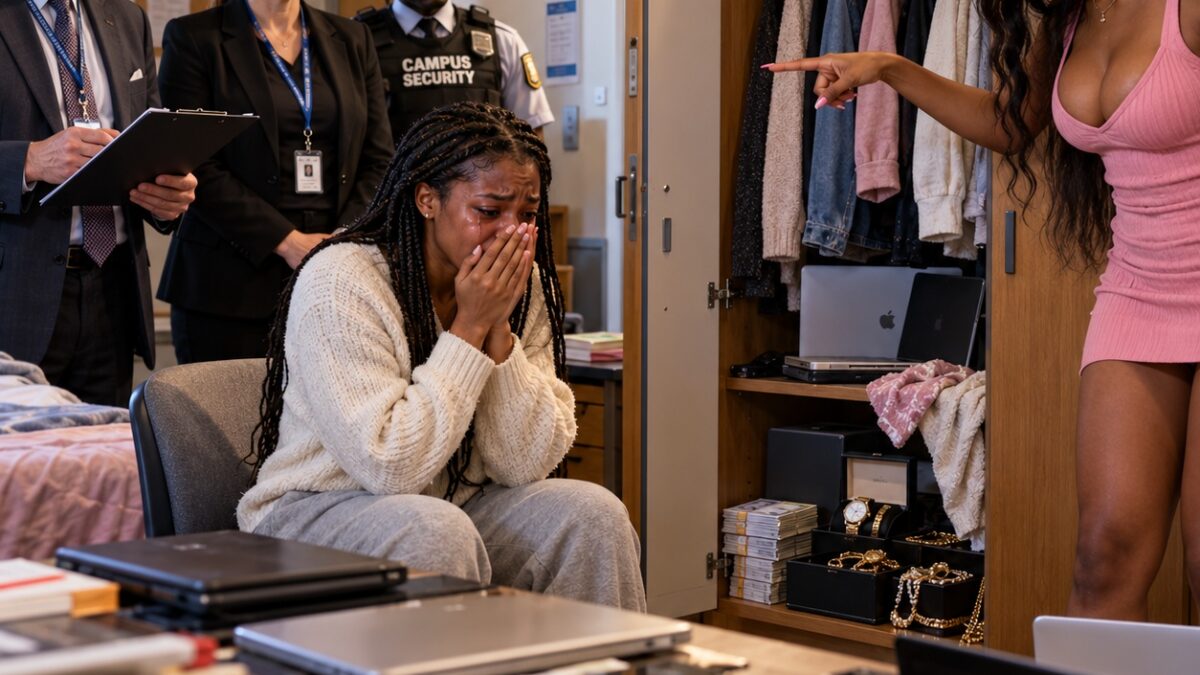
Then Tiwa used a public library computer to send an anonymous report claiming she had seen stolen property in my wardrobe and that I was selling items online.
That night, I called Mama.
I told her the laboratory had gone well.
For the first time in months, I thought maybe I was finding my way back.
Then somebody knocked.
University administrators.
Security.
Authorization to search Room 214.
I didn’t panic immediately.
That was how innocent I still felt.
“Search everything,” I said.
They started with my side.
Clothes.
Books.
Mama’s wrapper.
Then an envelope of cash.
“What is this?”
“My money.”
“From where?”
“Home. And some money Tiwa repaid.”
Tiwa stood nearby.
“For what?” an official asked.
“A scarf.”
They wrote it down.
Then somebody reached behind the wardrobe.
“I found something.”
A box came out.
I frowned.
“What is that?”
The lid opened.
Pearls.
A silver laptop.
A watch.
My stomach dropped.
Every item matched reported thefts.
I couldn’t breathe.
“Somebody put that there.”
The administrator looked at me.
“It is inside your wardrobe.”
Then came the key-card record.
My card had opened Room 221 when the watch disappeared.
Then the scarf purchase.
My card.
My name.
I turned toward Tiwa.
Everything suddenly aligned.
“You borrowed my card.”
Her face changed into disbelief.
“You begged me to buy that scarf.”
“Nkem?”
“You asked me to leave the door open.”
She stepped backward.
“I begged you to keep our door locked.”
I stared at her.
At the girl who had slept three meters from me for eight months.
The girl who had called my mother “Mama.”
The girl who had called herself my sister.
“Tiwa.”
She shook her head slowly.
“How could you?”
The administrators looked between us.
She continued.
“I defended you when people were talking.”
I couldn’t speak.
She was performing grief.
And she was better at it than I was at defending my own life.
They took me to an interview room.
A duty solicitor named Ifeoma arrived.
“I didn’t do it,” I said before she sat down.
“Then tell me slowly.”
“My roommate borrowed my card. She asked me to use my bank card for the scarf. She asked me to leave our door unlocked.”
“Messages?”
“No.”
“Witnesses?”
“No.”
“Anything in writing?”
“No.”
She held my gaze.
“Then tonight, it is your word against a box.”
During the interview, they laid the evidence out cleanly.
Key-card access.
My bank purchase.
Cash in my room.
My declining account balance.
Stolen items in my wardrobe.
I explained the loans to Tiwa.
The officer asked for proof.
“My notebook.”
“What notebook?”
“In my desk drawer.”
I had recorded every amount.
Every date.
Not because I suspected Tiwa.
Because my father had told me there was no second envelope.
I needed to know where every pound went.
The investigator was unimpressed.
“A notebook proves little.”
“It proves a pattern.”
My solicitor made them log it.
I was released under investigation after midnight.
No final decision.
My passport and identifying documents had to remain available.
The next morning, the university placed me on interim suspension.
My student card was deactivated.
I could not enter university buildings.
Not even Marlow Hall.
The disciplinary panel would sit in fourteen days.
If they expelled me, my student visa would collapse.
I would have to return to Nigeria.
I stared at the dean.
“Where do I sleep?”
The welfare office could provide temporary contacts.
Dr. Anosike was there.
He told the dean I had once been his strongest student.
“Something happened to her.”
Dean Yusuf nodded.
She couldn’t clear me without evidence.
But she said something I didn’t understand until later.
“Your roommate spoke very loudly at my residence meeting.”
“What does that mean?”
“Nothing I can act on.”
Then the older Nigerian porter who had helped me on my first day carried my bag outside.
“I folded your mother’s wrapper on top.”
“Thank you.”
He looked at me.
“I have opened doors for thieves for twenty years.”
I waited.
“You don’t walk like one.”
That was one of the few kind things I heard that day.
I had nowhere to go.
Except the people I’d rejected.
I stood outside Zainab’s residence and called.
When she opened the door, I couldn’t lift my eyes.
“I know I don’t deserve to ask.”
She crossed her arms.
“You laughed at me.”
“I know.”
“You believed her.”
“I know.”
“You accused Tamuno.”
“I know.”
“Did you steal anything?”
“No.”
She stepped aside.
“The sofa.”
I stared.
“One week.”
Tears filled my eyes.
“And I’m still angry, so don’t expect conversation.”
I walked inside.
She pointed at a plate.
“Eat.”
I almost cried harder over the rice than the suspension.
Then came the call I had been dreading.
My parents.
For months, I had hidden the missing money.
The low grade.
The damaged friendships.
Now I had to tell them I’d been arrested.
Mama answered.
“My daughter, why are you calling at this hour?”
“Are you sitting?”
“Jesus. Are you sick?”
“No.”
“Accident?”
“No.”
Papa came closer.
“What happened?”
I closed my eyes.
“I was arrested.”
Mama made a sound I had never heard before.
“For what?”
“Stolen things were found in my wardrobe.”
Silence.
“The university suspended me.”
Nobody spoke.
“If the disciplinary panel doesn’t believe me, I may be expelled and sent home.”
Papa asked only one question.
“Nkem.”
“Yes, Papa?”
“Answer me the way you would answer God.”
My whole body shook.
“Did you steal those things?”
“No.”
“Are you certain?”
“Before God, Papa. No.”
His response came instantly.
“We believe you.”
That broke me.
“Don’t.”
“What?”
“Don’t believe me that quickly.”
Mama whispered my name.
“I have lied to you.”
Then everything came out.
The money.
The loans.
The forty-one percent.
The fake eighty-two.
Missing study group.
Everything.
I cried until the sentences became difficult to understand.
When I finished, Papa was quiet.
Finally, he said, “Yes.”
I held my breath.
“You lied to us.”
“Yes.”
“That is a real fault.”
“I know.”
“It has damaged you.”
“Yes.”
“But theft is another question.”
I pressed my hand against my mouth.
“A child who falls into a pit and shouts wants to climb out.”
His voice became gentler.
“You have shouted.”
“How do I climb?”
“Truth.”
“All of it?”
“Especially the part that shames you.”
Mama asked whether I had eaten.
That was my mother.
Her daughter might be deported and she still wanted to know about dinner.
“Zainab gave me rice.”
“God bless that girl.”
They began fasting that night.
I lay on Zainab’s sofa with my mother’s wrapper over me.
And for the first time since I arrived in England, I stopped trying to protect anybody from the truth.
Back home, news spread quickly.
Chief Mosu had a nephew in London.
Soon the village knew I was under investigation.
He visited my father.
“I hear your daughter brings you shame.”
Papa told him the road he’d arrived on remained open for his departure.
Chief Mosu reminded him that four years and three months remained on their repayment agreement.
“Perhaps I should begin drawing my guest lodge.”
Papa didn’t react.
Then Chief Mosu said if England sent me home, perhaps I could clean it.
Chibuzo later told me he wanted to break a walking stick over the man’s head.
Papa stopped him.
“A man who argues with a goat becomes the second goat.”
Chibuzo wanted to leave school and work at a block factory to pay for my defense.
Mama refused.
“I sold one house for one child’s schooling. I will not sell the second child’s future.”
The village gathered support again.
Small amounts.
Food.
Savings.
Whatever they had.
The same people who had helped send me abroad were now preparing to help me remain there long enough to clear my name.
Not everyone believed me.
But enough did.
That was when Tamuno called.
He had heard what happened.
Zainab told me he had been documenting things.
“What things?”
“You.”
“Why?”
“Because he is irritating.”
She almost smiled.
“He never stopped wondering what happened.”
When I saw Tamuno, I apologized immediately.
“No excuse.”
He nodded.
“Accepted.”
I blinked.
“That quickly?”
“I’ve had four months to prepare.”
Zainab raised a hand.
“I have not accepted.”
We all laughed for the first time in days.
Then Tamuno placed a notebook on the table.
“Now tell us everything.”
I did.
From the first week.
The coat.
Loans.
Karaoke.
Laptop.
False rumors.
Key card.
Scarf.
Unlocked door.
I admitted everything embarrassing.
“I lied to my parents.”
Zainab wrote that down.
“I stopped studying properly.”
Another note.
“I chose Tiwa over both of you.”
Tamuno said, “Good.”
I frowned.
“Good?”
“A witness who admits her actual mistakes is easier to believe when she denies the crime.”
Then he opened his notebook.
February 14.
Car park.
Silver laptop.
A man with yellow hair.
“I saw Tiwa passing a laptop to somebody.”
My stomach tightened.
“At the time, I didn’t know it was stolen.”
“Why did you write it down?”
He shrugged.
“I write things.”
Zainab laughed.
“Of course you do.”
Then she opened her own diary.
She had dates too.
The day Tiwa told me they insulted me.
The following day when Tiwa told them I had insulted them.
Contradictory stories.
Different audiences.
Same purpose.
Isolation.
We started building a timeline.
Seven of the eleven thefts happened while I was working recorded café shifts.
My employer still had rotas.
The till system recorded my employee number.
That gave us verified locations.
Then Zainab searched the online marketplaces.
Thousands of listings.
We narrowed dates.
Items.
Location.
And found a seller account created months before the thefts had been blamed on me.
Headphones.
Tablet.
Then the scarf.
Gold and burgundy.
My breath stopped.
“That’s it.”
The photograph showed the scarf lying on a cream throw.
Tiwa’s cream throw.
The corner of her mirror appeared in the photograph.
Then we found a listing for a silver laptop.
Uploaded.
Later removed.
Tamuno pointed at it.
“The laptop they found in your wardrobe?”
“Yes.”
He stared at the screen.
“Maybe it didn’t sell.”
Zainab finished the thought.
“So she planted it.”
We kept going.
The key-card issue became critical.
Tiwa told me hers was broken.
But university access logs should show whether it was being used elsewhere while she carried mine.
If both cards were active at nearly the same time, her explanation collapsed.
Then Tamuno mentioned another detail.
The anonymous tip.
He’d seen Tiwa at Library Computer 7 late on the night before my arrest.
She was using a public terminal.
Laptop still inside her bag.
He wrote down the time because he had stopped to print something nearby.
9:42 p.m.
The anonymous report had been sent around that same period.
We couldn’t access the security cameras.
But police could.
“We don’t accuse her,” Tamuno said.
“Why not?” Zainab asked.
“Because feelings are not evidence.”
He pushed the file toward me.
“We ask questions they cannot ignore.”
Forty-one pages.
Work records.
Marketplace screenshots.
Diary entries.
Key-card inconsistencies.
Timeline.
Loan notebook.
Everything.
Then Zainab said, “We take it to the dean.”
Dean Yusuf gave Tamuno five minutes.
He needed less.
“Seven thefts occurred while Nkem was clocked into the café.”
He gave her the employment records.
“This seller account posted the same design scarf purchased with Nkem’s card.”
Screenshot.
“The photograph was taken on Tiwa’s side of Room 214.”
Another page.
“I saw Miss Bankole using Library Computer 7 at 9:42 on May 11.”
Dean Yusuf’s face changed.
Tamuno leaned forward.
“The anonymous report was sent near that time, wasn’t it?”
She stared at him.
“How do you know when the tip arrived?”
“I don’t.”
He smiled slightly.
“I guessed.”
Then he added, “Your face confirmed it.”
Zainab kicked him under the table.
Dean Yusuf told them both to sit down.
Then she called the detective.
I was given a temporary visitor pass.
Detective Sergeant Ojo arrived with news of his own.
The forensic results had come back.
My fingerprints were not on the box.
Not on the stolen items inside.
“Not one?”
“Not one.”
He leaned back.
“Somebody used gloves.”
I could barely breathe.
Then he said something that changed the direction of the case.
“A thief wearing gloves to hide stolen property in her own wardrobe bothered me.”
My notebook had also been found exactly where I said it would be.
The detective took our file.
Employment records.
Marketplace evidence.
Key-card questions.
Library time.
He requested security footage and network information.
“Everybody accused of theft has a roommate who did it,” he said.
My solicitor answered, “For once, perhaps one actually does.”
Things moved quickly after that.
University security footage showed Tiwa using the library computer.
Network records connected the seller account repeatedly to her phone and rose-gold laptop.
Access records showed her own key card working while she had claimed it was broken.
On the day my card opened Room 221, Tiwa’s card opened the stairwell on the same floor.
Both cards.
Same area.
Same time.
Then police found Kunle Ejayi.
At first, he denied knowing her.
Then they showed him evidence involving his gray hatchback.
Tamuno’s notebook included the February date and description.
Kunle began talking.
He had handled the online sales.
Tiwa supplied the property.
And he had kept messages.
One message broke something inside me when I heard it later.
“She trusts too much.”
Another:
“She never looks in the back of the wardrobe.”
Another:
“One of us goes home in disgrace. It will not be me.”
I sat silently while the investigator read them.
The theft hurt less than that sentence.
Because I finally understood how deliberately my trust had been studied.
Tiwa didn’t merely notice that I trusted her.
She built the plan around it.
The coat.
Sister.
Money.
Key card.
Unlocked door.
She had converted every act of trust into evidence.
When administrators approached her, she remained confident at first.
She mentioned her father.
Connections.
People who could make calls.
Then they presented the access records.
The seller account.
The library footage.
Kunle’s statement.
Her messages.
Eventually, she stopped denying everything.
The same night, her parents received the call.
Her father was a senator, exactly as she had told me.
Her mother begged him to use his connections.
Call the high commissioner.
Call a minister.
Make it disappear.
According to what I later learned, he refused.
He admitted something painful.
For years, whenever Tiwa faced consequences, he had removed them.
School problems.
Examinations.
A crashed car.
He had called people.
Paid people.
Protected her.
“We told ourselves it was love,” he said.
“But it was easier than raising her.”
That sentence stayed with me.
Because my parents were poor enough that consequences had never been optional.
If I spent money, it was gone.
If I failed, nobody could call a dean.
If I lost the scholarship, Chief Mosu got our house.
Our poverty had been harsh.
But it had taught me the reality Tiwa’s wealth had hidden from her.
Eventually everybody meets a consequence no parent can bribe.
The only question is whether you meet it early enough to learn.
Dean Yusuf called me into her office.
Detective Sergeant Ojo sat beside her.
My hands shook so badly that I clasped them together.
“Miss Okoro.”
“Yes, ma’am?”
The detective pushed my passport toward me.
“Every suspicion against you has been withdrawn.”
I stared at him.
“What?”
“The evidence establishes that the property was planted.”
I didn’t move.
“Miss Bankole has confessed to material parts of the scheme. Mr. Ejayi has also provided a statement.”
Dean Yusuf spoke next.
“The disciplinary panel is cancelled.”
I covered my mouth.
“There is nothing left for it to decide.”
“My record?”
“Cleared.”
“My student status?”
“Restored.”
She placed my university card on the desk.
“It was reactivated this morning.”
I touched it with one finger.
That little piece of plastic represented doors.
Library.
Engineering building.
Laboratories.
Everything that had vanished fourteen days earlier.
I looked at her.
“My scholarship?”
She paused.
My stomach dropped.
“Restored on one condition.”
“What?”
“You retake the failed assessment.”
I nodded immediately.
“And you pass.”
“That is fair.”
Dr. Anosike, who had joined the meeting, looked at me.
“You understand why?”
“Yes, sir.”
“That failure belongs to you.”
“Yes.”
He nodded.
“Good.”
I almost laughed.
Being blamed for my real failure felt strangely beautiful.
My forty-one percent was mine.
Nobody planted it.
Nobody manipulated a record.
Nobody framed me.
I had neglected my work.
I had lied.
And now I had the privilege of correcting something that was actually my responsibility.
Before Tiwa was transferred, she asked to see me.
I didn’t have to go.
I chose to.
She looked smaller without the confidence that had filled our room.
For several seconds, neither of us spoke.
Then she said, “You came.”
“Yes.”
“I didn’t think you would.”
“Neither did I.”
She started crying.
“I ruined everything.”
I stayed quiet.
“They took my place. My course. Everything.”
She looked at me.
“I just want to go home.”
I thought about the night I called my parents from Zainab’s sofa.
My father asking whether I had stolen anything.
The instant belief in his voice.
“My father took my call from a police station.”
Tiwa lowered her eyes.
“He asked me one question.”
I swallowed.
“And believed my answer.”
She cried harder.
“I don’t deserve anything.”
“I didn’t deserve his belief either.”
She looked confused.
“I had lied to him for months.”
I leaned forward.
“That is the difference between mercy and innocence.”
She stared at me.
I took off the navy coat.
The coat she had given me during my first winter.
I folded it.
Placed it beside her.
“What are you doing?”
“Returning it.”
“Nkem—”
“It kept me warm.”
My voice shook.
“And it cost me more than any coat should.”
She covered her face.
I stood.
Then I asked the question I’d been carrying.
“Were you ever actually my friend?”
She slowly looked at me.
“Yes.”
That answer hurt worse than no.
She whispered, “That is why it worked.”
I closed my eyes.
Of course.
A stranger could never have done that much damage.
Trust had been necessary.
I picked up my bag.
“Nkem.”
I stopped.
“I am sorry.”
I believed she was sorry in that moment.
That didn’t repair anything.
It didn’t need to.
“I forgive you.”
Her face collapsed.
I continued.
“Forgiveness doesn’t mean I trust you.”
She nodded.
“It doesn’t mean what you did disappears.”
“I know.”
“It means I don’t want to carry you inside me forever.”
I left the coat.
Then walked out.
My reset examination was three weeks later.
Tamuno and Zainab arrived at the library with enough books to rebuild a wall.
“No nights out,” Tamuno said.
“No distractions,” Zainab added.
“No roommates.”
I looked at her.
“Too soon.”
She smiled.
We studied.
Not heroically.
Slowly.
One concept at a time.
I rebuilt routines.
Sleep.
Food.
Work.
Lecture notes.
Practice questions.
I called my parents and told them the truth even when it wasn’t impressive.
When I spent too much one week, I told Papa.
He said, “Then spend less next week.”
No tragedy.
No lies needed.
When I struggled with a topic, I told Dr. Anosike.
He gave me additional problems.
When I was tired, I admitted I was tired instead of going out because somebody told me serious students needed a life.
The morning of the reset, I arrived thirty minutes early.
Tamuno looked at his watch.
“England failed to destroy your punctuality after all.”
“Go away.”
The score came back.
Eighty-four percent.
Dr. Anosike placed the paper on his desk.
“Welcome back, Miss Okoro.”
I smiled.
“Thank you.”
Then he repeated the sentence that had followed me through the entire disaster.
“Structures fail slowly.”
“I remember.”
“They are also repaired slowly.”
I looked at him.
“One honest joint at a time.”
He nodded.
“Remember that half too.”
I did.
The remaining years were not perfect.
That mattered.
I don’t want to tell you I was falsely accused, cleared, and magically became disciplined forever.
I still got tired.
I still worried about money.
I sometimes compared myself to wealthier students.
Sometimes I missed home so badly that Mama’s wrapper smelled like grief.
But I stopped confusing shame with failure.
When something went wrong, I spoke.
My parents learned the truth early.
My friends heard problems before they became emergencies.
I rebuilt my relationship with Tamuno and Zainab.
Zainab officially accepted my apology four months after telling me she had accepted only “half.”
She wrote the date in her diary.
Of course she did.
Tamuno remained quiet and irritating.
I remained grateful.
By graduation, my name was called with distinction.
Master of Science in Civil Engineering.
I walked across the stage wearing a cap Papa watched through a video call.
Chibuzo almost knocked the phone over shouting.
“Papa! Look at the cap!”
Papa laughed.
“I cannot read every word on that paper.”
His voice cracked.
“But I can read my daughter’s name.”
I held the certificate close.
“You gave me the foundation.”
Mama cried openly.
“Come home.”
Papa nodded.
“There is work here.”
He was right.
I returned to Nigeria carrying more than a degree.
I had specialized in water systems and structural planning.
The streamside farmland our family once depended on had always suffered from dry-season limitations.
Other nearby farms did too.
Water existed.
The problem was access, distribution, storage, and design.
I joined with engineers, local builders, and eventually my own small company.
Zainab remained involved from abroad and later through her growing engineering consultancy.
Tamuno liked to claim he only carried bags.
Nobody believed him.
We started small.
Irrigation channels.
Water control.
Survey work.
Improved dry-season farming.
My first serious project brought reliable water to Umuama.
The day water reached fields that usually went dry, the entire village came.
The old woman who had donated five thousand naira years earlier shouted from the crowd.
“You promised your first bridge would reach my farm!”
I laughed.
“The bridge is next.”
Papa stood near the water.
He looked at the flow.
“At school, did they teach you to command rivers?”
“No.”
I smiled.
“They taught me to calculate.”
Chibuzo corrected him.
“We calculated.”
Papa nodded solemnly.
“Two engineers.”
The changes grew.
Two planting seasons where some families previously managed one.
Higher yields.
Nearby villages requested similar systems.
Projects expanded.
My company took work in multiple states.
For the first time in my life, forty-two million naira stopped sounding like a number from another universe.
And I never forgot the deadline.
Five years.
The house.
Four months remained when I told Papa to come with me.
“To where?”
“Chief Mosu’s house.”
His eyebrows rose.
We arrived together.
Chief Mosu welcomed us with the old smile.
“The England returnee.”
I smiled.
“Chief.”
“Four months remain.”
“I know.”
He leaned back.
“Have you come to beg for time?”
“No.”
I placed the documents on his table.
Then the payment confirmation.
“Full repayment.”
His smile disappeared.
He read the papers.
Again.
“This is impossible.”
Papa said nothing.
Chief Mosu looked at me.
“From where?”
I smiled slightly.
“From yam and cassava.”
He stared.
“The land is worth more now.”
“I know.”
“I want sixty million.”
Papa finally spoke.
“We have a paper.”
Chief’s face hardened.
A village elder who had witnessed the original agreement came forward.
“A man who is sure of himself does not fear a sheet of paper.”
The same words Papa had used years earlier.
Chief Mosu looked at the signatures.
Five-year clause.
Forty-two million repayment.
Clear.
Binding.
He pushed the papers toward us.
“Take the old house.”
I stood.
“Thank you.”
He looked angry.
I could have enjoyed it.
I had imagined that moment in England.
Especially after he mocked Papa.
After he suggested I might clean his guest lodge.
I had dreamed of saying something sharp.
Something memorable.
Instead, I thought about everything that had happened.
Tiwa.
Forgiveness.
Consequences.
My father refusing to answer insult with insult.
So before leaving, I said, “Chief.”
He looked up.
“The next water channel will pass near your farmland.”
He frowned.
“I don’t want your charity.”
“It isn’t charity.”
“After what I said to your father?”
“Water does not keep malice.”
Papa looked at me.
Neither will I, I thought.
But I didn’t need to say it.
Mama entered the house first.
She stopped in the old kitchen.
Her hand covered her mouth.
“The same window.”
“Yes.”
She touched the wall.
“My kitchen.”
The mango tree still stood outside.
Older.
Larger.
Waiting.
Chibuzo ran through the rooms like a child despite being almost a qualified engineer himself.
Papa remained in the doorway.
I handed him the ownership papers.
“I told you I would bring it back.”
He didn’t take them immediately.
Instead, he looked at me.
“Do you remember what I told you before you left?”
“That this house was a foundation.”
He nodded.
“You thought I meant this.”
He tapped the paper.
“I did.”
“I meant you.”
I couldn’t speak.
He continued.
“A house can be sold.”
His voice softened.
“What you build inside yourself, nobody can buy.”
Mama touched my shoulder.
I looked around the room.
Years earlier, I’d cried because my parents were leaving this house because of me.
For months in England, I carried that sacrifice like a stone.
It made every pound feel dangerous.
Every mistake unforgivable.
Every bad grade a threat.
That fear helped Tiwa manipulate me because I believed I could never admit I was struggling.
I thought love had to be protected from bad news.
I thought my parents had sacrificed so much that I owed them perfection.
But the promise Papa asked from me at the airport had never been perfection.
Truth.
That was all.
And in the end, the lie about eighty-two percent had almost damaged me more deeply than the false theft accusation.
Because the theft accusation belonged to Tiwa.
The lie belonged to me.
It had taken a police station for me to understand the difference.
The person who framed me could be exposed.
Evidence could clear my record.
The university could reactivate my card.
My scholarship could be restored.
But nobody could repair my relationship with truth except me.
That repair happened slowly.
One honest conversation.
One exam.
One apology.
One difficult phone call.
One decision not to hide.
Just like Dr. Anosike had said.
Structures are repaired one honest joint at a time.
Years later, I still think about that.
People often imagine betrayal arrives with obvious villains.
Sometimes it doesn’t.
Sometimes it enters your life wearing a navy coat and calling you sister.
Sometimes manipulation doesn’t demand anything enormous at first.
It asks you to skip one study group.
Lend one card.
Buy one scarf.
Leave one door unlocked.
Keep one small secret from your parents.
Then another.
Then another.
Until the structure is carrying loads it was never designed to bear.
Tiwa didn’t destroy me in one move.
She weakened connections.
My friends.
My routines.
My finances.
My trust in my own judgment.
My honesty with my family.
By the time the stolen box appeared in my wardrobe, I had already been isolated enough that nobody seemed available to defend me.
Except they were.
I simply had to return to them.
Zainab’s sofa.
Tamuno’s notebook.
My café work records.
My father’s belief.
Mama’s fasting.
Chibuzo’s anger.
The porter who said I didn’t walk like a thief.
Dr. Anosike remembering the student I had been before everything shifted.
Even Dean Yusuf, who couldn’t clear me without evidence but noticed Tiwa spoke too loudly.
None of them saved me alone.
The truth did not arrive as one dramatic revelation.
It arrived as pieces.
A date.
A receipt.
A seller photograph.
A key-card record.
A cream throw.
A library computer.
A notebook nobody thought mattered.
A fingerprint that wasn’t there.
One honest joint at a time.
Eventually the structure held.
I heard about Tiwa again years later.
Not much.
I didn’t seek news about her.
I had meant what I said when I forgave her.
Forgiveness required distance.
I knew her family had stopped trying to erase consequences.
Her father wrote to mine once.
A private letter.
Papa let me read it.
It said, in part:
You sold your house so your daughter could build a life.
I sold my conscience repeatedly so mine would never feel the weight of hers.
I thought wealth meant having the power to protect a child from consequences.
You understood that love sometimes means allowing truth to reach them.
Papa folded the letter afterward.
“What will you reply?”
“I already did.”
“What did you write?”
He smiled.
“Raise the child who returns to you. Do not spend your life mourning the one you wish you had raised.”
That sounded like him.
No speeches.
No humiliation.
Just work still available to be done.
Tiwa had once asked whether we were really friends.
The answer remained complicated.
Yes.
For a time.
That was what made betrayal possible.
But friendship doesn’t become fake simply because somebody later abuses it.
Some of our laughter had been real.
Some comfort had been real.
The coat had been warm.
She had liked my mother’s crayfish.
She had sat beside me during difficult nights.
Then fear, entitlement, and the lifelong expectation of rescue turned me from friend into escape route.
Understanding that helped me more than pretending she’d always been a monster.
Monsters teach you little because they’re easy to avoid.
People teach you more.
People can love you and still harm you.
People can be frightened and still commit terrible things.
People can regret what they did and still owe consequences.
And people like me can be innocent of a crime while guilty of other mistakes.
Both truths can exist.
I was not the Marlow Hall thief.
I was also not the perfect daughter I pretended to be.
I had lied.
Neglected my work.
Spent money recklessly.
Rejected loyal friends.
Ignored warnings.
Those facts didn’t make me a criminal.
Admitting them helped prove I was telling the truth.
That lesson became part of how I eventually ran my engineering company.
Bad news moved upward immediately.
Mistakes were documented.
Nobody was punished merely for reporting a problem.
If a junior engineer found an error in my design, I wanted to hear it before concrete was poured.
If a field crew discovered a calculation did not match conditions, they stopped.
No shame.
No hiding.
Because structures fail slowly.
And so do companies.
Families.
Friendships.
Lives.
Usually in places nobody is looking.
The evening we reclaimed the house, Mama cooked in the old kitchen.
The smell moved through rooms that had been empty of us for years.
Chibuzo found Papa’s radio.
Still worked.
Barely.
Papa sat beneath the mango tree.
I joined him.
For several minutes, we said nothing.
Then he asked, “How much money remains after paying the chief?”
I laughed.
“Papa.”
“I am a farmer. I ask financial questions.”
“Enough.”
“That is not a number.”
“Enough that you will never have to sell this house for me again.”
He nodded.
“Good.”
Then he looked toward the irrigation channel visible in the distance.
“Your water changed that field.”
“It was a team.”
“Engineers always say team when they want to sound humble.”
“It really was.”
He smiled.
I looked at his hands.
Older now.
Years of farming in the lines.
Those hands had signed away the house.
Not because he believed I would become rich enough to buy it back.
Because he believed education could build something worth more than property.
For years, that had terrified me.
Now I understood.
He had not sold the house to purchase my success.
He had invested in my capacity.
Success was never guaranteed.
Character was the real return he hoped for.
I leaned against his shoulder.
“Papa.”
“Hm?”
“When I called from the police station, why did you believe me so quickly?”
He thought for a moment.
“I didn’t.”
I lifted my head.
“What?”
He smiled.
“I believed the answer you gave.”
“That is the same thing.”
“No.”
He shook his head.
“A parent can know a child is capable of mistakes.”
He looked at me.
“You had already lied to us, though I did not know that yet. You could fail. You could be foolish. You could trust the wrong person.”
He paused.
“But when I asked whether you stole, your voice had no hiding place left.”
I looked away.
“So you simply trusted me?”
“I chose to.”
That answer landed differently.
Trust wasn’t always the reward for certainty.
Sometimes it was a decision made while uncertainty still existed.
Exactly what I had done with Tiwa.
The difference was that healthy trust allows questions.
Tiwa demanded proof of loyalty whenever I hesitated.
Papa asked for truth.
I finally understood why one kind had nearly destroyed me while the other helped rebuild me.
Mama called from the kitchen.
“Food!”
Papa didn’t move.
She shouted again.
“Nkem! Chukwu!”
He smiled.
“Your mother has been calling me for thirty years.”
“Do you ever answer the first time?”
“Marriage requires mystery.”
I laughed.
We stood.
Before entering the house, I looked toward the mango tree.
The walls.
The streamside land beyond.
The property had returned.
But I wasn’t the girl who had left it.
That girl believed the weight of her family’s sacrifice had to be carried alone.
She believed one mistake could waste everything.
She believed saying “I’m struggling” would break her parents.
She believed friendship meant never questioning someone’s intentions.
She believed protecting people from truth was love.
I wanted to reach backward through time and tell her what I knew now.
Your father did not sell his house so you could become flawless.
Your mother did not sleep on the floor so you could become afraid of failure.
Your brother did not celebrate your admission so you could isolate yourself whenever you struggled.
They sacrificed so you could build.
And building includes correction.
Testing.
Failure.
Redesign.
Support.
Truth.
I couldn’t speak to that girl.
But I could live differently because of her mistakes.
That was enough.
Inside, Mama had covered the table.
Just like she had before I left.
“You remember your last night here?” she asked.
“Yes.”
“You barely ate.”
“I was terrified.”
“You hid it badly.”
“I thought I hid it perfectly.”
“No child hides fear from the woman who delivered her.”
Chibuzo sat down.
“Can we eat before this becomes a documentary?”
Mama slapped the back of his head lightly.
Papa laughed.
I looked around the table.
My family.
Our house.
Recovered not by a miracle.
Not by revenge.
Not because Chief Mosu became generous.
Recovered because an agreement had a deadline and I spent years doing the work required to meet it.
There was a symmetry in that I appreciated as an engineer.
Five years.
Load.
Time.
Material.
Foundation.
Everything carried something.
Everything had limits.
Everything needed support.
Mama placed food on my plate.
“Eat.”
“Yes, Mama.”
“Properly.”
“Yes.”
She looked suspiciously at how thin I still was.
“England did not feed you.”
“England tried.”
“Failed.”
I smiled.
Outside, water moved through the new channel toward farms that once waited helplessly for rain.
The house stood where my great-grandfather had built it.
Chief Mosu’s guest lodge existed only on old drawings.
Paper, as Papa once said, was cheap.
But the right paper could protect land.
A notebook could expose a pattern.
A key-card log could clear an innocent person.
A degree could help bring water home.
And a signed promise could return a house.
Years earlier, at the airport, Papa had told me I was carrying nothing to be ashamed of.
I finally understood him.
I had carried poverty.
Fear.
Ambition.
My family’s sacrifice.
Then mistakes.
Lies.
Betrayal.
A false accusation.
None of those things defined me alone.
What mattered was what I built from them.
After dinner, Papa handed me the property document.
“Keep it.”
I shook my head.
“It’s yours.”
“It belongs to the family.”
“So keep it here.”
He pushed it toward me.
“You brought it home.”
I held the paper.
Then Mama placed her hand over mine.
“A house can be sold.”
Papa repeated the sentence he’d told me earlier.
“What you build inside yourself, nobody can buy.”
I looked at them.
Then at Chibuzo.
At the walls.
At the future.
I had gone to England believing engineering meant learning how to build structures that would stand.
I came home understanding that the hardest structure I’d ever rebuild was myself.
And like every structure worth trusting, it wasn’t repaired by pretending the cracks had never existed.
It was repaired by finding them.
Naming them.
Opening them to inspection.
Then rebuilding carefully.
One honest joint at a time.