FULL STORY: My Foster German Shepherd Went Silent at the Dairy Gate, and Our Entire Valley Was Running Out of Time
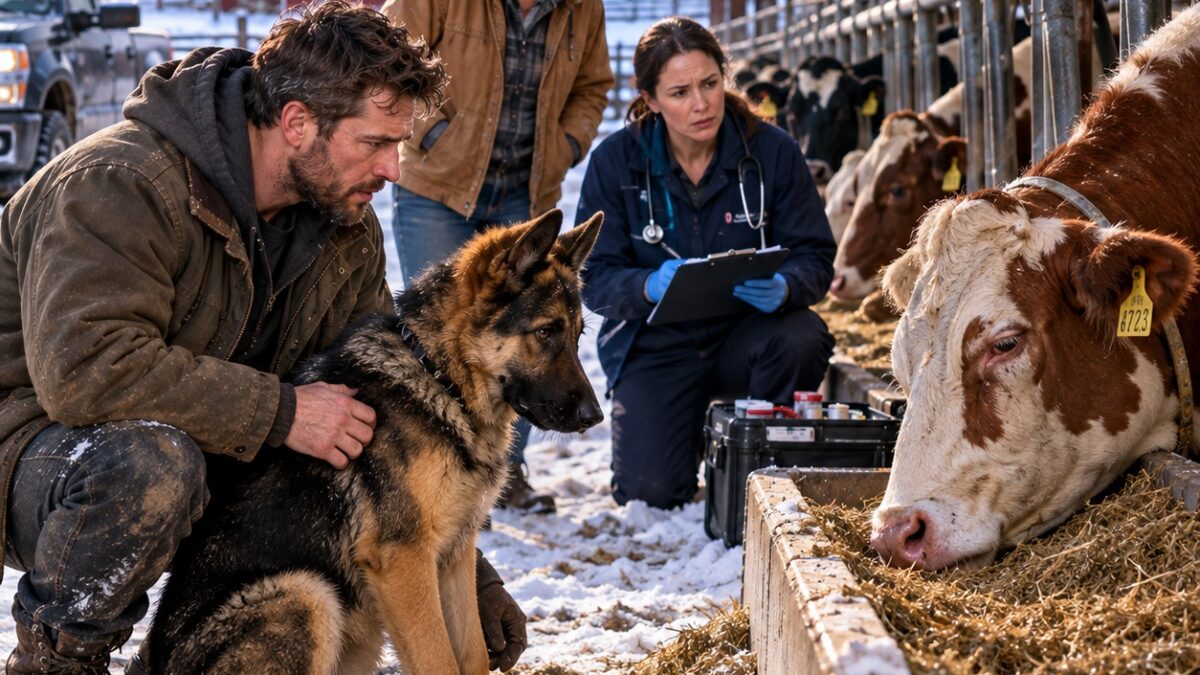
“Three days,” Ruth said.
Celia looked up from her notebook.
“Three days at your current feeding rate?”
“Maybe four if Daphne Crowell can figure out a safe adjustment.”
I knew Daphne. She worked with County Agricultural Extension and had a reputation for making complicated agricultural problems sound simple without pretending they actually were.
Celia wrote the number down.
“All right. We’ll start there.”
Ruth gave a humorless laugh.
“Three days doesn’t sound like much of a starting point.”
“It’s more than zero. And your cattle still have forage. We aren’t looking at an immediate starvation problem.”
“But we might be looking at something worse than one missed shipment.”
Celia didn’t answer immediately.
That silence bothered me.
She returned to the feeding bunk, took separate samples from the concentrate, sealed them in marked bags, and carefully recorded the lot information.
I watched her work. She didn’t throw around words like contamination or poisoning. She didn’t accuse the supplier. Every step was deliberate, and every question had a purpose.
Finally, Ruth asked what we were all thinking.
“Do you believe the feed is making my cows sick?”
“I believe three animals have reduced appetite after a change in their ration,” Celia replied. “That warrants investigation. It doesn’t prove the cause.”
Ruth looked frustrated.
“That’s not very reassuring.”
“Would you rather I gave you an answer I can’t defend?”
“No.”
“Then we do this correctly.”
I liked Celia immediately for that.
After years of dealing with people who confused certainty with competence, I had developed considerable respect for anyone willing to say they didn’t know something.
Mabel shifted her weight behind the gate.
Juniper, still sitting outside, raised his head.
For a moment, I thought Mabel might give him the bellow he was waiting for.
Instead, she turned away and sniffed the feed without eating.
Ruth watched her go.
“She’s never been like this.”
Celia closed her notebook.
“Let’s concentrate on getting her back to herself.”
I stayed for the rest of the morning.
There was a damaged fence section I genuinely needed to repair. A water valve was beginning to show its age, too. Neither job required me to remain until lunch, but I found reasons to work slowly.
Juniper spent most of that time near the feeding gate.
Every so often, he approached Mabel, waited for a response, and sat down again.
I didn’t think he understood illness.
He understood that something familiar had changed.
That was enough.
When we finally left, he kept looking through the rear window until Snowmere disappeared beyond the maple trees.
I reached over and scratched his neck.
“She’ll be all right.”
Juniper leaned against my hand.
I wished I had sounded more certain.
Two mornings later, I woke before sunrise because something was missing.
Normally, Juniper heard me move before my feet touched the floor. By the time I reached the kitchen, he’d be skidding across the hardwood, ready to enforce his personal belief that breakfast should be served immediately.
That morning, the house was quiet.
I found him beside the wood stove.
His head lifted when I entered, and his tail moved once.
“Morning, trouble.”
He watched me.
I opened the food container.
Nothing.
I poured his usual breakfast into the slow-feeder bowl.
He didn’t get up.
I stood there for a moment, holding the empty measuring cup.
“Juniper.”
He looked at the bowl.
Then he looked away.
The first cold pressure of fear settled beneath my ribs.
I crouched beside him and checked his gums, ears, and abdomen as carefully as I knew how.
He was alert. He could stand. He drank a little water.
But he didn’t come running to my voice, and he wasn’t interested in food.
The previous evening, he’d eaten less than usual. His stool had been loose overnight. I had noticed both things and told myself puppies sometimes had upset stomachs.
Now I wondered whether I’d used common sense as an excuse not to worry.
I called Celia.
She answered after three rings.
“Northam.”
“It’s Callahan.”
“What’s wrong?”
“Juniper won’t eat.”
Her voice changed.
“Tell me exactly what he’s doing.”
I explained his appetite, his energy, the water, and the loose stool.
“Is he responsive?”
“Yes.”
“Can he walk?”
“Yes.”
“Any vomiting?”
“No.”
She asked several more questions, then said, “Bring him to the mobile clinic. I’m near the agricultural supply yard.”
I looked at the puppy leaning against my knee.
“How soon?”
“Now would be good.”
Twenty minutes later, Juniper was on an examination mat inside Celia’s mobile clinic.
He looked almost embarrassed.
Under normal circumstances, he would have investigated every corner, sniffed the cabinets, and attempted to make friends with any human carrying a medical instrument.
Instead, he stayed beside my legs.
Celia checked his vital signs, hydration, abdomen, and weight.
Then she started asking about his food.
“Any new treats?”
“No.”
“Access to garbage or chemicals?”
“Not that I’ve found.”
“Anything unusual at the farms?”
“He stays beside me. I haven’t seen him eat anything there.”
“What brand of puppy food are you using?”
I lifted the bag I’d brought from home and set it on the counter.
Celia turned it toward the light.
The label read:
Keystone Ridge Working Puppy Formula.
Her hand stopped moving.
I noticed immediately.
“What?”
She read the manufacturing details.
“Keystone Ridge?”
“That’s what Paige recommended when she sent him home.”
“Is this his current bag?”
“Yes.”
“Do you have the lot number from the first bag you used?”
“I can check.”
Celia examined the ingredients.
“Emmett, this isn’t the same product Ruth feeds her cattle.”
“I know that.”
“And a problem with one product doesn’t automatically establish a problem with another.”
“Then why are you looking at it like that?”
“Because different formulas can share ingredient sources and processing networks.”
I stared at the bag.
The cooperative supplied much of the valley. Dairy concentrates, calf starter, minerals, working-dog products. Its delivery trucks were so common that I barely noticed them anymore.
“You’re saying Juniper might have eaten something connected to Mabel’s feed?”
“I’m saying we need to investigate whether there’s a connection.”
That answer was careful.
I hated it.
“Is he going to be okay?”
Celia looked at Juniper, then back at me.
“Right now, he’s mildly dehydrated and uncomfortable, but he’s responsive. I want basic blood work and a sample of this food tested.”
“And if it is connected?”
“Then knowing that gives us a better chance of preventing further exposure.”
She handed me written instructions for feeding, hydration, and monitoring.
Juniper could go home, she explained, provided he continued drinking and didn’t develop more serious symptoms.
She told me exactly which changes would require immediate attention.
I repeated them back.
She nodded.
“And no farm visits until he’s feeling better.”
Juniper lifted his crooked ear.
“He’ll be disappointed,” I said.
“He can file a complaint.”
“He usually does.”
She managed a brief smile.
I didn’t.
When I carried Juniper back to the truck, he rested his head against my chest.
He wasn’t fighting to get down.
That frightened me more than I wanted to admit.
That evening, snow drifted past my living room windows.
Juniper refused his regular sleeping spot and settled against my work boots instead.
I sat on the floor beside him.
The wood stove clicked softly as the metal expanded.
“You’re making this difficult,” I told him.
He sighed.
I had agreed to three weeks.
I had done that because three weeks came with a conclusion. A clear handoff. Someone else would eventually become responsible for the food, the vaccinations, the bad nights, the possible illnesses, and all the decisions nobody could guarantee would turn out right.
I’d convinced myself fostering was a kind thing I could do without rebuilding my entire life around another living creature.
Now I was sitting on the floor with one hand on a sick puppy and an almost desperate need to hear him breathe normally.
I thought about Paige’s call earlier that week.
Two people had asked about adopting him.
I had said that was wonderful.
I’d even sounded convincing.
But after hanging up, I’d remained in my parked truck for several minutes, watching Juniper sleep beneath his gray blanket.
I remembered how quickly I’d answered when Paige mentioned his future.
“That’s the point of fostering.”
She hadn’t disagreed.
Somehow that made it worse.
I looked down at Juniper.
“You’re supposed to be temporary.”
His chin remained across my boot.
The room felt painfully still.
Years earlier, when my father’s health began deteriorating, I had learned how frightening it was to be responsible for someone whose needs could change faster than your ability to meet them.
I had spent night after night listening for movement from his room, checking medications, watching appointments multiply, and telling everyone I was managing.
Eventually, I had to accept help I couldn’t provide by myself.
I had never completely forgiven myself for needing it.
Afterward, it became easier to keep my life small.
Tools.
Jobs.
A pickup.
A quiet house.
No promises that could follow me home and break my heart.
Then a puppy with a crooked ear came along and treated my rules as if they were suggestions.
I stayed beside him until long after the fire burned low.
The first laboratory warning arrived before dawn.
Celia called Eli Dorsey, the operations manager at Keystone Ridge Cooperative, shortly after receiving results that showed elevated mold-related toxins in one group of submitted samples.
It wasn’t proof that every product was affected.
It wasn’t permission to accuse every farm or every supplier in the chain.
But it was serious enough to justify stopping the linked feed lots while additional testing continued.
Eli didn’t argue.
He asked for the lot numbers.
Celia sent them.
Then he ordered the affected inventory held.
By breakfast, trucks that had been scheduled for delivery were sitting at Keystone Ridge.
By midmorning, farmers were calling.
By afternoon, people who had relied on the cooperative for decades were furious.
And I understood why.
Eli wasn’t hiding the problem. He was doing exactly what a responsible manager should do when preliminary evidence suggested something might be unsafe.
But his decision came with immediate consequences.
The dairy farms still had forage. Nobody was suddenly watching cattle starve in empty barns.
The danger was more complicated.
Some herds depended on balanced protein and mineral supplements. Newly weaned calves needed appropriate starter feed. Animals recovering from health problems or transitioning between rations couldn’t simply be given whatever was available.
Replacing a suspect ingredient meant finding an approved alternative, checking its nutritional suitability, and getting it to the right farm before existing supplies ran out.
And all of this was happening during a Pennsylvania winter when roads could close without warning.
Ruth called me while I was replacing a pipe coupling.
“Keystone Ridge stopped our next delivery.”
I held the wrench still.
“How much do you have?”
“Enough for now.”
“Ruth.”
She exhaled.
“Not enough to stop worrying.”
I looked across the yard.
Mabel was standing near the feeding area, more alert than she’d been earlier in the week, but still not eating the way she should.
“Have you spoken with Daphne?”
“She’s reviewing our ration. Celia’s coming back, too.”
“Good.”
“Emmett?”
“Yeah?”
“If this is happening here, how many other farms have the same problem?”
I had no answer.
Neither did she.
By the end of the day, we began finding out.
Keystone Ridge served dozens of operations across the surrounding valleys. Several product categories were connected to the investigation.
Replacement stock existed, but much of it was outside the immediate area.
Some farms had only a couple of days of verified safe supplements remaining. Others could last almost a week.
A few had hauling equipment and available drivers.
Many didn’t.
And every decision about who received the first replacement shipment meant someone else would receive theirs later.
Fear changed the way people talked.
Neighbors who had shared equipment for twenty years began asking whether another farm was receiving preferential treatment.
Farmers who had never missed a payment wanted to know whether their account history counted for anything.
Others argued that herd size should determine priority.
Everyone had reasons.
Not all of those reasons could fit on the same truck.
The emergency meeting took place in Keystone Ridge’s small conference room.
The room was built for twelve people.
More than twenty showed up.
I went because Ruth insisted.
“You’ve spent enough time fixing things on my property to know what this could become,” she told me.
“I’m not a feed specialist.”
“Good. Neither am I. That’s why we’re going to listen to the people who are.”
Juniper stayed home, resting beside the stove.
Driving without him felt strange.
I didn’t examine that feeling.
Inside the cooperative office, Eli stood at the front with a production report and a list of delayed shipments.
He was young for the amount of responsibility on his shoulders, and he looked as if he’d spent most of the previous night answering calls.
“We have preliminary results that require further investigation,” he explained. “We’ve placed the linked lots on hold while tracing the ingredient sources.”
Warren Clayburn interrupted.
“How long?”
“We don’t know yet.”
“That’s not an answer.”
“It’s the accurate answer.”
Warren was sixty-one, broad-shouldered, with a thick white mustache and the kind of expression that suggested he considered patience an unnecessary complication.
He owned Clayburn Dairy, one of the larger operations in the area.
His reputation wasn’t that he was cruel.
It was that he had worked too hard for too long to accept anyone telling him what he couldn’t do.
“My heifers don’t care about your laboratory schedule,” he said.
“I understand,” Eli replied.
“Then you understand why my Tuesday load needs to arrive.”
“I understand why you’re worried. I cannot release inventory that is currently under hold.”
Warren slapped the table.
“What am I supposed to do with that?”
Ruth shifted beside me.
“Same thing the rest of us are trying to do, Warren.”
He turned toward her.
“Easy for you to say. You’ve already got a veterinarian following your cows.”
“My cows weren’t eating.”
“And now everybody in the county knows about it.”
“They didn’t ask for attention.”
“Neither did my herd.”
The room began to fill with overlapping voices.
One farmer had thirty calves in a sensitive feeding stage.
Another had plenty of hay but almost no approved supplemental feed.
A third had enough reserve for himself but lacked the equipment to pick up additional inventory.
I stood near the back wall, listening.
The discussion was beginning to sound painfully familiar.
Not the agricultural details.
The structure.
Too many needs, too few resources, unreliable roads, and a group of frightened people convinced that being heard required speaking louder than everyone else.
Then the conference room door opened.
Dr. Daphne Crowell stepped inside carrying a clipboard.
She surveyed the room.
“Good. Everyone’s here.”
Nobody looked particularly pleased by her arrival.
Daphne walked to the whiteboard, uncapped a marker, and wrote six headings:
Animal numbers.
Animal groups.
Forage reserves.
Verified safe-feed days.
High-risk groups.
Transportation capacity.
Warren folded his arms.
“We already know we need feed.”
Daphne looked at him.
“That is the least useful version of our problem.”
The room went quiet.
She pointed toward the board.
“If we don’t organize this properly, the loudest person gets the first truck.”
Warren leaned forward.
“And what if the loudest person has the biggest need?”
“Then the numbers will prove it.”
That was the first useful sentence spoken in the room all evening.
For the next hour, Daphne asked exact questions.
How many animals?
Which ones were newly weaned?
Which animals were under veterinary care?
How many days of approved concentrate remained?
Could a ration safely be adjusted?
What transportation was available?
What roads could a fully loaded truck legally use?
And how much product did Keystone Ridge actually have?
Celia provided information about the animals she was treating.
Eli supplied inventory numbers.
The farmers provided their reserves and transportation capabilities.
Slowly, the argument turned into a working picture.
People were still scared.
Some were still angry.
But they could see that fear and need were not always the same thing.
By the end, the whiteboard was covered with names, quantities, routes, and dates.
I stared at it longer than I intended.
It looked like boards I’d stood in front of years earlier.
Different cargo.
Different geography.
Same kind of uncertainty.
During my military service, I’d worked around convoy planning and construction logistics in places where the wrong route could cost more than time.
You learned to think about bridge limits, vehicle capacity, weather, mechanical failures, alternate roads, and what happened if the lead truck couldn’t continue.
You also learned that plans rarely survived contact with reality.
The useful ones were designed to bend without breaking.
I was still looking at the route column when Eli came over.
“Ruth tells me you used to coordinate convoys.”
“Ruth talks too much.”
“That’s how I know she’s usually right.”
I folded my arms.
“That was another life.”
“Can you still read a road map?”
“Yes.”
“Can you tell me whether a trailer can safely clear a bridge?”
“Depends on the bridge and trailer.”
“Can you look at a delivery plan and tell me where it’s going to fail?”
I didn’t answer.
Eli glanced at the wall.
“We need someone to manage the transportation side.”
“You already have drivers.”
“I need someone who sees alternatives before the first option disappears.”
“Call somebody else.”
“Emmett—”
“No.”
My answer came out sharper than I intended.
Eli studied me.
“Did I ask something wrong?”
“No.”
“Then what’s the problem?”
I looked toward the whiteboard.
Too many names.
Too many families.
Too many consequences if someone made a mistake.
“I don’t do that work anymore.”
“Because you can’t?”
“Because I won’t.”
He was quiet for a moment.
Then he nodded.
“All right.”
He walked away.
No argument.
No pressure.
He accepted my answer, and somehow I hated that almost as much as I would have hated being pushed.
I left before anyone could ask me again.
That evening, I drove home and found Juniper waiting at the door.
He was doing better.
His appetite had begun returning, and his tail had almost recovered its usual enthusiasm.
I knelt and checked him anyway.
“You’re supposed to be resting.”
He sniffed my sleeve.
“No traveling.”
His tail moved.
“Don’t start.”
Twenty minutes later, we were in my truck.
I told myself I needed to inspect the repaired water pipe at Snowmere.
There actually was a pipe.
It actually did need checking.
Whether it needed checking at that exact hour was a separate matter.
I kept Juniper on a short leash and made the visit brief.
Mabel was at the feeding gate.
She looked brighter than she had during the first examination.
She had eaten more forage that afternoon and tolerated the adjusted ration Ruth and Daphne were using.
Juniper approached slowly.
No barking.
Mabel lowered her head.
They stood close enough to smell each other through the opening, but neither made a sound.
Then Juniper sat.
Mabel stayed.
I watched them for several minutes.
Neither animal could fix the other’s illness.
Neither knew which feed lot had been placed on hold, how many trucks were available, or whether the next storm would close the county roads.
Juniper had simply come back to the gate where his friend always waited.
And Mabel had come closer.
That was all.
But standing there, I felt something I couldn’t explain.
I’d spent years believing that if I couldn’t solve a problem completely, I was better off leaving it to someone who could.
I had treated uncertainty like a warning sign that said not to get involved.
Yet this ridiculous puppy didn’t seem to care whether his presence could accomplish anything.
He was there because he wanted to be there.
Ruth came out of the barn and stopped beside me.
For a while, neither of us spoke.
Then she said, “You know, that dog hasn’t asked you to fix a single thing.”
I looked at her.
“He’s asked for breakfast approximately four hundred times.”
“That’s different.”
“How?”
“He expects you to show up. Not to run the universe.”
I stared across the snow.
Juniper leaned a little closer to Mabel.
Ruth continued quietly.
“You’re allowed to help without becoming responsible for everybody’s outcome.”
I didn’t answer.
She let the silence stand.
The next morning, I sat in my truck before sunrise with an old road atlas spread across the steering wheel.
I marked Keystone Ridge, Snowmere, Clayburn Dairy, two bridges with weight restrictions, a set of secondary county roads, and an empty equipment warehouse near Millstone Junction.
The warehouse had a loading apron wide enough for medium trucks.
I remembered that from a repair job years earlier.
Juniper slept beneath his blanket in the passenger seat.
I picked up my phone.
Eli answered on the first ring.
“Dorsey.”
“It’s Callahan.”
He paused.
“Everything okay?”
“Send me your available trucks, confirmed inventory locations, driver hours, and the roads your drivers can actually use.”
Another pause.
Then he asked, “Does this mean you’re helping?”
“Transportation only.”
“Understood.”
“I don’t decide nutritional priorities.”
“Fine.”
“I don’t decide who deserves what.”
“Nobody asked you to.”
“And if your trucks are unsafe, I’m not putting them on the road.”
“Emmett?”
“What?”
“Thank you.”
I looked at the atlas.
“Don’t thank me yet.”
Within twenty-four hours, the cooperative conference room had become a makeshift logistics office.
Maps covered the walls.
Colored index cards identified farms and supply levels.
Blue lines marked transport corridors.
Someone brought enough coffee to qualify as an industrial supply.
Daphne organized the nutritional priorities into four categories.
Green meant a farm had adequate verified reserves and could wait.
Yellow meant supplies were becoming limited but there was still time for planned adjustments.
Orange meant the margin was narrowing, particularly for sensitive animal groups.
Red required immediate coordinated attention.
None of the colors meant one farmer was worth more than another.
They described what the animals needed and how quickly circumstances might become unsafe.
Celia added information about active veterinary cases.
Eli tracked what feed was physically available and where it was stored.
I built the routes around those decisions.
At our first planning meeting, I made the boundaries clear.
“Daphne determines nutritional need. Celia determines medical urgency. Eli tells me what inventory and equipment exist. I figure out how to move it.”
Daphne looked up from her paperwork.
“What happens when the route affects delivery priority?”
“I tell you what’s possible. You tell me what matters most.”
She nodded.
“Good.”
Eli raised his coffee cup.
“I love working with people who don’t want my job.”
“Nobody wants your job,” Daphne told him.
“That explains the recruitment problem.”
The humor helped.
Not much, but enough to remind us we were still people rather than numbers on a wall.
Our first major obstacle arrived before lunch.
Warren Clayburn walked into the room, saw that Snowmere had been assigned an orange priority while his dairy was yellow, and demanded an explanation.
“She’s getting a delivery before me?”
“Under the current assessment,” Daphne replied.
“My herd is bigger.”
“Yes.”
“I have more animals to feed.”
“Yes.”
“So why am I second?”
Daphne laid down her pen.
“Because Snowmere has cows recovering from a suspected ration-related problem, and several remain under veterinary observation. You reported a stronger forage reserve and approximately four days of verified concentrate at your present feeding rate.”
“Three and a half now.”
“Then we’ll update your figures.”
Warren turned toward me.
“Convenient.”
I knew that tone.
“What’s convenient?”
“You’ve been working Ruth’s farm all month.”
“I’ve worked yours, too.”
“You’re friends with her.”
“That doesn’t change the numbers.”
“But your routes are on the board.”
“My routes tell drivers how to reach farms. They don’t tell Daphne which animals need feed first.”
Warren pointed at Snowmere’s card.
“You can’t feed a cow with a spreadsheet.”
“No,” I said. “That’s why the people who understand the animals are making those decisions.”
His jaw tightened.
Celia stepped forward.
“I support Daphne’s assessment.”
Warren looked toward her.
“And if my heifers start showing problems?”
“You call me. We’ll evaluate them, and the priority can change.”
He stared at us.
I could see the calculation behind his anger.
He wasn’t simply furious that Ruth was receiving something first.
He was frightened of being responsible for a herd he couldn’t protect through winter.
I understood that feeling.
I understood it so well that part of me wanted to walk away from the room.
Instead, I kept my voice level.
“Warren, nobody’s asking you to accept less help because you’re difficult.”
His eyes narrowed.
“Good.”
“We’re asking everyone to work from the same evidence.”
“And if the evidence is wrong?”
“We correct it.”
He looked at the board one last time.
Then he left, shutting the door hard enough to rattle the glass.
Eli exhaled.
“That went beautifully.”
“No,” Daphne said. “It went honestly.”
I looked through the window as Warren drove away.
I suspected we hadn’t heard the last of him.
I was right.
But not in the way I expected.
We leased the abandoned warehouse at Millstone Junction for thirty days.
It had two roll-up doors, a broad loading apron, and enough space to hold pallets securely off the floor.
It didn’t have heat.
Eli called that unfortunate.
Daphne told him to worry about moisture and the approved storage conditions before complaining about his personal comfort.
A horse farm owner named Nadine Keller contributed twenty wooden pallets.
A local repair garage offered free inspections for vehicles working on the emergency feed deliveries.
Three farmers volunteered trailers.
A retired driver agreed to supervise the warehouse for part of each day as long as someone provided coffee that didn’t taste like boiled gravel.
Nobody made a grand speech.
People simply began bringing what they had.
I liked that.
I’d always trusted practical actions more than public declarations.
For two days, the system worked well enough.
Deliveries arrived late.
A pallet count came up short.
One farm discovered more reserve feed than it had reported. Another discovered less.
Daphne changed priorities.
Celia updated veterinary assessments.
I rerouted trucks.
Eli spent most of his time on the phone.
There were mistakes, but people reported them, and we fixed what we could.
For the first time since the supply hold began, the valley had a coordinated plan.
At home, Juniper was improving.
He ate his meals.
He stole a glove.
He resumed his campaign against the kitchen table legs.
I began allowing myself to feel relieved.
That was when he frightened me again.
One morning, he ate breakfast slowly.
He followed me toward the door, stopped halfway, and lay down.
His eyes remained alert, but his energy was gone.
I called Celia immediately.
She arrived at my house while fine snow blew across the yard.
Juniper barely protested when she examined him on the kitchen floor.
That was enough to make my stomach tighten.
Celia checked his hydration and abdomen, listened to his heart, and watched him walk.
Then she sat back.
“I want him admitted for monitoring.”
The words landed like a physical blow.
“How serious?”
“He’s mildly dehydrated again, and his energy has dropped. I want fluids, repeat blood work, and observation at the hospital.”
“He’s getting worse.”
“I’m not telling you he’s critically ill.”
“You’re sending him to a hospital.”
“Because I don’t want us waiting until a manageable problem becomes a more difficult one.”
I looked down at Juniper.
He leaned against my leg.
“Is he in danger?”
“He needs care, Emmett. He is alert, ambulatory, and responsive. We have time to do this properly.”
That should have comforted me.
Instead, I heard the word hospital and remembered other hallways.
Other waiting rooms.
Other doctors explaining that someone I loved needed more help than I could provide.
My father.
The first time I’d taken him to an appointment because he’d forgotten where he was supposed to be.
The night he’d woken convinced he was somewhere else.
The growing list of medications taped to the refrigerator.
And eventually, the day I sat across from a care coordinator and admitted that I couldn’t keep him safe by myself.
I remembered the guilt.
Worse, I remembered the relief.
Even now, I struggled to decide which feeling had hurt more.
Celia touched my forearm.
“Emmett.”
I looked up.
“He’s right here.”
Juniper looked at me.
She continued, “Let’s deal with the dog in front of us.”
I swallowed.
Then I lifted him gently.
“Okay. We go.”
The veterinary hospital was forty-five minutes away.
I drove without turning on the radio.
Juniper rested beside me in his secured harness, his gray blanket tucked around him.
Every few minutes, I glanced over.
When he closed his eyes, I checked his breathing.
When he opened them, I tried to act as if I hadn’t been watching.
“You’re going to be fine,” I told him.
He blinked.
I wished somebody could have said the same thing to me.
Celia had called ahead.
At the hospital, the staff reviewed his symptoms, examined him, and began fluids and laboratory monitoring.
He was stable.
They explained that more than once.
I heard them.
My body didn’t seem interested in believing them.
I sat in the waiting room for twelve minutes before standing up.
Then I walked toward a vending machine, looked at it without reading anything, and returned to my chair.
Celia appeared carrying two coffees.
“I don’t want coffee,” I said.
“I didn’t ask.”
She put one in my hand.
I took it.
Through a narrow window, I could see part of the treatment area.
Juniper lay on a padded surface while a technician checked his line.
His head was up.
He looked small.
I’d seen injured service members remain conscious and calm under circumstances that would have terrified most people.
I’d helped move equipment through dangerous conditions.
I’d spent years fixing problems while other people watched.
Yet nothing had ever made me feel as helpless as that five-month-old dog looking tired beneath fluorescent lights.
Celia stood beside me.
“He’s being monitored carefully.”
“I know.”
“They’re doing what he needs.”
“I know.”
“He’ll stay overnight.”
I turned toward her.
“Overnight?”
“Yes.”
“He doesn’t like unfamiliar places.”
“He likes people. The staff will look after him.”
“He likes me.”
The words came out before I could stop them.
Celia’s expression softened.
“Yes,” she said. “He does.”
I looked away.
My phone vibrated.
Eli.
I declined the call.
A message appeared.
Route Six closed. Ice and fallen tree above Hawthorne Pass.
Then another.
County says tomorrow morning at the earliest.
I stared at the screen.
Route Six was the primary westbound delivery corridor for the following morning.
Four farms depended on that run.
Two drivers had been scheduled around their legal operating hours.
One transfer stop would miss its window if we didn’t revise the plan.
The familiar pressure returned.
A problem.
A responsibility.
Something only I knew how to solve quickly enough.
I looked through the treatment-room window.
Juniper was still resting.
I imagined leaving him there while I drove back through the snow.
Then I imagined him waking and looking for me.
My chest tightened.
Celia watched me.
“What’s happened?”
“Road closure.”
“Can someone else help?”
I almost laughed.
“I designed the route.”
“That wasn’t my question.”
I looked at her.
She waited.
For years, I had believed that being responsible meant staying physically close to every problem until it was resolved.
During military service, that habit had made me useful.
During my father’s decline, it had nearly destroyed me.
I had somehow carried the same rule into everything that followed.
If something depended on me, I had to hold every piece of it.
If I couldn’t, I was failing.
Celia glanced toward Juniper.
“He’s staying here tonight whether you’re standing outside that door or not.”
“I know.”
“The staff knows what they’re doing.”
“I know.”
“And the people at Keystone Ridge?”
I looked at my phone.
They knew what they were doing, too.
I just hadn’t entirely accepted it.
I called Eli back.
“Dorsey.”
“Route Six is out,” he said immediately.
“I saw.”
“The alternate through Bracken Hollow has a weight restriction. Our Sterling can’t use it loaded.”
“Then don’t send it.”
“What about the smaller trailer?”
“Get the actual loaded weight. Not the advertised capacity.”
“Okay.”
“Call Mason Trent. He knows the logging road above East Mercer.”
“That road isn’t on the route sheet.”
“That’s why we’re checking it. He scouts it empty. Nobody takes a loaded vehicle through until we know the conditions.”
“Got it.”
“And call Daphne.”
“To change the priorities?”
“To ask which deliveries can move without putting animals into an inappropriate feeding situation.”
“Right.”
“She decides that. We adjust transportation around it.”
I looked through the hospital window.
A technician was speaking softly to Juniper.
My voice lowered.
“Send me the confirmed weights and road conditions. I’ll rebuild the schedule from here.”
Eli was quiet.
Then he asked, “Where are you?”
“At the veterinary hospital.”
“Juniper?”
“He’s stable. They want to observe him overnight.”
“Then stay there.”
I frowned.
“I can drive back.”
“Don’t. We have people here.”
I sat down.
For the next hour, the problem moved through more hands than mine.
Eli confirmed the available vehicle weights.
Mason inspected the alternate road and reported its surface, grade, and turning clearance.
Daphne adjusted the delivery sequence so two lower-priority stops could safely shift.
I used a legal pad to rebuild the route.
Two smaller loads replaced one heavy truck.
The transfer moved to Millstone Junction.
One trailer received a different assignment.
The farms with adequate reserve would receive their deliveries later.
Nothing was improvised at the expense of animal care.
Nothing was perfect.
But by 10:43 that night, Eli had the revised schedule.
He sent one message.
We can run this.
Daphne replied a few minutes later.
Priorities approved.
I set the phone down.
Celia looked at the updated hospital notes.
“Juniper’s resting. Nothing tonight suggests the team needs to escalate his treatment.”
I let out a breath.
For the first time that evening, the muscles in my shoulders began to loosen.
Celia sat across from me.
“You realize what you did tonight?”
“Changed a delivery route.”
“No.”
I looked at her.
“You let other people do their jobs.”
I considered an argument.
Couldn’t find one worth making.
Through the narrow window, Juniper slept while a technician checked on him.
Outside, snow kept falling.
Miles away, people were preparing trucks, checking roads, and moving feed.
For once, I wasn’t trying to hold every part of the problem.
And the world hadn’t fallen apart because I let go of one end.
Juniper came home on a Thursday morning.
I was standing outside the hospital when a veterinary technician brought him through the doors.
He looked thinner than when I’d carried him inside. His collar sat a little more loosely around his neck, and the fur along his sides had lost some of its puppy fullness.
But when he saw me, his tail started moving.
Slowly at first.
Then faster.
I crouched before he reached me.
He pressed his forehead against my chest with enough determination to nearly knock me backward.
For several seconds, I couldn’t speak.
I just held him.
Finally, I cleared my throat.
“Don’t make this emotional.”
Juniper licked my chin.
I closed my eyes.
“Too late.”
The technician smiled and handed me his leash.
Celia stood nearby with the discharge instructions.
“His hydration is better,” she said. “His laboratory values are improving. We still need to monitor his recovery, but he’s doing well enough to go home.”
“Improving doesn’t mean normal.”
“No, Emmett. It doesn’t.”
I appreciated that she never pretended good news was better than it actually was.
“What do I need to do?”
She reviewed his meal schedule, water intake, activity restrictions, and follow-up care.
“No running. No strenuous activity. Short walks only until he’s ready for more.”
Juniper immediately attempted to climb into the truck.
Celia looked at him.
“That includes jumping.”
I lifted him onto the passenger seat.
“He’s never been particularly interested in regulations.”
“Then perhaps you should set an example.”
I glanced at her.
“That’s an unreasonable standard.”
She smiled.
And for the first time in several difficult days, I found myself smiling back.
On the drive home, Juniper slept beneath his familiar gray blanket.
His head rested against the seat.
One oversized paw hung toward the floor.
I kept looking over.
At a stoplight, I reached across and rested my hand against his shoulder.
He didn’t wake.
I could feel his breathing.
That was enough.
For the next several days, I followed Celia’s instructions with a level of discipline that would have impressed my old commanding officers.
Juniper ate small meals.
He drank regularly.
He rested.
We took short walks around the yard.
I kept a notebook of his appetite, energy, and anything else Celia wanted monitored.
Ruth called every day.
Sometimes twice.
“How’s our patient?”
“Improving.”
“Is he eating?”
“Yes.”
“Stealing anything?”
“Not yet.”
“That’s concerning.”
On the third morning, Juniper stole my left work glove.
I found him beneath the kitchen table with half of it hanging out of his mouth.
“Well,” I said. “That’s encouraging.”
He stared at me.
“You’re still a criminal.”
His tail thumped.
“A recovering criminal, but a criminal.”
He got up and carried the glove toward the living room.
I let him keep it for another minute.
That afternoon, Paige called to ask about his health.
I gave her the medical updates, explained the hospital stay, and told her we were following the recommended recovery schedule.
She listened carefully.
Then she asked, “How are you?”
“Fine.”
“Emmett.”
“What?”
“I asked how you’re doing.”
I looked across the room.
Juniper was asleep beside the stove, one paw covering his stolen glove.
“I’m doing better.”
Paige didn’t immediately respond.
I suspected she understood considerably more than I intended to tell her.
After a moment, she said, “I’m glad.”
She didn’t mention the adoption inquiries.
Neither did I.
But the conversation remained with me long after we hung up.
Because for the first time, I had answered a question about my own well-being by thinking about someone else.
And that frightened me almost as much as it comforted me.
Five days after Juniper returned home, Ruth called about a sticking trough valve.
She described the noise it was making as “a mechanical insult to decent people.”
I told her I would come look at it.
Then I stood in the mudroom holding Juniper’s leash.
He sat in front of me.
His tail moved.
“You’re not going to run.”
His tail moved faster.
“You’re not going to jump.”
He stood up.
“That wasn’t permission.”
He sat again.
“And you’re not going near Mabel unless I decide you’re ready.”
Juniper barked.
I looked at the ceiling.
“Excellent. Full cooperation.”
By midday, we were turning into Snowmere Dairy.
The snowbanks were still high, but the sunlight had begun softening their edges.
Water dripped from the barn gutters.
Dark patches of gravel showed through the lane.
Winter hadn’t loosened its grip, but for the first time, I could imagine it eventually ending.
Juniper stood on the passenger seat before I stopped the truck.
He recognized the place.
His tail hammered against the blanket.
“Easy.”
He ignored me.
Ruth came out of the barn.
She looked through the passenger window, saw Juniper, and stopped.
For a moment, her face showed something she didn’t bother disguising.
Relief.
Then she smiled.
“Well, look who finally decided to return to work.”
I opened the truck door.
Juniper tried to launch himself out.
I caught his harness and lowered him to the ground.
“Walking.”
He attempted to trot.
“Juniper.”
He slowed to an exaggerated walk that somehow looked more defiant than running.
Ruth crouched and scratched beneath his chin.
“You got skinny.”
“He’s sensitive about that.”
“Good. He can eat his approved meals and get fat again.”
Juniper leaned against her knee.
Ruth looked up at me.
“You were worried.”
I considered denying it.
Then I looked at the woman who had watched me bring that puppy to the farm nearly every morning.
“Yeah.”
She nodded.
Nothing more needed saying.
Celia’s white veterinary vehicle was parked near the calf barn.
She emerged carrying her waterproof notebook, a camel coat moving around her boots as she crossed the yard.
Juniper recognized her immediately.
His ears rose.
Even the left one nearly stood straight.
Celia’s expression softened.
“Well, there’s my difficult patient.”
Juniper pulled toward her.
“Medical restrictions,” I reminded him.
Celia crouched and scratched behind his ears.
“You look terrible,” she told him.
His tail moved so enthusiastically that his entire body followed.
“Very convincing,” she added.
I folded my arms.
“Should I be concerned about your professional objectivity?”
“I’m assessing patient morale.”
“And?”
“Excellent. Much better than his owner’s.”
Ruth laughed.
Then she pointed toward the feeding gate.
“Mabel’s going to be furious if she misses this reunion.”
Juniper heard the name.
His whole body changed.
He looked toward the far side of the barn.
The gate.
The place where his morning arguments had once been the most important event in his life.
I shortened the leash.
“Slowly.”
He started walking.
Ruth and Celia followed.
Mabel stood near the feeding bunk.
She was stronger than she’d been when I’d last seen her. Her posture had improved, and the dullness in her eyes was gone.
But Ruth had told me she still wasn’t eating consistently.
Some meals were better than others.
The adjusted ration was helping, but recovery had been slower than anyone wanted.
Juniper stopped several yards from the gate.
Mabel lifted her head.
For a moment, neither animal moved.
The yard became strangely quiet.
My hand tightened around the leash.
Then Mabel stepped forward.
She pushed her enormous chestnut-and-white face through the feeding opening.
Her nostrils widened.
She drew in a breath.
And she bellowed.
Loudly.
Juniper jumped so hard that his front paws slid in opposite directions.
He nearly landed on his backside again.
Ruth burst out laughing.
Celia turned away, shoulders shaking.
I bit the inside of my cheek.
Juniper recovered his balance and stared at all three of us.
His expression was pure betrayal.
After everything he’d been through, we’d apparently brought him back to be publicly humiliated.
Mabel watched him.
Waiting.
Juniper straightened his front legs.
His crooked ear tilted outward.
Then he barked.
Mabel answered.
He barked again.
She bellowed louder.
Ruth laughed until she had to wipe her eyes.
Celia leaned against the fence.
“I was led to believe these conversations had intellectual depth.”
“Standards have slipped,” I replied.
Juniper gave one final bark.
Mabel snorted.
The argument seemed finished.
Then something happened that stopped Ruth’s laughter.
Mabel turned away from the gate.
She walked toward the feeding bunk.
Lowered her head.
And began to eat.
Ruth went completely still.
Mabel took one mouthful, chewed, and took another.
Ruth looked at Celia.
“Did you see that?”
“I did.”
“She wouldn’t touch that part of her ration earlier.”
Celia watched the cow carefully.
Mabel continued eating.
Ruth turned toward Juniper.
“He got her eating.”
Celia didn’t rush to agree.
“The adjusted ration has helped her. Her treatment and recovery time matter, too.”
“I know.”
“And we can’t assume one visit is responsible for a medical improvement.”
“I know that, Celia.”
The veterinarian glanced toward Juniper.
“But familiar routines can help an animal settle. Stress can affect appetite.”
Ruth looked at Mabel.
Then at the puppy.
“So he helped?”
Celia smiled gently.
“I didn’t say he didn’t.”
Ruth pressed her lips together.
Her eyes had become wet.
She looked away toward the barn.
I didn’t make a joke.
Neither did Celia.
Juniper, meanwhile, had become interested in an old patch of snow beside a fence post.
He had no idea anyone was discussing him.
That made the moment more meaningful.
He hadn’t performed a miracle.
He hadn’t cured an illness through some mysterious instinct.
He had returned to a place where he was expected.
Mabel had responded to something familiar.
And for a little while, the farm felt normal again.
I watched her eat.
For the first time in weeks, I understood how much hope could fit inside an ordinary gesture.
As the feed-response system continued, Juniper became something of an unofficial member of the team.
Tom Bristow, one of the delivery drivers, started asking about him before asking where to unload.
Luis Navarro, who worked at Snowmere, mysteriously developed a habit of keeping dog biscuits in his left jacket pocket.
He denied it.
Juniper exposed the arrangement by sitting in front of that pocket every morning.
A worker at the temporary warehouse brought an old tennis ball.
Juniper ignored it and stole the man’s glove.
“He’s got expensive tastes,” the worker complained.
“He’s got criminal tendencies,” I corrected.
People laughed.
They were tired.
We were all tired.
Not every farm had received everything it wanted. Some deliveries were still delayed, and some farmers remained angry with Keystone Ridge.
But the organized distribution system was beginning to help.
The farms with urgent nutritional needs were receiving appropriate supplies before their reserves became unmanageable.
Those with greater flexibility were adjusting under Daphne’s guidance.
Celia continued monitoring affected animals.
Eli kept tracing the implicated lots, coordinating testing, and dealing with the practical consequences of the holds.
I kept transportation moving.
And every time something went wrong, we corrected it without allowing one person to become the entire operation.
That last part had become important to me.
I was beginning to understand why.
One afternoon, Warren Clayburn arrived at Millstone Junction to collect a partial delivery.
He was still annoyed about the priority system.
He made that clear by speaking only to Eli while I checked straps on a parked trailer.
Juniper sat beside a pallet.
Ruth had stopped by and was telling Tom Bristow about Mabel’s latest argument with the puppy.
Warren listened without looking like he was listening.
Then Juniper wandered over.
Warren looked down.
“Don’t.”
Juniper sat directly on his boot.
Warren stared at him.
“Get off.”
Juniper looked up.
His tail moved.
For one brief second, Warren’s mouth twitched.
Then he remembered his reputation.
“Callahan. Get your dog.”
“Foster dog,” I corrected automatically.
Warren looked at me.
“Whatever you say.”
I opened my mouth to answer.
My phone rang.
Paige Merryweather.
I stepped away from the loading area.
“Callahan.”
“Do you always answer like you’re expecting someone to report an equipment failure?”
“Depends who’s calling.”
“Then I have something different.”
Her voice softened.
“We found a family.”
I stopped walking.
Behind me, a forklift beeped.
Someone called out a pallet count.
Juniper barked once at a loose strap.
“What family?”
“Outside Harrisburg. Experienced with German Shepherds. Fenced yard. One adult works from home. No other dogs currently.”
I looked toward Juniper.
He was sitting beside Warren, apparently trying to decide whether the man’s boot was an acceptable place to take a nap.
“They completed the application,” Paige continued. “References checked out.”
“Good.”
“They want to meet him.”
I swallowed.
“When?”
“This weekend, if possible.”
The warehouse noises suddenly seemed far away.
I looked at the puppy’s crooked ear.
At the dark burgundy collar I’d bought because the old shelter collar had begun wearing out.
At the dog who’d spent the past several weeks following me from room to room as though my presence were the most natural fact in his world.
“That’s good,” I said.
Paige didn’t answer.
“That’s what we wanted,” I added.
“Is it?”
I frowned.
“What?”
“Is that still what you want?”
I stared across the loading yard.
“Paige, we agreed this was temporary.”
“I know.”
“You said three weeks.”
“I did.”
“That’s the point of fostering.”
“Yes, Emmett.”
I waited for her to say something else.
When she finally spoke, her voice was careful.
“I need you to answer one question.”
“Go ahead.”
“Do you want Juniper to leave?”
I looked down.
The puppy had wandered back to my side.
He pressed his shoulder gently against my leg.
I didn’t speak.
Paige continued.
“Or is that the decision you made before you knew him?”
My throat tightened.
The question was so simple that I had nowhere to hide.
I’d spent weeks using the word foster as though repeating it could protect me.
I’d said it to Ruth.
To Tom.
To the woman at the hardware store.
To Warren.
To Paige.
Most of all, I’d said it to myself.
But when I imagined placing Juniper in another person’s car, watching him leave the shelter parking lot, and returning home to a house without his food bowl beside the stove, I felt something close to panic.
Not because the interested family was unsuitable.
They sounded wonderful.
Not because I thought nobody else could care for him properly.
That wasn’t true either.
I simply didn’t want him to go.
Paige waited.
Finally, I said, “I need to think.”
“All right.”
“He’s still recovering.”
“I know.”
“We should make sure he’s completely healthy before making decisions.”
“Of course.”
There was another pause.
Then she said, “Just make sure you’re thinking about what you want now, not what you were afraid of three weeks ago.”
After we hung up, I remained standing beside the warehouse.
Juniper looked at me.
I crouched and scratched beneath his collar.
“You’re causing trouble.”
He leaned against my hand.
Behind us, Warren called for another pallet count.
The world kept moving.
I wondered why deciding where a truck should go had become easier than deciding where my own dog belonged.
The next serious weather warning arrived at 5:17 one morning.
Heavy snow was expected by late afternoon.
The county warned that several secondary roads could become difficult or temporarily impassable for up to forty-eight hours.
I read the notice twice.
Then I opened the road atlas on my kitchen counter.
Juniper slept beside the stove.
“Of course,” I muttered.
He opened one eye.
“Not you.”
He closed it again.
By six-thirty, we were at Millstone Junction preparing for what should have been the final major replacement shipment before the storm.
That shipment mattered.
It contained protein-mineral supplements, transition ration components, and calf starter that could not safely be replaced with random available feed.
Daphne had organized the allocation down to individual pallets.
Celia had updated the veterinary cases.
Eli had confirmed each farm’s reserve.
I had checked the delivery routes, alternate roads, and available drivers.
There wasn’t much flexibility left.
At 8:04, Eli’s phone rang.
He listened.
His expression changed.
“Where?”
He looked toward the loading door.
“Can it move?”
Another pause.
“Don’t force it. Get the mechanic.”
He ended the call.
I was already reaching for the vehicle manifest.
“Which truck?”
“The second unit from the western supplier.”
“Mechanical problem?”
“Yes. Driver caught it before something worse happened.”
“Load damaged?”
“No.”
“Can another tractor take the trailer?”
“The nearest available replacement is three hours away.”
I looked at the weather map.
Three hours meant transfer time, road time, and increasing snow.
We didn’t have that kind of margin.
Daphne approached.
“How much product is delayed?”
Eli checked the paperwork.
“Six pallets of concentrate and four of calf starter.”
The room went quiet.
Only about two-thirds of the expected shipment was going to reach us on schedule.
Outside, the first truck was still approaching.
Inside, our carefully planned allocations had just become impossible.
Daphne took off her glasses.
“Update every reserve.”
Eli nodded.
“No estimates,” she added. “Actual quantities.”
“I know.”
“Ask what’s already been used today.”
“I know.”
“And confirm any unopened inventory they may have overlooked.”
He looked at her.
“Daphne.”
She stopped.
“I know,” he repeated.
Then he began dialing.
For the next ninety minutes, we lived inside numbers.
Seventeen calves here.
Forty-three cows there.
Twenty-eight bags instead of the twenty reported.
Seven bags instead of twelve.
One unopened tote.
Two days of verified supply.
Forty hours at the current rate.
Enough forage to maintain the herd while supplement quantities were carefully adjusted.
Not enough appropriate calf starter to make everyone comfortable.
By ten, the first replacement truck arrived.
Workers unloaded the pallets slowly enough to verify every label.
Nobody rushed.
Rushing could turn a difficult situation into a dangerous one.
I kept moving between the loading area and the map.
Then Daphne called me over.
Ruth stood beside her.
“What changed?” I asked.
Daphne pointed to a farm east of the ridge.
Holly Spring Farm.
Twenty-two newly weaned calves.
“They opened the last bags of their current calf starter this morning.”
I looked at the reserve figure.
“That doesn’t match yesterday.”
“They found less than expected during this morning’s inventory.”
“How long?”
“They’re fine today. They have shelter, water, and forage. This isn’t an immediate starvation situation.”
I waited.
Daphne’s mouth tightened.
“But by tomorrow morning, they either have the correct product or we begin making compromises I would rather avoid.”
I understood.
Young animals in a sensitive feeding transition had much less flexibility than a mature herd with adequate forage.
Then I noticed Ruth looking at Snowmere’s allocation.
Orange.
It was still due for a portion of the incoming concentrate.
Daphne followed her gaze.
“Ruth, I can make an additional temporary adjustment to Snowmere’s ration. Under the present conditions, I believe we have approximately forty-eight hours of reasonable flexibility.”
Ruth said nothing.
“I am not asking you to surrender your delivery,” Daphne continued. “I’m explaining the options.”
Ruth stared at the card.
I knew what she was thinking.
Snowmere had already endured weeks of uncertainty.
Mabel had only recently begun eating normally again.
Every adjusted feeding schedule meant more work, more calculation, and less room for error.
Ruth’s farm wasn’t wealthy enough to treat those problems casually.
Neither was Holly Spring.
“How long do those calves have?” she asked.
Daphne answered plainly.
“Until tomorrow morning before I’m facing a feeding decision I don’t want to make.”
“And my herd?”
“With the revised ration I’ve prepared, about two days before I’d become uncomfortable with the margin.”
“You’ll monitor it?”
“Yes.”
“Celia, too?”
“If necessary.”
Ruth looked toward the loading door.
Snow was beginning to fall.
Then she said, “Send the first part of mine to Holly Spring.”
I turned toward her.
“Ruth.”
She held up a hand.
“Don’t.”
Daphne studied her.
“You understand this reduces your margin?”
“I understand.”
“The storm may delay your replacement.”
“I know.”
“Then I want you to be certain.”
Ruth looked at the priority board.
“I’m not giving my feed away because I’m trying to be some kind of hero.”
Nobody answered.
“I’m moving my farm down the line for a day because those calves need it sooner.”
She pointed toward Snowmere’s card.
“My cows have a feeding plan we can manage for now. Those calves don’t have the same flexibility.”
Daphne nodded.
“Then we’ll document the change and keep monitoring both farms.”
Behind us, a thermos lid clicked.
Warren Clayburn had come into the warehouse to collect paperwork.
He’d heard the conversation.
For once, he didn’t complain.
He looked at Ruth.
Then at the board.
Then down at his coffee.
Nothing about his expression suggested he’d suddenly become an easy man.
But he didn’t say a word against her decision.
By noon, the sky had turned gray.
The ridgeline disappeared beneath thickening snow.
I changed the eastern route.
The calf starter would leave Millstone Junction first, take County 18 South, and turn onto Old Quarry Road.
It wasn’t the fastest route.
It was the one with the best chance of remaining usable.
Mason Trent was driving the lead truck.
At 1:23, he called.
I answered immediately.
“Talk.”
“Old Quarry’s blocked above Keller’s lower field.”
“Snowdrift?”
“Tree.”
“How big?”
“Big enough that I’m not trying to squeeze a truck around it.”
I closed my eyes for half a second.
“County road crew?”
“Already backed up.”
“Can you turn around?”
“There’s room lower down. But if we reverse now, we lose the delivery window.”
I looked at the map.
“Stay where you are. Keep clear of the obstruction.”
I walked toward Eli.
“Old Quarry’s blocked.”
He looked up.
“How bad?”
“Fallen tree across both lanes.”
“What equipment can reach it?”
We considered Snowmere’s small loader.
Too little capacity for the job.
Nadine Keller had a tractor.
No suitable front blade.
There were other options farther away, but the weather was closing in.
Then Eli looked at me.
We both knew who owned the equipment we needed.
Warren Clayburn.
A heavy loader.
Wide bucket.
Enough traction for the conditions.
Unfortunately, he was also the man who had spent most of the crisis accusing us of unfairness.
“I can call him,” Eli offered.
I took out my phone.
“No. I’ll do it.”
Before I could dial, a low diesel rumble came through the warehouse doors.
The windows vibrated faintly.
Everyone turned.
A large loader came around the end of the snowbank.
Behind the windshield sat Warren Clayburn.
He parked beside the outbound trucks, climbed down, and walked inside carrying his battered thermos.
Snow clung to his red coat.
I stared at him.
“What are you doing?”
Warren unscrewed the thermos.
“I still think your system is irritating.”
“Good afternoon to you, too.”
“Don’t get comfortable. I haven’t changed my opinion.”
“Then why are you here?”
He took a drink.
“Because those calves don’t care about my opinion of your scheduling.”
For the first time that day, Eli laughed.
Warren looked at him.
“Something funny?”
“No, sir.”
“Good.”
I stepped closer.
“Old Quarry Road?”
“I know.”
“How?”
“Mason called my nephew.”
I shook my head.
“This valley’s communication system is an absolute disaster.”
Warren screwed the lid back onto his thermos.
“Are we going to clear a road, or are we going to stand here criticizing my family?”
I grabbed my coat.
Twenty minutes later, Warren’s loader was moving through the snow ahead of us.
I followed in my pickup.
Mason waited near the obstruction, his truck’s hazard lights flashing through the gray afternoon.
The fallen tree lay across both lanes.
Its heavy branches had become tangled along the road edge.
The snow was thick enough that we needed to identify the shoulder before moving equipment.
Warren climbed down and surveyed the obstruction.
“Can you move it?” I asked.
He looked at me.
“You bring me all this way for decoration?”
I almost smiled.
We worked carefully.
Warren used the loader to shift the heavier sections.
Mason and I cleared smaller limbs and debris once the machinery was stopped and positioned safely.
We kept everyone outside the equipment’s working area.
Nobody tried to drag a loaded trailer across an unverified road edge.
Nobody attempted a shortcut into the ditch.
We opened only the space we could safely use.
Snow gathered on our shoulders.
The wind pushed beneath my collar.
At one point, Warren shouted from the loader.
“Your left!”
I stepped clear.
A moment later, he needed to reverse around a narrow section.
I moved where he could see me and signaled the available clearance.
He followed the signals without arguing.
Neither of us commented on it.
That was trust in its simplest form.
Two men who didn’t agree about everything accepting that the other knew what he was doing.
Mason stood beside his truck stamping his feet.
“I’d like it recorded that every career decision I’ve made led directly to this miserable afternoon.”
Warren leaned out of the loader.
“Then make your next decision useful and move that branch.”
Mason muttered something I chose not to hear.
After about forty minutes, we had one safe lane open.
I inspected the route through the obstruction.
Then I walked to Mason’s window.
“Stay centered. No passing. Keep the speed down.”
“You’re following?”
“All the way.”
He nodded.
The convoy moved.
One truck.
Then another.
My pickup behind them.
Warren remained at the obstruction until the last vehicle was through.
As I passed, I rolled down my window.
“Warren.”
He looked over.
“Thanks.”
He frowned.
“Don’t make a ceremony out of it.”
“Wouldn’t dream of it.”
He climbed back into his loader.
The drive to Holly Spring took nearly another hour.
Snow began swallowing the fence lines.
The barn lights were on before we arrived.
Workers were waiting beneath the shed roof.
Nobody cheered.
Nobody asked for a photograph.
They simply came forward when the truck stopped and helped unload the feed.
The calf starter came off first.
Exactly as Daphne had instructed.
I stood near the loading area and watched the bags move into safe storage.
The people at Holly Spring had spent the morning wondering whether the correct feed would arrive before the storm.
Now it was there.
That was enough.
We confirmed the delivery quantities, obtained the signatures, and checked that the receiving area was secure.
Then we turned back toward the valley.
When I reached Snowmere later, Ruth was standing near the barn entrance.
Snow had collected in her silver-brown hair.
“How were they?” she asked.
“Fine.”
“Everything arrived?”
“Everything scheduled for that stop.”
She exhaled.
“Good.”
I glanced toward Mabel.
The cow was chewing steadily at the feeding bunk.
Ruth followed my gaze.
“She’s still eating.”
“How’s your revised ration?”
“Daphne approved it. She’s checking again tomorrow.”
I nodded.
Ruth watched me for a moment.
“Warren helped?”
“He did.”
“Did you thank him?”
“He doesn’t like being thanked.”
“So you didn’t?”
“I respected his preferences.”
She laughed.
Then her expression softened.
“You all got those calves what they needed.”
I looked toward the darkening road.
“Everybody did their part.”
Ruth nodded.
“Exactly.”
It was after nine when I finally reached home.
Snow covered the porch steps.
My shoulders ached.
My gloves were damp.
I wanted nothing more complicated than dry clothes and a quiet fire.
When I opened the door, Juniper lifted his head from his blanket beside the stove.
His tail thumped.
Once.
Twice.
He stood and came toward me.
I knelt.
“Long day.”
He pressed his nose into my hand.
I scratched behind his ear.
“You should’ve seen Warren today.”
Juniper wagged.
“Don’t look so impressed. He was still insulting everybody.”
The puppy followed me into the kitchen.
My laptop sat on the table.
A new email notification glowed on the screen.
Paige Merryweather.
I opened it.
The family outside Harrisburg was ready to meet Juniper that weekend.
They had a fenced yard.
Experience with shepherds.
Strong references.
Everything I’d hoped for when I first agreed to foster him.
I read the message twice.
Then I sat down.
For a long time, I looked at the screen.
The sensible choice had always seemed obvious.
Find Juniper a good home.
Make the transfer.
Return to my quiet life.
Keep my schedule manageable.
Don’t take on another responsibility with no guaranteed outcome.
It was the same kind of reasoning I’d used after my father’s health began to decline.
The same arguments I’d made when I stopped visiting friends as often, refused invitations, and convinced myself solitude was easier.
I’d called it knowing my limits.
Sometimes it was.
But sometimes I’d used it to avoid finding out whether I could love something without controlling everything that might happen to it.
A soft rustling sound came from the mudroom.
I looked up.
Juniper had disappeared.
A few moments later, he returned carrying my left work glove.
The same glove he’d stolen repeatedly.
He walked toward me and placed it on my knee.
I stared at it.
“That belongs to me.”
He sat.
I didn’t take it away.
Instead, I closed the laptop.
Juniper leaned forward.
I rested my forearms on my knees.
“You know something?”
His head tilted.
“I don’t know if I’ll always get this right.”
He watched me.
“I’ll make mistakes.”
His tail moved once.
“I won’t always know exactly what you need.”
He came closer.
“And there are going to be days when I can’t fix whatever’s wrong.”
He rested his chin beside the glove.
I looked at him.
For years, my greatest fear had been making a promise I couldn’t keep.
When my father became unable to manage alone, I’d promised myself I would take care of everything.
The medications.
The appointments.
The meals.
The sleepless nights.
The calls.
The decisions.
And when the time came to transfer him into professional care, I’d felt as though I were breaking that promise.
I remembered signing the paperwork.
Remembered leaving afterward.
Remembered sitting in my truck, staring at the steering wheel, feeling an awful wave of relief.
Then hating myself for it.
I’d needed help.
He’d needed care beyond what I could safely provide alone.
Both things were true.
But I’d turned that experience into evidence that I couldn’t be trusted with another life.
I looked down at Juniper.
He wasn’t asking me to guarantee that he would never become ill again.
He wasn’t asking me to predict every storm.
He wasn’t asking me to become a veterinarian or control every possible risk.
He had needed medical care, and I’d taken him to people who knew how to provide it.
He had needed food, rest, and patience.
I’d given him those things.
He had needed someone to recognize when the situation was beyond what could be managed at home.
I’d finally learned to do that without calling it failure.
I rested a hand against his shoulder.
“I can promise to keep trying.”
Juniper leaned into me.
It wasn’t a dramatic moment.
Nobody was watching.
There was no music.
Only a tired man, a young dog, a stolen glove, and snow moving across the kitchen windows.
But something settled inside me that night.
I still hadn’t answered Paige.
The family was still waiting.
And for once, I wasn’t going to make a decision just to escape the discomfort of caring.
Over the following weeks, the worst of the winter feed crisis passed.
Not because someone gave a heroic speech or one truck saved the valley.
It passed through hundreds of small decisions made by people who had learned to work together.
Keystone Ridge tightened its incoming ingredient testing procedures.
Production lots were tracked more carefully.
The cooperative developed plans to maintain reserve inventory at multiple storage locations rather than depend so heavily on one distribution point.
Daphne helped County Agricultural Extension establish a winter contingency program using what we’d learned about reserves, animal groups, and transportation needs.
Celia continued monitoring affected animals and reviewing the evidence connected to the suspect feed lots.
The investigation remained more complicated than simply blaming every illness on one ingredient.
That mattered.
Some products had been implicated.
Some were not.
And while the shared supply network made a connection between Juniper’s illness and the feed problem worth taking seriously, I had learned not to confuse a reasonable suspicion with proof beyond what the testing supported.
I didn’t need an exaggerated explanation to appreciate how close we’d come to making difficult circumstances worse.
Eli’s decision to place the affected lots on hold had been costly.
He knew that better than anyone.
A few farmers changed suppliers.
Others remained frustrated.
Not every relationship with Keystone Ridge recovered.
Some people never forgave the interruption, even after they understood why it had happened.
Eli accepted that.
When people complained, he listened.
When records were requested, he provided them through the proper channels.
When deliveries were promised, he worked to meet those commitments.
Trust didn’t return because someone announced the crisis was over.
It returned slowly.
One accurate inventory report.
One shipment that arrived when expected.
One test result shared honestly.
One mistake acknowledged before somebody else discovered it.
Warren still complained.
That much hadn’t changed.
But one morning, he appeared at Millstone Junction carrying two coffees.
He set one beside my maps.
I looked at it.
“What’s this?”
“Coffee.”
“I can see that.”
“Then why are you asking?”
I picked it up.
No sugar.
Exactly how I drank it.
“You remembered.”
Warren frowned.
“Don’t make this sentimental.”
“Wouldn’t dream of it.”
He looked at the route board.
“You moved my Thursday delivery.”
“Twenty minutes.”
“Why?”
“Thaw is weakening the shoulders along County Nine. The school buses are also using that stretch in the morning.”
“My driver knows that road.”
“So do I.”
Warren took a drink.
“You overthink everything.”
“And yet you brought me coffee.”
He stared at me.
“I can take it back.”
I pulled the cup closer.
“No, you can’t.”
He made a sound that might have been a laugh.
We returned to the map.
That was as much of a friendship as either of us seemed interested in admitting.
But I understood what had changed.
Warren no longer treated the cooperative’s plan as something imposed by enemies.
He still argued.
He still demanded explanations.
But he had seen what happened when people put aside personal grudges long enough to help someone whose needs were more urgent.
And he’d become part of that solution.
Snowmere gradually returned to its ordinary routine.
Ruth’s feed records stopped looking like emergency calculations.
The cattle settled into stable rations.
Mabel regained her appetite.
More importantly, she regained her attitude.
One afternoon, I was tightening a bolt near the equipment shed when Mabel bellowed from the far side of the yard.
I turned so suddenly that I almost dropped the wrench.
Ruth saw me.
“Relax, Emmett.”
“I am relaxed.”
“You just saluted a cow with a socket wrench.”
“I did not.”
“You absolutely did.”
Mabel bellowed again.
Juniper barked from the truck.
Ruth smiled.
“See? Management agrees.”
I shook my head.
There was no point arguing with either of them.
Celia’s schedule returned to ordinary veterinary work.
Vaccinations.
Calving checks.
Routine herd visits.
Lameness assessments.
The kinds of appointments that didn’t require anyone to call before dawn.
I saw her at Snowmere more often than I’d expected.
Or perhaps more often than I wanted to admit I hoped.
One afternoon, she arrived while I was replacing a hinge.
Her camel coat moved in the breeze, and she carried the familiar waterproof notebook beneath one arm.
“You’re not supposed to be here today,” I said.
She stopped.
“That’s an interesting welcome.”
“I mean Ruth didn’t mention a visit.”
“Routine follow-up.”
“She usually mentions those.”
Celia studied me.
“Are you disappointed?”
“No.”
“Good.”
“Why would I be?”
She smiled.
“Exactly.”
Then she continued toward the barn.
I stared at the hinge for several seconds.
The bolt hadn’t moved.
From the doorway, Ruth called, “Need help with that?”
“No.”
“Sure?”
“I’m fine.”
She made a suspiciously pleased sound and disappeared inside.
I returned to the hinge.
Juniper sat beside me.
He looked from the barn to my face.
“Don’t start,” I told him.
He wagged.
The following week, Eli approached me after a meeting at the cooperative.
The warehouse was quiet.
Daphne had gone back to her office.
The other farmers had left.
I was updating a route board when Eli stopped beside me.
“We’re creating a seasonal logistics position.”
“No.”
“You haven’t heard the details.”
“Still no.”
“Part-time.”
“No.”
“Planning and coordination.”
“No.”
“No uniform.”
I looked up.
He smiled.
“I thought that one might get your attention.”
I set down the marker.
“Eli, I’m not joining another organization that believes my phone should ring at four every morning.”
“Would five be acceptable?”
“Goodbye.”
“Emmett.”
Something in his voice made me stop.
He wasn’t joking anymore.
“We don’t want you to run everything.”
“That’s reassuring.”
“We want you to do the part you’re good at.”
I looked toward the route board.
He continued.
“You see problems before the trucks get to them. You understand equipment and weather. You ask the right questions.”
“That’s a generous interpretation.”
“And you don’t pretend you know things you don’t.”
“Now it sounds like an insult.”
“It’s praise.”
“Needs work.”
Eli leaned against the table.
“We’re building a system that shouldn’t depend on any one person. We want you to help maintain that system.”
I considered the words.
A month earlier, the offer would have terrified me.
Not because I doubted my ability.
Because I knew exactly how easily being useful could become feeling indispensable.
And how quickly feeling indispensable could turn into believing you had no right to rest.
Eli pointed at the board.
“Nobody’s asking you to save the valley, Emmett.”
I looked at the names.
The roads.
The farms.
The warehouses.
Every part of the plan now depended on people who understood their own responsibilities.
Daphne wasn’t asking me to make nutritional decisions.
Celia wasn’t asking me to practice veterinary medicine.
Eli wasn’t asking me to become the cooperative.
He was asking me to contribute what I knew.
I picked up the marker again.
“What are the hours?”
Eli smiled.
“Now we’re negotiating.”
“Don’t ruin it.”
He laughed.
For once, the possibility of being needed didn’t feel like a trap.
It felt like being part of something.
That Saturday, a light snow fell before dawn.
By morning, the sky had cleared.
The fields were white again, but the sunlight had changed.
It was stronger than it had been in January.
Somewhere along the southern slopes, I could hear water dripping from the eaves.
I loaded Juniper into the truck.
He settled on his gray blanket with the quiet confidence of a dog who had traveled that road many times.
We made one stop before heading to Snowmere.
The animal shelter.
Paige Merryweather was waiting behind the front desk.
She looked at me when I walked in.
Then she looked at Juniper.
Then back at me.
“Morning, Emmett.”
“Morning.”
She didn’t ask why I was there.
I suspected she already knew.
She placed a folder on the counter.
Inside were the adoption papers.
I stood looking at them.
Three weeks.
That was what I’d agreed to.
Three weeks had become a month, then longer, through a winter none of us had planned.
I thought about the family outside Harrisburg.
They sounded kind.
Responsible.
Exactly the kind of people Paige had been hoping to find.
I had spent several days considering what I wanted to say.
I had finally spoken to her before coming in, and she had explained what steps were available if I wanted to adopt Juniper myself.
Now the papers were in front of me.
I read the first page.
Then the second.
I went back and read several sections again.
Paige watched.
Finally, she said, “You know, most people don’t review these like a bridge-construction contract.”
“Bridges matter.”
“So do dogs.”
I looked up.
“Yeah,” I said. “They do.”
Then I signed.
Paige gathered the pages.
“That’s it.”
I stared at her.
“That’s it?”
“That’s it.”
“You’re sure?”
She laughed.
“Emmett, this isn’t an examination.”
“Feels like there should be one.”
“You’ve spent weeks caring for him, following up on his medical treatment, and reorganizing your life around him.”
“That doesn’t guarantee I’ll be good at it forever.”
“No.”
The answer surprised me.
Paige’s expression softened.
“But you already know he needs care, patience, and commitment. And you’ve shown you’re willing to give those things.”
I looked down.
Juniper sat beside my boot.
He was watching someone walk through the far end of the lobby.
Then he leaned against my leg.
Paige came around the counter with her phone.
“Picture.”
“No.”
“Absolutely.”
“That wasn’t in the paperwork.”
“It’s a new regulation.”
“You’re making that up.”
“Completely.”
She pointed the phone toward us.
“Smile.”
I didn’t.
Juniper looked delighted.
She took the picture.
“Perfect.”
“It’s terrible.”
“It’s proof.”
“Of what?”
She lowered the phone.
“That you finally made a decision you actually wanted.”
I didn’t have an answer.
For once, I didn’t need one.
When we reached Snowmere, Mabel was waiting at the feeding gate.
Ruth stood nearby holding a mug.
Warren leaned against the fence with his steel thermos.
Celia had arrived a few minutes earlier and was standing near the barn.
I recognized her camel coat immediately.
Juniper was already standing before the truck stopped.
His tail struck the seat.
“Wait.”
He stared at Mabel.
“Wait.”
I parked.
Opened the door.
And Juniper launched himself into the snow.
“Walking!”
He bounded toward the gate.
Mabel pushed her broad face through the opening.
I saw her nostrils widen.
“Oh, here we go,” Ruth said.
Mabel inhaled.
Then she bellowed.
Juniper jumped so hard his front paws shot forward while his back paws slid the other way.
For one magnificent second, he appeared to be reconsidering the laws of physics.
Then he landed squarely on his backside.
Ruth burst out laughing.
Warren took a drink from his thermos at exactly the wrong moment and began coughing into his sleeve.
Celia shook her head.
“After all this time, he’s still not used to that?”
I watched Juniper stare at Mabel with deep personal offense.
“Some traditions should be preserved.”
Juniper scrambled upright.
Mabel waited.
Everyone expected him to bark.
But instead, he turned around.
He ran back across the snow toward me.
I frowned.
“Changed your mind?”
He stopped in front of my boots.
Then he lifted one oversized paw.
And placed it gently on the toe of my left boot.
Something in my chest shifted.
I looked down.
He looked up.
Warm brown eyes.
Crooked left ear.
Dark burgundy collar.
The same puppy I’d promised to foster for only three weeks.
The same puppy who had been too tired to eat.
Who had slept beneath hospital lights while I sat outside imagining all the ways I might lose him.
Who had helped me understand that staying beside someone wasn’t the same as controlling their future.
I crouched.
Ruth stopped laughing.
Celia watched from beside the barn.
Even Warren went quiet.
I reached into the pocket of my old Navy parka.
My fingers closed around a small metal tag.
I’d ordered it after making my decision.
The engraving was simple.
JUNIPER CALLAHAN
I held it in my palm for a moment.
Then I clipped it onto his collar.
The metal made a tiny sound.
Click.
Nothing dramatic.
Barely louder than a coin touching a tabletop.
But I heard it clearly.
So did everyone standing close enough.
Ruth raised one hand to her mouth.
Her eyes filled.
Celia’s face softened.
Warren turned away toward the field, suddenly very interested in the distant fence line.
I rested my hand against Juniper’s neck.
The puppy leaned closer.
For years, attaching my name to another living creature had seemed terrifying.
Names came with responsibility.
Commitments.
Obligations.
The possibility of failure.
My father’s name had once appeared beside mine on forms I had dreaded signing.
Care plans.
Medical records.
Decisions that couldn’t be undone simply because I wished I’d been stronger.
Somewhere along the way, I’d begun believing that loving someone meant being able to keep them safe from everything.
I’d confused responsibility with control.
And when life proved I couldn’t control enough, I stopped letting people and animals get close.
Now I looked at the little tag hanging from Juniper’s collar.
My name.
His name.
It didn’t mean I owned his future.
It didn’t mean nothing bad could happen.
It meant he had a home.
A place where somebody knew his habits.
Where his food bowl belonged.
Where his blanket would be waiting.
Where someone would notice if he didn’t eat breakfast.
And where, if I ever needed help caring for him, asking for that help would be part of keeping my promise—not breaking it.
I swallowed.
“Stay,” I whispered.
Juniper licked my chin.
Ruth laughed through tears.
I wiped at my face with one glove.
“Snow glare.”
Celia tilted her head.
“Strong clinical disagreement.”
Warren made a gruff sound into his thermos.
I suspected he was laughing.
Juniper suddenly remembered Mabel.
He turned.
The little tag swung against his collar.
Then he ran back toward the feeding gate.
Mabel was still waiting.
She bellowed.
Juniper barked.
She answered.
He barked again, so enthusiastically that his front paws slipped beneath him.
Ruth started laughing.
Then Warren laughed.
A real laugh.
Loud enough that he had to lower his thermos.
Celia joined them.
And somehow I did, too.
Our voices carried across the frozen yard.
The barns stood beneath the morning sunlight.
The cattle moved steadily along the feeding line.
A truck rattled down the lane toward the warehouse.
Somewhere in the distance, another farmer was probably calling Eli about a delivery time.
Winter wasn’t finished.
There would still be bills.
Equipment would break.
Roads would close.
Farmers would disagree.
Animals would become sick.
Good people would make mistakes.
Some relationships would recover slowly.
Others might never return to what they had been.
None of us had found a way to make life safe from disappointment or loss.
But standing there with Ruth, Warren, and Celia, watching my dog argue with a cow who had once been too sick to answer him, I understood something I’d missed for years.
I had been looking for a guarantee that loving someone wouldn’t hurt.
There had never been one.
My father had needed more care than I could personally provide, and accepting that help hadn’t meant I loved him less.
The farmers in our valley had needed resources no single person could supply, and working together hadn’t made any of them weak.
Juniper had needed medical attention I wasn’t qualified to give, and allowing trained professionals to care for him hadn’t made me less responsible.
Every important thing that winter had depended on people recognizing the limits of what they could do alone.
And showing up anyway.
Mabel bellowed again.
Juniper jumped.
Not quite as high this time.
I smiled.
He turned halfway toward me.
His tail moved.
For a moment, he simply watched.
I stayed where I was.
He seemed satisfied.
Then he turned back to Mabel and barked.
I stood with my hands in my coat pockets while the small metal tag caught the sunlight.
Juniper Callahan.
My dog.
My responsibility.
My family.
Not because I could promise him a perfect life.
But because I had finally learned that an imperfect promise made with love, effort, and the willingness to accept help was better than a lifetime spent refusing to make one at all.
And when Juniper looked back toward me one final time, I gave him the answer I’d spent years being afraid to say.
“I’m still here, buddy.”
He wagged his tail.
Then he returned to his argument with Mabel.
And this time, I knew exactly where I belonged.