𝗣𝗔𝗥𝗧𝟮:The HOA President Raised a Gun Over a Fake Form—She Never Saw the Badge Under My Daughter’s Shirt
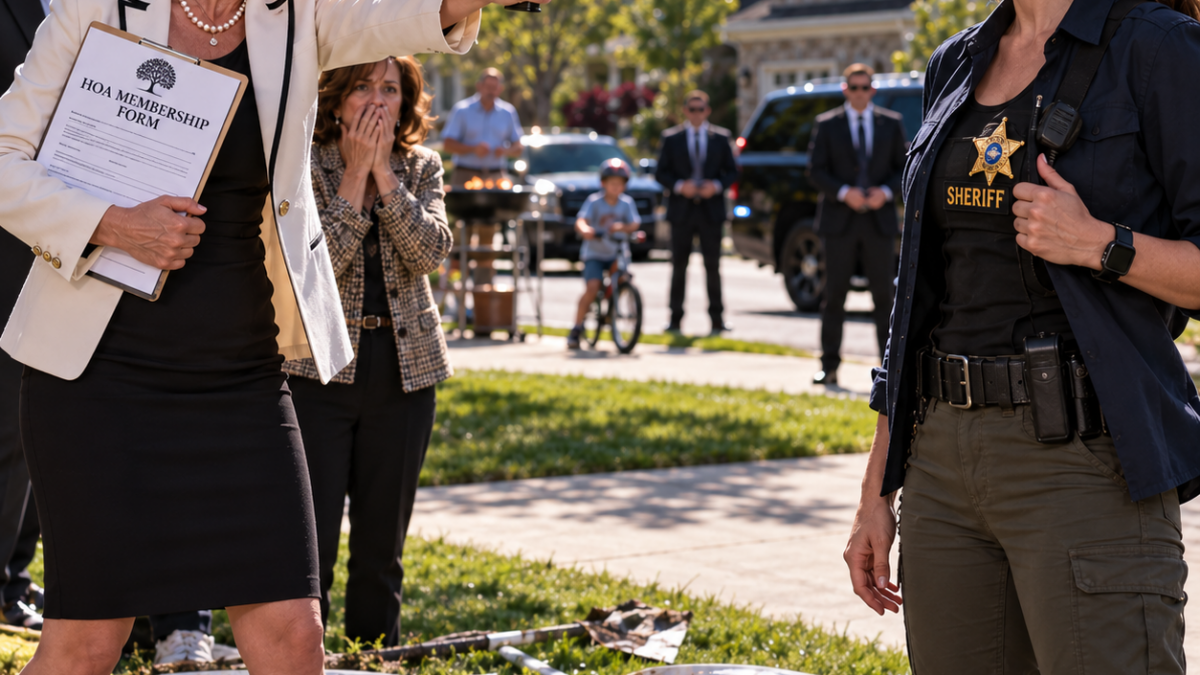


Calm.
Focused.
Already solving it.
“Diane,” Megan said, “lower the weapon.”
“Sign it.”
“Lower the weapon.”
Diane lifted the gun another inch.
“Sign it or I will use it.”
Then she said the sentence I have replayed in my head a thousand times since.
“This is HOA property, and you are trespassing on community values.”
Community values.
That was the phrase she chose while pointing a firearm at a woman standing on a deeded residential lot fifty feet outside the HOA’s actual recorded boundary.
Lot 47 was not HOA property.
Cedar Lane was not inside Diane’s jurisdiction.
The lower stretch of the street had never been annexed into Cedar Ridge.
But Diane had pretended otherwise for seventeen years.
She had mailed dues invoices to people who owed her nothing.
She had threatened liens she had no authority to file.
She had collected fines from widows, young families, retirees, and single parents who were too busy, too frightened, or too trusting to walk into the county clerk’s office and read a plat map.
My daughter had done that on day one.
That was why Diane was in the driveway.
That was why the gun was raised.
Behind Diane, lying in the grass where it had been ripped down two nights earlier, was a torn vinyl banner.
Bright white.
Blue letters.
I had hung it the day Megan moved in, because a father does foolish sentimental things when his only daughter buys her first house.
Most of the banner was muddy now.
Part of it had folded under itself.
But if Diane had looked down, if she had read even the visible half, the whole afternoon would have ended differently.
She did not look down.
People like Diane Whitmore rarely do.
They spend so much time looking over other people that they miss the truth lying right at their feet.
Megan’s left hand stayed open at her side.
Her right hand moved slowly toward her shirt lapel.
Not fast.
Not threatening.
Just a small, deliberate motion.
There was a device clipped beneath that lapel with a tiny red light blinking.
It had been recording since Diane’s black Lexus turned onto Cedar Lane.
My phone was recording from the porch.
The woman two houses down had her phone up too.
And Diane Whitmore, after years of ruling Cedar Ridge with fake invoices and real fear, had no idea she was giving us the one thing paper alone could not provide.
A crime she could not deny.
“Little squatter,” Diane snapped.
Her voice carried across the street.
“You think you can move in here and ignore the rules?”
Megan said nothing.
“You think you are special?”
The tiny red light kept blinking.
Diane’s finger tightened near the trigger.
“Answer me, sweetheart.”
That word did something to my daughter’s face.
Not anger.
Something colder.
Sweetheart was the word Diane used on every woman she had bullied into submission.
She had used it on Mrs. Rosario, seventy-two years old, when she took $3,200 from her over a fake lien.
She had used it on Anna from Lot 49 when she threatened to call the city inspector over a porch planter.
She had used it on a young couple with a toddler when they questioned why they had to pay dues to an HOA they had never joined.
Sweetheart.
The sugar on the blade.
Megan looked at Diane and waited one more second.
At the far end of Cedar Lane, two unmarked sedans turned onto the street.
No lights.
No sirens.
Just slow engines and trained people inside them.
Diane never heard them.
She was too busy looking at the woman she thought she could scare.
Megan opened her lapel.
Gold flashed beneath the navy shirt.
Diane’s eyes dropped to the badge.
For the first time that afternoon, her face lost its shape.
“Sheriff Megan Carter,” my daughter said.
Her voice was level.
“Drop the weapon now.”
I had seen my daughter in uniforms before.
Of course I had.
I had watched her graduate from the academy.
I had watched her pin on her first badge with hands that shook worse than she wanted to admit.
I had watched her stand at my kitchen sink at midnight, washing blood out from under her fingernails after a rollover crash outside Mason Creek because she had held pressure on a boy’s leg until paramedics arrived.
But I had never seen her like that.
Not as a child.
Not as a deputy.
Not even on the day she was sworn in as sheriff.
Standing in her own driveway with a gun pointed at her chest, my daughter looked like every lesson life had ever forced into her had finally become one clean line.
Do not panic.
Do not provoke.
Do not miss the truth.
Diane stared at the badge as if it had appeared by magic.
Her mouth opened, but no sound came out.
Carl Hennessy took one step backward.
Brenda Powell whispered, “Oh my God.”
From the porch, I heard myself breathe for the first time in what felt like hours.
Megan repeated herself.
“Drop the weapon, Diane.”
Diane’s eyes lifted from the badge to Megan’s face.
“You’re not—”
“I am.”
“You can’t be.”
“I can.”
“You live here.”
“I do.”
“You tricked me.”
“No,” Megan said. “You threatened me.”
The unmarked sedans rolled closer.
Doors opened.
Two county investigators stepped out, hands near their sidearms, movements smooth and controlled.
A third vehicle stopped behind them.
Detective Luis Marrero got out first.
Behind him came Deputy Erin Hale, who had known Megan since they were both rookies, and District Attorney Celia Rourke, who had no reason to be on Cedar Lane on a Saturday unless the day had been planned very carefully.
Diane finally heard the car doors.
Her head jerked slightly.
Not enough to turn.
She knew, somehow, that looking away from Megan would be worse.
“Diane Whitmore,” Megan said, “place the weapon on the ground and step back.”
The gun shook.
Not much.
Enough.
I wanted to shout.
I wanted to run down those porch steps and put myself between that barrel and my daughter the way I had when she was small and a neighborhood dog barked too close.
But she was not six anymore.
And this was not a dog.
“Diane,” Megan said, softer now, “do not make this worse.”
Diane’s face twisted.
“You ruined my neighborhood.”
The words came out broken.
Not guilty.
Not afraid for anyone but herself.
“You came here with your papers and your questions and your attitude. You turned people against me.”
“No,” Megan said. “I asked to see the recorded authority you claimed to have.”
“You embarrassed me.”
“I asked for a plat map.”
“You made me look like a criminal.”
Megan’s eyes did not move from the gun.
“You did that yourself.”
Something in Diane snapped.
Her face hardened into the expression I had seen once before, three days earlier, at the folding table in the Cedar Ridge clubhouse when Megan politely asked why Diane had been billing nonmembers for sixteen years and Diane smiled like a queen listening to a servant complain about rain.
“I built this community,” Diane hissed.
“You billed it.”
“I protected it.”
“You exploited it.”
“I kept standards.”
“You collected money from people outside your jurisdiction.”
Diane’s lips peeled back.
“They benefited from Cedar Ridge whether they signed or not.”
“They did not belong to Cedar Ridge.”
“They used our roads.”
“Cedar Lane is public.”
“They enjoyed our property values.”
“That is not a legal contract.”
“They lived beside us.”
“That is not consent.”
“They owed us.”
“No,” Megan said, and her voice sharpened for the first time. “They trusted you.”
That landed.
I saw it hit not only Diane, but Carl and Brenda too.
Across the street, Mr. Henderson had stepped away from his grill, spatula still in one hand, face pale.
The little boy on the bicycle had been pulled back toward his father’s chest.
Windows were full of faces now.
Cedar Lane, a street Diane had treated as a row of easy marks, was watching her hold a gun on the woman who had finally read the documents.
“Megan,” Detective Marrero called, low and careful.
“I’ve got her,” Megan said without looking back.
That was my daughter.
Steady enough to make the rest of us believe in the ground beneath our feet.
Diane’s wrist lowered one inch.
Then stopped.
“No.”
Megan’s jaw tightened.
“Diane.”
“No,” Diane said again, louder. “I will not be humiliated in my own neighborhood.”
“This is not your neighborhood.”
That came from behind Diane.
Not Megan.
Not one of the investigators.
Mrs. Rosario had stepped onto her porch.
She was small, silver-haired, wearing house slippers and a yellow cardigan even though the afternoon was warm. Her hands trembled on the railing, but her voice carried.
“This is not your neighborhood, Diane.”
Diane’s eyes flickered.
“You stay out of this, Elena.”
Mrs. Rosario stepped down one porch stair.
“You took my husband’s ring money.”
Diane’s face changed.
Just slightly.
Not regret.
I knew regret when I saw it.
This was calculation.
“That was a valid architectural penalty.”
“My fence was not in your association.”
“It affected visual continuity.”
“It affected nothing. I paid you because you said you would take my home.”
Diane’s mouth tightened.
“You were in violation.”
“No,” Mrs. Rosario said. “I was alone.”
That silence was different.
Heavier.
Because everyone on Cedar Lane knew Mr. Rosario had died the winter before Diane threatened her with a lien that did not exist.
Everyone knew Elena Rosario had sold her husband’s old truck to pay that $3,200.
Everyone knew and still, somehow, nobody had stopped it.
That is the kind of guilt a neighborhood carries quietly until someone brave enough names it out loud.
Megan’s eyes remained on the gun.
“Diane, last warning. Put it down.”
The two unmarked investigators had moved farther apart now.
Careful angles.
Open hands.
Ready.
Diane saw them.
Saw the neighbors.
Saw the phones.
Saw the badge.
For one terrible second, her finger seemed to settle differently.
Then Carl Hennessy spoke.
“Diane.”
His voice cracked.
She snapped her head just enough to glare at him.
“What?”
Carl’s face was gray.
“This is over.”
“You coward.”
“Please put it down.”
“You were there.”
He swallowed.
“You told us it was legal.”
“It was.”
“You told us the county approved the annexation.”
“It did.”
Carl shook his head slowly.
“No. It didn’t.”
Diane’s eyes narrowed.
Brenda made a strangled sound behind her hand.
Carl looked toward Megan, then toward the investigators.
“I have the emails,” he said.
The clipboard in Diane’s hand slipped slightly.
“What did you say?”
Carl’s throat moved.
“I have the emails. The old ones. From when the attorney told you Cedar Lane was outside the boundary.”
Diane’s face went still.
Not pale.
Still.
Like something inside had shut off to prevent collapse.
Megan did not react visibly, but I saw her right shoulder ease by a fraction.
She already knew.
Of course she did.
Carl had come to her two nights earlier after the torn banner incident, shaking so hard I thought he might faint in the kitchen.
He had brought a thumb drive.
He had brought meeting minutes.
He had brought copies of invoices Diane ordered him to send.
He had brought the first truth from inside Cedar Ridge’s board.
And now, standing behind Diane while she held a gun, he finally said it in front of everyone.
Diane breathed through her nose.
“You stupid little man.”
Carl flinched.
That told me everything about how those board meetings must have sounded for years.
Diane turned the gun slightly.
Not away from Megan.
Not fully.
But enough.
Megan moved.
It happened so fast my mind did not catch up until after Diane was on the ground.
One second Megan stood still.
The next, she had stepped inside the line of the gun, caught Diane’s wrist with both hands, turned hard, and drove the weapon down toward the concrete as Detective Marrero and Deputy Hale closed from both sides.
The gun hit the driveway with a sound I will hear until I die.
Diane screamed.
Not from injury.
From losing.
Marrero kicked the weapon away.
Hale pinned Diane’s arm.
Megan stepped back only when the gun was secured.
“Diane Whitmore,” Detective Marrero said, breathing hard, “you are under arrest.”
Diane twisted her head toward Megan.
“You set me up.”
Megan looked down at her.
“You brought the gun.”
“You recorded me.”
“You pointed a firearm at a sheriff.”
“I didn’t know.”
“That is not a defense.”
Neighbors poured onto porches, but nobody came close.
Brenda Powell was crying now.
Carl stood with both hands over his face.
Mrs. Rosario sat down on her porch step like her legs had finally surrendered.
I finally moved.
I came down the porch stairs too fast for a man my age and nearly stumbled on the last one.
Megan turned toward me.
For a second, she was not the sheriff.
She was my daughter.
The same girl who used to climb onto my workbench and ask why bolts had different heads.
The same girl who cried in my arms after her mother died because she hated the way casseroles kept arriving from people who did not know what else to do.
The same girl who, at fifteen, told me she wanted a life where bullies did not get to win just because everyone else was tired.
I reached her, but I did not grab her.
I had learned that after her first year in law enforcement.
Let her come back to herself first.
She looked at me, and the calm in her face cracked just enough for me to see the terror she had held behind it.
“Dad,” she said.
That was all.
I pulled her into my arms.
She let me.
Only for three seconds.
Maybe four.
Then she stepped back, wiped her face once with the heel of her hand, and became Sheriff Carter again.
“Secure the weapon,” she said.
Marrero nodded.
“Already done.”
“Any injuries?”
“No.”
“Witnesses?”
He looked around at the line of neighbors holding phones.
“Plenty.”
The banner lay in the grass between us and Diane’s Lexus.
The afternoon breeze lifted one muddy corner.
For the first time, Diane saw it.
Her eyes moved toward the torn vinyl as Deputy Hale brought her to her knees.
Only half the words were visible.
WELCOME HOME, SHERIFF—
The rest was folded under.
Diane stared at it.
Then at Megan.
Then back at the banner.
Her mouth parted.
That was the moment she understood that the truth had been lying in the grass the whole time.
If she had looked down when she arrived, she might have known who she was threatening.
If she had asked one honest question before raising that gun, she might have saved herself from committing the one crime no fake lien could bury.
But Diane Whitmore did not ask honest questions.
She issued demands.
And that afternoon, the demand finally cost her.
Diane was placed in the back of an unmarked sedan while half of Cedar Lane watched.
No sirens.
No flashing lights.
No drama she could later pretend was excessive.
Just handcuffs, a secured weapon, witness statements, recordings, and a woman who had spent years pretending paper gave her power being taken away because she forgot real law existed.
But the gun was not where the story began.
Not really.
The story began seven weeks earlier, when my daughter called me from her apartment and said, “Dad, I bought a house.”
I nearly dropped the socket wrench in my hand.
“You what?”
“I bought a house.”
“Without telling me?”
“I’m telling you now.”
“Megan.”
“It’s a good house.”
“You bought a house without letting your father inspect it?”
“You’re retired, not dead.”
“Exactly. I have time.”
She laughed, and that laugh loosened something in me I had not realized had been tight for years.
Since her mother died, Megan and I had become careful with happiness. We shared it, but gently, like it might bruise if handled too roughly.
“A real house?” I asked.
“Yes.”
“Not a condo?”
“No.”
“Not one of those modern boxes with no garage?”
“It has a garage.”
“Attached?”
“Yes.”
“How many amps in the panel?”
“Dad.”
“Roof age?”
“Dad.”
“Foundation?”
“You can inspect it tomorrow.”
“That should have happened yesterday.”
She laughed again.
“I love you too.”
The next morning, I followed her to Cedar Lane.
I knew Cedar Ridge, of course.
Everyone in our county knew Cedar Ridge.
Big entrance sign.
Stone columns.
Manicured medians.
Rules about shutters, fences, seasonal decorations, and mailbox posts.
The kind of place where people moved when they wanted order and stayed when they learned order had a cost.
But Megan’s house was not behind the Cedar Ridge entrance.
It sat on the lower stretch of Cedar Lane, past the old sycamores, where the road narrowed and the sidewalks ended.
Older homes.
Bigger yards.
No stone columns.
No manicured entrance.
No uniform mailboxes.
Lot 47 was a single-story brick ranch with faded shutters, a cracked walkway, and a maple tree shading half the roof.
The garage door groaned when Megan opened it.
The kitchen needed work.
The back deck had two boards I did not trust.
The electrical panel was outdated but not dangerous.
The foundation was solid.
The bones were good.
I walked through each room with my clipboard while Megan stood in the doorway smiling at me like she had known exactly how I would react.
“Well?” she asked.
I tried to look stern.
“You overpaid by maybe five thousand.”
“I did not.”
“You did.”
“The inspection report said otherwise.”
“Inspection reports are written by men who don’t love you.”
She rolled her eyes.
“The roof has five good years,” I said.
“Six.”
“Five.”
“Fine.”
“Water heater is ancient.”
“I budgeted for that.”
“Deck needs attention.”
“I know a guy.”
“You do?”
“My father won’t stop hovering unless I give him projects.”
I looked away because if I looked at her too long, I was going to cry.
My daughter had bought a house.
Her first.
Not a rental.
Not an apartment near the sheriff’s office.
A home.
A place with a maple tree, a bad deck, and enough garage space for my tools when I came over pretending she needed help.
I hung the banner that afternoon.
WELCOME HOME, SHERIFF MEGAN CARTER.
Blue letters.
Bright white vinyl.
I tied it between the porch posts while she stood in the yard with both hands on her hips.
“Dad, absolutely not.”
“Too late.”
“The neighbors will think I’m ridiculous.”
“They’ll think you’re loved.”
“I don’t need everyone knowing my title.”
“It’s not a secret.”
“I’m off duty here.”
“You’re still sheriff.”
She sighed.
“You are impossible.”
“I have references.”
Two nights later, the banner was gone.
Not removed.
Ripped.
One end still tied to the porch.
The rest dragged across the yard, muddy and torn near the maple tree.
Megan found it before I arrived.
When I pulled into the driveway, she was standing over it with her arms folded.
Her face had gone still in the way I recognized.
Not sadness.
Assessment.
“Wind?” I asked, though I knew better.
“No.”
“Kids?”
“No.”
She pointed to the porch rail.
The zip tie had been cut clean.
I felt anger rise in me.
“Who knew what it said?”
“Anyone who drove past.”
“You should put cameras up.”
“I already did.”
Of course she had.
That afternoon, an envelope appeared in her mailbox.
Not mailed.
Hand-delivered.
The letterhead read Cedar Ridge Homeowners Association.
I was at the kitchen table when she opened it.
She read silently.
Then handed it to me.
Dear Occupant of Lot 47,
You are hereby notified that your property is subject to Cedar Ridge Homeowners Association standards and membership requirements. Your recent exterior display, namely one unauthorized banner, violates community aesthetic guidelines and must be removed immediately. Failure to comply may result in fines, lien action, suspension of access privileges, and referral to municipal enforcement.
Below that was a membership form.
A demand for prorated annual dues.
A $250 administrative intake fee.
A $100 banner violation.
And a signature line.
I read the letter twice.
“Occupant?”
Megan nodded.
“Lot 47?”
“Yes.”
“Cedar Ridge?”
“Apparently.”
I looked out the kitchen window toward the quiet street.
“Are you in the HOA?”
“No.”
“You checked?”
“I checked before closing.”
“Check again.”
“I already did.”
She opened her laptop.
County recorder.
Subdivision map.
Cedar Ridge declaration.
Annexation documents.
Cedar Lane plat.
Lot 47 sat outside the HOA boundary.
Not barely.
Clearly.
The upper section of Cedar Lane had been annexed into Cedar Ridge years after the original subdivision was built.
The lower stretch had not.
Lots 43 through 52 were independent residential lots with no recorded obligation to Cedar Ridge.
No covenant.
No membership agreement.
No dues.
No authority.
“Then why are they sending this?”
Megan leaned back.
“That’s what I want to know.”
Most people would have called the HOA and argued.
Megan did not.
She made copies.
Then she started reading.
That was my daughter’s gift.
Other people got angry first.
Megan gathered facts first.
By evening, she had found eight prior owners along lower Cedar Lane who had received Cedar Ridge invoices.
By the next day, twelve.
Some had ignored them.
Most had paid.
One elderly widow had paid thousands under threat of lien.
A young couple on Lot 49 had paid dues for three years because they thought it was tied to property taxes.
A divorced father on Lot 51 had paid fines after Diane threatened to report his home-based repair business.
Lot 45 had changed hands twice, and both owners had apparently been charged “transition fees.”
Every payment went to Cedar Ridge HOA.
Every notice used confident language.
None cited a valid recorded covenant.
“That’s not a mistake,” Megan said late that night.
We sat at her kitchen table surrounded by printed documents.
The house still smelled faintly of paint and cardboard boxes.
I had come over to fix the deck.
Instead, I was watching my daughter build a case on a yellow legal pad.
“What is it?” I asked.
“A pattern.”
“You’re going to report it?”
“I’m going to verify it first.”
“You are sheriff.”
“That means I need to be more careful, not less.”
I hated that she was right.
She did not want anyone claiming she had used her position to settle a personal HOA dispute.
So she moved like a citizen first.
Records request.
County clerk.
Recorder’s office.
Tax assessor.
Prior filings.
Old meeting minutes.
Bank statements where residents were willing to share them.
She knocked on doors in plain clothes, introduced herself as Megan Carter from Lot 47, and asked whether Cedar Ridge had ever billed them.
Some neighbors were suspicious.
Some embarrassed.
Some relieved.
Mrs. Rosario cried at her kitchen table.
She had kept every letter in a shoebox.
Diane’s name appeared on all of them.
“Mrs. Rosario,” Megan asked gently, “did you ever sign a membership agreement with Cedar Ridge?”
“I don’t know.”
“May I see what they gave you?”
Mrs. Rosario searched the shoebox.
There was no agreement.
Only invoices.
Threats.
A letter titled FINAL NOTICE BEFORE LIEN.
The lien had never been filed because it could not legally be filed.
But Mrs. Rosario had paid anyway.
“They said I could lose the house,” she whispered.
Megan’s face remained calm.
Her hand under the table curled into a fist.
“I sold Daniel’s truck,” Mrs. Rosario said. “After he died. I didn’t have the savings.”
I had to stand and look out the window because I could not trust my face.
Daniel Rosario had driven that truck for twenty-five years.
Blue Ford.
Dented tailgate.
He used to wave at everyone.
Diane had taken a dead man’s truck from his widow with a fake threat on HOA letterhead.
That was when the case stopped being paperwork to me.
It became personal in a way I knew Megan was trying hard to resist.
Three days later, Diane Whitmore came to Lot 47 for the first time.
I was replacing a deck board in the backyard when Megan called out, “Dad.”
I came around the side of the house wiping sawdust from my hands.
Diane stood on the front walk wearing white slacks, a pale green blouse, and sunglasses too large for her face.
She had the posture of someone used to entering spaces she did not own and behaving as though everyone else should apologize for standing there.
Behind her stood Brenda Powell with a folder and Carl Hennessy with a tablet.
“Megan Carter?” Diane asked.
“That’s me.”
“I’m Diane Whitmore, president of the Cedar Ridge Homeowners Association.”
“I know.”
Diane smiled.
Not friendly.
Administrative.
“We received your refusal to complete the required membership paperwork.”
“I didn’t refuse. I requested your recorded authority.”
“The authority is long-standing.”
“That isn’t a document.”
Diane’s smile tightened.
“Lot 47 has historically complied with Cedar Ridge standards.”
“Prior owners may have paid you. That doesn’t create legal authority.”
“Community obligations are not optional simply because a new buyer dislikes them.”
“Recorded covenants aren’t optional either. Show me one.”
Diane removed her sunglasses slowly.
That was the first time I saw the real woman under the polite performance.
Her eyes were sharp, flat, and used to winning by making other people uncomfortable.
“You are new here,” she said.
“I am.”
“Then you might benefit from listening before embarrassing yourself.”
I took one step forward.
Megan glanced at me.
Barely.
It was enough.
I stopped.
Diane saw it and smiled.
She thought she had found weakness.
A father being managed by his daughter.
She did not understand discipline when she saw it.
“Ms. Whitmore,” Megan said, “I’m asking again. Please provide the declaration, amendment, annexation filing, signed agreement, or recorded instrument that places Lot 47 under Cedar Ridge authority.”
Brenda shifted behind Diane.
Carl looked down at his tablet.
Diane’s voice cooled.
“You will receive instructions at the appropriate time.”
“No,” Megan said. “You will receive a certified letter from me requesting proof before any further payment demand is considered.”
“Careful, sweetheart.”
There it was.
The word.
Megan’s eyes changed slightly.
Diane continued.
“This neighborhood has standards. People who come in with hostility tend to find out how expensive noncompliance can become.”
Megan smiled.
Small.
Not warm.
“I’m very familiar with expensive noncompliance.”
Diane did not know what to do with that.
She turned and left.
That night, Megan installed two more cameras.
One facing the driveway.
One facing the porch.
One hidden near the maple tree.
“Do you think she’ll come back?” I asked.
“Yes.”
“You sound sure.”
“She’s not used to being challenged.”
“Neither are you.”
Megan looked at me.
“I get challenged every day.”
“Not by criminals with letterhead.”
That almost made her smile.
Two days later, the banner was torn.
The camera caught a black Lexus stopping at 1:13 a.m.
It did not catch Diane’s face clearly.
It caught enough.
A person in a light jacket crossed the yard with a small blade, cut the zip ties, ripped the banner down, and dragged it across the grass.
Megan watched the footage twice.
Then saved copies.
She did not confront Diane.
That surprised me.
“Why not?” I asked.
“Because the banner isn’t the case.”
“It’s vandalism.”
“It’s leverage.”
“You’re letting her think she got away with it.”
“Yes.”
“Why?”
“Because people who think they got away with the small thing usually try the bigger thing.”
I did not like that.
But I had raised my daughter to think clearly.
Now I had to survive watching her do it.
On Thursday evening, Carl Hennessy came to Megan’s back door.
He looked like a man who had been arguing with himself for days and losing every round.
I was sanding the deck rail.
Megan invited him in.
He would not sit at first.
Then he sat.
Then he stood again.
Then he finally placed a thumb drive on the kitchen table.
“I can’t do this anymore,” he said.
Megan did not touch the drive.
“What’s on it?”
“Emails. Minutes. Old letters. A legal opinion.”
“About Cedar Lane?”
He nodded.
His eyes were wet.
“Diane knew.”
I felt my hands go cold.
“Knew what?” Megan asked.
Carl swallowed.
“That Cedar Lane wasn’t in Cedar Ridge. The attorney told her years ago. He said the lower lots could not be billed unless they signed voluntary agreements.”
“And did they?”
“No.”
“Then why continue?”
Carl looked at the table.
“Because they paid.”
The room went quiet.
Not surprised.
Worse.
Confirmed.
Megan’s voice softened.
“Carl, why bring this now?”
He rubbed both hands over his face.
“Mrs. Rosario came to the meeting last year asking for more time. Diane laughed after she left. Said grief made people easier to manage.”
I stood up so fast the chair scraped behind me.
Megan’s hand lifted slightly.
Dad.
I stayed where I was.
Carl cried then.
Quietly.
Ashamed.
“I should have said something.”
“Yes,” Megan said.
No comfort.
No cruelty.
Just truth.
“You still can.”
He nodded toward the drive.
“I am.”
From that moment, the case shifted.
Megan called Detective Marrero.
Not as a homeowner.
As sheriff.
But she also stepped back from direct investigative control.
Conflict of interest mattered.
She was a victim now.
A complainant.
A witness.
So District Attorney Celia Rourke assigned investigators from outside Cedar Ridge jurisdiction to review the documents.
The findings were worse than even Megan expected.
For seventeen years, Cedar Ridge had billed nonmember properties on lower Cedar Lane.
Not every month.
Not always consistently.
But often enough.
A transition fee here.
An architectural fine there.
A “community access contribution.”
A “roadside maintenance assessment.”
A “nonmember compliance penalty.”
Official-sounding nonsense.
The amounts were small enough most people paid rather than fought.
That was the genius of it.
No single bill large enough to force a lawsuit.
No single threat dramatic enough to make the evening news.
Just steady pressure on people who had jobs, children, illnesses, grief, mortgages, and no reason to believe an HOA president would fabricate authority out of thin air.
Megan collected statements.
Mrs. Rosario.
Anna from Lot 49.
The young couple with the toddler.
A retired mechanic.
A widowed nurse.
A man who had moved away after paying more than $5,000 in fake fines over eight years.
The paper trail grew.
So did Diane’s anger.
First came another letter.
Then a notice taped to Megan’s door.
Then a certified packet demanding she attend a “mandatory compliance hearing” at the Cedar Ridge clubhouse.
Megan went.
So did I.
So did Detective Marrero, sitting quietly in the back in plain clothes.
Diane sat at the front of the room behind a folding table like she was chairing a congressional committee.
Board members on either side.
Carl looked ill.
Brenda avoided Megan’s eyes.
About twenty residents attended, most from Cedar Ridge proper, people curious about the new woman from Lot 47 who had apparently caused so much trouble.
Diane called the meeting to order.
“Ms. Carter,” she said, “you have refused to complete membership documents, refused to pay required fees, displayed unauthorized signage, and engaged in hostile conduct toward this association.”
Megan stood.
“I have requested proof of authority.”
“You have been given instructions.”
“I have not been given a recorded covenant, deed restriction, annexation, or signed agreement.”
Diane smiled.
“This association has governed Cedar Lane for years.”
“No,” Megan said. “It has billed Cedar Lane for years.”
A murmur moved through the room.
Diane’s smile thinned.
“You are not recognized to speak beyond your own matter.”
“Then I’ll speak to my matter. Lot 47 is outside your boundary.”
Diane lifted a paper.
“We have prepared the necessary membership form. Sign it tonight, pay the outstanding balance, remove your unauthorized banner, and this board may consider waiving certain penalties.”
“May consider?”
“That is generous under the circumstances.”
Megan looked at the paper.
Then at Diane.
“No.”
Diane’s face hardened.
“No?”
“No.”
“Then this board will escalate enforcement.”
“You have no enforcement authority.”
“That is your opinion.”
“It is the county recorder’s record.”
Diane leaned forward.
“Sweetheart, you bought into the wrong neighborhood if you think arrogance will protect you.”
Megan’s voice remained level.
“I bought outside your neighborhood.”
For the first time, someone laughed.
Not loudly.
A small sound from the back row.
Diane’s eyes snapped toward it.
The room went quiet again.
But the laugh had happened.
And Diane had heard the crack.
After the meeting, Diane followed Megan into the parking lot.
I was ten feet behind.
Detective Marrero was farther back, pretending to check his phone.
“You think you’re clever,” Diane said.
Megan kept walking.
“You think because you have a few papers, you can undo seventeen years of precedent?”
“I think seventeen years of theft is still theft.”
Diane stopped.
There it was.
The word.
Megan turned back.
Diane’s face had gone pale with fury.
“You have no idea what I can do.”
“I’m starting to.”
“You will sign that form.”
“No.”
“You will.”
Megan looked at her for a long moment.
Then said, “Diane, don’t come to my house again unless you bring a lawyer or law enforcement.”
Diane smiled.
The smile was almost gentle.
“Careful what you ask for.”
Two days later, Diane came with a gun.
That Saturday afternoon had started peacefully.
Too peacefully, maybe.
Megan had asked me to come over and look at the deck stairs.
I brought tools.
She made iced tea.
We ate sandwiches standing at the kitchen counter because neither of us had bothered setting up the dining table yet.
She was tired.
I could see it around her eyes.
Not scared.
Tired.
Cases like this wore differently than normal crime. Normal crime usually knew it was crime. Diane’s version wore pearls, carried bylaws, and called theft “community standards.”
“You okay?” I asked.
Megan rinsed her plate.
“Yes.”
“Try again.”
She leaned against the sink.
“I keep thinking about Mrs. Rosario selling that truck.”
“I know.”
“She kept apologizing for not knowing better.”
“She trusted what looked official.”
“She said she felt stupid.”
“She wasn’t.”
“I know.”
Megan looked toward the living room, where boxes still lined one wall.
“I bought this house because I wanted quiet.”
I smiled sadly.
“You have never been good at quiet.”
“I tried.”
“No, you didn’t.”
That made her laugh.
A small laugh.
The last easy sound before Diane arrived.
At 4:39, the driveway camera pinged.
Megan looked at her phone.
“Diane.”
I stood.
“She alone?”
“No. Carl and Brenda are with her.”
Megan clipped the small recorder beneath her lapel before she opened the door.
I noticed.
Of course I noticed.
“Expecting trouble?”
“Expecting Diane.”
Diane’s black Lexus sat at the curb.
Carl and Brenda stood near the sidewalk.
Diane walked up the driveway carrying a clipboard.
No gun visible then.
Just the clipboard.
Just the form.
Just the same arrogance wearing Saturday-afternoon makeup.
Megan stepped outside.
I stayed on the porch with my iced tea.
“What can I do for you, Diane?” Megan asked.
Diane held out the clipboard.
“This ends today.”
“No, it doesn’t.”
“You will sign the membership form.”
“I will not.”
“Your refusal is creating distress throughout the community.”
“I imagine accountability does that.”
Diane’s nostrils flared.
“You think you can bully decent people with badges and technicalities?”
“I haven’t shown you a badge.”
Diane missed that.
Or maybe she heard it and did not understand.
“You moved here under false pretenses.”
“I bought a house.”
“You infiltrated this neighborhood.”
“I live on a public street outside your HOA.”
“You are a squatter on community values.”
That was when I started recording with my phone.
I did it openly.
Diane saw me.
“Put that away.”
“No.”
“You do not have consent to record me.”
“You’re standing in my daughter’s driveway.”
“This is association business.”
“This is a public-facing driveway and you’re threatening her.”
Diane’s eyes moved back to Megan.
“Your father is as disrespectful as you are.”
Megan said, “Dad, stay on the porch.”
The way she said it made me obey.
Diane shoved the clipboard toward her.
“Sign.”
“No.”
“Sign it.”
“No.”
Then Diane reached into her purse.
For one insane second, I thought she was pulling out a pen.
She pulled out a gun.
The world narrowed.
The safety clicked.
Everything after that became both too fast and too slow.
“You will sign this membership form right now,” Diane said, “or I will have you removed from my neighborhood.”
Megan told her to lower the weapon.
Diane raised it.
Carl whispered, “Diane, don’t.”
Brenda began crying before anything had happened.
And the little red light beneath Megan’s lapel kept blinking.
When Megan finally revealed the badge, Diane’s face collapsed.
When Carl admitted he had the emails, Diane’s world cracked open.
When Megan disarmed her, the whole neighborhood exhaled seventeen years of fear.
But arrest was only the beginning.
The days after Diane was taken away were stranger than I expected.
I thought people would celebrate.
Some did.
Quietly.
Mrs. Rosario brought Megan a plate of enchiladas and cried on the porch.
Anna from Lot 49 hugged her so hard I thought Megan might stop breathing.
The young couple with the toddler left flowers by the torn banner.
But many people did not know what to do with freedom after fear.
They were embarrassed.
Angry.
Relieved.
Suspicious.
Some had defended Diane for years because admitting she was wrong meant admitting they had helped her hurt neighbors.
That is a hard mirror.
Cedar Ridge proper split almost immediately.
One group claimed Diane had a breakdown and that her “mistake” with the gun should not erase years of service.
Another demanded a full audit.
A third tried very hard to pretend the entire thing was a personal dispute involving lower Cedar Lane.
Then the recordings came out in court.
Not leaked.
Not edited for gossip.
Played properly during preliminary hearings and referenced in filings.
Diane’s voice saying, “Sign it or I will use it.”
Diane saying, “This is HOA property.”
Diane calling Megan a little squatter.
Diane using sweetheart like a leash.
Diane’s own words did what no neighbor meeting ever could.
They removed plausible misunderstanding.
The financial investigation widened.
The Cedar Ridge accounts were subpoenaed.
Invoices to nonmember lots.
Fake penalties.
Improper transfers.
Board approvals with missing minutes.
Checks written to vendors connected to Diane’s friends.
Legal fees paid to threaten people who owed nothing.
Some board members cooperated.
Some suddenly forgot entire years of meetings.
Carl cooperated completely.
Brenda did too, eventually, though she spent the first interview crying so hard investigators had to pause twice.
“I knew it felt wrong,” she said.
Megan was not in the interview room.
Conflict of interest.
But she read the transcript later at her kitchen table.
I watched her face.
No satisfaction.
Only sadness.
Brenda had known enough to feel wrong.
Not enough to stop it.
That is how abusive power survives.
It rarely depends on one villain alone.
It depends on people nearby deciding discomfort is not evidence.
The district attorney filed charges tied to the gun first.
Aggravated assault.
Brandishing.
Coercion.
Attempted extortion.
Then came financial charges.
Fraud.
Theft by deception.
Falsifying association records.
Unauthorized collection of assessments.
Threatening invalid liens.
The civil cases followed.
One by one, lower Cedar Lane residents filed claims.
Some for small amounts.
Some for thousands.
Mrs. Rosario’s case became the one the local paper focused on because people understood the image of a widow selling her husband’s truck to pay a fake lien.
Diane’s attorney tried to argue that Cedar Ridge had operated under a good-faith belief that lower Cedar Lane was historically included.
Then Celia Rourke produced the old legal opinion from Diane’s own files.
The one Carl had saved.
It stated clearly that lots 43 through 52 were outside Cedar Ridge authority and could not be billed absent voluntary signed agreements.
The opinion was dated nine years before Diane pointed a gun at Megan.
Nine years.
After that, good faith died on the page.
Diane’s attorney pivoted.
Claimed board confusion.
Claimed administrative error.
Claimed Diane relied on bad advice.
Then investigators produced email threads where Diane wrote, “Do not put boundary language in resident-facing notices. It invites questions.”
Another where she wrote, “Lower lane owners usually pay after the second letter.”
Another where she wrote, “Elena R. is vulnerable but solvent. Give her until Friday, then send lien warning.”
I was sitting behind Mrs. Rosario when that email was read in court.
She made no sound.
She only closed her eyes.
Megan reached for her hand.
Mrs. Rosario held it.
Diane did not look at either of them.
By then, Diane looked smaller.
Not humbled.
Small.
There is a difference.
Humility comes from understanding harm.
Diane’s smallness came from losing the audience that once made her feel large.
The judge froze certain HOA accounts.
A receiver was appointed to review Cedar Ridge finances.
The board was suspended pending restructuring.
Residents who had once feared asking questions began showing up to meetings with folders, receipts, copies of notices, and years of swallowed anger.
The county clerk held a public workshop on reading plats and deed restrictions because so many people suddenly realized they had never understood the documents governing their own homes.
Megan attended from the back row.
Plain clothes.
No badge visible.
I sat beside her.
The clerk projected the Cedar Ridge boundary map onto a screen.
There it was.
Clear as daylight.
The lower stretch of Cedar Lane outside the shaded HOA boundary.
Lot 47 outside.
Mrs. Rosario outside.
Anna outside.
The young couple outside.
All of them outside.
A line on paper that would have saved people thousands if anyone had known to ask.
Mrs. Rosario raised her hand.
Her voice shook but held.
“How do we know if someone is lying to us with official-looking paper?”
The clerk paused.
Then answered gently.
“Official-looking paper is not the same as recorded authority. Ask for the recording number. Ask where it is filed. Ask for the instrument creating the obligation. If they cannot show you, do not assume they are right.”
Mrs. Rosario nodded.
Megan leaned toward me and whispered, “That should be taught in high school.”
“She’s right,” I whispered back.
“You always say that.”
“You usually are.”
“Usually?”
“You bought a house without me inspecting it first.”
She smiled.
For the first time in weeks, it reached her eyes.
The criminal case did not go to trial.
Not fully.
Diane held out longer than her attorney wanted.
She believed, even after everything, that a jury would see her as a community leader who made one terrible mistake under stress.
Then prosecutors prepared to introduce testimony from twenty-three lower Cedar Lane residents, financial records going back seventeen years, the legal opinion she ignored, the recordings from Megan’s driveway, my phone video, three neighbor videos, and the torn banner with the visible words “WELCOME HOME, SHERIFF.”
Diane accepted a plea.
The gun charges carried consequences she could not talk her way out of.
The fraud charges carried restitution.
She resigned permanently from any HOA or nonprofit board role as part of the agreement.
She was ordered to repay what she had taken.
Not all at once.
Not magically.
The court is not a fairy tale.
Money stolen over seventeen years does not return overnight.
But judgments were entered.
Properties were liened lawfully this time.
Accounts were seized.
Insurance refused to cover intentional misconduct.
Diane sold the black Lexus first.
Then the vacation condo she had never mentioned during community budget complaints.
Eventually, her Cedar Ridge house went on the market.
The same house where she had hosted compliance teas, board strategy dinners, holiday wine nights, and meetings where she decided which widow to threaten next.
I did not go watch the sign go up.
Neither did Megan.
Mrs. Rosario did.
She told me later she stood across the street for nearly ten minutes, not smiling, not crying.
Just looking.
“Did it help?” I asked her.
She thought about it.
“No,” she said. “But it ended something.”
That sounded right.
Justice does not always feel like joy.
Sometimes it feels like a door closing at last.
Cedar Ridge changed too.
A new board was elected under court supervision.
Boundary disclosures became mandatory.
Every invoice had to cite the recorded authority supporting it.
Residents outside the HOA received letters acknowledging they had no obligation to pay and apologizing for years of improper demands.
The apology letter was stiff.
Legal.
Not nearly enough.
But for some people, seeing the truth on letterhead mattered.
Mrs. Rosario framed hers beside a photograph of Daniel’s blue Ford.
Anna from Lot 49 used her restitution to rebuild the porch Diane had once threatened over a planter.
The young couple started a college fund for their toddler with the money they recovered.
Lot 47 got quieter.
Eventually.
Megan repaired the lawn where Diane’s heels had dug into the grass.
I replaced the deck boards.
We rehung the banner for exactly one afternoon, then took it down before weather could get to it.
Megan said she did not need it anymore.
I cut out one clean piece before we folded it away.
SHERIFF MEGAN CARTER.
Blue letters on white vinyl.
It sits in my garage now, above my workbench.
Not because she needs reminding.
Because I do.
For weeks after the incident, I woke at night hearing the safety click.
I would sit up in bed, heart racing, seeing the gun rise again.
Megan had nightmares too, though she tried to deny it.
One night, I found her on the porch at 2:00 a.m., sitting barefoot on the steps with a mug of tea gone cold beside her.
I sat next to her.
Neither of us spoke for a while.
Finally, she said, “I keep thinking I should have moved sooner.”
“No.”
“She could have fired.”
“You moved when you could.”
“I waited.”
“You de-escalated.”
“I gave her time.”
“You gave her a chance not to ruin her life.”
Megan looked at the dark street.
“I hate that part.”
“What part?”
“I hate that I still wanted her to put it down. After everything she did, I still wanted her to choose better.”
I looked at my daughter then and felt a kind of pride too heavy to carry comfortably.
“That is why you should wear the badge.”
She shook her head.
“No. The badge needs people who still hope the person with the gun makes the right choice.”
She wiped her face angrily.
“I’m so tired, Dad.”
“I know.”
“I just wanted a house.”
I put my arm around her shoulders.
This time she leaned in.
For longer than three seconds.
“You still have one,” I said.
She looked down Cedar Lane.
“So do they.”
That was the thing Diane never understood.
A neighborhood is not owned by the person who controls the meetings.
It is not owned by the loudest voice, the thickest folder, the sharpest threat, or the woman willing to turn fear into income.
A neighborhood belongs to the people who live there.
The widows.
The kids learning to ride bikes.
The fathers grilling hamburgers.
The retirees watering flowers.
The young couples counting grocery money.
The daughters buying first homes.
The neighbors too scared to speak until someone else finally does.
Diane had called Cedar Lane hers.
But after her arrest, people started acting like it belonged to them again.
They organized a block dinner without asking Cedar Ridge permission.
They planted flowers in mismatched pots.
They painted mailboxes different colors.
Mrs. Rosario put up a small wooden sign near her porch that said THE ROSARIO HOME in bright blue letters.
No one fined her.
No one dared.
The first time I saw it, I laughed so hard she came outside to see what was wrong.
“Do you like it?” she asked.
“I love it.”
“Daniel would have said it’s crooked.”
“It is.”
She smiled.
“I know.”
Megan’s house became a gathering place in a way none of us planned.
People came by with documents.
Questions.
Cookies.
Flowers.
Stories they had been afraid to tell.
Megan listened when she could.
When it became too much, she directed them to attorneys, the clerk, the receiver, victim advocates.
She learned boundaries.
So did they.
One afternoon, the little boy from two doors down rode his bike into her driveway, stopped in front of the garage, and said, “My mom says you arrested the mean lady.”
Megan crouched.
“I helped.”
“Because she had a gun?”
“Yes.”
“Are you scared of guns?”
Megan thought about it.
“I respect them.”
He frowned.
“What does that mean?”
“It means I know they can hurt people, so I take them seriously.”
He considered this with the solemnity of a six-year-old judge.
“Were you scared?”
“Yes.”
His eyes widened.
“But you’re sheriff.”
“Sheriffs get scared.”
“What do they do?”
“Try to do the right thing anyway.”
He nodded slowly.
Then said, “My bike has a loose chain.”
Megan looked toward me in the garage.
“Grandpa Carter can fix that.”
I lifted a finger.
“I am not Grandpa Carter to the whole street.”
The boy looked at me.
“Can you fix it?”
I sighed.
“Bring it here.”
That was how I became Grandpa Carter to the whole street.
I pretended to hate it.
I did not.
A year after Diane’s arrest, Cedar Lane held its first block party.
No permits beyond what the city required.
No HOA approval.
No compliance table.
No Diane with a clipboard.
Folding chairs filled driveways.
Kids drew chalk pictures on the pavement.
Mr. Henderson grilled too many burgers.
Anna brought lemonade.
Mrs. Rosario made enough enchiladas to feed a small army.
Someone hung string lights between two maple trees.
At sunset, Megan stood near the edge of her lawn, watching people move from yard to yard without fear.
I stood beside her.
“You okay?” I asked.
She smiled.
“Yes.”
“Try again.”
She looked at me.
Then back at the street.
“I think I am.”
That was the most honest answer she had given in months.
Across the road, Carl Hennessy arrived.
He had not come to any informal gatherings before.
People still did not know what to do with him.
He had helped Diane for years.
He had also handed over the emails that helped end it.
Both things were true.
He walked up to Megan holding a folder.
My shoulders tightened.
Megan noticed.
Of course she did.
“It’s all right,” she said quietly.
Carl stopped a few feet away.
“I’m moving,” he said.
Megan nodded.
“I heard.”
“I wanted to bring this before I left.”
He held out the folder.
She took it.
Inside were more copies.
Old notices.
Meeting notes.
A handwritten list of residents Diane had targeted most often.
“I should have given you everything sooner,” he said.
“Yes,” Megan said.
He flinched.
Then nodded.
“I know.”
She looked at him for a long moment.
“Thank you for giving what you did.”
His eyes filled.
“I don’t deserve that.”
“No,” she said. “But the truth still mattered.”
Carl left before dinner.
Mrs. Rosario watched him go.
Then said softly, “People are not one thing.”
Megan heard her.
“So I’m learning.”
Diane did not return to Cedar Lane.
Not once.
Her house sold to a family with three children and a golden retriever that escaped twice in the first week.
The new owners asked Megan if the neighborhood was “strict.”
Megan laughed so hard she had to sit on the porch step.
“No,” she said when she recovered. “Not anymore.”
The mother looked confused.
The rest of us laughed too.
Some stories become funny only after they stop hurting so sharply.
Others never become funny at all.
The gun never did.
The safety click remained with me.
Even now, years later, an unexpected metallic snap can pull me back to that porch.
But memory changed shape over time.
At first, the sound belonged to fear.
Then anger.
Now, when I hear it in my mind, I also see what came after.
My daughter’s open hand.
The blinking red light.
The badge beneath the navy shirt.
Mrs. Rosario stepping onto her porch.
Carl finally telling the truth.
Neighbors filming.
Investigators arriving without sirens.
The gun hitting concrete.
Diane looking down at the banner too late.
That is the image I keep.
Not Diane with power.
Diane realizing she never had as much as she thought.
Because fear can look like power for a long time.
So can money.
So can letterhead.
So can a title.
President.
Chairwoman.
Community leader.
Protector of values.
But real authority does not need to steal.
Real authority does not need fake liens, forged boundaries, or a gun in a driveway.
Real authority can stand still with open hands and say, “Drop the weapon now,” because truth is already on its side.
Megan still lives in Lot 47.
She replaced the water heater.
The roof lasted exactly five years, and I have never let her forget it.
The deck is solid now.
The maple tree shades the porch in summer.
The garage holds too many of my tools because I keep “forgetting” them there.
On quiet evenings, we sit outside with iced tea and watch Cedar Lane be ordinary.
Ordinary is underrated.
Ordinary means no one is knocking with fake invoices.
No widow is crying over a threat she does not understand.
No young mother is choosing between groceries and a made-up fine.
No HOA president is mistaking fear for respect.
Sometimes people walk past and wave.
Sometimes they stop to ask Megan a question.
Sometimes the little boy with the once-loose bike chain rides by and yells, “Hi, Sheriff!”
She always waves back.
One spring afternoon, Mrs. Rosario came over carrying a small box.
Inside was a toy truck.
Blue.
Metal.
Old.
Daniel’s favorite from childhood, she said.
Not the real truck Diane’s threat had forced her to sell.
A smaller one he had kept on a shelf in the garage.
“I want you to have it,” she told Megan.
Megan tried to refuse.
Mrs. Rosario would not allow it.
“You helped me get part of him back,” she said.
Megan held that little truck like it weighed more than gold.
Later, she placed it on the mantel.
It is still there.
A reminder that restitution is not always money.
Sometimes justice is a widow seeing the truth written down.
Sometimes it is a street learning to speak.
Sometimes it is a daughter surviving a gun because she stayed calmer than the woman holding it.
And sometimes it is a torn banner in the grass, muddy and half-folded, telling the truth to anyone humble enough to look down.
Diane never looked down.
That was her mistake from the beginning.
She never looked down at the boundary maps.
Never looked down at the signatures missing from the agreements.
Never looked down at the people beneath her threats.
Never looked down at the money she took from hands that could barely afford to open.
Never looked down at the banner in the grass until the handcuffs were already on her wrists.
If she had, she might have seen what everyone else eventually saw.
Cedar Lane was never hers.
Fear was never law.
And my daughter was never the little squatter Diane thought she could scare into signing a fake form.
She was the sheriff.
She was the homeowner.
She was the woman who stood in her own driveway with a gun pointed at her chest and waited for the truth to finish recording.
That is how Diane Whitmore lost everything.
Not because Megan shouted louder.
Not because I protected her.
Not because the neighborhood suddenly became brave all at once.
Diane lost because, for the first time in seventeen years, someone asked her one simple question and refused to move until she answered it.
Show me where it says you have the right.
She never could.
And when the clipboard failed, when the fake forms failed, when the word sweetheart failed, when fear failed, she reached for a gun.
That was the day Cedar Lane stopped being afraid of paper.
And started believing in proof.