𝗣𝗔𝗥𝗧𝟮 :The Puppy Who Found the Secret Beyond My Fence
FULL STORY CONTINUATION
Jessa slid a folder across the desk.
“Food schedule, veterinary contact, vaccination record, emergency number, basic settling-in guidance.”
I read every page.
Of course I did.
If you were going to make a mistake, you at least learned the operating environment first.
Walt watched from a chair in the corner, visibly enjoying himself.
I signed the final line.
Jessa took the form.
“Twenty-one days,” she said.
“Three weeks,” I corrected.
“Yes. Exactly.”
She studied me, then nodded. “Exactly.”
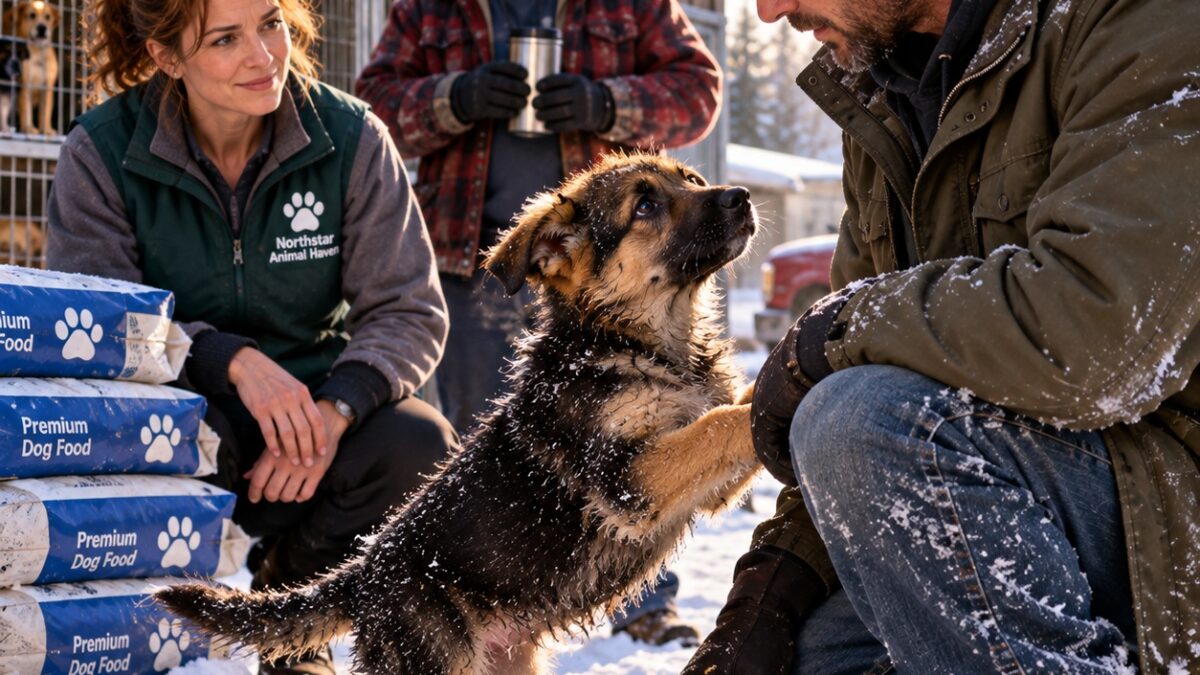
Pax left the shelter wearing a narrow navy collar with a small brass tag.
In my truck, he refused the passenger-side dog bed Jessa had provided and spent the entire drive sitting awkwardly against my thigh.
At home, I carried the crate inside, arranged food and water bowls in the mudroom, placed toys in a basket, and positioned a dog bed beside the sofa with the precision of someone establishing a field station.
Pax inspected everything.
He sniffed the crate.
Sniffed the bowls.
Stepped into the bed.
Turned once.
For three full seconds, I almost felt vindicated.
Then Pax stepped out, walked to my boots, grabbed one lace in his teeth, and began backing away.
“Give me that.”
Pax backed faster.
“Pax.”
The puppy turned and trotted around the coffee table.
I followed.
Pax accelerated.
For the next forty seconds, a retired Navy rescue swimmer was defeated by ten pounds of German Shepherd and a shoelace.
When I finally recovered it, Pax flopped onto the rug, tongue out, looking delighted.
“You’re temporary,” I told him.
Pax sneezed.
That evening, snow began falling again.
I ate soup at the kitchen counter while Pax slept under the table.
The house sounded different with another living thing inside it.
Tiny claws against hardwood.
The soft clink of a collar tag.
An occasional sigh beneath a chair.
I had spent three years removing unpredictability from my life. Pax seemed determined to return it one stolen object at a time.
At 10:30, I turned off the lights.
I sat on the sofa for a few minutes before bed.
Pax wandered over to the new dog bed. He sniffed it. Looked at me. Looked back at the bed.
“Don’t.”
Pax climbed onto the sofa.
“You have your own bed.”
He turned twice beside me.
“Pax.”
The puppy dropped against my hip.
Then one small front leg slid across my forearm.
His head settled against my side.
Within moments, his breathing softened.
I did not move.
Outside, snow whispered against the windows. Somewhere across town, a plow scraped along an empty street. The furnace clicked once and went quiet.
I looked down at the paw resting across my sleeve.
There was no demand in it.
No expectation.
No knowledge of who I had been, what I had failed to prevent, or how carefully I had arranged my life so nothing could reach far enough inside to hurt me again.
The puppy simply trusted the place where he had fallen asleep.
I touched the edge of the old dive watch with my thumb.
Then stopped.
I left my hand where it was.
Three years was a long time to become accustomed to an empty house.
It turned out one night was enough to hear the difference.
By the third morning, I had learned that silence could be destroyed by something weighing less than fifteen pounds.
It began at 5:41 a.m.
Soft scrape of claws across hardwood.
Then a thump.
A pounce.
Another thump.
I opened my eyes.
From somewhere beyond the bedroom door came the unmistakable sound of an object being dragged with great determination.
I sat up.
“Pax.”
The dragging stopped.
For three seconds, the house went still.
Then the sound resumed faster.
I crossed the hallway and found the German Shepherd puppy backing through the kitchen with one of my work gloves clenched triumphantly between his teeth.
Not both gloves.
Only the left one.
Pax froze when he saw me.
I folded my arms.
His amber-brown eyes widened.
“Put it down.”
Pax ran.
The chase lasted long enough for me to discover three things.
First, a ten-week-old German Shepherd could fit beneath the kitchen table faster than a forty-seven-year-old former rescue swimmer could turn around it.
Second, the legs of that table had somehow become tactical obstacles.
Third, Pax believed being chased was the highest form of human affection.
By the time I recovered the glove, my coffee had gone cold.
The next morning, another left glove disappeared.
Then another.
On Thursday, I crouched beside the sofa, reached underneath, and pulled out four left gloves arranged beside a dish towel, half a shoelace, a tennis ball that did not belong to either of us, and one wooden spoon.
I stared at the collection.
Pax sat behind me, tail beating softly against the rug.
“You have a problem.”
He tilted his head.
A truck door slammed outside.
Moments later, Walt came in without knocking, carrying his sticker-covered thermos and a paper bag that smelled of fried dough. He stopped in the living room, looked at me, looked at the pile, looked at Pax, then slowly removed his hat.
“I owe you an apology.”
I narrowed my eyes. “For what?”
“I underestimated him.”
“He’s stealing gloves.”
“Left gloves.”
“Yes.”
Walt pointed at Pax as if presenting evidence to a jury. “That’s ideology.”
“He’s ten weeks old.”
“That’s when extremists are most dangerous.”
I closed my eyes.
Pax immediately stole the wooden spoon.
The kitchen had once been the quietest room in my house.
Now water bowls overturned without warning, towels vanished from chair backs, and one very small animal repeatedly discovered that wet paws left satisfying dark prints across the floor.
The first time Pax knocked over his water, I cleaned it.
The second time, I moved the bowl onto a rubber mat.
The third time, Pax stepped into the bowl with both front paws, jumped out, and sprinted through the living room.
I followed the trail of footprints across the floor, over the rug, and onto the tile near the entryway.
Pax stopped there and looked back.
I stared at him.
He sneezed.
“No.”
He sneezed again.
Walt, who had witnessed the entire incident from the kitchen, bit into a donut and said, “He makes a persuasive case.”
Sometime during that first week, the house developed a rhythm I had not planned.
Food at six.
Outside after meals.
Short training sessions.
Nap.
Play.
Outside again.
Pax learned “sit” quickly.
“Stay” was less successful.
“Leave it” appeared to be interpreted as a philosophical suggestion.
I found myself speaking more than I had in months.
“No.”
“Down.”
“Not the cord.”
“That is not food.”
“Why do you have that?”
Most of the questions received the same response: tilted head, crooked ear, and an expression of deep personal innocence.
It should have annoyed me.
Often, it did.
But annoyance was different from emptiness.
That distinction unsettled me more than the mess.
There were other things I noticed.
Things that were not funny.
On the fifth morning, I put on my coat to walk to the mailbox at the end of the driveway.
Pax, asleep near the radiator, woke instantly.
He scrambled upright and rushed to the door.
“I’m getting the mail.”
He pressed against my boot.
“You’re staying here.”
The moment I opened the door, Pax tried to follow. I blocked him gently with one leg, stepped outside, and closed the door.
The mailbox stood less than forty yards away.
The trip took perhaps ninety seconds.
When I returned, Pax sat behind the glass storm door.
Not playing.
Not barking.
Waiting.
His small body was so close to the door that his nose nearly touched the glass.
I stopped on the porch.
Pax saw me.
He stood so quickly his paws slipped.
I opened the door.
He pushed against my legs, then followed me through the kitchen as though confirming every part of me had returned.
That evening, I went into the bathroom and shut the door.
When I came out ten minutes later, Pax lay directly across the threshold.
He raised his head.
I stepped over him.
He got up and followed.
The pattern repeated.
Coat meant alertness.
Keys meant worry.
Closed door meant waiting.
Once I noticed it, I could not stop noticing.
On Friday afternoon, I called Jessa.
She answered over barking. “How’s my favorite temporary foster?”
“Which one?”
“The furry one.”
I looked across the room.
Pax was asleep with his head inside an empty cardboard box.
“He follows me everywhere.”
“That’s not surprising.”
“He sits at the door when I leave.”
“How long are you leaving him?”
“Minutes.”
“And what does he do when you come back?”
“Acts like I crossed the Atlantic.”
Jessa was quiet for a moment.
“He had several transitions in a very short time,” she said. “Veterinary clinic, intake, temporary room, exam area, your house. For a puppy that age, that’s a lot of change.”
“So I endure it?”
“No. You make leaving boring and coming back boring. Short absences. Predictable routine. Don’t punish him for being worried.”
I watched Pax’s side rise and fall inside the box.
“He thinks people disappear.”
Jessa did not answer immediately.
“Maybe,” she said. “Or maybe he hasn’t learned yet that they come back.”
Something about that sentence bothered me long after the call ended.
Not because of Pax.
Because I understood the logic too well.
Pax tried to keep the world close because he expected loss.
I had spent three years doing the opposite for the same reason.
I did not enjoy the comparison.
I decided it was inaccurate.
Then I spent the next hour thinking about it.
Two days later, another odd habit appeared.
I measured Pax’s breakfast into the bowl. He ate most of it, drank water, then picked up several pieces of kibble and carried them toward the back door.
“Where are you going?”
Pax stood waiting.
I opened the door and followed him into the fenced yard.
Morning sunlight lay blue-white across the snow.
Pax trotted toward the rear fence, nose low. Near a clump of dormant shrubs, he dropped the kibble.
Then he sniffed around the base of the fence.
I walked closer.
“You hiding food now?”
Pax looked at me.
I crouched.
Three pieces of kibble lay on the snow.
A few inches away was a print.
Not Pax’s.
Larger.
Canine, most likely.
The edges had softened in the morning sun, but the difference in size was obvious.
I looked through the fence toward the narrow strip of trees beyond the property.
Nothing moved.
Only bare branches and snow.
I stood.
“Probably somebody’s dog.”
Pax remained at the fence.
I called him back.
He came, though reluctantly.
That afternoon, I placed a small bowl of food near the back porch, far enough from the fence that I could see it clearly from the kitchen.
By morning, the food had not been touched.
A dusting of snow covered the top layer.
I dumped it, cleaned the bowl, and told myself that settled the matter.
Later that day, Pax carried three more pieces of kibble toward the fence.
I watched him from the kitchen window.
This time, he did not leave them in the same place. He pushed his nose beneath the lowest rail, dropped the kibble on the other side, and waited.
Nothing happened.
After nearly a minute, Pax came back inside.
I made a note to ask around about a loose dog.
I did not attach meaning to it.
There was no reason to.
By Sunday, the calendar on the kitchen wall had become harder to ignore.
Not because I checked it.
Because Pax’s foster period was marked in Jessa’s handwriting on the paperwork magneted beside it.
Twenty-one days.
Three weeks.
A clean boundary.
I preferred boundaries.
They told you where things ended.
The phone rang just after lunch.
Jessa.
“Yes?”
“I’ve got an update,” she said.
“That sounds dangerous.”
“It isn’t. A family in Duluth submitted an adoption application for Pax.”
I looked at the puppy.
Pax had successfully found a loose thread on the corner of the rug and was now very proud of himself.
Jessa continued, “They’ve passed initial screening. Two adults, one child, fenced yard, previous shepherd experience. Nothing is decided yet. They’d meet him after the foster period, assuming everything checks out.”
I said nothing.
“Reed,” Jessa said. “I heard you.”
“What do you think?”
I looked at the calendar.
Twelve days remained.
“Sounds good.”
Jessa waited.
“That’s all?” she asked.
“What else should there be?”
“Nothing.”
Her answer was too neutral.
I disliked it.
“Good family on paper?”
“Yes.”
“Then good.”
“All right.”
We ended the call.
I remained standing in the kitchen.
Pax had abandoned the rug and was watching me now.
“What?”
He blinked.
“You’re going somewhere with a yard.”
Pax sat down.
“People who know shepherds.”
Pax yawned.
I glanced back at the calendar.
Twelve days.
Plenty of time.
That evening, snow began falling in slow, broad flakes.
Walt had stopped by earlier and left a container of stew in the refrigerator with a note that read:
Human food. Do not feed to ideological puppy.
I ate half of it.
Pax ate his own dinner.
For a while, the house settled.
Then I realized something was missing.
My last left winter glove.
I stood.
“Pax.”
A shadow moved beneath the kitchen table.
I walked around one side.
Pax appeared on the other.
The glove hung from his mouth.
“No.”
His tail moved.
“Give it here.”
Pax backed away.
I stepped forward.
The puppy ran around the table, past the chair, into the living room.
I followed.
Pax doubled back.
I anticipated the turn this time and nearly caught him.
Nearly.
He slipped between the table legs and emerged on the opposite side with the glove still in his mouth.
“You’re not smart enough for this.”
Pax accelerated.
“You’re ten weeks old.”
Another lap.
“You don’t even understand taxes.”
Pax flew across the kitchen.
I reached left.
He went right.
And then, without warning, laughter came out of me.
Real laughter.
Not the breath of amusement I sometimes gave Walt.
Not a polite reaction.
A full, startled sound that filled the kitchen and made me stop moving.
Pax stopped too.
For one strange second, we stared at each other.
Then Pax dropped the glove.
My chest still held the shape of the laugh.
It felt unfamiliar.
Almost borrowed.
My eyes shifted past Pax.
On the shelf near the dining room doorway stood a framed photograph.
My wife, caught mid-laugh on a summer afternoon. One hand raised against the camera as if she had been asking me to stop taking pictures.
The warmth left my face.
The kitchen became quiet.
Not empty.
Quiet.
There was a difference now.
Somehow that made it worse.
I looked at the photograph.
Three years.
Three years of believing sorrow was one of the last things that still connected me to her.
For a few seconds, I had forgotten to carry it.
The realization arrived with sharp private shame.
Pax walked toward me.
I did not move.
The puppy placed one paw on the toe of my boot.
I looked down.
The stolen glove lay forgotten beneath the table.
Outside, snow brushed softly against the windows.
Inside, the house held two sounds at once.
The memory of laughter.
And the small steady breathing of a dog who had no idea why it had stopped.
The sound that changed everything did not belong to the storm.
That was what made me stop.
Wet snow had been falling over Northstar Bay since midafternoon, heavy enough to soften the edges of rooftops and turn the narrow road behind my house into a pale ribbon without tire marks.
By five, the sky had lowered into a blue-gray ceiling over Lake Superior, and wind moved through the bare trees with a low, continuous rush.
I stood on a short ladder beneath the porch light, replacing a bulb that had started flickering two nights earlier.
Below me, Pax had been attacking a rubber ball with enormous seriousness.
One moment, the puppy was pouncing on it.
The next, he went motionless.
I twisted the new bulb into place.
Light flooded the porch.
Pax did not look up.
His head had turned toward the seasonal cottages beyond the back lane. His more confident left ear stood straight. The tip of the right leaned outward.
His entire body seemed to listen.
“What?”
Pax barked once.
I climbed down.
The puppy waited.
Five seconds passed.
Then Pax barked again toward the same distant point.
Not excitement.
Not the sharp demand he used when his ball disappeared under furniture.
I looked through the falling snow.
The cottages sat roughly a hundred yards away, dark behind a line of birch trees. Most were empty from November through April. Summer decks had been buried under snow for weeks.
Pax barked a third time.
Then I heard it.
Clang.
Very faint.
I held still.
Wind moved through the branches.
Nothing.
Then—
Clang.
Clang.
Two metallic strikes separated by several seconds.
My posture changed.
I did not consciously decide to become alert.
My body simply remembered how.
I stepped inside long enough to grab my phone, leash, and heavier gloves.
Pax rushed toward the door.
“Easy.”
He bounced in place.
I clipped the leash onto his navy collar.
“You’re staying with me.”
We crossed the yard.
The wet snow reached over Pax’s paws, forcing him into a ridiculous high-stepping gait that would have been funny under different circumstances.
Every few yards, the puppy stopped, listened, then pulled again.
The sound grew clearer.
Metal against metal.
Three taps.
Pause.
Two more.
My eyes moved across the cottages.
Number 14, dark.
Number 15, boarded for winter.
Number 16 had yellow municipal tape stretched across the front steps and a red notice fixed beside the door.
UNSAFE ENTRY. STRUCTURAL REPAIR REQUIRED.
I stopped at the edge of the property.
Pax pulled toward it.
“Hold.”
The puppy strained against the leash.
Then came the sound again.
Clang.
And beneath it, so faint I almost missed it—
“Help.”
I already had the phone in my hand.
The emergency dispatcher answered on the second ring.
I gave the address, described the building notice, and said there appeared to be a child inside.
“Do not enter if the structure is unstable,” the dispatcher said.
“I’m not entering.”
I moved around the side of the cottage.
Snow beside the wall had been disturbed by small boot prints. They led toward a low kitchen window.
I crouched.
Inside, the room was dim but not dark. Snow light leaked through the other windows, enough to reveal cabinets, an overturned chair, and a section of floor near the kitchen sink that had collapsed several inches.
A girl sat awkwardly beside it.
One leg disappeared between two broken floorboards.
A short length of metal pipe lay in her hand. She raised it weakly and struck a larger pipe beside her.
Clang.
Pax began whining.
The girl’s head snapped toward the window.
“Hey,” I called.
Her face changed immediately.
Not relief exactly.
The shock of discovering someone had finally answered.
“Can you hear me?”
She nodded fast. “Yes.”
“What’s your name?”
“Maisie.”
“How old are you, Maisie?”
“Eleven.”
“Okay. I’m Reed. Help is coming.”
Her lower lip trembled. “My phone fell.”
“I can see that.”
It lay several feet away, screen glowing faintly beneath the edge of a cabinet.
I kept my voice level.
“Don’t try to reach it.”
“I already did.”
“Did anything shift when you moved?”
She nodded.
A soft creak came from somewhere beneath the kitchen.
My eyes tracked the floor.
“Then don’t move again unless someone tells you to.”
Pax stood with both front paws against the siding beneath the window.
Maisie looked down toward him.
“Is that your dog?”
“Temporarily.”
Even then, the word came automatically.
Pax whined again.
Maisie gave the smallest laugh.
“That doesn’t sound temporary.”
I almost answered.
Another creak rolled through the room.
Maisie’s face tightened.
“What happened?” I asked.
“There’s a cat.”
“A cat?”
“She comes by our street sometimes. Gray. White feet. I feed her behind our garage.”
I watched the damaged floor rather than her expression.
“She came in here?”
Maisie nodded. “The side door was open a little. I thought I could get her and leave.”
“Where is she now?”
“I don’t know.”
Movement flickered behind the far counter.
Two pale eyes appeared briefly.
Then a gray cat slipped across the back of the room and vanished through a gap near the side doorway.
Maisie stared.
“You have got to be kidding me.”
Despite myself, I almost smiled.
“The cat appears to have solved its own problem.”
“That is so unfair.”
“Agreed.”
The wind pushed against the cottage.
Boards complained somewhere above us.
Maisie looked toward the sound.
Her breathing quickened.
“Look at me,” I said.
She did.
“Can you feel your foot?”
“Yes.”
“Can you wiggle your toes inside your boot?”
She concentrated. “Yes.”
“Good. Any sharp pain?”
“Mostly my ankle. And my knee hurts from sitting weird.”
“Okay. Don’t pull at it. Let the fire department handle the floor.”
She wiped one cheek with her sleeve. “I’m cold.”
“Keep your coat zipped. Pull your hands inside your sleeves if you can do it without moving your leg.”
Maisie obeyed carefully.
“You’re doing fine.”
“I’m crying.”
“You can cry and still be doing fine.”
She considered that.
Then nodded.
Pax sat beneath the window.
The puppy no longer barked. Each time Maisie spoke, his head tilted toward her voice.
Sirens appeared as a muted rise beneath the wind.
Not dramatic.
Just closer every second.
Red light soon flashed across the snow between the birch trunks.
A volunteer fire truck stopped at the lane.
Three figures came toward the cottage carrying equipment.
The first was Leah Brennan.
Forty-nine, compact, strong, short black bob heavily silvered at the temples. A navy insulated fire service jacket broadened her shoulders. Reflective piping caught the emergency lights. A radio sat high on her left side, and a yellow flashlight was clipped across her chest.
She recognized me immediately.
“Where?”
“Kitchen. Low window on the east side. Eleven-year-old girl. Right leg caught between damaged boards. She has feeling in the foot. Building shifted when she tried to move.”
Leah nodded once.
“You went inside?”
“No.”
“Good.”
There was no praise in the word.
Just confirmation.
That was one reason I respected people who knew their jobs.
Leah pointed to one firefighter. “Check the crawl space access from outside. Nobody steps onto that kitchen floor until we know what’s supporting it.”
She pointed to the second. “Bring the stabilization kit around.”
Then to me.
“Stay at the window. Keep her talking. Tell me immediately if anything changes.”
I nodded.
No argument.
No attempt to make myself useful beyond what was actually useful.
Leah disappeared toward the side entrance.
I returned to the window.
Maisie had heard the voices.
“They’re here?”
“They’re here.”
“Are they going to cut the floor?”
“Probably.”
“My dad is going to kill me.”
I raised an eyebrow. “I suspect your father is currently more interested in you being all right.”
“You haven’t met him.”
“Fair point.”
For several minutes, the cottage became a world of controlled sounds.
Leah calling measurements.
A tool case opening.
Boots moving over snow outside.
The radio crackling.
The old house answering with occasional dull pops as temperature changed.
Pax remained seated beside my leg.
Snow gathered along his black saddle.
I brushed it away with one glove.
Maisie looked toward us through the window.
“What’s his name?”
“Pax.”
“What does that mean?”
“Peace.”
She listened to the scraping and tapping coming from the other side of the room.
“That’s a weird name for today.”
I looked down at the puppy.
“Yes.”
The side door opened carefully.
Leah appeared inside but stayed on a section of floor her team had already checked.
“Maisie, I’m Leah. We’re going to get you out, but I need you to stay exactly where you are for a little longer.”
Maisie’s composure cracked.
“How long?”
“Not long enough for me to lie to you and say two minutes.”
The honesty seemed to calm her more than reassurance would have.
Leah and her crew worked from the safer section of the room, stabilizing the damaged area before moving closer.
I could not see every step.
I did not need to.
I knew the rhythm of competent people solving a problem.
Observe.
Communicate.
Slow down before speed becomes dangerous.
That rhythm had once been the most natural thing in my life.
Now I stood outside it.
And surprisingly, that was all right.
Then the floor gave another dry crack.
Maisie gasped.
Pax sprang to his feet and barked.
“Stay,” I said.
The puppy trembled but remained where he was.
Inside, Leah’s voice never changed.
“Nobody move.”
Several seconds passed.
I found myself counting without meaning to.
One.
Two.
Three.
Leah spoke again.
“We’re stable.”
Maisie began crying harder.
“I want my dad.”
“I know,” I said.
“I shouldn’t have come in.”
“No.”
“I knew the sign was there.”
“Yes.”
The answer made her look at me.
I kept my voice gentle.
“You made a bad decision. That’s different from being a bad kid.”
Maisie swallowed. “You always talk like that?”
“Unfortunately.”
A watery laugh escaped her.
Pax whined.
I rested one hand against the puppy’s shoulders.
Ten minutes later, Leah’s team lifted the damaged section enough to free Maisie’s boot without forcing her leg.
No dramatic collapse.
No sudden race against seconds.
Just careful hands, clear instructions, and a frightened child finally able to move.
Leah supported Maisie toward the side exit while another responder steadied her.
The instant Maisie appeared outside, Pax tried to rush forward.
I held the leash.
“Easy.”
Maisie was wrapped in a thermal blanket and seated on the rear step of the rescue vehicle. One ankle was supported for the trip to be checked. She looked exhausted, embarrassed, and profoundly relieved.
Then headlights swung hard into the lane.
A dark SUV stopped crooked near the fire truck.
A tall man in a navy quilted winter jacket climbed out before the engine had fully gone quiet.
“Maisie!”
Neil Cooper crossed the snow almost at a run.
Forty-three, lean, close-cut dark blond hair, several days of beard shadow across a narrow face. His pale blue eyes found his daughter and lost every trace of composure.
“Dad.”
He reached her, then stopped himself from grabbing her too quickly. Instead, he crouched. His hands hovered near her shoulders.
“Are you okay?”
“I’m okay.”
“You’re sure?”
“She needs to be checked,” Leah said calmly. “Nothing we’re seeing suggests a serious injury, but we’re not guessing with an ankle.”
Neil nodded several times.
Only then did he seem to notice me and Pax.
Maisie followed his gaze.
“Dad, that’s Pax.”
As though that explained everything.
“And Reed.”
Neil stood.
Before he could say anything, Maisie looked at me.
“Can I hug him?”
I assumed she meant her father.
Then she pointed at Pax.
“Oh.”
I brought the puppy closer.
Maisie crouched as much as the responder allowed and opened her arms.
Pax stepped into them.
For once, he did not chew anything.
He pressed his head against her coat while she buried her face briefly in the fur behind his ears.
“You heard me,” she whispered.
Pax’s tail tapped softly against the snow.
When Maisie was helped into the vehicle, Pax watched until the door closed.
Then he turned toward me.
Without hesitation, the puppy rose onto his hind legs and planted both front paws against my chest.
I bent automatically.
Pax hooked his legs higher toward my shoulders. His warm muzzle pressed against my collar.
And suddenly, I was somewhere else.
Not fully.
Flashes.
Cold rotor wash.
A rescue harness tightening beneath gloved hands.
A voice in a headset.
Hospital light reflected on polished floor.
My wife’s hand motionless beneath mine.
A clock changing numbers while there was nothing left for me to do.
My lungs forgot their rhythm.
I lowered Pax carefully, turned away from the others, breathed once, then again.
I pressed my thumb against the scratched edge of the dive watch.
The metal was cold.
The present returned piece by piece.
Snow.
Engines.
Leah speaking to a responder.
Pax leaning against my boot.
When I turned back, Neil stood several feet away.
He had noticed enough not to ask.
“Thank you,” he said.
I shook my head. “Pax heard her.”
Neil looked down at the puppy, then back at me.
“But you followed him.”
The rescue vehicle pulled away.
Red light washed once across the snow-covered cottage and disappeared around the bend.
That night, long after Pax had fallen asleep, I sat at my kitchen table with the porch light glowing outside.
I could still hear the tapping in my head.
Metal against metal.
A child refusing to let the empty cottage swallow her voice.
But Neil’s words had somehow become louder.
Pax heard her.
But you followed him.
I looked toward the living room.
The puppy slept on the rug, one oversized paw twitching through whatever dream occupied him.
For three years, I had believed survival meant knowing which directions not to go.
That night, for the first time, I wondered what might happen if I stopped choosing the direction away.
By Monday morning, Northstar Bay had decided I was interesting.
I considered this a serious community failure.
The first sign appeared on my porch.
A foil-covered plate of cinnamon rolls sat beside the door with a handwritten note tucked under the edge.
For my rescue.
I stood over it in the cold for several seconds.
Pax sniffed the plate.
“No.”
He sniffed harder.
“They’re not yours.”
The puppy looked up at me with a face suggesting the distinction was unfair.
The second sign appeared at the Harbor Cup Café.
I stopped there because I needed coffee and because until that week the owner had respected the ancient social contract between tired men and people who poured caffeine.
Money exchanged hands.
Coffee appeared.
Nobody asked personal questions.
That contract was broken at 7:18 a.m.
Mara, the woman behind the counter, slid my cup toward me.
“No charge.”
I stared at it. “Why?”
She pointed through the front window.
Across the street, a man I barely knew lifted one hand in greeting.
I looked back at the cup.
“I can pay.”
“I know.”
“Then let me.”
“No.”
“This town is becoming unreasonable.”
From beneath the table beside my boots, Pax sneezed.
Mara smiled. “He agrees with me.”
“He eats snow.”
“Still counts.”
By Wednesday, things became worse.
A reporter from the Northstar Bay Chronicle appeared outside the animal shelter with a notebook, a camera, and the kind of hopeful expression that made me immediately suspicious.
Walt intercepted her before she reached me.
Walter Denning had appointed himself my media representative without permission, training, or any detectable sense of shame.
He stood in front of the reporter with his sticker-covered thermos held against his chest like official credentials.
“Mr. Halverson does not answer questions about feelings before eight in the morning.”
Standing six feet behind him, I said, “I don’t answer them after eight either.”
The reporter laughed.
Walt nodded seriously. “You see the difficulty?”
“I only want a short quote about what happened at the cottage.”
“There was a fire department,” I said.
“I’ve already spoken to Captain Brennan.”
“Good.”
“And Mr. Cooper.”
“Excellent.”
“And his daughter.”
“She’s eleven with her father present.”
“Fine.” The reporter glanced toward Pax. “Can I at least get a photo of the dog?”
I considered it.
Pax chose that exact moment to move.
The reporter had placed one mitten on top of her notebook.
Her left mitten.
Pax took it with surgical precision.
“Pax.”
The puppy ran.
The reporter laughed again.
Walt shouted after him, “Do not negotiate with him. He has an agenda.”
For the next thirty seconds, professional journalism gave way to four adults attempting to recover one mitten from a German Shepherd puppy who had discovered public attention was much more entertaining when everyone was moving.
The eventual article appeared with no photograph of me.
The headline read:
LOCAL PUPPY HELPS ALERT RESIDENT TO CHILD IN DISTRESS
I approved.
Walt complained that his contribution had been ignored.
“You stood in the parking lot.”
“I managed the press.”
“You lost to a dog.”
“That happened off the record.”
The attention faded slightly as the week continued.
But something else did not.
People had begun speaking to me again.
Not with pity.
That was the difference.
For years, conversations changed the moment someone remembered my wife. Voices softened. Questions became careful. Silences grew too long.
Now people asked about Pax.
How big would he get?
Was he chewing furniture?
Did he really steal gloves?
A retired teacher stopped me near the hardware store and told me German Shepherds were too smart for civilization.
A teenager stocking shelves showed me photos of her family’s old shepherd.
A city snowplow driver asked if Pax had learned not to eat rocks yet.
“No,” I said.
“Good luck.”
Then he walked away.
The exchange lasted less than fifteen seconds.
I thought about it for the rest of the drive home.
There had been nothing to survive in it.
No condolences.
No careful concern.
Just two people discussing a dog that occasionally tried to swallow gravel.
It should not have mattered.
It did.
On Saturday, I brought Pax to Northstar Animal Haven for a scheduled check-in with Jessa.
The damaged puppy wing was still under repair. Plastic sheeting sealed one corridor, and the dull buzz of power tools came from behind it.
Pax had already memorized the building. The moment we entered, he pulled toward the front desk.
Jessa looked up from paperwork.
“Your temporary roommate seems happy.”
“He thinks this place contains unlimited food.”
“It almost does.”
Pax sat.
Jessa stared at him. “Did you train that?”
“Yes.”
“Impressive.”
Pax immediately stood and tried to investigate the trash can.
Jessa nodded. “There it is.”
The front door opened behind us.
Maisie Cooper came in with Neil. Her ankle was supported by a light brace beneath her boot, but she was walking comfortably. Her mustard parka was unzipped, and her cranberry knit hat sat crooked over the long braid falling across her right shoulder.
A turquoise sketchbook was tucked beneath one arm.
Neil carried a bakery box.
“I was told bribery was appropriate,” he said.
Jessa accepted the box. “Your information is excellent.”
Maisie had already spotted Pax.
“Can I?”
She looked at me first.
I glanced toward Neil.
Neil nodded.
“Go ahead.”
Maisie crouched.
Pax launched himself toward her with enough enthusiasm that I shortened the leash before affection became collision.
“Easy.”
Pax managed something approximating easy.
Maisie buried both hands in the thick honey-and-black fur around his neck.
“Hi, hero.”
“He did very little paperwork,” I said.
Maisie looked up. “That’s why people like him more.”
Neil coughed to hide a laugh.
I looked at him. “You could have stopped that.”
“I chose not to.”
Maisie opened her sketchbook.
She had drawn Pax.
At least, I assumed it was Pax.
The ears occupied nearly half the page. One leaned sideways. The body looked too small for the feet.
Underneath, she had written PAX in large block letters.
I studied it.
“The ears are accurate.”
“They’re his best feature.”
Pax attempted to eat the corner of the page.
Maisie pulled it away. “Art critic.”
For a while, we sat near the shelter’s front windows while snowmelt ticked from the roof outside.
Maisie talked about the cat. It had apparently returned behind her garage the day after the rescue as though nothing had happened.
“I named her Betrayal,” Neil said.
“She did not.”
“I’m considering it.”
“You called her Socks.”
“That was before she abandoned me.”
I found myself listening instead of waiting for the conversation to end.
That was new enough to be uncomfortable.
Maisie scratched Pax beneath the chin.
Then, without warning, she asked, “Are you keeping him?”
The room did not change.
No dramatic silence.
No one turned toward me.
But something inside my chest tightened.
“No.”
Maisie looked at me.
“He has a family in Duluth interested in adopting him.”
“But he lives at your house.”
“For now.”
She thought about that.
Children, I was discovering, did not always argue with the parts you expected them to argue with.
Maisie simply looked down at Pax again.
“He knows where your kitchen is.”
“Yes.”
“And where you sleep?”
“Yes.”
“And where the gloves are?”
I glanced at Neil.
Neil stared determinedly at the bakery box.
Maisie continued stroking Pax’s ears.
“That sounds pretty home-ish.”
I had no answer I wanted to give an eleven-year-old.
So I gave none.
Maisie did not press.
That made it worse.
Later, after Neil and Maisie left, I helped Jessa stack donated blankets.
I told myself I was helping because she was short on staff.
Jessa did not challenge this explanation.
She folded one blanket.
“So.”
I knew that tone.
“No.”
“You don’t know the question.”
“Yes, I do.”
“What is it?”
“You’re going to ask why I’m not keeping Pax.”
Jessa folded another blanket. “I wasn’t.”
I looked at her.
“I was going to ask whether you’ve actually decided.”
“I have.”
“Then why do you look annoyed?”
“I often look annoyed.”
“That’s true.”
I stacked the blankets too precisely.
“The Duluth family has experience with shepherds.”
“Yes.”
“Fenced yard?”
“Yes.”
“Two adults?”
“Yes.”
“A child?”
“Yes.”
“Stable household?”
Jessa stopped folding.
“Also yes.”
I waited.
She studied me for a moment, then asked, “Are you deciding what is best for Pax, or what is least frightening for you?”
My hand stopped.
The shelter noises seemed farther away for a second.
A dryer turning somewhere in back.
A kennel latch.
Pax’s brass tag tapping once against the floor.
I looked toward him.
The puppy slept beneath a chair.
“I’m not afraid of a dog.”
“That wasn’t what I asked.”
My jaw tightened.
I resumed stacking blankets.
Jessa let me.
She did not try to win.
That irritated me almost as much as the question.
The problem was that fear did not look like fear when I organized it.
It looked like preparation.
Pax would grow.
He would need more exercise.
He might get sick.
He might get hurt.
He could slip through a gate, run into a road, grow old.
One day, inevitably, he would stop breathing.
I had learned exactly what love cost when it ended.
I could already see the invoice waiting.
The Duluth family became easier to imagine the more frightened I became.
Large yard.
A child throwing tennis balls.
Two adults sharing responsibility.
A house where nobody sometimes woke at three in the morning and sat alone in the dark because a memory had arrived too clearly.
It was easy to call that objectivity.
Harder to admit it might be escape.
That evening, Pax returned to the back fence.
I noticed because the puppy stopped mid-play.
A tennis ball rolled past him.
He did not follow it.
He stared beyond the fence.
I stepped onto the porch.
“What is it?”
Pax moved toward the rear corner.
The snow there had crusted over during the day.
Several prints marked the area beyond the fence.
Large canine tracks.
Not fresh enough for me to know exactly when they had been made.
I crouched.
Pax sniffed beneath the lowest rail.
Then I saw movement far beyond the fence between two birch trunks.
Something dark crossed the narrow strip of woods.
A dog.
Large.
Thin enough that I could see the sharp line of its body.
Even at a distance, it stopped once and turned its head for half a second.
Narrow muzzle.
Upright ears.
Then it disappeared into the trees.
Pax whined.
I stood.
“Stay.”
I did not climb the fence.
Did not chase it into the woods.
The light was fading, and an unknown frightened dog could travel farther if approached carelessly.
Instead, I took out my phone.
Jessa answered.
“I think your loose dog is real.”
“Where?”
I described the tracks and the glimpse through the trees.
“I’ll notify animal control and the clinic,” she said. “If you see it again, don’t corner it.”
“I know.”
“I know you know.”
I looked at Pax.
The puppy remained fixed on the empty trees.
“Could be a shepherd mix,” I said.
“Could be.”
“Thin.”
Jessa became quieter. “Okay. I’ll put the word out.”
After the call, I brought Pax inside.
For several minutes, the puppy kept returning to the glass door, watching, listening, waiting for something I could not see.
That night, the house felt unusually small.
Pax slept near my chair.
The calendar hung across the room.
Eight days remained.
I tried to read.
I reached the bottom of the same page three times.
Finally, I put the book down and called Jessa.
She answered on the fourth ring.
“You see the dog again?”
“No.”
A pause.
“Okay.”
I looked at Pax.
He slept on his side, front paws folded awkwardly beneath his chest.
“I’ll bring him back when the twenty-one days are up.”
Jessa did not respond immediately.
“The Duluth family can meet him,” I said.
“Yes.”
I pressed my thumb against the edge of the old dive watch.
“You’re sure?” she asked.
I looked at the calendar.
Then at Pax.
“That’s what’s best.”
Jessa did not say that was not an answer.
She did not need to.
“Okay,” she said.
The call ended.
The room became quiet again.
Pax woke.
He blinked once, stood, stretched, and crossed the small distance between us.
I kept my eyes on the dark television screen.
Pax rested his head on my knee.
No whining.
No demand.
Just weight.
Warm and trusting.
I placed both hands on the arms of the chair.
I did not touch the puppy.
Because if I did, I was afraid the truth would become harder to call temporary.
Day twenty arrived bright enough to make the cold look harmless.
Northstar Bay lay beneath a hard blue sky, every roof and fence rail edged in white. Sunlight struck the snow with such force that I had to narrow my eyes when I stepped onto the back porch.
The weather radio was less optimistic.
Temperatures would fall sharply after midnight. Wet snow before dawn, followed by wind.
I listened to the forecast once.
Then again.
Not because I had missed anything.
Because the alternative was going back inside and finishing Pax’s bag.
It sat open on the kitchen table.
Leash.
Brush.
Blue ring-shaped chew toy.
Veterinary papers.
Deworming medicine.
Folded towel.
Steel food bowl.
Pax disliked the bowl because his reflection appeared in the bottom and apparently constituted an insult.
I put the bowl into the bag.
From the hallway came a soft scraping sound.
I looked up.
Pax entered dragging the blanket.
The same blanket I had folded and packed less than a minute earlier.
He backed into the kitchen, paws sliding slightly on the floor, blanket trailing behind him like a defeated flag.
I stared.
Pax stared back.
“Give me that.”
He lowered his head.
I took one step forward.
The puppy immediately turned and dragged the blanket toward the living room.
“Pax.”
No response.
I followed.
Pax managed to get the blanket halfway around the sofa before stepping on it himself and rolling sideways.
For a moment, he disappeared inside a loose fold of fabric.
Then his head emerged.
One ear up.
One leaning outward.
I pressed my lips together.
“You are not helping.”
Pax climbed onto the blanket and lay directly across it.
I stopped.
Humor drained out of the room almost as quickly as it had arrived.
Tomorrow morning, I would drive Pax back to Northstar Animal Haven.
The Duluth family would come later.
Nothing had changed.
That was what I told myself.
I had agreed to three weeks.
Three weeks were almost finished.
The arrangement had done exactly what it was supposed to do.
The damaged shelter wing was nearly repaired. Pax was healthier, more confident. He knew several commands now. He slept through most nights. He had stopped panicking when I checked the mailbox, though he still waited by the door.
Temporary had not become permanent simply because twenty days had passed.
I crossed the room.
Pax watched me.
I reached for the blanket.
Pax placed one paw over it.
I looked at the paw.
Then at the dog.
“You don’t understand possession.”
Pax blinked.
“That blanket belongs to the shelter.”
Another blink.
I sighed.
“Fine.”
I left it where it was.
At noon, Walt arrived with two coffees and no useful advice.
That made him unusually valuable.
He entered, saw the open foster bag on the kitchen table, then looked toward Pax asleep on the blanket.
Walt did not ask whether I had changed my mind.
He simply removed his coat, sat at the table, and opened the paper cup.
“You packed the ugly bowl.”
“He needs it.”
“He hates it.”
“He eats from it.”
“He approaches it like it insulted his mother.”
I sat across from him.
“It’s a bowl.”
“Not to Pax.”
For several minutes, we drank coffee.
Outside, snow slid from the porch roof in a soft rush.
Walt turned the cup slowly between both hands.
“I did something like this once.”
I looked at him.
Walt rarely introduced serious subjects without first hiding them beneath three jokes.
“Like what?”
“Found a reason not to care before caring had a chance to become inconvenient.”
I leaned back.
Walt looked toward the window.
“After Diane and I divorced, I spent about four years pretending the lesson was that relationships were inefficient.”
I said nothing.
“Every woman I met had some flaw that made the whole thing impossible. One talked too much. One didn’t talk enough. One lived twenty minutes away.”
“That sounds difficult.”
“Devastating commute.”
Despite myself, my mouth moved.
Walt continued.
“The truth was simpler. Starting something meant giving it the power to end.”
My expression closed. “This isn’t the same.”
“No.”
Walt nodded immediately.
I had expected an argument.
None came.
“No,” he said again. “It isn’t the same.”
He took another drink.
“But fear’s usually not very creative.”
I looked toward Pax.
The puppy was awake now, chin resting on the blanket, watching us.
“I’m not afraid.”
“Sure.”
“You don’t believe me.”
“I believe you believe you.”
I frowned.
Walt stood.
“That’s enough emotional maturity for one visit.”
He picked up his thermos.
At the door, he paused.
“For what it’s worth, I’m not telling you to keep him.”
I waited.
“I’m telling you to make sure you’re actually giving him away for his sake.”
Then Walt left.
The house felt larger after the door closed.
Not emptier.
That would have been easier.
Around five, Neil’s SUV pulled into the driveway.
Maisie climbed out carrying her turquoise sketchbook against her chest and walking without the brace she had worn the week before.
I opened the door before they reached the porch.
Neil held up a book.
“You loaned me this.”
I looked at the cover.
A collection of essays about Great Lakes shipwrecks.
“You finished it?”
Neil nodded. “Depressing.”
“That’s why you liked it.”
“I did.”
Maisie had already crouched beside Pax.
The puppy rushed forward, tail moving hard enough to throw his entire back end slightly off balance.
“Hi.”
Pax immediately tried to investigate the sketchbook.
“No eating culture,” Maisie told him.
I looked at Neil.
“She’s been rehearsing that for most of the drive.”
Maisie opened the sketchbook.
A new drawing filled the page.
Pax stood in profile with enormous feet, a thick black saddle, and ears that could have belonged to a much larger animal.
I pointed to the right ear.
“That one’s still too straight.”
Maisie corrected it with two quick pencil strokes.
“There. Better.”
At the bottom, she had written:
Pax, Professional Glove Thief.
I stared.
Neil raised one hand. “I had nothing to do with the title.”
“Walt,” I said.
“Almost certainly.”
Maisie sat cross-legged on the rug while Pax settled beside her.
For a few minutes, she showed me other drawings.
The cottage.
The fire truck.
Leah wearing what appeared to be an absurdly large firefighter helmet.
A gray cat labeled Socks, Formerly Betrayal.
I studied that one.
“You forgave her?”
“She came back.”
The answer was casual.
Simple.
Maisie had already turned the page.
I did not.
The words stayed with me.
She came back.
Neil must have noticed something in my face because he changed the subject.
“Tomorrow’s the day.”
I nodded.
Maisie stopped drawing.
“You’re taking Pax back in the morning?”
“Yes.”
She looked down at the puppy.
Pax had discovered the pencil eraser and was trying to lick it.
Maisie rescued the pencil.
“Can I come say goodbye before school?”
I almost said no.
Goodbyes had always seemed worse with witnesses.
Then Pax rolled onto one side, pressing his shoulder against Maisie’s knee.
I heard myself answer.
“Sure.”
“What time?”
“Eight.”
“I’ll be here at seven fifty-nine.”
Neil looked at her. “You will be here when I get you here.”
“Seven fifty-nine.”
“We’ll negotiate.”
When they left, Maisie hugged Pax at the door.
Not dramatically.
Just long enough to make me look away.
By nine, the temperature had begun dropping.
The wind strengthened.
Snow started again. Not the dry powder of earlier in the week, but large, damp flakes that struck the windows and clung.
I checked the back gate.
Then the porch light.
Then the forecast.
Then, because I could not think of anything else left to check, the lock on the front door.
Pax followed every inspection.
“You know,” I told him, “most dogs relax at night.”
Pax trotted after me toward the living room.
“Some even sleep.”
Pax jumped onto the sofa.
I pointed toward the dog bed.
“You own furniture.”
Pax turned twice and sat beside me.
I stared at the television without switching it on.
Pax leaned against my hip.
Then slowly, one front paw came across my forearm.
The exact gesture from the first night.
I looked at it.
Twenty days earlier, the contact had felt strange because I had forgotten what uncomplicated trust felt like.
Now it felt strange for the opposite reason.
I knew it too well.
“Don’t make this harder.”
Pax lowered his head against my side.
Within minutes, he was asleep.
I remained awake.
I tried imagining the Duluth house.
Fenced yard.
Child.
Morning walks.
Someone throwing a ball.
Pax stretched near another sofa, sleeping beside another pair of boots.
The images came easily.
That was the problem.
I had spent years becoming good at imagining endings before beginnings had time to take hold.
I looked down.
Pax dreamed with one paw twitching.
Tomorrow, I told myself.
Tomorrow was the correct thing.
At some point after midnight, I slept.
Near dawn, Pax woke me with a soft whine.
I opened my eyes.
The room was gray.
Wet snow pressed against the windows.
“What?”
Pax stood beside the sofa.
Another whine.
Then he moved toward the back door.
I checked the clock.
Too early for rational creatures.
I pulled on my boots and opened the door.
Cold air rushed into the kitchen.
The yard had changed overnight. Wet snow coated the fence rails and bent shrubs nearly to the ground.
I stepped onto the porch wearing only my thermal shirt and NWU trousers.
“Go.”
Pax bounded into the snow. He disappeared almost to his belly, resurfaced, then moved toward the center of the yard.
I rubbed one hand over my arm.
The wind had shifted colder.
“I’m getting my jacket.”
Pax was near the porch.
The yard was fenced.
I turned inside.
I was gone less than a minute.
My NWU blouse lay across the chair. I pulled it on, grabbed the heavy watch cap, and headed back toward the door.
Outside, something cracked.
Wood.
Not loud.
A short, dry snap beneath the weight of snow.
Then silence.
I opened the door.
“Pax.”
No puppy came running.
I stepped onto the porch.
The yard appeared empty.
“Pax.”
Still nothing.
I descended the steps.
My eyes moved over the fence.
Snow.
Shrubs.
Old maple.
Then I saw it.
At the far rear corner, one weathered fence board had pulled loose from its lower fastener and swung outward several inches. Fresh snow lay beneath it except where something small had gone through.
I crossed the yard quickly.
Beyond the opening, tiny paw prints marked the new snow.
They led toward the narrow tree line.
I crouched.
One print.
Then another.
Straight away from the house.
No returning tracks.
A cold sensation moved through me that had nothing to do with weather.
“Pax!”
My voice carried into the trees.
Nothing answered.
Not a bark.
Not the jingle of a brass tag.
Only wind moving wet snow from branch to branch.
I stared at the small tracks disappearing into the gray woods.
Twenty days I had spent preparing to give the dog away.
It took less than sixty seconds to discover I had never prepared to lose him.
Fear reached me before thought did.
I was through the opening in the fence and into the trees before I realized I had left the back door standing open.
Wet branches struck my shoulders. Snow swallowed my boots to the ankle, then deeper where wind had pushed it into low drifts.
Pax’s tracks were easy to follow at first.
Small dark impressions punched into fresh white surface, moving in an almost straight line away from the house.
I followed them fast.
Too fast.
“Pax!”
Nothing.
The tree line thickened.
Thirty yards.
Forty.
My breathing sharpened, not from exertion, but from something older.
A phone ringing in another room.
Hospital lights.
A voice telling me to wait while someone else made decisions.
I increased my pace.
Then my right boot slid on buried ice.
I caught myself against a birch trunk.
The impact broke panic for half a second.
Enough.
I stood there with one gloved hand pressed against the bark, breath clouding in front of me.
I looked down.
Thermal shirt beneath an unfastened NWU blouse.
No proper outer layer.
No water.
No flashlight.
No audio.
No one knew where I was.
I had spent years teaching younger rescue personnel exactly what this was.
A frightened searcher stopped thinking.
A stopped-thinking searcher became another problem for someone else to solve.
I closed my eyes.
“One casualty,” I whispered.
The old training phrase came back automatically.
“Don’t make two.”
I forced myself to breathe slowly.
Then I pulled out my phone.
Walt answered immediately.
“You okay?”
“No.”
The word surprised both of us.
I looked at the tracks disappearing through the trees.
“Pax got through the fence.”
A chair scraped loudly on Walt’s end.
“How long?”
“Maybe three minutes. Four.”
“Where?”
“Behind the house. Tracks go northeast through the tree strip.”
“I’m coming.”
I swallowed.
“Walt.”
“Yeah?”
The next words felt absurdly difficult.
“I need help.”
Silence.
Not hesitation.
Something more careful.
Then Walt said, “You’ve got it.”
The call ended.
I phoned Leah Brennan next.
Her voice changed the instant she understood.
“Stay where you are.”
“I still have tracks.”
“You have tracks now. If the snow thickens, you may not in ten minutes. Mark your position and don’t keep pushing alone.”
I knew she was right.
I hated that she was right.
“I’m about forty yards behind the fence.”
“I’ll bring two people. Send me your location. I’m also calling Jessa.”
“Good.”
I sent the pin.
Then I stood in the snow and waited.
Waiting was almost unbearable.
Pax could be moving farther away every second.
But I stayed.
That choice hurt more than running.
Seven minutes later, Walt appeared behind me wearing a brown canvas jacket, snow boots, and an expression I had never seen on his face.
No joke.
No thermos.
“You all right?”
“No.”
Walt nodded once.
This time, he did not try to fix the answer.
Headlights flashed beyond the houses.
Leah arrived with two volunteer firefighters carrying packs, lights, rope, and winter rescue gear.
Jessa came in a separate vehicle minutes later, hair hurriedly tied back and her green work vest hidden beneath a heavier coat.
Neil pulled in behind her.
I frowned. “I didn’t call you.”
“Walt did,” he said.
Walt shrugged. “You needed bodies who know the neighborhood.”
Neil tightened his gloves. “Maisie’s with my mother.”
I wanted to tell him he did not need to be there.
Instead, I said, “Thanks.”
It came out rough.
Neil nodded.
Leah gathered us beside the fence.
“No one spreads out randomly. We follow the track as long as we have it. Reed takes point because he knows Pax’s prints. I’m behind him. Walt and Neil stay center. Tom and Eric cover the sides. Jessa stays with the carriers.”
Jessa held up two collapsible animal carriers and a thermal blanket.
“Hopefully unnecessary.”
I looked toward the trees.
“Let’s move.”
We entered in a narrow line.
The world beyond the houses was strangely muted. Snow absorbed sound. Bare branches clicked overhead. Headlamps made small tunnels through gray dawn.
Pax’s tracks continued between birches, over a shallow mound, then down toward an old drainage corridor I had nearly forgotten existed.
At seventy yards, we found something else.
A larger paw print, partly filled with snow.
Jessa crouched beside it.
“The same size as the ones near your fence.”
I studied it.
“Looks like it.”
She did not speculate.
She simply stood.
We moved again.
The two sets of tracks did not overlap consistently. The larger ones were older, blurred at the edges.
Pax’s prints were fresh and sharp.
At roughly one hundred yards, the ground dipped.
I saw several tiny brown shapes scattered in the snow.
I stopped.
Kibble.
Three pieces, swollen slightly from moisture.
My stomach tightened.
I remembered Pax carrying food from the kitchen, dropping it near the fence.
The larger prints.
That thin shape I had seen between the birches.
I had assumed the puppy was hiding food.
Maybe that had never been what he was doing.
“Reed.”
Leah’s voice brought me back.
I pointed.
“Food.”
Jessa saw it.
Her expression changed, but she said only, “Keep going.”
Another thirty yards.
Then Pax barked once.
Weak.
Everyone stopped.
My head snapped toward the sound.
“Pax!”
A second bark answered.
Rougher this time.
From lower ground ahead.
I moved faster.
Leah caught my shoulder.
“Controlled.”
I almost shook her off.
Almost.
Then I nodded.
We descended carefully through a narrow opening between spruce trees.
At the bottom of the slope was an old concrete drainage culvert, half hidden beneath snow and brush. One end faced the woods. The other disappeared beneath an old service road.
A spruce had fallen across the entrance during the night. Its trunk rested above the culvert at an angle. Branches packed into the opening—not completely sealed, just enough to create a trap.
I crouched.
“Pax.”
Something moved inside.
A small black-and-gold head appeared between two branches.
Amber eyes caught the light.
“Hey.”
I dropped to one knee.
Pax tried to come forward.
Then stopped.
Behind him came a low sound.
Not a growl exactly.
More a strained warning.
Jessa moved closer but stayed beside me.
“Mother dog.”
The head of a larger shepherd mix became visible farther inside.
She was thin beneath her winter coat, black and tan, dulled by snow and dirt. One hind leg disappeared beneath a heavy branch that had shifted into the mouth of the culvert.
No blood.
No visible severe injury.
She simply could not get enough room to pull free.
Pressed into the protected space beside her were three puppies.
Small.
Maybe four weeks old.
They huddled together beneath Pax’s side.
Pax himself was wet along the belly and legs. His body trembled visibly.
My first instinct was immediate.
I reached toward the branch.
Leah’s hand closed around my wrist.
“No.”
“I can move it.”
“You don’t know what’s carrying weight.”
“He’s freezing.”
“And if that trunk shifts, you close the opening.”
I stared at her.
Every muscle in my body wanted action.
Leah held my eyes.
“Let us make space.”
For one terrible second, I felt the old helplessness again.
That familiar hatred of standing still while someone else controlled what happened next.
But this time, helplessness was not the same as uselessness.
I understood that difference now.
Barely.
I moved back.
Leah’s team worked quickly without rushing.
Tom cleared loose branches by hand. Eric placed blocking beneath the fallen limbs so nothing could settle farther. A compact jack was positioned where the wood could be lifted only enough to relieve pressure, not thrown aside.
No heroics.
No dramatic heave.
Millimeters first.
Then inches.
Jessa crouched near the opening, speaking softly to the mother dog, hands visible.
“Easy. Nobody’s taking them away from you.”
The dog watched her, exhausted and wary.
Pax looked toward me.
“Stay,” I murmured before realizing I had spoken aloud.
Pax’s tail moved once against the concrete.
Leah glanced at me.
“Ready?”
The branch rose slightly.
Enough.
Jessa reached in first for the puppies because they were closest to the entrance.
One at a time.
The first was black and tan, cold but moving. She wrapped it in a towel and placed it inside the insulated carrier.
The second made a thin squeaking sound.
The third tried weakly to crawl back toward the culvert.
Jessa smiled despite herself. “Opinionated. Good.”
Pax shifted when the puppies were moved.
He tried to stand.
His front paws held.
His back legs wobbled.
Then he sat down hard.
My chest tightened.
“Pax.”
The puppy looked at me.
Jessa backed clear with the final pup.
“There’s room now.”
I did not wait for a second invitation.
I knelt at the entrance.
Pax came forward.
Not running.
Not dramatically.
Just one shaky step.
Then another.
I reached in and lifted him.
Pax reacted instantly.
Both small front legs hooked across my upper chest. His muzzle disappeared beneath my collar.
The same position as the first day at the shelter.
But I did not freeze this time.
I closed both arms around him, hard enough to feel him breathe, gentle enough not to frighten him.
Pax trembled against me.
I buried my face briefly against his damp fur.
“I’m here.”
The words broke halfway through.
No one looked away quickly enough to pretend they had not noticed.
I did not care.
For three years, I had treated grief like something that required privacy. As if pain became less dangerous when nobody witnessed it.
Now tears ran down my face in the cold while six people stood nearby, and for once, I did nothing to hide them.
Pax pushed his nose closer into my neck.
I closed my eyes.
“Let’s go home.”
Behind us, Leah’s crew lifted the branch a little farther while Jessa and Tom helped guide the mother dog free.
She avoided putting full weight on one hind leg, but remained alert. The moment the carrier with her puppies moved, her attention followed it.
“She needs veterinary care,” Jessa said, “but she’s responsive.”
I looked at the kibble scattered near the culvert entrance.
The pieces Pax had carried toward the fence.
The thin shepherd I had glimpsed days earlier.
Maybe the mother had come near the houses searching for food.
Maybe Pax had smelled her.
Maybe he had only learned that when he left kibble near the fence, the smell returned later.
No grand understanding was required.
No miracle.
Just repetition.
Scent.
Sound.
Recognition.
And a puppy too young to know that some things were supposed to be somebody else’s problem.
By the time we reached the vehicles, dawn had brightened the eastern sky.
Pax was wrapped in a thermal blanket inside my arms.
Jessa drove the mother and puppies.
I followed her to Northstar Veterinary Clinic with Walt in the passenger seat because nobody trusted me to drive alone while looking at Pax every five seconds.
Dr. Evelyn Shaw met us at the side entrance.
Forty-two, slender, composed, dark hair tucked behind one ear beneath the clinic lights. Tortoiseshell glasses framed dark brown eyes that took in everything quickly. A dark olive scrub top showed beneath her gray clinic jacket, and a green-tubed stethoscope hung around her neck.
She examined Pax first.
Temperature.
Heart rate.
Gums.
Breathing.
Then the mother.
Then each puppy.
Nobody rushed her.
Finally, Evelyn straightened.
“Pax is mildly hypothermic and exhausted. We’ll warm him gradually and monitor him.”
My jaw tightened.
“But he’s stable.”
The word landed.
Evelyn continued. “The mother dog is dehydrated. Her leg appears to have a soft tissue injury, but I’m not finding signs that suggest a major fracture. We’ll confirm after she’s warmed and more comfortable. The puppies are cold, hungry, responsive.”
I exhaled.
Only then did I realize I had been holding my breath.
Evelyn looked at me.
“You can sit down.”
“I should have seen it.”
“What?”
“The dog. She was behind my property. Pax was carrying food out there for days. I saw tracks.”
Evelyn removed her glasses and wiped fog from one lens.
“You saw tracks?”
“I saw her once at a distance. I should have checked farther.”
“You notified the shelter.”
“I could have found them earlier.”
Evelyn replaced her glasses. Her expression remained calm.
Not soft.
Not stern.
Factual.
“Maybe.”
I looked at her.
She did not offer me the lie I seemed to be asking for.
Then she glanced through the treatment room window where Pax lay beneath warming blankets, eyes half closed.
“But you found them soon enough.”
That was all.
No speech about fate.
No lesson about second chances.
I looked through the glass.
Pax’s right ear leaned slightly sideways against the blanket.
His eyes opened, found me, then closed again.
Soon enough.
For most of my life, I had measured myself against the people I could not save.
That morning, for the first time, two words asked me to measure something else.
Pax slept through most of the afternoon beneath a stack of warm clinic blankets.
I did not.
I sat in a molded plastic chair beside the examination room, elbows on my knees, watching through the half-open door every time someone passed.
The puppy looked impossibly small when he was asleep.
Without the oversized feet scrambling across my floors, without the crooked right ear reacting to every sound, without a stolen glove hanging from his mouth, Pax was simply a young German Shepherd curled beneath a blanket.
I had spent three weeks insisting that fact mattered.
Young dog.
Temporary foster.
Twenty-one days.
Clear beginning.
Clear ending.
None of those words survived the sight of Pax waking, lifting his head, and immediately looking around until he found me.
His tail moved once beneath the blanket.
I stood.
Evelyn entered behind me carrying a clipboard.
“Temperature is back where I want it,” she said. “He’s tired, but I’m comfortable sending him home with you. Keep him warm, quiet, and boring for the rest of the day.”
Pax watched me.
“Boring I can do.”
Evelyn glanced at me over her glasses. “I’m less convinced than I was yesterday.”
I almost smiled.
In the room farther down the hall, the mother shepherd was resting after fluids and an examination. Her three puppies were warm, fed, and sleeping in a heated enclosure nearby.
Stable.
That word had become unexpectedly beautiful.
Jessa arrived to collect paperwork connected to the rescued dogs. She found me fastening Pax’s navy collar.
“Ready to go home?” she asked.
I looked at Pax.
For once, the answer came before fear had time to organize a competing argument.
“Yes.”
Jessa nodded toward the front desk. “I’ll get his foster discharge form ready.”
“No.”
She stopped.
I straightened.
“I want to keep him.”
Jessa said nothing for several seconds.
Not because she was surprised.
Because she seemed determined to make me say exactly what I meant.
So I did.
“I’m not bringing him back for the Duluth meeting.”
“Okay.”
“I want him.”
Jessa’s expression softened only slightly.
“You want to change the file to foster-to-adopt?”
“Yes.”
“Then you still have six pages to fill out.”
I stared at her. “I’ve had him for three weeks.”
“Pax still can’t sign.”
From the examination table came the faint sound of a tail tapping against vinyl.
I looked at the puppy.
“You planned this.”
Jessa handed me a pen.
“I manage a shelter. Paperwork is my revenge against humanity.”
The forms took fifteen minutes.
I read every line.
Of course I did.
Home environment.
Veterinary responsibility.
Exercise expectations.
Training commitment.
Emergency contact.
Walt’s name went into that box.
I hesitated before writing it.
Then kept writing.
The Duluth family had not yet met Pax, so Jessa called them before any appointment had been scheduled. They were disappointed, but understanding. Another shepherd mix at the shelter had recently become available—older and calmer, perhaps better suited to their household.
Nobody lost a promised dog.
Nobody became the villain in someone else’s happy ending.
By evening, Pax was back inside my house.
He walked directly to his water bowl, drank, inspected the kitchen, checked beneath the table, then slowly crossed into the living room and collapsed on the rug as if confirming the universe had finally returned to proper order.
I sat beside him on the floor.
Pax opened one eye.
“This is permanent now,” I said. “I thought you should know.”
Nothing.
The eye closed.
I rested a hand against his shoulder.
For once, permanence did not sound like a threat.
It sounded like a responsibility I could understand.
Over the next several weeks, winter held Northstar Bay firmly in its grip.
The sun stayed longer each afternoon, but snow still covered the harbor roads, and ice remained thick along the edge of Lake Superior.
The mother shepherd recovered slowly under Evelyn’s care. Her leg improved with rest. Her strength returned. The puppies grew rounder, louder, and increasingly offended by any barrier placed between them and food.
No one adopted them immediately.
Jessa would not allow it.
They stayed with their mother until old enough to transition safely, then received vaccinations and health checks before applications were considered.
Maisie visited only with Neil.
Naturally, she wanted all three.
Naturally, Neil said no.
Then she wanted two.
Neil still said no.
Negotiations eventually reached one.
Weeks later, after the shelter completed its normal screening and home process, the Cooper family was approved for the smallest puppy of the litter.
Maisie named her Pebble.
I looked at the dog.
Pebble was attempting to climb into an empty supply box and had already knocked over a water dish.
“Why Pebble?”
Maisie lifted her as though presenting evidence.
“Because she’s small and makes everything fall down.”
Neil looked at me. “I voted for Grace.”
“You lost badly.”
Pax greeted Pebble with intense curiosity and very little dignity. Within ten minutes, she had bitten his tail, stolen part of his toy, and fallen asleep against one of his back legs.
Pax looked toward me with the exhausted expression of someone reconsidering the value of family.
I laughed.
This time, there was no photograph in the room to stop me.
More importantly, there was no need for one.
My wife had not disappeared because I laughed.
That understanding did not arrive like revelation.
It accumulated slowly.
A cup of coffee with Walt.
Maisie arguing with a pencil.
Neil calling about a loose gutter.
Jessa complaining about adoption forms.
Pax sleeping beside my boots.
Grief had not become smaller.
Life had become larger around it.
Pax continued stealing left gloves.
Adoption changed nothing about his criminal philosophy.
One morning, I found my final intact winter glove beneath the kitchen table. Pax was asleep beside it, both front paws wrapped around the glove as if protecting priceless property.
A knock sounded at the door.
I opened it.
Leah Brennan stood outside in her navy fire service jacket, snow dusting the shoulders.
She carried no rescue gear, which I found suspicious.
“What?”
“Good morning to you, too.”
“That sounds like Walt.”
“I’ll try to recover.”
She stepped inside when I moved aside.
Pax woke, saw her, then returned to the glove.
Leah noticed.
“Still doing that?”
“Only left ones.”
“Selective criminal behavior.”
I waited.
Leah did not waste time.
“The department is running a winter safety session next month.”
“No.”
“I haven’t asked you anything yet.”
I frowned.
Apparently, everyone in town had started using Jessa’s technique.
Leah continued. “Cold exposure. Ice awareness. What to do when somebody gets into trouble near the lake. Basic decision-making before emergency crews arrive.”
“You have firefighters.”
“We do.”
“Paramedics.”
“Some.”
“Then you’re covered.”
“I want someone who has spent twenty years teaching people why instinct and good judgment aren’t always the same thing.”
I folded my arms. “I’m retired.”
“I noticed.”
“I don’t want a job.”
“I’m not offering one.”
I looked at her.
“One session,” Leah said. “Community Center. Ninety minutes. You don’t have to inspire anyone.”
“Good.”
“You don’t have to tell war stories.”
“Better.”
“You demonstrate cold-weather decision-making and explain how not to turn one emergency into two.”
That phrase stopped me.
I looked toward Pax.
The puppy remained asleep beneath the table, one paw still across my glove.
I remembered standing in the woods without enough clothing, fear driving me forward faster than sense.
I remembered stopping.
Calling Walt.
Calling Leah.
I need help.
Once, I would have hated anyone knowing that part.
Now it felt like the most useful part of the story.
“One session,” I said.
Leah nodded. “Start with one.”
The community center was fuller than I expected.
Not crowded.
Just full enough that I briefly considered leaving through the side door.
Walt appeared beside me holding two coffees.
“I checked. Side door sticks.”
“I wasn’t leaving.”
“Of course not.”
Neil sat near the back.
Maisie had claimed a front-row chair and placed her turquoise sketchbook on her lap.
Leah adjusted a projector.
Several parents, high school students, volunteer responders, and people who spent winters around the lake talked quietly among themselves.
Nobody was there to see a hero.
They were there because winter around Lake Superior punished bad decisions without caring how experienced someone believed himself to be.
I could work with that.
Jessa arrived five minutes before the session began.
Pax walked beside her. He had come directly from a routine veterinary check.
The puppy was larger now, not dramatically, but enough that his legs were beginning to match his feet.
His right ear still leaned slightly outward.
When he saw me, his pace increased.
“Easy,” Jessa said.
Pax ignored the suggestion and came directly to me.
I lowered one hand.
Pax pressed against my leg.
“He’s cleared,” Jessa said. “Healthy. Increasingly opinionated.”
“He was already opinionated.”
“Now he has body weight to support it.”
Maisie approached carrying a piece of paper.
“I made something.”
I accepted it.
The drawing was simpler than her earlier ones.
A man in winter clothes stood in the center. Beside him was a German Shepherd with ears far too large for his head. Behind them were several people. One held coffee. One wore a firefighter jacket. One held a clipboard. A girl stood near the front.
Across the bottom, in uneven pencil, Maisie had written:
Thank you for following Pax.
I read it again.
There were more polished ways to describe what had happened during the last several weeks.
Psychologists probably had words for it.
Grief.
Avoidance.
Attachment.
Reconnection.
Maisie had used four.
They were better.
I looked at Pax.
He had led me out of the shelter hallway into a house that had been silent too long.
Toward a trapped child across the snow.
Toward a mother dog and her puppies.
But the puppy had never led me toward a secret.
He had led me toward people.
And eventually, I had stopped turning away.
“Thanks,” I said.
Maisie looked suspicious. “That’s it?”
I folded the drawing carefully.
“It’s going on my refrigerator.”
Her face brightened. “That’s better.”
Leah called everyone to their seats.
I walked to the front of the room.
For the first few seconds, the old discomfort returned.
Too many eyes.
Too much expectation.
Then Walt noisily opened his coffee lid in the back.
Maisie whispered something to Neil.
Pax lay beside my chair.
Normal sounds.
Ordinary people.
I began.
“The first thing you need to know about cold-weather emergencies is that panic loves speed.”
The room quieted.
I continued.
And I did not think once about escaping.
Afterward, I drove toward home, then turned off near the overlook above Lake Superior.
Snow still covered Northstar Bay.
Winter had not surrendered.
The lake stretched toward the horizon beneath a pale afternoon sky. Steel-blue where wind had swept the ice clean.
I stepped out.
Pax followed.
We stood near the rail.
For a while, I thought about my wife.
Not the hospital.
That surprised me.
I remembered flour on her cheek one Christmas morning.
The way she had hated my habit of checking door locks twice.
The sound of her laughing from another room.
The memories hurt.
They were supposed to.
Love had existed there.
Pain was not evidence that I had failed to move on.
It was evidence something had mattered.
I rested both hands on the cold railing.
For three years, some part of me had believed healing required a choice.
Remember her or continue.
Grieve or laugh.
Keep the past or enter the future.
I finally understood how false that choice had been.
I could miss her and still go home to Pax.
I could remember the worst day of my life and still have a good one.
I could know with complete certainty that everything I loved was temporary and love it anyway.
The wind strengthened.
Pax sneezed.
I looked down.
“Ready?”
Pax headed for the truck.
I opened the passenger door.
The dog jumped onto the seat, turned around, and looked back at me.
Waiting.
Not worried.
Just checking.
I climbed behind the wheel.
Pax immediately placed one paw across my forearm.
I laughed.
“You know you have your own seat.”
The paw remained.
I started the engine.
Behind us, Lake Superior reflected the last pale light of afternoon.
Ahead, the road curved through Northstar Bay beneath snow-covered pines.
I pulled away from the overlook.
For the first time in three years, I did not feel as though moving forward meant leaving someone behind.
I was simply going toward tomorrow.