𝗣𝗔𝗥𝗧𝟮 :The HOA Queen Forgot the Water Had a Memory
FULL STORY CONTINUATION
Within two weeks, Marissa raised the stakes.
Two bright orange buoys appeared near the mouth of the channel, each carrying a white sign with black block lettering.
HARBOR CREST CONTROLLED WATERWAY.
AUTHORIZED VESSELS ONLY.
I stood on my deck looking at those buoys for a long time before I even took pictures.
There was something almost childish about them.
Not innocent childish.
Possessive childish.
The kind of thing a person does when reality refuses to cooperate, so she goes outside and sticks signs in the water as if the channel might be intimidated into changing ownership.
I photographed the buoys from three angles and called the harbor office.
A safety investigator named Micah Bordon pulled the permit records while we spoke. I heard computer keys through the line, then a small, humorless exhale.
“No permits,” he said.
“Any authority for the HOA to restrict that channel?”
“None.”
“Do they control any portion of the navigable waterway?”
“No.”
I asked for written confirmation.
Not because I needed someone to tell me what I already knew, but because paper mattered. Records mattered. Quiet facts in writing mattered more than arguments shouted across water.
Micah sent the letter that afternoon.
I forwarded a copy to Marissa.
She did not remove the buoys.
Instead, she went to war.
At the next HOA meeting, she described the Blue Meridian as a danger to the community, a floating hazard too large for a residential waterfront. She proposed a rule barring any vessel over sixty feet from the channel during hours the HOA would set for itself.
Heather Belmore, the board treasurer, asked a quiet question.
“Do we actually have the right to make rules on that water?”
I was not in the room, but later I was told the question hung there longer than Marissa liked.
Marissa waved it off and said the association’s attorney was handling the matter.
No legal opinion existed.
Heather made a small note in the margin of her agenda.
That small note would matter later.
Meanwhile, the patrol boat began shadowing the Blue Meridian almost every time I left the dock.
So I started logging each approach.
Deck cameras.
Chart plotter.
Radar.
Radio recordings.
Engine data.
Every departure became a file.
I did not want a fight, but I had spent too many years around machines to ignore the value of clean records. Machines do not remember insults. They do not care who has the prettier stationery. They record position, speed, direction, time, and change.
One afternoon, the patrol boat cut across my bow close enough to make my stomach tighten.
I eased off the throttles immediately.
Marissa’s voice crackled over the radio.
“You should learn to listen before somebody gets hurt.”
I keyed my microphone and kept my tone level.
“Marissa, this is a marine channel. If you have a legal issue, send it through an attorney.”
She never answered.
But the Blue Meridian’s radio system recorded every syllable.
Her next move came as a document titled FINAL WATERFRONT COMPLIANCE NOTICE.
It warned that if I kept violating HOA rules, the association would instruct the marina to refuse me fuel, pump-out, and repair services.
That was Marissa’s second serious mistake.
The marina did not belong to the HOA.
The marina manager confirmed in writing that nobody had ever given Marissa that kind of power.
By then, I had a file thick enough that even patience needed counsel.
I handed everything to Jonah Merrick, a maritime attorney with a reputation for being almost irritatingly calm.
He read every letter, looked at the photos, listened to the radio recording, studied the map, then sat back in his chair.
“Do not sue her yet,” he said.
That surprised me.
“I thought that was why I brought you the file.”
“No,” Jonah said. “You brought me the file because she is trying to make you look like the aggressor. Do not help her. Follow every rule. Record everything. Give her no excuse to turn this into a personal feud.”
So I did exactly that.
Before each trip, I checked my cameras, GPS, radar, engine data recorders, and the satellite time reference that stamped every file. Everything worked. Every system had redundant logs. Every second aboard the Blue Meridian became a point on a timeline.
Across the bay, Marissa called a closed session of the board and asked for authority to let the patrol boat intercept and escort non-compliant vessels.
The board refused.
The minutes stated plainly that the patrol boat was limited to safety observation, emergency response, and property inspection.
Marissa signed those minutes herself.
Then, without telling anyone, she kept the keys.
That Saturday morning, the sky was pale and windless.
The channel ahead lay flat as poured glass.
I eased the Blue Meridian away from my dock at no-wake speed, moving so gently her bow barely disturbed the surface. The engines hummed beneath me with the low, familiar rhythm of something powerful held in restraint.
Less than three minutes later, a small target bloomed on my radar screen.
It had just left the HOA docks.
It was accelerating straight toward the channel.
I looked up.
The patrol boat slid into view off my starboard side.
Marissa was at the wheel.
Alone.
That detail registered immediately. HOA procedure required two people aboard for every patrol. It was a safety rule Marissa had written herself.
No second crew member.
No observer.
No one to stop her.
For about thirty seconds, she ran parallel to the Blue Meridian, matching my speed close enough that I could see the set of her jaw through the glass.
Then the gap began to shrink.
Her voice came over the radio.
“Blue Meridian, turn around and return to your dock.”
I replied, “You have no authority to block a public channel. I am maintaining course and speed through the no-wake zone.”
The patrol boat surged forward.
On the radar display, the number I watched most closely was the closest point of approach, the predicted minimum distance between two vessels.
It was collapsing fast.
Too fast.
I pulled the throttles back.
The patrol boat adjusted its course to follow.
That was the moment my stomach went cold.
This was not harassment anymore.
Marissa was trying to put her boat across my bow.
I did everything a careful captain is trained to do.
I brought both engines to neutral, then gave them a gentle touch of reverse, bleeding off speed as quickly as possible without losing control of seventy-four feet of yacht inside a narrow channel.
The Blue Meridian nearly stopped dead in the water.
All Marissa had to do was keep going straight.
She would have passed ahead with room to spare.
Instead, she turned the wheel.
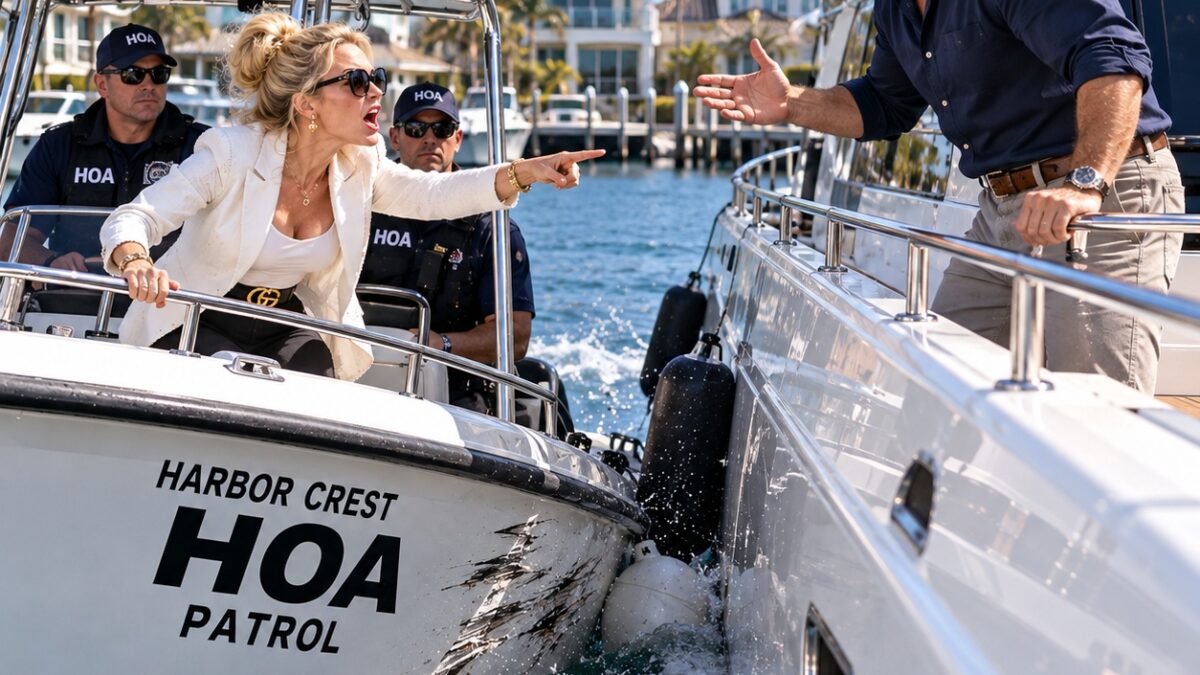
The patrol boat swung hard and drove into the Blue Meridian’s port quarter with a deep grinding crack of metal, fiberglass, and force.
The impact tore open the side of the hull.
A salon window splintered into a web of white cracks.
The port stabilizer fin took the full force of the blow and drove it into the structure behind it.
Water began seeping into a technical compartment, though the watertight bulkhead held.
I shut down the port propulsion system immediately.
The shaft locked solid.
I did not chase her.
I did not scream.
I did not threaten.
I issued a safety call over the radio, logged my exact coordinates, and requested a tow.
Marissa did something entirely different.
Within seconds, she had her phone up, filming my yacht and shouting across the gap.
“You just rammed the HOA patrol boat!”
I answered once, evenly.
“Do not move your vessel until the scene is documented.”
She ignored me.
She restarted her engine and ran straight back to the HOA docks, leaving the scene before any authority arrived.
Later, Micah Bordon wrote that departure into his initial report.
It became one of the first details that made investigators uneasy.
Back at the HOA docks, Marissa tied off the patrol boat with shaking hands. I learned later that she stood there staring at the crumpled fiberglass on its bow, fear coming first, sharp and cold.
But fear did not last long with Marissa.
Within minutes, it hardened into something more familiar.
A plan.
She had been the one holding the camera.
She had been the one shouting the accusation.
If she put her version on paper before anyone else spoke, she believed the story would belong to her.
She walked straight to the clubhouse office, opened her laptop, and began to type.
Two hours later, I received an email with a subject line in all capital letters.
NOTICE OF PROPERTY DAMAGE AND LIABILITY.
Marissa claimed the Blue Meridian had abruptly changed course and struck a patrol boat that was nearly stationary. The HOA demanded that I accept full responsibility for all damage to its vessel and warned that a lawsuit would follow if I refused.
She had written her version of events before anyone else had a chance to write theirs.
That was exactly what Jonah had warned me about.
People like Marissa did not simply lie.
They tried to arrive first.
They tried to frame the room before evidence walked in.
At the haul-out yard, the news grew worse.
The port shaft had been knocked out of alignment. The stabilizer mount had been shoved into the internal structure. Two composite frames already showed signs of delamination.
Nate Ransom, a marine surveyor and accident reconstruction specialist, ran his palm along the crushed section of hull and shook his head slowly.
“This won’t be a bill for a few hundred thousand,” he said.
The Blue Meridian was lifted into dry dock, water streaming from her keel as she rose.
Paula Hightower, the marine claims adjuster handling the case for my insurer, arrived with an independent survey team. As panels came off and the outer skin was peeled back, the true scale of the damage emerged.
The patrol boat had struck one of the most expensive places on the entire yacht.
Hull structure.
Stabilization.
Propulsion.
Sensors.
All within a few feet of one another.
Paula walked the damaged section for nearly an hour without saying much.
Then she began writing numbers.
Structural repairs to the hull, composite frames, and finish work came to roughly one point four eight million dollars. Stabilizer, shaft alignment, transmission, and propulsion components added another six hundred forty thousand. Damaged sensors, electronics, and connected systems accounted for about one hundred ninety thousand. Haul-out engineering, storage, and specialized inspections came to about one hundred ten thousand. Covered loss of use and incidental costs added another one hundred eighty thousand.
Projected claim: two point six million dollars.
When Marissa heard the figure, she changed tactics overnight.
She stopped demanding that I cover the patrol boat.
Instead, she emailed every household in Harbor Crest, announcing that the community had been attacked by an outside yacht owner. She warned residents that I was trying to push a multi-million-dollar bill onto their shoulders.
Neighbors who had never spoken to me suddenly crossed the street when they saw my truck.
Marissa had taken a collision and turned it into a siege, casting herself as guardian at the gate.
Then she produced her own incident reconstruction.
According to her account, the patrol boat had been drifting at roughly 1.8 knots when the Blue Meridian came through too fast, swung suddenly to the left, and left her no time to escape.
Jonah read it twice.
Then he noticed what was missing.
No GPS data.
No radar.
No engine logs.
No video before impact.
No radio transcript.
No original electronic files.
The entire document rested on Marissa’s word.
That afternoon, Jonah sent the HOA a preservation notice requiring the association to protect all GPS data, AIS records, engine telemetry, video, radio communications, patrol logs, maintenance files, and original electronic records connected to the patrol boat.
In less than a day, the HOA replied.
The patrol boat did not store historical GPS data, it claimed.
Marissa added a note of her own, stating that the boat’s AIS transponder had been malfunctioning for some time before the collision.
I read the reply and felt the ground shift beneath the case.
Not because I believed her.
Because I remembered the gray box.
I found the video I had shot from my dock weeks earlier and sent Paula a still frame of the patrol boat’s stern.
She enlarged the label and ran the model number.
It was not part of the navigation system at all.
It was a fleet telematics unit.
An independent device commonly installed by insurers or fleet managers to record speed, position, and operating hours, with its own power, its own memory, and its own way of reporting home.
Jonah sent a second request that evening.
This time, it did not go to the HOA.
It went directly to the fleet management company whose name appeared on the device.
Six hours later, Jonah called me.
His voice was quieter than usual.
“Do not answer another email from Marissa,” he said.
“Why?”
“We just found the patrol boat’s track history.”
The first data confirmed something surprising.
Marissa had been telling the truth about one thing.
The patrol boat’s AIS had stopped transmitting.
But the timing told a much uglier story.
The transponder broadcast normally all morning, then vanished from the network roughly ten minutes before Marissa left the dock.
Shortly after the collision, it came back online as if nothing had happened.
Marissa clearly knew at least one system could track her boat, and she believed switching it off would be enough.
The telematics unit had nothing to do with AIS.
It had its own antenna, its own storage, its own cellular link, and a backup battery.
It recorded position and speed every single second, regardless of what anyone did at the helm.
While formalities dragged on, Marissa tried to seize the advantage.
She called an emergency HOA meeting and asked the board to approve a three-hundred-thousand-dollar legal fund to defend the community against what she called my fraudulent claim.
Heather Belmore objected.
She remembered clearly that the board had never authorized Marissa to intercept anyone. When Marissa insisted the morning of the crash had been an emergency enforcement situation, Heather could not think of a single emergency.
After the meeting, Heather went to the clubhouse office and pulled the patrol boat checkout sheet.
In Marissa’s own handwriting, the purpose of that Saturday’s trip was listed as dock marker inspection.
Not enforcement.
Not emergency.
Not escort.
That night, Heather quietly copied the board minutes and the checkout log to a private drive before anyone could alter them.
At the yard, Nate rebuilt the Blue Meridian’s final minutes from four separate sources: navigation GPS, engine control units, radar track, and camera footage stamped with satellite time.
Every source told the same story.
My yacht had been slowing down.
It had never surged toward anything.
In the seconds before impact, the engines moved from ahead to neutral, then into reverse.
If I had wanted to ram Marissa, the engine data would have shown the opposite.
Rising throttle.
A turn toward her.
Instead, it showed a captain doing everything possible to stop.
Still, Jonah wanted the patrol boat side of the record.
Marissa, sensing pressure building, made another move.
She submitted a radar screenshot she claimed came from the patrol boat that morning, showing the Blue Meridian veering across her path.
Nate studied it for less than a minute before finding the problem.
The file metadata did not match the date of the collision.
The image had been captured during a different patrol three weeks earlier, on a day when the Blue Meridian had never even left her dock.
The dispute was no longer just about seamanship.
Now there were signs that documents were being used to build a version of events that had never happened.
Jonah did not confront her.
He did not announce what Nate had found.
He simply filed the screenshot and metadata away.
Marissa still believed nobody had evidence from her boat, and Jonah wanted her to keep believing that as long as possible.
Late on a Thursday, the fleet company finally delivered a certified telematics file, authenticated and sealed.
Jonah opened the cover email first.
The final line was short, technical, and devastating.
Tracker remained operational continuously throughout the incident window.
Nate loaded the patrol boat’s data in a small conference room at the yard while I stood behind him with Jonah and Paula.
He synchronized both tracks on a single chart.
Blue Meridian in blue.
Patrol boat in red.
Every point aligned to satellite time.
When Nate pressed play, the two lines began to move.
At first, the patrol boat cruised at around three knots near the HOA docks. Then the red line bent toward the channel.
Toward me.
The distance closed.
The blue line told a calm story.
The Blue Meridian dropped from 4.2 knots to 3.1, then below two, then nearly zero.
The red line told the opposite story.
The patrol boat did not slow.
It climbed to 5.4 knots, then 6.1 inside a no-wake zone meant to protect docks and swimmers.
Nobody in the room spoke.
Paula leaned closer to the screen.
Jonah slowly took off his glasses.
Then came the final fourteen seconds.
As my engines went to neutral, the patrol boat’s heading swung another eleven degrees toward me.
As I began to reverse, the patrol boat’s throttle increased again.
Just before impact, it was moving at nearly seven knots.
There was no turn away.
No reduction in power.
No drift.
The red line traced a clean, deliberate arc straight into the Blue Meridian’s port quarter.
Nate replayed the animation three times.
For the first time since the collision, nobody had to weigh my word against Marissa’s.
Two colored lines on a screen were telling the whole story.
Nate found something else.
Marissa claimed the current pushed her patrol boat left.
He pulled the tidal current data for that exact morning and that exact stretch of channel.
The water had been flowing in the opposite direction.
To reach the Blue Meridian at the angle shown by the damage, the patrol boat needed active steering input.
Drift alone could never have carried it there.
Micah Bordon received a copy of the synchronized tracks the following morning. He had spent nineteen years investigating collisions on that coastline, and he had learned to distrust any account written within hours by the person most likely to be blamed.
He compared the data against his own scene notes, including the time the patrol boat left before anyone could document it.
Then he amended his initial report.
The amendment was dry and bureaucratic, the kind of language no one would quote at dinner.
But it carried real weight.
The harbor authority now officially questioned Marissa Langley’s version of events.
Jonah asked the question every opposing lawyer would ask.
Could the GPS be wrong?
Nate nodded.
“A single GPS point can be off by a few yards,” he said. “But GPS error cannot explain dozens of consecutive points with consistent speed and heading ending at exactly the moment the camera records impact.”
Then he layered in the patrol boat’s engine data.
It matched perfectly.
Paula updated the claim file that evening with one line.
Primary liability evidence favors the Blue Meridian.
My insurer prepared to pay for repairs under my policy, then pursue subrogation—the process of recovering that money from whoever was responsible.
The two-point-six-million-dollar claim was no longer aimed at me.
It was turning slowly and heavily toward Harbor Crest and Marissa Langley.
That raised a problem nobody at the HOA wanted to face.
If the crash was simple negligence, the association’s commercial policy might respond. But if evidence showed intentional conduct or action far outside authority the board had granted, coverage could become complicated fast.
That was when Heather called Jonah.
She did not ask him to go easy on Marissa.
She did not ask him for anything.
She brought him the minutes.
Three days before the collision, the board had formally rejected Marissa’s request to intercept vessels.
Marissa had known the decision.
Signed the record.
Taken the boat anyway.
Written a false purpose on the checkout sheet.
Jonah read the pages in silence.
Then he looked up.
“What did Marissa tell the insurance company about why she was on the water that day?”
Heather met his eyes.
“She told them the board ordered her to stop Elliot.”
Marissa called a special meeting of the full association, convinced it was her last chance to rally the community behind her.
The clubhouse filled with homeowners, board members, attorneys, and a representative from the HOA’s insurer. Every chair was taken. People stood along the back wall.
Marissa spoke for nearly thirty minutes.
She called me reckless.
She called the two-point-six-million-dollar figure inflated.
She suggested the Blue Meridian’s GPS records could easily have been edited by a man whose company built navigation equipment.
Then she asked the board to approve a special assessment on every household to fund the legal fight.
Heather declined to vote.
Instead, she asked that the minutes from the meeting held three days before the collision be read aloud.
The room fell silent as the secretary read the passage stating that the patrol boat could not be used to intercept or compel vessels outside HOA property, and that Marissa’s proposal had been rejected.
Marissa said the minutes were wrong.
Heather held up a copy bearing Marissa’s own electronic signature.
Then Jonah stepped forward as counsel for the claimant.
He did not give a speech.
He put the GPS chart on the screen and ran the final sixty seconds.
The room watched the blue line slow while the red line sped up.
Marissa interrupted, voice sharp.
“That data could be fabricated.”
Nate stood and explained calmly that the patrol boat’s data had not come from me at all. It had come from a fleet tracking device managed by an independent third party.
Marissa went still.
“Which device?”
Nate put a photograph on the screen.
The small gray box mounted beside the antenna at the stern of the patrol boat.
Marissa recognized it instantly.
Everyone in the room watched her recognize it.
She had switched off the AIS before leaving the dock, never realizing the box behind her had been quietly recording every second on its own.
Jonah ran the last fourteen seconds again in slow motion.
Heading changed.
Throttle increased.
Gap closed.
Impact.
Then the patrol boat left the scene.
Next came the radar screenshot Marissa had submitted.
Jonah displayed its metadata beside the collision date, and the three-week gap spoke for itself.
At that point, the HOA’s own attorney rose and asked to end the meeting.
He was not protecting me.
He was protecting the association.
Because every additional sentence Marissa spoke was making Harbor Crest’s position worse.
Within days, the HOA’s commercial marine insurer sent a reservation of rights letter announcing it would investigate coverage separately because of questions about authorization and possible intentional conduct.
That did not mean the HOA was off the hook.
The association owned the patrol boat and had allowed Marissa to reach it.
But the board finally understood the danger in front of them.
If the insurer denied part of the coverage tied to Marissa’s conduct, Harbor Crest could lose millions because of one president’s personal decision.
That same week, the board voted to suspend Marissa’s executive authority.
Her keys to the patrol boat were collected and locked in the clubhouse safe.
For the first time since she took office, Marissa controlled nothing on that water.
As the last board members gathered their papers, Heather handed Jonah one more document.
An internal email Marissa had sent to a fellow board member two days before the crash.
One sentence.
If he won’t turn around voluntarily, I’ll make him.
That email changed the strategy of every party involved.
Jonah was careful not to call it proof of intentional ramming. Words can be explained, softened, argued in more than one direction, and Marissa’s lawyers would certainly try.
But placed beside the GPS track, throttle data, disabled AIS, defied board decision, false trip purpose, recycled radar image, and her post-crash accusation, that sentence became one more damaging piece in a picture that no longer needed much explaining.
I refused to turn the case into a public fight.
I did not call reporters.
I did not stand at the end of my dock shouting across the water.
I did not confront Marissa when I saw her at the fuel pier.
I let the data do the work.
Paula finalized the damage file after weeks of engineering review.
The final number barely moved.
Two point six million dollars.
The Blue Meridian would sit in the yard for months because damage to the stabilizer mount forced builders to open the internal structure far deeper than anyone expected.
Meanwhile, the HOA’s insurer hired its own independent reconstruction expert.
Marissa pinned her hopes on that second opinion.
Surely, she thought, a different expert would find room for doubt.
The new expert’s conclusions mirrored Nate’s almost exactly.
The analysis cross-checked GPS tracks against the Blue Meridian’s engine timestamps, dock cameras, radar, wind and current records, patrol boat engine telemetry, and the telematics signal.
Timing differences between systems amounted to only a few seconds.
There was no remaining scenario in which a nearly motionless patrol boat had been struck by a speeding yacht.
From that point on, the insurers stopped arguing about who caused the collision and started arguing about who would pay which share.
That was when the case turned truly painful for Marissa.
The HOA carried responsibility as the owner of the patrol boat and the organization that had let her near it. But Marissa was also named individually because she used the vessel outside the authority the board had granted.
The insurer did not simply announce that she owed the entire two point six million on her own. That would have been unrealistic.
Instead, it reserved the right to dispute coverage for her personal actions.
The board had to hire separate counsel.
Marissa had to hire her own.
Three teams of lawyers now studied the same set of data, and not one wanted anything to do with her original story.
The woman who once wrote warnings about canvas colors now spent her afternoons in attorney offices signing engagement letters and retainer checks.
Heather felt the weight of it differently.
For two years, she had voted alongside Marissa on nearly everything: the patrol boat, the warning letters, the fines. Not because she believed every rule was right, but because asking questions had always seemed harder than letting Marissa keep steering.
Now Heather understood that her silence had helped build the machine that crashed into the Blue Meridian.
She could not undo those votes.
What she could do was keep the records honest.
She guarded the copies of the minutes and the checkout log as if the future of Harbor Crest depended on them.
In many ways, it did.
One evening, Marissa found me at the marina inspecting a shipment of replacement parts.
She skipped any greeting and offered a deal.
The HOA would drop every fine and lift every waterfront restriction against me if I agreed to reduce the claim.
I set down my clipboard.
“There are no fines anymore, Marissa. You turned this into an insurance claim. Now the data decides.”
Her voice hardened.
“If Harbor Crest goes bankrupt, dozens of homeowners will blame you.”
I looked at her for a long moment.
“They weren’t driving the patrol boat.”
It was the first time I had struck back directly with words.
A few days later, the Harbor Crest board received a formal subrogation demand from my insurer seeking reimbursement of two point six million dollars.
The letter named two responsible parties.
Harbor Crest Homeowners Association.
Marissa Langley.
The negotiations stretched across several rounds, each colder than the last.
Marissa clung to one final escape route. Her lawyer argued that a fleet tracking device was not precise enough to establish the exact angle of a collision.
Nate surprised everyone by agreeing with part of that statement.
A single GPS unit should never be used to fix a boat’s position down to a few inches.
For one brief moment, Marissa looked like she had finally won something.
Then Nate continued.
“They do not need inches. They need to know which boat was slowing down and which boat was speeding up. GPS can determine that easily. The engine data confirms it. The radar confirms it. The camera, damage angle, and current all confirm it.”
At the final reconstruction session, Nate laid six data sources side by side on one shared timeline.
Fourteen seconds before impact, the Blue Meridian reduced throttle.
Eleven seconds before impact, the patrol boat turned toward her.
Eight seconds before impact, I shifted to neutral.
Six seconds before impact, the patrol boat accelerated.
Four seconds before impact, the Blue Meridian began reversing.
At zero, the boats collided.
No version of anyone’s story could rearrange that sequence.
Marissa finally stopped claiming I had rammed her.
Her lawyer shifted to a new explanation.
She had simply misjudged the distance.
But changing the story so late only made insurers more cautious, not less. An honest mistake does not usually arrive with a disabled transponder, a false trip log, a recycled radar image, and an email promising to make someone turn around.
The Harbor Crest board scheduled a formal vote.
Marissa was removed as president.
The board opened an internal investigation into the entire waterfront enforcement program she had built. The two orange controlled-waterway buoys were hauled out of the channel. Every fine connected to boats outside HOA property was voided. The patrol boat was banned from enforcement duty of any kind.
Heather addressed the homeowners directly.
She wanted them to understand one thing clearly.
I had never demanded money from the HOA because of a personal feud.
The claim existed because my property had been seriously damaged.
If Marissa had not driven that patrol boat into the Blue Meridian, the two-point-six-million-dollar figure would never have existed at all.
Several residents who had once crossed the street to avoid me stared down at the table in front of them.
Marissa left the clubhouse through a side door.
No board members walked beside her.
She no longer held the patrol boat keys.
She no longer had authority to issue a single warning.
For months, she had insisted I was an outsider with no voice in Harbor Crest.
Now her own association had formally abandoned her version of events.
Still, the story was not finished.
The insurers and attorneys had to decide how the money would be divided.
A week later, Jonah called me.
“They’ve agreed on liability,” he said. “Now they’re only arguing about how much of it belongs to Marissa.”
There was no dramatic arrest at the end.
No police cars filled the marina parking lot.
No secret badge or powerful friend rescued me at the last minute.
What defeated Marissa was the very technology built to record the truth on the water.
After months of negotiation and coverage disputes, my insurer recovered most of what it paid through a settlement among the insurers, the HOA, and Marissa.
The association’s organizational responsibility was handled through its coverage and appropriate reserve funds.
The portion tied to Marissa’s unauthorized conduct became a separate obligation under the agreement. She had to make a very large personal contribution to the settlement and secure the rest of her obligation with her own assets.
The HOA never published individual figures because the settlement was confidential.
But one number never left anyone’s memory.
Two point six million dollars.
The total claim born from a single collision.
Not long afterward, the new board demanded that Marissa also reimburse the association for additional expenses created by her unauthorized use of the patrol boat and inaccurate records.
A few months later, she sold her waterfront home.
There was no tearful scene.
No shouting on the lawn.
Only a white sign with red letters planted at the edge of her yard, facing directly across the channel she once declared under her control.
FOR SALE.
The patrol boat was sold too.
The board hired a professional marina service for safety work instead of running its own patrol.
The orange buoys disappeared.
The controlled-waterway signs disappeared.
Every HOA rule about boats outside association boundaries was erased from the books.
Something quieter changed in Harbor Crest too.
Homeowners who had paid fines for loud music or late guests received refund letters from the new board, along with a short apology Heather insisted on writing herself.
People began leaving their boats tied up without wondering who might be watching from the water.
One evening, Heather walked down the peninsula to the end of my dock.
No HOA officer had ever done that without a complaint in hand.
She did not bring a warning.
She did not bring a demand.
She simply thanked me for refusing to back down.
Then she walked home.
Late that spring, the Blue Meridian finally left the yard.
Her port quarter had been rebuilt from the frames out. The stabilizer was replaced. The shaft and propulsion system were realigned. Every camera, GPS receiver, and data recorder had been tested and certified.
I brought her home to Harbor Crest on a quiet afternoon.
The water was silver under a low sun.
No patrol boat raced out to meet me.
No loud hailer crackled across the channel.
Nobody ordered me to turn around.
When the Blue Meridian passed the spot where the collision happened, I eased back to the proper no-wake speed and glanced at the chart plotter.
On the screen, there was only an ordinary GPS line.
A thin trail behind a slow-moving boat.
To anyone else, it meant nothing.
But I still kept a copy of the data from that Saturday morning.
Not as a trophy.
As a reminder.
Marissa’s greatest mistake was not ramming my yacht.
It was believing truth depended on who spoke first.
She believed writing her report before anyone else could decide the story.
She believed switching off one transponder made her invisible.
She believed the HOA’s name on a hull made the channel hers.
She never understood that modern boats do not simply move.
They remember.
Fourteen seconds of data accomplished what months of arguing never could.
It showed who slowed down and who sped up.
It showed who turned and who held course.
It showed who transformed a pointless HOA feud into a two-point-six-million-dollar claim carrying her own name.
I pushed the throttles forward once I cleared the last marker.
The Blue Meridian’s bow lifted, and her wake spread wide and white behind her.
Back along the shore, the Harbor Crest docks stood in their neat little row, freshly painted and perfectly ordinary.
For the first time in a long time, they looked like docks again.
Not borders.
Not weapons.
Not extensions of one woman’s ego.
Just wood, cleats, lines, and water.
The channel opened ahead of me, calm and bright under the late sun.
And this time, nobody tried to stop me.