𝗣𝗔𝗥𝗧𝟮 :The Firebreak She Called an Eyesore Was the Only Thing Keeping Her House Alive
FULL STORY CONTINUATION
The first violation letter arrived eleven days later.
Certified mail.
Heavy cream paper.
Silver Creek Estates logo embossed across the top in a font someone probably paid too much to select.
The letter cited Section 9.44 of the covenants, conditions, and restrictions: maintenance of property aesthetics. It informed me that my “unimproved western parcel boundary” constituted a persistent visual eyesore detrimental to community property values.
The fine was four hundred dollars a month, compounding.
I read the letter on my back porch with black coffee while the Elkhorn ridge burned amber in late sun. Somewhere in those ponderosa stands, fuel moisture content had dropped below fifteen percent for the third straight week.
My roof-mounted weather station confirmed it every morning.
I checked those readings the way other people check sports scores.
Then I wrote back.
Polite.
Professional.
Two pages.
I cited Montana Code Annotated 76-13-104, the state wildfire mitigation statute. I referenced my DNRC-approved defensible-space plan and my county permit number. I noted that Montana law prohibited HOA covenants from overriding state fire safety regulations.
I attached copies of everything.
Signed it Garrett Brooks, retired county wildfire mitigation planner.
Shelby’s response came eight days later.
The fine had doubled to eight hundred.
She had added a second violation for unauthorized earth moving and a third for failure to respond constructively to board communication.
That third one almost made me smile.
I had responded with two pages of law and permits.
What she meant was I had not surrendered.
That was when the neighborhood campaign started.
Shelby had a talent for turning a gravel strip into a social emergency.
She hosted what she called community vision evenings on her teak deck. Rosé in stemless glasses. Charcuterie boards from the specialty shop in Helena. String lights. Lavender candles. The kind of staged warmth that makes people feel included while being recruited.
She invited every homeowner within four blocks.
Then she stood at the railing in a white linen blazer and pointed across the fence at my property like a museum docent presenting a crime scene.
“Look at that,” she would say, gesturing with her wine glass. “Every one of us invested in this community. We planted. We landscaped. We made Silver Creek beautiful. And then there’s that.”
My neighbor to the south, Pete Hadley, told me about it the next morning.
Pete was a retired electrician, sixty-three, with a rusted pickup and the honest discomfort of a man who hated gossip but hated dishonesty more.
“She had drone footage,” Pete said. “Shot straight down. Your firebreak looked like a scar on a hillside.”
“It is a scar,” I said. “That’s the point. It’s a scar fire can’t cross easily.”
Pete shook his head.
“She put the word eyesore on it in big white letters. Red arrow. Before-and-after slides.”
“What was the before?”
“Stock photo of a lush forested lot.”
“Of course.”
Pete leaned against my porch rail.
“Twelve people signed her petition that first night.”
By the end of the month, she had thirty-one signatures.
The petition called for mandatory removal of all unnatural ground-cover disruptions within ninety days.
Then came the whisper campaign.
Poor Garrett.
Still struggling after his wife passed.
Some kind of government inspector, wasn’t he?
Spent his whole career telling people what to do with their land, and now he can’t stop.
I heard that version from three different neighbors in two weeks, each delivered with the same tilted-head sympathy.
Shelby had rehearsed the phrasing.
Probably practiced it in the Range Rover mirror.
She was smart.
I will give her that.
She understood that in a gated community, social pressure can cut deeper than a bylaw. She did not need to be right. She needed everyone else to believe I was unreasonable.
The part she missed was the gravel.
I drove to the Lewis and Clark County assessor’s office on a quiet Tuesday in late June and pulled the wildfire risk overlay for Silver Creek Estates.
The map showed what I already knew.
The entire western boundary of the subdivision sat inside a designated wildland-urban interface zone.
My property was the buffer.
My firebreak was the line.
Directly east of that line, highlighted in the darkest red on the county map, was Shelby Prescott’s address.
Her house was not just in the fire zone.
It was the first structure a wildfire would reach if my firebreak failed.
Teak.
Redwood.
Juniper.
Cedar mulch.
Without my gravel, her property was not a home.
It was a stack of kindling with a mortgage.
I folded the map, put it in a manila envelope, and drove home.
I did not show it to anyone yet.
I put it in the filing cabinet with the violation letters, permit copies, and compounding fines.
Document.
Witness.
File.
That is how you survive people who prefer theater.
Shelby brought her petition to the next HOA board meeting like a weapon wrapped in cardstock.
The Silver Creek community room smelled of bad coffee and floor polish. Folding chairs. Old projector. A few dozen homeowners pretending they were there to discuss neighborhood standards rather than watch Shelby perform.
She stood at the front in a fitted sage blazer, cream slacks, hair pinned, heels sharp.
She clicked to the first slide.
Aerial photo of my property.
My firebreak, circled in red.
“This,” she said, tapping the screen with one manicured nail, “is the single biggest threat to property values in Silver Creek.”
Not drought.
Not wildfire.
Not the fact that half the homes in the room had landscaping pressed against their siding like kindling arranged by a decorator.
My gravel.
She clicked again.
A bar chart.
Property comps from three surrounding neighborhoods. Each one higher in price per square foot than Silver Creek.
“At current market estimates,” Shelby said, “we are underperforming comparable subdivisions by eleven percent. Eleven percent. That is forty to sixty thousand dollars per home.”
Murmurs moved through the room.
“And the common denominator,” she continued, “is visible right outside the west window.”
Heads turned.
Through the glass, in the fading light, you could just make out the edge of my firebreak.
I raised my hand.
Shelby smiled like she had been hoping I would.
“Mr. Brooks?”
“The property value gap has nothing to do with my firebreak. Those neighborhoods are closer to Helena, have newer construction, and sit in different school catchments. The price difference existed before I moved here.”
Shelby tilted her head.
One strand of platinum-blonde hair slipped across her cheekbone like it had rehearsed the moment too.
“Garrett, I appreciate your perspective,” she said. “But thirty-one homeowners disagree.”
She held up the petition.
“The community has spoken.”
She moved to the vote.
Aesthetic Harmony Mandate, Section 12.7.
All residential lots must maintain a minimum eighty percent vegetation coverage on visible boundaries. Noncompliant properties face escalating fines of seven hundred fifty dollars per day, and the board reserves authority to remediate at the owner’s expense.
The vote was seven to two.
Shelby did not blink.
Afterward, Pete caught me in the parking lot.
“She’s filing for a lien,” he said.
“On what grounds?”
“Unpaid fines. Board attorney starts paperwork this week. She wants it on record before your next mortgage review.”
The night smelled of pine sap and cooling asphalt. The Elkhorn ridge stood black against a sky full of stars.
“Pete, you know what a lien does to a retired county employee on a fixed income?”
“I know.” He kicked at a pebble. “I also know she doesn’t care.”
That was the truth of Shelby Prescott.
She did not hate my firebreak because it was ugly.
She hated it because it was mine and I would not bend.
Every man on that board folded when she smiled.
Every woman at those deck parties deferred when she poured rosé.
I was the first person in Silver Creek who told her no, and Shelby Prescott did not process the word no.
She processed it as a dare.
The lien paperwork arrived the following Friday.
Fourteen thousand eight hundred dollars in accumulated fines, compounding at eight percent monthly interest.
The letter gave me thirty days to remediate the aesthetic violation or face foreclosure proceedings.
I sat on my porch that evening and read it twice while my weather station beeped.
Wind shifting southwest.
Humidity dropping.
I looked west at the gravel.
One hundred fifty feet of silence.
Behind it, the forest stood thick, still, and full of everything it was waiting to burn.
Then I made two calls.
The first was to Ruth Callaway, an attorney in Helena who wore boots to depositions and had never lost an HOA case in Lewis and Clark County.
“Ruth,” I said, “I need someone who knows wildfire law and isn’t afraid of a woman in Valentino heels.”
She laughed once.
“Send me the file.”
The second call was to the Montana DNRC field office in Boulder.
A man named Troy Emerson picked up.
I had worked with Troy for twelve years before retiring.
“Troy, I need a formal wildfire hazard assessment on a residential parcel in Silver Creek Estates.”
“Whose parcel?”
“Mine and the one directly east of it.”
A pause.
Then Troy said the four words I needed.
“I’ll send a crew.”
I drove to Billings the second week of July to see Claire.
She had a seasonal posting with Fish, Wildlife, and Parks up near the Beartooth Range, and I had not seen her since Ellen’s birthday in April.
We grilled steaks on her apartment balcony, talked about nothing important, and for two nights, I slept through the night for the first time in a month.
On the third morning, my phone buzzed.
Trail camera alert.
West boundary.
Motion detected.
I opened the app and felt my stomach drop.
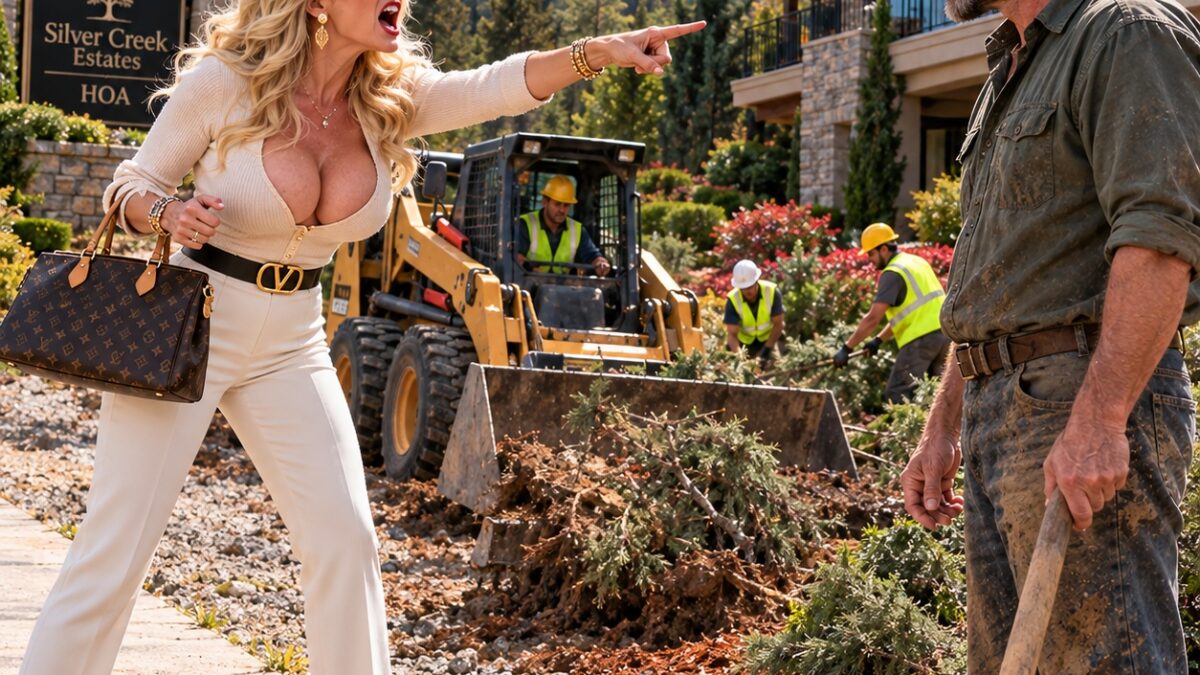
A yellow Bobcat skid steer was parked at the southwest corner of my property.
Two men in work boots were unloading a flatbed stacked with burlap-wrapped root balls, bags of cedar bark mulch, rolls of sod, and irrigation line.
A third man was already on the Bobcat, bucket lowered, scraping my gravel into a pile.
Through the camera mic, the sound was a metallic howl.
Steel teeth on compacted earth.
Gravel popping under treads like little bones breaking.
And Shelby stood at the edge of my property line in a powder-blue athleisure set, white sneakers, oversized sunglasses perched on her head like a crown. Phone in one hand. Iced coffee in the other.
She was smiling.
Not mildly.
Not nervously.
Beaming.
The glow of a person who believes she has already won.
She pointed toward the center of the firebreak and said something to the Bobcat operator. I could not hear her clearly over the engine, but the camera caught her mouth.
All of it.
I watched for eleven minutes.
The Bobcat scraped away the gravel.
The crew shoveled topsoil over the exposed earth.
They unrolled sod in wide strips.
They planted juniper bushes every eight feet. Dense. Resinous. Decorative torches in the shape of landscaping.
They packed cedar bark mulch six inches deep between the plantings.
They laid drip irrigation lines connected to nothing.
Then Shelby took a selfie.
Thirty seconds later, the HOA Facebook group pinged.
Finally addressing Silver Creek’s biggest eyesore. Fresh landscaping courtesy of the beautification fund. You’re welcome, neighbors. 🥂
Forty-seven likes in the first hour.
Twelve heart reacts.
Board member Darlene Hobbs commented, So much better. Thank you, Shelby.
I sat on Claire’s balcony with the phone in my lap.
Claire came outside with coffee, saw my face, and stopped.
“Dad, what happened?”
I showed her the footage.
She watched without speaking.
When the Bobcat scraped through the section I had compacted by hand the summer Ellen died, Claire set her mug down carefully.
“She can’t do that.”
“She just did.”
“Those are junipers.”
“Yes.”
“Dad, juniper has a—”
“I know what juniper does.”
Claire looked at me with Ellen’s eyes, brown with gold flecks. Right then, they were furious.
“What are you going to do?”
I finished my coffee and looked toward the Beartooth Range.
“I’m going to drive home,” I said. “I’m going to look at what she did. Then I’m going to let her keep thinking she won.”
I left Billings at noon.
Three hundred twelve miles.
I stopped once for gas outside Big Timber.
The clerk asked if I was all right.
I told him I was fine.
I was not fine.
But I was focused, and in my line of work, those two things often look the same.
I pulled into Silver Creek at eleven that night.
My headlights swept across the western edge of my property.
The firebreak was gone.
One hundred fifty feet of gravel, compacted earth, and engineered emptiness replaced by rows of juniper, mounds of cedar bark, and strips of fresh sod already curling at the edges in the July heat.
Bobcat tracks were still visible in the new soil.
The air smelled like cedar shavings and diesel exhaust.
It smelled like a funeral home built on top of a gas station.
The Elkhorn ridge rose behind the new plantings, black and still.
Fifty yards of dry forest pressing against a wall of fresh kindling a woman in powder-blue yoga pants had called beautification.
I went inside.
Opened the filing cabinet.
Pulled out the wildfire risk map.
Set it beside the trail camera footage on my laptop.
Then I started building a case.
Ruth came to my house on Thursday morning in a mud-splashed Subaru, cowboy boots under her blazer, and a banker’s box under one arm.
“I pulled HOA financials,” she said, dropping the box on my kitchen table. “Four years of board minutes, expense reports, and vendor invoices.”
I poured coffee.
She spread documents across the table like a surgeon laying out instruments.
“Start with the landscaping company that destroyed your firebreak,” she said. “Prescott Ridge Landscape Design. Registered in 2021. Two employees. Last year’s revenue, one hundred ninety-four thousand. Every penny from Silver Creek HOA contracts.”
I read the name again.
“Prescott Ridge.”
“Wade Prescott,” Ruth said. “Shelby’s brother-in-law. Contractor’s license issued eighteen months after Shelby became HOA president.”
She tapped an invoice.
“Eighteen thousand four hundred dollars for ‘community beautification west-boundary remediation.’ That is your firebreak, Garrett. Billed to the HOA general fund.”
She pulled out a spreadsheet highlighted in yellow.
“In four years, Silver Creek homeowners paid seventy-three thousand dollars in special beautification assessments. Thirty-one thousand went to Prescott Ridge. Another nine thousand went to Ridgeline Property Solutions.”
“Let me guess,” I said. “Dale Prescott.”
“Shelby’s husband. Sole proprietor. Consulting fees for aesthetic compliance reviews.”
I sat down.
The coffee tasted bitter.
Ruth was not finished.
“Dale is a licensed real estate appraiser. In the last two years, he appraised fourteen properties in Silver Creek for refinancing or resale. Every single appraisal cites recent community beautification improvements as a value-add factor.”
I looked at her.
“That’s circular.”
“That’s fraud-adjacent at minimum,” Ruth said. “Appraiser independence is required under USPAP. He cannot financially benefit from improvements he then uses to justify value increases.”
She closed the folder.
“Garrett, this is not just a woman who hates gravel. This is a closed-loop money machine. Homeowners pay assessments. Shelby directs spending to her brother-in-law. Dale uses the results to inflate values. The inflated values justify more assessments. It feeds itself.”
I looked out the window at the juniper.
“She destroyed my firebreak for eighteen thousand dollars.”
Ruth shook her head.
“She destroyed your firebreak because it was the one thing in Silver Creek she could not monetize. Bare gravel does its job and refuses to be pretty. That made it useless to her.”
By the end of the week, Ruth filed a complaint with the Montana Board of Real Estate Appraisers and requested a forensic audit of the Silver Creek HOA under the Montana Nonprofit Corporation Act.
“The financial angle is mine,” Ruth told me. “The fire angle is yours. That is the one she cannot charm her way out of.”
I spent the next six weeks doing what I do best.
Planning a defense that did not look like a fight.
DNRC sent a crew first.
Two field assessors in green polos with clipboards and a fuel-moisture meter walked the former firebreak for forty-five minutes. They measured juniper spacing. Tested cedar bark moisture. Photographed mulch depth. Checked slope, wind exposure, canopy distance, and ember catch points.
The lead assessor, Grace Kenner, stood at the north end and looked back at the whole line.
“This is a Class One fire hazard,” she said. “Juniper every eight feet with resinous bark mulch as ground cover. In a sustained wind event, this entire strip could ignite in under ninety seconds. Whoever planted this turned a firebreak into a fuse.”
I thanked her.
The formal notice arrived within ten business days.
It classified the vegetation as a significant wildfire hazard and recommended immediate removal and restoration of defensible space. It cited state law and copied the HOA board.
Technically, the notice went to me as landowner.
Ruth responded by identifying Shelby Prescott and the Silver Creek HOA as the parties that installed the hazardous vegetation without my consent. She attached the trail footage, landscaping invoice, survey, and HOA board minutes.
Then I called a reporter at the Helena Independent Record.
Colleen Marsh covered land use and county government. I had worked with her years before on a fuel-reduction grant story. She was thorough, patient, and impossible to charm.
I sent her the HOA financials, DNRC notice, and survey.
No commentary.
No spin.
Just the paper trail.
She called after reading it.
“Garrett, how long has this been going on?”
“Four years.”
A pause.
Keyboard clicking.
“I’ll need to verify independently.”
“I’d be disappointed if you didn’t.”
I installed four trail cameras that week.
Two facing the planted zone.
One on the new fifty-foot buffer I built closer to my house.
One on the driveway.
That new buffer was smaller and uglier than the original, which meant it was also honest. It would not protect Shelby anymore. It would not protect half the neighborhood. It would protect my house.
That was the geometry of what she had done.
She had destroyed the community’s firewall and left me no choice but to build a personal one.
Shelby found out about the DNRC notice on a Tuesday.
By Wednesday morning, she had posted on the HOA Facebook group.
Government Overreach and the Assault on Community Standards.
She called the notice bureaucratic intimidation.
She called DNRC irrelevant.
She called the hazard classification politically motivated.
She meant me.
The post ended with a screenshot of the notice and one bold sentence.
They want us to live in a gravel pit. Not happening.
Thirty-eight likes.
Twenty-two comments.
Stay strong, Shelby.
This is what happens when government people retire into real neighborhoods.
I read it from my porch while wind blew east and the junipers along my former firebreak swayed like they were waving goodbye to common sense.
Three days later, Dale Prescott’s attorney sent Ruth a six-page cease-and-desist letter accusing me of malicious harassment and frivolous government complaints.
Ruth called laughing.
“They want you to retract a DNRC hazard complaint. That’s like asking a doctor to retract a diagnosis because the patient dislikes the word tumor.”
“What do I do?”
“Nothing. We let them wave the letter while the state does its job.”
Shelby escalated again at the September HOA meeting.
She proposed a resolution to expel me from the community.
Not fine me.
Expel me.
She cited persistent noncompliance, hostile behavior toward elected board members, and conduct detrimental to property values.
I sat in the back row.
Pete sat next to me with his arms crossed.
No one else sat near us.
Shelby stood at the podium in a fitted black dress and pearl earrings, hair freshly colored, a little warmer blonde than last month.
“Some of you know Garrett Brooks,” she said. “He moved here two years ago. Since then, he has refused to comply with community standards. He has filed complaints with the state designed to undermine property values. He has harassed board members. And now he has invited a government agency onto our mountain to tell us how to landscape our own homes.”
She paused.
“This isn’t about gravel. This is about whether one man’s paranoia gets to hold an entire community hostage.”
The vote failed.
Barely.
Shelby needed a two-thirds supermajority under Montana HOA rules to interfere with a homeowner’s property rights through association action. She got fifty-eight percent.
Not enough.
She stared at the vote count for three full seconds.
Then she smoothed her dress, picked up her clutch, and said, “We’ll revisit this.”
Those three words sounded colder than the Bobcat engine.
After the meeting, Lorraine Webb stopped me in the parking lot.
She was sixty-seven, a retired schoolteacher who lived four houses east of Shelby.
“Mr. Brooks,” she said, “I don’t know if your gravel is right or wrong, but I know what Shelby is doing isn’t about the neighborhood. It’s about control.”
“What changed your mind?”
She looked around before answering.
“I checked my assessment history. I’ve paid six thousand dollars in beautification fees since Shelby became president. My yard looks exactly the same.”
I thanked her.
That night, I wrote her name in my notebook.
Not as evidence.
As a reminder.
Not every signature on a petition means agreement.
Some mean fear.
The next morning, I found an envelope on my doorstep.
No return address.
Inside was a printout of my DNRC complaint with a handwritten note in blue ink.
Drop it or the lien becomes foreclosure.
No signature.
But I had seen Shelby’s looping S on HOA sign-in sheets.
I photographed the note, logged date and time, sealed it in plastic, and filed it.
Document.
Witness.
File.
The sabotage came at 2:14 a.m. on a Thursday in late September.
The camera caught two pickup trucks backing up to the eastern edge of my new fifty-foot buffer. One white Ford F-250. One silver Chevy Silverado. Headlights off.
They dumped twelve loads of cedar bark mulch directly onto the gravel.
Shovels.
Wheelbarrows.
Thirty minutes in the dark.
The mulch covered sixty feet of firebreak two inches deep.
The white Ford belonged to Wade Prescott.
License plate clear in infrared.
I called Ruth at seven.
“They dumped fuel on my firebreak.”
“Who?”
“Wade Prescott’s truck. I have it on camera.”
Three seconds of silence.
“File a police report today. Send me the footage. I’ll add it to the audit complaint.”
I cleaned the mulch off by hand.
Four hours with a flat shovel and a rake.
Every scoop smelled like cedar and arson.
Three days later, the Helena Independent Record published Colleen’s story.
Beautification or Embezzlement? Silver Creek HOA Faces Financial Questions.
The article was twelve hundred words. It did not accuse anyone of anything. It simply laid out the numbers.
Seventy-three thousand in assessments.
Thirty-one thousand to Shelby’s brother-in-law.
Nine thousand to Shelby’s husband.
Fourteen appraisals citing improvements funded by assessments controlled by the appraiser’s wife.
An appraisal compliance expert called it a textbook conflict of interest.
A former HOA attorney called the financial structure a serious fiduciary concern.
Shelby was quoted once.
This is a coordinated smear campaign by a disgruntled homeowner. Our beautification program has increased property values across the community.
She did not deny the numbers.
She could not.
Receipts do not care about confidence.
Within forty-eight hours, eleven homeowners requested full HOA financial records. Three contacted the Montana Attorney General’s Consumer Protection Division. Two hired attorneys.
Pete called that evening.
“Garrett,” he said, sounding lighter than he had in weeks, “Lorraine Webb just knocked on my door. She has fourteen homeowners ready to call a special meeting to remove Shelby.”
“Fourteen?”
“In two days.”
I sat on my porch, looking at the ridge. The pines had turned a dull amber under drought stress. The Forest Service had posted a fire watch advisory three days earlier.
The next week, Dale Prescott’s appraiser license was suspended pending investigation. Shelby’s homeowners insurance company also sent her a letter after receiving the DNRC hazard classification.
Her premium jumped from forty-two hundred a year to eleven thousand eight hundred.
She had planted the fuel.
Now she was paying to insure it.
I heard about the letter through Pete, who heard it through Lorraine, who heard Shelby screaming about it through an open kitchen door.
Shelby called the insurance company a scam.
She called DNRC a weapon.
She called me a name I will not repeat.
She never called a landscaper.
The junipers stayed.
The mulch stayed.
The drip lines still connected to nothing.
And the Elkhorn ridge kept drying, one brittle needle at a time.
The fire started on October 11 at 3:47 p.m.
A downed power line on the ridge.
Wind from the southwest at thirty-one miles per hour.
Relative humidity nine percent.
I smelled it before I saw it.
The air shifted from pine to char in less than a minute.
Then the smoke column rose above the ridge like a gray fist punching through the sky.
I grabbed my go bag.
Loaded the filing cabinet into my truck.
Drove east to Pete Hadley’s house and parked on his gravel driveway.
Then I turned around and watched.
The fire hit Silver Creek’s western edge at 5:22 p.m.
It came through the pines fast and low, crowning in the treetops and throwing embers two hundred yards ahead of the flame front.
The sound swallowed everything.
Sirens.
Shouting.
Engines.
All of it vanished under combustion and wind.
My fifty-foot firebreak held.
Embers landed on bare gravel and died.
Flames reached the buffer and found nothing to climb.
My house stood untouched.
The gravel did what gravel does.
It refused to burn.
Shelby’s juniper did what juniper does.
The fire hit the former firebreak zone—the one she had called an eyesore and transformed into landscaping.
The planted vegetation ignited like it had been waiting its whole life for that moment.
Juniper first.
Resin flashing orange-white.
Then cedar bark mulch.
A ground fire raced through the decorative strip at walking speed.
Drip lines melted.
Sod curled black.
Ornamental border stones cracked from heat.
The fire crossed the planted strip in under two minutes.
Then it reached Shelby’s property.
Her teak pergola caught at 5:31 p.m.
Her redwood privacy fence at 5:33.
The cedar accent wall at 5:36.
Firefighters saved the structure, barely.
The interior survived.
The exterior looked like a burnt matchbox wearing a mortgage.
Three other homes sustained damage.
All east of the former firebreak zone.
All in the path the fire would not have taken if one hundred fifty feet of gravel had still been there.
No one died.
I still thank God for that.
But damage across Silver Creek exceeded two million dollars.
Shelby’s house alone accounted for nearly half a million.
The emergency HOA meeting happened nine days later.
Standing room only.
The community room smelled like smoke and fury.
Shelby sat in the front row, not at the podium.
That was the first sign she understood the world had changed.
She wore a wrinkled Tory Burch jacket with a water stain on one sleeve. Flats instead of heels. Hair pulled back with a clip. No pearls. No performance.
The county fire marshal spoke first.
He pointed to a burn-path diagram.
The former firebreak zone was highlighted in red.
“The vegetation installed in this corridor acted as a fuel bridge,” he said. “Without it, the fire’s eastward advance would have been significantly impeded.”
Grace Kenner from DNRC spoke next.
She held up her hazard report.
“We classified this corridor as a Class One fire hazard eleven months ago. The responsible parties were notified. No remediation occurred.”
The insurance adjuster spoke third.
He was polite.
Devastating.
“Several claims in this corridor may be subject to denial or reduction. Property owners who received and ignored wildfire hazard notices may not qualify for full coverage under standard homeowner policies.”
Shelby’s face went white.
Not pale.
White.
The color of a person watching the future collapse in fluorescent light.
Then I spoke.
I did not raise my voice.
I stood at the back with a manila folder and read the numbers.
Seventy-three thousand in assessments.
Thirty-one thousand to Wade Prescott.
Nine thousand to Dale Prescott.
Eighteen thousand four hundred dollars to destroy a firebreak that would have saved two million dollars in damage.
The room was silent.
Not polite silence.
Not agreement.
Math silence.
Lorraine Webb stood from the fourth row.
She looked directly at Shelby.
“Your house is the eyesore now, Shelby.”
Nobody laughed.
Nobody needed to.
The sentence landed like a gavel.
Shelby grabbed her bag and walked toward the exit.
She pushed through the double doors into the parking lot.
The October air hit her face.
So did the Lewis and Clark County sheriff’s deputy standing beside his cruiser with a summons in his hand.
Embezzlement.
Fraud.
Willful destruction of wildfire mitigation infrastructure.
The deputy was polite.
Shelby was not.
She said three words as he handed her the papers.
“This isn’t over.”
It was.
The case took fourteen months.
Shelby pleaded no contest to the embezzlement charge in exchange for reduced destruction charges.
She received probation, four hundred hours of community service, restitution, and a permanent ban from serving on any HOA board in Montana.
Dale Prescott lost his appraiser license after the Montana Board of Real Estate Appraisers found multiple USPAP violations.
Wade Prescott’s landscaping company lost its contractor license after the county reviewed three years of permits.
The Prescotts sold what remained of their house in February.
The listing called it a renovation opportunity.
The buyer paid cash and gutted the interior within a week.
Shelby moved to Bozeman.
Dale followed.
I heard she took an entry-level job at a property management firm with no authority over landscaping decisions.
I never saw either of them again.
Silver Creek held new elections in December.
Turnout was the highest in community history.
Pete Hadley became president.
Lorraine Webb became treasurer.
Their first act was abolishing the beautification assessment fund.
Every homeowner received a partial refund.
Their second act was hiring a certified wildfire mitigation consultant to develop a real community defensible-space plan.
They hired me pro bono.
I designed fuel reduction for every property in Silver Creek.
Gravel buffers.
Vegetation setbacks.
Ember-resistant landscaping zones.
Fire-adapted species, spaced correctly and maintained properly.
Ugly to no one who understood what they were looking at.
Fifteen homeowners cleared defensible space within sixty days.
By spring, Silver Creek qualified for Firewise USA recognition.
Insurance premiums across the community dropped an average of twenty-two percent.
The original firebreak was restored in March.
One hundred fifty feet of compacted gravel along my western boundary.
I did not build this one by hand.
The community paid for it.
Pete drove the skid steer himself.
When he finished, he stepped off the machine, looked at the fresh gravel, and shook his head.
“Kind of beautiful, actually.”
“It always was,” I said.
In April, Silver Creek dedicated a small fire-safety education station at the trailhead where my property meets the Elkhorn ridge.
A kiosk with wildfire preparedness information, evacuation maps, and a QR code linking to DNRC defensible-space guidelines.
They named it Sullivan Point after the previous owner of my land, the man who had first cleared trees along that line back in 1987.
They asked if they should name it after me.
I said no.
I did not need my name on anything.
The gravel was enough.
Claire drove down from Billings for the dedication. She wore her Fish, Wildlife, and Parks jacket and hiking boots that had actually touched dirt.
She stood beside me at the kiosk and read the plaque.
Then she looked at the firebreak stretching south along the ridgeline.
“Mom would have liked this,” she said.
“She would have complained about the gravel.”
Claire laughed.
“She would have planted wildflowers around the edges and told everyone it was her idea.”
I smiled because that was exactly right.
The Elkhorn ridge behind us was already showing green at the base of blackened pines. New growth pushing through char. The forest recovering the way forests do—slowly, quietly, without anyone filing a permit.
That evening, I sat on my porch with black coffee.
The sunset turned the ridge copper and gold. The wind was calm. The air smelled clean.
The gravel in my firebreak caught the last light and held it.
Heat.
Rain.
Time.
It held all of it the same way it had always held its purpose.
Just sitting there.
Doing its job.
Nobody calls it an eyesore anymore.