𝗙𝗨𝗟𝗟 𝗦𝗧𝗢𝗥𝗬:The Lock on Her Door Was the Cruelest Lie in the Snow
FULL STORY CONTINUATION
The words came in fragments after that.
She had been walking to the old mail station where the church volunteer van was supposed to pick her up for an appointment in town. She had papers in her bag. Important papers. A man came from beside the building, asked whether she needed help, then grabbed the strap.
When she stepped back, Atlas lunged between them.
There had been shouting.
A struggle.
A sharp cry from Atlas.
The bag straps snapping.
Black sleeves.
Boots slipping in snow.
Then the man ran toward the tree line with the bag clutched against his chest.
I did not ask her to describe the impact.
Her face had already done that.
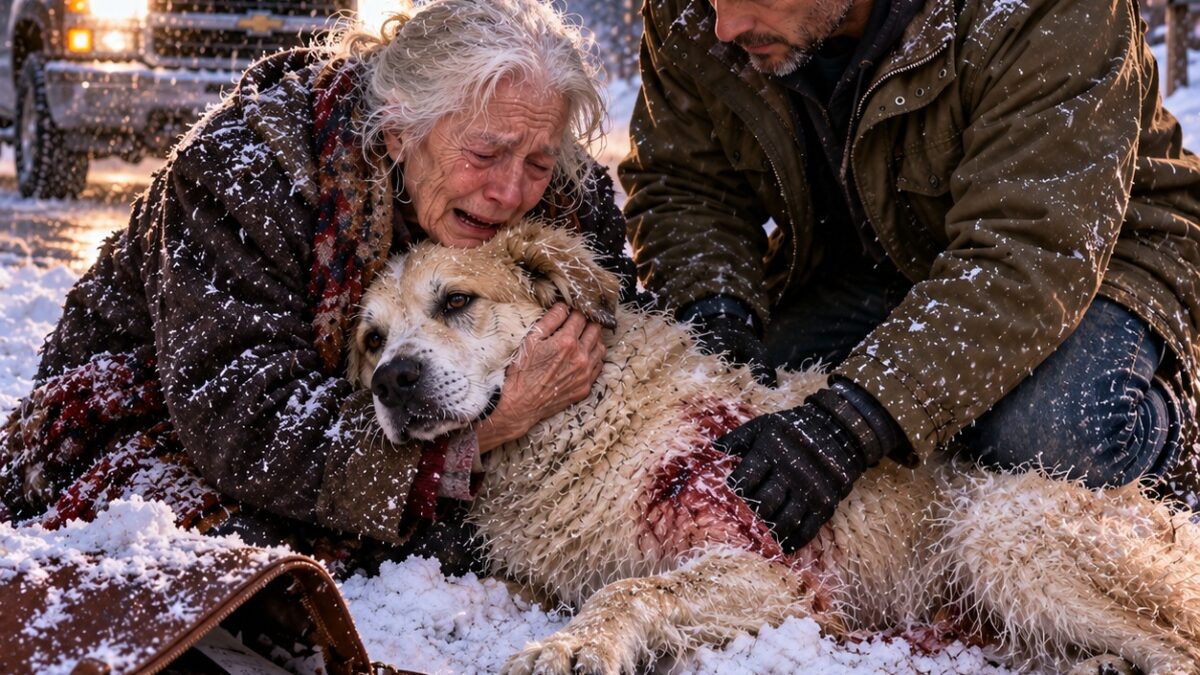
I looked around because old training and maintenance work had taught me that scenes spoke when people could not. The snow beside the road was torn up with several sets of marks. Small boot prints where the woman had tried to brace herself. Deeper prints from a larger man cutting toward the pines. A broken leather strap near the ditch. A long drag mark where Atlas must have tried to rise and failed.
Near the road edge, dark slush was stamped with oily mud, and I caught a faint smell of burned motor oil even through the cold.
This was not a random fall.
It was not confusion.
It was violence shaped to look like opportunity.
“What’s your name, ma’am?”
“Miriam Ashford.”
“Miriam, I’m going to get Atlas warm and move him without bending that shoulder more than we have to. You’re going to help me keep his head steady.”
“I can’t leave him.”
“I’m not asking you to.”
That answer seemed to hold her together for another minute.
I jogged back to the truck, pulled a folded tarp from the bed, then a moving blanket, a tie-down strap, and my canvas jacket liner. With my shoulder hunched against the wind, I called Dr. Pearl Vance’s clinic.
Pearl did not waste questions.
She was the mountain vet everyone trusted and nobody lied to twice—gray-brown hair, sharp hazel eyes, hands that could be blunt and merciful in the same movement. If a creature had a chance, Pearl worked as if chance were a duty.
“Keep him flat,” she said. “Keep him warm. Don’t let the woman freeze. Get here. Call if breathing changes.”
I slid the tarp beside Atlas, speaking low though I did not know whether he heard me.
“Easy, boy. Not asking you to fight. Just asking you to come along.”
Miriam kept one hand beneath Atlas’s jaw and whispered his name over and over, not loudly now, but with a rhythm older than language.
Moving him took care and strength.
I did not lift him like some hero in a story. Atlas was too large, too hurt, and too real for that. I worked the tarp under him inch by inch, padded the injured shoulder with the blanket, and had Miriam hold his head while I drew the corners together into a rough sling.
The wind kept filling the tarp with snow.
My knees sank into roadside slush.
Twice, Atlas made a low sound that tightened Miriam’s face until I thought she might break.
“He’s still here,” I said each time, partly to her and partly to myself. “He’s still here.”
We loaded Atlas into the back seat because the truck bed was too cold. I drove with the heater turned high and the passenger window cracked just enough to keep the glass clear.
Miriam sat in back beside him, bent over his body, one thin hand resting against the red leather collar.
Only when the old mail station disappeared behind us did she begin speaking again—not to me exactly, but into the moving dark.
The bag had held her identification, copies of the deed to her house, a letter from a legal aid office, notes from an old lawyer, and something her son Daniel had written before he died.
“They told me I was confused,” she said. “They told people I agreed to leave. But I know my house. I know what my husband built. I know what my son promised.”
I watched the road, headlights catching snowflakes like sparks burned white.
I did not understand the whole of it yet.
The house.
The son.
Whoever had told people she was confused.
But I understood the way she said home.
Not like property.
Like a name that had been taken from her mouth.
“Who told people that?”
Miriam looked down at Atlas.
Her answer came so softly the heater almost swallowed it.
“My daughter-in-law.”
My hands tightened on the wheel.
Ahead, the clinic lights appeared through the storm, low and yellow beyond a row of dark spruce.
I swung into the lot too fast, gravel snapping beneath the tires, and stopped near the side entrance where Pearl had left the light burning.
Before I could get out, Miriam leaned close to Atlas’s ear.
Her voice had thinned to almost nothing.
“Hold on, old boy. I lost your master. I lost my house. I will not lose you in the snow too.”
I opened the door into the storm.
For the first time that night, the cold felt less like weather than a witness.
Pearl Vance had been two minutes from locking the clinic when my pickup slid into the side lot, headlights smeared wide by snow.
She pulled the door open and saw Miriam in the back seat, bent over something too large and too still.
Pearl did not ask the first three questions that came to mind.
“Bring him through here,” she said. “Treatment table two. Keep him flat.”
Miriam and I moved Atlas inside on the tarp as carefully as the storm allowed.
I took most of the weight.
Miriam refused to release the dog’s head until Pearl stepped close and said, not unkindly, “If you want him to live, let me have him now.”
That was the first time Miriam seemed to understand that love could get in the way of treatment.
Her hands opened.
Pearl and her assistant, Lena Price—a young woman who had come back from her car with wet hair under a wool cap—transferred Atlas onto the padded table. The dog made a low sound, not a full cry, but enough to make Miriam clutch the doorframe.
“Out,” Pearl said to her. “You’re shaking hard enough to drop, and I need room.”
Miriam started to protest, but I put a steady hand near her elbow without gripping it.
“Let them work,” I said. “He’s still here.”
The phrase had become less comfort than measurement.
Atlas was still breathing.
Atlas still had a pulse.
Atlas was still a body in the room and not a memory yet.
Pearl cut through wet fur near the shoulder, checked gum color, listened to lungs, called numbers to Lena, and moved with the kind of controlled urgency I recognized from field medics who had learned fear became useful only after it had been given a job.
“Shocky. Cold. Shoulder trauma. Soft-tissue bruising. Possible fracture, but not my first problem. Warm fluids. Oxygen now. Pain control after pressure comes up. Get the warming blankets.”
Miriam stood in the hallway until her knees began to bend beneath her.
I got her into the waiting room and put her in the chair nearest the wall heater, an old metal unit that rattled as if doing its best out of civic duty.
She looked smaller in the light than she had seemed on the roadside.
Ninety years had folded her down, but not erased the dignity in the way she held her spine.
I took a paper cup of tea from the little counter near the reception window and placed it in her hands.
She did not drink.
She held it as though warmth might give shape to the rest of her.
“He was my son’s dog first,” she said, though I had not asked. “Daniel brought him home as a puppy because he said the house needed someone who believed every guest was suspicious until proven kind.”
The faintest broken smile touched her mouth and vanished.
“Atlas used to sleep across the kitchen doorway. Daniel said it was because he liked the draft. I knew better. He was guarding me even then.”
I sat across from her, forearms on my knees, watching steam rise between us.
I knew better than to press too hard.
People in shock tell truth sideways.
Outside, snow hissed against the windows.
Inside treatment, Pearl’s voice rose and fell in clipped commands.
I was about to ask who had taken the bag when the clinic door opened and Deputy Tessa McCrae stepped in with the storm at her back.
She shook snow from her navy sheriff’s jacket, removed her gloves one finger at a time, and took in the room with the quick, quiet assessment of someone who had learned to see what people left out.
Tessa was thirty-nine, medium-built and steady, with dark hair tied low, brown eyes that did not wander, and a tan deputy shirt visible beneath her coat. She did not look theatrical enough for television.
That made her better.
“Pearl called,” she said. “Mrs. Ashford.”
Miriam nodded.
Tessa came closer but did not tower over her. She pulled a small waterproof notebook from her pocket and lowered herself into the chair beside mine, angled toward Miriam rather than across from her.
“I’m Deputy McCrae. We can go slow. I know Atlas is being treated, and I know you’re cold. I need to understand what happened because the sooner I know, the less time the man who did this has to disappear.”
That did what pity would not have done.
Miriam lifted her eyes.
“He took the bag,” she said. “Not my ring.”
Tessa’s pen paused.
“Tell me about that.”
Miriam held out her left hand.
A thin wedding band, old and dulled by years, still circled one finger.
“He could have taken it. He could have taken my watch. He didn’t even look. He wanted the bag.”
Tessa glanced once at me, and I saw the same conclusion settle behind her face that had settled behind mine.
Not random.
Not simple.
Miriam began again, this time with fewer sobs and more sequence.
Her son Daniel had died in the fall after a heart attack that came without enough warning to let anyone prepare their lives around it. He had been fifty-nine, a quiet carpenter who repaired half the town’s sagging porches for less money than he should have charged and still called his mother every morning from the driveway before starting his truck.
After Daniel’s death, his widow, Celeste Ashford, had moved through the house with a tenderness Miriam first mistook for grief.
Celeste handled phone calls, bank letters, insurance notices, utility bills.
She said Miriam should not have to worry at her age.
She said paperwork was cruel to the old.
She said Daniel would have wanted Miriam protected.
At first, Miriam let her.
Grief makes even obvious cages look like assistance if they are padded with the right words.
Then mail stopped arriving in Miriam’s name.
The kitchen phone no longer rang.
Celeste began telling neighbors Miriam was confused.
A side lock changed because Celeste said the old one stuck.
Forms appeared at the table, and Celeste guided Miriam’s hand to sign them as if helping a child finish homework.
“I asked what they were,” Miriam said. “She said care authorization, temporary help, things to keep the house safe until I felt stronger. I wanted to believe her because Daniel loved her once, and I thought that meant there must still be something in her worth trusting.”
Tessa wrote without interrupting.
I looked down at my hands.
I hated the neatness of it.
Not the crime itself.
The way it had not arrived wearing a mask.
It had arrived as help.
“What was in the bag tonight?” Tessa asked.
Miriam’s fingers tightened around the tea.
“My identification. Copies of the deed. A letter from the legal aid office. Notes from Mr. Bellamy, the lawyer my husband used years ago. And Daniel’s last letter to me.”
Her voice changed on the last item, thinned to a strand.
“I was going to meet Marian Doyle. She helps people who can’t pay much. Reverend Haskins arranged the ride from the old mail station because Celeste has my car keys and the church van could get me before the roads closed.”
Tessa’s expression did not sharpen.
It settled.
“So someone knew where you would be and when.”
Miriam looked toward the treatment door.
“Celeste saw the letter from Marian. I know she did. It was moved from the flower tin.”
“The flower tin?” I asked softly.
Miriam looked almost embarrassed.
“Old women are allowed a few foolish hiding places.”
“That’s not foolish,” Tessa said. “That’s evidence of intent to keep the appointment.”
The door to treatment opened before Miriam could answer.
Pearl stepped out, pulling off one glove.
Her face gave nothing away easily, which made the silence before she spoke feel longer.
“He’s through the first drop,” she said. “Not safe. Through the first drop. Temperature is coming up. Blood pressure is better than it was. Shoulder is bad. I don’t like how much blunt trauma there is along the ribs, but I don’t hear a puncture. He’s on oxygen and warmed fluids. I’m not moving him again tonight unless he crashes and I have no choice.”
Miriam made a sound that was not relief because it did not have enough strength for that.
Pearl looked at her more closely.
“Now you. Your lips are blue. Lena is bringing another blanket. Drink the tea before I start treating you too.”
In another room, a machine ticked softly.
We could see Atlas through the glass panel of the recovery area, laid on blankets with an oxygen line near his muzzle. His long cream coat had been clipped in uneven patches where Pearl needed access. He looked smaller there, robbed of the illusion fur gave him, but not defeated.
Miriam rose too quickly, and I stood in case she fell.
Pearl might have told her to sit down again, but something in the old woman’s face stopped even Pearl.
Miriam went to the glass and placed her palm flat against it.
“Atlas,” she whispered.
For a moment, nothing happened.
Then the dog’s eyelids trembled.
His head shifted once, barely, then again with more effort.
Pearl inhaled sharply, almost a warning.
Atlas should not have tried.
Every movement cost him, but the old dog lifted his muzzle just enough to touch the glass from the other side, his nose leaving a faint mist mark opposite Miriam’s hand.
No one in the room spoke.
Tessa lowered her notebook.
I felt something old and unwelcome open in my chest.
The memory of my mother’s house after her death.
The cold stove.
The chair pushed in.
The brutal quiet of arriving too late.
I had spent years believing guilt was a private weather system, something a man endured alone and did not ask others to stand in.
But watching Atlas strain toward Miriam, watching Miriam hold herself upright by the force of being needed, I understood that this was not a favor I could complete and leave behind at the clinic door.
The stolen bag.
The changed locks.
The daughter-in-law’s careful words.
The dog nearly dying in a ditch.
These were not separate troubles.
They were one thing tightening around a ninety-year-old woman until even her home had begun to deny her name.
Atlas touched the glass once more, weaker.
This time, Miriam bowed her head until her forehead rested near her hand.
“Good boy,” she breathed.
I stood behind her with melting snow darkening my boots, and felt with a weight that frightened me that some part of the story had reached back through my own locked rooms and found me.
By morning, Gray Pine had been reduced to two colors—the white of snow that would not stop falling and the dark ribs of trees, roofs, fences, and telephone poles trying to hold their shape beneath it.
Pearl kept Atlas through the night. She did not use the word safe, but she allowed herself to say stable in the careful tone of a woman who knew better than to hand out hope without a receipt.
Miriam slept less than an hour in a vinyl chair beside the clinic heater, wrapped in two blankets, hands folded around a paper cup gone cold long before dawn.
I stayed too.
Not because anyone asked me.
Not because the waiting room offered comfort.
Because leaving would have felt too much like the old pattern.
Help just enough to quiet the conscience.
Step away before the story became a claim.
Tessa came in a little after seven, snow crusted along her jacket, a folder tucked under one arm, that black waterproof notebook already open in her gloved hand.
She spoke first to Pearl, who stood behind the reception counter with a mug of coffee and the expression of a woman who had been awake long enough to dislike everyone equally.
Atlas was sedated, warm, still weak, and not to be moved.
Miriam was exhausted but clear.
“If you’re taking her out in this,” Pearl said, “you bring her back before noon or you bring her somewhere warm. She’s ninety, not a sworn deputy.”
Tessa nodded.
“I need to document the house before anyone has time to tidy the truth.”
Pearl looked through the glass toward Miriam, who was watching Atlas breathe through the recovery room panel.
“Then don’t let her stand in the cold longer than she has to.”
That was how the morning began.
Not with sirens.
Not with a dramatic warrant.
With an old woman fastening her coat with trembling fingers, a deputy warming the patrol vehicle, and me scraping ice from my windshield because I could not imagine letting Miriam face the house alone.
I drove behind Tessa’s cruiser through streets that looked both familiar and estranged, snow softening Gray Pine’s hard edges while making every mistake more permanent.
Old Mill Road curved out beyond the last church lot, past maple trees black with wet bark, past a cattle fence nearly buried to the top rail, and then toward the Ashford place.
The house sat back from the road behind a pale blue fence and a maple old enough to have witnessed three generations come and go beneath it. White clapboard. Green trim. Wide porch. Steep roof. A wind chime frozen near the porch beam. A ceramic birdbath turned upside down near the walk. A mailbox leaning slightly, red flag rusted at the hinge.
It was not grand.
That was part of what made it hurt.
Grand houses could feel like assets.
This one looked lived into.
Miriam stopped at the gate and gripped the top rail with both hands.
For a moment, I thought the cold had struck her again.
Then I saw her eyes moving from window to window, not searching for damage exactly, but for recognition.
“Daniel painted that fence the summer after his father died,” she said almost absently. “He said blue would make winter less bossy.”
Tessa did not hurry her.
I stayed a step behind, close enough if she stumbled, far enough not to make her feel managed.
When we reached the porch, the first clear fact waited in the door like an insult.
A new lock.
Bright brass.
Wrong against the weathered wood.
Miriam stared at it, and something in her face changed.
On the roadside, she had cried because Atlas was dying. In the clinic, she had shaken because grief, cold, and fear had all found the same bones.
Here, she did neither.
She became very still.
“That is not my lock.”
Tessa photographed it from three angles.
Then the doorframe.
Then the fresh scratch marks near the plate.
“When was the last time you entered through this door?”
“Three days after Daniel’s funeral,” Miriam said. “After that, Celeste said the hinge was unsafe and used the side entrance. Then the side key stopped fitting.”
“Did you agree to have this changed?”
“No.”
Before Tessa could ask the next question, a vehicle came up the road behind us and stopped hard enough to spray slush.
A dark green SUV sat at the curb, engine ticking, and Celeste Ashford stepped out with the kind of composure that had clearly been assembled before she opened the door.
She was in her mid-forties, tall enough to look commanding beside Miriam, with red-brown hair pinned neatly beneath a cream knit hat. Her camel wool coat was belted at the waist. Her black gloves were leather. Her boots were too polished for the road conditions.
Her face was attractive in a controlled way—high cheekbones, pale green eyes measuring the porch, Tessa’s badge, my boots, Miriam’s blanket-wrapped shoulders, and the camera lens still pointed at the lock.
“What is this?” Celeste asked, breath visible in the air. “Deputy, if there’s a problem, I wish someone had called me before frightening Miriam.”
The use of Miriam’s first name landed strangely.
Not affectionate.
Possessive.
Tessa closed her notebook with one finger marking the page.
“Mrs. Ashford reported a theft and assault last night. We’re documenting related concerns at her residence.”
Celeste’s gaze moved to Miriam, softening by half a degree.
“Oh, Miriam, you shouldn’t be out in this weather. This is exactly what I’ve been trying to explain to people. She gets confused when she’s upset.”
My jaw tightened, but Miriam spoke before anyone else could.
“I am not confused about my own front door.”
Celeste gave a tired smile meant for Tessa.
Not Miriam.
“No one said you don’t recognize doors. But after Daniel passed, things became difficult. She agreed to temporary care arrangements. The house is being managed while we sort everything out.”
“Managed by whom?” Tessa asked.
“By family.”
“That isn’t a legal category.”
The smile thinned.
Celeste opened her leather handbag and produced a folder with careful speed, as if she had practiced being prepared.
“I have documents.”
Tessa took them, stepped under the porch eave, and began reading.
I watched Celeste watch her.
The woman’s face barely moved. Yet every small delay in Tessa’s eyes made Celeste’s hands adjust on the strap of the bag.
The pages were photocopies.
Some had signatures.
Some did not.
One referenced care authorization. Another mentioned assistance with utilities. None looked like permission to change locks, remove property, or decide where Miriam could live.
Tessa did not say that immediately.
She asked instead, “Do you have originals?”
Celeste’s answer came too quickly.
“Not with me.”
“Do you have a court order granting you control over this residence?”
“We’re in the process.”
“That’s not what I asked.”
Celeste looked toward me then, as if choosing a lesser target.
“And who is he? Because I find it troubling that a stranger is involving himself in a vulnerable woman’s private family matters.”
I had been called worse by people with better reasons.
I kept my voice level.
“I drove her dog to Pearl’s clinic after someone attacked him and stole her bag.”
“Allegedly stole,” Celeste said.
Miriam flinched.
Not at the legal caution.
At how quickly Celeste could make violence sound uncertain.
Tessa noticed.
“Mrs. Ashford still owns this home.”
Celeste’s eyes sharpened.
“The estate and care situation is complicated.”
“Again,” Tessa said, “not what I asked.”
For the first time, Celeste’s expression showed a hairline fracture.
Not fear yet.
Annoyance at being handled by someone who did not accept the script.
Miriam turned away from us and moved toward the front window. Snow had begun gathering on the sill. She raised one hand to shade the glass and peered inside.
I saw the moment the house wounded her.
Her shoulders sank, not from weakness, but from recognition denied.
“His bed,” she whispered.
Tessa stepped closer.
“Whose?”
“Atlas.”
Through the window, I could see into the front room.
A floral chair.
A lamp without its shade.
Boxes stacked near the wall.
Miriam pointed toward the back, where a dog bed had been shoved near the mudroom door, half-folded as if ready for trash. Beyond that, through another interior doorway, the porch behind the kitchen was visible. A metal water bowl sat outside, frozen solid, tilted against the step.
“That bowl was never kept outside in winter,” Miriam said.
Her voice had gone flat, and the flatness was worse than weeping.
“Daniel would have scolded me for that.”
Celeste crossed her arms.
“The dog was aggressive with visitors. I moved some things for safety.”
“Atlas was Daniel’s dog,” Miriam said. “He knew who belonged.”
The sentence hung there, quiet and devastating.
I looked past the bowl, past the porch, and saw boxes visible through the kitchen window. One had Daniel Office written on the side in thick black marker, sealed with packing tape. Another box had been torn open and rifled through. A stack of framed photographs lay face down on the floor, their backs showing pale rectangles where dust had not settled.
I thought of my mother’s chair pushed neatly against the wall after her death.
How a house could be made cruel not by breaking things, but by arranging them as if a life had already been dismissed.
My anger did not flare.
It cooled.
Condensed.
Became a tool I would not put down.
Tessa moved around the porch, photographing the bowl, the visible boxes, the new lock, the side door, the footprints half-filled with snow.
Celeste followed, her calm less perfect now.
“Deputy, this is unnecessary. You’re letting a confused old woman and a man who knows nothing about our family turn grief into accusation.”
“Then clear it up,” Tessa said. “Open the door.”
Celeste did not move.
The wind worked at the loose edge of her coat.
“I don’t think that’s wise without my attorney.”
“You called it family management a minute ago. Now you need an attorney to let the homeowner inside.”
Celeste’s mouth closed.
Miriam looked at the house again, and this time she did not ask to go in.
That restraint told me more than a plea would have.
She was not afraid of the house.
She was afraid of seeing how thoroughly someone had tried to edit her out of it.
We continued along the side path where snow had drifted deep against the siding.
Near the rear porch, under an overhang, I noticed a small black camera tucked beneath the eave, half obscured by a curl of ice. Its casing was old, sun-faded, mounted on a bracket that had begun to rust, but a tiny red light pulsed faintly behind the frosted cover.
“Tessa,” I said.
Celeste turned before the deputy did.
That was the giveaway.
Miriam followed my gaze.
For the first time since arriving, something like memory brightened her face.
“Daniel put that up,” she said. “After I slipped on the back step one winter. He said if I wouldn’t stop opening the door for every noise, at least I should see who was there first.”
Tessa leaned in without touching it.
“Does it record?”
“It used to,” Miriam said. “There was a small screen in the pantry, but it stopped working last year.”
I studied the wiring, the weatherproof casing, the little indicator light still blinking like a tired heartbeat.
“Screen might have stopped,” I said. “Camera didn’t.”
Celeste’s composure finally shifted visibly.
Her gloved hand tightened around the strap of her bag hard enough to crease the leather.
“That device hasn’t worked in years.”
Tessa looked at her.
“Then you won’t mind if we preserve it.”
She took out her phone, made a call to evidence intake, then another to Marian Doyle, the legal aid attorney whose name had already begun to matter more with every minute.
Her voice stayed steady as she explained the changed lock, the documents, the condition of the property visible through the windows, and the active indicator on an exterior camera installed by Miriam’s son.
When she hung up, she removed a strip of evidence tape from her kit and sealed the small area around the camera mount without disconnecting it.
Celeste stood on the porch steps, snow gathering on the shoulders of her expensive coat, no longer able to make herself look merely inconvenienced.
Miriam remained at the gate, facing the house she still owned but could not enter.
I stood beside her.
Not touching.
Not promising.
Simply present.
The red camera light blinked once.
Then again.
Faint but alive under the ice, as if the house itself had decided it was not finished telling the truth.
By noon, the storm had thinned from violence into stubborn weather—the kind that no longer frightened the town but still slowed every errand into labor.
Tessa spent the first part of the day turning suspicion into procedure. She photographed the changed locks, logged the condition of the Ashford house, filed the initial report on the theft and assault, and requested access to whatever could be recovered from Daniel Ashford’s old rear porch camera.
She did not use the word conspiracy.
Not in paperwork.
Not over the phone.
Words that large could collapse under their own weight if used too early.
She wrote targeted theft, suspected elder coercion, possible unlawful exclusion from residence, potential link to property control dispute.
It sounded colder than what had happened.
That was the point.
Cold language could sometimes travel farther through official channels than outrage.
I understood a different kind of procedure.
I was not a deputy, and Tessa reminded me of that before I left the station.
“You ask questions,” she said, standing beside her cruiser with one boot on a ridge of frozen slush. “You don’t corner anyone. You don’t touch anything. You don’t decide a man looks guilty and drag him to me by his collar.”
I looked at her.
“That’s something people do often?”
“Men with useful hands and old military training sometimes confuse evidence with permission.”
“Noted.”
She studied me a second longer, then softened just enough to become human again.
“The burned oil smell. Yellow paint. Torn black sleeve. Those are good details around here. Good details are how people get found. Call me before you follow anything past a conversation.”
I nodded.
She let me go.
At least officially.
I took the mill truck instead of my own pickup because the mill truck was known at every garage between Gray Pine and the county line, and people talked more easily to a man who looked like he had come to ask about a belt, a bearing, or a part no one stocked anymore.
The first two places gave me nothing but coffee steam and shrugs.
A gas station on Route 14 had seen plenty of black coats, plenty of men who smelled like bad engines, and no one willing to attach memory to trouble.
At Larsson’s Tire, a young clerk remembered a man with a ripped sleeve buying cigarettes, then admitted he remembered that only because I had asked about a ripped sleeve.
I did not push.
False memory was just another kind of snowdrift.
Step wrong and it swallowed the road.
I kept going.
The place that finally answered was Wickham Auto and Salvage, a low corrugated-metal garage wedged between a frozen creek and a field of dead vehicles half buried under snow. The sign had lost two letters. A red shop rag was tied around the office door handle to keep it from rattling in the wind.
Inside, the air was warm with old oil, rust, tobacco no one admitted smoking, and the slow death of engines waiting for spring.
Earl Wickham emerged from behind the lift with a wrench in one hand and suspicion in both eyes. He was sixty-seven, short and thick through the middle, white stubble, cap stained so deeply with grease it had become its own color, hands permanently printed with the underside of machines.
“Mill send you?” he asked.
“No.”
“Then I’m closed.”
“Door was open.”
“That’s how cold gets in and idiots announce themselves.”
I almost smiled.
“Looking for a man with a black coat, yellow paint on one sleeve, burned-oil smell, maybe torn fabric near the cuff.”
Earl’s expression did not change, but his wrench lowered half an inch.
“You a cop now?”
“No.”
“Good. You’d be too depressing at parties.”
I let the silence sit.
Earl glanced toward the bay door, then back at me.
“What’d he do?”
“Hurt a dog. Stole from a ninety-year-old woman.”
That did more than I expected.
Earl’s mouth tightened.
Men like Earl could ignore taxes, regulations, and half the Ten Commandments if the engine sounded right.
But they had their own private borders.
“Rafe Colton,” he said at last. “Could be. Works odd jobs. Wears a black jacket that’s more patch than jacket. Yellow paint’s from Gilley’s old road-service plow. Rafe helped strip it last week and leaned in wet paint like a genius.”
“Where does he stay?”
“Wherever the heat’s on and nobody’s asked him to leave yet. Sometimes above the closed laundromat. Sometimes at the scrap shed behind Barlow’s. Sometimes in his car until it won’t start.”
Earl turned and spat into a coffee can by the workbench.
“He owes everybody. Owes me for a starter. Owes Barlow for tires. Owes Red Pike money. You don’t want to owe Red Pike.”
“Anyone paying him recently?”
Earl’s eyes narrowed.
Not at the question.
At the answer forming.
“Saw him two nights ago with a woman in a green SUV. Red hair. Good coat. Not the kind that comes here unless money got lost or a husband did. She stayed in the vehicle. He leaned in the passenger window. When he came back, he had an envelope and acted like it made him taller.”
I did not speak right away.
I had learned long ago that useful men often kept talking if given room to hate what they remembered.
Earl wiped his hands with the red rag, making them no cleaner.
“If this is about Miriam Ashford, you tell Tessa. I saw Rafe sniffing around the road to St. Luke’s yesterday. Asked me if the church van still ran afternoon pickups in weather. I told him to mind his own rot.”
My phone was in my hand before Earl finished.
Tessa answered on the second ring.
“Talk.”
I did.
She listened without interruption, then said, “Go home or go to Pearl’s. I’ll verify Earl’s statement myself.”
“You want me out of it.”
“I want the case alive when it reaches the prosecutor.”
That ended the fieldwork.
By midafternoon, Marian Doyle arrived at the sheriff’s office carrying a brown leather document case so overstuffed it looked like it had survived several administrations and one small flood.
Marian was fifty-eight, compact, quick-eyed behind thin framed glasses, her salt-and-pepper bob tucked behind one ear, burgundy wool coat dusted with snow. She had the exhausted alertness of a legal aid attorney who had spent decades watching polite paperwork become a weapon in the wrong hands.
She spread copies across Tessa’s desk with the quiet fury of someone arranging bones.
“Miriam Ashford is still the primary lawful owner,” she said. “No recorded deed transfer. No guardianship order. No court-approved conservatorship. These forms Celeste waved around—care authorization, utility assistance, some medical contact language, and one financial access form that is either incomplete or deliberately misrepresented—none of it gives Celeste the right to change locks or exclude Miriam.”
Tessa leaned over the papers.
“Can you get emergency relief?”
“I can file for it faster if we can show coercion, targeted theft, and immediate risk of asset dissipation.”
She tapped one page.
“Celeste relied on fog. Age, grief, fatigue, family words. Management. Protection. Temporary care. People hear those and assume legality came with them.”
I stood near the door because I had come to give a fuller statement and stayed quiet when Marian began.
I thought of Miriam at the window, saying Daniel would have scolded her about the frozen water bowl.
I wondered how many crimes began not with force, but with someone changing the names of things until cruelty sounded administrative.
The camera recovery came after four.
A county evidence technician named Joel Armand brought the unit in sealed packaging, along with the small storage card that had somehow survived cold neglect and Celeste’s apparent confidence that broken screens meant dead witnesses.
The first files showed squirrels, blown leaves, Daniel Ashford years earlier stepping onto the porch in a flannel coat. Miriam laughing at something off-frame. Atlas younger and heavy-coated, shaking snow from his back.
Miriam watched those clips from a chair beside Marian and did not cry.
That restraint made me look away.
Then the dates shifted.
After Daniel’s death, the rear porch became a corridor of removal.
Celeste appeared three times carrying boxes from the back door to her SUV. One box bore Daniel’s name. Another held folders. In a later clip, she dragged Atlas’s bed outside with two fingers, as if even touching it too fully offended her.
She set the water bowl beyond the kitchen step and looked back once over her shoulder before closing the door.
The room went silent.
It was not dramatic footage.
No shouting.
No confession.
Just the small, efficient relocation of a dead man’s traces and an old dog’s place in the house.
Then Joel clicked to the night before the assault.
The image was grainy, warped by snow passing close to the lens.
A dark figure came into frame near Celeste’s back door.
Black coat.
Cap low.
A flash of yellow paint on one sleeve when he raised his arm.
Celeste opened the door only wide enough to keep her face half hidden, but the porch light caught the red-brown of her hair and the leather of one black glove.
She handed the man an envelope.
He tucked it inside his coat and left without stepping fully into the house.
Marian exhaled through her nose.
Tessa said nothing, but wrote the time code down.
It did not prove everything.
Not yet.
But it changed the shape of the room.
Celeste was no longer merely a distressed daughter-in-law managing a complicated elder-care situation.
She was a woman linked on video to a known petty thief the night before a targeted attack on Miriam’s documents.
That was not fog.
That was weather with a direction.
I left the sheriff’s office near dusk and went to Pearl’s clinic because I had nowhere else that felt honest.
Atlas was barely awake.
The dog lay on layered blankets behind the recovery glass, one shoulder shaved and bandaged, an oxygen line still close enough for Pearl to reach if his breathing changed. Pearl stood with arms crossed, watching him like a commander watching a stubborn soldier.
“He reacts to high heels,” she said without turning.
I looked at her.
“Lena walked past in boots earlier. Nothing. A woman dropped off a cat in heeled shoes. Atlas tried to rise before he was awake enough to know where he was.”
I looked at the old dog’s cream muzzle, the red collar, the body that had placed itself between Miriam and harm because instinct recognized what manners refused to name.
“You think he knew Celeste was trouble?”
“I think dogs notice patterns people excuse.”
Pearl glanced at me.
“Miriam’s resting in the back office. Don’t wake her unless you have better news than I do.”
I moved closer to the glass.
Atlas opened his eyes.
For a moment, the dog stared as if deciding whether I had earned a category. Then he shifted painfully and pressed his head into my palm when I reached through the partly opened panel.
It was not trust exactly.
Not yet.
It was assignment.
I felt it in the weight of that old skull against my hand.
The phone at Pearl’s reception desk rang then.
Pearl answered, listened, and looked toward me before she spoke.
“It’s Tessa,” she said, covering the receiver. “Rafe Colton just tried to sell an old leather handbag at a resale shop in North Hartley. Clerk thought it matched the alert.”
I looked down at Atlas.
The dog’s eyes had closed again, but his head remained on my hand.
Warm.
Heavy.
Alive.
Outside, evening gathered over Gray Pine.
Somewhere beyond the snow, the stolen bag had surfaced.
The resale shop sat on the edge of North Hartley with windows fogged from the inside and a row of half-buried lawn chairs chained beneath the awning, as if summer had been arrested and forgotten there.
By the time Tessa pulled into the lot, snow had started falling again in small mean flakes that did not look impressive until they gathered in every footprint and made the road behind them vanish by degrees.
I rode with her because the clerk had described the bag as old brown leather with a broken strap and a brass clasp shaped like a leaf, and Miriam, resting at Pearl’s clinic, was too exhausted to identify it herself.
Tessa had made my role clear before we left Gray Pine.
I was there to confirm what I had seen and stay out of the way.
Inside the shop, heat rattled from a ceiling vent, and the air smelled of dust, wet wool, old books, and furniture polish. The clerk, a thin woman in her sixties with blue reading glasses perched low on her nose, stood behind the counter pretending not to stare at the man in the back aisle.
Rafe Colton was taller than I expected and smaller than his crimes required.
A long, nervous man in a black coat patched at the elbows, cap pulled low, one sleeve torn near the cuff and marked by a dried smear of yellow paint. He was turning a leather handbag over in his hands, trying to look like someone deciding whether to sell a thing that belonged to him.
Tessa did not rush him.
She stepped into the aisle with the clean calm of a person closing a gate.
“Rafe Colton.”
His head jerked up for one second.
His face showed calculation.
Then calculation lost to panic.
He bolted toward the side door, knocking into a rack of winter coats and sending hangers clattering across the floor.
Tessa moved fast but did not have to move far.
Rafe hit the icy sidewalk outside. His boots slipped out from under him, and he went down hard beside a snowbank with a curse that carried more fear than pain.
I stayed by the door, hands open, watching Tessa secure him with one knee in the snow and one hand on his wrist.
It was over in less than twenty seconds, which made the violence done to Miriam feel even uglier.
A man this easily frightened had nearly killed an old dog because someone more composed pointed him in the right direction.
In the trunk of Rafe’s battered sedan, Tessa found the bag.
The strap was snapped where Miriam said it would be.
Inside were her identification, the copy of the deed, the legal aid appointment letter, and folded notes from the old attorney. The documents were damp around the edges but readable.
Missing were Daniel’s final letter and several handwritten pages Miriam had described as private notes.
The kind a son writes when he knows his mother will need courage more than instructions.
At the station, Rafe began with the oldest lie available to small thieves.
He found it.
Then Tessa placed printed stills from the porch camera on the table.
The black coat.
The yellow sleeve.
Celeste’s half-open back door.
The envelope in his hand.
Rafe stared at the pictures as if betrayed by light itself.
“That don’t prove I touched the old lady,” he muttered.
Tessa did not raise her voice.
“No. It proves you lied about finding the bag. Your phone will tell us the rest.”
His eyes flickered.
That was where the fear lived.
When she mentioned a warrant, unread messages, the unpaid envelope, and the possibility that whoever hired him would let him carry the worst of it alone, Rafe’s mouth began working before pride could organize another defense.
He said Celeste told him the bag was family property.
She had said Miriam was confused, that the papers belonged to the Ashford estate, that the old woman was being manipulated by outsiders who wanted the house sold cheap.
Rafe admitted Celeste gave him Miriam’s pickup time near the old mail station and told him to make it look like a street theft so Miriam would miss Marian Doyle.
He insisted he had not meant to hurt the dog.
“Thing came at me,” he said, voice cracking. “Big white bastard came out of nowhere. I swung to get loose. I didn’t know it was old. I didn’t know it’d go down like that.”
I was not in the interview room.
I watched through the glass with Tessa’s permission only after she told me silence was the price of standing there.
Still, my hands curled once at my sides.
I had seen Atlas breathing shallow under Pearl’s oxygen line.
I had seen Miriam hold a cold cup of tea like a life raft.
Rafe looked less like a monster than a weak man who had let money rent the empty places in his spine.
Somehow, that made it worse.
Later, Celeste came to the station voluntarily because Tessa’s call had been worded carefully enough to make refusal look worse than arrival.
She entered in the same camel coat, hair pinned neatly, black gloves removed finger by finger as if manners still belonged to her.
She did not ask after Atlas.
That was the first thing I noticed.
She asked whether Miriam was comfortable, whether the deputy understood how fragile grief can make the elderly, whether anyone had considered the years she had spent caring for Daniel when his heart began failing in stages too small for neighbors to notice.
There was real bitterness under the performance.
I could hear it.
So could Marian Doyle, who stood near Miriam in the lobby rather than the interview room, a brown legal file held against her coat.
Celeste said the Ashfords had always treated her like a visitor in a house where she cooked, cleaned, scheduled Daniel’s appointments, and watched the man she married become someone she could not save.
She said Miriam floated above practical burdens, beloved and useless, while Celeste handled bills and blood pressure and funeral arrangements.
The more she spoke, the more dangerous her grief became, because it kept reaching for entitlement and calling it justice.
“I gave my life to that family,” Celeste said at last, composure splintering around the edges. “Years. Doctors. Bills. Nights when he couldn’t breathe and she went to bed because she was tired. I handled everything while she got to be loved for being gentle. And when he died, what was I supposed to have? Nothing? A thank-you note and a house full of memories that treated me like a guest?”
Her voice cracked on the last word.
For one brief second, I could hear the pain underneath.
It was real.
That was the worst of it.
Real pain made poisonous by entitlement.
Marian’s answer was quiet.
Not dramatic enough to be a speech.
Firm enough to end one.
“Pain can explain why someone reaches for the wrong door. It does not give anyone the right to lock an old woman out of her own.”
Celeste looked at her then with clean hatred, and for a moment all the soft language disappeared.
Tessa did not arrest her that afternoon.
There were warrants to prepare, prosecutors to consult, evidence to secure, but Celeste left the station no longer wrapped in the safety of ambiguity.
Rafe’s statement, the messages on his phone, the recovered bag, the video, and the property records had begun forming a shape no amount of family language could soften.
Before dark, Tessa arranged for Miriam to return to the house under supervision to collect clothing, medication, and personal effects.
Pearl objected to the outing until Miriam stood in the clinic hallway, still pale, still tired, and said, “If I do not go now, she will burn what she cannot explain.”
Pearl looked at me.
Then at Tessa.
Then at Atlas behind the glass.
“One hour,” she said. “And if she drops, I am blaming both of you in writing.”
Old Mill Road looked colder than it had that morning.
Celeste was not there when we arrived.
Tessa had made sure of that.
The new lock had been bypassed under temporary authority, and when the door opened, the house smelled wrong to Miriam before she named why.
Too much lemon cleaner.
Too little woodsmoke.
No dog warmth.
She walked inside slowly, one hand near the wall but not touching it, as if the house itself were bruised.
I followed, carrying an empty box and a flashlight.
Though the power worked, I had learned that people returned to wounded places at their own speed.
Advice only tripped them.
In the kitchen, Miriam touched the edge of the table Daniel had repaired years earlier. The maple top bore a lighter strip where he had sanded out a burn mark and never matched the stain properly.
“He said imperfection proved the table was honest,” she said.
Her teacup was gone from its shelf.
Her husband’s photograph lay face down near a stack of cookbooks.
In the mudroom, Atlas’s sleeping mat had been shoved into a corner of the utility closet, crusted with dried slush.
Miriam did not cry at those things.
She gathered them with terrible neatness.
The photograph upright.
The cup rescued from a lower cabinet.
The mat folded across my arms as if it were ceremonial cloth.
Then she stopped beside the cold fireplace.
“Daniel’s letter,” she said.
I turned.
The ash bucket was empty, but the trash can beside the hearth held kindling scraps, torn envelopes, and a crumpled piece of paper darkened along one edge where fire had kissed it but not taken.
Miriam reached before Tessa could stop her.
Her fingers shook as she opened it.
The handwriting inside was firm, slightly slanted, the kind of writing made by a carpenter who pressed too hard because pencils were often used on lumber before paper.
Miriam read silently at first.
Then her breath broke.
I looked away.
Not because I did not care.
Because some grief deserved not to be watched too eagerly.
She read one line aloud, barely more than air.
“If anything happens to me, Mom, don’t leave the house unless leaving is your own choice.”
Her hand went to her mouth.
Another line followed after a long pause.
“Atlas will know who comes in love and who comes in wanting.”
The room seemed to close around that sentence.
Tessa stood near the doorway, notebook lowered.
I held the dog’s folded mat and felt the weight of it like a body.
Miriam pressed the burned letter against her chest, then reached into her coat pocket and pulled out Atlas’s red collar tag, the one Pearl had removed during treatment and given back for safekeeping.
She held both together.
The letter.
The red leather circle.
A loyalty no one had managed to steal.
When she began to cry, it was not the broken panic I had heard beside the old mail station.
It was deeper.
Quieter.
Grief finding ground at last.
I stayed in the kitchen doorway and did not offer comfort I had not earned.
I understood then that Miriam had not needed someone to rescue her from loving her son too much, or trusting too long, or believing the house still remembered her.
She needed proof that her love had not been foolish.
That Daniel had not left her defenseless.
That Atlas had not been wrong to stand between her and the world.
Outside, snow tapped against the windows.
Inside, Miriam held the letter that had not burned, and the house, for the first time since I entered it, felt as if it had taken a breath.
The courthouse in Gray Pine did not look built for drama.
It was a square brick building with narrow windows, a flagpole that groaned in the wind, and steps salted so heavily they looked dusted with flour. On a better day, it might have disappeared into town business—parking tickets, property filings, marriage licenses, complaints between neighbors whose fences had moved three inches over twenty years.
But that morning, with snow falling hard enough to blur the maples across the street, the building felt like the only place in the county where truth had been asked to arrive on time.
Marian Doyle had filed for emergency relief before sunrise.
Because Miriam Ashford was ninety.
Because the storm had not fully released the roads.
Because the evidence now pointed toward targeted theft, unlawful exclusion from a residence, and possible elder coercion.
The court agreed to hear the matter in a small side courtroom normally used for probate disputes and preliminary hearings.
I stood just inside the door while Tessa helped Miriam remove her coat.
Miriam looked smaller in the courthouse light than she had in her kitchen.
But not weaker.
There was a difference, and I was beginning to understand it.
Weakness bent away from pressure.
Miriam seemed to draw inward around something pressure could not reach.
Marian set her brown leather file case on the counsel table and began arranging documents in precise stacks.
Deed records.
Copies of the disputed forms.
Still images from Daniel’s porch camera.
The recovered appointment letter from legal aid.
Photographs of the changed lock.
Rafe Colton’s signed statement.
Screen captures of his messages with Celeste.
Pearl Vance’s veterinary report.
A written statement from Reverend Paul Haskins confirming Miriam had been scheduled for a church volunteer pickup at the old mail station on the day her bag was stolen.
None of it looked like thunder.
It looked like paper.
That was what made it powerful.
Celeste arrived ten minutes before the judge, wearing the camel coat and black gloves I had come to associate with polished restraint that never quite became dignity. She had brought an attorney from Montpelier, a pale man with expensive glasses and the strained courtesy of someone who had learned too much too recently.
Celeste did not look at Miriam when she entered.
She looked at the evidence table.
Then at Marian.
Then at Tessa.
As if calculating which part of the room had betrayed her most.
Judge Alden Reeves entered without ceremony, a tall man in his late sixties with white hair, heavy eyelids, and a voice that made people answer the question asked rather than the question they preferred.
He began by making the purpose of the hearing clear.
This was not a criminal trial.
No final ownership decision would be made that day.
The court was considering emergency protection, access to residence, preservation of property, and whether there was sufficient evidence to freeze further transactions pending full review.
That clarification calmed nothing.
If anything, it made the room more tense because no one could hide inside spectacle.
Marian spoke first.
She did not accuse Celeste of every possible evil.
She built the case slowly, as if repairing a staircase, one board at a time.
Miriam remained the recorded owner of the house on Old Mill Road.
No guardianship order existed.
No conservatorship had been granted.
The documents Celeste relied upon were care-related forms, utility and medical contact authorizations, and one incomplete financial access document, none of which gave her authority to change locks, remove Miriam’s personal property, discard the dog’s belongings, or prevent Miriam from entering her residence.
Then Marian moved to timing.
The legal aid appointment had been set.
The church pickup had been arranged.
Miriam’s bag had been targeted before she could attend.
The man who stole it had received money from Celeste the night before.
The room stayed silent except for the soft mechanical hum of the courthouse heat and the scratch of the judge’s pen.
Celeste’s attorney argued that grief, confusion, age, and family strain had created misunderstandings. He said Celeste had been caring for an elderly mother-in-law after the sudden death of her husband, that she had acted to protect assets from deterioration and to prevent Miriam from being exploited by outsiders.
Marian let him finish.
Then she called Miriam.
I watched the old woman rise.
For a second, I thought she might refuse help out of pride, but she allowed me to steady her elbow until she reached the witness chair, then removed my hand gently, not unkindly.
Under oath, Miriam’s voice began thin but clear.
Celeste’s attorney asked about her age first.
Then whether she sometimes misplaced things.
Whether grief affected her sleep.
Whether Daniel’s death left her distressed.
Whether she had trusted Celeste with household matters.
Miriam answered yes where yes was true.
That was what made the rest of her testimony matter.
She did not pretend to be untouched by age.
She did not claim perfect memory in all things.
But when Marian asked who owned the house, Miriam gave the full legal description because her late husband had made her memorize it after a boundary dispute in 1989.
When asked where the breaker box was, she named the pantry wall behind the flower bin.
When asked who repaired the front porch after the spring flood, she named Daniel, the year, the neighbor who helped lift the boards, and the exact corner where the joist still sat slightly crooked.
When asked why she had gone to the old mail station in the storm, she did not say vaguely that she wanted help.
She gave Reverend Haskins’s pickup time, Marian’s office address, the items inside the bag, and the reason each mattered.
The judge looked over his glasses.
“Mrs. Ashford, did you agree to leave your home permanently?”
Miriam turned toward him, not toward Celeste.
“No, Your Honor. I agreed to let my daughter-in-law help me make phone calls after Daniel died. That is not the same as giving her my house. It is not the same as becoming a child.”
The words did not shake.
That was when I saw Celeste’s face change.
Not collapse.
Harden.
As if Miriam’s steadiness offended her more than accusation would have.
Reverend Paul Haskins testified next, a broad gentle man with a trimmed silver beard and a church key ring that made a faint sound when he stood. He confirmed Miriam had contacted him about transportation to legal aid, that she had spoken coherently about her appointment, and that she had never described herself as moving out or surrendering the house.
Tessa followed with the theft report, photographs, and chain of evidence.
Pearl’s report was admitted through affidavit and supporting medical notes. Atlas’s injuries were consistent with blunt trauma sustained during a struggle, not with a fall or vehicle strike. The dog had suffered shock and exposure but had survived emergency stabilization.
Rafe’s signed statement was read into the record in relevant part.
He admitted Celeste told him to take the bag and make it look like a random theft so Miriam would miss the appointment. He admitted he had kept messages as leverage because payment had not been completed.
Celeste’s attorney objected to parts of it, and the judge limited what could be considered.
The damage had already entered the room.
Then I was called.
I had dreaded that more than I expected.
Not because I feared courtrooms, but because testimony has a way of turning human suffering into sequence, and I did not want to make the roadside smaller than it had been.
I kept my hands loose on my knees and told only what I knew.
The cry by the old mail station.
Miriam’s awareness of where she had been going.
The broken strap.
The footprints.
The smell of burned oil in the slush.
Atlas breathing shallow in the snow.
Miriam naming the contents of the bag before anyone else knew why it mattered.
Marian asked whether Miriam appeared confused about her destination or purpose.
“No,” I said. “She was cold, frightened, and worried about the dog. But she knew where she was going. She knew who she was supposed to meet. She knew what had been taken.”
Marian paused.
“And what did you understand the situation to be?”
I looked once at Miriam.
Then at the judge.
“That she did not need someone to decide her life for her. She needed people to stop taking pieces of it and calling that protection.”
No one spoke for a moment after that.
Celeste broke the silence later when Marian’s final questions turned to the house.
“She had a whole life,” Celeste said suddenly before her attorney could stop her. “Everyone talks like I stole some fairy-tale cottage from a helpless old saint. I gave years to Daniel. Years. Doctors. Bills. Nights when he couldn’t breathe and she went to bed because she was tired. I handled everything while she got to be loved for being gentle. And when he died, what was I supposed to have? Nothing? A thank-you note and a house full of memories that treated me like a guest?”
Her voice cracked on the last word.
For one brief second, I heard the pain underneath.
It was real.
That was the worst of it.
Real pain made poisonous by entitlement.
Marian did not move quickly.
She let the statement settle.
Then she said, “Loss may explain bitterness, Mrs. Ashford. It does not convert bitterness into inheritance. And it does not give anyone the right to steal documents, change locks, hire a thief, or silence a ninety-year-old woman by calling her confused.”
Judge Reeves recessed for nineteen minutes.
Miriam sat with her hands folded over Daniel’s burned letter, which Marian had placed in a protective sleeve. She did not look at Celeste.
Celeste stared at the wall.
I stood near the window and watched snow strike the glass, each flake vanishing into water as soon as it touched the warmer pane.
When the judge returned, his ruling was measured and devastating in its restraint.
Miriam’s right of access to the Old Mill Road residence would be restored immediately under deputy supervision.
Celeste was restrained from entering or removing property until further order.
All transactions, transfers, liens, or withdrawals connected to the residence or Miriam’s assets were frozen pending full review.
The questionable documents were to be examined, originals produced, and records preserved.
The criminal matters involving theft, assault-related circumstances, elder exploitation, coercion, and harm to the animal would be referred to the county prosecutor.
He did not call it justice.
Courts rarely used such large words in small rooms.
But Miriam closed her eyes when he finished, and for the first time since I had met her, her shoulders lowered as if some invisible hand had stopped pressing down.
Outside the courtroom, people began moving, speaking softly, gathering papers.
Celeste left through another door with her attorney, face empty in a way that did not look like remorse.
Miriam did not ask about her.
She looked at me instead.
“Do you think Pearl would let Atlas come home soon?”
It was such a small question after such a large morning that I felt the answer lodge in my throat.
“I think he’ll come when she says he can survive your cooking.”
Miriam gave a sound almost like a laugh.
I offered my arm as we stepped out of the courthouse into the falling snow.
The wind lifted the edge of her scarf, but she did not bow her head against it. She walked slowly, carefully, with me beside her and Tessa ahead clearing the salted steps.
The white storm no longer looked like something erasing her.
It looked, at last, like something she was passing through.
Atlas came home on a Thursday afternoon when the snow had begun to lose its authority over the town.
It still lay deep along Old Mill Road, piled high against fences and crouched in shadows beneath pines. But the top crust had softened under a pale sun, and water had started to run in narrow silver threads along the ruts.
Pearl did not release the old dog because he was healed.
She made that clear three times in the clinic lobby while Miriam sat upright in a chair with both hands folded over the red leather collar tag in her lap.
Atlas was alive, warm, breathing without assistance, and angry enough about confinement to be considered medically promising.
But his shoulder would need weeks of careful management. His movement would need to be limited, and no one in their right mind was to let him charge stairs, visitors, shadows, or bad memories.
“He is not young,” Pearl said, signing the discharge sheet with the blunt pressure of her yellow marker. “He is also not fragile in the way people think old animals are fragile. He wants work. That is the danger. You have to protect him from his own sense of duty.”
Miriam looked through the glass at Atlas, who stood unsteadily beside Lena Price, cream coat clipped unevenly near the shoulder, one ear ragged, old eyes fixed on Miriam as if discharge instructions were a foolish delay created by humans with no respect for urgency.
“He has been protecting me for years,” Miriam said.
Pearl’s face softened only at the edges.
“Then return the favor.”
I drove them back because Miriam’s car keys were still part of the evidence mess and because no one needed to ask me.
Atlas rode in the back seat on blankets, harnessed loosely so he could lie without pressure on his bad side.
He panted once when the truck turned onto Old Mill Road.
Not from pain exactly.
Recognition.
Miriam heard it and turned in her seat.
“Yes,” she whispered. “We’re going home.”
The house appeared beyond the old maple and the pale blue fence like a thing pulled back from underwater. White clapboard, green trim, wide porch still heaped at the corners with snow. The front walk had been freshly shoveled by Reverend Paul and two men from St. Luke’s who had come before breakfast without making ceremony of it.
Tessa was waiting near the steps, stamping warmth into her boots, a new set of keys in one gloved hand and an order folded inside her coat pocket.
She did not smile broadly when Miriam got out.
Tessa was too careful with victories for that.
She simply placed the keys in Miriam’s palm and said, “This set is yours. Locks were changed under supervision. Celeste has no access under the temporary order.”
Miriam closed her fingers around the keys and looked at the door.
For a long second, I thought she might ask me to open it.
Instead, she stepped forward, slow but straight, with Atlas pulling lightly at the leash behind her, as if the old dog intended to inspect every inch of what had been taken.
The key turned.
The door opened.
Cold air came out first, carrying lemon cleaner, dust, old wood, and the faint absence of all the ordinary smells that make a house believe in itself.
Miriam stepped over the threshold.
Not like a rescued woman returning to shelter.
Like the owner of a wounded place coming back to do the work.
The house was not destroyed.
That would have been easier to understand.
It had been rearranged with a colder kind of violence. Photographs moved. Cupboards reordered. Daniel’s office half-emptied. The kitchen table wiped too clean. The stove cold. The back porch cluttered with objects Celeste had meant to discard or did not know how to value.
Miriam stood in the center of the kitchen and took it in without crying.
Then she looked at me.
“The lamp over the sink always flickered,” she said. “Daniel said he fixed it, but he never did.”
I glanced at the old fixture, then nodded as if she had given me a command post.
“I’ll look at it.”
That became the first hour.
Not speeches.
Not healing.
Not the world setting itself right because a judge signed paper.
Work.
I replaced the bulb and found a loose wire in the fixture. Tessa checked the rear door and confirmed the order had been posted. Pearl arrived with medication, written instructions, and a look that made me put down the hammer whenever Atlas tried to stand too quickly. Reverend Paul brought soup in glass jars, two bundles of firewood, and a stack of folded blankets from women at the church, who had apparently decided Miriam would not be allowed to say she did not need them.
The house began to make sounds again.
Kettle.
Water heating.
Floorboards accepting weight.
A shovel scraping the porch.
Atlas lowering himself onto the restored bed near the kitchen with a groan so satisfied it made Miriam cover her mouth and laugh through tears she refused to fully shed.
In the days that followed, I kept finding reasons to stop by.
At first, they were real and narrow.
The fence latch needed replacing.
The back step had warped.
The porch light had a cracked casing.
The pantry shelf leaned forward under too many jars.
I brought tools in the bed of my truck, fixed each problem, and left before supper if I could manage it. Miriam learned quickly that if she offered payment, I looked uncomfortable, and if she offered coffee, I accepted only because refusing a ninety-year-old woman coffee in her own kitchen felt like a crime.
Atlas decided before I did.
The old dog would lift his head when I entered, thump his tail once, and then settle again, as if checking off the arrival of a necessary person.
The house adjusted around me too.
A hook by the mudroom began holding my extra work gloves.
A small tin of screws appeared near the window because Miriam said she was tired of me searching my pockets.
One afternoon after I finished repairing the broken section of blue fence, Miriam stood beside me in the snow and said she did not want the house to become a museum of what had been done to her.
“If I sit inside and hate her,” she said, not needing to name Celeste, “then she still occupies a room.”
I pushed the fence post straight and held it there while the cement mix settled.
“You’re allowed to hate what happened.”
“I do.”
Her answer was immediate.
Almost sharp.
Then she looked back at the porch where Atlas slept in a square of winter sun.
“But I do not want hatred to be the last person invited in.”
That was how Winter Table began.
Not as an announcement.
As a practical rebellion.
The first week, Miriam opened her front room on Saturday from two to five. Reverend Paul mentioned it after service. Tessa told a retired mill worker who had been calling dispatch just to hear a human voice. Pearl sent over a woman whose husband had died and whose cat needed medicine she could not organize. I cleared space by moving two heavy chairs back where Miriam wanted them.
There was tea.
Soup.
A plate of biscuits.
A stack of old books.
A telephone with large numbers.
A basket for mail that needed explaining.
And a sign Miriam wrote by hand.
Winter Table. Come in before the cold convinces you not to.
People came awkwardly at first.
Old men pretended they were only checking the road.
Widows brought jars they did not need to bring.
A Vietnam veteran named Ellis Shaw sat by the window for forty minutes without removing his gloves, then finally asked if anyone knew how to call the VA office without being transferred six times.
Miriam did.
I found myself filling the woodbox, fixing a loose cane tip, adjusting a walker brake, and listening to more silence than conversation.
Atlas lay near the kitchen, bandaged shoulder resting carefully, watching each arrival with the grave patience of an old guardian who had decided the house could belong to many people and still remain Miriam’s.
News about Celeste arrived in pieces and never became the center of the room.
Charges were filed.
Rafe’s cooperation reduced some possibilities and confirmed others.
Celeste’s attorney negotiated where he could and failed where the evidence refused to bend.
There would be more hearings, restitution questions, restrictions, consequences.
I did not pretend to understand all of it.
Miriam listened when Marian explained each step, signed what needed signing, and returned to pouring tea.
She did not forgive Celeste for what had been done.
But she also refused to feed the wound until it grew into a second owner of the house.
“The law may take care of her,” she told me one evening as I repaired a sticking drawer in the kitchen. “I have to take care of what she tried to ruin.”
By late winter, the thaw came in earnest.
Snow withdrew from the porch rails in uneven strips, revealing old paint, rusted nail heads, and the blue fence brighter where I had repaired it. Atlas could walk the length of the hall twice a day under Pearl’s strict schedule and considered this insulting. Miriam grew steadier in her own rooms.
The front parlor filled every Saturday with people who had once believed loneliness was a private defect rather than a weather system common to mountain towns.
I, who had spent years making myself useful in ways that ended quickly, began staying through supper.
I still spoke little.
Still fixed things that did not strictly need fixing.
But one night, after everyone left and Atlas slept near the stove, Miriam set the table for two and placed three things between us.
Daniel’s burned letter, sealed in a clear sleeve.
Atlas’s red collar tag.
And a set of papers from Marian Doyle.
I looked at the papers and felt the room shift before I understood why.
Miriam folded her hands—the same hands that had clutched Atlas in the snow, signed court documents, poured tea for strangers, and opened her own door again.
“I have been thinking about family,” she said.
I did not joke.
Something in her tone would not allow it.
“Daniel is not replaceable. I would not insult him by pretending otherwise. And I am not asking you to become someone softer or louder or easier than you are.”
She paused, and the old house creaked around us as meltwater dripped from the eaves outside.
“But I am ninety years old, Wyatt. I do not have to let the last people who carry my name be the ones who tried to take it from me.”
My throat tightened before I knew what it meant.
“Marian says adult adoption is possible,” Miriam continued, “though paperwork is slower than feeling. I would like to begin it, if you allow. And if the law takes its time, I would like permission to call you my son before the law catches up.”
I looked down because the room had blurred in a way I was not prepared to explain.
I had spent years believing I failed at being a son when it mattered most. I had arrived too late for my mother, loved her too quietly, assumed there would be more time until time proved it owed me nothing.
Now this old woman, who had every reason to protect the little family she had left from further risk, was offering me not gratitude.
Not obligation.
A place.
Atlas lifted his head with effort, then rested his heavy muzzle on my knee.
The decision in that gesture felt older than the conversation.
I placed one hand on the dog’s warm head and let the silence hold long enough to become honest.
“Miriam,” I said at last, voice rougher than I wanted. “If you’re sure you want a son who talks less than your furniture and fixes things when he doesn’t know what to say, I think I can learn how to stay.”
Miriam began to cry then.
But it was not the sound I had heard beside the old mail station.
It was not fear.
Not a plea.
Not a life breaking open in the snow.
It was the quiet trembling release of someone sitting in her own kitchen beside a living dog across from a man who had stopped standing at the edge of the doorway.
Outside, the last of winter loosened its grip on the roof.
Inside, Atlas closed his eyes.
The letter lay safe between us.
And the house kept its light on.