𝗙𝗨𝗟𝗟 𝗦𝗧𝗢𝗥𝗬:The K9 Who Refused to Leave the Station Doors Was Waiting for One Voice to Come Back
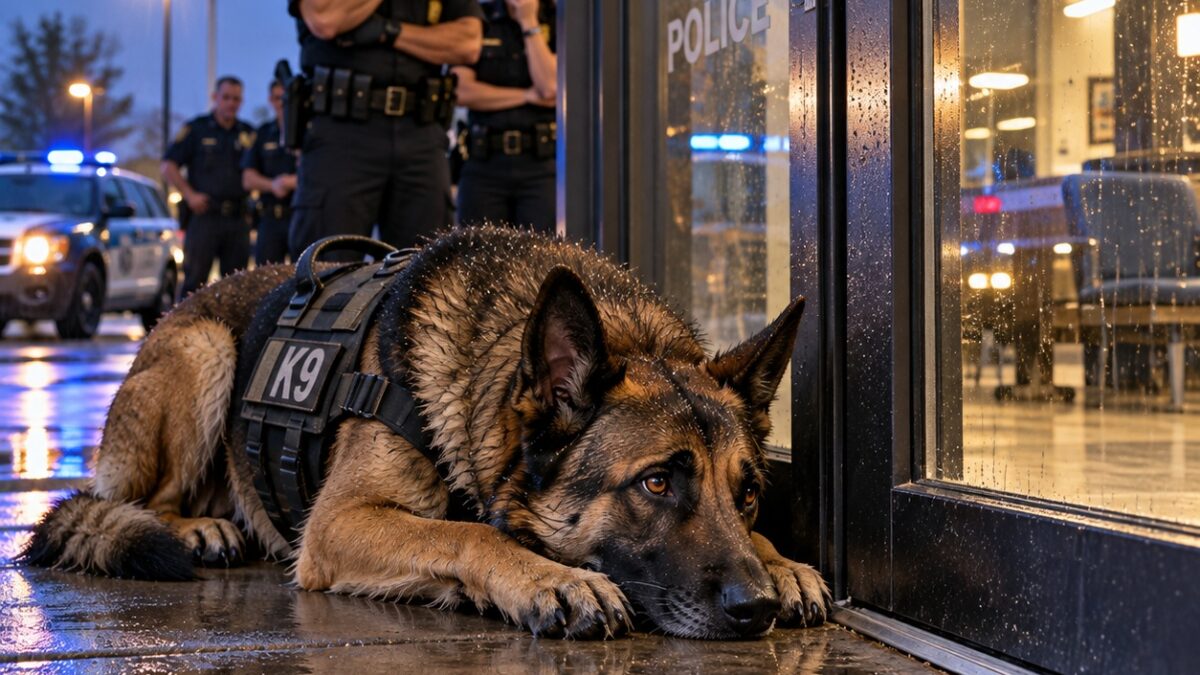
FULL STORY CONTINUATION
Dr. Moran answered after several transfers.
I had spoken with her twice during the week, but every conversation had sounded almost the same.
Stable but critical.
No major change.
Still unconscious.
We were waiting.
Medicine contains more waiting than people imagine.
Television makes hospitals look like a series of dramatic decisions.
Real hospitals are full of hours.
Numbers.
Monitoring.
Small changes.
People standing beside beds wishing they could do something meaningful.
That was where Thomas had been for six days.
“What can you tell me?” I asked.
Dr. Moran paused.
“His condition is finally more stable.”
I closed my eyes.
That was the first genuinely good sentence I had heard all week.
“Stable?”
“Yes.”
“Is he waking?”
“Not yet.”
The relief disappeared almost as quickly as it came.
She continued carefully.
“He remains deeply unconscious. But the acute crisis has eased.”
I looked through the station window.
Max had not moved.
“Doctor, his dog is deteriorating.”
“Max?”
“You know his name?”
“Half the department has mentioned him.”
Despite everything, I smiled.
“That sounds right.”
I told her what was happening.
Seven meals barely touched.
Minimal sleep.
Constant vigil at the entrance.
Standing every time a car arrived.
Dr. Moran listened.
Then said something I did not expect.
“Keep talking to him.”
“To Max?”
“Yes.”
“I have.”
“No. I mean if Thomas changes.”
I waited.
“There are cases where familiar voices, music, touch, or emotional cues appear meaningful during recovery from impaired consciousness. We can’t promise anything. We certainly can’t turn it into a guarantee.”
“I understand.”
“But if Thomas shows signs of waking, we’ll let you know.”
“What are you thinking?”
“A familiar connection might matter to both of them.”
I looked at Max again.
The dog had spent six days trying to maintain his half of that connection.
“I’ll keep my phone on.”
“You should.”
I almost hung up.
Then asked:
“Doctor?”
“Yes?”
“Does Thomas know we’re here?”
Another pause.
“We don’t know.”
I hated that answer.
But it was honest.
“Talk to him anyway,” she said.
“To Thomas?”
“If you visit.”
The hospital allowed only limited access then.
Thomas’s family had been with him whenever they could.
I had visited once.
His room had frightened me.
Thomas had always seemed larger than hospital furniture.
Strong shoulders.
Steady voice.
A man who could control a ninety-pound working dog with two fingers and one quiet command.
Seeing him unconscious beneath white sheets, surrounded by monitors, felt wrong.
I had stood beside him and said the most useless things imaginable.
The station is fine.
Your paperwork is still terrible.
Nobody has stolen your locker.
Then I told him about Max.
That was when the monitor changed slightly.
Not dramatically.
Nothing anyone called medical evidence.
Just enough that I noticed.
“Max is waiting for you,” I said.
“He is making everybody miserable.”
The rhythm changed again.
A nurse glanced at the monitor.
I looked at her.
She smiled.
“Keep talking.”
So I did.
“He won’t leave the front doors.”
I leaned closer.
“You trained a monster.”
Thomas didn’t move.
But I had left believing something in him might still be listening.
That sixth night, I stayed late.
The station slowly emptied.
Patrol shifts changed.
Lights dimmed.
Someone left a blanket beside Max.
He moved off it.
Of course.
I brought fresh water.
He drank a little.
“Good.”
His eyes returned to the parking lot.
At eleven, one of the night officers came through the doors.
“Still there?”
“Still there.”
“Has he slept?”
“Not enough.”
The officer stood beside me.
“My dog would have forgotten me by lunch.”
“No, he wouldn’t.”
“Mine absolutely would. I feed him and he still prefers my wife.”
Max suddenly stood.
Head high.
We both looked outside.
Headlights turned in.
A vehicle stopped.
Max took one step toward the glass.
A woman got out.
Not Thomas.
His ears lowered.
He returned to the same spot.
That moment broke something in me.
“How many times has he done that?”
“Every car.”
The officer swore quietly.
Then walked away.
I sat on the floor beside Max.
I don’t remember deciding to.
One minute I was standing.
The next I was leaning against the wall with him.
For almost an hour, neither of us moved.
“You know,” I finally said, “he’s going to be furious when he finds out you’ve been skipping meals.”
Max blinked.
“He’ll blame us.”
Nothing.
“He always blames us when you do something wrong.”
One ear shifted.
“That’s right.”
I rubbed his shoulder.
“He says you’re perfect.”
Max closed his eyes.
For maybe five minutes, he slept.
Then a car door slammed outside.
He woke immediately.
Seventh morning came behind gray fog.
I must have dozed at my desk because the ringing phone startled me so hard I nearly knocked over a coffee cup.
The clock said 6:18.
Hospital.
My heart stopped before I answered.
You learn to fear early calls.
Good news usually waits for office hours.
Bad news doesn’t.
“This is—”
“It’s Dr. Moran.”
I stood.
“What happened?”
There was a sound in her voice.
Not fear.
Emotion.
“Thomas opened his eyes.”
For a second, I couldn’t understand the words.
“What?”
“He woke.”
I grabbed the edge of the desk.
“Is he conscious?”
“Yes.”
“Talking?”
“Barely.”
I laughed.
Or cried.
Maybe both.
“Is he okay?”
“He is extremely weak. Confused. But responsive.”
Then she said:
“His first question was about the dog.”
I looked toward the front entrance.
Max was visible through the hallway.
Same place.
Same posture.
“What did he say?”
Dr. Moran took a breath.
“He asked, ‘Where’s Max?’”
My eyes burned.
“Can he speak to him?”
“We can try.”
I didn’t even hang up properly.
I switched the call to my cell phone and ran.
Two officers looked up as I passed.
“What happened?”
“Thomas is awake.”
The station changed instantly.
Chairs scraped.
Someone shouted.
But I kept moving.
Max heard me coming and turned.
For the first time in a week, I approached him carrying something he might actually want.
I dropped to one knee.
“Max.”
He looked at me.
“Listen.”
I put the phone on speaker.
There was hospital noise.
A faint electronic beep.
Then silence.
I almost panicked.
“Thomas?”
A breath.
Then a voice.
Weak.
Rough.
Barely recognizable.
“Max…”
The dog froze.
Not figuratively.
Every muscle stopped.
His ears snapped forward.
The entire lobby became silent.
The voice came again.
“It’s me, buddy.”
Max stood.
His eyes widened.
I moved the phone closer.
He pushed his nose toward it.
Sniffed.
Then tilted his head.
Thomas continued slowly.
“I’m here.”
Max made a sound.
Soft.
High.
Nothing like his working bark.
More like air escaping from something that had been holding pressure for seven days.
“Hang on,” Thomas whispered.
A pause.
“I’m coming back.”
Max touched his nose to the phone.
Then licked the edge of the case.
Someone behind me began crying.
I didn’t turn around to see who.
Thomas said his name once more.
“Max.”
The dog’s tail moved.
One sweep.
Then another.
The first tail movement we had seen all week.
“Good boy.”
That did it.
Max lowered himself to the floor.
His entire body seemed to loosen.
Shoulders.
Neck.
Jaw.
The tension that had held him upright for seven days simply disappeared.
He put his head on his paws.
Closed his eyes.
And slept.
Right there.
While Thomas was still on speaker.
“Is he there?” Thomas asked.
“Yes.”
“What is he doing?”
I looked down.
“Sleeping.”
A weak laugh came through the phone.
“Finally.”
I laughed too.
“He’s been waiting for you.”
Silence.
Then Thomas said:
“I know.”
The call lasted less than two minutes.
Thomas was too weak for more.
But Max slept for almost six hours afterward.
Deep sleep.
The kind where paws twitch.
At one point he rolled slightly onto his side.
Everybody walked around him quietly.
No one wanted to wake him.
When he finally did wake, he ate.
Not everything.
Enough.
Chicken.
His regular food.
A little water.
Then more food.
I sent the hospital a message.
MAX ATE.
Dr. Moran responded:
THOMAS SMILED.
That became our communication system for the next three days.
Thomas sat up.
Max ate breakfast.
Thomas spoke longer.
Max slept through the night.
Thomas began physical therapy.
Max gained energy.
There was no miracle.
Not in the medical sense.
Thomas’s recovery came from physicians, nurses, therapists, medication, his own body, and time.
But none of us doubted that hearing Max mattered to him.
And hearing Thomas mattered to Max.
Sometimes healing needs more than one kind of medicine.
Three days after Thomas woke, Dr. Moran called.
“We’re considering something unusual.”
“How unusual?”
“A visit.”
I looked at Max.
He was standing beside my desk now instead of the station doors.
“From me?”
“From Max.”
I sat up.
“Seriously?”
“Hospital administration approved a controlled visit.”
I almost shouted.
“What do we need?”
“Clean dog. Updated veterinary records. Controlled route. Limited time.”
“You’ll have the cleanest police dog in the state.”
The morning of the visit, Max received more grooming than most officers did before promotion ceremonies.
Bath.
Brush.
Paws cleaned.
Collar polished.
Harness inspected.
I brushed him twice.
One officer walked by.
“He’s prettier than you.”
“Everybody’s prettier than you.”
Max ignored us.
He seemed different that morning.
Alert.
Focused.
Not restless.
Almost as though he understood exactly where he was going.
When I clipped on his leash, he walked directly toward the vehicle.
No hesitation.
The trip to the hospital was quiet.
Max sat behind me.
Every few minutes, I looked at him through the mirror.
Ears forward.
Eyes fixed through the windshield.
“Do you know?”
His ears moved.
“I think you know.”
At the hospital entrance, Dr. Moran met us.
She smiled the moment she saw him.
“So you’re Max.”
Max looked at her.
Then past her.
Hospital smells hit him immediately.
Disinfectant.
Food carts.
People.
Medication.
Rubber flooring.
A thousand unfamiliar scents.
He became intensely focused.
We had planned to walk slowly.
Max had other plans.
Not pulling.
He was too well trained for that.
But every step had purpose.
Staff stopped.
Nurses smiled.
Visitors moved aside.
Someone whispered:
“Is that his partner?”
I heard another person answer:
“Yes.”
Max ignored them.
Elevator.
Fourth floor.
Hallway.
Right turn.
Dr. Moran walked ahead.
“Thomas knows you’re coming.”
“How is he?”
“Nervous.”
I looked at her.
“Nervous?”
“He has spent the entire morning asking whether Max will recognize him.”
I stopped walking for half a second.
“That idiot.”
Dr. Moran smiled.
“That was approximately my response.”
We reached the room.
I could see Thomas through the partly open door.
Pale.
Thinner.
Sitting slightly upright.
Several lines and monitors remained.
But his eyes were open.
Alive.
Thomas saw me.
Then he saw Max.
Everything in his face changed.
Max stopped.
His body became rigid again.
Not from fear.
Recognition.
Thomas whispered:
“Hey, buddy.”
I unclipped the leash.
“Go.”
Max crossed the room.
Fast.
Then slowed at the bed.
That detail stays with me.
This was a dog capable of launching himself over barriers without hesitation.
But he reached Thomas and became careful.
He put his front paws against the edge.
Thomas raised one weak hand.
Max sniffed it.
Once.
Then pushed his head beneath it.
Thomas broke.
No other word fits.
His face collapsed.
He wrapped both arms around Max’s neck.
Max climbed carefully onto the lower edge of the mattress.
The nurse started to intervene.
Dr. Moran raised a hand.
Let them.
Max pressed his head against Thomas’s chest.
Thomas buried his face into the dog’s coat.
“I’m sorry.”
His voice cracked.
“I’m sorry I left you.”
Max whined.
Thomas laughed while crying.
“I know.”
The tail began hitting the bed.
Thump.
Thump.
Thump.
Faster.
Max licked Thomas’s hands.
His cheek.
Thomas tried to stop him.
“Okay.”
Lick.
“Okay.”
Lick.
“Max.”
Lick.
Thomas laughed harder.
The sound filled the room.
I had not heard him laugh since the training field.
A nurse wiped her eyes.
Dr. Moran turned toward the window.
Max finally settled beside him.
Thomas rested one hand on his shoulders.
His fingers disappeared into the copper-colored fur.
For several minutes, nobody spoke.
We didn’t need to.
People sometimes misunderstand working dogs.
They imagine the relationship is entirely command and obedience.
Handler gives instruction.
Dog performs task.
Reward follows.
That is part of it.
But years of working side by side create something harder to describe.
The dog learns breathing.
Movement.
Mood.
Routine.
The handler learns ears.
Tail.
Eyes.
Tiny changes in posture.
They read each other.
Trust becomes automatic.
Thomas and Max were not simply officer and equipment.
They were partners in the most literal sense.
Finally Dr. Moran whispered to me:
“Look at the monitor.”
I did.
His numbers had shifted.
Nothing dramatic.
Nothing magical.
But his heart rate had changed.
His breathing had steadied.
“Is that good?”
She nodded.
“He is calmer.”
Thomas looked over.
“I can hear you.”
“Good.”
“Don’t turn me into one of your hospital stories.”
“You already are.”
Max raised his head.
Thomas smiled down at him.
“Traitor.”
The first visit lasted twenty minutes.
It felt like five.
When I told Max it was time to go, he ignored me.
Thomas scratched his ear.
“You have to.”
Max stayed.
“Go with Camille.”
Nothing.
“Max.”
The dog’s eyes locked on him.
“I’ll be here tomorrow.”
One ear twitched.
Thomas pointed toward me.
“Go.”
Max climbed down.
Slowly.
He followed me to the door.
Then turned.
Thomas lifted one hand.
“Tomorrow.”
Max left.
No fight.
No panic.
That was important.
Before hearing Thomas’s voice, separation had meant disappearance.
Now Max understood there was a tomorrow.
The next afternoon, we returned.
And the next.
Every day for two weeks.
Those visits became the center of Thomas’s recovery.
Physical therapy in the morning.
Max in the afternoon.
Thomas began sitting longer.
Then standing.
Then taking steps.
The first time he walked with a therapist, Max stood beside the parallel bars.
Thomas gripped them.
“Don’t look at me like that.”
Max stared.
“He thinks you’re slow,” I said.
Thomas gave me a look.
“Get out.”
“Doctor’s orders.”
“No doctor ordered you to insult me.”
Dr. Moran passed the doorway.
“I support it.”
Thomas laughed.
That laugh became more common.
Three steps.
Five.
Ten.
The first time Thomas stumbled, Max stood so quickly the therapist nearly tripped over him.
Thomas caught himself.
“I’m okay.”
Max remained standing.
“I said I’m okay.”
Still standing.
Thomas sighed.
“Fine. Stay there.”
Max sat.
I leaned toward Dr. Moran.
“He trained Thomas well.”
She smiled.
“Clearly.”
We all noticed Thomas worked harder when Max was present.
That doesn’t mean the dog replaced therapy.
He didn’t.
The therapist was excellent.
Thomas hated him.
Which probably meant he was doing his job.
But with Max watching, Thomas pushed through one more step.
One more repetition.
One more minute sitting upright.
One afternoon, Thomas had a bad day.
Recovery isn’t a straight line.
He was exhausted.
Frustrated.
His legs weren’t cooperating.
He threw a therapy band across the room.
“I can’t do this.”
The therapist said nothing.
Neither did I.
Max walked to the bed.
Put his chin on Thomas’s knee.
Thomas looked down.
“Not you too.”
Max stayed.
“I know.”
Thomas rubbed his head.
“I said I’d come back.”
The dog continued staring.
Thomas took a breath.
Then picked up the band.
“One more.”
That was Max’s therapy method.
No encouragement speech.
No medical terminology.
Just presence.
One more.
Thomas told me later that during the coma he remembered almost nothing.
Fragments.
Sound.
Pressure.
Voices that felt very far away.
He wasn’t sure what was real.
But he remembered a dog barking.
Not actual barking in the room.
Memory.
He dreamed he was standing somewhere dark while Max barked from the other side of a closed door.
“I kept trying to find him.”
We were sitting beside his hospital bed when he told me.
Max slept against the chair.
“What happened?”
“I couldn’t get the door open.”
“That sounds terrible.”
“It was.”
Thomas looked down.
“Then I heard somebody say he was waiting.”
My chest tightened.
“Was that me?”
“Maybe.”
“I told you.”
“I know.”
“You heard?”
“I don’t know.”
That was the answer.
We never tried to turn it into something more certain than it was.
Maybe Thomas heard us.
Maybe his mind built fragments into dreams.
Maybe memory created meaning afterward.
It didn’t matter.
He had fought his way back.
And when he returned, his first concern was Max.
The day before discharge, Dr. Moran gathered us.
Thomas could walk independently for short distances.
He would still need therapy.
Still need monitoring.
Still need restrictions.
No immediate return to full duty.
Thomas hated that.
“I’m fine.”
“You nearly collapsed walking twenty yards yesterday.”
“Technical issue.”
“Your body is not electrical wiring.”
Thomas looked at me.
“Why is she always angry?”
“Because you are irritating.”
Dr. Moran continued.
“You are going home.”
Thomas smiled.
That ended the argument.
“Tomorrow.”
He looked at Max.
“You hear that?”
Max wagged his tail.
The station planned a welcome.
Originally it was supposed to be small.
Nothing involving Thomas ever remained small once everybody started pretending they weren’t emotional.
By noon, officers from different shifts had volunteered to come.
Dispatch.
Administrative staff.
Several nurses.
A therapist.
Someone ordered food.
Someone else decorated the front desk.
I removed half the decorations because the place looked like a child’s birthday party.
Then somebody put them back.
On the morning Thomas returned, Max knew something was happening.
He paced.
Not anxiously.
Excited.
He kept checking the parking lot.
This time, he wasn’t waiting hopelessly.
He expected Thomas.
That difference changed everything.
A little after ten, the official department vehicle turned into the lot.
Max saw it.
His whole body changed.
Thomas was visible through the passenger window.
Max barked once.
The vehicle stopped.
Thomas opened the door.
He stepped out carefully.
No wheelchair.
No hospital gown.
Uniform pants.
Department sweatshirt.
Pale.
Thinner.
Alive.
Max ran.
Thomas barely had time to brace himself.
“Easy—”
Max launched into him.
Thomas caught the dog around the shoulders and dropped to one knee.
Everyone around us started cheering.
Thomas laughed.
Max made those same soft whining sounds from the hospital room.
“You waited?”
Thomas whispered.
Max licked his face.
“You idiot.”
More licking.
“You’re supposed to eat.”
Tail wagging.
“Sleep.”
Whine.
Thomas buried his face in the dog’s neck.
For a moment the cheering faded.
Nobody wanted to interrupt.
I watched Thomas hold the animal who had spent seven days believing the world had broken.
Then Thomas looked up at me.
His eyes were wet.
“You let him stay outside?”
“He refused to move.”
“You could have ordered him.”
“We tried.”
Thomas looked down at Max.
“Of course you did.”
I folded my arms.
“He gets that from you.”
Thomas smiled.
“Good dog.”
Max leaned into him.
The department chief stepped forward.
“Welcome back, Vance.”
Thomas stood slowly.
“Good to be back.”
“You’re not cleared for duty.”
Thomas’s smile disappeared.
“I knew there’d be a catch.”
Everyone laughed.
Max walked beside him into the station.
That was the first time he crossed those doors willingly in more than two weeks.
For seven days he had guarded the entrance from outside.
Now Thomas crossed with him.
That felt like closing a circle.
Recovery continued for months.
The hospital had been only the beginning.
Thomas attended therapy.
Medical reviews.
Strength training.
He hated restrictions.
He complained constantly.
Max attended as much of it as he was allowed.
When Thomas did balance exercises at home, Max sat nearby.
When Thomas walked farther each week, Max walked with him.
When Thomas rested, Max rested.
The dog who once refused to sleep now seemed determined to supervise Thomas’s naps.
Thomas joked that he had gone from police officer to protected witness.
Eventually, limited duty became field evaluation.
Field evaluation became modified patrol.
And one morning, months after the training collapse, Thomas arrived at the station in full uniform.
Max was already beside him.
Nobody made a speech.
Thomas would have hated one.
The chief simply handed him paperwork.
“Cleared.”
Thomas read it.
Then looked up.
“That’s it?”
“What do you want? Balloons?”
“No.”
“Good.”
Thomas looked at Max.
“You ready?”
Max stood.
Ears forward.
Thomas smiled.
“Let’s work.”
I watched them walk toward the patrol vehicle.
Same man.
Same dog.
Except not the same.
You could see it in the smallest things.
Thomas touched Max more often.
A hand across the shoulders before loading into the vehicle.
A quiet word before entering the station.
Max checked Thomas constantly.
If Thomas coughed, ears turned.
If Thomas stopped walking, Max stopped.
If Thomas sat longer than expected, Max moved closer.
Their connection had always been strong.
Now it carried memory.
Every partnership has a moment when trust stops being theoretical.
For them, it was seven days of separation.
Thomas learned Max had waited.
Max learned Thomas had returned.
Neither forgot.
People began asking about the story.
Other departments heard.
Hospital staff told friends.
Someone posted a photograph of Max sitting outside the station.
Then another photograph from Thomas’s return.
Suddenly strangers were calling him “the dog who waited seven days.”
Thomas hated the attention.
Max did not care.
One reporter asked Thomas whether he believed Max had somehow known he was alive.
Thomas looked at the dog.
“I think he knew I hadn’t come home.”
“Is that different?”
“Yes.”
“How?”
Thomas thought.
“Dogs don’t need the same explanations we do.”
The reporter waited.
“He didn’t know what a coma was.”
Thomas touched Max’s neck.
“He knew his partner was missing.”
That answer stayed with me.
We human beings explain grief with words.
Diagnosis.
Prognosis.
Uncertainty.
Neurological response.
Recovery.
Max had one fact.
Thomas was gone.
So he waited.
People romanticized that waiting later.
They called it beautiful.
It wasn’t beautiful while it was happening.
It was painful.
Max was losing weight.
He was exhausted.
We worried about his health.
Loyalty can hurt when it has nowhere to go.
The beautiful part came when the waiting ended.
The voice through the phone.
The first sleep.
The hospital reunion.
Thomas walking through the station doors.
Hope is only beautiful because despair came first.
Months later, I asked Thomas something.
We were sitting in the break room.
Max lay beneath the table.
“Did you know?”
Thomas looked up.
“Know what?”
“That he waited outside.”
“Before you told me?”
“Yes.”
He shook his head.
“No.”
“Not even when you woke?”
“No.”
“What did you think?”
He stared into his coffee.
“I thought he’d been reassigned temporarily.”
“You asked for him before asking where you were.”
Thomas shrugged.
“Priorities.”
“Your mother was furious.”
“She’ll survive.”
I smiled.
Then he became serious.
“I dreamed about him.”
“The door?”
“Yes.”
He rubbed one hand over his face.
“I know dreams aren’t evidence.”
“No.”
“But I remember trying to get back.”
“To Max?”
“To somewhere.”
He looked beneath the table.
Max’s eyes were open now.
Watching him.
“Maybe those are the same thing.”
We sat quietly.
The station around us continued.
Phones.
Radios.
Footsteps.
Normal life.
Thomas eventually said:
“You know what scared me after?”
“What?”
“Finding out how long he waited.”
“Why?”
“Because I couldn’t explain why I didn’t come back.”
“He’s a dog.”
“He’s my partner.”
“I know.”
Thomas leaned down.
Max lifted his head.
“I kept thinking he believed I abandoned him.”
I understood then why Thomas apologized in the hospital.
It hadn’t been rational.
Love rarely is.
“You didn’t.”
“I know.”
“So does he.”
Thomas looked at me.
“How?”
“He slept after hearing your voice.”
That settled it.
Thomas nodded.
Max put his head down again.
One year after the collapse, Thomas brought doughnuts to morning briefing.
That was how he marked anniversaries.
No speeches.
Sugar.
I knew the date.
He knew I knew.
Neither said anything until briefing ended.
Then I walked outside with him.
Max stopped at the front entrance.
The exact place where he had waited.
Thomas noticed.
For a moment, all three of us stood there.
“You remember?” I asked.
Thomas gave me a look.
“I wasn’t here.”
“I meant him.”
Max sniffed the concrete.
Then looked toward the parking lot.
Thomas crouched.
“You waited here?”
Max looked at him.
Thomas rubbed his chest.
“Seven days.”
Tail wag.
“Couldn’t give the poor officers a break?”
More wagging.
“You always have to be dramatic.”
I laughed.
“That from you?”
Thomas stood.
Max moved beside him.
Then something happened that I almost missed.
Thomas walked toward the parking lot.
Max followed immediately.
No hesitation.
No backward glance.
That was when I knew the memory no longer owned him.
For months after Thomas returned, Max occasionally paused near the doors.
He had once treated them as a boundary.
If he stayed there, maybe Thomas would come back.
Now Thomas was already beside him.
The door had become just a door again.
I thought about that often.
Trauma changes places.
A parking lot becomes where someone disappeared.
A hospital hallway becomes where someone returned.
A station entrance becomes seven days of waiting.
Healing doesn’t erase the place.
It gives it another meaning.
The same doors Max had refused to leave eventually became the doors he walked through every morning beside Thomas.
That mattered.
The officers changed too.
We became more attentive to our K9s.
Not sentimental in some useless way.
Practical.
Rest.
Nutrition.
Transitions after handler injury.
Behavior during separation.
We had always respected working dogs.
After Max, we understood their emotional attachment differently.
A K9 isn’t a machine you park until the handler returns.
Routine matters.
Bond matters.
Absence matters.
Several procedures were reviewed.
Backup handlers spent more time with each dog.
Emergency plans became clearer.
Thomas joked:
“So my medical crisis created paperwork.”
“Your finest contribution.”
“Glad I could help.”
Dr. Moran visited the station once.
Max recognized her.
Or at least he treated her like somebody familiar.
Thomas hugged her.
She protested.
“Professional boundaries.”
“You kept me alive.”
“A team kept you alive.”
“You were on the team.”
“Fine.”
Then she looked at Max.
“And apparently so was he.”
Thomas smiled.
“Obviously.”
She crouched.
Max allowed her to pet him.
Dr. Moran glanced up.
“I still tell people about that phone call.”
“So does everyone.”
“I don’t mean as a miracle.”
Thomas nodded.
“I know.”
“I tell them because medicine can become so technical that we forget patients have lives outside the room.”
She touched Max’s shoulder.
“Sometimes remembering the life they are trying to return to matters.”
Thomas looked at the dog.
“That sounds better than miracle.”
“It is.”
I agreed.
I have never liked calling Thomas’s recovery a miracle.
Not because it didn’t feel miraculous.
It did.
But that word can erase the people who worked.
Paramedics.
Emergency physicians.
Nurses.
Therapists.
Thomas himself.
And Max.
Not as a cure.
As a reason.
There is a difference between curing someone and reminding them what they are trying to come home to.
Max did the second.
Thomas once told me that physical therapy made sense only after the first hospital visit.
Before that, recovery was theoretical.
Get stronger.
Improve mobility.
Return to baseline.
After Max climbed onto his bed, recovery became concrete.
Walk far enough to take Max outside.
Build enough strength to handle him.
Recover enough balance to work beside him.
Get home.
Goals matter more when they have faces.
Or in Max’s case, ears.
Years have passed since then.
Thomas and Max still patrol together.
Max has a little gray around his muzzle now.
Thomas makes jokes about retirement whenever Max moves slowly after a long day.
Max ignores him.
I still watch them sometimes.
Parking lot.
Patrol car.
Thomas opens the rear door.
Max jumps in.
Same ritual.
Then Thomas pauses before closing it.
Every single time, he touches the dog’s shoulder.
Sometimes only for a second.
I know why.
So does he.
Maybe Max does too.
People who hear their story usually focus on the seven days.
They should.
Seven days is extraordinary.
But I think the real story is everything afterward.
Waiting proves loyalty.
Returning gives loyalty somewhere to go.
Max did not need Thomas to reward him for waiting.
Thomas did not owe him an explanation.
They simply resumed the partnership with a deeper understanding.
That is how some bonds survive terrible things.
Not through dramatic declarations.
Through ordinary repetition.
Walk.
Work.
Eat.
Rest.
Return.
One evening, near the end of shift, Thomas and I stood outside the station.
Max lay at his feet.
Sunset reflected in the glass doors.
“You know,” I said, “he almost killed me that week.”
Thomas looked down.
“How?”
“Wouldn’t eat.”
“He’s stubborn.”
“Wouldn’t sleep.”
“Also stubborn.”
“Wouldn’t come inside.”
Thomas smiled.
“Good training.”
I stared at him.
He laughed.
“Sorry.”
“You should be.”
Thomas bent down.
Max immediately lifted his head.
“Hey.”
Max’s tail moved.
“Thank you.”
The dog looked at him.
Thomas rarely spoke about that week emotionally.
I stayed quiet.
“For waiting,” he said.
Max stood.
Pressed against Thomas’s leg.
Thomas rubbed behind his ears.
“I came back.”
Max leaned harder.
Thomas looked at me.
“Think he forgives me?”
“No.”
Thomas frowned.
“Why?”
“He’s planning disciplinary action.”
“That sounds serious.”
“Loss of treat privileges.”
Thomas smiled.
Max looked between us as if both humans were embarrassing.
Then the radio called Thomas’s unit.
He straightened.
“That’s us.”
Max became instantly alert.
Thomas opened the vehicle.
Before Max jumped in, Thomas said:
“Partner?”
Max looked at him.
“Let’s go.”
They left.
I stood there longer than necessary.
The same parking lot.
The same station.
The same doors.
Years earlier, I had watched an ambulance carry Thomas away while Max stood frozen in that exact place.
For seven days, the dog believed his entire world existed somewhere beyond those doors and that if he waited long enough, it would return.
Eventually, it did.
Not unchanged.
Thomas carried scars from the medical crisis.
Max carried the memory of waiting.
All of us carried something from that week.
But they returned to the street together.
That is what I remember most.
Not the collapse.
Not the coma.
Not even the reunion.
The return.
Two partners walking out side by side after life had separated them and tried, for seven terrible days, to convince one of them that the other was gone.
Max never accepted it.
Maybe that is the simplest definition of loyalty I know.
Not refusing reality.
Refusing to abandon someone before reality has finished speaking.
When Thomas disappeared, Max waited.
When Thomas woke, he asked for Max.
When the phone carried Thomas’s voice across the distance between them, Max finally slept.
And when Thomas walked back through those station doors weeks later, Max ran to meet him like every second of those seven days had been leading to one moment.
Thomas still patrols with one hand sometimes resting lightly on Max’s shoulder.
Max still watches Thomas more carefully than he watches anyone else.
And every time I see them leave together, I remember the dog sitting beside the glass doors in the fog, exhausted but unwilling to move.
People like to say loyalty is something you promise.
I don’t think that’s true anymore.
Loyalty is what remains when promises cannot be spoken.
It is a dog waiting through rain and darkness because his partner has not come home.
It is a weak man waking from a coma and asking about the one creature he believes may still be waiting.
It is a voice through a phone saying, “I’m here.”
And a tired animal finally allowing himself to close his eyes.
Because after seven days of uncertainty, Max did not need anyone to explain medicine, hospitals, or recovery.
He needed only one thing.
To know Thomas was still coming home.