𝗙𝗨𝗟𝗟 𝗦𝗧𝗢𝗥𝗬:The HOA Queen Said I’d Never Belong on Her Street—She Didn’t Know What My Deed Said
𝗙𝗨𝗟𝗟 𝗦𝗧𝗢𝗥𝗬 𝗜𝗦 𝗜𝗡 𝗧𝗛𝗘 𝗙𝗜𝗥𝗦𝗧 𝗖𝗢𝗠𝗠𝗘𝗡𝗧


“You know these get big.”
“So?”
“It’ll shade half the porch.”
“When we’re old.”
I looked at her.
“That the plan?”
“That’s always the plan.”
She smiled.
We never got old together.
The first symptoms appeared eighteen months after we moved in.
Fatigue.
Weight loss.
Back pain.
She told me it was stress.
I told her it was not.
Pancreatic cancer.
Advanced.
Fourteen months between diagnosis and funeral.
There are numbers I can forget from forty years of surveying work.
Distances.
Angles.
Parcel dimensions.
I cannot forget fourteen months.
I cannot forget the doctor’s mouth moving after he said stage four.
I cannot forget Nadine squeezing my fingers because she knew I was about to break before I did.
She died in a hospital room on a gray Monday morning.
Her last sentence was exactly like her.
Practical.
No poetry.
No grand declaration.
She grabbed my wrist and said:
“Don’t you ever let anybody make you leave that house.”
I laughed through tears.
“Nobody’s making me leave.”
“Promise.”
“Nadine.”
“Promise me.”
So I did.
“I promise.”
She died three hours later.
For a while, the house stopped whispering.
It groaned.
Every floorboard reminded me she was gone.
The bedroom was unbearable.
The kitchen worse.
I removed the porch swing because I could not stand sitting beside an empty space where she should have been.
But I stayed.
Because I had promised.
And because some promises matter more after the person who asked for them is no longer here to enforce them.
I maintained the property obsessively.
Maybe too much.
Trim repainted every spring.
Gutters cleared.
Lawn edged.
Workshop organized.
Magnolia fertilized.
Mulch refreshed.
Driveway pressure-washed.
I fixed anything that squeaked, leaned, cracked, faded, or leaked.
That was how I grieved.
Other men drink.
Some disappear into television.
I sanded wood.
Every Saturday morning, I went into the workshop behind the house, turned on an old radio that had followed me through two deployments, and worked.
Bookshelves.
Cabinets.
Small tables.
Anything that required measurements and patience.
The trouble started on one of those Saturdays.
I was shaping a walnut board when I heard footsteps near the porch.
I set down the hand plane.
Wiped sawdust from my palms.
Walked around the garage.
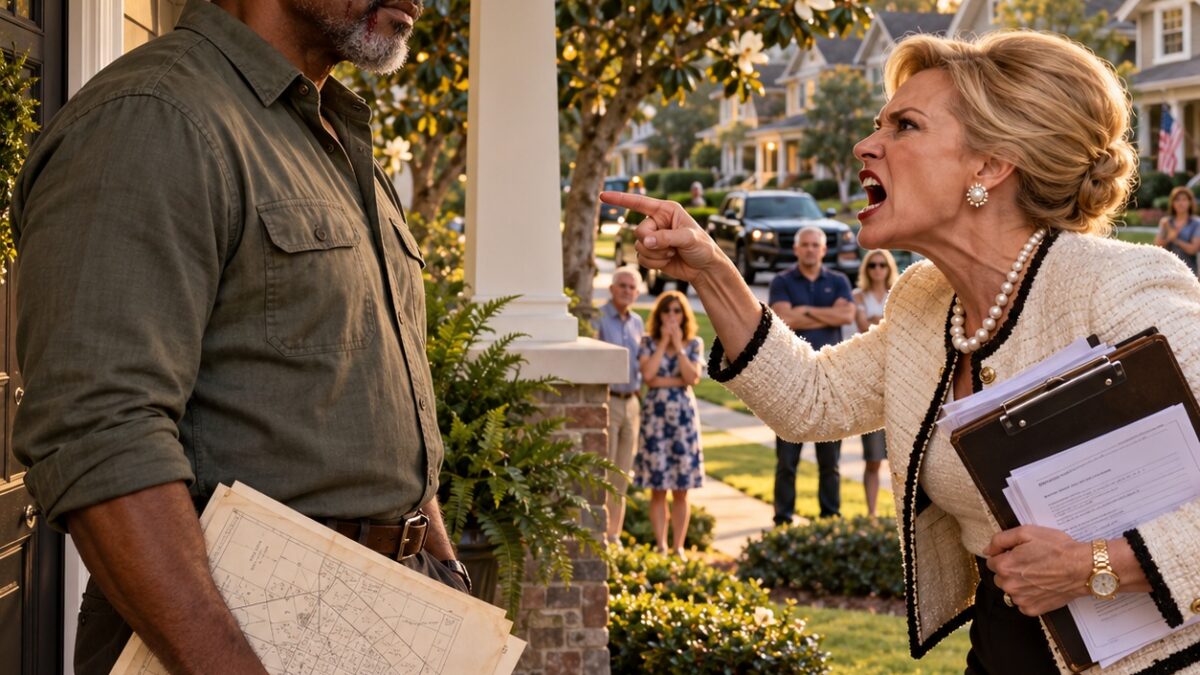
A woman stood at my front steps.
Blond bob.
Silver streaks.
Pearl chain holding her reading glasses.
Linen blazer.
Pressed cream slacks.
Clipboard.
Smile.
She looked like the kind of woman who could sell you a house, organize the neighborhood Christmas drive, and report your garbage cans before breakfast.
“Mr. Vance?”
“Yes, ma’am.”
She extended her hand.
“Colleen Whitfield. President of the Briarcliff Estates Homeowners Association.”
I knew the name.
Everybody did.
Colleen had been president for nearly a decade.
“Nadine and I met you once.”
Her smile paused for half a second.
“Oh.”
“Community fundraiser.”
“Of course.”
She clearly did not remember.
Then the smile returned.
“Well, I wanted to officially welcome you to our little community.”
I had lived there years.
I almost corrected her.
Did not.
“Thank you.”
She lifted the clipboard.
“And I wanted to mention a few tiny things.”
There is no phrase in suburban America more dangerous than a few tiny things.
She turned the page toward me.
Three violations.
Mailbox paint color not approved.
Trash cans visible from the street on a noncollection day.
Unauthorized structure visible through garage window.
I looked toward my mailbox.
Black.
Plain.
The same black it had been when Nadine and I bought the house.
The trash cans were inside the garage.
The “unauthorized structure” was wall shelving I had built inside my own workshop.
I looked at Colleen.
“The shelving?”
“You can see a portion through the window.”
“It’s inside.”
“Our architectural standards cover visible structures.”
“Shelving?”
She smiled.
“I know it sounds picky.”
“Yes, ma’am.”
“But standards only work if everyone follows them.”
I took the notice.
At the top:
BRIARCLIFF ESTATES HOMEOWNERS ASSOCIATION
LOTS 1 THROUGH 120
I noticed that.
Registered it.
Then let it go.
That would haunt me later.
“Anything else?”
“No.”
She tilted her head.
“We’re just trying to keep this community beautiful.”
“My yard bothering someone?”
“Oh, no.”
She laughed lightly.
“Not at all.”
My lawn looked like a golf course.
She knew it.
I knew it.
But the conversation was not about grass.
Not yet.
“Take care, Mr. Vance.”
“You too.”
Her heels clicked down my walkway.
That was violation number one.
Over the next six weeks, I got eight more.
Garden hose left visible.
Holiday wreath hanging two days beyond the approved seasonal window.
Pickup parked six inches too close to the sidewalk.
Garage door open more than thirty minutes.
Bird feeder not approved.
Exterior light temperature supposedly inconsistent.
Firewood stack visible from the street.
Workshop noise outside preferred hours.
That last one arrived after I used an orbital sander at 10:07 on a Saturday morning.
I started saving every notice.
At first, because that was habit.
Army Corps teaches documentation.
Survey work teaches documentation.
Consulting teaches documentation.
If it happened, write it down.
Photograph it.
Date it.
Label it.
So I created a manila folder.
HOA CORRESPONDENCE.
Then a second.
Then a binder.
I answered every violation.
Politely.
Always politely.
Trash cans visible for eleven minutes because pickup came late?
Photo attached showing cans returned inside at 7:02 a.m.
Wreath allegedly outside holiday display period?
The covenants used the phrase seasonal decoration but never defined the season.
Pickup truck too close to sidewalk?
I measured the distance with a survey tape and included the photograph.
Six inches.
Then moved it anyway.
I corrected everything.
Even when correction made no sense.
My yard became so perfect it felt hostile.
Nothing out of place.
Nothing personal.
No garden tools.
No hoses.
No decorations unless explicitly approved.
For the first time in my life, I started looking at my own property through somebody else’s eyes.
That is what harassment does.
It relocates the observer into your head.
You begin policing yourself for them.
The neighborhood cookout happened in June.
I did not know about it.
Every house received a flyer.
Mine did not.
I was sitting on the porch eating reheated meatloaf when I smelled charcoal.
Then laughter.
Music.
Children.
A block party somewhere behind my fence.
I walked to the side yard.
Saw folding tables.
Balloons.
Coolers.
Neighbors from both sides.
I stood there maybe ten seconds.
Then went inside.
That hurt more than the violation notices.
Paper is paper.
Exclusion is personal.
The next afternoon, Garrett Price came over.
My next-door neighbor.
Sixty-one.
Retired electrician.
Good man.
Quiet.
He carried a plate covered in foil.
“Leftovers.”
I knew what they were.
“Cookout?”
He looked embarrassed.
“Yeah.”
“Was I invited?”
He rubbed the back of his neck.
“I assumed everybody was.”
“That’s not an answer.”
“No.”
I nodded.
Garrett stared at his shoes.
“Colleen handled flyers.”
“Of course.”
He handed me the plate.
“Burgers are good.”
I almost refused.
Then took it.
“Thanks.”
He stayed.
Did not leave.
That meant he had something else.
“What?”
He exhaled.
“She’s talking.”
“About?”
“You.”
I laughed without humor.
“What’s she saying?”
“Nothing direct.”
“That means something direct.”
Garrett hesitated.
“At the cookout she said some people aren’t used to this kind of community.”
I looked at him.
“What kind?”
“She didn’t say.”
“She didn’t need to.”
“No.”
Garrett looked miserable.
“She said it’s an adjustment.”
“For who?”
He had no answer.
I nodded.
“Thanks for telling me.”
He left.
I sat on the porch long after.
The magnolia leaves moved overhead.
I could almost hear Nadine saying:
Do not let this woman into your head.
I wished she were there.
Not because I needed advice.
Because loneliness makes insult heavier.
Eleven violations in, I wrote formally to the HOA board.
Requested a meeting.
Selective enforcement.
Harassment.
Unequal treatment.
I cited the governing documents.
Asked for records.
Asked for review.
Mentioned federal fair-housing protections without accusing anyone directly.
Certified mail.
Receipt requested.
Nothing.
No response.
Weeks later, I discovered why.
Garrett had seen Don Prescott, the HOA secretary and Colleen’s closest ally, receive my envelope.
Then he saw Don give it to Colleen in a Food Lion parking lot.
She read it.
Folded it.
Put it into her purse.
The board never saw it.
When Garrett finally told me, I sat at my kitchen table holding a copy of the letter.
“So she intercepted it.”
“Looks that way.”
“You sure?”
“Yes.”
“Why didn’t you say something sooner?”
He looked ashamed.
“Didn’t want trouble.”
I stared.
Then softened.
Fear is easy to judge when it is not yours.
“You have it now.”
He nodded.
“Sorry.”
That evening, I called my daughter.
Briana lived in Charlotte.
Thirty-two.
Attorney.
Sharper than I ever was.
She listened without interrupting.
Then said:
“Dad, this is harassment.”
“It’s a nuisance.”
“No.”
“I’ve dealt with worse.”
“You were in the Army.”
“Army Corps.”
“You know what I mean.”
I almost smiled.
“This is your home.”
“I know.”
“You don’t have to earn the right to exist there.”
That sentence got under my skin.
“I’m documenting.”
“Good.”
“I’m not doing nothing.”
“I know.”
We were quiet.
Then she said:
“Mom would hate this.”
I looked toward the porch.
Magnolia shadow against the window.
“Yes.”
After we hung up, I stepped outside.
The place where the porch swing used to hang looked empty.
I touched the porch railing.
“I promised you.”
The next month, Colleen created the Briarcliff Beautification Committee.
Official purpose:
Maintain neighborhood standards.
Real purpose:
Watch me.
Three retirees.
Matching visors.
Shared spreadsheet.
They photographed everything.
My driveway.
Front porch.
Mailbox.
Truck.
Workshop.
A package sitting near my door for one hour.
Ninety percent of their reports targeted me.
Enough complaints against other people were added to create plausible fairness.
One afternoon, I saw a woman named Linda standing across the street photographing my front yard.
I walked out.
“Can I help you?”
She startled.
“Oh.”
“Something wrong?”
“No.”
Her phone dropped to her side.
“Committee.”
“What are you photographing?”
She looked toward my gutter.
“Possible mildew.”
I stared.
“Possible.”
“Yes.”
“On my gutter.”
“Yes.”
“It rained yesterday.”
She flushed.
“I don’t make the rules.”
“No.”
I nodded.
“You just enforce them.”
She left without answering.
Then came the Facebook post.
COMMUNITY STANDARDS UPDATE.
Some residents have accumulated multiple violations and continue to disregard rules that keep Briarcliff a place we are proud to call home.
Forty-two likes.
Clapping emojis.
No name.
Everybody knew.
I read every reaction.
That was a mistake.
I stopped after seeing Doug Henderson—who waved at me every morning—like the post.
The harassment moved beyond the HOA after that.
Caldwell County Code Enforcement arrived one Tuesday.
A white truck.
Inspector.
Clipboard.
He approached looking apologetic.
“Mr. Vance?”
“Yes.”
“We received a complaint you are operating a commercial business from the property without authorization.”
I nearly laughed.
“My consulting practice?”
“Yes.”
“Come in.”
I made coffee.
Then handed him the home-occupation permit obtained the month Nadine and I moved in.
He reviewed it.
Checked the county number.
“Looks fine.”
“I know.”
He looked embarrassed.
“Sorry for the trouble.”
“Who complained?”
“You know I can’t disclose—”
“HOA?”
He gave me a look.
That was enough.
The case closed.
No violation.
No fine.
No problem.
Except there was.
Because the woman across the street watched the county truck from behind her curtains.
Because somebody later asked Garrett whether I had “business problems.”
Because I lost half a day proving I had a right to do something I had done legally for years.
And because the inspector arrived already expecting wrongdoing.
That is the hidden cost of harassment.
Not just fines.
Time.
Sleep.
Reputation.
Nerves.
My blood pressure rose six points.
Doctor asked about stress.
I said I was fine.
Men my age lie to doctors about stress as if admitting pressure means failing some test.
I was not fine.
At two in the morning, I would wake and think I heard footsteps.
I checked cameras before I had cameras.
Looked out windows.
Checked the mailbox twice daily.
When the mail truck came, my stomach tightened.
I began recognizing HOA envelopes by weight.
That is not normal.
I knew that.
Still, I let it continue.
Until one night, I stopped thinking like a target and started thinking like a surveyor.
I filed a formal records request.
Violation history.
Financial statements.
Board minutes.
Enforcement logs.
Architectural approvals.
The HOA resisted.
Then produced enough.
I built a spreadsheet.
Every homeowner.
Every violation.
Date.
Type.
Fine.
Outcome.
The pattern was ugly.
I had received four times more violations than anybody else.
Not twice.
Four times.
The next highest household had built an unapproved deck.
I had received complaints for a hose.
Then I checked Colleen’s property.
County GIS.
Aerial imagery.
Permit database.
Backyard shed.
No county building permit.
No HOA architectural approval in records.
I filed the complaint.
Exactly by the book.
No anonymous tip.
No emotion.
Certified documentation.
County code report.
Copies to board members’ home addresses.
Not the HOA office.
Five envelopes.
Five signatures.
This time Colleen could not intercept them.
The county notice reached her Friday.
Saturday morning, she came onto my lawn.
No clipboard.
No smile.
“YOU filed a complaint against me.”
I set down my coffee.
“I filed a code report.”
“You had no right.”
“Same right you used.”
“That is different.”
“How?”
“I am president of this association.”
“And?”
“I protect this neighborhood.”
“From sheds?”
Her face reddened.
“You think you’re clever.”
“No.”
“You’re a troublemaker.”
“I’ve lived here five years.”
“And every year this street gets worse.”
I looked at her.
“Because of me?”
“You know what I mean.”
“No.”
She stepped closer.
“People like you move into good communities and don’t understand how things work.”
There it was.
People like you.
Across the street, Doug and his wife were washing their car.
They stopped.
I let silence sit between us.
“People like me how?”
Colleen’s mouth opened.
Closed.
“This used to be a safe neighborhood.”
I waited.
“Before?”
She saw the trap.
Too late.
“Don’t twist my words.”
“I asked one question.”
“You are harassing me.”
“You’re standing on my property.”
“I can call the police.”
“You can.”
She stared.
Then walked away.
Doug crossed the street after.
I thought he might say:
That was wrong.
He said:
“You know, Sterling, maybe it’d be easier to go along with her.”
I stared at him.
“She just stood on my lawn and nearly said this street was safer before Black people moved in.”
He looked away.
“I didn’t hear that.”
“You heard enough.”
“She’s connected.”
I laughed quietly.
“That your advice?”
“I’m just saying.”
“You’ve said.”
He walked back.
I went inside.
Closed the door.
Sat at the kitchen table.
Nadine’s photograph sat on the sideboard.
Savannah.
Anniversary trip.
She was laughing on a bench near the river because a pigeon had tried stealing my sandwich.
I picked it up.
“She almost said it.”
My voice broke.
“She almost said it, baby.”
I cried then.
Not because Colleen hated me.
Because the neighborhood saw it and still asked me to accommodate her comfort.
Briana did not offer sympathy when I called.
She offered instructions.
“Get a full boundary survey.”
I laughed.
“I am a surveyor.”
“Then act like one.”
That shut me up.
“What are you thinking?”
“You keep telling me this property is older than the subdivision.”
“Yes.”
“You keep saying the HOA documents say lots one through one-twenty.”
“Yes.”
“Dad.”
I stopped.
“Pull the original plat.”
I looked toward my filing cabinet.
A thought entered.
Small.
Sharp.
I had been so focused on whether the HOA enforced rules fairly that I had never asked the more basic question.
Could they enforce them at all?
That night, I pulled everything.
Deed.
Closing package.
Title policy.
Survey.
Tax records.
Old plat.
County GIS.
Spread the documents across the dining table.
I had spent thirty years reading legal descriptions.
Metes and bounds are a language.
North seventy-eight degrees east, two hundred thirty-one feet.
South fourteen degrees west to an iron pin.
Along the old road.
Back to point of beginning.
My deed contained no Briarcliff lot number.
No subdivision reference.
Nothing.
I opened the recorded 1998 plat.
Briarcliff Estates.
Lots 1 through 120.
Four streets.
Then there was my property.
At the corner.
Marked:
PARCEL 0-A
EXISTING HOMESTEAD
EXCLUDED
I stared.
Read it again.
Zoomed in.
Printed it.
Then opened the CC&Rs.
Page one.
Paragraph three.
These covenants, conditions, and restrictions shall apply to lots 1 through 120 of Briarcliff Estates as recorded in Plat Book 14, Page 312.
Lots one through one-twenty.
My house was not one of them.
My property predated the subdivision by decades.
The developer had built Briarcliff around the existing homestead.
My parcel was never annexed.
Never bound by covenants.
Never subject to the HOA.
I sat back.
The dining light hummed.
A moth hit the window.
My hands were completely still.
Then I said:
“Oh.”
That was all.
Five years.
Dues paid.
$4,250.
Sixty violations.
More than $14,000 in alleged fines.
Threats.
Letters.
Surveillance.
Exclusion.
All of it from an organization that had exactly zero authority over my property.
I called Briana.
She answered half asleep.
“Dad?”
“I found it.”
Silence.
“What?”
“Parcel zero-A.”
She became awake immediately.
“Talk.”
I explained.
She went silent.
Then started laughing.
Not happy.
Disbelieving.
“Dad.”
“Yeah.”
“They fined somebody who isn’t in their HOA.”
“Sixty times.”
“You paid dues.”
“Five years.”
“That’s conversion.”
“Possibly.”
“Fraud.”
“Potentially.”
“Declaratory judgment.”
“Yes.”
“Selective enforcement.”
“Yes.”
“Dad.”
“What?”
“We are going to ruin her week.”
I smiled for the first time in months.
But I did not file immediately.
That surprised Briana.
“You’re waiting?”
“Yes.”
“Why?”
“Because Colleen thinks the lien vote is October fifteenth.”
She paused.
“What are you planning?”
“Let her finish.”
My years in the Army Corps taught me something beyond surveying.
Do not interrupt an adversary who is documenting your case.
So I moved slowly.
Phase one:
Record everything.
Ring doorbell.
Two security cameras.
Front yard.
Side boundary.
Cloud backup.
Audio where lawful.
I tested angles twice.
Phase two:
Let Colleen escalate.
Hardest part.
I knew the truth now.
Every instinct wanted to march into the board meeting and throw the plat onto the table.
Instead, I waited.
Every new violation became evidence.
Every letter.
Every false statement.
Every threat.
Briana wrote three words on a sticky note.
LET HER DIG.
I taped it to my bathroom mirror.
Phase three:
Lawyer.
Nolan Crawford.
Real-estate litigator in Charlotte.
Twenty-two years’ experience.
Quiet man.
Read every page.
Then removed his glasses.
“Mr. Vance.”
“Yes.”
“I have seen power-drunk boards.”
I nodded.
“Selective enforcement.”
“Yes.”
“Fraudulent assessments.”
“Yes.”
“I have never seen sixty violations issued against property outside the association.”
“I was wondering.”
He looked at the plat.
“This is extraordinary.”
“What do we do?”
“Declaratory judgment first.”
He counted on his fingers.
“Return of dues.”
Another finger.
“Harassment.”
Another.
“Selective enforcement.”
Another.
“Potential Fair Housing claim.”
Another.
“Defamation depending on communications.”
Then:
“Punitive exposure if we prove knowing conduct.”
I leaned back.
“What about the fines?”
“Worthless.”
The word felt incredible.
“Every one?”
“Every one.”
“Lien?”
“Invalid.”
I thought of the envelopes.
Sleepless nights.
Magnolia.
Nadine’s last words.
“File before the lien meeting.”
“When?”
“October tenth.”
“Meeting fifteenth.”
He looked at me.
“Five days.”
“Exactly.”
We assembled witnesses.
Garrett came first.
He sat at my kitchen table staring into coffee.
“I should’ve spoken sooner.”
“Speak now.”
He told us about a phone call.
Colleen outside clubhouse.
“I don’t care what it takes. I want him out of this neighborhood. He’s dragging down property values.”
Garrett signed an affidavit.
His hand shook.
Edith Callaway signed next.
Seventy-four.
Widow.
Colleen fined her two hundred dollars for memorial wreaths after her husband died.
“The wreath had his name.”
She swallowed.
“I took it down.”
“Why?”
“Because I was tired.”
I understood.
The Davis family provided their records.
Other homeowners.
Patterns.
Then I hired a certified independent surveyor.
Former Army Corps colleague from outside the county.
No conflict.
His report was blunt.
Parcel 0-A is not within Briarcliff Estates.
Period.
Everything went into a banker’s box.
Briana labeled it:
WHITFIELD VERSUS REALITY.
October tenth, Nolan filed.
Sterling Vance v. Briarcliff Estates HOA, Colleen Whitfield, Don Prescott.
Twenty-two pages.
Certified plat attached.
That should have been enough.
Colleen made sure it wasn’t.
Before service reached her, she called police.
Claimed I threatened her.
Deputy Roy Collier arrived.
Crew cut.
Hands on belt.
The kind of posture that tells you someone expects trouble before you speak.
“Complaint.”
“From Mrs. Whitfield?”
He did not confirm.
I invited him in.
Played the camera footage.
Colleen on my lawn.
Pointing.
Shouting.
Me standing still.
He watched.
Then shifted his weight.
“I don’t see a threat.”
“No.”
“Will you be filing anything against her?”
“She trespassed.”
“That’s more civil.”
Of course.
Civil.
Meaning everybody can keep hurting you until paperwork convinces somebody to care.
He left.
I saved his visit footage too.
Then Colleen sent the email.
NEIGHBORHOOD SAFETY CONCERN.
An individual making threats toward HOA leadership.
Residents advised to lock doors.
Remain vigilant.
Report suspicious activity.
No name.
Did not need one.
The Black man on Ridgecrest Lane is dangerous.
That was the message.
The next morning, a neighbor crossed the street to avoid passing my property.
I watched from workshop.
That hurt.
Far more than I expected.
I set down the sanding block.
Stood still.
Then closed the blinds.
Colleen moved the lien hearing forward.
October twelfth.
Emergency board session.
No notice to me.
Then she sent another mass email.
This time she named me.
Sterling Vance.
My full address.
“History of noncompliance.”
“Community safety.”
“Property value protection.”
Nolan read it.
Then laughed once.
“Defamation.”
I said nothing.
“Invasion of privacy.”
Nothing.
“She has also probably violated her own governing documents.”
I looked at the sticky note photo Briana had texted.
LET HER DIG.
Nolan smiled.
“Exactly.”
October eleventh, process server delivered the lawsuit.
At 7:40 that evening, my doorbell camera alerted.
Colleen.
On my porch.
Lawsuit crushed in one fist.
Mascara smudged.
I had been washing dishes.
I dried my hands.
Opened the door.
Stayed inside the threshold.
“You think you can sue me?”
“Mrs. Whitfield, speak to counsel.”
“Me?”
“Yes.”
“You are suing me?”
Her voice rose.
“I held this community together.”
I said nothing.
“While people like you—”
“People like me?”
She stepped closer.
“Yes.”
“Explain.”
“Don’t do that.”
“Do what?”
“Pretend.”
I felt my pulse.
Camera above us.
Red light.
“Pretend what?”
“That you belong.”
There it was.
Raw.
“You move into a place like this and think money makes you equal.”
I stared at her.
“It doesn’t.”
“Leave my property.”
“You don’t deserve this property.”
My jaw tightened.
“Leave.”
“You don’t deserve to breathe the same air as the people on this street.”
Somewhere inside, Nadine’s voice:
Stay still.
I kept my hands at my sides.
“Leave.”
Colleen’s face twisted.
“Say something!”
“I have.”
“Coward.”
Then she slapped me.
Open hand.
Left cheek.
Hard.
The sound cracked across the porch.
My head turned.
Teeth cut the inside of my cheek.
Copper taste.
Ear ringing.
For three seconds, everything stopped.
Then I turned back.
Colleen was breathing hard.
I lifted one hand.
Open palm.
Pointed upward.
Ring camera.
Red light.
“You just assaulted me on my property.”
Her face changed.
I pointed toward garage.
Second camera.
“With your son watching.”
She looked toward car.
Connor.
Sixteen.
Passenger seat.
He had seen everything.
His mother’s face drained.
She backed away.
Caught heel on step.
Nearly fell.
Went to car.
Connor never looked up.
Tail lights disappeared.
I closed the door.
Sat at kitchen table.
Touched my cheek.
Then looked at Nadine’s photo.
“I stayed.”
My voice shook.
“I stayed, baby.”
Police report followed.
This time video existed.
Assault.
Racial statements.
Civil battery.
Potential hate-crime implications.
Everything recorded.
Cloud backup completed before Colleen reached the end of the street.
The next morning, Edith Callaway hit reply all.
I have been quiet long enough.
Her message spread through Briarcliff.
She described the wreath fine.
The targeting.
Her shame at staying silent.
Others replied.
Garrett.
Davis family.
People began switching sides.
Not because facts changed.
Because safety did.
People often find courage after someone proves the bully can bleed.
I appreciated support.
I also remembered their earlier silence.
Both can exist.
Colleen hired Russell Bennett.
Litigator.
Filed counterclaim.
Intimidation.
Harassment of HOA leadership.
Nolan read it.
“Did he research the property boundary?”
“Apparently not.”
“This is going to be embarrassing.”
October twenty-eighth.
Courtroom 3B.
Standing room only.
Board members.
Neighbors.
Reporter.
Briana.
Garrett.
Edith.
And in back:
Connor Whitfield.
Hood up.
Alone.
Judge Ruth Eddington entered.
No smile.
Reading glasses.
Everything about her communicated that time was expensive.
Colleen sat with binder.
Sixty violations.
Color tabs.
Photos.
Fines.
Her monument.
Russell Bennett went first.
Professional.
Confident.
Twenty-two minutes.
Chronic noncompliance.
Community standards.
$14,400 unpaid fines.
Lien authority requested.
Colleen sat straighter.
Then Nolan stood.
Did not touch violation binder.
“Your Honor, before addressing any alleged violation, we have a threshold issue.”
Judge looked up.
“Jurisdiction.”
Bennett froze.
Nolan submitted certified 1998 plat.
Sterling’s deed.
CC&Rs.
He walked through each slowly.
Lots one through one-twenty.
Parcel zero-A.
Excluded existing homestead.
No covenant reference.
No annexation.
No authority.
Then:
“Mr. Vance’s property has never been part of Briarcliff Estates.”
Silence.
“The HOA has no jurisdiction.”
Colleen’s face changed.
“Every violation is void.”
Bennett started flipping pages.
“Every fine is void.”
More pages.
“Every dollar of dues collected over five years was taken from a property never legally subject to this association.”
Judge Eddington looked directly at Colleen.
“Ms. Whitfield.”
Colleen swallowed.
“Your Honor—”
“Is parcel zero-A listed within the recorded covenants?”
“Well, everyone on Ridgecrest—”
“That is not what I asked.”
Silence.
“Yes or no.”
Colleen looked at Bennett.
He looked down.
“No.”
Judge:
“No what?”
“No, Your Honor.”
I heard somebody gasp behind me.
Briana touched my arm.
Then Nolan asked to play video.
Porch.
October eleventh.
Courtroom television came on.
There was Colleen.
Screaming.
People like you.
Equal.
You do not belong.
The words sounded worse amplified.
Then slap.
CRACK.
Several people flinched.
I watched Connor.
He stood.
Walked out.
Did not look at mother.
That may have been the only moment Colleen visibly broke.
Her son leaving.
Not lawsuit.
Not map.
Not judge.
Connor.
Nolan stopped the video.
“This is not a dispute about mailbox color.”
Judge stared at screen.
“This is a documented campaign against a homeowner whose property was never under this association’s authority.”
Nolan continued.
“Sixty violations.”
“Five years of dues.”
“Defamatory communications.”
“False police complaint.”
“Selective enforcement.”
“Recorded assault.”
“And racial statements directly revealing motive.”
Nobody moved.
Judge Eddington ruled on jurisdiction that afternoon.
My property was not part of HOA.
Never had been.
All sixty violations void.
All fines void.
No lien.
Dues returned.
$4,250 plus interest.
The larger civil case settled three weeks later.
$85,000.
Harassment.
Emotional distress.
Battery.
Defamation.
Colleen personally responsible for another $15,000 punitive component.
Her own money.
Then criminal case.
Simple assault.
She pleaded no contest.
Probation.
Community service.
Permanent record.
She resigned.
Don Prescott resigned two days later.
Board published apology.
HUD opened investigation.
Deputy Collier went under administrative review.
The binder became evidence.
That was the part Briana loved.
“Her binder buried her.”
I smiled.
“She built it carefully.”
“Apparently.”
The very thing Colleen created to prove I was a problem became the clearest evidence of systematic targeting.
After everything settled, Garrett came over with two beers.
We sat on porch steps.
No swing yet.
Magnolia leaves overhead.
“I’m sorry.”
I nodded.
“I should’ve spoken.”
“Yes.”
He looked at me.
“You’re not supposed to say yes.”
I laughed.
“You want honesty or comfort?”
“Fair.”
I handed him beer.
“You spoke when it counted.”
“Too late.”
“Late is not never.”
We sat until streetlights came on.
Neighborhood sounded normal.
Dog barked.
Screen door slammed.
Kids on bicycles.
For first time in year, I did not wonder whether somebody was reporting me.
That weekend, Briana visited.
She found me in hallway with Nadine’s photograph.
Savannah.
The one I had kept inside linen closet because looking at it hurt too much.
“You okay?”
“Yes.”
“Liar.”
“Yes.”
I hung it above fireplace.
Stepped back.
“There she is,” Briana whispered.
I nodded.
“There she is.”
Next Saturday, I bought a porch swing.
White oak.
Wide enough for two.
Mounted it where old one had been.
First time I sat, chains creaked.
Same sound.
I closed my eyes.
For one second, I could almost feel Nadine beside me.
“You happy?”
I asked empty air.
Magnolia leaves moved.
Good enough.
I used part of settlement to create something I wish had existed before all of this.
The Nadine Vance Community Land Trust.
Free boundary surveys.
Title reviews.
Help for first-time buyers.
Elderly homeowners.
People threatened by HOA overreach.
Quarterly workshop at county library.
Nolan volunteered.
First session:
Forty-three people.
I held up plat map.
“This cost fifteen dollars at Register of Deeds.”
People leaned forward.
“It may be most important fifteen dollars you spend.”
I told them:
Read your deed.
Read covenants.
Do not assume a logo on envelope means authority.
Do not assume board knows law.
Document everything.
Do not confuse silence with guilt.
And never let somebody’s confidence replace evidence.
Months later, doorbell rang Saturday morning.
Young Black couple.
Little girl in yellow dress poking magnolia leaves.
They had moved into lot eighty-four.
Actual HOA property.
The man held violation notice.
He looked embarrassed.
“Mr. Vance?”
“Yes.”
“Garrett said you might know what this means.”
I looked at envelope.
Briarcliff logo.
New board now.
Different president.
Still paperwork.
I smiled.
“Come in.”
They sat at kitchen table.
Little girl asked if magnolia was old.
“Five years.”
“My mom likes flowers.”
“So did my wife.”
The parents exchanged glance.
I opened notice.
Mailbox paint.
I laughed.
“What?”
The man looked worried.
“Nothing.”
I shook my head.
“Some things never die.”
Then explained their rights.
The story people tell afterward is that I beat the HOA.
I do not think of it that way.
I survived a woman.
An institution enabled her.
Neighbors stayed silent until silence became uncomfortable.
Documents saved me.
Cameras saved me.
A daughter who told me to stop tolerating nonsense saved me.
But mostly, Nadine saved me long before any of it happened.
Do not let anybody make you leave that house.
I used to think that sentence was about property.
It was not.
It was about dignity.
Home is not wood and deed descriptions.
It is the place where you have decided you do not need permission to exist.
Colleen wanted me to feel temporary.
Conditional.
Tolerated.
She wanted every envelope to say:
We decide whether you belong.
She was wrong legally.
More importantly, she was wrong about something deeper.
Nobody gets to vote on another person’s humanity.
No board.
No president.
No neighborhood Facebook group.
No woman with clipboard.
I still live there.
Magnolia is taller now.
Workshop still smells like walnut dust.
Jazz radio still works somehow.
Garrett visits.
Edith comes to land-trust workshops.
Briana calls too often and says not enough.
The porch swing creaks every evening.
Sometimes I sit on one side.
Sometimes center.
Once in a while, without thinking, I leave room beside me.
Old habits.
Or love.
I do not know.
One spring morning, the magnolia bloomed heavier than it ever had.
White flowers everywhere.
I stood beneath it.
Looked toward porch.
Remembered Nadine saying:
It will bloom when we’re old.
She did not make it.
I did.
That still feels unfair.
But grief and gratitude often live in same room.
I touched the trunk.
“We made it.”
Then went inside.
On desk sat another HOA letter.
Not mine.
From somebody asking trust for help.
I opened it.
And started measuring.