𝗙𝗨𝗟𝗟 𝗦𝗧𝗢𝗥𝗬:The Dying War Dog Exposed the Lie They Buried in My Military File
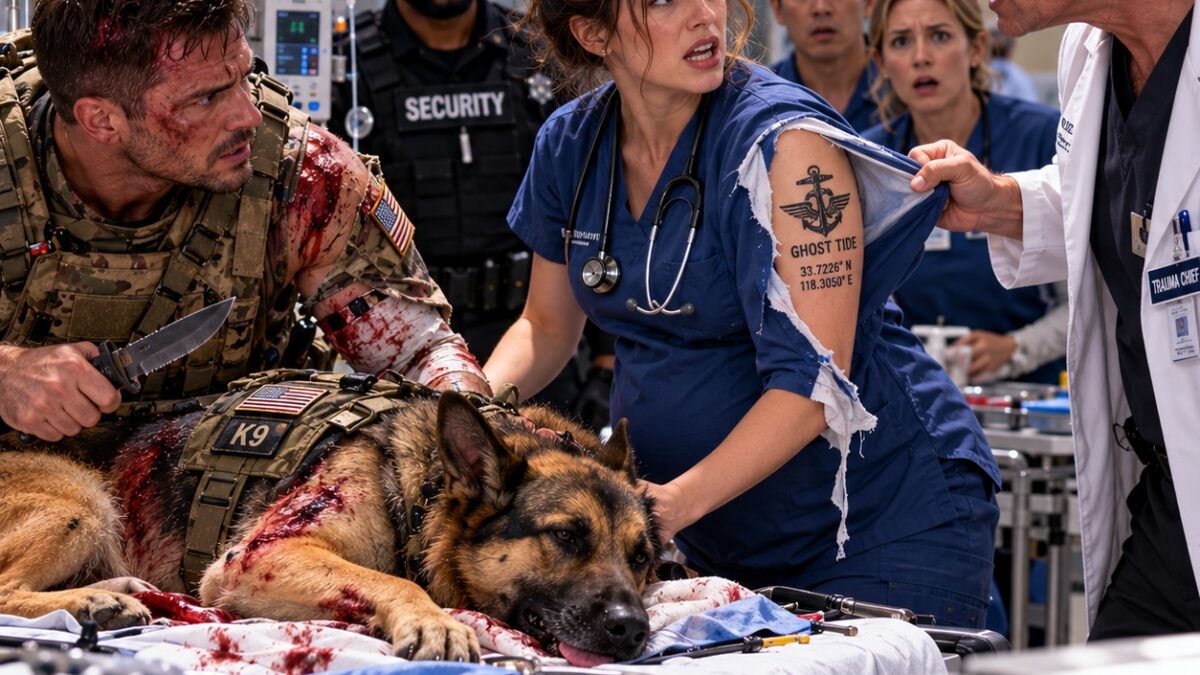
PART 2 and FULL ENDING  Thank you

“Nurse Callum.”
“His breathing pattern is wrong. The flank wound could have punctured the chest cavity. If air is trapped—”
“Are you a veterinarian?”
“No.”
“Then allow someone qualified to make that determination.”
He turned again.
“Security, I said.”
The dog convulsed once.
The soldier’s hands tightened beneath him.
And I made the decision that changed everything.
I moved to the dog’s side.
Weston grabbed my arm hard enough to bruise.
“You’re done,” he said. “As of right now, you are terminated. You no longer work in my department.”
Then he yanked me backward.
My sleeve tore from elbow to wrist.
And the tattoo I had hidden for six years appeared under the fluorescent lights.
Two crossed anchors.
A wave.
The words GHOST TIDE.
Coordinates.
A date.
The soldier looked at my arm.
Then at me.
And he whispered a call sign I had not heard since Afghanistan.
FULL STORY CONTINUATION
For three seconds, I forgot the room.
That sounds impossible in an emergency department, but it happened.
The monitors kept beeping. Nurses kept shifting. Security moved somewhere behind me. Weston’s fingers were still clamped around my torn sleeve. The bleeding soldier was still kneeling beside the trauma table with his dog dying in front of him.
But all of it went far away when he said that call sign.
Not a name.
A call sign.
The kind of identifier that belongs only to one operation, one place, one group of people who were there when the world narrowed to survival and dawn and whether the next helicopter could reach you before the valley took everybody still breathing.
The soldier looked at my tattoo like he had just found proof of a ghost.
I stared back at him and knew immediately that he knew enough to be dangerous.
Then the dog lurched again.
A convulsive, involuntary motion.
His chest barely rose.
I turned away from Weston, from the tattoo, from the call sign, from the six years I had spent making myself ordinary, and went back to the patient in front of me.
Because yes, he was a dog.
And yes, Hargrove Memorial had no protocol for him.
But he was dying on my trauma table.
And I knew what to do.
“Theo,” I said.
Theo Barfield was twenty-six, eighteen months into ER nursing, still learning which battles cost too much and which ones cost your soul if you walked away from them.
He was standing frozen near the supply cart.
“Cart,” I said.
He moved.
No permission.
No question.
He pulled the cart within reach and stepped just slightly between me and Weston.
It was not a dramatic gesture. It did not look like defiance unless you knew how hospitals worked.
I knew.
So did Weston.
“Barfield,” Weston snapped. “Do not assist her.”
Theo’s hands shook.
But he did not move the cart away.
I looked at the soldier.
“What’s your name?”
“Chief Petty Officer Dax Orin.”
“What happened?”
“Training exercise. Wire barrier. Rook hit it full speed. Left side.”
Rook.
Now the dog had a name.
“How long has he been breathing like this?”
“Fifteen minutes. Maybe twenty.”
“He needs decompression. Right now.”
Weston’s voice came from behind me, sharp enough to cut through the room.
“This woman is no longer employed here. Security, remove her.”
Security had arrived.
They did not move.
Maybe because the situation had developed too fast. Maybe because the dog on the table was making a sound that did not let decent people pretend nothing was happening. Maybe because everyone in that room knew Weston had fired me thirty seconds before I started trying to save a life, and even people afraid of him understood that the sequence mattered.
I spoke to Dax, not Weston.
“Hold him here. Exactly here. If he fights, pressure on his shoulders, not his chest. Talk to him.”
“He understands Dutch commands.”
“Then use them.”
Dax leaned close to Rook’s ear and started speaking in a low, steady cadence.
I did not understand the words.
Rook did.
His struggling changed, not enough to call it calm, but enough.
I worked fast.
The decompression procedure was improvised, adapted, risky, and based on training that did not appear anywhere in my nursing file. I had done variations of it in places with worse lighting, less equipment, and people shooting at us. I had never expected to do it again in a civilian hospital after being fired in front of half the emergency department.
Behind me, Weston was still talking.
Liability.
Unauthorized procedure.
Remove her now.
I screened him out.
A minute later, Rook gasped.
One sharp intake.
Then a more normal exhale.
Still labored. Still fragile. But no longer the shallow, failing disaster of seconds before.
Color began to return around his muzzle.
Dax said something in Dutch, and his voice cracked on the last word.
I kept my fingers where they were and checked Rook’s pulse again.
“Better,” I said. “Not good. Better.”
Dax’s eyes stayed on the dog.
“What now?”
“He needs surgical intervention. The flank bleeding is partially controlled, but there’s internal damage I can’t assess here. Is there a military veterinary surgical team attached to your unit?”
“Portland. Naval Aerospace Medical Facility. Forty minutes.”
“Call them. Now.”
Dax reached for his radio.
Weston’s voice exploded across the bay.
“Will someone explain why this woman is still in my emergency department?”
A new voice answered from the ambulance bay doorway.
“I would like to hear the answer to that myself.”
The man who stepped inside wore tactical gear cleaner than Dax’s and moved like he had been trained to take up exactly the amount of space necessary and not one inch more.
Behind him came four others.
Two of them read the room like medics.
Not civilian medics.
Military.
The man’s eyes went to Dax first.
Then Rook.
Then me.
He stopped.
Recognition moved over his face faster than Dax’s had. More controlled. More contained.
But unmistakable.
Commander Seth Avery.
I had not seen him in six years.
The last time I saw him, he had been lying in a river valley in eastern Afghanistan, one of seven operators pinned down for nine hours after an extraction route failed, bleeding into my gloves while I made decisions that were later rewritten by men who had not been there.
Seth looked at my torn sleeve.
The tattoo.
The coordinates.
Then he looked at Weston.
“Who is this man?” he asked me.
“Dr. Patrick Weston,” I said. “Trauma chief. He terminated me thirty seconds before I decompressed your operator’s K-9.”
Seth held Weston’s gaze.
There was no contempt in the look.
Contempt requires emotional investment.
This was flatter than that.
More final.
“Commander Seth Avery, Naval Special Warfare,” he said. “I need you to stay exactly where you are while I figure out what’s happening in your department.”
Weston’s face tightened.
“You have absolutely no authority here.”
“The dog,” Seth said, cutting him off without raising his voice. “Is he stable?”
The question was for me.
“Temporarily. He needs surgery. Portland team is forty minutes out. If we don’t manage the hemorrhage, we’ll lose the ground fast.”
“What do you need?”
I told him.
One of his medics moved before I finished the sentence.
Weston took three steps forward, and for the first time since I had known him, his voice cracked at the edge.
“I want everyone to understand that this woman was terminated. She has no standing here. Anything she has done in the last five minutes constitutes unauthorized—”
“Sir.”
Theo’s voice came from near the nurse’s station.
It shook slightly.
He was terrified.
He said it anyway.
“I want to go on record that I assisted with the procedure under Nurse Callum’s direction. If there are disciplinary consequences, attach them to my file too.”
Weston turned.
His face changed color.
From the doorway of Trauma Bay Three, Sandra Okafor said, “Same.”
Someone else said it too.
Then another.
Same.
Same.
The Portland veterinary team arrived sooner than forty minutes because they had pushed the drive hard. Dr. Voss came through the doors with equipment cases in hand, took one look at Rook, one look at me, and made the decision good clinicians make in a crisis.
He asked the person who knew what was happening.
“What have you done so far?”
I gave him the summary.
Fast.
Clean.
No defensiveness.
He listened, nodded once, and said, “Retraction and monitoring. Can you do that?”
“Yes.”
And I did.
For forty-one minutes, we worked over Rook while Dax sat in the corner and finally allowed one of Seth’s medics to treat the wounds he had ignored since he arrived. His eyes never left the dog for more than a few seconds.
Weston vanished to the administrative wing.
That worried me more than if he had stayed and shouted.
Patrick Weston angry was dangerous.
Patrick Weston strategic was worse.
At 12:43 a.m., while Dr. Voss closed Rook’s flank wound and the dog’s vitals remained fragile but stable, I got a text from Sandra.
Fitch wants incident reports from all nursing staff. Weston is upstairs calling it an unauthorized procedure by a terminated employee. He’s trying to reframe this.
Of course he was.
Weston had survived for years because he understood the power of the official first version. If he wrote the first record, everyone else had to argue uphill.
But he had forgotten one thing.
I kept records too.
I messaged a nurse named Joelle Pratt, who had left Hargrove fourteen months earlier after a dispute with Weston that had never been formally resolved.
Three words.
I need it.
Her reply came ninety seconds later.
Already sent. Check your secondary email.
The archive was there.
I opened it on my phone and felt the past eighteen months rearrange themselves.
Emails.
Personnel notes.
Performance reviews downgraded after nurses complained.
Internal communications between Weston and department leadership.
Nothing explosive alone.
Everything damning together.
That was Weston’s gift.
Precision.
He never falsified loudly. He adjusted. Reordered. Rephrased. Shifted a timestamp. Moved blame half an inch at a time until the chart told a story that protected him and punished whoever had questioned him.
Routine audits missed that.
Careful ones did not.
I forwarded the archive to Seth.
His reply came under a minute later.
I need fifteen minutes and a room.
The small conference room off the nurses’ station smelled like stale coffee and recycled air. Seth brought two of his people inside. One opened a laptop before the door was fully closed.
“Talk me through what you sent,” Seth said.
I did.
It took eight minutes.
Eighteen months of patterns compressed into the spine of the problem.
Retaliatory performance reviews.
Altered chart sequences.
Patient delays framed as system issues.
Two internal complaints closed with soft language.
A department protected by the fact that Patrick Weston was good enough to make his cruelty look like excellence.
When I finished, Seth asked, “Do you have copies of all of this?”
“Yes.”
“Where?”
“Not in this building.”
Something like approval moved across his face.
“Good.”
Theo texted next.
Weston’s coming downstairs with Fitch. Sandra says he’s calling your presence trespassing.
Seth stood.
“Then we’re done waiting.”
The floor felt different when we returned.
Everyone sensed something was about to happen.
Gary Fitch, the overnight administrator, stood near the nurse’s station holding a clipboard like it might protect him. Weston was beside him. His eyes tracked me first, then Seth, then the people behind Seth.
He recovered quickly.
I gave him that.
“Miss Callum,” he said, not Nurse Callum. Deliberate. “You have been formally terminated. Your continued presence in this building is trespassing.”
“Commander Avery requested my assistance with matters relating to his unit’s K-9 asset,” I said. “I’m here in that capacity.”
“You have no capacity here. You were fired.”
“Under what documentation?” Seth asked.
Weston looked at him.
“I beg your pardon?”
“The termination. What documentation was filed? What was the stated cause? Who authorized it above your level?”
Fitch’s hand tightened on the clipboard.
Seth continued calmly.
“Because a verbal termination in a trauma bay during an emergency procedure without HR involvement or written notice sounds like something we should understand before my people start pulling together the formal record.”
Weston’s jaw worked once.
“This is an internal hospital matter.”
“It involved a military working dog, a Navy operator, and a medical professional whose service record I am currently having reviewed for context.” Seth turned to Fitch. “Preserve all documentation related to tonight’s events. Electronic records, incident reports, personnel communications, all of it. My office will file a formal preservation request by 0800. If anything is altered or deleted before then, that becomes a separate legal matter.”
Fitch swallowed.
“I’ll need to involve legal.”
“Please do,” Seth said. “I’ll wait.”
Weston turned to me.
“You think this protects you?”
His voice was quiet now.
Not controlled quiet.
The real kind.
The kind underneath the performance.
“You think some military connection changes what you did tonight? It doesn’t. You performed outside your scope on an animal this facility has no protocol to treat. Whatever your background is—”
He gestured at my arm.
“—it doesn’t change what I can document.”
I looked at him.
For three years and eight months, I had watched him use voice, authority, and paperwork to make people smaller. I had filed reports that went nowhere. I had seen nurses choose silence because they had mortgages and children and student loans and no appetite for becoming Weston’s next lesson.
I felt no fear.
None.
“Go ahead and document it,” I said. “I’ve been documenting too.”
Something moved behind his eyes.
Fast.
Gone.
But I saw it.
He understood, in that instant, that while he had been building one record, someone else had been building another.
Then Dr. Voss’s voice came over the intercom.
“Someone get Callum. His pressure’s dropping.”
I was already moving.
For twenty minutes, I worked beside Voss while Rook’s pressure dropped, steadied, dropped again, then finally held. Dax stood in the corner with his fists pressed flat to his thighs, his whole body locked down against the terror he refused to show.
When it stabilized, I kept my fingers on Rook’s pulse for another thirty seconds before believing it.
“He’s stable,” I told Dax. “For now.”
Dax nodded once.
Not gratitude.
Operational receipt.
Then he looked at my arm.
“Your file,” he said. “The sealed part. What happened in it?”
“That’s not a conversation for tonight.”
“I’m not asking for tonight.” His gaze held mine. “I’m asking because there are men alive right now who came home because someone we were told was gone did the job anyway.”
Something old tightened inside my chest.
“I’m not gone.”
“No,” Dax said. “You’re not.”
He looked again at the coordinates.
“The man who told us you didn’t make it,” he said. “He’s still inside the program.”
My hand went still against Rook’s side.
“What’s his name?”
Dax told me.
The name sat in the room like a live wire.
Colonel Raymond Straoud.
I had not heard it aloud in six years.
Straoud had not been in the valley. He arrived for the debrief forty-eight hours later in a clean uniform with prepared questions and a conclusion already disguised as inquiry.
He was the man who wrote that I suffered a stress-induced breakdown after the operation.
He was the man who recommended my file be sealed.
He was the man who turned my decision to stay alive, stay useful, and keep men breathing into a document saying I was nonfunctional.
For six years, I had believed I had simply been pushed out.
Standing beside Rook’s table, with Dax watching me, I understood something colder.
I had been erased.
I found Seth in the corridor.
He read my face before I spoke.
“What happened?”
“Dax told me who authored the Ghost Tide closure assessment.”
A tightening around his eyes.
He knew.
Not all of it.
Enough.
“You knew the name.”
“I knew who signed the assessment. I did not know what it said about you.”
“My service record is sealed. The distributed version wouldn’t show it. The full assessment would be buried where nobody without the right clearance could question it.”
“If that’s accurate,” Seth said carefully, “then Straoud falsified an operational record.”
“Yes.”
“And if he used that record to influence program design after Ghost Tide—”
“He did.”
I did not know how I knew until later, when Warren Tull called.
At 4:45 a.m., Dr. Ellard Boon suspended Patrick Weston’s clinical privileges pending internal review.
At 4:47, Weston left the conference room and passed me in the hall without looking at me.
At 4:50, my phone rang.
Unknown number.
I answered.
“Lieutenant Ren,” a man said.
I had not been called that in six years.
“Who is this?”
“My name is Warren Tull. I was Ghost Tide’s program liaison at Naval Special Warfare Command. I was in that debrief with Straoud.”
I walked away from the nurses’ station.
“You watched him file a false assessment.”
“I watched him conduct a debrief structured to reach a predetermined conclusion.”
His voice carried the weight of a confession rehearsed too long.
“What changed?”
“Last week, I was pulled into a program review meeting. Straoud was presenting updated medical integration doctrine for special operations forward deployment. He used Ghost Tide as a case study. Your file has been used for six years as evidence that embedded forward medical support is not sustainable under prolonged combat stress.”
I leaned against the corridor wall.
He had not just buried me.
He had weaponized me.
A lie about my failure had been used in rooms I never entered to shape programs I never knew existed.
“What did Straoud need to cover?” I asked.
“The valley operation was approved with a four-hour medical support window. You stayed eleven. Straoud ordered withdrawal. If it came out that your choice to stay saved six operators, it also came out that Straoud had ordered the medical element to abandon people who would have died without you.”
I closed my eyes for exactly two seconds.
Then opened them.
“I need you on record.”
“I know.”
“Seth Avery will call you in five minutes.”
The formal military medical inquiry opened at 5:12 a.m., before Straoud could successfully reseal my complete service record under an emergency national security motion.
Barely.
That mattered.
Straoud moved fast.
He invoked national security provisions, not personnel privacy, not routine classification. He tried to seal everything before the inquiry could lock the documents in place.
But Tull had kept an email for six years.
In it, Straoud described classifying my separation as health-related instead of disciplinary as “the cleanest administrative resolution given the insubordination question and the exposure it creates.”
He had written it down.
People do that sometimes.
They believe a record is buried so completely that the truth inside it becomes safe.
Tull executed a formal exhibit declaration from a Portland hotel business center with a mobile notary beside him. The email entered the inquiry file before Straoud’s sealing motion could swallow it.
The record stayed open.
At 7:00 a.m., Boon called me into his office.
He looked like a man who had been told his house had foundation problems he should have discovered years earlier.
“In the last four hours,” he said, “we have identified documentation suggesting altered patient records, falsified personnel actions, and unauthorized use of staff system credentials spanning at least eighteen months.”
The head of HR confirmed four staff personnel files affected, potentially seven.
Boon rescinded my termination.
He documented Voss’s assessment that my intervention had been clinically appropriate and likely lifesaving.
Then he asked for everything I had preserved.
“The patient cases. The altered records. The personnel patterns. All of it.”
“It’s clean,” I said. “Dated, sourced, unaltered.”
“Good. Chain of custody matters now.”
“The nurses whose evaluations were downgraded,” I said. “While the review is ongoing, is there interim relief?”
HR hesitated.
“We can suspend the downgraded evaluations pending review.”
“Then do that today.”
It was not a request.
Boon looked at me.
Then turned to HR.
“Today.”
By 9:20 a.m., four nurses had formal notice that negative evaluations were suspended pending review. By 9:45, Weston was notified that his clinical privileges were suspended pending investigation. By 10:03, the Navy inquiry officially listed Warren Tull as a cooperating witness and the Ghost Tide Operational Assessment as a primary document under review.
I was not present for most of those steps.
I was in Trauma Bay One, sitting on a stool with my back against the wall and my eyes closed, not asleep but allowing my body the mercy of stillness.
Seth found me there with real coffee from outside the building.
“Rook is being transferred to Portland at noon,” he said. “Dax is going with him.”
“Good.”
“He wanted me to tell you something before he left.”
I waited.
“He said when someone tells you a soldier didn’t make it, and you later find out she did, you owe her more than a corrected record.”
Of course he had not said what the more was.
Men like Dax rarely did.
Later that morning, Weston’s attorney called and threatened a civil lawsuit for defamation, interference with professional reputation, and unauthorized medical practice.
I listened.
Then said, “Does your client know about the electronic access logs?”
Silence.
Brief.
Telling.
“Every modification made to a patient record generates a timestamp and credential record,” I said. “Those logs are part of the preservation record as of this morning. If your client modified patient records under staff credentials, that will come out in discovery.”
The attorney ended the call professionally.
That was its own kind of retreat.
Three weeks later, Dax walked into Hargrove Memorial in dress uniform with Rook at his side.
The dog’s flank was shaved where the surgical drain had been. A thin red scar crossed his left side. He favored it slightly, but his tail was working at full operational capacity.
We gathered in the lobby because no one had arranged a ceremonial space, and somehow that made it better.
Hospitals are not built for ceremony.
They are built for people waiting, working, bleeding, hoping, and surviving things at inconvenient hours under bad lighting.
Dax held out an envelope.
“Preliminary record correction,” he said. “The full correction takes longer. Seth pushed for interim acknowledgement.”
I took it but did not open it right away.
The weight was nothing.
Paper.
Ink.
Two pages.
And six years.
When I finally opened it, the language was formal, bureaucratic, and not meant to heal anything.
It corrected my separation classification from health-related to honorable discharge following completion of assigned duties.
It reinstated my rank at separation.
It entered my commendation into the accessible record.
And it noted that the prior operational assessment authored by then-Colonel Raymond Straoud contained material inaccuracies and had been withdrawn pending formal inquiry.
Withdrawn.
Six years of being used as someone else’s cautionary tale.
Withdrawn.
I folded the document and put it back into the envelope.
Seth stepped forward.
“I want to say something that isn’t part of the official record.”
He was not a man who made speeches. You could hear that in the careful discomfort of his voice.
“When I saw you in that trauma bay, I spent about thirty seconds trying to figure out a situation I didn’t understand. Then I watched you work and stopped trying to figure it out, because the situation was handling itself.”
He paused.
“You didn’t need me to recognize you. You never did. But I’m glad you let me anyway.”
I looked at him.
“You pulled my record in ninety minutes.”
“Someone owed me a significant favor.”
“I’d say you used it well.”
“I’d use it again.”
Rook had been sitting with impressive patience through the human conversation, but he apparently decided the matter had gone long enough without involving him. He stood, walked to the end of his leash, and put his nose against my knee.
I looked down at the scar on his flank.
The shaved patch.
The tail still going.
I reached down and put my hand on his head.
He leaned into it with the full, unembarrassed weight of an animal that had decided I was safe.
“Good boy,” I said.
The same words I had said three weeks earlier when I did not yet know whether they would be true.
They were true now.
The inquiries unfolded over the next four months.
Straoud did not go quietly.
Men like him rarely do.
His legal team challenged jurisdiction, authentication, witness credibility, everything they could reach.
Every challenge took time.
Every challenge failed.
The inquiry found deliberate falsification of an operational record, abuse of classification authority, and conduct unbecoming an officer. His retirement was not voluntary. His pension was reduced. He lost two commendations. He was barred from future advisory roles with Naval Special Warfare Command.
It was not prison.
I had known it probably would not be.
The misconduct lived in paperwork, and institutions often punish paperwork crimes with institutional consequences.
Was it enough?
Enough is a complicated word.
It was sufficient for accountability.
It was not sufficient for everything it had cost.
Patrick Weston’s case moved separately.
The hospital review took eleven weeks. The electronic access log audit confirmed modifications to seven patient records. Six showed Weston’s administrative credentials accessing files outside his assigned cases. One showed a nursing credential used from a terminal in Weston’s office.
His lawsuit vanished in week seven after the access logs appeared in discovery.
The Oregon Medical Board suspended his license pending re-evaluation.
Four nurses received formal letters acknowledging that prior adverse actions had been retaliatory and would be expunged from their employment records.
Joelle Pratt got hers at another hospital sixty miles south, where she had already started remembering what she was good at.
Theo Barfield helped audit patient records with the meticulous focus of someone who had found a purpose and was no longer afraid of it.
Sandra Okafor kept the floor steady while the floor learned how much had been wrong beneath its feet.
And me?
In November, Dr. Boon offered me a new role.
Senior Patient Safety and Clinical Accountability Officer.
Direct access to his office and the board.
Authority to redesign reporting systems, audit mechanisms, and documentation protections across departments.
“I considered outside candidates,” he told me. “Fresh eyes. No institutional baggage.”
Then he looked at me.
“But the honest argument for you is that you know where the gaps are because you were the person who fell through them.”
That was not a comfortable credential.
It was a real one.
“If I take it,” I said, “I’m not taking it to protect the institution.”
“I know.”
“The reporting structure must be independent of department chiefs.”
“Yes.”
“Staff need a direct channel with documented response timelines and mandatory follow-up. Not a form that disappears into management.”
“Agreed.”
“It needs teeth.”
“You’ll design the teeth.”
I took the job.
On those terms.
Then Boon placed a formal hospital commendation in front of me.
It documented the emergency intervention on March 14th. The eleven minutes between Weston’s termination and Rook’s stabilization. The clinical judgment under active professional hostility.
Then it documented something else.
My eighteen months of personal records.
The courage required to keep documenting inside an environment structured to make documentation dangerous.
“This goes in your personnel file,” Boon said. “Unless you prefer otherwise.”
I thought about six years of a record saying the wrong thing.
Then about the next person who might need the right record to exist.
“It goes in,” I said.
That November evening, Dax came back to Hargrove in jeans and a gray jacket that looked strange on him because some people carry uniform in their bones even when they are out of it.
Rook was with him.
Fully healed.
Scar white now.
Walking cleanly.
Cleared for duty.
I was coming off shift when I saw them in the lobby.
Rook saw me before Dax did.
His ears moved. His body shifted toward me with the certainty of scent memory. He walked to the end of his leash and sat, vibrating with the effort not to jump.
I crouched in front of him and put both hands on either side of his face.
He pressed his nose to my forehead and held it there.
That undid something in my chest I had not known was still tight.
“Hi,” I whispered.
Dax watched quietly.
“He’s cleared for full duty,” he said. “We ship out in three weeks.”
“Where?”
“Can’t tell you that.”
“No,” I said. “I know.”
He reached into his jacket and produced something small, flat in his palm.
A unit coin.
Naval Special Warfare emblem on one side.
On the reverse: the date of the valley operation, the coordinates, and beneath them, in small engraved letters:
GHOST TIDE HELD THE LINE.
“From the men who were there,” Dax said. “The ones still living. Seth coordinated it. Took about four minutes to get everybody’s agreement.”
I took it.
It was warm from his pocket.
For six years, I had thought of the valley as work.
Not heroism.
Not legend.
Work.
The job that needed doing, done under bad conditions because the alternative was worse.
That framing had protected me.
It had also let me accept, for too long, a version of myself that said I failed.
I had not failed.
I had held.
And the difference between those two things was everything.
“Thank you,” I said.
I drove home through Bellford in the early November dark with the coin on the passenger seat, the corrected record in a file somewhere, a new job starting Monday, and the feeling of Rook’s nose still warm on my forehead.
The city moved past my windows.
Headlights.
Lit kitchens.
Wet pavement.
Ordinary life continuing the way it always does after extraordinary things rip open beneath it.
I thought about the moment Weston grabbed my arm.
The tear of cheap hospital fabric.
The tattoo under fluorescent light.
Dax saying the call sign.
Rook dying on the table.
The choice in front of me.
Step back and let the official room do what it had decided to do.
Or step forward because I knew how to help.
I had not known stepping forward would open Straoud, Ghost Tide, Weston, the altered records, the buried file, the coin, the new role, the corrected truth.
I had not known any of that.
I had only known that a dog was dying and I was the person in the room who knew what to do.
And standing still when you know how to help is not neutral.
It is a choice with consequences.
The world is full of people whose training does not show in their title, whose experience does not fit in their personnel file, whose courage has no official line item, whose records say less than the truth because someone powerful found it convenient that way.
Some of them have tattoos.
Most do not.
The tattoo was never the point.
The point was the choice.
The choice to hold the line when the authorization runs out.
The choice to document when nobody listens.
The choice to step forward when the room has already decided you do not matter.
At a red light, I picked up the coin from the passenger seat.
GHOST TIDE HELD THE LINE.
I held it for one breath.
Then the light changed.
I set the coin back down and drove home through the November dark, carrying a corrected record, a dog’s survival, and the long, imperfect work waiting for me Monday morning.
Because the gaps do not close themselves.
Someone has to find them.
Someone has to write them down.
Someone has to stand there when the room says move.
And sometimes, the woman they just fired is the only one who knows where to begin.