𝗙𝗨𝗟𝗟 𝗦𝗧𝗢𝗥𝗬:The Dying Mother Shepherd Wouldn’t Release the Bloodstained Jacket of a Missing Federal Ranger
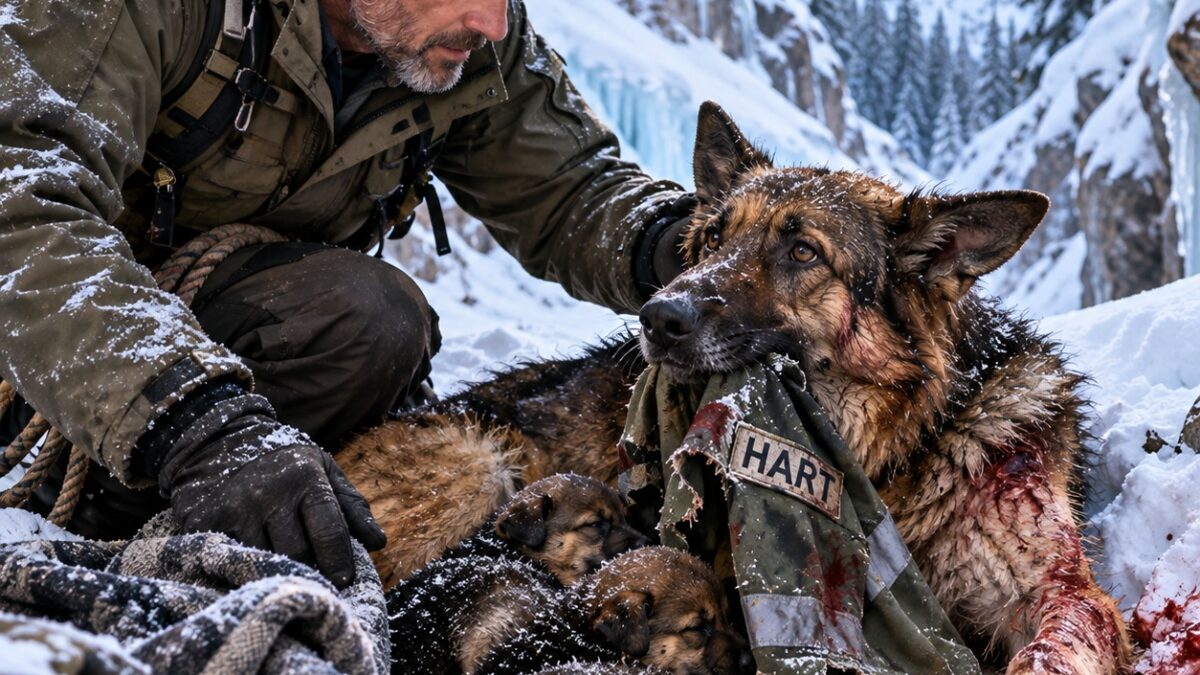
Evelyn Hart had visited my cabin twice in the previous month.
She was a federal ranger assigned to the Elk River Basin, a woman in her late thirties with chestnut hair, sharp brown eyes, and a habit of asking questions as though she’d already considered every easy answer.
The first time she came, she wanted to know whether the old maintenance road along the eastern side of Elk River Dam was still passable.
The second time, she asked about abandoned service tunnels and forgotten trails connecting the basin to the higher ridges.
I’d shown her my old topographic maps.
I’d pointed out a washout that had made one road useless to ordinary vehicles, and a lower access route that hadn’t appeared on public maps in years.
She’d listened carefully, taken notes, and thanked me.
Both times, a sable German Shepherd had waited near her truck.
Her name was Sable.
Now that same dog lay bleeding in front of me, guarding three puppies and a piece of Evelyn’s torn jacket.
I remembered the way Evelyn had studied those maps.
The seriousness behind her questions.
The concern she hadn’t quite managed to hide.
I looked up toward the rim of the ravine.
Someone had been there with her.
Someone had fired a weapon.
And whatever happened had left Sable badly injured.
“Where is she?” I whispered.
Sable’s ears shifted.
The torn left ear trembled.
She tightened her jaw around the fabric.
I didn’t try to take it.
Instead, I placed my hand gently against her shoulder.
“I know her, girl.”
Her eyes stayed on mine.
“She came to my cabin. I know who she is.”
I couldn’t tell whether those words meant anything to her. What mattered was the tone. She had already decided I might be allowed near her puppies, but she wasn’t ready to surrender the one thing connecting her to Evelyn.
I waited.
Finally, Sable loosened her jaw.
The fabric slipped into my hand.
I unfolded it carefully.
The name was unmistakable.
EVELYN HART.
I felt the old part of my mind awaken.
Not the fear.
The calculations.
Blood loss. Exposure. Time since the struggle. Direction of travel. Possible armed suspects. Failing visibility.
I was standing at the intersection of two emergencies.
Four animals might die if I delayed.
A missing woman might die if I walked away.
There was no easy choice.
I tucked the cloth into a waterproof pocket and turned my attention to the puppies.
The smallest was frighteningly cold.
Its tiny mouth opened, but no sound emerged.
I pulled my jacket open and placed it against the warm layer beneath, then carefully moved the other two close beside it.
I kept the heat sources wrapped and separated from their skin.
Sable watched every movement.
“All three,” I told her. “I’ve got all three.”
She tried to lift herself.
Pain caught her immediately.
Her head dropped, and a sharp breath escaped through her teeth.
I examined her leg as carefully as I could without moving it unnecessarily.
It was badly fractured.
Her other injuries suggested she’d been struck or dragged as well as fallen.
Her gums looked too pale.
She needed veterinary care urgently.
But the nearest clinic was miles away, the storm was closing in, and my radio had no reliable signal from the ravine.
I knew one thing.
I couldn’t leave her there.
Getting Sable out took nearly everything I had.
I made a temporary support sling from spare material in my pack and the strongest pieces of equipment I carried.
I secured her injured leg as best I could without trying to straighten the fracture.
Then I worked her toward the upper ledges in slow, controlled movements, using the rope and existing rock shelves to take the weight whenever possible.
The puppies stayed wrapped against my chest.
I could feel their faint movements beneath my jacket.
That feeling kept me careful.
Sable endured the climb with a silence I found almost unbearable.
Whenever the sling shifted against her broken leg, her breath caught.
Once she let out a strangled cry.
I stopped immediately.
“Easy. I’ve got you.”
Her amber eyes found mine.
I waited until her breathing settled.
Then we moved again.
By the time I reached the rim, sweat had soaked the inside of my shirt.
The wind turned that moisture cold almost immediately.
The bloodstained tracks were disappearing beneath fresh snowfall.
I knew I was losing evidence with every minute.
More importantly, I might be losing Evelyn.
I looked down the slope toward the direction the bootprints had taken.
Then I looked at Sable.
Her breathing was shallow.
The puppies were still barely warm enough.
I couldn’t carry them through an extended search in those conditions, and I couldn’t abandon them in the open.
I thought about my cabin.
The wood stove.
Dry towels.
The insulated mudroom.
A place where I could warm the puppies properly and stabilize Sable while waiting for help.
It was the sensible destination.
It was also in the opposite direction from Evelyn’s trail.
I stood there longer than I should have.
Then I remembered an old granite hollow farther along the ridge.
I’d once used it during an unexpected freezing rainstorm.
The rock shelf protected the rear from wind, and a fallen cedar concealed much of the entrance.
It wasn’t a substitute for medical care.
But it could provide temporary shelter while I tried to reach someone by radio.
I dragged Sable there in short intervals, taking care not to jolt her injured leg.
The distance wasn’t great.
The effort felt endless.
By the time we reached the hollow, the sky had darkened enough to make it seem like late afternoon.
I cleared the snow from the rock floor and laid out my emergency insulation.
I arranged a nest for the puppies inside my pack, close enough that Sable could see and smell them.
She tried to pull herself closer.
“Hold on.”
I shifted the bedding toward her.
The smallest puppy made a thin squeaking sound.
Sable stretched her neck and touched its back with her nose.
For the first time since finding her, I saw something like relief in her eyes.
It lasted only a moment.
Then she looked toward the forest again.
Toward Evelyn.
I took out my radio.
“Red Hollow Base, this is Calder. Anybody receiving?”
Static.
I tried another frequency.
“Red Hollow, come in.”
Nothing.
I climbed onto a low rock shelf outside the shelter, holding the radio high enough to clear the surrounding stone.
“Mara, if you’re on this frequency, I need veterinary assistance.”
A burst of noise answered.
Then a voice.
“Liam?”
I closed my eyes for one second.
“Mara. Can you hear me?”
“You’re breaking up. Go ahead.”
Dr. Mara Keen had operated the veterinary clinic in Red Hollow for years.
She had treated everything from working ranch dogs to injured wildlife, and she possessed the kind of calm that made people stop panicking long enough to listen.
I gave her the essential information.
“Adult female German Shepherd. Severe hind-leg fracture. Blood loss. Recent delivery. Three newborn puppies with significant cold exposure.”
Her response came through in fragments.
“Keep them warm… not against direct heat… minimize movement… check her breathing…”
“There’s more,” I interrupted.
Static cracked.
“What?”
“Evelyn Hart. Federal ranger. I found her dog’s tracks near a struggle. Blood. A spent casing. Her jacket is torn. I think Evelyn’s missing.”
For a second, the radio went quiet.
Then Mara’s voice returned.
“Did you say Evelyn Hart?”
“Yes. I’m north of Elk River Trail, near the old ridgeline. Tell Sheriff Callow. There may be armed men involved.”
“Liam, give me your exact—”
Static swallowed the rest.
I changed position.
Repeated the warning.
Tried again.
Nothing.
The connection was gone.
I stood in the wind with the radio in my hand.
I’d reached someone.
That mattered.
But Mara might have heard only half the location.
Sheriff Ben Callow might spend hours trying to determine where to send help.
And Evelyn might not have hours.
I returned to the shelter.
Sable was watching me.
I held up the torn jacket fabric.
“I told someone.”
She stared at it.
“I don’t know how much they heard.”
Her head turned toward the ridge.
I followed her gaze.
My survival pack contained enough supplies to make the shelter better than bare rock.
I arranged the windbreak, secured the covering, and checked the puppies again.
Then I fashioned a simple noise alarm at the entrance so I would know if something disturbed the shelter.
It was a poor substitute for staying.
I knew that.
But I had no safe way to move all four animals farther in the storm while also following Evelyn’s trail.
I removed my old military watch.
The scratched metal had been on my wrist for years.
I placed it beside the puppy nest.
I don’t know why I did that.
A dog couldn’t tell time.
The puppies wouldn’t know what it meant.
Maybe I needed to leave something of mine there because part of me was afraid I wouldn’t come back.
Sable watched.
I knelt beside her.
“I’m going to find Evelyn.”
Her ears lifted.
“You stay with your babies.”
She pressed her muzzle against the smallest pup.
Then she looked back at me.
I touched her shoulder.
“I’ll come back.”
The promise frightened me the moment I said it.
Still, I meant it.
The trail was already fading.
Snow filled the shallow footprints first.
Blood disappeared beneath a thin white crust.
Broken branches remained, though, and the deeper marks left by heavy equipment were harder for the storm to erase.
I followed the signs downhill.
A boot heel had gouged the snow near a fallen tree.
Dark stains marked a broken branch at about waist height.
A second cartridge casing lay half buried farther along the slope.
Near it, I found a small metal hair clip.
The kind Evelyn had worn when she’d visited my cabin without her wool cap.
There was a dark stain along one edge.
I slipped it into an evidence pouch.
My stomach tightened.
She hadn’t gone willingly.
The human footprints eventually met a set of wide, blocky vehicle tracks.
A tracked utility machine.
Heavy enough to transport equipment through deep snow.
Its path headed toward restricted land near Elk River Basin.
I’d helped map parts of that terrain years earlier, and I knew how easily someone could disappear there during winter.
The public trail ended well before the old dam infrastructure.
Beyond that, the mountain became a maze of service cuts, maintenance tracks, abandoned equipment areas, and steep drainage channels.
Many routes were supposed to be closed.
Some hadn’t been properly inspected in years.
I remembered Evelyn’s questions.
The eastern service road.
The old lower tunnel.
The routes hidden from the main highway.
My pace quickened.
By late afternoon, I reached a ridge overlooking a narrow valley east of the dam.
The storm had begun driving snow sideways.
I moved into the trees, dropped onto my stomach, and raised my binoculars.
At first, I saw only gray.
Then a light moved.
Not daylight.
A floodlight.
I adjusted the focus.
Another appeared farther down the slope.
Below me sat a concealed encampment surrounded by timber and rock.
Several trucks had been parked beneath white tarps.
A tracked utility vehicle stood near a stack of metal containers.
A generator operated beneath a crude shelter.
Armed men moved between the vehicles and a small timber building near the rear of the camp.
I counted eight visible figures.
There might have been more inside.
Their movements were organized enough to concern me.
These weren’t lost hunters waiting out the storm.
Somebody had planned the location, the equipment, and the routes.
I shifted my binoculars toward the timber building.
A man passed through the doorway.
For a moment, the hanging tarp moved aside.
I saw a woman tied to a support post.
Chestnut hair.
Dark-green ranger jacket.
Blood along one shoulder.
Evelyn Hart.
Alive.
I lowered the binoculars before my hands could begin shaking.
I’d found her.
Then I raised them again.
She was bruised and clearly injured, but her head remained upright.
She watched the men around her with the same fierce attention I’d noticed on her visits to my cabin.
Whatever they’d done to her, they hadn’t broken her.
I studied the rest of the camp.
The tracked machine was positioned near a narrow route leading toward the old maintenance access beneath Elk River Dam.
Men were loading heavy cases onto a transport sled.
The containers looked familiar in a way I didn’t like.
Then I saw the man supervising them.
He wore a dark parka and black gloves.
A pale scar cut down the right side of his face.
I recognized him from photographs and conversations in Red Hollow.
Silas Bourne.
A former private security contractor who’d lost his license after a weapons transport scandal.
For months, his name had circulated alongside rumors about illegal weapons, stolen fuel, and extremist meetings in remote parts of Montana.
Some people dismissed those stories as exaggerated.
I never had.
Men like Bourne didn’t need everyone to agree with them.
They needed enough frightened or angry people to follow orders.
Through the binoculars, I watched him enter Evelyn’s building.
He carried a rugged electronic device.
I recognized it as ranger equipment, or something close to it.
Evelyn’s face tightened when he held it up.
Their voices were too far away for me to understand clearly, but the argument wasn’t difficult to recognize.
He wanted access.
She wasn’t giving it to him.
A younger man entered the building carrying equipment.
He was thin, with a dark knit cap and a brown-gray jacket that looked too large for him.
A bright orange cord was wrapped around his wrist.
He kept looking toward Evelyn.
He looked frightened.
Later, I learned his name was Wade Harker.
At that moment, all I knew was that he appeared more afraid of Bourne than of the woman tied to the post.
Then Bourne emerged and gathered several men beneath the main tarp.
The wind briefly carried pieces of their conversation uphill.
“…dam access…”
“…charges…”
“…power…”
“…Red Hollow…”
I froze.
I watched the sled.
The metal cases.
The route toward the service tunnel.
Then I understood what Evelyn had been investigating.
The dam.
Elk River Dam held an enormous reservoir above the valley.
Red Hollow lay downstream.
If someone deliberately damaged critical portions of that structure, the consequences could reach far beyond the mountain.
The storm would make everything worse.
County roads were already difficult to travel.
Communication was unreliable.
Evacuation would be slow.
And Bourne’s group was moving equipment toward the dam while much of the valley was preparing to shelter from the weather.
I felt my pulse in my throat.
I’d come into the mountains looking for a wounded woman’s trail.
Instead, I’d found an organized armed operation positioned beside critical infrastructure.
I wanted to move immediately.
Get down the slope.
Reach the timber building.
Cut Evelyn loose.
Then do whatever was necessary to keep Bourne away from the dam.
That was the old instinct.
Close the distance.
Control the immediate threat.
Make the decision before the enemy could.
But I was one man.
Eight or nine armed suspects occupied the valley.
Evelyn was their hostage.
Sable and three newborn puppies were waiting in a rock shelter behind me.
And the dam was too important to entrust to one reckless attempt.
I stayed where I was.
Counted the men again.
Studied their movements.
Noted the buildings and transport equipment.
Then I took out my radio.
“This is Liam Calder. Emergency traffic. Ranger Evelyn Hart is alive. Armed group in Elk River Basin. Possible explosives moving toward Elk River Dam.”
Static answered.
I tried another channel.
Repeated the warning.
The third time, I thought I heard someone respond.
Maybe Mara.
Maybe Sheriff Callow.
The signal vanished before I could identify the voice.
I gave my estimated coordinates twice.
Then I waited.
Nothing.
I looked down at the camp.
Bourne was shouting instructions.
The sled was being loaded.
Whatever he intended, he wasn’t waiting for the storm to clear.
And somewhere behind me, Sable was waiting for a promise I’d made in the snow.
Returning to the first shelter was harder than finding it.
The wind had shifted.
Tracks I’d followed earlier had vanished.
The trees seemed unfamiliar beneath the new snow.
I used the terrain and the compass rather than depending on footprints.
When I reached the granite hollow, the noise alarm remained undisturbed.
I ducked beneath the covering.
Sable lifted her head.
The relief I felt at that small movement surprised me.
“Hey, girl.”
Her breathing was still labored.
The puppies lay bundled beside her, their tiny bodies moving faintly beneath the insulation.
The smallest had worked its way halfway out of the wool.
I tucked it back carefully.
Sable watched my face.
I knelt beside her.
“She’s alive.”
Her ears lifted.
“Evelyn. I found her.”
Sable tried to stand.
The movement pulled against her injured leg, and she nearly collapsed forward.
I caught her shoulder.
“Easy.”
She struggled weakly against my hand.
“You’re not going down there like this.”
Her eyes remained fixed on the entrance.
I knew the look.
She wanted Evelyn.
She wanted her puppies.
She couldn’t understand why the world had forced her to choose.
I rested my hand against her neck.
“I know.”
She lowered her head only when one puppy began squeaking.
I looked toward the distant ridge.
The storm was growing worse.
Leaving the animals in that shelter for another extended period was dangerous.
But carrying them all the way back to the cabin would take too long.
I remembered another protected rock pocket above the old maintenance cut, closer to the dam’s eastern access.
The location wasn’t ideal.
No wilderness shelter was going to solve the problem of a severely injured mother dog needing professional treatment.
But the second hollow was more protected from the prevailing wind, and it would let me return to the puppies more quickly if I managed to get Evelyn out.
I didn’t like the decision.
I especially didn’t like moving Sable again.
Still, I couldn’t see a safer practical option.
I gathered the puppies against my chest.
Rebuilt the sling.
Then we began moving.
Every few yards, I stopped to check Sable.
She never tried to bite.
She never stopped watching me.
The new shelter was tucked beneath a fallen cedar, its roots sheltering a narrow pocket of stone.
I cleared the accumulated snow and arranged the insulation again.
The puppies settled close to their mother.
Sable touched each one with her muzzle.
I checked the windbreak, secured the covering, and placed my watch beside them.
For a moment, I remained crouched in the entrance.
Through the trees, I could hear a distant mechanical sound.
The tracked vehicle.
The generator.
The camp was closer than before.
So was the old drainage cut.
I looked at Sable.
“I have to go now.”
Her amber eyes followed me.
“She’s close.”
I reached down.
Touched the side of her face.
“I’m bringing her back.”
This time, Sable didn’t try to rise.
She rested her torn ear against the bedding.
But she kept looking toward the tunnel.
I waited for darkness.
Not because I believed it made me invisible.
It didn’t.
Snow reflected what little light remained, and a man moving where no man belonged could still be spotted.
But the storm had forced Bourne’s guards to spend most of their attention protecting themselves from the weather.
They walked with their heads down.
Their gloves were stiff.
Their coats snapped in the wind.
The heavy snowfall reduced visibility around the outer equipment area.
I studied the camp again from the ridge.
The men were still loading cases.
Evelyn remained in the timber building.
The main floodlights made some areas dangerously exposed, but the tarp-covered vehicles created deep shadows.
I waited until I understood enough of their movements to know when a guard was most likely to be away from the building.
Then I moved.
The first hundred yards were the worst.
Open ground.
Low brush.
An exposed crossing where I had to wait for a heavy gust to obscure the view from the nearest truck.
I moved from cover to cover, careful not to rush simply because my nerves wanted the distance behind me.
By the time I reached the vehicle area, my hands were numb.
My ribs ached from the effort of moving Sable earlier.
I paused behind a stack of covered supplies and listened.
A man near the generator complained about the cold.
Another shouted that the loading team was behind schedule.
Someone answered with an insult.
They were tense.
Good.
Tension created mistakes.
It also made men more likely to fire at something they didn’t recognize.
I kept that in mind.
I needed the guards distracted long enough to reach Evelyn.
A sudden problem with the auxiliary power system gave me the opening I needed. I interfered with the exposed equipment without approaching the fuel, and the floodlights illuminating one side of the camp went dark.
Men began shouting.
The technician hurried toward the auxiliary unit.
A guard left the rear of the timber building to investigate.
Another moved toward the equipment stack.
Their attention shifted away from Evelyn’s door.
I waited until the first guard was separated from the others.
Then I intercepted him.
The struggle was brief, ugly, and silent enough not to bring the camp down on us.
I restrained him and moved him out of immediate view.
He was breathing.
He would live.
The second guard came around the corner sooner than I expected.
His flashlight swept across my position.
I dropped behind a timber stack.
He muttered into his radio, receiving only interference.
Then he stepped closer.
We collided near the edge of the storage area.
His elbow caught me hard beneath the ribs.
I felt pain flare along my side.
He reached for his weapon.
I stopped him before he could bring it up.
For one terrifying instant, my body remembered an old method of ending a fight permanently.
I could feel exactly how little additional force it would take.
That knowledge frightened me.
Not because I didn’t know how to use it.
Because I did.
I changed my grip.
Controlled the man’s movement.
Disarmed him.
And restrained him without killing him.
When it was over, I remained crouched beside him, breathing through my teeth.
He lay unconscious but alive.
Snow gathered on the back of his jacket.
I checked his breathing and moved him away from the exposed weather as safely as I could.
Then I whispered something I hadn’t expected to need.
“Not tonight.”
I wasn’t going to let Bourne turn me back into the man I’d spent years trying to escape.
Not if there was another way.
I reached the timber building a few minutes later.
The back entrance was partly concealed beneath a hanging tarp.
I listened.
Inside, someone moved across the floor.
A man’s voice rose, then faded.
When the footsteps receded, I opened the door.
Evelyn sat tied to a support post.
Her wrists were bound behind her.
Her cheek was bruised.
The shoulder of her ranger jacket had been torn open, exactly where Sable’s bloodstained cloth had come from.
She looked up sharply.
For one instant, she seemed ready to fight.
Then she recognized me.
“Calder?”
I raised one hand.
“Keep your voice down.”
Her expression changed.
“How did you find me?”
I moved behind her and began cutting the restraints.
“Sable.”
Everything in her face changed.
“Where is she?”
“Alive.”
Her breath caught.
“Hurt badly. Broken leg.”
Evelyn closed her eyes.
“And the puppies?”
“All three alive.”
She made a small sound that barely seemed human.
I kept working.
“They’re in a shelter above the old drainage cut.”
Evelyn turned her face away.
I saw tears slipping down her bruised cheek.
“She kept them alive?”
“Yes.”
I cut through the last restraint.
“She kept something else, too.”
I took the bloodstained cloth from my pocket.
Evelyn stared at her own embroidered name.
Her shoulders began trembling.
I gave her a moment.
Not long.
We didn’t have long.
Finally, she whispered, “He threw her down there.”
“I know.”
“I couldn’t stop them.”
I crouched in front of her.
“Evelyn.”
She lifted her eyes.
“Your dog is alive. Your puppies are alive. That’s what we work with now.”
She drew a shaky breath.
Then her expression changed.
The ranger returned.
“We have to reach the tunnel.”
I glanced toward the door.
“We have to get you out.”
“No.”
She caught my sleeve.
“Bourne has explosives moving toward the lower maintenance gallery. If we leave now, he could still get them into position.”
“I saw the sled.”
“Then you understand.”
“I understand you’re injured, and there’s an armed group between us and the exit.”
She held my gaze.
“There’s an entire town below that dam.”
I didn’t answer.
She continued.
“Bourne wanted my ranger device because of the route data. He forced me to try to unlock it. I’ve been stalling.”
“How much does he know?”
“Enough to get inside the old service system. Not enough to guarantee he can move safely through it.”
I looked toward the workbench.
Her ruggedized device rested inside an open case.
“Can we take it?”
“Yes.”
She tried to stand.
Her legs nearly folded.
I caught her beneath one arm.
“Easy.”
“I’m fine.”
“You’re not.”
“I can walk.”
“That’s different.”
She gave me an angry look.
I almost smiled.
Even bruised and exhausted, Evelyn Hart wasn’t interested in being told what she couldn’t do.
I helped her steady herself.
Then she said something that made me look toward the door.
“Wade tried to warn me.”
“Who?”
“The younger man. Orange cord around his wrist.”
I remembered him.
“He was the one who sent the anonymous information?”
She nodded.
“He says he didn’t know the full plan. He thought Bourne was moving material for leverage, not trying to destroy the dam.”
“He’s part of the group.”
“I know.”
“Which means he’s dangerous.”
“I know that, too.”
I checked the weapon I’d recovered and listened outside.
Evelyn continued.
“He left me a small knife. Told me the back latch sticks and there’s a drainage cut behind this building.”
“Can we trust him?”
“I don’t know.”
That was the answer I needed.
“Then we don’t build our lives around his conscience.”
Evelyn nodded.
“But if there’s a chance to stop him from helping Bourne again, we take it.”
I studied her face.
She had already made a calculation I recognized.
Saving the town mattered more to her than making sure she escaped unharmed.
It was admirable.
It was also how people ended up dead.
Before I could answer, someone outside shouted.
Another voice responded.
Then a sharp metallic clanging rang through the camp.
The missing guards had been discovered.
Bourne’s voice cut through the noise.
Orders.
Angry.
Immediate.
Evelyn looked at me.
“They know.”
“Yes.”
A truck engine started.
Men hurried past the front of the building.
Through a gap in the boards, I saw Bourne emerge beneath the floodlights that were still working.
He grabbed the younger man with the orange cord and shoved him toward the sled team.
The loading operation accelerated.
I understood what was happening.
Bourne was moving ahead of schedule.
Whatever time we’d gained by disrupting the camp was disappearing.
I took Evelyn’s arm.
“We’re leaving through the back.”
She nodded toward the low door.
“The latch sticks.”
I tested it.
She was right.
I put my shoulder against it.
Nothing.
Evelyn stepped forward and kicked near the lower edge.
The latch gave.
Cold air swept into the room.
We slipped outside.
Behind us, Bourne was shouting for his men to move the equipment toward the dam.
Ahead lay the abandoned maintenance route.
I helped Evelyn down into the drainage cut.
Snow blew over us.
She was shaking badly now.
I couldn’t tell how much came from the cold and how much from pain.
“You still with me?” I asked.
She nodded.
“Then keep moving.”
We followed the rock wall until the old service entrance appeared through the drifting snow.
It looked like a black crack beneath an overhang of ice.
Evelyn pointed toward a rusted marker.
“There.”
I cleared snow from the manual latch and pulled.
The door resisted.
Then it opened with a groan.
Cold, damp air spilled from the darkness beyond.
Behind us, the storm swallowed the lights of Bourne’s camp.
I looked toward the ridge one last time.
Somewhere above us, Sable lay beside three newborn puppies.
I’d promised her I would bring Evelyn back.
Now I was taking Evelyn into the one place where Bourne might already be preparing to kill us all.
I stepped into the tunnel.
And the first sound I heard wasn’t a human voice.
It was the deep, continuous pressure of water against the concrete walls.
The temperature changed almost immediately.
Outside, the cold had been sharp and dry enough to burn exposed skin.
Inside, it was damp, penetrating, and somehow harder to ignore.
Water dripped from overhead seams.
Old mineral stains ran down the concrete walls.
Frozen puddles reflected the narrow beam of my flashlight.
The deeper we went, the louder the structure seemed to become.
A dam isn’t silent.
Even when everything is operating normally, there are vibrations, distant mechanical sounds, water moving through designated channels, and subtle changes in pressure that travel through concrete.
I had worked around heavy structures during my military service.
I understood enough to respect them.
But this was different.
Elk River Dam held back a reservoir large enough to change the lives of everyone downstream if something catastrophic happened.
The infrastructure didn’t care why men had entered it.
It wouldn’t distinguish a political statement from a maintenance failure.
It would only respond to force.
Evelyn walked beside me with one hand along the wall.
Her breathing was shallow.
Every few steps, she paused to regain her balance.
I wanted to tell her to stop.
I also knew she’d already decided that wasn’t an option.
“Main corridor?” I whispered.
“Straight ahead. Then it divides.”
“Which direction?”
“Lower gallery.”
“Are you certain?”
“I inspected this access system after last spring’s slide.”
She pointed toward a faded directional marking.
“The lower route connects to the critical maintenance area.”
I swept my flashlight across the walls.
Rust.
Ice.
A loose length of cable hanging from an old bracket.
Nothing that belonged in a functioning modern access corridor.
“Why was this entrance still usable?” I asked.
“It was supposed to be restricted.”
“Supposed to?”
“I recommended keeping the secondary access closed until the inspection work was complete.”
I looked at her.
“You think Bourne found the old plans?”
“Either that or someone gave him information.”
I didn’t ask who.
We had enough problems with the people we already knew were involved.
The tunnel sloped downward.
The walls narrowed.
We reached a junction where the air smelled faintly of old oil and wet metal.
Then Evelyn stopped.
Her hand closed around my sleeve.
“Light.”
I lowered my flashlight.
She pointed toward the floor beside a pipe support.
A dark package sat against the concrete.
It was compact and deliberately positioned.
Not abandoned equipment.
Not a forgotten maintenance tool.
I felt my mouth go dry.
Evelyn whispered, “That’s one.”
I stared at it.
I’d seen explosive devices before.
Enough to know that touching something unfamiliar while standing inside critical infrastructure was a terrible way to prove courage.
“Don’t get closer,” I told her.
She had already taken a small canister from her belt.
Reflective marking paint.
She marked the wall above the device and the floor a short distance away.
I watched carefully.
“What are you doing?”
“Making sure the bomb-response team can locate it.”
“If they reach us.”
She looked at me.
“When.”
I didn’t argue.
We moved on.
At the next access point, we found another suspicious package.
Evelyn marked it.
Farther down, another.
Three locations.
Multiple pieces of an organized plan.
I knew enough not to speculate about the precise engineering consequences of each placement.
Evelyn understood the maintenance system better than I did, and the expression on her face became more strained with every discovery.
“How bad?” I asked.
She looked at the third marker.
“Bad enough.”
“That’s not a measurement.”
“No. It’s the only answer I can defend without a structural assessment.”
Even then, bruised and bleeding, she refused to invent certainty.
I respected that.
I also hated what it meant.
We couldn’t simply remove the devices ourselves.
We didn’t know whether moving them would make the situation worse.
And we had no reliable way to communicate with qualified personnel.
What we needed was time.
I began looking for anything that might connect the separate devices to Bourne’s intended command system.
My background gave me some familiarity with field equipment, but I wasn’t a bomb technician, and I wasn’t going to pretend otherwise.
After several minutes, I located part of an improvised communications arrangement near an old service panel.
I studied it without approaching the explosive packages.
The setup suggested Bourne intended to coordinate multiple points.
I couldn’t make the devices safe.
But I could attempt to interrupt one part of the control path without handling the charges themselves.
I explained the risk to Evelyn.
She listened.
“Will it stop him?”
“Maybe delay him.”
“How long?”
“I don’t know.”
She glanced toward the dark corridor behind us.
“Then maybe is what we have.”
I worked carefully.
My fingers had become stiff with cold, and the flashlight seemed to turn every movement into a harsh shadow.
I avoided disturbing anything I couldn’t identify.
When I finished, part of the improvised control system was no longer functioning as Bourne had intended.
That was all I could say with confidence.
It wasn’t neutralized.
It wasn’t safe.
And if Bourne had another way to initiate his plan, we might have accomplished nothing beyond buying a little time.
I closed the panel.
“Let’s move.”
Evelyn nodded.
Then a voice echoed through the tunnel.
A man’s voice.
Angry.
Close.
I switched off my flashlight.
Darkness swallowed us.
Boots scraped against the concrete.
Someone cursed.
Another man shouted for a light.
Then I heard Bourne.
“Bring him.”
Something heavy struck the wall.
A body.
Evelyn’s fingers tightened around my arm.
We stepped into a narrow side passage as beams swept across the upper junction.
Two armed men dragged a younger man between them.
His knit cap was gone.
Blood marked his mouth.
His face looked swollen.
The orange cord on his wrist stood out against the darkness.
Wade Harker.
Bourne followed behind him.
He held himself with the same controlled arrogance I’d watched from the ridge.
But his expression had changed.
He looked furious.
“You wanted to warn people?” Bourne said.
One of the guards shoved Wade against the wall.
The younger man stumbled.
Bourne stepped closer.
“Then watch what warning costs.”
Wade fell to the floor.
He tried to get up.
A guard kicked him back down.
I felt Evelyn move beside me.
I caught her arm.
She turned toward me with anger in her eyes.
I shook my head once.
Not yet.
Bourne and his men continued toward the lower gallery.
One carried a hard equipment case.
Another held a portable control unit.
I watched it pass.
Then I looked at Evelyn.
My attempt to interrupt the first system had not ended the danger.
Bourne had prepared another option.
Of course he had.
A man who trusted nobody enough to tell them the full truth about his plan would never put all his confidence in one piece of equipment.
We waited until the last footsteps faded.
Then Evelyn pulled away from me.
“Wade.”
I hesitated.
“He helped create this situation.”
“He also tried to warn me.”
“That doesn’t make him safe.”
“No.”
She looked toward the passage.
“But he might know what Bourne is carrying.”
I didn’t like it.
She was right.
We found Wade slumped against the wall.
He looked up when Evelyn approached.
His face changed.
“You’re alive.”
“Yes.”
He swallowed.
“I thought—”
“Can you move?” she interrupted.
He gave a weak laugh.
“Not very fast.”
I crouched beside him, keeping enough distance to react if he reached for something.
“What is Bourne carrying?”
Wade looked at me.
For a moment, fear seemed to close his throat.
Then Evelyn said his name.
“Wade.”
His eyes returned to her.
“You wanted me to know what was happening,” she said. “Now tell us.”
He lowered his head.
“He has a backup.”
“What kind?”
“A hand control. Short-range.”
“Can he still use it?”
“I don’t know. The main relay’s damaged, but he said he could do enough from the lower gallery.”
I glanced toward the direction Bourne had gone.
“How many men?”
“Two with him. Others farther back.”
“Where’s the nearest working radio?”
Wade wiped blood from his mouth.
“Camp equipment. Stronger system in the crawler. Some handhelds use the same frequency.”
Evelyn knelt closer.
“Wade, listen to me.”
He looked at her.
“None of this stops being your responsibility because you finally told the truth.”
His eyes filled.
“I know.”
“But you can still prevent it from getting worse.”
He nodded.
I studied the young man’s face.
He was frightened.
Ashamed.
Probably realizing for the first time that the consequences of his choices would follow him long after that night.
I didn’t feel sorry enough to forgive him.
He had helped move dangerous material through the basin.
He had participated in a group that kidnapped a federal ranger and injured her dog.
His claim that he hadn’t understood Bourne’s intentions might have been true.
It didn’t make him innocent.
Still, I wasn’t interested in punishment while the dam remained threatened.
“Find a working radio if you can,” I told him. “Get on an emergency channel. Tell them Ranger Hart is alive and explosives have been placed in the lower service system.”
He nodded again.
I pointed toward the upper passage.
“And stay away from Bourne.”
As Evelyn stood, Wade caught her sleeve.
“I’m sorry about Sable.”
Her expression hardened.
He released her.
“I didn’t know she had puppies,” he whispered.
Evelyn looked at him for a long moment.
Then she said, “That doesn’t change what happened to her.”
Wade closed his eyes.
We left him sitting against the wall.
The lower gallery was broader than the service corridor.
Heavy concrete supports divided the space into sections, and pipes disappeared into the darkness above us.
The sound of water seemed to move through the floor.
Evelyn knew the arrangement better than I did.
She studied the markings and pointed toward an auxiliary hatch.
“If we reach that, we may be able to get above the gallery.”
“Could it lead outside?”
“Eventually.”
“Could it help us stop Bourne?”
“Maybe.”
That word again.
Maybe.
We had been living on it for hours.
I moved toward the hatch.
Then a flashlight beam struck Evelyn’s face.
She froze.
I turned.
Bourne stood between us and the exit.
Two armed men were positioned behind him.
He held a pistol in one hand.
A compact control device in the other.
The scar along his cheek looked pale in the reflected light.
“Well,” he said. “The mountain’s full of surprises tonight.”
I kept my rifle pointed low.
Bourne studied me.
“You’re the one who caused trouble in my camp.”
I said nothing.
He smiled faintly.
“Former military?”
I didn’t answer.
“Of course. My people are alive, and you left them tied up instead of finishing the job. Only someone with training would be that efficient and that sentimental.”
Evelyn shifted slightly beside me.
Bourne noticed.
He moved fast.
Before I could get a clear angle, he caught Evelyn and pulled her against him.
The pistol pressed into her side.
She gasped.
I stopped.
“Weapon down,” Bourne ordered.
I looked at Evelyn.
Her jaw was set.
She was thinking.
So was I.
Every possible movement had consequences.
If I raised my rifle, he could shoot her.
If I stepped closer, his guards could fire.
If I waited, he could still try to use the control device.
“Down,” he repeated.
I lowered the rifle.
Placed it on the concrete.
Then lifted my hands.
Bourne smiled.
“There he is.”
One of his men moved forward and kicked the rifle away.
Bourne pushed Evelyn toward the wall.
“On your knees.”
I knelt.
The concrete soaked cold through my pants.
My ribs ached.
One shoulder throbbed from the fight near the camp.
I could feel exhaustion beginning to interfere with the sharpness of my thinking.
Bourne looked down at me.
“You know what I hate about men like you?”
I didn’t answer.
“You spend your lives learning how to kill people. Then you come home and start pretending you’re better than everyone else.”
I watched his hands.
The pistol.
The device.
Evelyn.
“You think discipline makes you moral,” he continued. “It just makes you useful.”
I kept quiet.
He wanted an argument.
An angry response.
Something he could use to turn his own cruelty into a debate.
I wasn’t giving him that.
Evelyn spoke instead.
“There are families living below this dam.”
Bourne turned toward her.
“Families who don’t understand what protects them.”
“They understand enough to know you want to kill them.”
His face tightened.
“You think this is about killing?”
“If you deliberately damage the dam, you know civilians could die.”
He looked at her with open contempt.
“Red Hollow needs to understand what dependence costs.”
Evelyn laughed bitterly.
“You’re planning to punish people for living near a reservoir.”
Bourne stepped closer.
“You’re not listening.”
“I’m listening very carefully.”
He grabbed her arm.
She winced.
I shifted my weight.
Both guards raised their weapons.
Bourne saw me move.
“Stay where you are.”
I stopped.
My pulse pounded in my ears.
For the first time since finding Sable, I couldn’t see a workable path forward.
There was no hidden route.
No easy distraction.
No safe angle.
Only three armed men, an injured ranger, and a portable control device I couldn’t afford to ignore.
Bourne came closer.
He pressed the pistol beneath my jaw.
The metal was cold enough to feel unreal.
“Tell me something, soldier.”
I stared at him.
“How does it feel knowing you came all this way and still can’t stop me?”
I didn’t answer.
He leaned closer.
I could smell coffee and damp wool.
“You could have stayed in your cabin.”
I thought of Sable lying in the ravine.
Three puppies trembling against her body.
The strip of Evelyn’s jacket between her teeth.
I thought of every time I’d convinced myself that staying away from other people’s pain was the safest choice.
Bourne was right about one thing.
I could have stayed in my cabin.
But I hadn’t.
And even with a gun beneath my chin, I didn’t regret coming.
I only regretted that I hadn’t yet found a way to finish what I’d started.
Bourne ordered Evelyn to open the auxiliary hatch.
She refused.
He pushed the gun harder against my jaw.
“Do it.”
Evelyn looked at me.
Her eyes were wet, but her voice remained steady.
“You don’t have the main relay anymore.”
Bourne smiled.
“I don’t need it.”
He lifted the hand control slightly.
“You cost me convenience. Not purpose.”
The guards looked nervous.
The lower gallery was no place for a gunfight, much less the detonation of explosive devices.
I could see that at least one of them understood the difference.
His rifle kept shifting toward the tunnel entrance.
Bourne didn’t notice.
Or didn’t care.
He was consumed by the need to prove that nothing could stop him.
“Open the hatch,” he repeated.
Evelyn hesitated.
I saw the struggle in her face.
If she complied, he might reach another part of the dam.
If she refused, he might shoot me.
I wished I could tell her not to worry about me.
But a speech about sacrifice would have been useless.
She needed a way to keep the town safe.
So did I.
My mind kept searching.
A step backward.
A sudden turn.
A distraction.
Anything that might move the gun away from Evelyn long enough for me to act.
Every option ended with somebody getting shot.
Then I heard something.
Very faint.
A scrape.
At first, I thought it was water moving through an old drain.
Then came a low sound.
Ragged.
Uneven.
Almost a growl.
Bourne’s eyes shifted toward the tunnel entrance.
One of the guards raised his flashlight.
The beam moved across the floor.
And there, at the edge of the darkness, stood Sable.
For a moment, I couldn’t understand what I was seeing.
The German Shepherd was covered in snow.
Her long sable fur hung wet against her body.
The temporary support around her broken leg had slipped out of position.
Blood marked the cloth.
She stood on three legs, barely able to hold herself upright.
Every breath moved painfully through her chest.
But her amber eyes were fixed on Evelyn.
“Sable?” Evelyn whispered.
The dog lifted her head.
Evelyn’s voice broke.
“Oh, God. Sable, no.”
I felt something collapse inside me.
The puppies.
I’d left them in the shelter.
Sable had dragged herself away from them.
She must have heard Evelyn through the old drainage cut, or followed the scent into the service entrance.
I would never know exactly how.
All I knew was that a dog who had been too injured to stand at the bottom of a ravine had somehow found her way into that tunnel.
Bourne stared at her.
“That thing is still alive?”
His voice carried genuine irritation.
As though her survival were a personal insult.
Sable growled.
The sound was weak.
But there was no mistaking what she meant.
Bourne turned toward her.
The pistol moved away from my jaw.
Only a few inches.
For one breath.
That was all Sable gave us.
Then she lunged.
It wasn’t a clean leap.
Her injured leg failed almost immediately.
The motion became a desperate, uneven surge forward.
But she was close enough.
Her jaws caught Bourne’s gun hand.
He screamed.
The pistol discharged.
The shot struck high above us.
Dust and mineral fragments fell from the ceiling.
Evelyn dropped to the floor.
I moved.
No thought.
No hesitation.
I caught Bourne’s arm before he could pull away from Sable.
His balance was already broken.
I drove him down onto the wet concrete, controlling the weapon hand while he struggled.
He fought hard.
He was stronger than I expected.
But surprise had taken away his advantage.
His control device slipped toward his other hand.
Evelyn saw it.
She kicked it out of his reach.
Then she swept the fallen pistol farther across the floor.
One of Bourne’s guards shouted.
I heard a body strike concrete behind me.
When I looked up, Evelyn had forced the nearest man off balance.
The other guard hesitated, apparently uncertain whether he wanted to fight for a leader lying facedown with a wounded dog attached to his arm.
“Weapon down!” I shouted.
The man froze.
Evelyn pointed toward the floor.
“Now!”
He lowered the rifle.
For a second, I thought he might change his mind.
Then he let go.
The weapon struck the concrete.
I tightened my hold on Bourne.
He bucked beneath me.
“Get off!”
“Stop fighting.”
He tried again.
I knew exactly how to injure him badly enough to end the resistance.
That knowledge came automatically.
It would have been easy.
Part of me wanted to.
I’d seen Sable bleeding.
I’d seen Evelyn’s bruises.
I’d seen the puppies struggling for warmth.
And I’d spent the last several hours imagining what could happen to Red Hollow if Bourne succeeded.
For one dangerous instant, I wanted him to feel even a fraction of the helplessness he’d inflicted on everyone else.
Then I looked at Sable.
She had released his hand.
She lay on her side, struggling to breathe.
Evelyn was crawling toward her.
I adjusted my grip.
Used only enough force to restrain Bourne.
And secured his wrists.
He was alive.
He would face the law.
I wouldn’t give him another victim.
Not even himself.
Evelyn reached Sable and pulled the dog’s head into her lap.
“I’m here.”
Her voice trembled.
“I’m here, baby. I’m right here.”
Sable’s amber eyes moved weakly toward her.
Evelyn pressed her forehead against the dog’s torn ear.
“I’m sorry.”
I kept Bourne restrained and watched the remaining guards.
One of them backed away from his discarded weapon.
The other held his hands where we could see them.
They no longer looked like men preparing to reshape the world.
They looked cold.
Frightened.
Very aware that the cause they’d followed might get them killed.
Evelyn stroked Sable’s face.
The dog’s eyes shifted.
Past Evelyn.
Toward the tunnel entrance.
I knew what she was searching for.
“The puppies,” I said.
Evelyn looked up.
“Where are they?”
“In the rock shelter. Above the drainage cut.”
Sable made a weak sound.
I knelt beside them long enough to touch her shoulder.
“They’re alive, girl.”
Her breathing remained shallow.
“They’re safe for now.”
I looked toward the tunnel.
I wanted to run.
The heat packs were fading.
The snow was falling.
Three newborn puppies were lying alone in a makeshift nest, waiting for a mother who had somehow crossed a mountain on a broken leg to save their owner.
But Bourne wasn’t secure enough to leave.
The remaining suspects were still scattered through the tunnel.
And the explosives hadn’t been cleared.
Leaving could undo everything we’d accomplished.
I hated that choice.
I hated it more than anything I’d faced that night.
Then Wade Harker stumbled into view from the upper passage.
He was bleeding from the mouth.
His face looked gray.
He had a radio in his hand.
“Camp frequency,” he said weakly. “There’s a stronger repeater in the crawler.”
I looked at him.
“Can you reach the others?”
He nodded.
“Channel Three. Code phrase is ‘North Gate.'”
I took the radio.
Checked its condition.
Then handed it back.
“Call them.”
His hands shook.
He tried once.
Failed.
Evelyn looked up from Sable.
“Wade.”
He turned toward her.
“You wanted to warn people.”
His eyes filled.
“Yes.”
“Then do it now.”
He swallowed.
Raised the radio.
And spoke.
“North Gate. North Gate. This is Harker.”
Static crackled.
“Command compromised. Bourne is restrained. Stop movement toward the dam.”
He looked at me.
I nodded for him to continue.
“Explosive control system disrupted. Do not proceed. Repeat, do not proceed.”
A man’s voice burst through the speaker.
“What the hell are you talking about?”
Wade closed his eyes.
Then he told the truth.
“Bourne lied. This wasn’t storage or leverage. He was going to damage the dam. People in Red Hollow could die.”
Silence.
Then angry voices.
Questions.
Disbelief.
One man cursed at Wade.
Another demanded confirmation.
Evelyn reached for the radio.
“This is Federal Ranger Evelyn Hart.”
Her voice was strained, but every word was clear.
“Law enforcement has been alerted. Explosive materials remain present. Move away from suspicious devices. Put down your weapons and follow instructions.”
She paused.
“Whatever you believed you were joining, this ends now.”
The radio crackled again.
This time, the voice on the other end sounded uncertain.
I took the microphone.
Identified myself.
Gave the location.
Repeated the essential information.
Then I switched to the emergency frequency Wade had identified.
“This is Liam Calder with Ranger Evelyn Hart at Elk River Dam. Armed suspects. Explosive devices in the lower service area. Request immediate law enforcement and specialized response.”
I gave our coordinates.
Repeated them.
For several seconds, there was nothing.
Then a familiar voice came through.
“Liam?”
My throat tightened.
“Mara?”
“Liam, is that you?”
“Yes.”
“Where are you?”
“Inside the lower service gallery. Evelyn’s alive. She’s injured. Sable’s here and critical. Three newborn puppies are in a sheltered rock pocket above the old drainage cut.”
There was a moment of silence.
Then Mara spoke with the same practical calm she’d used when I first reached her from the mountain.
“Sheriff Callow is already moving. State patrol and federal rangers are coordinating. The roads are bad, but they’re coming.”
I closed my eyes.
“Tell Ben the site isn’t safe. We need bomb technicians.”
“He knows.”
“Tell him again.”
“I will.”
I looked at Sable.
“And Mara?”
“Yes?”
“Please be ready for the dog.”
Her voice softened.
“I already am.”
The reply should have relieved me.
Instead, it made the next few minutes feel even longer.
Help was coming.
But help wasn’t there yet.
Bourne lay restrained against the concrete, breathing hard through clenched teeth.
Wade remained near the radio.
The two guards we’d disarmed sat against the opposite wall with their hands visible.
Farther up the tunnel, other members of Bourne’s group were still armed.
And somewhere nearby, several explosive devices remained dangerous.
Nothing was finished.
Bourne lifted his head.
“You think you’ve won?”
I looked at him.
He laughed.
“You think a few people with badges can reach this mountain before—”
“Be quiet,” I said.
His expression twisted.
“You don’t even understand what I was trying to do.”
“I understand you threatened a town full of people.”
“They needed to wake up.”
“They were sleeping in their homes.”
He opened his mouth again.
I turned away.
There was nothing useful left to hear.
Wade continued transmitting instructions over the camp frequency.
Some of Bourne’s men argued.
One insisted that their leader had a contingency plan.
Another demanded to know whether the explosives were still active.
A third sounded frightened enough that he could barely complete a sentence.
I kept the instructions simple.
Weapons down.
Move away from the marked areas.
Stay in a designated chamber.
Keep hands visible.
Wait for law enforcement.
One man refused and announced that he was leaving through the old service route.
I warned him that officers were approaching and he risked being mistaken for an active armed threat.
There wasn’t an officer waiting at every exit.
I knew that.
But I also knew the man had no reason to believe otherwise.
He stopped arguing.
Eventually, the voices quieted.
Wade sat back against the wall.
His hands were trembling.
Evelyn remained beside Sable.
She had taken off her damaged ranger coat and wrapped it around the dog’s body.
I gave her the spare insulating layer from my pack.
Sable lay between us, breathing shallowly.
Her injured leg had swollen badly.
She no longer attempted to move it.
I knelt and checked her condition as carefully as I could.
I didn’t like what I saw.
Evelyn watched my face.
“Don’t.”
I looked up.
“Don’t what?”
“Don’t tell me something comforting because you think I need to hear it.”
I swallowed.
“She’s in bad shape.”
Evelyn closed her eyes.
“I know.”
“She’s still breathing.”
“I know that, too.”
I rested my hand against Sable’s shoulder.
“She needs Mara.”
Evelyn looked toward the tunnel entrance.
“Then where are they?”
I had no answer.
We could hear the storm pushing air through the old passages.
Every so often, a distant metallic sound traveled along the concrete.
Sable stirred when Evelyn spoke.
Her torn ear moved.
The smallest response.
But it was enough to make Evelyn lean closer.
“That’s my girl.”
She touched Sable’s forehead.
“You’ve done enough.”
Sable opened one amber eye.
Evelyn’s mouth trembled.
“You hear me? You’re done fighting now.”
I watched the dog’s breathing.
I thought about the puppies.
The small white mark beneath the youngest one’s chin.
Their tiny bodies inside my pack.
My watch lying beside them.
I wondered how much warmth remained in that shelter.
I imagined the covering shifting beneath the storm.
Snow entering through a gap I hadn’t noticed.
Three newborn lives becoming colder while their mother lay in the tunnel.
I wanted to run.
I wanted to pick Sable up and carry her out.
I wanted to leave Bourne on the floor and let someone else deal with the explosives.
But the remaining suspects had surrendered only because they believed somebody was maintaining control.
If I left too soon, the situation could collapse.
I had spent years telling myself I wanted a life without responsibility.
Now I was responsible for more than I could carry.
And there was nothing heroic about the feeling.
It was awful.
I looked toward the tunnel entrance again.
Evelyn noticed.
“The pups.”
I nodded.
“You have to stay,” she said quietly.
“I know.”
“Until Ben gets here.”
“I know.”
She looked down at Sable.
Then she said something I would remember long after that winter ended.
“She didn’t come all this way so you could let Bourne have another chance.”
I stared at her.
She continued.
“We’ll get the puppies. But right now we have to finish keeping the town safe.”
I looked at the dog lying between us.
Sable had left her newborns because she heard Evelyn in danger.
It wasn’t a calculation.
It wasn’t a tactical decision.
It was loyalty that had pushed her beyond what her body should have endured.
But Evelyn was right.
Saving the puppies meant nothing if we allowed the situation around us to become dangerous again.
So I stayed.
I kept Bourne restrained.
Kept the radio close.
Kept listening.
And waited for help.
I don’t know exactly how long we remained in that gallery.
Time stopped behaving normally.
Every minute seemed longer than the one before it.
Wade sat with his back against the wall, occasionally answering questions from the men farther up the tunnel.
He had stopped trying to explain himself.
That was probably wise.
Whatever he told investigators later, the consequences of his decisions were not going to disappear because he’d finally done something right.
Bourne remained silent.
For once, that silence was useful.
Evelyn kept speaking softly to Sable.
Sometimes she talked about the puppies.
Sometimes about familiar trails.
Once, she described a clearing near the lower ridge where Sable liked to roll in fresh snow.
I listened without looking at her.
Her voice changed when she spoke to the dog.
The hard professional edges disappeared.
She sounded exhausted.
Young.
Afraid.
I understood then that bravery wasn’t the absence of those feelings.
Sometimes it was continuing to do what needed doing while all of them were present.
At last, a different sound traveled through the upper corridor.
Bootsteps.
Several sets.
Measured movement.
Then a voice called out an identification.
Sheriff Ben Callow.
I’ve never been so relieved to hear another man’s voice.
“Lower gallery!” I shouted. “We’re here!”
He answered.
“Callahan?”
“Yes.”
“Identify the threats.”
I gave him the essential information.
Armed suspects.
Weapons on the floor.
Bourne restrained.
Devices marked but not cleared.
Injured ranger.
Critically injured dog.
Ben arrived with state officers and federal rangers behind him.
His brown winter coat was crusted with snow, and frost clung to his thick mustache.
He took one look at the scene.
Then he looked at me.
“Long night?”
I almost laughed.
“Site isn’t safe.”
His expression became serious.
“Understood.”
Specialized responders moved forward to assess the explosive threat.
The remaining suspects were secured and removed under police control.
Bourne was taken into custody.
He began speaking again almost immediately.
Something about federal power.
Something about warnings.
Something about making people understand.
Nobody argued with him.
Nobody needed to.
He was no longer commanding the room.
The bomb-response personnel took responsibility for locating and securing the dangerous materials.
Evelyn gave them the locations she’d marked.
I described the control arrangement I’d interrupted, including the uncertainty about what might still be functional.
I didn’t exaggerate what I’d accomplished.
They needed facts.
Not a hero story.
Only after the officers confirmed they had control of the scene did I finally release the breath I’d been holding.
Ben looked at Evelyn kneeling beside Sable.
“Medical help’s coming.”
“She needs Mara,” I said.
“We’re coordinating transport.”
“Now, Ben.”
He looked at the dog.
Then at me.
His expression changed.
“I know.”
A rescue technician arrived carrying a folding stretcher and thermal equipment.
Sable whimpered when they lifted her.
Evelyn walked beside the stretcher with one hand resting against the dog’s head.
I followed until they reached the upper passage.
Then I stopped.
The puppies.
I looked toward the entrance.
And ran.
The climb to the rock shelter nearly finished me.
My legs felt heavy.
My ribs burned.
The last of my energy seemed to disappear into the snow.
But I kept moving.
Above the drainage cut, the storm had piled fresh drifts against the rock wall.
I found the fallen cedar.
Then the partly concealed entrance.
The noise alarm remained in place.
I dropped to my knees and pulled the covering aside.
For one terrible second, I heard nothing.
My heart seemed to stop.
Then a tiny cry came from inside the pack.
I leaned forward.
All three puppies were still there.
They were cold.
Weak.
Moving only slightly.
But alive.
I closed my eyes.
“Thank God.”
I didn’t allow myself another second.
I gathered the puppies into the warm layers inside my jacket, keeping them protected from the wind.
The smallest made a thin sound against my chest.
“I’ve got you.”
I picked up my watch.
It was cold enough to sting my fingers.
I fastened it around my wrist.
Then I headed back down the slope.
By the time I reached the service entrance, my breathing had become ragged.
Several rescue workers were preparing to move Sable.
Evelyn saw me first.
Her face changed.
“The puppies?”
I opened my jacket enough for her to see.
Three tiny bodies.
Alive.
Evelyn pressed a hand against her mouth.
“Oh, God.”
Mara had instructed the responders to avoid unnecessary handling, but we were able to bring the puppies close enough for Sable to recognize them while preparations for transport continued.
At the first weak cry, her eyes opened.
Her head moved a fraction.
I crouched beside her.
“Look who’s here.”
Evelyn helped guide the puppies close.
One.
Then the second.
Then the smallest, with the pale mark beneath its chin.
Sable couldn’t lift her head.
She couldn’t lick them.
She could barely move.
But her breathing changed.
Her eyes followed their tiny movements.
Evelyn leaned close.
“They’re here, baby.”
Her voice broke.
“All three.”
Sable let out a long, trembling breath.
Then she closed her eyes.
I felt fear seize my chest.
“Sable?”
Evelyn went still.
A responder checked the dog.
“She’s breathing.”
I looked at her again.
She was exhausted beyond anything I could describe.
But she was alive.
And for the first time since I’d found her in the ravine, she wasn’t trying to protect everyone by herself.
Red Hollow was still standing when the storm began to break.
The dam held.
The reservoir remained contained.
The explosive devices were secured by trained personnel, and the armed group was taken into custody.
From the highway, the town looked much as it always had after a hard winter storm.
Snow on the rooftops.
Lights in the windows.
Smoke rising from chimneys.
People digging their vehicles out before breakfast.
Most residents had no idea how close they had come to an emergency that might have changed the valley forever.
I didn’t have time to think about any of that.
I was at Mara Keen’s veterinary clinic.
Sable lay on the examination table.
Mara was working.
The clinic’s backup generator hummed outside, keeping the medical equipment running through the unreliable power supply.
Evelyn stood beside the table.
Her damaged ranger jacket still hung from her shoulders.
Dried blood darkened the fabric.
A bruise spread across her cheek.
She should have been receiving more medical attention herself, and I told her so.
She barely heard me.
Her eyes remained on Sable.
Mara examined the leg.
Checked the dog’s condition.
Reviewed the blood loss and cold exposure.
Her expression gave nothing away.
I had known Mara long enough to understand that silence.
She was thinking.
Calculating.
Deciding what could be done safely and what needed to happen immediately.
Finally, she looked at us.
“The fracture is severe. She’s lost significant blood, and she’s been through far too much physical stress.”
Evelyn swallowed.
“Can you save her?”
“I’m going to do everything medically appropriate that I can.”
“That’s not an answer.”
“It’s the answer I have.”
Evelyn closed her eyes.
Mara softened her voice.
“She survived the night. That matters. But survival and recovery aren’t the same thing.”
I stood near the back wall.
The three puppies were being cared for in a warmed enclosure under the staff’s supervision.
Every so often, one made a tiny sound.
Each time, Evelyn turned instinctively.
Mara noticed.
“They’re being looked after. Right now, Sable needs our attention.”
Evelyn stepped closer.
Mara said, “Talk to her.”
Evelyn leaned toward the dog’s torn ear.
“Hey, baby.”
Her voice was barely audible.
“I’m here.”
Sable lay still.
“The puppies are okay.”
Evelyn brushed a trembling hand along her head.
“You don’t have to protect anybody right now.”
She swallowed.
“You can rest.”
Mara and her team prepared Sable for treatment.
I remained at the clinic because I couldn’t imagine being anywhere else.
A few hours earlier, I’d been kneeling beneath a gun inside Elk River Dam.
I’d watched a dying dog find strength she shouldn’t have possessed.
Now I was standing beside a veterinary surgery area, completely unable to do anything useful with my hands.
I hated that feeling.
So I cleaned what Mara told me to clean.
Carried equipment when asked.
Kept the hallway clear.
Made coffee nobody remembered to drink.
And stayed.
When the first major treatment was finished, Mara came to find us.
Her face was tired.
But not defeated.
“Sable made it through.”
Evelyn covered her mouth.
I felt my knees weaken.
Mara held up one hand.
“She’s not out of danger. We’re going to monitor her closely.”
“Her leg?” I asked.
“We’ve stabilized and treated the fracture. She’ll need a long recovery, and we have to be realistic about what that leg may be capable of afterward.”
Evelyn looked toward the treatment room.
“Will she walk?”
Mara hesitated.
“I believe she has a chance to regain useful mobility. But I can’t promise she’ll return to the work she did before.”
Evelyn’s face tightened.
I’d seen Sable waiting beside Evelyn’s truck.
The calm way she’d watched the trees.
The quiet attention she gave every unfamiliar sound.
She was more than a companion.
She was part of Evelyn’s working life.
A partner on remote trails.
A presence beside her through long patrols and difficult weather.
To imagine Sable unable to follow her through the mountains was painful.
But to imagine losing her altogether was worse.
Mara looked at both of us.
“She needs rest. Actual rest. No work. No difficult terrain. And no one encouraging her to prove she’s still the dog she used to be.”
Evelyn nodded.
Mara stepped closer.
“Love is important. It isn’t a treatment plan.”
“I understand.”
“Then make sure you keep understanding when she starts looking better.”
I almost smiled.
That sounded exactly like Mara.
I had never been happier to hear her being difficult.
News spread through Red Hollow faster than the roads could be cleared.
By the afternoon, everyone knew fragments.
An armed group had been arrested near the dam.
A federal ranger had been kidnapped.
Explosives had been discovered.
A veteran who lived in the mountains had helped stop the threat.
And somehow, a German Shepherd with newborn puppies had been involved.
Some details were accurate.
Others grew larger every time they were repeated.
Sheriff Callow spent much of the following week correcting misinformation.
I gave the statements investigators needed and cooperated with the proper authorities.
I had no interest in turning the experience into a public performance.
When someone asked me whether I considered myself a hero, I told him I’d found a wounded dog and followed evidence to a missing woman.
That was true.
It was also the only version of the story I cared to discuss with strangers.
Silas Bourne remained in custody.
His plan had failed.
The dam had been protected, and the investigation into his wider network continued.
Wade Harker was also held accountable for his involvement.
He had carried equipment.
He had remained with the group.
He had helped create the danger that nearly destroyed the town.
Those facts didn’t disappear.
Neither did the fact that he’d eventually warned Evelyn, helped us understand Bourne’s backup plan, and used the radio to convince other men to stop.
Evelyn asked the prosecutor to document his cooperation accurately.
She told me why one afternoon at Mara’s clinic.
“Wade made terrible decisions,” she said. “He doesn’t get to pretend otherwise.”
I nodded.
“But when he finally understood what Bourne intended, he tried to warn someone.”
“Too late.”
“Yes.”
She looked toward Sable’s recovery area.
“Too late to prevent everything. Not too late to help stop what came afterward.”
I considered that.
“Do you forgive him?”
She was quiet for a long time.
“No.”
I looked at her.
“Not yet. Maybe not ever. But I don’t need to forgive him to tell the truth about what he did.”
I respected her for that.
The world was rarely divided neatly into people who had done only good and people who had done only evil.
Wade was responsible for his choices.
He was also responsible for the choice he made when he finally turned against Bourne.
Both belonged in the record.
Neither erased the other.
Sable’s recovery was slow.
Painfully slow.
At first, she barely lifted her head.
The staff monitored her closely.
Her leg required careful management.
She needed assistance with basic movement, and everything had to be done without putting additional stress on the healing fracture.
The puppies needed their own careful feeding and temperature management.
Mara and her team coordinated their care, keeping them close to their mother whenever medically appropriate.
Sable’s first instinct when she became more alert wasn’t to look for food.
It was to search for her puppies.
I was standing near the recovery pen when she woke enough to notice they weren’t immediately beside her.
Her head lifted.
Her breathing quickened.
She made a low, frightened sound.
Evelyn was beside her in an instant.
“Easy, girl.”
Sable tried to move.
Mara stepped forward.
“Don’t let her put weight on that leg.”
Evelyn stroked her neck.
“They’re right here.”
Under Mara’s guidance, the puppies were brought close.
One by one.
Sable touched them with her nose.
The first.
The second.
Then the smallest.
She lingered over that one.
The puppy with the pale chin patch made a faint squeaking sound and pushed closer.
Sable’s body relaxed.
It was the first time I’d seen her look anything close to peaceful since the ravine.
Evelyn sat beside the pen afterward, one hand resting through the opening.
She didn’t say much.
She didn’t have to.
Over the following days, I began noticing something else.
Whenever Evelyn arrived at the clinic, Sable’s ears shifted before the door opened fully.
She knew the sound of her steps.
Or the scent on her coat.
Or some familiar combination of things I didn’t understand.
But she knew.
And no matter how tired she was, she always tried to lift her head.
Evelyn would kneel.
Touch her face.
And whisper, “I’m here.”
Every time, Sable settled again.
I came to look forward to those visits more than I expected.
Sometimes I arrived before Evelyn.
Sometimes after.
I fixed a draft beneath Mara’s rear door.
Repaired a damaged cabinet latch.
Stacked firewood near the generator shed.
Eventually, Mara stopped pretending she didn’t know I was inventing reasons to remain nearby.
One afternoon, she found me examining a perfectly functional shelf bracket.
“Liam.”
I looked up.
“What?”
“There’s nothing wrong with that.”
“Could loosen.”
“It hasn’t moved in eleven years.”
“That’s how failures start.”
She folded her arms.
“You’re welcome to sit with the dog without repairing my entire building.”
I looked toward the recovery pen.
Sable was asleep.
The puppies lay in a warm heap nearby.
“I know.”
Mara studied me for a moment.
Then she said, “Good.”
She walked away before I could argue.
I put the wrench down.
Sat beside Sable.
And stayed.
Evelyn struggled with guilt more than anyone realized.
She was a disciplined woman.
Good at presenting information clearly.
Good at staying composed when other people were frightened.
But whenever she thought nobody was listening, she talked to Sable.
Not the way she spoke to her during ordinary visits.
These were apologies.
“I’m sorry I trusted that message.”
“I’m sorry I brought you to the ridge.”
“I should have known it was a trap.”
“I should have protected you.”
One evening, I was repairing a latch in the back room when I heard her whisper something that made me stop working.
“You almost died because of me.”
Silence followed.
Then Mara’s voice.
“Evelyn.”
I heard a chair move.
“She didn’t fight because you failed her.”
Evelyn didn’t answer.
Mara continued.
“She fought because you were in danger. And because those puppies were alive.”
“You don’t understand.”
“I understand that she’s healing, and every time she opens her eyes, you’re standing over her apologizing for something neither of you can undo.”
Evelyn’s voice cracked.
“You think I can just stop feeling guilty?”
“No.”
Mara’s answer was firm.
“I think you can stop turning her courage into another reason to punish yourself.”
There was a long silence.
Then Evelyn said, “I was supposed to keep her safe.”
Mara’s voice softened.
“And now you’re doing exactly that. You’re here. You’re following the treatment plan. You’re helping her recover.”
I set down my wrench.
The conversation sounded painfully familiar.
Different circumstances.
Same burden.
The belief that loving something meant being able to prevent every bad thing that could happen to it.
I had lived with my own version of that belief for years.
It was one reason I’d moved into the mountains.
Why I’d stopped inviting people into my life.
Why I’d convinced myself solitude was peace.
You couldn’t lose what you refused to love.
That had been the theory.
It hadn’t worked particularly well.
I looked toward the recovery room.
Sable had never stopped loving Evelyn because the world became dangerous.
She’d never stopped protecting her puppies because she was hurt.
And Evelyn hadn’t abandoned Sable because caring for her had become difficult.
Maybe love was never supposed to be a guarantee against suffering.
Maybe it was the reason people kept coming back after suffering had already happened.
I finished repairing the latch.
Then I went to sit with them.
The puppies grew stronger.
Slowly at first.
Then with the astonishing determination of creatures who had no idea how close they’d come to not surviving.
Their eyes began to open.
They learned to crawl with purpose.
Their tiny movements became clumsy attempts at walking.
The smallest, with the pale patch beneath its chin, seemed particularly determined to explore places Mara had not approved.
I built a low wooden whelping box with smooth edges and enough room for safe bedding.
Mara inspected it.
She ran one hand along the corners.
Checked the height.
Looked at the spacing.
Then nodded.
“Acceptable.”
I stared at her.
“Acceptable?”
“Would you prefer that I lie?”
“I’d prefer enthusiasm.”
“Build something worth getting enthusiastic about.”
I laughed.
Mara smiled.
That was the entire review.
The puppies were transferred into the improved space when Mara considered it appropriate.
Sable watched them with the same fierce attention she’d shown in the ravine.
But something was different now.
When one of the puppies moved too far from her, she no longer had to struggle across frozen rock to protect it.
Someone was always nearby.
A technician.
Mara.
Evelyn.
Sometimes me.
The first time Sable allowed me to lift the smallest puppy without raising her head, I felt a strange tightening in my throat.
She watched me.
But she didn’t growl.
I held the puppy close.
“You’re getting soft, girl.”
Her ear moved.
“Don’t tell anyone.”
I placed the puppy back beside its siblings.
Sable touched it with her nose.
Then she closed her eyes.
Trust didn’t arrive all at once.
It came through small things.
The dog who had once threatened to spend her last breath defending her puppies now knew that other hands could help keep them safe.
I wondered how many years I had spent refusing to learn the same lesson.
By the time Mara began discussing Sable’s discharge, several weeks had passed.
Winter still covered Red Hollow.
The mountain roads were improving slowly, but deep snow remained along the ridges.
The investigation into Bourne’s group continued.
Federal teams moved in and out of Elk River Basin.
Evelyn returned to limited professional responsibilities as her injuries healed.
There were reports to complete.
Questions to answer.
Hearings to prepare for.
And the forest still needed its ranger.
But Sable couldn’t return to the work she’d done before.
Not yet.
Possibly never in the same way.
Her injured leg was healing, but her recovery would require time, supervision, and restrictions that made long patrols impossible.
She also had three puppies who needed care.
Evelyn stood outside the recovery room when Mara explained the next stage.
“She can leave the clinic soon,” Mara said. “But she’s going to need a quiet environment and strict instructions.”
Evelyn nodded.
“I can make arrangements.”
Mara studied her.
“You have a full schedule.”
“I can change it.”
“Some of it.”
Evelyn looked through the doorway.
Sable lay beside the puppies.
She had begun lifting herself more comfortably, though her movements remained careful.
“I won’t leave her somewhere she doesn’t know.”
“I know,” Mara said.
There was no criticism in her voice.
Only concern.
I stood beside the doorway.
For several days, I’d been thinking about something.
I hadn’t said it because I wasn’t sure whether I had the right.
Evelyn loved Sable.
Sable loved Evelyn.
I didn’t want to turn their recovery into an opportunity to claim something that wasn’t mine.
But I had a warm cabin.
A quiet location.
A stove.
Space for the puppies.
And I lived close enough for Mara to visit and Evelyn to come whenever her work allowed.
I looked at the dog.
Then at Evelyn.
“My place is quiet.”
Both women turned toward me.
I continued.
“There’s room beside the stove. I can build a ramp over the front step. Keep the bedding low. Follow whatever care schedule Mara gives me.”
Evelyn said nothing.
I felt awkward suddenly.
“I don’t mean permanently.”
She looked at me.
“I mean, unless that becomes appropriate. I’m not trying to decide anything for you.”
Mara’s mouth twitched.
I ignored her.
“I can look after them while you’re working,” I continued. “And you can come whenever you want.”
Evelyn’s expression softened.
I looked toward Sable.
“If she’s comfortable there.”
For a long time, nobody spoke.
Then Evelyn asked, “You’re offering to take care of all four?”
“Yes.”
“With her leg?”
“Yes.”
“And the puppies?”
I glanced toward the whelping box.
The smallest puppy was attempting to crawl over one of its siblings.
“Apparently, yes.”
Evelyn almost smiled.
“You know they won’t stay that small.”
“I’ve been warned.”
“Three growing German Shepherd puppies are going to destroy that quiet cabin of yours.”
I thought about my empty rooms.
The rifle locked in its cabinet.
The stove.
The long evenings without another voice.
“Maybe it could use some noise.”
Evelyn’s eyes filled.
She looked away.
Then she nodded.
“Let me think about it.”
“Of course.”
I meant that.
I hadn’t offered because I wanted gratitude.
I’d offered because I finally understood that I had something useful to give.
Not military skill.
Not a perfect plan.
Not protection against everything that might happen.
A place.
Time.
Patience.
A willingness to stay.
When the day came, I drove ahead of Evelyn on the plowed road to my cabin.
Sable traveled in her vehicle on thick blankets, with the puppies secured appropriately nearby.
I had spent the previous two days preparing the house.
A shallow ramp replaced the step at the entrance.
A windbreak protected the porch.
I moved furniture to create a clear path from the door to the warmest part of the living room.
The whelping box sat beside the stove at a safe distance.
Fresh bedding covered the floor.
Water bowls waited nearby.
Mara’s written instructions were attached to a clipboard on the wall.
Medication schedule.
Movement restrictions.
Follow-up appointments.
Warning signs.
Everything had its place.
I’d checked it three times.
Then checked it again.
When Evelyn’s vehicle stopped outside, I felt more nervous than I had while approaching Bourne’s camp.
That annoyed me.
There was no reason for it.
I was just welcoming a recovering dog and her puppies into a cabin.
Except I knew the truth.
For years, I’d built my life around making sure nobody needed anything from me that I couldn’t finish by sundown.
And now I was opening my door to four lives that would need something tomorrow.
And the next day.
And the day after that.
I stepped onto the porch.
Evelyn climbed out.
She looked at the ramp.
Then at the windbreak.
Then through the open doorway.
“You’ve been busy.”
“A little.”
She gave me a knowing look.
“Sure.”
Together, we helped Sable out of the vehicle with the support Mara had provided.
The dog moved carefully.
Her injured leg remained protected.
Her amber eyes traveled over the trees.
The porch.
The doorway.
Then she saw me.
Her tail moved once.
I crouched.
“Hey, girl.”
She approached slowly.
Sniffed my hand.
And leaned her head against it.
I swallowed.
“Welcome back.”
Inside, she stopped just beyond the doorway.
Her nose worked.
She smelled the fire.
The blankets.
The familiar equipment I’d carried through the mountains.
Evelyn’s coat.
And the puppies, now moving inside their crate.
Sable took another careful step.
Then another.
She reached the bedding beside the stove.
Lowered herself slowly.
And released a long, trembling sigh.
Evelyn crouched beside her.
For a while, she simply rested one hand against Sable’s neck.
Then she leaned close.
“I’ll come back.”
Her voice shook.
“You hear me? This isn’t goodbye.”
Sable lifted her muzzle and licked Evelyn’s wrist.
Once.
Slowly.
Then she turned toward the puppies.
I brought them close under Evelyn’s and Mara’s instructions.
The smallest crawled over its siblings and promptly became stuck nose-first against Sable’s chest.
Evelyn laughed.
Not the brittle laugh of someone trying not to cry.
A real laugh.
Warm.
Surprised.
The sound filled my cabin.
I hadn’t realized how long it had been since I’d heard laughter in that room.
Evelyn looked at me.
“You sure about this?”
I glanced at the puppies.
One had already discovered the corner of the bedding.
Another appeared determined to climb something that couldn’t be climbed.
Sable watched them with exhausted patience.
I considered giving Evelyn an answer that sounded confident and impressive.
Instead, I told her the truth.
“No.”
She blinked.
I smiled slightly.
“But I’m staying.”
She looked at me for a long moment.
Then she nodded.
“That’s enough.”
And somehow, it was.
Winter remained over Red Hollow for several more weeks.
The dam stood at the head of the valley, unchanged to anyone who didn’t know what had happened inside it.
The investigation continued.
Bourne remained in custody.
Wade’s cooperation was documented along with his involvement.
The town returned to the ordinary work of winter.
Clearing roads.
Feeding livestock.
Repairing equipment.
Waiting for spring.
But my cabin had changed completely.
Sheriff Callow began stopping by with excuses so poor that I eventually stopped pretending to believe them.
“Paperwork,” he’d say.
Then he’d spend twenty minutes kneeling beside the puppies while one chewed his glove.
Mara came to examine Sable, change dressings when needed, and monitor her progress.
She usually stayed long enough to drink coffee beside the stove.
Evelyn visited after patrols.
Sometimes she arrived with snow still covering her shoulders.
Sometimes she was so tired that she barely spoke.
She would take off her coat, sit on the floor, and let Sable rest her head across her boot.
The first few visits were emotional.
Evelyn worried about every small change in Sable’s movement.
Every moment of stiffness.
Every sign that the dog might be trying to do too much.
Mara reminded her to follow the recovery plan rather than judge everything by fear.
Gradually, Evelyn learned to relax.
Not because she stopped caring.
Because she began trusting the care Sable was receiving.
And Sable, who had once pushed herself through unimaginable pain to reach Evelyn, slowly learned that she didn’t have to follow her everywhere to know she was coming back.
I didn’t go hunting again that winter.
My rifle stayed cleaned, unloaded, and locked away.
There were too many other things to do.
Water to carry.
Wood to split.
Bedding to wash.
Medicine schedules to follow.
Puppies to keep from chewing through my belongings.
The smallest one developed a fascination with my bootlaces.
The second preferred dragging towels across the floor.
The third seemed convinced that every visitor had come specifically to admire him.
Sable tolerated their chaos with the weary dignity of a mother who had survived far worse.
Some evenings, I sat by the stove watching them sleep.
And I thought about the morning I’d found her.
The ravine.
The blood.
The torn jacket.
The way she’d growled when I first reached toward her puppies.
I’d believed I was going into the woods to find silence.
Instead, I found four lives that refused to let me remain alone.
I thought about Evelyn, too.
The courage it took to keep arguing with Bourne while tied to a post.
The fear in her voice when she first heard that Sable was alive.
The guilt she’d carried afterward.
And the way she kept returning to my cabin, even when work exhausted her, because Sable was waiting.
Nothing about that winter had turned out the way I’d expected.
Not the danger.
Not the rescue.
Not the recovery.
And certainly not the home I’d ended up making.
But for the first time in years, I no longer measured peace by how completely I could shut out the world.
Peace had become something else.
A warm room.
A recovering dog sleeping without fear.
Three puppies breathing softly beside her.
A veterinarian who knew when to be stern.
A sheriff who pretended he didn’t like animals.
A ranger who came back when she promised.
And an old veteran who had finally learned how to make room.
On the last evening of that long storm season, the snow fell softly.
Not the violent snow that had nearly buried Elk River Basin.
Just a light, quiet snowfall drifting between the trees.
Red Hollow glowed far below my cabin.
Warm lights scattered across the dark valley.
The dam stood beyond them, holding the reservoir where it belonged.
Inside, the puppies slept in a heap beside the stove.
They were bigger now.
Stronger.
Full of the restless energy of young dogs who had no memory of the ravine where their lives had almost ended.
Sable lay beside me on the porch.
Her sable coat caught the pale moonlight.
Her torn ear had healed into a shape that would never be quite the same.
Her rear leg still needed care.
She would never move through deep snow with the easy confidence she’d once possessed.
But she was alive.
And when I rested my hand against her head, she looked up at me with calm amber eyes.
I thought about the first time we’d met.
She had been curled around her newborn puppies beneath a shelf of ice.
Bleeding.
Freezing.
Terrified.
Yet she had refused to release the one piece of Evelyn Hart she’d managed to carry away from the attack.
That strip of fabric had led me to a missing ranger.
The ranger had led us to an armed group.
And the wounded dog had ultimately given us the chance to stop a man who was willing to put an entire town in danger.
But none of that was what mattered most to me as I sat on the porch that night.
I looked at Sable.
At the quiet movement of her breathing.
At the house behind us.
I’d spent years believing I needed the mountains because they asked nothing from me.
No promises.
No attachments.
No lives I might fail to protect.
I had mistaken distance for healing.
And silence for peace.
Then a mother dog had shown me something I should have understood long before I reached fifty.
You don’t have to be unbreakable to protect someone.
You don’t have to do everything alone.
And surviving isn’t always the same thing as living.
I scratched gently behind Sable’s good ear.
She leaned against my boot.
Inside, one of the puppies made a sleepy sound.
Sable lifted her head.
Listened.
Then settled again.
She knew they were safe.
So did I.
For the first time since leaving military service, I didn’t feel as though I were standing guard against a world that might take everything from me.
I was simply sitting outside my home, watching snow settle across the mountains.
And when I eventually opened the cabin door, Sable rose carefully and followed me inside.
The stove was warm.
The puppies were sleeping.
There was enough space for all of us.
I closed the door behind her, set another log on the fire, and watched as she lowered herself beside her babies.
For years, I’d been searching for a place where the past couldn’t reach me.
That night, I finally understood I’d been looking for the wrong thing.
I didn’t need a home where nothing could hurt me.
I needed one where the wounded could rest, where the frightened could feel safe, and where nobody had to face the cold alone.
Sable closed her eyes.
I sat beside the stove.
And for the first time in a very long while, the silence in my cabin didn’t feel empty.
It felt like home.