𝗙𝗨𝗟𝗟 𝗦𝗧𝗢𝗥𝗬:The Abandoned Puppy Kept Looking at Me Like He Knew the Promise I Had Broken
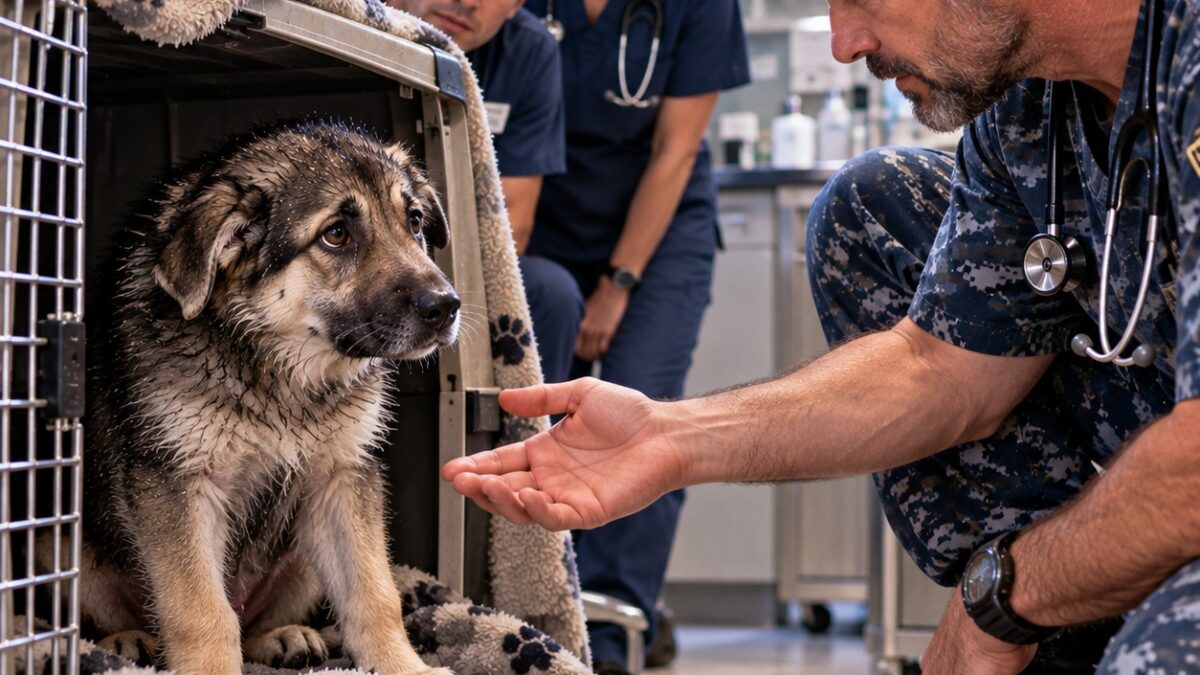
FULL STORY CONTINUATION
By noon, the rain had softened into a cold mist.
Counselor ate a small meal, drank again, and slept for almost two hours in a recovery pen lined with blankets. When he woke, he seemed transformed from exhausted roadside stray into curious puppy.
Not wild.
Not frantic.
Curious.
He inspected the edges of his enclosure, watched staff pass, and studied every sound.
A metal tray clattered in another room.
His head snapped up.
He looked immediately toward the hall.
I happened to be walking past.
Our eyes met.
The puppy remained still.
When I continued walking without concern, Counselor lowered himself again.
I noticed.
I told myself I noticed because noticing behavior was part of my profession.
At 2:17, an old blue pickup pulled up outside.
Counselor stood so quickly his back foot slipped on the blanket. He hurried to the front of the pen, body rigid with attention. A gray-haired man climbed from the truck and entered the clinic carrying a terrier.
Counselor’s tail began moving.
Not wildly.
Hopefully.
The man passed the doorway.
Counselor leaned forward.
The man never looked at him.
Ten seconds later, the puppy sat down.
By 3:40, it happened again.
Different truck.
Different older man.
Same reaction.
Stand.
Watch.
Wait.
Quiet disappointment.
I saw it from the hall.
At 4:55, another pickup rolled slowly past without stopping.
Counselor rose anyway.
He watched it disappear through the rain, then returned to his blanket.
Something uncomfortable settled in my chest.
I had seen animals wait before.
At doors.
At windows.
Near familiar coats.
Animals do not understand explanations the way people want them to. They understand patterns, smell, sound, routine, the shape of someone entering a room.
The old bus stop where Counselor had been found sat miles outside town. Too far for a four-month-old puppy to casually wander from most neighborhoods. Someone had belonged to him.
Or he had belonged to someone.
The distinction suddenly felt important.
By seven that evening, the clinic was quiet again. Rainwater crawled in silver lines down the windows. Marissa had left after confirming the foster enclosure was secure and Counselor would remain at the clinic overnight. Evan departed five minutes later after telling the puppy very seriously not to discuss pending litigation without counsel.
I finished last.
I checked treatment one.
Treatment two.
Pharmacy.
Rear door.
Lights.
I picked up my keys from the reception counter and started toward the exit.
Counselor was lying inside the recovery area.
I glanced through the glass.
“You’re safe tonight,” I said quietly.
The puppy raised his head.
A vehicle passed outside.
Earlier, that sound would have sent him immediately toward the front of the pen.
This time, Counselor did not look at the street. He did not look at the door. He did not look toward the rain.
He looked directly at me.
My hand stopped on the light switch.
For several seconds, neither of us moved.
Then one silver-gray ear tilted slightly sideways.
And I, who believed almost every problem became simpler once properly identified, found myself standing in a darkening veterinary clinic with the uncomfortable sense that this particular problem had just noticed me first.
By the third morning, Counselor had learned where the clinic refrigerator hummed loudest, which cabinet contained treats, and exactly how long I could tolerate a crooked food bowl before correcting it.
The answer was fourteen seconds.
Marissa had placed the bowl beside the recovery pen after breakfast, parallel to the water dish, both edges lined neatly with the grout between the floor tiles.
I walked past once.
Stopped.
Turned back.
Moved the bowl half an inch.
Counselor watched from the other side of the gate.
I continued toward the pharmacy.
The puppy waited until I disappeared.
Then he stretched one silver-gray paw through the opening and pushed the food bowl sideways with his nose.
It scraped across the floor.
Evan, standing at the counter with a roll of gauze in one hand, froze.
He slowly looked toward Counselor.
Then toward the hallway.
Then back at the puppy.
“Do that again.”
Counselor blinked.
Evan crouched.
“Come on. For science.”
Counselor lowered his nose to the bowl and nudged it farther until it sat at an angle that would have bothered me from three rooms away.
Evan’s smile widened.
I returned carrying a folder.
I saw the bowl.
Stopped.
Evan turned away immediately and became intensely interested in the gauze.
I looked at Counselor.
Counselor looked back.
The food bowl sat between us at approximately thirty degrees.
I moved it straight.
Counselor waited.
I took one step.
Scrape.
I turned.
The puppy was sitting perfectly still.
Evan made a choking sound.
I looked at him.
“Problem?”
“No.”
“Then breathe normally.”
“I am.”
“You are not.”
I walked away.
Evan crouched beside the pen.
“You are going to get me fired.”
Counselor gave a soft conversational grumble.
“Worth it,” Evan whispered.
The joke should have lasted one morning.
It did not.
By Thursday, Counselor had graduated from rearranging bowls to stealing one of my indoor shoes.
My shoes were plain, dark, practical, and always positioned beneath my desk with the toes facing outward. Evan noticed the absence first.
He leaned against my office doorway.
“Missing something?”
I did not look up from the chart in my hands.
“No.”
“One shoe.”
I lowered the chart.
My left shoe was where it belonged.
The right one was gone.
I looked beneath the desk.
Nothing.
Then toward the hallway.
Counselor was visible through the open treatment room door.
The puppy lay with his front paws extended, chin resting between them. Directly beneath his chest was the missing shoe.
I stared.
Counselor stared back.
“Bring it.”
The puppy did not move.
“Counselor.”
One ear lifted.
The other leaned slightly outward.
I walked toward him.
Counselor placed one paw on the shoe.
Evan stepped into the hall behind me.
“I am no legal expert,” he said, “but that seems like possession.”
I crouched.
The puppy’s tail tapped once against the floor.
“Drop it.”
Counselor released the shoe immediately.
I picked it up.
The puppy gave a long low sound.
“Wooo-er.”
I straightened.
“No commentary.”
“A-woo.”
Evan leaned against the wall and closed his eyes.
“This is better than cable.”
I put the shoe back beneath my desk.
Ten minutes later, it was gone again.
Marissa eventually found it under the reception chair.
No one could prove anything.
By Friday afternoon, I had begun doing something I disliked almost as much as losing control of my environment.
I had begun anticipating him.
When I entered the staff room, I looked first beneath the table. When I set anything low enough for a German Shepherd nose to reach, I reconsidered its location. When the clinic grew too quiet, I became suspicious.
And when Counselor appeared beneath my desk during paperwork, curled himself against one leg, and rested his chin directly on my boot, I stopped reading the same sentence three times.
I looked down.
The puppy was asleep.
Silver-gray fur covered the top of his head and shoulders, softening into cream around the lower muzzle and chest. His oversized paws extended across the floor, each one looking as though it belonged to an older dog temporarily attached to a puppy.
I could have moved.
I needed the drawer behind my chair.
I stayed where I was for eleven minutes.
I later told myself waking a resting patient would have been unnecessary.
That explanation satisfied no one because I wisely told no one.
The imitation became harder to dismiss.
At first, it happened often enough to be amusing.
I stood near the treatment counter with both hands resting on my hips.
Counselor, several feet away, rose and sat straighter.
I leaned against a cabinet.
Counselor shifted onto one hip.
I heard something in the parking lot and tilted my head.
Counselor tilted left.
Never perfectly.
Never like a trained trick.
Just close enough.
Evan started keeping notes.
I discovered them taped inside a supply cabinet. At the top of the page, Evan had written:
TIMES COUNSELOR HAS COPIED DR. MERCER.
Below it:
8:22 — Doctor crosses arms. Puppy sits taller.
9:47 — Doctor tilts head at printer. Puppy tilts head at doctor.
11:03 — Doctor stares at Evan after inappropriate comment. Puppy also stares at Evan.
11:04 — Hostile workplace.
I removed the page.
“No.”
Evan looked up from labeling a specimen container.
“No?”
“No list.”
“It’s observational data.”
“It’s nonsense.”
“Science has been called worse.”
“Stop documenting it.”
Evan nodded. “Understood.”
The next morning, another page appeared.
The title had changed.
COMPLETELY RANDOM COINCIDENCES WITH NO PATTERN WHATSOEVER.
I stared at it for a long time.
Marissa walked past.
“Better title.”
“You encouraged this.”
“I corrected the spelling.”
I tore the page down.
Evan made a new one after lunch.
This time, I left it up.
I claimed I had more important things to do.
There were always more important things to do.
Vaccinations.
Follow-up calls.
Medication schedules.
A nervous beagle who would only cooperate if Marissa sang quietly under her breath.
An orange cat named Walter who attempted to occupy every surface except the exam table.
Counselor’s world expanded from his recovery pen to brief supervised periods in the back hall and staff area. And as the week went on, the funny pattern changed.
It became less funny.
Not because it stopped.
Because I began noticing what happened before it.
The clinic vacuum turned on unexpectedly near the boarding area. Counselor startled. His shoulders tightened. He took one step back.
Then he looked down the hallway.
I stood there discussing a discharge plan with Marissa. I did not react to the vacuum.
Counselor watched me for two seconds.
His body loosened.
He sat.
Another afternoon, a broad man in a rain jacket entered carrying a carrier. Counselor had never seen him. The puppy rose quickly, ears forward. The stranger bent slightly and offered a hand.
Counselor did not approach.
He looked toward me.
I was standing at reception, relaxed, neutral.
Only then did Counselor move forward to investigate.
I noticed.
I told myself it was ordinary.
Then a metal frame slipped from Evan’s hands in treatment one and hit the floor with a hard clatter that echoed through the clinic.
Counselor jumped sideways. His paws skidded once. He froze.
And before he looked toward the noise, before he looked toward Evan, before he did anything else, he looked at me.
I was already watching him.
“It’s fine,” I said.
Not loudly.
Not even particularly gently.
Normally.
Counselor stayed still another moment.
Then the tension left his shoulders.
He sniffed the floor.
Marissa saw the whole thing.
That evening, while Counselor slept beneath the staff room table, she stood beside me at the sink rinsing a mug.
“He checks you.”
I dried my hands.
“He watches everyone.”
“No. He watches everyone. He checks you.”
I glanced through the doorway.
Counselor’s paws stuck out from beneath the table.
“That is not a clinical distinction.”
“It is if you’re paying attention.”
“I am paying attention.”
Marissa smiled faintly. “That’s why you’re annoyed.”
I gave her the look that usually ended conversations.
Marissa had known me too long.
She dried the mug and returned it to the cabinet.
“When something surprises him, he looks at you before he decides what to do.”
“He is young.”
“Yes.”
“He is in an unfamiliar environment.”
“Yes.”
“He is looking for environmental cues.”
“Yes.”
“Then we agree.”
Marissa folded her arms.
“You just used six words to avoid saying safe.”
I looked at her.
“What?”
“He uses you to decide whether something is safe.”
“That is not what I said.”
“It is exactly what you said with better posture.”
I picked up a chart.
“You’re anthropomorphizing.”
“No, you’re hiding behind vocabulary.”
I walked away.
Marissa called after me, “That’s also a pattern.”
I did not answer.
I disliked the idea because it carried more weight than it had any right to.
A puppy could watch me.
Fine.
A puppy could learn my movements.
Also fine.
But being used as a reference point was different.
It suggested trust.
And trust, in my experience, was simply another word for a promise that had not been tested yet.
That night, after the clinic closed, I remained in my office longer than necessary.
The rain had stopped.
Outside, water dripped steadily from the awning.
Counselor slept in the recovery area.
I opened a drawer looking for a battery.
Instead, I found an old photograph.
I had forgotten it was there.
Two men stood beside a military transport vehicle beneath a white sky.
One was a younger version of me—no silver in my hair, no lines around my eyes, posture too rigid even then.
Beside me stood Daniel Cross, laughing at something outside the frame.
At Daniel’s boots sat an old shepherd mix with a gray muzzle.
Scout.
I stared at the picture.
Memory is irritating that way.
It ignores schedules.
Years after Daniel left the service, after illness reduced his world from travel and work to a quiet house and medical appointments, I had visited him whenever I could.
Scout had been old by then. Slower. Still followed Daniel from room to room.
Three weeks before Daniel died, I sat beside his bed while Scout slept on the floor.
Daniel had said, “You’ll look after him.”
I answered without hesitation.
“Of course.”
At the time, it had not felt like a promise with complications.
It had felt obvious.
Then orders came.
A long overseas assignment.
No practical way to take Scout.
I arranged for another former service family to care for him permanently. Good people. A large yard. Someone home most days. I visited when I returned. Scout had been happy, safe, loved.
No one accused me of abandoning anything.
Scout certainly had not.
He greeted me with the same old tail wag and gray face, as if no betrayal had occurred at all.
That somehow made it worse.
Because I had promised Daniel I would be the one.
And then I had not been.
Years later, I knew the facts.
Circumstances changed.
I made the responsible decision.
Scout lived comfortably to old age.
Every reasonable argument had been made.
None changed the private verdict I carried.
Promises were easiest before life altered the terms.
So I stopped making certain kinds.
I treated animals. I protected them while they were my responsibility. Then they went home.
Clean.
Clear.
Professional.
No confusion about where duty ended.
I returned the photograph to the drawer and closed it.
The soft click sounded louder than expected.
From the recovery area came a quiet “a-woo.”
I looked toward the doorway.
Counselor was awake.
“Go to sleep.”
The puppy lowered his head.
I waited.
Counselor closed his eyes.
I stayed in the office another minute anyway.
Across the week, Marissa worked through every practical avenue she could.
She posted photographs with local rescue networks, called nearby shelters, reviewed missing dog reports, checked neighborhood groups, asked animal control to compare recent calls from surrounding counties. The problem was that Counselor had been found near an old bus stop on Brier Road, where Bellweather thinned into long properties, secondary roads, and patches of woods.
He might have wandered a mile.
Or five.
He might have slipped from a yard.
He might have been traveling in a vehicle before becoming separated.
There was no tag.
No chip.
Only behavior.
Old trucks.
Older men.
Waiting.
On Monday afternoon, nearly a week after he arrived, Counselor was lying beneath my desk again.
I had given up pretending this was accidental.
I was reviewing lab results when the phone rang at reception.
Marissa answered.
“Mercer Veterinary Clinic.”
A pause.
“Yes, this is she.”
Another pause.
Her expression changed.
I noticed because Marissa’s expressions rarely changed without reason.
She reached for a pen.
When Counselor lifted his head at her voice, Marissa listened.
“Yes.”
She glanced toward me.
“About four months?”
I stopped reading.
Counselor sat up.
Marissa’s questions became slower.
“Male? German Shepherd?”
She looked directly at me now.
“What color?”
The clinic seemed to narrow around the answer.
Marissa wrote something down.
“Silver-gray. Cream on the chest and muzzle. One ear still tipped when tired. Large paws.”
I stood.
Counselor watched me.
Marissa asked, “What is your name?”
She wrote again.
Rachel Danner.
Thirty-nine.
Her father had been hospitalized unexpectedly several weeks earlier. During the rush of moving belongings and arranging temporary care, his German Shepherd puppy had been staying with an acquaintance. A gate had been left unsecured. By the time anyone realized, the puppy was gone.
Searches had turned up nothing.
The family assumed he had traveled farther than expected.
Rachel’s voice on the phone cracked once, then steadied.
Marissa asked her to send photographs.
I remained beside the desk.
Counselor had risen now.
Not agitated.
Alert.
Marissa’s phone chimed.
She opened the message.
For a moment, she said nothing.
Then she turned the screen toward me.
The photograph had been taken outdoors in warmer weather. An older man sat in a wooden chair beneath a porch roof. One hand rested on his knee. At his feet lay a German Shepherd puppy—silver-gray back, cream-colored chest, amber eyes, one ear upright, one leaning, the same pale triangle of fur at the center of his chest, the same oversized paws.
Counselor.
No question.
No guess.
No coincidence.
In the photograph, the puppy’s body was pressed against the old man’s boots as though that place had always belonged to him.
I stared at the image longer than I intended.
Behind me came the soft click of nails against the floor.
Counselor had walked closer.
I looked down at him.
The puppy looked up, waiting for whatever my face might tell him.
For the first time since Brier Road, there was an answer.
Somewhere, there was a man who knew this dog.
Somewhere, there was a home Counselor had not forgotten.
And I suddenly understood the waiting at the window.
The old trucks.
The gray-haired strangers.
The hope that rose and fell each time the front door opened.
Counselor had not been waiting for just anyone.
He had been waiting for someone to come back.
The next morning arrived with a sky the color of wet slate.
By eight, the rain had thinned to mist, leaving the clinic windows silver and the parking lot shining beneath weak autumn light. Benny—though everyone at Mercer Veterinary Clinic still called him Counselor out of habit—had already finished breakfast and rearranged his water bowl twice.
I noticed both things.
I also noticed I was checking the clock more often than usual.
At 9:12, Marissa stepped into my office with her coat folded over one arm.
“Rachel called.”
I looked up.
“She and her father are ready.”
I closed the file in front of me.
“Address?”
“Twenty-two minutes east.”
I stood.
Marissa watched me.
“You don’t have to come.”
“I know.”
“You could stay here.”
“I know.”
“You’re coming anyway.”
I picked up my keys.
Marissa nodded once. “Thought so.”
Evan was crouched beside Benny in the back hall, fastening a simple lead to his collar. The puppy’s silver-gray coat had dried into a soft ridge along his shoulders, while the creamy white fur on his chest made the pale triangle stand out sharply.
Both ears were almost upright that morning, though the right tipped slightly outward when Evan scratched behind it.
“So this is it,” Evan said solemnly. “You’re going home, Counselor.”
Benny looked up.
Evan lowered his voice.
“Please remember me when you become wealthy.”
I appeared in the doorway.
“He is a dog.”
“That attitude is why he’ll cut you out of the will.”
I took the lead.
Benny immediately looked at me.
Not at the door.
Not at Marissa.
Me.
I pretended not to notice.
The drive took us beyond the denser streets of Bellweather, past wet maples and split-rail fences into a quieter part of the county where old houses sat farther from the road.
Benny spent the first several minutes looking through the window. Then he settled behind my seat. Every time I shifted my hand on the steering wheel, Benny’s ears moved.
Marissa glanced sideways.
“You’re doing it again.”
“Driving?”
“Pretending you don’t know he’s watching you.”
“He’s in a moving vehicle. That explains everything.”
“It explains enough.”
She let the silence sit.
The Danner house stood at the end of a narrow lane lined with sycamores. It was a modest brick ranch with a detached garage, a shallow porch, and a blue pickup truck parked beneath an aluminum awning.
The moment I turned into the driveway, Benny stood.
His entire body changed.
No whining.
No jumping.
Just sudden absolute attention.
I felt the lead tighten slightly in my hand.
“That truck,” Marissa said.
I nodded.
Same shape.
Same deep blue as the pickups Benny had reacted to.
A woman stepped onto the porch.
Rachel Danner looked exactly like she sounded—composed, practical, carrying more responsibility than she wanted anyone to notice. Her dark-blond hair was pulled low at the back of her neck, held by a small bronze clip. She wore a heather-gray sweater beneath a rain jacket and held the screen door open with one hand.
She saw Benny.
Her face changed.
“Oh.”
That was all she said.
Benny did not recognize her voice.
Not yet.
He remained close to my leg.
Rachel came down the steps slowly.
“He got bigger.”
“Puppies are inconsiderate that way,” Marissa said.
Rachel gave a small laugh, but her eyes had already filled.
“My dad’s inside.”
I looked toward the house.
“Is he ready?”
Rachel hesitated.
“He thinks he is.”
That answer told me more than yes would have.
Inside, the house carried the smell of coffee, old wood, and machine oil that had probably lived in the walls for decades. A pair of work boots stood beneath a bench near the door. An old photograph of a woman laughing beside a fishing boat hung above them.
Several cardboard boxes sat near the hallway.
Some sealed.
Some still open.
The signs of a house preparing to become something else.
Benny stopped.
His nose moved rapidly.
Once.
Twice.
Then his head snapped toward the living room.
A man sat in a wooden chair beside the window.
Arthur Danner was seventy-one, broad through the hands and shoulders despite the weight he had lost. His navy-and-cream flannel shirt hung slightly loose. White hair remained thick around the sides of his head, thinner above, and several weeks of pale stubble shadowed a face built from deep lines and weather.
He held a cane against one knee.
For half a second, no one moved.
Arthur stared at the puppy.
Benny stared back.
Then Arthur’s hand slipped from the cane.
“Benny.”
The puppy made a sound I had never heard from him before.
Not the dramatic a-woo.
Not the argumentative grumble.
A thin, breathless whine.
Arthur leaned forward.
“Benny, boy.”
The lead pulled through my hand before I consciously loosened it.
Benny ran.
Not wildly.
Straight.
Direct.
Certain.
He crossed the living room in seconds and pressed himself against Arthur’s knees so hard the older man had to brace one hand against the chair. His tail moved in frantic sweeps. His head pushed beneath Arthur’s palm. He whined again, then twisted sideways, then tried to climb closer without understanding that his growing body no longer fit into the space he wanted.
Arthur laughed once.
Then the laugh broke.
He bent down carefully. Both hands found Benny’s neck.
“Oh, you ridiculous thing.”
Benny leaned into him.
Arthur buried his face briefly against the silver-gray fur behind the puppy’s ears.
Rachel turned toward the window.
Marissa looked down.
I remained near the doorway.
I had witnessed thousands of reunions between animals and owners. Most were joyful. Some chaotic. A few quiet.
This one was different.
There was no doubt.
No testing.
No hesitation.
Benny had known him from one word.
I felt something in my chest loosen.
Good.
This was good.
This was the ending.
The puppy had been found.
The owner had been found.
The waiting was over.
Problems were supposed to feel satisfying when solved.
Arthur sat back.
Benny planted himself directly across the older man’s boots. One paw rested on the worn leather.
Arthur looked at me.
“You’re the doctor.”
“Nolan Mercer.”
He nodded. “Rachel told me what you did.”
“The road crew found him.”
“You kept him safe.”
“The clinic did.”
Arthur looked down at Benny.
“Still argues?”
Marissa laughed.
I glanced at her.
Arthur smiled. “So he does.”
Rachel leaned against the mantel.
“He started that with Dad.”
Arthur scratched Benny’s chest.
“Only when he disagreed.”
“That was frequent?” Marissa asked.
“Constant.”
Benny gave a soft rumble.
Arthur pointed at him. “See?”
Even I smiled slightly.
Then Arthur stood.
Or tried to.
The moment he shifted forward, Benny moved out of the way automatically. Arthur placed both hands on the arms of the chair, rose halfway, stopped, tried again. The movement was controlled but slow. His left leg trembled once before steadying.
Rachel stepped toward him.
“I’m fine.”
“I didn’t say anything.”
“You were going to.”
“I was going to breathe.”
“Do it farther away.”
Rachel stopped.
I watched without appearing to.
Arthur straightened, reached for the cane, and moved three careful steps toward the kitchen.
Benny followed immediately.
The puppy’s body, so compact beside me, suddenly looked enormous beside Arthur’s unsteady stride.
Not dangerous.
Just young.
Powerful in the way he would become.
Arthur stopped near the doorway.
Benny almost bumped his leg.
Arthur caught himself against the wall.
Rachel was there instantly.
“I’m fine.”
This time, her voice sharpened.
“Dad.”
“I said I’m fine.”
Benny sat.
His ears lowered slightly.
Arthur looked at him.
The stubbornness drained from his face.
“Sorry, boy.”
I looked away.
The next hour made the situation clearer.
Arthur had recently suffered a serious medical episode that left him with reduced stamina and balance. He was recovering. Doctors expected improvement, but no one could tell him exactly how much or how quickly.
Rachel wanted him to move closer to her.
Not assisted living.
Not a facility.
A smaller rental property ten minutes from her house.
One floor.
Fewer steps.
Less yard.
Arthur hated every part of that description.
“It sounds like a shoebox,” he said.
“It has two bedrooms.”
“One is the size of this coffee table.”
“It is not.”
“Then the coffee table is unusually ambitious.”
Marissa smiled.
Rachel sighed.
I said nothing.
I watched Benny.
The puppy had settled beside Arthur again, one paw on the man’s shoe.
Arthur noticed me looking.
“I got him after my wife died.”
Rachel’s expression softened.
Arthur scratched behind Benny’s ear.
“House got too quiet.”
He looked toward the framed photograph above the bench.
“Thirty-eight years of another person moving through rooms. Then one day, you can hear the refrigerator turning on from the other end of the house.”
No one interrupted.
“Rachel suggested a dog.”
Rachel lifted one finger. “I suggested an older dog.”
Arthur nodded. “She suggested an older dog. And I came home with this.”
Benny sneezed.
Arthur smiled.
“Bad judgment runs in the family.”
“You drove two counties over for him,” Rachel said.
“He looked lonely.”
“You looked lonely.”
Arthur glanced at her.
“That too.”
Benny raised his head and gave a soft low a-woo.
Arthur rubbed his forehead.
“Still correcting me.”
I could see how easy it would be to say nothing.
Arthur loved the dog.
The dog loved Arthur.
That was true.
It was also not the whole truth.
I waited until Benny wandered toward Marissa before speaking.
“How much walking are you doing right now?”
Arthur looked at me.
“Enough.”
Rachel closed her eyes.
I stayed neutral.
“How far?”
“Mailbox.”
Rachel added, “On good days.”
Arthur frowned at her.
I continued.
“Benny is about four months old.”
“I know how old my own dog is.”
“I’m not questioning that.”
Arthur’s jaw tightened.
I chose my next words carefully.
“He’s going to get substantially larger.”
Arthur said nothing.
“He’ll need structured exercise, training, socialization. He’ll become stronger before he becomes sensible.”
Marissa murmured, “Sometimes much stronger.”
Arthur watched Benny investigate a cardboard box.
“I’ve had dogs before.”
“I believe you.”
The older man looked back at me.
“Then what are you saying?”
“I’m saying you should think about what caring for him will look like six months from now. Not today.”
Silence.
Rainwater dripped from the porch roof outside.
Arthur’s grip tightened slightly on the cane.
Rachel stepped in.
“He isn’t telling you to give him up.”
I looked at her.
“No. I’m not.”
Arthur’s eyes remained fixed on me.
“Sounds like it.”
“I’m telling you to decide based on the dog Benny is becoming, not only the puppy he is today.”
That landed differently.
Arthur looked down.
Benny had found a loose corner on a cardboard box and was trying to determine whether cardboard deserved investigation by mouth.
“Benny.”
The puppy froze.
Arthur pointed away from the box.
Benny sat immediately, then gave an offended little grumble.
Arthur smiled despite himself.
“Still listens.”
“He does,” I said.
Arthur’s face changed again because we both knew listening was not the problem.
Strength was.
Energy was.
Time was.
The slow uncertainty of recovery was.
Arthur looked toward Rachel.
“You already decided.”
Rachel shook her head. “No.”
“Don’t lie to me.”
“I decided I’m worried.”
“That’s the same thing in softer clothes.”
“No, Dad. It isn’t.”
For several seconds, father and daughter simply looked at each other.
Then Arthur turned away.
“I need a few days.”
I nodded.
“That’s reasonable.”
Arthur looked surprised.
“You’re not going to tell me what to do?”
“No.”
Marissa glanced at me.
Arthur rested both hands over the cane.
“I want him home.”
“I know.”
“I can take care of him.”
I did not answer.
Arthur’s voice lowered.
“I could.”
I heard the difference.
Not can.
Could.
Past confidence slipping into future uncertainty.
I knew better than to expose it.
“Take a few days,” I repeated.
Arthur nodded.
So Benny went back to the clinic.
And I immediately regretted how relieved I felt about that.
I began avoiding the puppy the next morning.
Not obviously.
I did very little obviously.
I simply found reasons to work elsewhere. Charts normally completed in my office were carried to treatment three. Inventory Marissa could handle suddenly required my personal attention. I entered through the back door twice in one day.
The first time, Benny was lying outside my office.
The second time, Benny was waiting in the rear hall.
I stopped.
Benny looked up.
“How did you know I was here?”
The puppy stood.
I walked past.
Benny followed three steps, then stopped near the doorway.
Later that afternoon, I moved paperwork into the consultation room.
Ten minutes later, Benny lay outside the closed door.
Evan came around the corner. He looked at the puppy, then at me through the narrow glass panel.
He opened the door.
“Doctor.”
“What?”
“You’re losing.”
“To what?”
“Hide-and-seek.”
“I am not hiding.”
Evan pointed down.
Benny had placed one paw across the threshold.
I looked at him.
Evan said, “You’re losing hide-and-seek to a dog who doesn’t have all his adult teeth yet.”
“Go back to work.”
“I am working.”
“No. You’re narrating.”
Evan left.
Benny stayed.
And that was the part I could not explain away.
The puppy was not panicked. He did not scratch doors. He did not cry when I left a room. He did not refuse food or become frantic when separated.
He simply preferred to know where I was.
Once he knew, he settled.
That was somehow worse.
Dependency I could reject.
Preference was harder.
On the fourth day, the call came.
Marissa answered.
Her expression told me before she said my name.
“Arthur wants to come in.”
I looked toward Benny.
The puppy was asleep beneath the reception desk.
“Today?”
“This afternoon.”
Arthur arrived with Rachel just before closing.
He moved more slowly than before.
Benny heard his voice from the hall and ran to him.
Same joy.
Same certainty.
Arthur knelt as far as he safely could and held him. For several minutes, no one spoke about the decision.
Arthur asked if Benny had eaten.
Marissa said too much.
Arthur asked if he had been behaving.
Evan said no.
Benny protested.
Everyone laughed.
Then the laughter ended naturally.
Arthur sat.
Benny remained against his leg.
Arthur stroked the puppy’s head for a long time. When he finally spoke, his voice was steady.
“I can give him love.”
I watched him.
Arthur’s hand slowed over the silver-gray fur.
“I’m no longer sure I can give him the life he’ll need.”
Rachel lowered her eyes.
Marissa went still.
I knew what it cost Arthur to say it because I knew the shape of the argument inside him.
Love should have been enough.
It felt cruel that sometimes it was not.
Arthur looked at me.
“Don’t let anybody take him because he’s pretty.”
I nodded.
“They’ll be screened.”
“He needs someone who’ll work with him.”
“Yes.”
“He gets bored.”
“I know.”
“He talks too much.”
From the desk, Evan whispered, “We know.”
Arthur almost smiled.
Then he looked down at Benny.
“You’re going to be a lot of dog.”
Benny placed his chin on Arthur’s knee.
Arthur’s face folded in a way I had not expected.
Not dramatically.
Just enough.
He rubbed one thumb between Benny’s ears.
“I thought I had more time.”
Rachel moved closer.
Arthur took a slow breath.
Then another.
Eventually, he stood.
Benny stood with him.
Arthur walked toward the exit.
Benny followed.
Arthur stopped.
The puppy stopped too.
Rachel opened the door.
Arthur did not move.
Then he turned back.
He placed both hands around Benny’s face and looked into the amber-brown eyes.
“You listen to somebody. All right?”
Benny licked his wrist.
Arthur laughed once through the strain in his voice.
“Never did listen to me.”
He straightened.
Marissa took Benny’s lead gently.
Arthur walked outside.
Benny tried to follow.
Not wildly.
One step.
Then another.
The lead tightened softly.
He stopped.
Arthur heard the nails against the floor.
I saw it in his shoulders.
The older man froze in the doorway.
For one second, I thought he might turn around.
He did not.
He looked toward the parking lot instead.
Rachel placed a hand against his back.
Together they walked to the blue pickup.
Benny stood quietly beside Marissa, watching.
Arthur climbed into the passenger seat.
Only after the door closed did Benny sit.
I remained several feet away.
For years, I had told myself the responsible choice I made for Scout had been a broken promise.
Now I watched another man make almost the same choice.
And for the first time, the decision did not look like abandonment.
It looked like love stripped of pride.
Love willing to be misunderstood.
Love strong enough to admit that wanting someone beside you and being able to give them what they needed were not always the same thing.
Benny finally turned from the glass.
His eyes found me.
I did not move.
The puppy crossed the lobby and sat at my boots.
Outside, Arthur’s blue pickup disappeared into the fading afternoon.
Inside, I looked down at the dog between my feet.
For years, I had believed letting go meant failing someone.
Standing there with Benny waiting quietly beside me, I was no longer certain that was true.
By Wednesday morning, Benny had a temporary home.
On paper, it was difficult to argue with.
David and Helen Lawson lived fifteen minutes north of Bellweather in a quiet neighborhood where the houses sat farther apart and the backyard seemed designed by people who believed grass should have room to breathe. Both in their fifties. Both experienced with large dogs. Predictable schedules. Fenced yard. No small children. No other pets. No travel planned.
References excellent.
Their veterinarian spoke highly of them.
Marissa checked everything twice.
I checked it a third time.
“You realize I already did this,” she said from behind reception.
“I realize.”
“And you trust me.”
“I do.”
“And yet.”
I continued reading the Foster application.
Marissa waited.
I turned the page.
She leaned back.
“This is fascinating.”
“What is?”
“Watching a man verify information he already believes.”
I ignored her.
Benny lay several feet away, chewing the corner of a rubber toy with the solemn concentration of someone dismantling evidence.
Since Arthur’s decision, the puppy had returned to clinic routine as though nothing had changed. Breakfast at seven. Walk at eight. Nap beneath my desk whenever opportunity allowed. Occasional theft. Frequent commentary.
But something had shifted in me.
I no longer corrected people when they called him Benny.
I no longer pretended Counselor was simply easier for paperwork.
Arthur had given the dog back his real name.
That mattered.
I had not said why.
Marissa had not asked.
At 10:30, the Lawsons arrived.
Helen Lawson was compact, warm-faced, and practical. Her husband, David, was taller, soft-spoken, and carried the faint stiffness of someone who had spent too many years working at a desk.
They did exactly what I wanted prospective foster parents to do.
They did not rush toward Benny.
They did not clap their hands or make high-pitched noises.
They let him approach.
Benny sniffed David’s trousers, then Helen’s shoes, then returned to my leg.
Helen smiled.
“He likes you.”
“He watches everyone.”
Behind me, Marissa made a sound that might have been a cough.
I did not turn around.
David crouched slightly.
“Can I?”
“Let him come to you,” I said.
David offered the back of one hand.
Benny stretched forward, sniffed, and his ears relaxed.
Good.
Helen asked practical questions.
How much was he eating? What commands did he know? How was he on leash? Any issues with strangers? Any guarding around food? Any fear responses?
I answered carefully.
“He’s young. He’s still learning. He startles at unfamiliar sounds, but recovers well.”
Helen nodded.
“And the talking?”
Evan appeared from nowhere.
“He has opinions.”
I looked at him.
Evan immediately added, “Medically insignificant opinions.”
Benny made a soft grumble.
David laughed.
Everything was right.
That made the moment strangely difficult.
At noon, Benny left with the Lawsons.
Marissa packed his food, medical notes, favorite rubber toy, and a blanket from the recovery pen. Evan brought the lead to the front desk.
I stayed near the treatment hall.
I told myself there was no reason to crowd the departure.
Benny walked with Helen to the door.
Stopped.
Turned.
His amber-brown eyes found me.
There it was again.
Not panic.
Not pleading.
A question.
I kept my posture loose.
“Go on.”
Benny looked at me another second, then followed Helen outside.
The glass door closed.
The car pulled away.
I watched until it turned at the intersection.
Marissa stood beside me.
“He’ll do well there.”
“That wasn’t what I asked.”
“It’s the relevant answer.”
I returned to work.
For the next hour, the clinic ran efficiently.
Perfectly, even.
No bowls moved out of line.
No shoes vanished.
No gray-and-cream head appeared beneath my desk.
No low a-woo interrupted me when I became too serious.
At 2:20, I reached beneath my chair with one hand while reading a chart.
My fingers touched nothing.
I froze.
Then pulled the drawer open instead.
At 3:05, the vacuum started in the boarding hall.
I looked automatically toward the doorway.
There was no puppy waiting to see whether the sound mattered.
At 4:10, a pickup stopped outside.
My eyes went to the front window before I realized why.
Marissa noticed.
She did not say anything.
The silence became irritating in ways I could not defend.
It was not truly silent. Phones rang. Kennel doors clicked. A terrier barked at an employee carrying a broom. Evan dropped a metal bowl and blamed gravity.
But beneath all of it, something was missing.
A rhythm.
A set of small interruptions I had spent almost two weeks pretending were inconveniences.
Near closing, Evan carried two water bowls into the staff room. He set them down, stopped, looked at both, then quietly picked one up again.
I saw him.
He saw me seeing him.
Neither of us made a joke.
That bothered me most.
The next day was worse because it was easier.
Human beings adapt quickly.
The clinic adjusted.
The recovery pen was sanitized.
The blanket was gone.
A boarding dog occupied the space by afternoon.
Work filled the gaps because work was good at doing that.
I nearly convinced myself the emptiness had been exaggerated.
Then I opened my office door and automatically looked down.
Nothing lay across the threshold.
I stood there longer than necessary.
By Friday morning, I had mostly stopped looking.
Marissa received the first update from Helen Lawson shortly after nine.
Benny had slept near the front door. He had eaten only part of dinner. He had explored the yard, responded well to basic cues, and shown no destructive behavior.
The message included a photograph.
Benny lay on a rug beside a wide front window, silver-gray back curved toward the camera, head resting on his paws, eyes open.
I glanced at the screen.
“Adjustment period.”
Marissa looked at me.
“I didn’t say anything.”
“He needs time.”
“I still didn’t say anything.”
I returned to my chart.
At noon, another message came.
Benny had played briefly with a ball in the yard.
Good.
At night, he returned to the front door.
I said nothing.
Saturday morning, Helen called.
Marissa took the phone into her office. She was there almost twelve minutes. When she came out, I was waiting near reception.
I had not consciously decided to wait.
“What?”
Marissa held the phone against her palm.
“They’re not having behavioral problems.”
“Good.”
“He isn’t damaging anything.”
“Good.”
“He’s responsive.”
“Good.”
“He’s eating less than they’d like.”
My jaw tightened.
“How much less?”
“Enough that they noticed. Not enough to be medically concerning yet.”
“Activity?”
“Normal outside. Quiet indoors.”
I folded my arms.
Marissa continued, “He spends a lot of time by the door.”
“He’s adjusting.”
“Yes.”
“Three days is not enough time to draw conclusions.”
“I agree.”
I looked at her.
That was not the response I expected.
“So?”
“Helen asked if one of us could visit.”
“Why?”
“To see whether his behavior changes around someone familiar.”
I said nothing.
Marissa’s eyes sharpened.
“I can go.”
“No.”
The answer came too quickly.
Marissa waited.
I adjusted my tone.
“I should evaluate him. Clinically.”
“Yes,” she said. “Of course.”
Evan, passing with a stack of folded towels, slowed.
I looked at him.
Evan kept walking.
“I said nothing.”
“You were preparing to.”
“I was preparing to breathe.”
“Do it elsewhere.”
The Lawson house looked exactly as it had sounded on the application.
Orderly.
Quiet.
Safe.
A broad yard extended behind the brick house, enclosed by a high wooden fence. A covered patio held two chairs and a row of potted herbs. There was enough open space for a German Shepherd to run without immediately finding something breakable.
I should have liked it.
I did like it.
That made what happened next more difficult.
Helen met us in the driveway.
Marissa climbed out first.
I remained behind the wheel a moment, looking toward the house.
“You coming?” Marissa asked.
“Yes.”
I opened the door.
Inside, something barked once.
Not loudly.
Then silence.
Helen smiled with a little uncertainty.
“He heard the car.”
We walked toward the gate.
David appeared at the back door.
Benny stood behind him.
For an instant, the puppy did not move.
Then I stepped fully into view.
Benny changed.
The difference was so immediate I almost wished it had been subtle.
His ears rose.
His head came up.
His entire body seemed to release a tension no one had noticed until it disappeared.
David opened the door.
Benny ran.
He crossed the patio, down the two shallow steps, across the damp grass, straight toward me.
I braced instinctively for impact.
It never came.
Benny stopped inches away.
No jumping.
No barking.
No frantic circling.
He simply pressed close to my leg, so close that the side of his shoulder touched my boot.
Then Benny exhaled.
Long.
Audible.
His entire body softened.
I looked down.
Benny looked up once—amber eyes, one ear straight, the other tipped slightly—then sat.
That was all.
No spectacle.
No miracle.
Nothing I could dismiss as excitement.
Benny had simply arrived where he wanted to be.
Helen’s expression changed.
“Oh,” she said softly. “I think that means…”
Marissa stayed silent.
David leaned against the doorframe.
“Well,” he said quietly. “That answers one question.”
I crouched.
I checked Benny’s eyes.
Gums.
Hydration.
Body condition.
Anything that would let me remain a veterinarian instead of the man the dog had just crossed a yard to stand beside.
“Physically, he looks fine.”
Helen nodded.
“He is. That’s what’s been confusing us.”
Benny leaned slightly against my knee.
I shifted away half an inch.
Benny shifted too.
Marissa saw it.
She still said nothing.
We sat on the patio for coffee.
Benny lay under my chair.
Helen explained the last three days carefully.
“He isn’t miserable,” she said. “That’s important. I don’t want you thinking he’s been distressed every minute.”
I nodded.
“He plays outside.”
“Yes.”
“He responds to you.”
“Yes,” David added. “He sleeps, mostly. But he keeps track of the front of the house.”
“When cars slow down, he listens,” Helen said. “When someone walks by, he checks the window. At night, he lies near the door.”
I glanced beneath the table.
Benny’s chin rested across the toe of my boot.
Helen followed my gaze.
“He hasn’t done that with either of us.”
I looked up.
“He needs time.”
Helen smiled gently.
“Maybe.”
There was no defensiveness in her voice.
No wounded pride.
That surprised me.
David rubbed his hands together.
“We’ve fostered dogs before.”
“I know.”
“Sometimes they arrive ready to attach themselves to the next safe person.”
He looked at Benny.
“And sometimes they arrive already attached.”
My shoulders stiffened.
Marissa finally spoke.
“That doesn’t automatically mean Nolan.”
I turned to her.
She ignored me.
“It may mean the clinic. Familiar smells, routine, people he knows.”
Helen nodded.
“That’s possible.”
David smiled faintly, but he did not run to the van.
Silence.
I looked away toward the yard. Wet leaves had gathered along the fence. A small bird landed on the top rail, and Benny’s ear moved beneath the table.
He did not rise.
The dog was calm.
That was the problem.
I had expected exuberance, separation excitement, something youthful and obvious.
Instead, Benny looked relieved.
Relief was harder to argue with.
We stayed nearly forty minutes.
Benny played briefly with David in the yard. He responded when Helen called. He drank water. He looked comfortable.
This was not a bad home.
I needed that fact.
When it was time to leave, Marissa stood first.
Benny rose.
I stayed seated.
The puppy watched me.
Helen looked at David.
David looked back.
A quiet decision passed between them.
Helen turned to me.
“We’ve been talking.”
I already disliked the sentence.
“We think he should go back with you. To the clinic, for now.”
I frowned.
“You agreed to foster.”
“We did.”
“You have the space.”
“Yes.”
“Experience.”
“Yes.”
“You said there are no significant behavioral issues.”
“There aren’t.”
“Then why end the placement after three days?”
Helen leaned forward.
“Because fostering isn’t about proving a dog can tolerate our house.”
I said nothing.
“It’s about helping him get where he belongs.”
The words landed too cleanly.
David added, “Maybe that’s not with you. Maybe it’s someone else eventually. But he’s telling us something right now.”
My jaw tightened.
“Dogs don’t make adoption decisions.”
“No,” Helen said. “People do.”
Marissa looked at me.
I stood.
Benny stood immediately.
“This does not mean I’m adopting him.”
Marissa blinked.
“No one just asked you.”
David looked down to hide a smile.
Helen failed completely.
I picked up the lead.
“This is temporary.”
“Of course,” Marissa said.
“Until we identify the appropriate placement.”
“Absolutely.”
“You’re doing that thing.”
“What thing?”
“Agreeing in a way that is not agreement.”
Marissa opened the gate.
“I have no idea what you mean.”
Benny walked beside me to the van.
For the first time all afternoon, his tail lifted.
Back at the clinic, Evan saw us enter and froze with a clipboard in his hands.
He looked at Benny.
Then me.
Then Marissa.
“Did I miss a board meeting?”
“Foster placement ended,” I said.
Evan nodded slowly.
“Any particular reason?”
“No.”
Marissa walked past. “Yes.”
I turned. “Marissa.”
She kept walking.
Evan looked at Benny.
“Welcome back, Counselor.”
Benny answered with a drawn-out a-woo.
Evan smiled.
“There he is.”
That night, I stayed late.
I told myself there was paperwork.
There was always paperwork.
Outside, wind pushed dry leaves in small circles across the parking lot. Most clinic lights were off. Benny had eaten a full dinner—no hesitation, no coaxing. He inspected the recovery area, stole one paper towel from a low shelf, and settled beneath the staff room table as if three days had been erased.
I entered carrying a mug of coffee I no longer needed.
Benny stood and followed me.
I sat at the table.
Benny sat beside me.
I looked down.
He looked up.
For several seconds, we remained like that.
Then I tilted my head slightly to the left.
Benny tilted his.
I straightened.
Benny straightened.
I narrowed my eyes.
Benny’s dark markings gave his face the absurd appearance of narrowing back.
The laugh escaped before I could stop it.
Not the short exhale I sometimes used when Evan said something mildly funny.
A real laugh.
Quiet at first.
Then warmer.
It surprised me almost as much as it surprised Benny.
The puppy’s tail began striking the floor.
I looked away, still smiling.
“You are ridiculous.”
“A-woo.”
The laugh came again.
Then, almost as quickly, it faded.
I stared into my coffee because somewhere between the Lawson house and that quiet room, the problem had changed.
I had spent days asking what Benny wanted.
Arthur.
A familiar voice.
A safe place.
A person to watch when the world changed.
Now Benny’s answer seemed increasingly clear.
That should have simplified things.
Instead, something colder and more complicated settled beneath my ribs.
Benny wanting me was not the difficult part anymore.
The difficult part was the question I had successfully avoided for years.
Whether I wanted Benny back.
Not for one night.
Not until the next foster family.
Not while circumstances were convenient.
For mornings.
Training.
Mess.
Years.
The inevitable changes no promise could prevent.
Benny rested one oversized paw against my boot.
I looked down at it.
For once, the puppy did not make a sound.
He did not need to.
The question in the room belonged entirely to me now.
The storm arrived before dark.
By four in the afternoon, the sky over Bellweather collapsed into a single sheet of charcoal. Wind pushed the first hard drops sideways across the clinic windows, and the trees along the parking lot bent in long, slow arcs that made the whole street seem to breathe.
At 4:17, the first transformer failed somewhere east of town.
At 4:19, the lights flickered.
At 4:20, everything went black.
For half a second, Mercer Veterinary Clinic disappeared into silence.
Then every animal in the building reacted at once.
A dog barked sharply from boarding.
A cat yowled from a carrier.
Someone in reception gasped.
The backup generator coughed once.
Twice.
Then came alive with a deep mechanical hum.
Emergency lights blinked on.
I was already moving.
“Marissa, check treatment rooms. Evan, rear kennels and generator panel. Nobody opens exterior doors unless someone is physically standing there.”
My voice was calm.
Not loud.
That was what made people listen.
Marissa grabbed a flashlight from the desk drawer.
“Phones are still up. Landlines, for now.”
“Good.”
Thunder rolled over the roof.
The lights flickered again.
Evan disappeared down the back hall.
I checked each room myself.
Treatment one.
Clear.
Treatment two.
Two cats waiting for pickup. Both restless, secure.
Recovery.
Stable.
Benny was in the rear foster area, standing with both front paws pressed against the gate. His amber eyes followed me the moment I entered.
“Stay.”
Benny sat.
I moved on.
The clinic shifted into a different rhythm.
No longer appointments.
No longer schedules.
Just needs.
A woman arrived carrying a nervous spaniel wrapped in a blanket because her apartment building lost power and the elevators were out. An elderly couple came with two cats in separate carriers after their heating system failed. A young man called because his dog had become frightened by thunder and wedged itself under a bed.
No emergency.
Just panic.
I talked him through it.
“Don’t drag him out. Give him space. Close the room. Put water nearby. Stay calm.”
Another call came before I finished.
Then another.
The storm deepened.
Rain hit the roof so hard it became a steady roar.
The generator kept working, but the lights dimmed each time a larger piece of equipment started.
Marissa looked toward me.
“We need to reduce nonessential load.”
“Turn off the laundry dryer. Staff microwave stays off. Shut down treatment three unless we need it.”
Evan appeared from the hall.
“Generator’s holding.”
“For now,” I said.
“For now.”
I nodded. “For now is enough.”
That was how I had always handled unstable situations.
Never ask the next hour to solve itself.
Handle the next minute.
Then the next one.
Military years had taught me to narrow the world until the problem fit inside something manageable.
Check the room.
Check the patient.
Check the power.
Check the people.
Do not speculate.
Do not drift.
Do not stop.
By seven, everyone in the clinic had eaten except me.
Marissa noticed.
“You need food.”
“I’m fine.”
“That wasn’t a question.”
“I’m fine.”
She held out half a sandwich.
I looked at it.
Thunder cracked close enough to vibrate the windows. A dog barked in the back.
I turned.
Marissa put the sandwich directly into my hand.
“Congratulations. Now you’re fine with food.”
I stared at her.
She walked away.
I took one bite while moving down the hall.
That was as close to a meal as I allowed myself.
Benny handled the storm better than expected. Each time thunder rolled, his ears shifted. His body tensed. Then he looked through the gate toward the corridor. If I was visible, Benny settled faster.
I noticed this.
I did not have time to feel anything about it.
At 7:43, the front door opened.
A man in his late sixties entered with an old shepherd mix beside him. The dog moved slowly, gray around the muzzle and shoulders, but alert. The man wore a soaked field jacket and carried a canvas bag.
“House is out,” he said. “Heat too. I’ve got somewhere to go, but they won’t allow dogs.”
Marissa came forward.
“We can keep him here tonight.”
The man exhaled.
“Thank you.”
I crouched beside the dog.
“Name?”
“Cooper.”
“Medications?”
“Arthritis pills with dinner. I brought them.”
I checked the bag.
Everything labeled.
“Good.”
The dog’s collar shifted as I examined him.
A small metal tag slid into view.
Not a normal ID tag.
Older.
Scratched.
Military.
I froze.
Only for a second.
No one else noticed.
The man did.
“You serve?”
I looked at him.
“Years ago.”
“Me too.”
The man touched the tag with one finger.
“That belonged to my brother. Put it on Cooper after he passed.”
I nodded once.
I could have asked more.
I did not.
The old tag caught the emergency light again.
Suddenly, I was not in the clinic anymore.
Not fully.
I saw a different dog.
Gray muzzle.
A military photograph tucked inside a drawer.
Daniel’s voice.
You’ll look after him.
My own answer.
Of course.
The memory was brief.
That made it worse.
Long memories could be resisted.
A single image could slip through without permission.
I stood.
“Cooper can stay in the quiet kennel.”
The man smiled tiredly.
“Appreciate it.”
I handed the lead to Evan.
“Keep him away from the louder dogs.”
“Got it.”
I walked away before anyone could ask me anything.
The storm continued for another two hours.
By nine, half the county seemed dark. The clinic phone finally slowed. Animals settled. Owners who needed temporary boarding had gone home or found shelter. The generator still hummed, though a warning light had appeared on the panel.
Evan checked it twice.
“We’re okay if we reduce ventilation in unused rooms.”
“Do it.”
We closed off the rear storage corridor, adjusted airflow, turned off every unnecessary light.
Marissa moved Benny from the warmer holding area into the back hall where the temperature was more stable. The puppy padded out quietly.
No games.
No stolen towels.
Even Benny seemed to understand the building had changed.
I kept moving until there was nothing left to move toward.
That was the dangerous part.
At 9:36, Marissa found me standing in treatment two, staring at a blank wall.
“You’re done.”
“I’m not.”
“You are for five minutes.”
“I need to check the generator.”
“Evan checked it.”
“I need to check Cooper.”
“I checked him.”
I looked at her.
Marissa held my gaze.
“Sit down somewhere.”
“I’m fine.”
“You’ve said that six times today.”
“And it remains true.”
“No, it remains a sentence.”
For a moment, neither of us moved.
Then the lights dimmed again.
I looked toward the hall.
Marissa sighed.
“Five minutes, Nolan.”
I left the room.
But instead of the staff room, I went to the rear corridor.
It was quieter there. One emergency light glowed near the ceiling, throwing pale gold across the floor. Rain drummed farther away now, the storm beginning to move east.
I sat on a low bench outside the storage room.
For the first time that day, I had no task in my hands.
No clipboard.
No phone.
No leash.
Nothing.
Silence arrived too quickly.
I looked down at my fingers.
Steady.
Always steady.
That had once been a point of pride.
I thought of Cooper’s tag.
Daniel.
Scout.
Arthur.
Benny.
The connections came without order.
For years, I had told myself one story about my life.
I had failed a promise.
Therefore, I should be careful with future ones.
It sounded responsible.
Disciplined.
Almost noble if phrased correctly.
Sitting in the dim corridor, I finally heard the lie inside it.
I had not built distance because I feared failing.
I had built distance because promises made things matter.
And things that mattered could be lost.
Daniel had mattered.
Scout had mattered.
I had lost both anyway.
That was the part I never said.
Not even to myself.
I leaned forward, forearms on my knees.
The generator hummed through the wall. Rainwater ticked from the gutters outside.
I closed my eyes.
What frightened me was not being unable to keep every promise.
No one could do that.
What frightened me was loving something enough to make the promise in the first place.
Because once you cared, time became dangerous.
Age became dangerous.
Change became dangerous.
Every ordinary day carried the knowledge that it would not last.
A soft click sounded behind me.
I opened my eyes.
Benny stood at the end of the corridor.
Marissa must have left the back gate open when she moved him. The puppy looked small beneath the emergency light, silver-gray coat, cream chest, huge paws, one ear perfectly upright, the other tipped slightly outward.
I stared.
Benny stared back.
No a-woo.
No grumble.
No theatrical complaint.
The puppy walked toward me slowly.
I did not move.
Benny stopped beside my knee.
Then placed his chin on it.
I looked down.
“Not tonight.”
Benny stayed.
I shifted my leg aside.
Benny stepped once and placed his chin back.
I let out a tired breath.
“Go lie down.”
Nothing.
“Benny.”
The puppy’s ears moved.
Still nothing.
I leaned back against the wall.
“You don’t listen nearly as well as everyone thinks.”
Benny closed his eyes.
I looked toward the ceiling.
For a long time, my hands remained clasped.
Then one loosened.
Slowly, I placed it on Benny’s head.
Warm fur.
Soft ears.
The familiar little ridge between them.
Benny exhaled.
My throat tightened.
I tried swallowing it away.
That did not work.
One tear escaped before I could stop it.
Then another.
Nothing dramatic.
No collapse.
No sound.
Just the quiet failure of a wall that had stood too long.
I rubbed my thumb once between Benny’s ears.
“Daniel would have liked you.”
The words surprised me.
I had not intended to say them.
Benny opened his eyes.
A tiny sound came out.
“A-woo.”
I laughed.
A broken, tired laugh.
I wiped my face with the heel of one hand.
“You really don’t understand no, do you?”
Benny’s tail tapped the floor once.
I smiled despite myself.
For several minutes, we stayed exactly like that.
The storm moved farther away.
Thunder softened.
The clinic settled.
At the far end of the hall, Marissa appeared.
She stopped when she saw us.
I did not notice.
Marissa quietly turned around and left.
Eventually, Benny lay down beside the bench.
One paw touched my boot.
The old instinct returned.
Solve the problem.
Make a decision.
Move.
But this was not that kind of moment.
And for once, I refused to use emotion as evidence.
Benny had found me when I needed someone.
That mattered.
It mattered more than I wanted.
But one dark corridor and one difficult night did not decide a decade.
A German Shepherd could live ten years.
Maybe longer.
There would be mornings when I was tired.
Training sessions when I was impatient.
Bills.
Travel.
Illness.
Changes.
A growing dog who would become stronger, smarter, and more demanding than the puppy resting at my feet.
Wanting Benny tonight was easy.
The real question would come tomorrow.
Whether I could want the responsibility when nothing dramatic was happening.
When the lights were on.
When the storm was gone.
When Benny was simply there.
I looked down.
Benny was asleep.
I rested one hand lightly on his shoulder.
“No decisions tonight,” I whispered.
Outside, somewhere beyond the dark windows, the first distant power line came back to life.
But in the hallway, I stayed where I was.
Not because I had found the answer.
Because for the first time in years, I was finally willing to ask the question.
By eight the next morning, the storm had moved east and left Bellweather washed clean. Puddles filled the edges of the parking lot. Broken twigs lay across the sidewalk. The clinic’s main power had returned sometime before dawn, and the generator sat silent behind the building like a machine embarrassed by how much attention it had received.
Inside, everything looked normal again.
That was useful.
Normal was where decisions became honest.
I arrived twenty minutes early.
Benny was already awake behind the half gate in the back hall, silver-gray coat brushed into uneven ridges from sleep, one ear leaning slightly outward.
His amber eyes tracked me from the moment I entered.
No dramatic reunion.
No whine.
No leap.
Just that steady look.
I stopped.
Benny tilted his head.
I almost smiled.
Then I walked into my office and opened a fresh legal pad.
At the top, I wrote:
BENNY — LONG-TERM RESPONSIBILITIES.
I stared at the words.
Then underlined them once.
Food.
Veterinary care.
Insurance.
Training.
Exercise.
Work schedule.
Travel.
Emergency backup care.
Housing.
Aging.
Long-term medical needs.
Behavioral changes.
Financial planning.
I paused, then added:
Furniture.
I stared at that word too.
Crossed it out.
A soft scrape came from beneath the desk.
I looked down.
Benny had somehow followed me in and was now trying to pull the corner of a dropped file folder toward himself with one paw.
“No.”
Benny stopped and looked up.
“A-woo.”
I pointed toward the doorway.
“You are making a strong argument against yourself.”
Benny sat.
I returned to the list.
At 8:17, Evan walked in carrying two coffees.
He set one beside my elbow and looked at the legal pad.
Then he leaned closer.
His eyebrows rose.
“Are you adopting a dog or acquiring a small corporation?”
I did not look up.
“A corporation sheds less.”
Evan nodded. “Depends on management.”
I looked at him.
He raised both hands.
“I’m leaving.”
He walked three steps, stopped, and turned back.
“For the record, if you add quarterly projections, I’m calling Marissa.”
“Leave.”
“Yes, sir.”
Benny watched the doorway, then looked back at me.
I wrote:
Training.
Circled it.
That became the first phone call.
The trainer Marissa recommended was Julia Vance, forty-four, former working dog handler, direct in a way I appreciated.
I explained Benny’s age, breed, current behavior, known history, and temperament.
Julia listened.
Then asked, “What do you want from the dog?”
I frowned.
“Reliable obedience.”
“That’s not what I asked.”
I leaned back in my chair.
“Structure.”
“What kind?”
“Recall. Leash manners. Neutrality around distractions. Household boundaries.”
“Anything else?”
I looked down.
Benny had placed his chin across my boot.
“Confidence.”
Julia paused.
“For the dog?”
I looked at Benny.
“For both of us, probably.”
The answer embarrassed me slightly.
Julia did not comment.
She scheduled an assessment for the following week.
Next came the work schedule.
I had always treated my calendar like a wall. Appointments fit into it. Procedures fit into it. Emergencies disrupted it, but only temporarily.
A dog would not care about my calendar.
A dog would still need exercise at six in the morning.
Training after a ten-hour day.
Consistency when I was tired, distracted, annoyed, or late.
I rewrote two weekly blocks.
Morning walk.
Evening training.
Weekend longer exercise.
Buffer time between closing and paperwork.
Then I stared at the schedule.
Marissa entered without knocking.
She looked at the pad.
Then at me.
“So.”
“No.”
“I didn’t ask anything.”
“You were going to.”
“I was going to ask whether treatment two is free.”
“It is.”
Marissa smiled.
I narrowed my eyes.
She stepped inside anyway.
“What have you done?”
“Nothing.”
“That’s a lie.”
I pushed the legal pad toward her.
She read silently. Her expression changed from amusement to something quieter.
“Training scheduled. Backup care working on it. Travel?”
“I rarely travel.”
“That isn’t a plan.”
“I know.”
Marissa looked at me.
“That answer is better than most.”
I leaned back.
“If I leave town, I need two backup options.”
“You have one.”
“Who?”
“Me.”
“No.”
Marissa’s eyebrows rose.
“No?”
“You manage the clinic. You have your own life. I’m not building a system that depends entirely on you.”
“Good.”
She tapped the legal pad.
“Then I’m emergency backup. Not routine.”
I considered.
“Fine.”
“And Evan.”
“No.”
From the hall came Evan’s voice. “I heard that.”
I did not raise mine.
“Good.”
Marissa sat in the chair across from me. Her tone shifted.
“Nolan.”
I looked at her.
“Don’t do this because you think Benny needs to be rescued.”
My jaw tightened slightly.
“He doesn’t.”
“Good. He’s safe here.”
“Yes.”
“He could be safe somewhere else.”
“Yes.”
Marissa folded her hands.
“Then why are you doing all this?”
I looked toward the doorway.
Benny lay just outside it now, front paws crossed, eyes half closed. He looked absurdly peaceful for a creature who had rearranged my life in less than a month.
I took my time answering.
“Because wanting him not to leave isn’t enough.”
Marissa said nothing.
“I need to know whether I’m willing to change the way I live.”
“Are you?”
“I’m trying to answer that honestly.”
She watched me.
I continued.
“I don’t want to keep him because he chose me. That isn’t a plan.”
“No.”
“I don’t want to keep him because last night was difficult.”
“Good.”
“I don’t want to keep him because I think I owe him something.”
Marissa nodded.
I looked at the legal pad again.
“I think I have to decide whether I want to build a life that includes him.”
That was the sentence.
Not rescue.
Not fate.
Not obligation.
A life.
Marissa leaned back.
“That sounds like the right question.”
For the rest of the day, I kept asking it.
Not in words.
In details.
Insurance provider.
Pet coverage options.
Preventive care estimates.
Food costs based on adult German Shepherd size.
Boarding facilities.
I dismissed two.
Saved three.
I called a colleague who owned two shepherds and asked about joint care, adolescence, exercise needs, stubbornness, and the stage apparently known as “Why is this dog suddenly pretending he has never heard English?”
The colleague laughed for almost ten seconds.
I did not.
I wrote it down.
At lunch, Benny stole the cap off my pen.
I held out my hand.
“Give it.”
Benny turned his head away.
“Benny.”
One ear shifted.
“Give.”
The puppy slowly opened his mouth.
The cap dropped into my palm.
I looked at him.
Benny gave a tiny a-woo.
“You’re expensive already.”
His tail thumped once.
By midafternoon, I had made a second list.
REASONS NOT TO DO THIS.
Long work hours.
Travel limitations.
Training demands.
Cost.
Noise.
Hair.
Schedule changes.
Responsibility during emergencies.
I stared at the list, then made a third.
REASONS TO DO THIS.
I stopped after the heading.
My pen hovered.
Benny was asleep beneath the desk again.
I listened to his breathing soften.
I did not write anything.
That list felt dangerous in a different way.
Too easy to fill with emotion.
I closed the pad.
There was one conversation left.
Arthur.
I drove out the next afternoon alone.
Benny stayed at the clinic with Marissa.
I did that intentionally.
This was not a visit to display the dog.
Not an emotional appeal.
Not a performance.
Arthur answered the door himself. He looked better than he had during our first meeting, though he still leaned on the cane.
“Nolan.”
“Arthur.”
“You bring him?”
“No.”
Arthur’s eyes sharpened.
“That bad?”
“No.”
I almost smiled.
“He’s fine.”
Arthur stepped aside.
“Coffee? Black? I assumed.”
The house had changed since my last visit. More boxes. Fewer pictures on the walls. The room already looked partially gone.
Arthur poured coffee with one hand and lowered himself into the same wooden chair where Benny had found him.
I sat opposite.
Neither of us spoke immediately.
Arthur looked at my face, then said, “You want him?”
I exhaled through my nose.
“I came prepared with a much longer explanation.”
Arthur smiled.
“Still give it.”
So I did.
Training plan.
Daily schedule.
Veterinary care.
Costs.
Insurance.
Travel backup.
Emergency care.
Long-term housing.
Aging.
Behavior.
Adult size.
What would happen if my work changed.
What would happen if the clinic changed.
What would happen when Benny was no longer easy.
Arthur listened without interrupting.
Not once.
By the time I finished, the coffee had gone cold.
Arthur rested both hands on the top of his cane.
“You rehearsed that?”
“No.”
“You absolutely rehearsed that.”
I looked at him.
Arthur almost laughed.
Then his face turned serious.
“I’m going to ask you one question.”
I waited.
Arthur looked toward the empty patch of floor beside his chair.
The place where Benny had once lain.
“When he becomes inconvenient.”
I said nothing.
Arthur continued.
“When he’s not funny anymore.”
Silence.
“When he’s too big for your office.”
My jaw tightened.
“When he ruins something expensive.”
I looked down at my cup.
“When your schedule gets ugly.”
Arthur’s voice remained calm.
“When he gets old.”
That one landed deepest.
I looked back at him.
Arthur’s eyes were wet but steady.
“And when he becomes inconvenient?”
I had answers.
Many.
Structure.
Contingency plans.
Financial preparation.
Training.
But Arthur had not asked for logistics.
He had asked about permanence.
I let the silence remain.
Then I said, “Then he’ll still be mine.”
Arthur did not move.
For several seconds, he simply looked at me.
I continued, quieter.
“If I take responsibility for him, it doesn’t end when it becomes difficult.”
Arthur looked away.
His thumb moved once over the wood of the cane.
I saw the breath leave him slowly.
“That’s what I needed to hear.”
Rachel came by later that evening.
The transfer was discussed carefully.
Paperwork.
Ownership records.
Medical information.
Consent.
Nothing cinematic.
No one treated Benny like property being traded between strangers.
Arthur reviewed every page.
Rachel read them too.
Marissa handled the clinic portion.
I signed last.
My name looked unusually permanent on the page.
Nolan Mercer.
Owner.
I stared at the word for a second.
Then set down the pen.
Marissa slid a new collar across the counter.
Dark navy.
Simple.
Strong.
A small tag hung from it.
BENNY
NOLAN MERCER
BELLWEATHER, VA
I picked it up.
Evan leaned over my shoulder.
“Well—”
“Don’t.”
“I didn’t say anything.”
“You were about to.”
“I was going to say congratulations.”
“That is still saying something.”
Arthur sat nearby.
Benny stood between his boots one last time.
Arthur unfastened the old collar. His fingers slowed around the buckle.
Benny licked his wrist.
Arthur smiled.
“There you go again.”
I approached.
Arthur handed me the collar.
Not ceremonially.
Just directly.
I took it, then fastened the new one around Benny’s neck. The tag clicked lightly against the buckle.
Benny shook himself.
The metal jingled.
Everyone looked at him.
For half a second, I felt the strange weight of the moment.
A legal signature.
A collar.
A name.
Nothing magical.
Still, the room seemed different.
I reached for the pen I had used.
Benny moved faster.
He grabbed it neatly in his mouth.
I stared.
“Benny.”
The puppy stepped backward.
“Give.”
Benny’s eyes brightened.
“Give.”
He dropped the pen.
Then immediately picked it up again.
Evan covered his mouth.
Arthur laughed.
Rachel laughed.
Marissa leaned against the counter.
I held out my hand.
“Benny.”
The puppy finally surrendered the pen.
The cap had tooth marks.
I examined it.
Evan nodded solemnly.
“Beautiful ceremony.”
Arthur laughed harder.
I looked at Benny.
Benny looked back.
Then came the familiar sound.
“A-woo.”
This time, I smiled without fighting it.
Not because everything had become easy.
Nothing had.
Tomorrow still contained training, schedules, bills, walks in bad weather, unexpected problems, and years.
That was the point.
I clipped the lead to Benny’s new collar.
Benny moved to my side.
Arthur watched us.
I looked at him.
“I’ll bring him to visit.”
Arthur nodded.
“I know.”
I turned toward the door.
Benny followed.
Not because he was being rescued.
Not because I needed saving.
Because a decision had finally been made in daylight with every difficult part included.
And when the clinic door closed behind us, I understood something I had not understood in years.
A promise was not a guarantee that nothing would change.
It was the decision about who you intended to be when it did.
By the time winter loosened its grip on Bellweather, Benny had grown into his paws.
Mostly.
The silver-gray German Shepherd who had once moved through Mercer Veterinary Clinic like four oversized feet attached to a puppy now stood taller through the shoulders, deeper through the chest, and far more certain of his own balance.
Both ears were upright most of the time.
The right still tipped outward slightly when he was tired.
I came to recognize that as a warning.
A tired Benny was more likely to steal something.
Usually a sock.
Occasionally a towel.
Once, inexplicably, the television remote.
I found it beneath Benny’s bed with no visible damage and spent several minutes asking questions no one expected the dog to answer.
Benny answered anyway.
“A-woo.”
I stared at him.
“That is not an explanation.”
“Woo.”
“That is also not an explanation.”
From the kitchen, Evan called, “Sounds pretty convincing from here.”
I closed my eyes.
Some things had not changed.
That mattered.
I still arrived at the clinic early.
Still aligned clipboards.
Still checked the rear door twice at closing.
Still preferred my instruments arranged in an order nobody else completely understood.
Still wore the same calm expression whenever Evan said something ridiculous, although the expression failed more often now.
There were other signs.
Dog hair in the passenger seat of my truck.
A folded travel bowl behind the driver’s seat.
A rubber ring under my office cabinet.
A leash hanging beside my coat.
One corner of the staff room couch that Benny had claimed without negotiation.
I never officially acknowledged the couch arrangement.
Everyone else did.
Evan taped a small handwritten sign above that corner:
COUNSELOR’S OFFICE.
I removed it.
The next morning, it came back laminated.
I left it.
That was considered a major institutional victory.
Benny’s arguments became part of the clinic’s daily life.
When I said no, Benny often replied.
When I said stay, Benny stayed, then complained about the concept.
When I asked Evan why there were three open boxes of gloves on the same counter, Benny produced a long a-woo from beneath the desk.
Evan pointed. “Independent witness.”
I looked down.
Benny looked up.
“You are not involved.”
Benny tilted his head.
Marissa, sorting mail nearby, said, “He disagrees.”
The laughter came easier now.
Not always.
But enough.
There were still evenings when I sat in my truck for a few extra minutes after closing, hands resting on the steering wheel, watching Benny breathe in the passenger footwell.
There were still moments when a military patch on an old jacket, the smell of machine oil, or a certain kind of silence returned me to memories I did not ask for.
Benny did not erase any of that.
I no longer expected him to.
That was another change.
Healing, I discovered, was less like replacing a damaged part and more like learning how to live without pretending the damage had never happened.
On a cool Thursday afternoon in early spring, Arthur Danner came to visit.
He called first.
That was probably why I became anxious at ten in the morning.
By eleven, I had checked Benny’s collar twice.
By noon, I had reorganized the same stack of patient forms three times.
Marissa watched from reception.
“What are you doing?”
“Working.”
“You’ve moved that folder three times.”
“It was in the wrong place.”
“It was in your hand.”
I set it down.
Marissa smiled faintly.
“He’ll be fine.”
“I know.”
“Arthur will be fine.”
“I know.”
“You’re worried anyway.”
I did not answer.
That was answer enough.
I was not worried Benny would choose Arthur and leave with him.
The idea had crossed my mind once briefly, and I dismissed it almost immediately. Dogs were not legal documents. They did not make ownership decisions by standing beside one person longer than another.
What worried me was Arthur.
I had seen the way the older man looked at Benny the day he signed the papers.
Love had been there.
So had loss.
The two occupied the same face.
I did not know what it would feel like for Arthur to walk into the clinic and see Benny larger, healthier, happier, and clearly living a life that continued without him.
At 2:18, the front door opened.
I heard Arthur before I saw him.
“Well, that bell is still obnoxious.”
His voice carried through reception.
Benny was asleep in my office.
His head came up.
One second.
That was all.
His body went completely still.
Then Arthur laughed at something Marissa said.
Benny exploded into motion.
He flew through the office doorway.
I stood.
“Benny—”
Too late.
The dog crossed the hall, claws clicking against tile, tail already moving.
Arthur had barely stepped fully inside.
Benny reached him, stopped for half a heartbeat, then pressed his head against Arthur’s chest.
Arthur’s breath left him in one sound.
“Oh.”
His cane shifted against the reception desk.
Marissa caught it before it fell.
Arthur placed both hands on Benny.
The dog pushed closer, not jumping, not wild, just desperate to occupy every inch of space between them.
Arthur bent carefully.
“Look at you.”
Benny whined softly.
Arthur laughed.
Then stopped laughing.
His face tightened.
He buried one hand in the thick fur along Benny’s neck.
“You got big.”
Benny’s tail struck the side of the reception desk.
Thump.
Thump.
Thump.
Arthur lowered himself slowly into the waiting room chair.
Benny moved with him, sat directly between his knees, and placed his chin against Arthur’s chest.
Arthur closed his eyes.
That was when the tears came.
Quietly.
No dramatic sobbing.
No collapse.
Just tears slipping down an old man’s face while a dog he had let go pressed against him as if the months between them had been a misunderstanding.
I remained at the far end of the hall.
I did not approach.
This moment belonged to Arthur first.
Rachel had come too. She stood near the front window, one hand covering her mouth. Marissa looked down at the counter. Even Evan, who could usually locate humor in a tax audit, said nothing.
Arthur opened his eyes.
He cupped Benny’s face.
“You remember me?”
Benny licked his wrist.
Arthur laughed through tears.
“Of course you do.”
Something tightened behind my ribs.
I looked away, not because the scene was painful, but because it was beautiful in a way that carried pain inside it.
That was different.
For several minutes, Benny stayed completely with Arthur.
He sniffed the old flannel shirt, pressed against Arthur’s knees, pawed once at the cane, investigated the same watch Arthur always wore.
Every movement said recognition.
Not vague familiarity.
Memory.
Eventually, Arthur asked me questions.
Training.
Food.
Weight.
Exercise.
I answered from where I stood.
“He’s doing well.”
Arthur scratched Benny beneath the chin.
“He still talks?”
From beneath his hand came, “A-woo.”
Arthur laughed.
“There it is.”
Evan finally spoke.
“We’ve tried to discourage unnecessary testimony.”
I looked at him.
Evan shrugged. “Unsuccessful.”
The room relaxed.
Conversation returned.
Rachel told Marissa Arthur had moved into the smaller house near her. Arthur complained that the second bedroom was still too small. Rachel reminded him it held a queen-sized bed. Arthur said that proved nothing.
Benny remained at Arthur’s feet.
I found myself watching too closely.
I knew I was doing it.
Still, I watched.
Then Benny lifted his head and looked across the room at me.
I stayed still.
No command.
No pat on my leg.
No whistle.
Nothing.
Benny looked back at Arthur.
Then at me again.
Arthur saw it.
So did Rachel.
The puppy—no, not really a puppy anymore—stood.
Arthur’s hand slipped from his neck.
For one second, something crossed the older man’s face.
Small human fear, perhaps.
Then Benny walked across the lobby, straight to me.
He sat against my left leg, close enough that his shoulder touched my boot.
But he did not turn his back on Arthur.
He stayed facing him, watching him, tail resting on the floor.
I looked down.
Then toward Arthur.
Arthur stared at Benny.
His expression changed slowly.
The sadness did not disappear.
It became something else.
Something wider.
Arthur nodded once.
“He remembers where he came from.”
I swallowed.
Benny’s ear twitched.
Arthur looked directly at me.
“And he knows where he lives.”
The room went very quiet.
I had prepared for many possible things Arthur might say.
Not that.
I looked down again.
Benny was sitting calmly beside me.
No tension.
No uncertainty.
No choice being demanded.
That was what struck me most.
Benny had not left Arthur emotionally to come to me.
He had carried Arthur with him.
The realization went through me with uncomfortable force.
For years, I had imagined love as a limited space.
Someone left.
Someone else entered.
A promise failed.
A new one risked replacing the old.
But Benny seemed incapable of understanding love that way.
He remembered Arthur.
He loved Arthur.
He lived with me.
He trusted me.
None of those truths erased the others.
Benny raised his head, looked at me, then produced a long theatrical “A-woo.”
Arthur laughed.
Rachel laughed.
Evan bent over the desk.
Marissa shook her head.
I closed my eyes for half a second, then looked down at Benny.
“All right.”
Benny’s tail moved.
I scratched lightly behind the tilted ear.
“Our home.”
Arthur turned his face toward the window. His hand lifted briefly to his eyes.
I pretended not to notice.
A moment later, I had to blink several times myself.
Evan noticed.
Evan, to his credit, said nothing.
Arthur stayed nearly an hour.
Before leaving, he knelt as far as his recovering body comfortably allowed and put both hands around Benny’s neck.
“I’ll visit again.”
Benny gave a soft sound.
Arthur smiled.
“That wasn’t a question.”
When Arthur stood, Benny did not try to follow him out.
He walked to the door with him, watched Rachel help Arthur into the car, then remained beside me as the vehicle pulled away.
I looked down.
Benny looked up.
No sadness that I could interpret.
No confusion.
Just awareness.
People could leave a room without disappearing from a life.
I wished I had understood that twenty years earlier.
Maybe forty.
The clinic closed at six.
Marissa left first.
Then Evan.
By 6:30, the building had become quiet.
I finished the last chart in my office while Benny slept on the couch corner nobody officially admitted belonged to him. Outside, the last sunlight stretched thin and gold across the parking lot.
I closed the file.
Sat a while without moving.
Daniel came to mind.
Not Daniel ill.
Not the last promise.
Something older.
Daniel laughing beside a military vehicle while Scout sat at his feet.
For years, I had allowed one unfinished promise to rewrite the entire memory. I had treated love as though its value depended on perfect completion.
If I could not stay forever, I had failed.
If I could not guarantee the ending, I should never begin.
Arthur had challenged that.
Benny had destroyed it.
No one could promise that life would hold still.
People got sick.
Orders changed.
Homes became too large.
Dogs grew old.
Circumstances broke plans without asking permission.
The promise was never that nothing would change.
The promise was presence while presence was possible.
Care while care was needed.
Honesty when the old plan no longer worked.
And courage enough to keep loving after learning exactly what loss could cost.
Benny had not repaired my past.
He had not replaced Daniel.
He had not turned my decision about Scout into something that suddenly never hurt.
He had done something more useful.
He had separated grief from guilt.
I stood.
The room darkened around me.
“Time to go.”
Benny opened one eye.
Did not move.
I picked up the leash.
Benny remained on the couch.
“Benny.”
The other eye opened.
“We’re leaving.”
A low grumble.
I stared.
“You have been asleep for forty minutes.”
“Rrr-woo.”
“You’ve had a difficult day.”
“A-woo.”
“You greeted one person.”
Benny stretched slowly, deliberately, then climbed down.
I turned off the office light.
We walked through the clinic together.
Treatment rooms dark.
Reception quiet.
The laminated COUNSELOR’S OFFICE sign hanging crookedly near the staff room couch.
I stopped at the front door, checked the lock once, then out of habit, checked it again.
Benny sat beside me.
I looked down.
The dog looked up.
I folded my arms.
Benny straightened his front legs.
I tilted my head left.
Benny tilted his head left.
For one second, I simply stared.
Then I laughed.
The sound filled the empty lobby.
Benny’s tail hit the floor.
I opened the door.
Cold evening air moved in around us.
We stepped outside.
Benny walked beside me across the parking lot, close but not touching.
I looked ahead.
Streetlights had begun to glow.
Somewhere, a lawn mower started two houses away.
A truck rolled slowly through the intersection.
Ordinary sounds.
Ordinary evening.
For the first time in many years, I did not find myself measuring the present against everything I had lost.
I did not think about the people who were gone.
I did not think about promises that had changed shape.
I did not think about endings.
I thought about the dog walking beside me.
Tomorrow morning.
Muddy paws.
Training appointments.
Missing socks.
A water bowl he would almost certainly push out of alignment.
A life that would never be perfectly controlled again.
I opened the truck door.
Benny jumped inside, then immediately turned around and gave me the familiar serious look.
I shook my head.
“I know.”
Benny tilted one ear.
I climbed in.
Ahead of us, the road stretched through the fading Virginia light.
And for once, the future did not feel like something waiting to take from me.
It simply felt like somewhere we were going together.