𝗙𝗨𝗟𝗟 𝗦𝗧𝗢𝗥𝗬:She Used My Grandfather’s Road Like It Belonged to Her, Destroyed Our Signs and Garden, and Threatened Me With Her HOA Title — Until I Built Something She Never Expected!
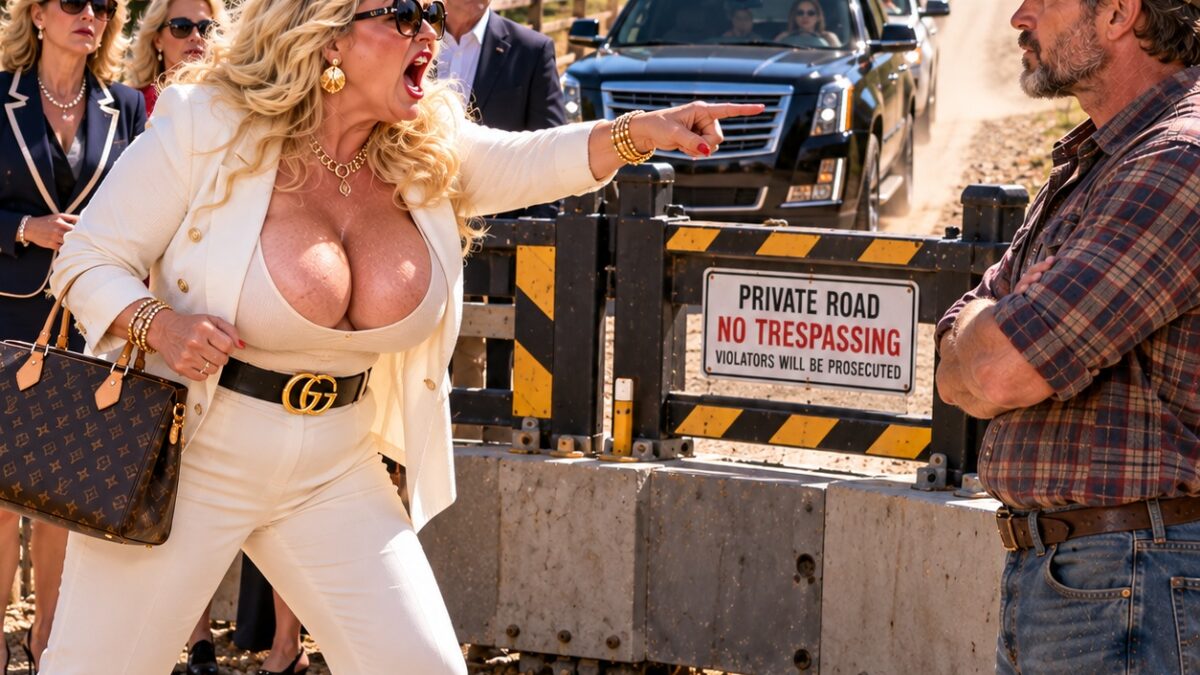
FULL STORY CONTINUATION
Elena and I moved onto the property in January 2023.
Three months after the funeral.
The house still smelled like Roy in small stubborn ways. Pipe tobacco in the mudroom, even though he had quit twenty years earlier. Lemon oil in the kitchen cabinets. Dust and old paper in the hallway closet. Every tool in the shed hung exactly where he had left it, outlined against plywood like a museum display nobody had asked to curate.
Elena took one look at the peach trees and rolled up her sleeves.
“They need pruning,” she said.
I laughed.
“What?”
“We just moved in.”
“And they’ve been waiting.”
That was Elena. She could see work and beauty in the same glance and never understood why people separated them.
We had plans.
Replace the south culvert.
Repair the roof over the back room.
Repaint the porch.
Prune the trees.
Plant wildflowers along the lane.
Sell peaches under Roy’s old canvas awning when summer came.
Quiet plans.
Ordinary plans.
The kind of plans that do not survive first contact with an HOA president who believes convenience is a legal doctrine.
The first morning we woke up there, January 14, I heard tires on gravel at 6:15 a.m.
The sound came through the kitchen window before the sun had fully cleared the trees. Crunching gravel. Engine. Dust. Not one vehicle. Several.
I stood with coffee in hand and watched a silver BMW X5 roll down Roy’s lane at thirty miles an hour, kicking up a rooster tail that settled across the peach trees like dirty snow.
Two minutes later, a red F-150.
Then a white minivan.
Then a black Audi sedan.
Four vehicles in nine minutes, all using my grandfather’s private farm road like it had been designed for their commute by some benevolent government agency that anticipated their needs and preapproved their entitlement.
I walked outside in my robe and boots.
The ruts were deeper than they should have been.
The drainage ditch Roy had cut decades earlier was clogged with mud.
The culvert on the south end—the one he had warned me about—was cracked, and water had pooled across the low spot, softening the base layer into something that looked less like a farm lane and more like a logging trail after a storm.
Elena came out twenty minutes later with two coffees.
One for her.
One for me.
Because Elena Thorne does not begin a serious conversation about property rights before caffeine is distributed equally.
“How many?” she asked.
“Four so far.”
“It’s six-thirty.”
“I noticed.”
“Your grandfather let them?”
“He must have.”
She looked down the lane.
“Roy would have.”
That was true.
Roy would have let a stranger use his road, borrow his truck, borrow his tools, and stay for dinner if they asked politely and looked like they needed help. His generosity was legendary, which meant it had also been abused by the kind of people who treat kindness like an unlocked gate.
By the end of that first week, I had counted the traffic.
Thirty-two vehicles a day, Monday through Friday.
Twenty-one on Saturdays.
Fourteen on Sundays.
The busiest hour was 7:00 to 8:00 a.m., when Creekstone Ridge Estates emptied toward my road like a subdivision-sized river trying to cut its own channel.
Creekstone Ridge sat east of our property, a seventy-two-home development built in 2017 by a developer named Garrett Hargrove. The houses ran from $550,000 to $1.1 million. Stone entrance gates. Wrought iron. Community pool with a waterfall feature. Clubhouse with a coffee bar. A marketing slogan that read, Where modern living meets Southern grace.
If that sentence were a person, it would wear a monogrammed vest to a barbecue and correct the pitmaster.
The development had one serious problem.
Access.
Its only official entrance was on Magnolia Drive, opposite from the direction most residents needed to travel for work, school, shopping, and Highway 19. To reach Highway 19 using the official route, residents had to go north through two residential streets, turn onto Old Mill Road, crawl through downtown Cedar Falls, cross the railroad tracks, and merge at the Chevron station.
Fourteen minutes on a good day.
Twenty-two during school-zone traffic.
Or they could take Roy Thorne’s gravel road.
A quarter mile.
Ninety seconds.
Straight shot to County Route 7, which met Highway 19 half a mile south.
Door to highway in three minutes.
And for six years before I moved in, they had been doing exactly that.
I learned later that the original development plan included a second entrance on the east side connecting directly to County Route 7. Hargrove’s engineers designed it. The county planning commission approved Creekstone Ridge contingent on dual access.
Then Hargrove quietly dropped it from the final build because the secondary entrance would have cost about $400,000.
The county failed to catch it.
Residents bought houses.
The missing road became somebody else’s problem.
That somebody was my grandfather.
Then me.
The HOA president was Brenda Kavanaugh.
I need to describe Brenda because she moved through this story the way she moved through my land—fast, polished, certain, and without a legal right to be there.
Brenda was fifty-two but looked younger from a distance and more dangerous up close. Salon-blonde hair, high cheekbones, ice-blue eyes, designer sunglasses, and a white Cadillac Escalade with chrome running boards and a vanity plate that read BREN-DA, because apparently her name required punctuation to express its full authority.
She had been HOA president for five years. In that time, by her own proud count, she had filed 217 violation notices.
Garbage cans visible too long.
Porch lights the wrong warmth.
Mailbox flowers outside the approved palette.
A twelve-year-old’s lemonade stand reported as unauthorized commercial activity.
That one pushed a single mother named Kesha Harris to move to Dawson six months later. Brenda counted it as compliance.
She governed Creekstone Ridge with violation letters, cashmere, intimidation, and the moral confidence of a woman who had confused being beautiful with being right.
I put up the first sign that weekend.
White background.
Black letters.
Private Property. No Through Traffic.
Elena helped me set the cedar post in concrete. She held the level while I packed the base.
“Give it forty-eight hours,” she said.
It lasted thirty-six.
Monday morning, the sign was face down in the drainage ditch, post snapped clean at the base. Someone had used a truck bumper or tow strap.
I replaced it.
Wednesday morning, same thing.
Sign in the ditch.
Post broken.
That afternoon, I bought a trail camera and mounted it on a pine twenty feet from the sign.
Thursday at 11:14 p.m., the camera caught a black Jeep Wrangler pulling up. Plate visible. Registered to Travis Kavanaugh, nineteen years old.
Brenda’s son.
He got out, attached a tow strap to the signpost, climbed back into the Jeep, and yanked the whole thing loose in forty-three seconds. Then he threw the sign into the woods and drove back toward Creekstone Ridge.
I printed the photos.
Elena looked at them once.
“His mother sent him.”
“You don’t know that.”
“Marcus, a nineteen-year-old did not drive twelve minutes out of his way at eleven o’clock at night to destroy a private road sign as a personal hobby. That’s not vandalism. That’s an errand.”
Brenda came to my door that Saturday morning at 9:15.
White Escalade parked diagonally across the driveway.
Louis Vuitton heels clicking on Roy’s porch steps.
Cream silk blouse. Quilted vest. Tom Ford sunglasses pushed onto her head despite the overcast sky.
She smiled at me with the kind of smile calibrated in a mirror until it could fake warmth without risking sincerity.
“Marcus Thorne,” she said. “I’m Brenda Kavanaugh, HOA president at Creekstone Ridge.”
“I know who you are.”
“I wanted to welcome you to the neighborhood.”
“We’re not in your neighborhood.”
The smile held.
Load-bearing.
“Well, adjacent then.”
“I wanted to talk to you about the road.”
“Oh, the lane,” she said lightly. “It’s kind of been a community road for years. Your grandfather was always so sweet about it.”
“It is not a community road. It is private property. My deed includes it. The county does not maintain it. There is no easement.”
She tilted her head.
The kind of tilt people use when they have already decided you are wrong but want to grant you one more sentence before closing the gate.
“Well, technically, sure. But it’s been used by the community for six years. At some point it becomes an understood access point. I believe most courts call that an easement by use.”
“Georgia prescriptive easement requires twenty years of continuous, open, notorious adverse use.”
The smile thinned.
“They have six.”
“I’m not a lawyer.”
“No.”
“But I am a community leader, and this road is important to seventy-two families.”
“My grandfather was generous. That does not create a legal right.”
She took a breath, the kind people take when a conversation refuses to follow the script they rehearsed in the rearview mirror.
“Marcus, I’m trying to be friendly.”
“I understand.”
“Nobody wants a fight. But this road has been part of our daily life for half a decade, and putting up signs and being difficult is not going to make you any friends.”
She said being difficult the way a queen might say peasant.
“The sign was pulled out twice,” I said. “I have trail camera footage of your son removing it.”
For the first time, the smile cracked.
Only a hairline fracture.
Enough to show the real Brenda underneath the silk and perfume.
“Travis was goofing around,” she said. “I’ll talk to him.”
“He destroyed a sign on private property.”
“He’s a teenager.”
“He’s nineteen.”
“Seriously, Marcus. The sign sends the wrong message.”
“The message that the road is private?”
“The message that you don’t want to be part of the community.”
“I don’t want forty cars a day on my land.”
She looked past me toward the lane.
“You will not make this difficult for seventy-two families.”
“That sounds like a threat.”
“No,” she said, putting her sunglasses back on. “It’s advice.”
She left three minutes later.
Elena had heard everything from the kitchen.
“She is not going to stop,” she said.
“I know.”
“What are you going to do?”
“Replace the sign. Then wait.”
The next sign went into a three-foot hole with quick-set concrete and chicken wire around the base so a strap would not grip easily. Below it, I added another placard.
No Trespassing. Violators Will Be Prosecuted Per O.C.G.A. § 16-7-21.
I included the statute number because people who ignore plain English sometimes slow down when they see legal code, the same way a speeding driver suddenly discovers respect for limits when a patrol car appears.
The sign stayed up.
The traffic did not stop.
It increased.
Thirty-two vehicles became forty-one. Word spread through Creekstone Ridge that the new guy was trying to close the shortcut, and the community response was to use it more aggressively, as if volume could become law.
The ruts deepened.
The ditch collapsed.
A truck clipped Roy’s old mailbox and bent it fifteen degrees.
Someone’s SUV left tire tracks through the wildflower strip Elena had spent two weekends preparing along the lane.
Eight feet of tire marks through fresh seed and straw.
Elena stood over the damage for a long time.
Then she said, very calmly, “I want you to know that I am calm, but when a person drives through my wildflower bed on a private road at fifty miles an hour in a vehicle that costs more than my first apartment, I do not feel generous.”
I filed a complaint with the sheriff’s office.
Deputy Mike Rawlings came out, looked at the damage, watched the footage, and shook his head.
“Technically, this is criminal trespass,” he said. “But the DA is not going to prosecute forty cars a day one at a time.”
“What do I do?”
“Block the road.”
“Can I?”
“It’s your road. You can put a wall across it if you want.”
That sentence followed me for weeks.
A wall.
Not yet.
Brenda’s formal demand letter arrived the following week.
HOA letterhead.
Forest-green embossing.
Expensive paper.
It requested that I “maintain adequate road conditions on the community access road” and remove all signage impeding community access.
Maintain the road.
She wanted me to grade gravel, fix potholes, repair drainage, and absorb the cost so seventy-two families could trespass more comfortably.
It was the HOA equivalent of a burglar calling the homeowner to complain that the broken window he used to get in was too narrow for the television.
Elena read the letter twice.
“She wants us to repave her shortcut.”
I called Vivian Park, a property rights attorney in Dawson who had won three HOA disputes the previous year. Vivian listened without interruption, which is how you know an attorney is taking you seriously.
They stop talking and start calculating.
“You are not in their HOA,” she said. “Your property predates their development by fifty-six years. There is no easement. Georgia requires twenty years for prescriptive rights and they have six. And they put in writing that they want you to maintain the road?”
“That’s what the letter says.”
I could hear her smile through the phone.
“Marcus, I’ve practiced law nineteen years. This is the easiest case I’ve had since a man asked me to send a cease-and-desist to his neighbor’s rooster.”
Brenda responded to legal pushback the way Brenda responded to anything outside her control.
By escalating.
She went door to door through Creekstone Ridge with a clipboard in one hand and a designer handbag in the other, telling residents that I was hostile, unstable, and threatening legal action against families with children. She told one couple that closing the road would add ninety minutes to their commute, which was mathematically impossible unless they planned to detour through Alabama.
She collected thirty-eight signatures on a petition titled Protect Community Access — Preserve the Ridgerest Lane Throughway.
She filed it with the county board of commissioners and sent a copy to the local paper. Then she posted a photo of herself holding the clipboard on Instagram.
Fighting for our neighborhood. Some people don’t understand community, but we do. #ProtectOurAccess #CommunityFirst #CedarFallsStrong
Three hashtags and a Chanel lipstick smile.
The county board reviewed the petition in open session.
Commissioner Helen Odum, sixty-three years old and unimpressed in the way only a woman who has heard fifteen years of HOA complaints can be unimpressed, read the property record aloud.
Private road.
Private property.
No county maintenance.
No recorded easement.
No public access obligation.
“The petition is noted and filed,” she said. “This board has no jurisdiction over private property access.”
Brenda spoke for seven minutes during public comment about community, safety, and neighborly obligations.
Commissioner Odum said, “Thank you, Ms. Kavanaugh. The board’s position is unchanged.”
Brenda drove home through my property at forty miles an hour.
That same week, at 11:00 p.m., someone left the road entirely and drove across forty feet of Elena’s garden, crushed a row of young crepe myrtles, and left tire ruts through Roy’s former vegetable bed.
The trail camera caught a white Cadillac Escalade.
Plate: BREN-DA.
The tracks did not curve.
They were straight.
Aimed.
Elena stood in the mud beside the crushed trees.
“She did this on purpose.”
“Maybe she missed the road in the dark.”
“Marcus, that woman has driven this lane a thousand times. She did not miss it. She wanted us to see it.”
She was right.
Brenda had driven through those plantings like a child dragging a stick through a sandcastle because destroying something another person built made her feel powerful.
Except this was not a child.
This was a fifty-two-year-old woman with a Cartier bracelet and the moral architecture of a parking meter.
Rigid.
Transactional.
Incapable of mercy.
“I’m going to stop this,” I said.
Elena looked toward the lane.
“I know exactly how you’re going to stop it. And I think your grandfather would approve.”
I hired Cal Drummond, a licensed surveyor with twenty-eight years of experience, steel-toed boots, a sun-faded Braves cap, and a speaking style made entirely of measurements.
He spent two days on the property with a total station, GPS receiver, and Roy’s deed description. He located every iron monument Roy had set. Four corners. Eight intermediate points. Every one still in the ground, all within a quarter-inch of where they belonged.
“Your grandfather set good iron,” Cal said. “Most monuments from the sixties are off by six inches. His are dead on.”
The survey confirmed what I already knew.
Every inch of the gravel lane was on my property.
Forty-seven feet from the nearest Creekstone Ridge property line.
No easement.
No right-of-way.
No recorded access.
Nothing.
But Cal found something else.
While checking the development plat, he overlaid Creekstone’s approved plans with the development agreement. Paragraph 14C required the developer to construct and maintain a secondary vehicular access point on the eastern boundary connecting to County Route 7 before the final certificate of occupancy for Phase 2.
Phase 2 was lots 37 through 72.
Final certificate issued March 2019.
Secondary road never built.
Garrett Hargrove had simply skipped it.
The county had failed to verify the condition.
And for six years, seventy-two families had been driving through my property because the developer who sold them homes saved $400,000 by not building the road he was legally required to build.
Brenda had chosen not to hold the developer accountable.
She put on a Burberry trench coat and came after me instead.
I called Vivian that afternoon.
After I read her the development condition, she went silent for eight seconds, which for Vivian was equivalent to a standing ovation.
“Marcus,” she said, “you just handed me two cases. One against the HOA for trespassing and property damage. One against the developer for failing to build the access road.”
“Can I block the road?”
“You can block it, wall it, trench it, or pave it with gold and put a statue of yourself on top. It’s your property.”
“I’m thinking concrete barriers.”
Another pause.
“You design highway barriers for a living, don’t you?”
“I do.”
“Then I suspect Ms. Kavanaugh has no idea what she has been driving through.”
“No, ma’am. She does not.”
For the next four weeks, I did what I do professionally, except instead of protecting highway motorists, I was protecting my property from a woman who believed a vanity plate and expensive shoes could convert trespassing into tradition.
I designed a barrier system using highway median specifications.
F-shaped New Jersey barriers.
Precast concrete.
Each unit ten feet long.
Thirty-two inches tall at the base, tapering upward.
Four thousand pounds each.
Engineered to stop, absorb, redirect, and hold.
I had specified these barriers on forty-three state highway projects. I knew what happened when a vehicle contacted one at thirty-five miles an hour.
The vehicle stopped.
The barrier did not.
I ordered twelve units from Southeast Precast and specified eight additional steel bollards—six-inch schedule 40 pipe filled with concrete, set in forty-two-inch footings—so no one could drive around through the shoulder.
I filed for a county permit.
Site plan.
Structural specs.
Survey.
Letter from Vivian.
The county approved it in nine business days.
Dale Teague, the building inspector, called me personally.
“Mr. Thorne, I’ve reviewed permits for eleven years. This is the first time someone has submitted highway barrier specifications for a residential property, and it is the most thorough application I have ever seen.”
“I do this for a living.”
“I can tell.”
That afternoon, I sent certified letters to Brenda and the HOA board.
Permanent barriers would be installed in thirty days.
Private property.
No vehicular access after installation.
Plan alternate routes.
Vivian reviewed the letter.
“Thirty days is generous. You could install tomorrow.”
“I want it documented. When she hits them, I want a judge to see she had a month’s warning.”
“When she hits them?”
“I have watched this woman drive through signs, gardens, county rulings, and common sense. The only thing she has not driven through is four thousand pounds of concrete, and that is only because I have not put it there yet.”
“You sound very certain.”
“I calculate impact probabilities for a living. Brenda Kavanaugh is a ninety-five percent probability.”
Vivian said, “Then make sure those barriers are up to spec.”
“They are highway grade.”
“And Brenda drives?”
“A six-thousand-pound Escalade at thirty-five.”
“Then the barriers will be fine.”
Brenda received the letter on a Tuesday.
Her response was full Brenda.
Within forty-eight hours, she filed an emergency motion for a temporary restraining order. Judge Harold McKeen denied it in a fourteen-minute hearing, noting the property was private, the barriers were permitted, and the motion presented no legal basis for relief.
Fourteen minutes.
That was how long Brenda’s argument lasted against the deed.
She called the building department and demanded my permit be revoked.
Dale Teague told her no.
She asked for his supervisor.
His supervisor told her no more slowly.
She called the fire marshal claiming the barriers would block emergency access. Fire Marshal Ron Ortiz inspected the site, confirmed adequate access through Magnolia Drive, and noted that the missing secondary entrance was the developer’s compliance issue, not mine.
She started another petition.
Safety First — Stop the Ridgerest Roadblock.
Thirty-four signatures this time.
Four fewer than before.
Even some of Brenda’s followers were beginning to notice that saying safety louder did not change the law.
Then she called the local newspaper.
Reporter Skyler Cho came out and interviewed both of us.
I showed her deed, survey, development agreement, trail camera footage, permit, photographs, and letters.
Brenda told Skyler I was destroying the fabric of the community and that good neighbors do not build walls. She said it in a white linen dress and Valentino sandals, blonde hair catching the afternoon light like a woman lit by a cinematographer who owed her money.
Skyler’s article ran the following Thursday.
Property Owner to Install Highway Barriers After Years of Trespassing by HOA Residents.
Subheadline:
Developer Never Built Required Second Entrance, Records Show.
It was factual.
Thorough.
Devastating.
It quoted Commissioner Odum, the fire marshal, and the building inspector. It included Paragraph 14C from the development agreement. It included Brenda’s final quote at the end, because Skyler had the instinct of a reporter who knows when someone has handed her the rope.
“He should be grateful we’re improving his property value by driving on it.”
Grateful.
After broken signs, crushed gardens, traffic at dawn, damaged drainage, and eight months of being told my grandfather’s road belonged to everyone but us, Brenda’s conclusion was that we should be grateful.
The article was shared hundreds of times.
Brenda posted an Instagram story that night standing in front of the Creekstone gates, arms crossed, cheekbones angled like weapons.
When you stand up for what’s right, not everyone will understand, but the truth always wins.
For once, she was right.
The truth was about to win.
The barriers went up on a Tuesday in October.
I hired Dean Parsons, a heavy-equipment operator I had worked with on four highway projects. He arrived at 7:00 a.m. with a flatbed carrying the first six barriers and a two-man crew.
Each barrier was placed with quarter-inch tolerance.
Aligned along the property boundary.
Gaps sealed with interlocking keyways.
The bollards went in next, eight posts set in concrete. I installed four road-closed private-property signs with reflective sheeting visible from three hundred feet.
By noon, the lane was closed.
Twelve Jersey barriers.
Eight steel bollards.
Four signs.
And one structural engineer who had spent twenty-two years designing things that do not move unless physics says they may.
Dean stepped back and looked at the barrier line.
“Marcus, in twenty years of placing barriers, this is the first time I’ve done it in somebody’s yard.”
“How does it look?”
“Like a highway exit ramp retired to the countryside.”
“Nobody’s getting through?”
He grinned.
“Nobody’s getting through.”
“That’s the point.”
I installed two additional trail cameras with night vision and cloud backup every sixty seconds.
Then I went inside, sat on Roy’s porch, and waited.
Elena brought me sweet tea.
She looked at the barriers.
“Your grandfather would have put up another sign.”
“My grandfather put up signs for forty years. Look where that got us.”
“Fair point.”
The first twenty-four hours were quiet.
Vehicles approached.
Stopped.
Turned around.
Fourteen turnarounds day one.
Eleven day two.
By day four, the traffic dropped to two or three confused stragglers who apparently had not yet learned that the free highway through Marcus Thorne’s peach orchard had closed permanently.
The calm lasted six days.
On Monday evening, October 16, at 6:18 p.m., the sky turned the color of a bruise.
Brenda Kavanaugh came home.
She had been in Atlanta at a real estate conference since Thursday. She had read the certified letter. She had read the newspaper article. She had filed the TRO, called the fire marshal, and started the petition.
But she had not seen the barriers in person.
The trail camera captured everything.
Her white Escalade entered the lane from the Creekstone side at thirty-seven miles per hour.
Chrome running boards.
BREN-DA plate.
Six thousand pounds of entitlement moving through private property like habit had become law.
She came around the curve past the third row of peach trees.
The headlights swept the lane.
The barriers appeared in her windshield at about one hundred ten feet.
At thirty-seven miles an hour, a vehicle covers that distance in about two seconds.
She hit the brakes.
The anti-lock system engaged.
Tail lights stuttered.
The Escalade slowed from thirty-seven to approximately fourteen before the front bumper contacted the first Jersey barrier.
The barrier did what F-shaped precast concrete is designed to do.
It absorbed impact.
Redirected force.
Stopped forward movement.
The Escalade came to rest in eight inches.
The front bumper crumpled.
The hood buckled.
Airbags deployed.
Headlights went dark.
Steam rose from the cracked radiator in a thin white column against the October dusk.
The barrier did not move.
Not an inch.
Not a millimeter.
It had been designed to stop a forty-thousand-pound semi at highway speed.
Brenda’s Escalade was a rounding error in a Chanel blazer.
I was on the porch when I heard it.
The screech of tires.
The deep thud of steel meeting concrete.
The hiss of a radiator surrendering.
Elena and I walked down the lane.
Brenda sat behind the wheel, airbag deflated in her lap, white powder dusting her blazer and hair. Her Cartier bracelet still gleamed at her wrist. Chanel lipstick had smeared across her chin like a surrender flag she did not know she was waving.
She looked through the cracked windshield and said something I will remember for the rest of my life.
“You put walls in my road.”
I looked at the sign.
The deed.
The barriers.
The lane my grandfather built in 1963.
“It’s not your road, Brenda. It never was.”
She called 911.
“There are concrete walls blocking a public road,” she told dispatch. “I hit them. Someone put them here illegally.”
Deputy Mike Rawlings responded.
The same deputy who had told me months earlier that I could block my own road.
He looked at the barriers.
The signs.
The permit numbers.
The survey markers.
Then he looked at Brenda still sitting beside her ruined Cadillac.
“Ma’am,” he said, “this is a private road. The barriers are permitted. There are four signs posted. You received certified notice thirty days ago.”
“I have the right to use this road.”
“No, ma’am. You don’t.”
He cited her for criminal trespass and reckless driving.
The tow truck took ninety minutes.
During that time, Brenda called her husband, her attorney, her insurance agent, and three board members. Each call had the same tone: the voice of a woman who had never been wrong and could not process the possibility while sitting beside the physical evidence of exactly how wrong she was.
The insurance claim was denied the following week.
Vehicle operated on private property without authorization. Damage resulted from contact with a lawfully permitted barrier. Claim denied. Exclusion for illegal activity.
The Escalade was a total loss.
Sixty-eight thousand dollars of white Cadillac, chrome running boards, vanity plate, and an Hermès scarf still hanging from the mirror, sitting in a salvage yard because a woman told thirty-seven different ways that a road was not hers decided to drive it one more time.
Then Brenda sued me.
Her attorney filed a negligence claim alleging I had created a dangerous obstruction on a customarily used access road.
Vivian responded with a twelve-page motion to dismiss.
She attached the deed.
Survey.
Development agreement.
Permit.
Certified letter.
Newspaper article.
Trail camera footage.
Instagram posts.
And Brenda’s own HOA newsletter from March 2021, where she had written:
Creekstone Ridge is a private community. Our gates, our roads, and our standards are what separate us from the properties around us.
Our roads.
Our standards.
She had written that while driving on someone else’s road every single day.
The irony was not subtle.
It was structural.
And I say that as a man who understands structural loads.
Judge McKeen dismissed the suit in six minutes.
His written order included one sentence Vivian later framed.
The plaintiff cannot claim a right to use a private road she has been trespassing on while simultaneously asserting the privacy of her own community’s roads.
I filed my countersuit in November.
Trespass.
Property damage.
Harassment.
Destruction of signage.
Intentional damage to landscaping.
Vivian included every trail camera clip, every vehicle, every day, eight months of evidence. Brenda’s Escalade alone had made 712 trips.
The HOA settled for $143,000 covering property damage, landscaping, road repair, legal fees, and a provision requiring the HOA to cease all use of the road.
Brenda’s personal liability added another $38,000.
Her total losses were larger than that.
Escalade.
Attorney fees.
Insurance premiums.
Criminal trespass citation.
Reckless driving.
A mark against her real estate license she could not buy, charm, or accessorize away.
In December, Creekstone Ridge removed Brenda as HOA president by a vote of sixty-one to four.
The four votes in her favor were her husband, her son, and two neighbors who apparently had not read the newspaper or noticed that their former president had driven her Cadillac into a concrete wall on a road seven officials had already told her was not hers.
The new president was Diane Holloway, retired civil engineer and wife of Frank Holloway, the man who once opened a window in February because Brenda’s perfume was still haunting a meeting room from December.
Diane’s first act was to petition the county to enforce the original development agreement.
Garrett Hargrove was ordered to build the secondary entrance he had skipped six years earlier.
The new access road—paved, county-inspected, and properly connected to County Route 7—opened the following September.
Twelve minutes of commute time eliminated.
Six years of trespassing ended.
Four hundred thousand dollars of construction finally paid by the man who should have paid it in the first place.
Elena planted a garden where the tire tracks used to be.
Crepe myrtles along the lane.
Wildflowers in the drainage margin.
Roy’s peach trees pruned, fed, and bearing fruit for the first time in three seasons.
The barriers are still there.
I repainted them last spring.
Standard highway gray.
Reflective markers.
Elena says they look like public art.
I say they look like a property line.
Roy’s road is quiet now.
No engines at 6:15.
No dust on the peach leaves.
No tire tracks through flowers.
Just gravel, birdsong, and the kind of silence a man earns when he finally protects what his grandfather built.
The couple who bought Brenda’s house stopped by our farm stand last October. Brenda had sold four months after the settlement at a $47,000 loss, which is the real estate version of finally meeting a mirror that tells the truth.
The husband bought a bushel of Albertas and a jar of Elena’s peach preserves.
“We heard about the road thing,” he said. “That’s quite a story.”
“It’s simple,” I told him. “A woman drove on a road that wasn’t hers. I put up signs, and she ignored them. I put up barriers, and she hit one.”
He laughed.
“Those are highway barriers, aren’t they?”
“F-shaped New Jersey barriers. Four thousand pounds each.”
“What are they rated for?”
“Sixty miles an hour against a forty-thousand-pound semi.”
He looked down the lane at the gray concrete line standing in the Georgia sun like the world’s most boring Stonehenge.
“And she hit one in a Cadillac at thirty-seven?”
“That’s right.”
“How did that work out for the barrier?”
“Fine. Didn’t move.”
“And the Cadillac?”
“Total loss.”
He shook his head.
Then he looked toward the peach trees.
“Your grandfather built this road?”
“1963. Box blade and fourteen loads of crusher run.”
“Good road.”
“Good man.”
After they left, Elena and I sat on the porch while the evening cooled. The peach trees threw long shadows across the lane. Somewhere beyond Creekstone, cars moved along the new access road Hargrove had finally built, far from my grandfather’s gravel.
Elena took my hand.
“Roy knew,” she said.
“Yes,” I said. “He did.”
He knew people would confuse generosity with permission.
He knew a road built with sweat can become invisible to those who only see convenience.
He knew that if you do not defend what is yours, someone else will start calling it theirs.
The lane he built still runs from the house to County Route 7. It is quiet, private, and mine. Every stone. Every crowned inch. Every culvert. Every peach blossom dusted by morning light.
And the barriers will stand as long as the concrete holds.
If I did my job right, that should be about a hundred years.
Maybe longer.
Long enough for anyone who comes after me to understand the lesson Roy tried to leave in his last words.
A road can be generous.
A road can be useful.
A road can carry family, neighbors, peaches, rainwater, grief, and memory.
But a road is not public just because arrogant people get used to taking it.
Brenda Kavanaugh learned that the hard way.
At thirty-seven miles per hour.
In a Cadillac.
Against four thousand pounds of concrete that did not care how beautiful she was.