𝗙𝗨𝗟𝗟 𝗦𝗧𝗢𝗥𝗬:She Gave Me Three Days to Abandon My Mountain Cabin and Sent Workers to Tear It Down — But She Made One Fatal Mistake on the Property Records!
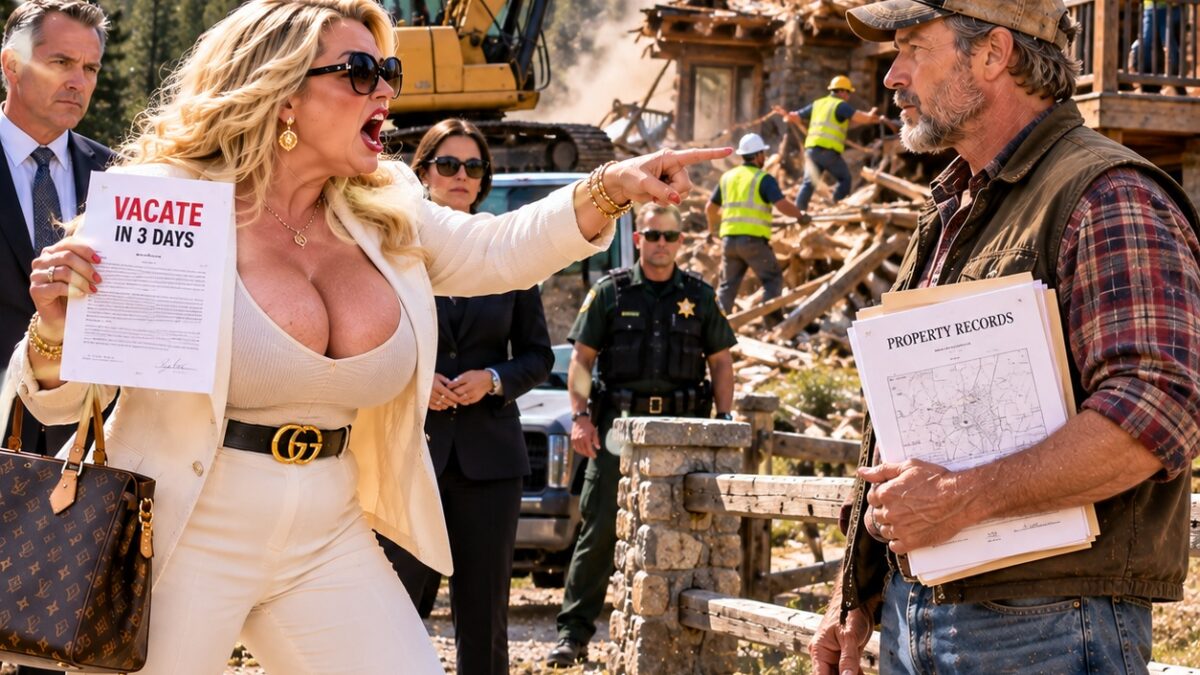
FULL STORY CONTINUATION
I should have taken her more seriously.
That is one of the many things a man tells himself after the damage is already done.
At the time, I did what I had spent most of my professional life doing. I trusted the records. The deed was in my name. The county had processed the tax sale. The parcel was recorded. The boundary description was clear enough that any surveyor worth his salt could follow it from the base of the mountain to the ridge and back again.
Vivian Holt could say whatever she wanted.
A smile did not move a property line.
A Range Rover did not override a deed.
An HOA title did not turn private land into community property.
So I went back to work.
That first week on the mountain, I patched the worst part of the roof with salvaged tin. I replaced two broken windows with panes I found at a salvage yard outside Maryville. I cleaned eleven years of leaves and squirrel nests from the front room. I ran a generator off the back porch for a lamp, a radio, and a hot plate that took twenty minutes to heat soup and sounded like it was negotiating with death each time I plugged it in.
I slept on an air mattress in the living room with a wool blanket, a revolver I had not fired in years, and a framed photograph of Sarah propped against my duffel bag.
In the photo, she was wearing a yellow sundress on the courthouse steps, laughing at something the photographer had said. I was beside her in a borrowed blazer that fit badly across the shoulders. She had teased me about that jacket for twenty years.
I kept the photo where I could see it when I woke.
Maybe that sounds sentimental.
I did not care.
Grief makes some objects into architecture. You build around them because without them, the room collapses.
On the third day after Vivian’s visit, I drove down the mountain for supplies. Lumber. Roofing nails. A new battery for the generator. Canned food. Work gloves. More coffee than one man needed but less than I was going to drink.
The round trip to Maryville took four hours.
When I turned off the county road and onto the gravel access road that led up to my cabin, I found the way blocked.
Not with a gate.
Not with a chain.
With three dump trucks’ worth of crushed rock and felled pine trees piled across the road at the point where the mountain trail met the paved entrance to Ridgerest Estates.
The barrier was six feet high and forty feet across.
Professional work.
Expensive work.
Someone had paid for it.
I parked at the base and stared at it for a long time, hands still on the wheel, engine idling, lumber stacked in the bed behind me.
Then I shut the truck off.
There are moments when a man understands he has reached the edge of politeness.
I was not ready to cross it yet.
So I unloaded the lumber, strapped the first bundle to my back, and started walking.
The cabin sat 2.2 miles uphill on switchbacks. October air in the Smokies has a clean bite to it, and that day the air felt sharp enough to scrape my lungs when the grade steepened.
I made four trips.
Lumber first.
Generator battery second.
Roofing nails and canned food third.
By the fourth trip, sweat had soaked through my flannel, my boots were slick with wet leaves, and the light had turned orange under the trees. Every step felt like Vivian’s voice saying, You don’t own anything up here.
I slept hard that night.
Not peacefully.
Hard.
The way a body collapses when exhaustion beats anger by half an inch.
The next morning, I called the county road department. A woman named Patty in the permits office told me the blockade appeared to sit on private HOA property and the county could not intervene without a formal complaint and surveyor’s report proving otherwise.
I knew she was wrong.
But knowing was not enough.
That was the part people forget. Truth without documentation is just another voice.
I needed a survey.
I needed proof.
And I needed time.
That evening, Dale Sutter found me.
Dale was seventy-two, a retired carpenter who lived in a small cabin at the base of the mountain on five acres outside the HOA boundary. I had seen him once or twice from a distance, a lean old man in suspenders and a faded ball cap, moving like someone who knew where every rock and root waited under the leaves.
He came up the trail with a flashlight in one hand and a thermos in the other.
“Saw your truck at the bottom,” he said. “Figured she’d gotten to you already.”
That was how I learned Vivian Holt was not a new problem.
She was a pattern.
Dale sat on my half-finished porch and told me the history while pouring coffee strong enough to dissolve regret.
Harlon Whitfield had owned the mountain since 1961. He built the road himself, cutting trees, grading dirt with a borrowed bulldozer, laying gravel over two summers with more stubbornness than money. Ridgerest Estates did not exist then. The mountain road belonged to Harlon.
Then Wade Holt arrived fifteen years earlier with development plans and permits.
He bought flat land at the base—eighty acres from what had once been connected to old Whitfield holdings, or so everyone assumed. He built fifty-two houses, paved roads, put in a pool, tennis courts, a clubhouse, and formed the HOA. Once the development was complete, residents began using the mountain road as though it had come with the deal.
“Nobody questioned it,” Dale said, holding the thermos between both hands. “Nobody was up here to say different.”
Then his voice lowered.
“You’re the fourth person she’s come after.”
I looked at him.
“Vivian?”
“Vivian and Wade. Same machine. Different hands.”
He told me about the Burks family, who had lived near the lower ridge. Vivian got the county to condemn their deck over a code violation that sounded fake even in Dale’s retelling, then filed a lien for unpaid HOA assessments they never agreed to pay. The Burks sold at a loss and moved to Alabama.
“She does not need to win in court,” Dale said. “She just needs people tired enough to leave before court.”
That sentence stayed with me.
Because it was not just true of Vivian.
It was true of every petty tyrant I had ever seen in land disputes. The goal is not always to be right. Sometimes the goal is to make the truth too expensive, too lonely, or too exhausting to defend.
That night, after Dale left, I opened my file box.
My surveyor instincts had been quiet since Sarah died, but they had not disappeared.
I started building a record.
Photographs of the blockade with GPS coordinates.
Timestamped video.
Copies of my tax sale deed.
County auction terms.
Notes from Vivian’s first visit.
Exact quotes.
Dates.
Times.
Everything.
The next morning, I called Sheriff Tom Garrison and filed a formal complaint about the road blockade. He came out that afternoon, tall and lean with a gray mustache and the patient expression of a man who had heard too many people use the word “property” like a weapon.
He looked at my deed.
Looked at the blockade.
Drove down to Vivian’s house.
By the next morning, contractors began removing the rock and trees one truckload at a time, slowly enough to make sure I still had to hike supplies for days in between.
A week later, a certified letter arrived from the HOA attorney.
It demanded $12,400 in back HOA assessments for the mountain property, plus a $700 road maintenance fee. The letter claimed the mountain parcel had been part of Ridgerest Estates since the HOA’s formation.
I read it once.
Folded it.
Put it in the file.
Then I drove to Knoxville to empty my storage unit.
I had put off that trip for months.
Inside the unit were the last boxed-up pieces of the life Sarah and I had built before grief turned our house into a museum I could not bear to visit.
Her watercolor paintings.
Survey equipment.
Photo albums.
Her mother’s wedding quilt.
A box of journals.
The leather-bound ones Sarah wrote in every morning before work, sitting at our kitchen table with her coffee and whatever flowers she had cut from the yard.
I loaded everything carefully into the truck bed, covered it with a tarp, and drove back to the mountain feeling, for the first time, like maybe I was bringing my old life into the new one instead of running from it.
The road was clear when I returned.
The blockade was gone.
I drove up the gravel switchbacks slowly, listening to the supplies shift behind me.
At the cabin, I knew something was wrong before I stepped out of the truck.
The front door was closed.
That was not unusual.
The lock was.
A brand-new brass deadbolt had been installed where my old lock had been.
My key did not fit.
A laminated notice was taped to the door at eye level.
By order of Ridgerest Estates HOA. This structure has been secured pending safety review. Unauthorized entry is criminal trespassing. V. Holt, President.
For a while, I simply stood there reading it.
Then I walked around back.
My belongings were in the yard.
Not stacked.
Not covered.
Dragged.
My clothes had been dumped near the tree line.
My toolbox lay on its side, wrenches scattered in the mud.
The air mattress was deflated and draped over a stump.
One of Sarah’s watercolor boxes had burst open, brushes half-buried in wet leaves.
Then I saw the cardboard moving box.
The one labeled in my handwriting:
Sarah — personal.
It had been in the living room, taped shut, placed against an interior wall where the roof did not leak.
Now it was on its side in the grass.
It had rained two days earlier.
The cardboard was soft and dark, half collapsed.
I knelt.
Opened it.
Her journals were soaked.
Ink had bled through the pages, her morning handwriting dissolving into blue smears that stained my fingers. Whole years of her thoughts had become ghosts. Grocery lists. Prayers. Little notes about neighbors. Lines about me I would never read now. The shape of her loops remained in places, but the words were mostly gone.
The wedding photo was still in its frame, but water had seeped beneath the glass. A brown waterline cut across the bottom third of the image, right through the courthouse steps and our shoes.
I sat in the wet grass holding that frame until the cold went through my jeans.
The mountain was quiet.
No birds.
No wind.
Just water dripping from the eaves of a house someone had locked me out of.
“She would have known what to do,” I said.
Nobody answered.
I called Sheriff Garrison.
He arrived within the hour, read the laminated notice, looked at the lock, then walked around the yard and stopped when he saw the journals spread in my lap.
His face changed.
Not much.
Enough.
He used a pry bar to pop the deadbolt without ruining the frame.
“Mr. Cole,” he said, “I’ve told Mrs. Holt she has no authority over this property. You need a lawyer.”
While he was still writing the report, the white Range Rover appeared on the gravel road.
Vivian stepped out holding a Yeti tumbler with a straw, wearing tan suede boots and a camel-colored cashmere wrap that probably cost more than my generator.
She saw Sheriff Garrison and did not flinch.
“Sheriff,” she said, honey over broken glass, “I was only trying to protect community property.”
“This is not community property,” he said.
“If this man has a valid claim, I’m sure the courts will sort it out.”
Her eyes moved past him to the backyard.
To my clothes.
My tools.
The ruined box.
Sarah’s journals.
The warped photo.
She looked at them the way a person looks at trash someone forgot to take to the curb.
“I had my maintenance crew secure the building,” she said. “If personal items were left inside an abandoned structure, that’s not really our responsibility, is it?”
For three seconds, Sheriff Garrison stared at her.
Then he put his notebook in his pocket.
“Ma’am,” he said, “I’d recommend you stop coming up this mountain.”
Vivian smiled.
“Of course, Sheriff. Whatever you say.”
That night, she emailed every household in Ridgerest Estates.
The squatter situation on the mountain has been resolved. The board is moving forward with clubhouse renovation plans as scheduled.
Dale forwarded me a copy.
I sat at my kitchen table under one working lamp, Sarah’s journals spread across every surface, trying to dry them page by page.
Most of the words were gone.
A few survived.
Enough to see how she looped her Gs like figure eights.
Enough to remember her fingers wrapped around a pen.
Enough to hurt in a way that made the air feel too thick.
I put the wedding photo back on the wall after replacing the glass.
I left the waterline.
Some damage you do not repair.
You keep it where you can see it so you remember what kind of person you are fighting.
It was Dale who showed me the listing.
He came up the trail one morning holding his phone at arm’s length, squinting at the screen because he refused to admit he needed reading glasses.
“You seen this?”
It was a Zillow page.
The mountain cabin—my cabin—listed as a community renovation project under Ridgerest Estates HOA.
There were seven photos.
I recognized every one because they showed work I had done.
My roof patches.
My replaced windows.
My cleaned porch.
My fresh primer on the rail.
All of it under the heading:
HOA-led renovation of historic mountain property coming soon as Ridgerest Community Clubhouse.
Projected completion: April of next year.
As if I would be gone by then.
That night, I screenshotted every page. Every photo. Every description. Every timestamp.
But the listing was only the warning.
The real attack arrived three days later in an envelope from the county building department.
Vivian had filed a formal petition to have my cabin condemned and demolished as an unsafe abandoned structure posing imminent risk to the health and safety of Ridgerest residents. The petition was signed by Vivian Holt and co-signed by five members of the HOA board.
It included twelve pages of photographs.
My cabin, yes.
But old photos.
Before my repairs.
Before I patched the roof.
Before I replaced the windows.
Before I cleared the porch.
She had taken the ugliest record of the cabin and held it until it could serve her lie.
The petition went to the county planning commission.
The chairman of the planning commission was Wade Holt.
Vivian’s husband.
He signed the demolition review order within forty-eight hours.
He did not recuse himself.
He did not disclose his wife’s involvement.
He did not mention that he was the developer who built Ridgerest Estates.
He simply signed it, stamped it, and scheduled an inspector to visit my cabin in two weeks.
That was when I finally understood what Dale meant.
I was not fighting one woman.
I was fighting a machine.
A husband and wife machine that had operated in daylight for years because people mistook confidence for legitimacy and paperwork for truth.
I attended the next planning commission meeting.
Clean jeans.
Button-down shirt.
Deed in a folder.
When public comment opened, I stood and explained calmly that I was the owner of record, actively living in and renovating the structure, and that the petition had been filed by a woman who had already locked me out illegally and destroyed personal property.
Wade Holt sat at the commission table in a navy sport coat, hands folded, watching me with the polished patience of a man who had signed papers for a living and rarely been questioned.
“Mr. Cole,” he said, “the commission has a duty to protect public safety. Your renovation, however well-intentioned, does not change the structural concerns raised by community members. The review will proceed as scheduled.”
I looked at Vivian.
She sat in the second row, legs crossed, cream cashmere sweater, pearl studs, leather portfolio on her lap.
She was smiling at her husband.
Not at me.
At him.
The smile people share when the script is going exactly as rehearsed.
I walked out of that building knowing two things.
First, I needed a lawyer.
Second, I needed the old maps.
Dale followed me into the parking lot and leaned against my truck.
“Wade built that whole subdivision,” he said. “He’s chaired that commission twelve years. Signs off on his own projects. Always has.”
I looked toward the courthouse.
Something he had said weeks earlier came back to me.
Wade bought eighty acres at the base.
On what land?
Whose land?
How much of it?
Most people hear those questions as drama.
A surveyor hears them as math.
I drove back to the cabin and went straight to the truck. My old survey equipment was still packed in its cases. The theodolite. GPS unit. Steel measuring tape. Orange flagging ribbon. Iron stakes. Mallet. I had not touched most of it in three years.
The lenses were dusty.
The GPS needed a firmware update.
The tape reel was stiff.
I cleaned everything.
Charged everything.
Calibrated everything.
The next morning, I woke before dawn and started walking the mountain.
It took three days to survey all 720 acres.
Slopes.
Ridge lines.
Creek beds.
Timber stands.
Old section corners.
Boundary trees.
Markers half-buried under leaves.
I logged coordinates every fifty meters. I drove stakes. I tied orange flagging. My hands blistered where the mallet handle rubbed against calluses grief had softened.
For three days, I was not a widower in a broken cabin.
I was not a squatter in Vivian’s story.
I was a surveyor again.
Quiet.
Careful.
Precise.
On the third evening, I spread two maps across the kitchen table.
The first was Harlon Whitfield’s 1962 plat, the original survey filed at the county clerk’s office. India ink on linen. Parcel 114-00007 covering the entire mountain from valley floor to ridge line. 720 acres.
The second was Wade Holt’s 2011 subdivision plat, showing Ridgerest Estates on eighty acres at the base.
The boundary between the subdivision and the mountain should have aligned cleanly with the original Whitfield line.
It did not.
I laid my fresh survey data over both maps.
Then I saw it.
Wade’s boundary line was wrong.
Not by inches.
Not by a surveying tolerance.
By forty acres.
The true Whitfield line followed the base of the mountain where the flat ground met the natural slope.
Wade’s line had been shifted four hundred meters uphill.
On paper, the adjustment looked like a clean line.
On the ground, it swallowed forty acres of mountain.
Twelve of Ridgerest’s fifty-two homes sat beyond the true boundary.
The pool was on my land.
The tennis courts were on my land.
The main entrance road crossed my parcel for three hundred meters.
And Lot 47, a 5,200-square-foot stone-and-timber mansion with a three-car garage, heated infinity pool, and an assessed value of $2.4 million, stood entirely on parcel 114-00007.
Vivian and Wade Holt’s house.
On my dirt.
I checked the numbers three times.
Then a fourth.
I overlaid GPS data with the 1962 markers, the 2011 plat, and my fresh stakes.
No ambiguity.
Wade Holt had shifted the boundary by forty acres, built luxury homes on land he did not own, and filed the plat through the county office where he served as planning commission chairman.
He had signed both sides of his own paperwork.
Developer.
Approver.
Same hand.
Same day.
Nobody caught it because nobody had lived on the mountain to object.
Until now.
I sat there at two in the morning and laughed.
Not because it was funny.
Because the irony made my chest hurt.
The woman who changed my locks, destroyed Sarah’s journals, listed my cabin online, petitioned the county to demolish my home, and raised an HOA war against me was sleeping every night in a mansion built on my mountain.
I called Clare Peton at 2:07 a.m.
Clare was a real estate attorney in Knoxville I had worked with many times during my surveying career. She was sharp, compact, and allergic to sloppy records.
She answered on the second ring.
“Ethan?”
“I need a quiet title action.”
“At two in the morning?”
“You’re going to want to see these maps.”
Three days later, Clare sat at my kitchen table with my overlays spread in front of her.
She put on her reading glasses and did not speak for eleven minutes.
I counted.
When she finally looked up, she said one word.
“Beautiful.”
That was Clare’s way of saying the trap was not mine.
It was Wade’s.
He had built it.
Filed it.
Signed it.
Lived on it.
We just needed to ask the court to read the map.
Clare filed the quiet title action in Chancery Court.
Cole v. All Persons Claiming Interest in Parcel 114-00007.
In plain English, the case asked the court to confirm ownership of the disputed land.
The notice was published in the county newspaper. Anyone who believed they had a claim had thirty days to respond. But Clare and I did not tip our hand. The notice used only the legal description and parcel number. No street names. No subdivision references.
Unless you knew how to read the plat, you would not know Ridgerest Estates was involved.
Then I hired Neil Kinsey, an independent licensed surveyor from Chattanooga with no ties to the county.
Neil was sixty-one, built like a fence post, and had testified in more boundary disputes than some judges had heard. He spent four days on the mountain with his own equipment and crew.
His results matched mine to the centimeter.
The forty-acre discrepancy was real.
Documented.
Bulletproof.
Then Clare pulled deeper county records.
What she found turned a civil boundary fight into something much uglier.
Wade Holt had filed the 2011 subdivision plat in two capacities.
As the developer, applying to subdivide.
As the planning commission chairman, approving the subdivision.
Same document.
Same signature.
Same date.
In most counties, that alone would trigger a conflict investigation. In ours, Wade had been chairing the commission so long nobody had questioned him.
The county clerk recorded the plat.
The lots sold.
The houses were built.
Forty acres of someone else’s mountain disappeared under polished landscaping and stone mailboxes.
Clare took the maps and signatures to District Attorney Karen Whitaker.
She did not file a formal complaint yet.
She requested a meeting.
Showed the overlays.
Showed the two signatures.
Let the math speak.
The DA studied the documents and said, “I want this on my desk the day the court rules.”
Meanwhile, I went quiet.
No more calls to the sheriff unless Vivian acted.
No responses to HOA letters.
No planning commission speeches.
No arguments.
I repaired what I could. Rehung the back door. Rebuilt enough of the porch to sit with coffee. Put plastic over the broken windows. Installed trail cameras at boundary markers along the encroachment line.
From Vivian’s perspective, it probably looked like I had surrendered.
She had no idea what quiet meant from a surveyor.
In my line of work, the most dangerous part of a boundary dispute is never the argument.
The argument is noise.
The measurement is the truth.
Clare called on a Friday evening.
“Hearing set. Six weeks. Judge Morrison. Are you ready?”
I looked at the file on my kitchen table.
The deed.
The maps.
The survey.
The photographs.
The trail camera footage.
The emails.
The Zillow screenshots.
The certified letters.
Sarah’s ruined journal pages, pressed flat between sheets of wax paper, a few surviving words still visible in her looping hand.
“I’ve been ready since she changed my locks,” I said.
Vivian did not wait for the hearing.
She did not wait for the county inspector’s final report.
She did not even wait for the demolition process she claimed to respect.
The week after I went quiet, she went loud.
I was in Knoxville at Clare’s office reviewing deposition strategy when my phone buzzed.
Trail camera alert.
Then another.
Then four more.
I opened the app and watched live footage of a flatbed truck backing up to my cabin with a Bobcat chained to the bed. Behind it sat a white pickup with Greer Brothers Demolition stenciled on the door.
Four men in hard hats climbed out and began unloading.
I called Sheriff Garrison from Clare’s parking lot.
“Tom, they’re tearing down my house.”
“On my way,” he said. “Don’t drive angry.”
I drove angry anyway.
Ninety minutes of white-knuckled interstate.
Thirty minutes of switchbacks.
The last mile of gravel so fast my truck bottomed out twice.
By the time I reached the cabin, the damage was done.
The porch I had rebuilt with salvaged lumber was ripped away from the house and lay in a pile of splintered boards and bent nails. Three windows were smashed. The back door I had rehung was torn from its hinges. The generator cables had been cut clean, not pulled loose.
The Bobcat sat in front of my cabin with the key still in the ignition and its bucket raised like a fist.
Sawdust and splinters covered the ground.
Broken glass caught the late sunlight.
Heavy boot prints circled the foundation in a pattern that told me the crew had walked the perimeter looking for the fastest way to take the building apart.
But they had missed one thing.
The trail camera on the oak tree forty feet from the front door had recorded everything.
I pulled the SD card and played it on my laptop in the yard.
The footage was clean.
The Greer Brothers crew arriving.
The Bobcat unloading.
Men prying off the porch.
One putting a boot through the front window.
Another cutting the generator cables.
Then the final shot.
Vivian Holt’s white Range Rover parked two hundred meters downhill.
Vivian leaning against the driver’s door, watching through binoculars with a Yeti tumbler in her other hand.
She looked like she was watching a horse race.
The audio caught her voice when one of the contractors walked down to report.
“Make sure the porch is completely gone. And cut those cables. If he can’t run a generator, he can’t live up here. Bill it to the HOA maintenance account.”
I saved the footage in three places.
Laptop.
USB drive.
Cloud backup Clare could access from Knoxville.
Sheriff Garrison arrived twenty minutes later. He walked the site in silence, photographing everything.
When he finished, he stood by his cruiser and looked at me.
“This is destruction of property, Mr. Cole. Clear as day.”
Then the Range Rover came up the road.
Vivian stepped out in the same boots, same quilted vest, same tumbler.
She approached without hurrying.
“Sheriff,” she said, “we’re demolishing an unsafe structure as authorized by the county planning commission.”
She pulled a folded paper from her vest pocket.
Wade’s demolition review order.
“It’s all documented.”
Garrison looked at the paper.
Then at her.
“A review order is not a demolition permit, Mrs. Holt. And this man has a court date in five weeks that will determine who owns what. You might want to think about what a judge will say when he sees this.”
Vivian’s smile did not crack.
“The judge will see a community protecting itself from a squatter. That’s all.”
She drove away.
The sheriff filed his report.
My house had holes in it and no porch.
I slept on the cot that night with plastic taped over broken windows and mountain wind coming through like it owned the place.
It did.
And so did I.
The emergency HOA meeting happened the following Tuesday inside the Ridgerest Community Clubhouse, a low-slung building with vaulted ceilings, a stone fireplace, and floor-to-ceiling windows overlooking the pool that, as I now knew, sat on my land.
I was not there.
Dale was.
He sat in the back row and recorded the whole thing on his phone, holding it steady on his knee the way a man holds evidence when he knows its weight.
Vivian stood at the podium in a tailored navy blazer and white silk blouse, wireless microphone clipped to her lapel like she was hosting a TED Talk.
Her speech lasted twelve minutes.
She called me a transient individual with a questionable tax deed.
She said I was actively devaluing homes and threatening children’s safety.
She showed photographs of my construction site framed to make a cabin renovation look like a hazardous waste dump.
Scrap lumber as debris.
Generator as industrial equipment.
Survey stakes as some kind of eccentric defense perimeter.
“This man is turning our mountain into a junkyard,” she said.
Our mountain.
The phrase did not make me angry when Dale showed me the video later.
It made me focus.
She proposed a special assessment.
$1,800 per household.
Forty-eight of fifty-two families voted yes.
Some reluctantly.
Some enthusiastically.
Most because Vivian had spent years training them to believe fear was governance.
Total collected: $86,400.
The Ridgerest War Chest.
She hired Thornton Gage and Associates, a Nashville real estate litigation firm with an hourly rate large enough to need oxygen.
Within ten days, they filed suit against me, claiming adverse possession of the mountain cabin and seeking an injunction to stop my renovation work.
Their theory was creative.
I will give them that.
They argued the HOA had exercised open, continuous, hostile possession through road maintenance, trail clearing, security patrols, and community stewardship. Tennessee adverse possession law did not fit their facts cleanly, but Thornton Gage wrote as though confidence might become precedent if the sentence ran long enough.
Clare read the filing and laughed so hard she had to set down her coffee.
“They’re claiming they own a property they just tried to demolish,” she said. “You cannot simultaneously own something and destroy it.”
“Is that your legal argument?”
“It may not be the heading, but it’s the heart.”
Vivian filed more complaints too.
Illegal campsite.
Sanitation issues.
Unpermitted renovation.
Code enforcement came up, looked around, found running spring water, a composting toilet, solar panels, and nothing worth shutting down.
The lawsuit papers arrived on a Thursday.
I read them by lamplight while eating canned vegetable soup straight from the pot because my only bowl had been broken when Vivian’s crew dragged my belongings into the rain.
Dale came by with groceries.
Bread.
Peanut butter.
Apples.
A six-pack of Yuengling he set on the counter without comment.
“They’re spending eighty-six thousand dollars to take your house,” he said.
“Seems that way.”
“How much are you spending?”
“About forty-seven thousand less than that.”
“How?”
“I don’t need three Nashville lawyers to prove where a boundary line is. I just need the line.”
Dale opened two beers and handed me one.
We sat near the plastic-covered window while wind pressed against the sheeting and the mountain settled into its nighttime sounds.
Owls.
Branches.
The distant creek coming down from the north ridge.
The hearing was six weeks away.
Neil’s survey was filed.
The DA had the fraud evidence.
Clare’s case was ready.
I did not leave the mountain once in those six weeks.
I did not need to.
Everything I needed was already measured, staked, filed, and waiting.
The Chancery Court hearing was set for 10:00 a.m. on a Wednesday in January.
By 9:15, the courtroom was standing room only.
Vivian had organized a chartered bus from Ridgerest and strongly encouraged attendance. Most of the neighborhood came. They filled the gallery like spectators at a sentencing, which, in a way, they were.
They just did not know whose.
Jenny Tate from the Blount County Herald sat in the press row with a notebook and digital recorder.
Sheriff Garrison stood near the back in full uniform.
Dale sat in the last row, quiet as a fence post, phone in his breast pocket recording audio.
Vivian and Wade sat in the front row.
She wore a cream blazer with gold buttons, pearl earrings, and heels that clicked on the tile whenever she shifted. Wade wore a charcoal suit and burgundy tie, looking like a man who had spent fifteen years getting everything he wanted and had no reason to expect Wednesday would be different.
The three Thornton Gage attorneys sat at the respondents’ table in matching navy suits.
Their lead counsel, Harrington, presented first.
Silver hair.
Smooth voice.
Fifteen minutes of polished argument.
He described the HOA’s decade of investment in the mountain property, road maintenance, trail clearing, security patrols, community expectations, reliance interests, adverse possession precedent, and the supposed instability created by my tax sale deed.
He called my deed procedurally valid but substantively disruptive.
Clare wrote nothing.
When Harrington sat, she stood with one manila folder in her hand.
Five-foot-four.
Brown hair pulled back.
No theatrics.
No thick binder.
No legal fog.
“Your Honor,” she said, “I’d like to show the court two maps.”
The first image appeared on the screen.
Harlon Whitfield’s 1962 plat.
India ink on linen.
Parcel 114-00007.
720 acres.
Mountain base to ridge line.
Then she projected Wade Holt’s 2011 subdivision plat.
Ridgerest Estates.
Eighty acres.
“These maps should align,” Clare said. “They do not.”
She overlaid them.
The boundary lines split on the screen like two roads parting ways.
Wade’s line ran four hundred meters higher up the slope than Whitfield’s recorded boundary.
The gap between them glowed red.
Forty acres.
“Forty acres of parcel 114-00007 were absorbed into the Ridgerest subdivision plat without legal conveyance, without sale, without easement, and without knowledge or consent of the property owner,” Clare said. “Those acres belong to my client, Ethan Cole, through the deed recorded at the county clerk’s office. They have belonged to this parcel since 1962.”
The courtroom changed temperature.
I felt it.
Gasps from the gallery.
Residents turning to each other.
Then to Vivian.
Then to Wade.
Then back to the screen.
A woman in the fourth row whispered, “Oh my God.”
Jenny Tate stopped writing.
Even Harrington’s jaw tightened.
Clare continued.
She entered Neil Kinsey’s independent survey.
The county clerk’s original records.
The tax sale deed.
The chain of title.
The plat comparison.
Then she turned to Judge Morrison.
“Your Honor, we would also like to enter into evidence that the 2011 subdivision plat was filed by Mr. Wade Holt in his capacity as developer and approved by Mr. Wade Holt in his capacity as planning commission chairman. Same document. Same signature. Both lines.”
Wade’s face went the color of old drywall.
His hand gripped the pew armrest.
Vivian sat perfectly still, smile frozen in place like a mask someone had forgotten to remove.
Judge Morrison looked down at the documents for a long time.
Then he looked at me.
“Mr. Cole, do you wish to add anything?”
I stood.
For a moment, I thought of Sarah.
Not as an argument.
As balance.
I thought of her journals drying on the windowsill, words bleeding into paper. The wedding photo with the waterline across the bottom. The porch she would have wanted me to build. The way she used to say, “Ethan, the truth does not get louder just because people refuse to hear it.”
I did not look at the judge.
I looked at Vivian.
“Mrs. Holt,” I said, “you spent months calling me a squatter. You changed my locks. You threw my wife’s photographs and journals into the rain. You listed my house as your clubhouse. You sent men with a Bobcat to tear it apart. You raised eighty-six thousand dollars from your neighbors to sue me out of my own home.”
My voice stayed level.
“But you don’t even own the ground your house is standing on. I do. I own the whole mountain. And your mansion is sitting right on top of it.”
The courtroom went silent.
Vivian’s smile finally broke.
Not into anger.
Not into tears.
Into nothing.
A blank stillness, like a window with the light gone out behind it.
Judge Morrison ruled from the bench.
Quiet title granted.
All 720 acres of parcel 114-00007 confirmed as the property of Ethan Allen Cole.
The adverse possession claim denied on all counts.
The courtroom erupted—not in shouting, exactly, but in the chaotic breath of people realizing they had been brought there to watch someone else lose and had instead watched the floor open beneath their own certainty.
Sheriff Garrison walked to the front of the courtroom.
He stopped beside Wade Holt and spoke quietly.
“Mr. Holt, the district attorney’s office has asked me to inform you that you are under investigation for deed fraud. I’d advise you not to leave the county.”
Wade did not move.
Vivian stared straight ahead.
Her latte sat untouched on the bench beside her, condensation running down the cup and pooling on the wood.
Jenny Tate was already writing the lead.
The indictment came six weeks later.
Two counts of deed fraud against Wade Holt.
He resigned from the planning commission that same day. His developer license was suspended pending trial. The Blount County Herald ran the story above the fold.
Vivian was removed as HOA president by emergency vote, forty-eight to four.
The war chest was ordered returned.
Thornton Gage sent Vivian a final invoice for $34,000.
She paid it herself.
I had a decision to make about the twelve houses sitting on my land.
Clare laid out my options.
Ejectment.
Market-rate buyouts.
Negotiated transfers.
Ground leases.
Litigation against individual homeowners.
Something else.
I chose something else.
Those twelve families had not shifted the boundary line.
They had not signed Wade’s fraudulent plat.
They had not destroyed Sarah’s journals.
They had bought homes in good faith, raised children there, planted gardens, paid mortgages, and believed the county records because ordinary people have to trust someone’s paperwork eventually.
I offered each household a thirty-year ground lease at $200 a month with right of first refusal.
Below market by a factor of three.
Clare said I was being too generous.
I told her I was not punishing families for Wade Holt’s fraud.
All twelve signed.
The pool and tennis courts stayed open under a separate lease.
The entrance road received a recorded easement.
The lease income funded two things.
First, the Smoky Mountain Forest Conservation Trust.
Six hundred acres of the mountain placed under permanent conservation easement.
No subdivision.
No luxury lots.
No clubhouse.
No second Wade Holt drawing lines where the land did not permit them.
Second, the Sarah Cole Memorial Scholarship, awarded each year to a child in Blount County who had lost a parent.
The first recipient was a fourteen-year-old girl from Alcoa whose father died in a construction accident. She wanted to study environmental science. When I met her, she had nervous hands and serious eyes, and Sarah would have loved her instantly.
The cabin took four more months to finish.
I rebuilt the porch with hand-carved poplar railings.
I built a swing from plans I found in Sarah’s watercolor notebook. She had sketched it years earlier with one word written underneath.
Someday.
I hung it facing east.
Solar panels went on the south roof.
A wood stove made from reclaimed iron sat in the corner.
Running water came from the spring, gravity-fed.
Sarah’s wedding photo went above the fireplace in a new frame.
New glass.
Same waterline.
I left it visible because some scars are not disfigurement.
They are testimony.
Vivian and Wade put Lot 47 on the market.
It sat seven months.
Every buyer’s agent called me about the ground lease.
I told them the truth.
Eventually, Vivian sold at a $400,000 loss and moved to Nashville.
Wade’s trial was still pending.
They did not leave together.
Dale came up the mountain the day the swing was finished.
He brought coffee and sat in the chair beside the railing, looking out over the valley where the Ridgerest rooftops showed through morning fog.
“Old Harlon would have liked you,” he said.
“Why?”
Dale smiled.
“He always said the mountain picks who stays.”
We sat there a long time.
Below us, somewhere behind the trees, a for-sale sign still stood in front of a mansion built on my dirt.
In spring, Pastor Wheeler organized the first Ridgerest Mountain Festival on my land.
That sentence alone would have made Vivian furious.
I manned the grill.
The twelve families brought side dishes.
Children ran between trees.
Someone brought a fiddle.
Dale sat under a pop-up tent giving everyone unsolicited advice about porch framing.
A little boy asked me what a surveyor does.
I thought about it.
Then I said, “We figure out where things really belong.”
He seemed satisfied with that.
So was I.
I came to the mountain to disappear.
I thought if I could find a broken house far enough above the valley, I could live quietly among trees, fog, tools, and memory until grief stopped walking through every room like it owned the place.
Instead, I found a woman who tried to take what was mine because she thought I looked too tired to fight for it.
She was almost right.
That is the part I do not like admitting.
When I saw Sarah’s journals ruined in the grass, something in me wanted to sit down and stay down. Not because Vivian had beaten me, but because grief makes every new cruelty feel like confirmation that the world is not worth repairing.
But then I heard Sarah’s voice in my head.
Not mystical.
Not dramatic.
Just memory.
Ethan, measure it.
That was what she used to say whenever I came home frustrated from a boundary dispute, a family argument over inherited land, or a client who wanted a line to be where it felt fair instead of where the deed placed it.
Measure it.
So I did.
I measured the road.
The mountain.
The cabin.
The maps.
The lie.
And when the truth finally appeared, it was not loud.
It was not emotional.
It did not care what Vivian wore, how many families she frightened, how much money the HOA raised, or how many times Wade had signed his own name where someone else should have reviewed it.
The truth was a line on a map.
A stake in the ground.
A deed in a courthouse.
A mountain waiting for someone to read it correctly.
Nobody can take what is already yours if you are willing to prove where it begins and where it ends.
That is what the mountain taught me.
That is what Sarah would have wanted me to remember.
Not revenge.
Not bitterness.
Not the satisfaction of watching Vivian Holt’s smile finally disappear.
Something simpler.
Something stronger.
The line holds.