𝗙𝗨𝗟𝗟 𝗦𝗧𝗢𝗥𝗬:She Divorced Me Over One Wedding Invitation—But the Name on It Hid the Truth About Our Marriage
PART 2 and FULL ENDING  Thank you

The typing bubbles finally appeared.
Then disappeared.
Returned.
A message came through.
God, Mark. You are exhausting. You have the papers. Sign them. That is all I have to say.
I read it three times.
Then called immediately.
She rejected it.
I typed:
No. You don’t get to leave me divorce papers without even telling me why.
Her answer came almost instantly.
I don’t want to talk to you anymore.
Why?
You seriously don’t know?
I sat on the edge of my desk.
My brain started running through the previous weeks.
Had I forgotten an anniversary?
No.
Sixth anniversary had been three months earlier.
We had dinner downtown.
Had I insulted her parents?
I barely spoke to them because they had never liked me much.
Had I worked too much?
Probably.
But not suddenly.
Had we fought?
Normal married arguments.
Dishwasher.
Money.
My habit of leaving shoes by the door.
Nothing that explained divorce papers.
I typed:
I honestly don’t know. If I did something, tell me. Give me a chance to apologize.
Her response:
If you don’t know by now, you’re impossible.
I called again.
Rejected.
I wanted to throw the phone.
Instead I wrote:
Please. I am begging you. Just tell me what I did.
Long pause.
Then:
The wedding invitation.
I stared.
What wedding invitation?
I looked around the desk.
Bills.
A yellow legal pad.
Laptop.
Pens.
And beneath one trade magazine, a cream envelope with dark red roses printed in one corner.
I pulled it free.
Of course.
A wedding invitation.
I had opened it two nights earlier, skimmed it, laughed at the ridiculous coincidence, and dropped it on my desk because I planned to send a gift.
Across the top:
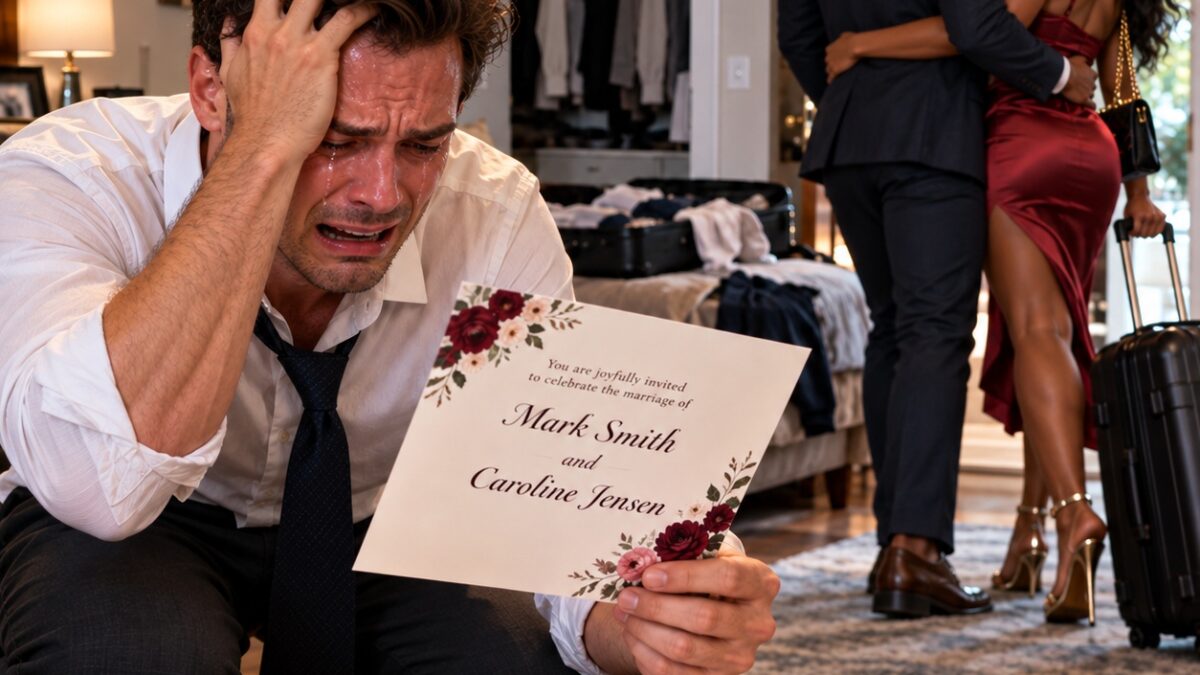
You are joyfully invited to celebrate the marriage of Mark Smith and Caroline Jensen.
My name is Mark Smith.
I actually laughed.
Not because the situation was funny.
Because the explanation was so simple that I thought the entire nightmare was about to end.
I texted:
You mean the invitation with roses on it?
So now you suddenly remember.
Heidi, that isn’t my wedding invitation.
Three dots appeared.
You’re disgusting.
I stood.
It’s from an old friend from high school. HIS name is Mark Smith.
That is the worst excuse I’ve ever heard.
I closed my eyes.
This was going to require more explanation than I expected.
The groom had not always been Mark Smith.
In high school, his name was Mark Donnelly.
He was a year ahead of us.
After graduation, his parents divorced under ugly circumstances involving his father, and during college he legally changed his surname to his mother’s maiden name.
Smith.
He became Mark Smith.
My name.
We occasionally joked about it after reconnecting through friends.
I typed all of that.
Heidi answered:
I went to the same high school. There was no other Mark Smith.
His name wasn’t Smith back then. He changed it later.
Convenient.
It’s true.
Sure.
My pulse began pounding.
Call him.
No response.
Seriously. I’ll give you his number. Call him. Ask him yourself.
She answered:
He’s your friend. You’d just tell him what to say.
I stared at my phone.
That was when the first real fear entered me.
Not anger.
Fear.
Because this no longer felt like a wife who had discovered something suspicious and wanted an explanation.
It felt like a woman refusing to allow an explanation to exist.
I typed:
Call Dan Wright. Call Lisa Morrison. Call anybody from school who kept up with him. They know.
I’m not wasting my time helping you create an alibi.
Heidi, there is a literal bride’s name on the invitation.
I know how cheaters work.
Apparently not very well, because you think I’m secretly getting married while I’m still legally married to you and left the invitation sitting on the desk.
That response earned me twenty minutes of silence.
I thought logic had finally reached her.
Then:
I took photos of the invitation from every angle, so don’t even think about destroying it and claiming I made it up.
I sat there staring at that message.
“Destroy it?”
I said the words aloud to an empty room.
Why would I destroy evidence of another man’s wedding?
I wrote:
Keep the photos. Please. They prove exactly what I’m telling you.
Sign the papers.
Meet me.
No.
Ten minutes. Coffee shop. Police station lobby if you don’t trust me. Anywhere.
No.
You’re ending our marriage over something we can verify in one phone call.
Her answer came:
Just be grateful I’m not trying to take anything from you.
That sentence chilled me.
Heidi was walking away without asking for the house.
Without fighting over savings.
Without trying to claim any real share of the things we had built during six years of marriage.
At the time I interpreted that as rage.
Later, I understood it differently.
She needed the divorce quickly.
Cleanly.
Before anybody asked why.
I tried for hours.
Texts.
Calls.
Email.
I even drove to her parents’ house.
Her father opened the door six inches.
“She doesn’t want to see you.”
“Sir, this is a misunderstanding.”
“Then you should’ve thought about that before cheating.”
“I didn’t cheat.”
He started closing the door.
“Please.”
He stopped.
“There is another man with my name.”
The expression on his face said I had insulted his intelligence.
“Go home, Mark.”
“Ask her to call the groom.”
“Go home.”
The door closed.
I sat in my car for forty minutes afterward.
Rain started.
I kept staring at the porch.
Part of me expected Heidi to come out.
She never did.
Eventually she blocked me.
Phone.
Social media.
Email.
Everything.
My attorney advised me not to harass her.
“Harass?”
“You’ve attempted contact extensively.”
“She’s my wife.”
“She has communicated that she does not want direct contact.”
“She thinks I’m marrying somebody else.”
“She filed for divorce.”
“Because of an invitation.”
My attorney took off his glasses.
“Mark, whether her reasoning is rational or not, you cannot force someone to remain married.”
That sentence made me feel like the floor had disappeared.
People talk about divorce as though the paperwork ends a relationship.
For me, the relationship had ended before I even knew there was a problem.
I wasn’t allowed a final dinner.
No last conversation.
No chance to look my wife in the eyes and say:
Please believe me.
Everything became attorneys.
Signatures.
Waiting periods.
Asset disclosures.
I considered fighting.
For what?
You cannot litigate someone into trusting you.
So eventually I signed.
Heidi took very little.
Some personal savings.
Her car.
Her belongings.
She wanted speed more than money.
That confused everybody except me.
I thought it proved how disgusted she was with me.
I thought she genuinely believed I had humiliated her so badly that she preferred losing money to spending another hour connected to my life.
That interpretation nearly destroyed me.
For the first several months after the divorce, I replayed every year of our marriage.
Every stupid argument.
Every time I worked late.
Every birthday where I bought the wrong gift.
Every night I fell asleep while she was talking.
Maybe the wedding invitation had only been the final trigger.
Maybe I had made her so insecure that an impossible explanation sounded plausible.
Maybe I had failed her in ways I could not see.
I lived alone in the house for nine months.
Then I couldn’t stand it anymore.
Every room contained Heidi.
The kitchen drawer she organized.
The bedroom curtains she chose.
The little scratches on the hardwood from when we moved the dining table ourselves and nearly got divorced over whether lifting or sliding was easier.
I sold the house.
Changed jobs.
Moved across town.
My aunt Barbara became worried about me.
That is putting it gently.
She started appearing without warning carrying casseroles.
“Are you eating?”
“Yes.”
“Coffee isn’t food.”
“I had toast.”
“That isn’t food either.”
“Aunt Barb.”
“You look terrible.”
“Thank you.”
“You’re welcome.”
She was my father’s older sister and believed boundaries were suggestions invented by people who needed more relatives in their lives.
About eleven months after the divorce, she called me.
“Dinner Friday.”
“No.”
“I wasn’t asking.”
“I’m busy.”
“No, you’re sad.”
“Same schedule.”
“You’re meeting someone.”
I nearly hung up.
“No.”
“Yes.”
“Barbara.”
“She isn’t looking for a husband.”
“Then why is she meeting me?”
“Because I’m asking both of you to eat.”
“That sounds exactly like a blind date.”
“It isn’t blind. I’ve shown her your picture.”
I groaned.
“Aunt Barb.”
“Seven o’clock.”
“I said no.”
“Wear the blue shirt.”
Then she hung up.
The woman was named Rachel Morgan.
And the first thing she did after sitting across from me was say:
“Your aunt lied to me too.”
I looked up.
“What did she tell you?”
“That this was a casual dinner with her nephew and she needed company.”
I almost smiled.
“She told me you weren’t looking for anything.”
“I wasn’t.”
“Good.”
“Good?”
Rachel opened the menu.
“I don’t particularly want to be someone’s emotional rehabilitation project.”
That caught me off guard enough to make me laugh.
It was the first real laugh I remembered having in months.
Rachel did not ask what happened to my marriage that night.
Barbara had apparently told her only that I was divorced and struggling.
We talked about work.
Books.
Bad movies.
The restaurant’s suspicious obsession with truffle oil.
At the end of dinner, Rachel said:
“This was less awful than expected.”
“Strong review.”
“You can quote me.”
I did not ask for her number.
She gave it to Barbara anyway.
We became friends before anything else.
Rachel saw exactly how broken I was and never once treated me as if she had been assigned to repair me.
She did small things.
Invited me hiking with friends.
Texted me when a movie came out that we had joked about.
Brought soup when I caught the flu.
Listened when I finally told her about Heidi.
The entire story.
Wedding invitation.
Same name.
Divorce papers.
Blocking.
Rachel did not immediately say Heidi was crazy.
That mattered.
Instead she asked:
“Did you ever verify the groom’s identity independently?”
“Yes.”
“How?”
I showed her the social media page.
Mark Smith.
Formerly Mark Donnelly.
High school.
Wedding photographs eventually appeared.
Rachel stared.
“So you were telling the truth.”
“Yes.”
“And she could have checked in ten minutes.”
“Yes.”
Rachel put my phone down.
“I’m sorry.”
That was all.
No lecture.
No judgment.
Just:
I’m sorry.
I started healing.
Slowly.
About a year after the divorce, my phone rang from Dan Wright.
We had gone to high school together.
Not best friends.
Friendly.
Dan was one of those people who seemed to know everyone and everything.
“Mark Smith.”
“Dan.”
“You alive?”
“Mostly.”
“Good enough.”
He hesitated.
“What?”
“Can I ask you something?”
“Sure.”
“How much do you know about Heidi since the divorce?”
My stomach tightened.
“Nothing.”
“Nothing?”
“She blocked me.”
“Okay.”
“Why?”
Long pause.
Dan said:
“I don’t know if telling you this is helpful.”
“That’s a terrible way to start.”
“I know.”
“What happened?”
“Do you remember Curtis Hale?”
I did.
Two years older than us.
Popular in high school.
Good-looking.
Always seemed ten years more confident than everybody else.
“Yes.”
“Heidi dated him before you.”
I remembered vaguely.
She had called him an immature mistake.
“What about him?”
“They’ve been seeing each other.”
My chest went cold.
“What do you mean seeing?”
Dan sighed.
“Before your divorce.”
No.
I stood from the couch.
“No.”
“Mark.”
“How long?”
“I don’t know exactly.”
“Dan.”
“Maybe a year.”
I could not speak.
Curtis was married.
I knew that.
Two kids.
Owned a construction company with his brother.
“You’re sure?”
“Yes.”
“How?”
“Mutual friends.”
“Rumors?”
“More than rumors.”
I began pacing.
“Why are you telling me now?”
“Because things blew up.”
“How?”
“Heidi confronted Curtis’s wife.”
“What?”
“She wanted him to leave his family.”
I stopped.
“He wouldn’t.”
“Apparently not.”
“So Heidi went to his wife?”
“Yes.”
“What did she say?”
“Basically told her the affair had been going on and asked her to get out of the way.”
I sat again.
The absurdity was almost too large to process.
“What happened?”
“Curtis’s wife filed for divorce.”
Of course.
“And she sued Heidi.”
“For interfering in the marriage?”
“Yes.”
Several states handle those claims differently, but Curtis and his wife had property and business interests spread through jurisdictions where civil claims and settlement pressure became very real.
“Heidi paid?”
“Settlement.”
“How much?”
“Enough to hurt.”
My mind went back to the divorce.
The speed.
Her refusal to verify.
The fact that she took almost nothing.
Suddenly everything looked different.
“She wanted out.”
Dan was quiet.
“She needed an excuse.”
“Yes.”
The wedding invitation had not convinced Heidi I was cheating.
It had given her a story.
A clean story.
A story where she was the betrayed spouse.
A story that allowed her to run directly toward Curtis without admitting she had already been unfaithful.
I felt physically sick.
All those months I blamed myself.
All those nights wondering what I had done.
Heidi had not left because she believed my ridiculous explanation was false.
She refused to verify it because proving me innocent would destroy the excuse she wanted.
“Mark?”
“I’m here.”
“You okay?”
“No.”
“Sorry.”
I laughed bitterly.
“I thought the invitation ruined my marriage.”
Dan said nothing.
“She used it.”
“Looks that way.”
I ended the call.
Then sat alone for nearly an hour.
Rachel came over after work.
She found me still on the couch.
“What happened?”
I told her.
She sat beside me.
No dramatic reaction.
No “I knew it.”
She simply took my hand.
“I hate that you spent a year blaming yourself.”
That sentence broke something open.
I cried.
Not because I wanted Heidi back.
Because I finally understood the marriage I had been mourning did not exist in the form I imagined.
Grief changed after that.
It became cleaner.
Still painful.
But no longer poisoned by self-hatred.
Rachel and I became a couple several months later.
Then serious.
Then inseparable in a way that felt completely different from my marriage to Heidi.
Not more passionate in some movie sense.
Safer.
Rachel disagreed with me openly.
If something bothered her, she said it.
If she suspected something, she asked.
If she was angry, she did not disappear and build a secret case.
I learned to do the same.
Two years after Heidi left, I asked Rachel to marry me.
She said:
“You’re sure?”
I laughed.
“I bought a ring.”
“That isn’t an answer.”
“Yes.”
“About me?”
“Especially you.”
She smiled.
“Then yes.”
We got married quietly.
Family.
Friends.
No ballroom.
No elaborate production.
Dan came.
So did the other Mark Smith.
The invitation groom.
When I introduced him to Rachel, he said:
“So apparently my wedding ruined Mark’s first marriage.”
Rachel deadpanned:
“Try not to ruin this one.”
He laughed.
I thought that chapter was finished.
Then, almost exactly three years after Heidi had placed divorce papers on my desk, my phone rang.
Unknown number.
I answered because I was expecting a contractor.
“Hello?”
Silence.
Then:
“Mark?”
I knew the voice.
My whole body became still.
“Heidi.”
“Oh.”
She sounded almost relieved.
“You recognized me.”
“What do you want?”
Pause.
“It’s been a long time.”
“Three years.”
“Yes.”
“How did you get this number?”
“Dan.”
That irritated me.
Later I learned she had gotten it indirectly, not from him personally.
“I need to talk to you.”
“No.”
“Please.”
I almost hung up.
Then curiosity stopped me.
Not love.
Not hope.
Curiosity.
“What?”
Heidi inhaled.
“I know.”
“Know what?”
“The invitation.”
I looked toward the kitchen.
Rachel was making coffee.
She glanced at me.
I mouthed:
Heidi.
Her eyebrows rose.
She did not leave.
Heidi continued.
“We had our high school reunion two weeks ago.”
“I heard.”
“You weren’t there.”
“No.”
“I was talking to someone.”
“Dan.”
“How did you—”
“He called me.”
Silence.
“So you know?”
“I know what?”
“That there really was another Mark Smith.”
I almost laughed.
Three years.
Three years.
Thousands of dollars in attorney fees.
A house sold.
A marriage ended.
And now:
There really was another Mark Smith.
Heidi spoke quickly.
“I didn’t know.”
“You didn’t want to know.”
“I was upset.”
“I gave you his number.”
“I thought he would lie.”
“I told you to call other classmates.”
“I wasn’t thinking clearly.”
“For weeks?”
“Mark.”
“For the entire divorce?”
“I made a mistake.”
I looked at Rachel.
She quietly placed coffee beside me.
No fear.
No jealousy.
Trust.
The contrast nearly hurt.
Heidi continued.
“I was so worried about how to contact you after I found out.”
“Why?”
“To fix things.”
I frowned.
“What things?”
“Us.”
I actually thought I misheard.
“There is no us.”
“You know what I mean.”
“No. I really don’t.”
She laughed nervously.
“The divorce happened because of a misunderstanding.”
“The divorce happened because you filed for divorce.”
“But the reason was wrong.”
“Okay.”
“So.”
“So?”
“We can fix it.”
I stared at the wall.
“How?”
“Well, we could meet.”
“No.”
“Mark.”
“What exactly do you think is going to happen?”
“We reconcile.”
The word sounded insane.
“You divorced me three years ago.”
“Yes, but—”
“No.”
“It wasn’t because I stopped loving you.”
I almost choked.
Rachel heard enough through the phone to cover her mouth.
I turned slightly away because I did not want to laugh.
Heidi kept talking.
“We can sign another marriage certificate.”
“What?”
“Get remarried.”
“You think we just reset?”
“Well, basically.”
“Basically?”
“We were good before all of this.”
I became quiet.
That was when I realized Heidi still thought I knew nothing.
She thought I had spent three years frozen where she left me.
Same house.
Same job.
Same devastated husband waiting for the misunderstanding to be corrected.
She had no idea Dan told me.
No idea I investigated.
No idea I knew about Curtis.
I asked:
“Why didn’t you verify my story three years ago?”
“I told you. I was hurt.”
“No.”
“What?”
“That isn’t why.”
“Yes, it is.”
“You needed the invitation.”
Silence.
“What are you talking about?”
“You needed me to be guilty.”
“Mark.”
“Because if I wasn’t guilty, then you had to explain why you really wanted the divorce.”
Her voice became harder.
“I don’t like what you’re implying.”
“I’m not implying anything.”
Rachel’s eyes met mine.
I continued.
“Curtis Hale.”
Nothing.
The silence lasted so long I checked whether the call had dropped.
“Heidi?”
“Who told you?”
There it was.
Not:
What are you talking about?
Not:
Curtis who?
Who told you?
I leaned back.
“So it’s true.”
“It’s complicated.”
“No.”
“Mark—”
“You were sleeping with Curtis while we were married.”
She inhaled sharply.
“I made mistakes.”
“How long?”
“Why does it matter?”
“It matters because you just called asking me to remarry you.”
Silence.
“About a year.”
My stomach twisted even though I already knew.
“One year.”
“We were having problems.”
“We were?”
“You were always working.”
“I worked forty-five hours a week.”
“You were emotionally distant.”
“I asked you what was wrong for months.”
“You wouldn’t understand.”
“You’re right. Apparently I didn’t understand my wife was sleeping with her married ex-boyfriend.”
“Don’t say it like that.”
“How would you prefer?”
“I was confused.”
“You were thirty-two.”
“That doesn’t mean I couldn’t be confused.”
I looked at Rachel.
She shook her head slowly.
Not angry.
Almost stunned by the shamelessness.
I asked:
“So the invitation.”
Heidi stayed quiet.
“You saw it and thought I’d given you a perfect excuse.”
“No.”
“Yes.”
“No.”
“You refused every way of checking.”
“I was angry.”
“You took almost nothing in the divorce.”
“I didn’t want your money.”
“You wanted to be free fast enough to chase a married man.”
“That’s unfair.”
“Is it?”
“He told me his marriage was over.”
I laughed.
“And you believed him?”
“Yes.”
“Interesting.”
“What?”
“You demanded I believe you now because you were confused, but you wouldn’t spend ten minutes verifying whether your own husband was telling the truth.”
“Mark.”
“And then you asked Curtis’s wife to divorce him.”
Her voice snapped.
“She wasn’t making him happy.”
I closed my eyes.
There are moments when someone reveals more about themselves in one sentence than years of marriage ever did.
“You actually said that.”
“You don’t know their marriage.”
“No.”
“And neither did you.”
“He loved me.”
“Did he leave her?”
Silence.
“Did he?”
“No.”
“Then she sued you.”
Heidi’s breathing changed.
“How much do you know?”
“Enough.”
“Dan?”
“Dan gave me one thread.”
“You’ve been investigating me?”
“After I learned you’d cheated during our marriage? Yes.”
“That is creepy.”
I laughed.
“Sure.”
“You have no right to spy on me.”
“I used public records and information people freely gave me. Calm down.”
She became quiet.
Then unexpectedly:
“I’m sorry.”
The words landed differently than I expected.
Not satisfying.
Just late.
“So sorry.”
“I know I hurt you.”
“Yes.”
“I was selfish.”
“Yes.”
“I thought Curtis and I were supposed to be together.”
“Okay.”
“He wasn’t who I thought he was.”
“No.”
“After everything exploded, his wife sued me.”
“I know.”
“I had to pay a lot.”
“I know.”
“I worked two jobs.”
“I know.”
“I paid everything.”
I frowned.
“Everything?”
“Yes.”
“You’re debt-free?”
“I finally was.”
Was.
Interesting word.
“Heidi.”
“What?”
“What do you actually want?”
“You.”
“No.”
“Mark.”
“No.”
“Please just listen.”
“I’ve listened.”
“I’ve changed.”
I felt strangely calm.
“I truly understand what I did.”
“Good.”
“I know how much I hurt you.”
“Good.”
“I suffered too.”
There it was.
The pivot.
“My life became hell after Curtis.”
I said nothing.
“I lost friends.”
Silence.
“My parents were embarrassed.”
Silence.
“I had to work constantly.”
Still nothing.
“I paid the settlement.”
She sounded irritated by my lack of sympathy.
“What do you want me to say?”
“I don’t know.”
“Congratulations?”
“Don’t be cruel.”
“I am not being cruel.”
“You sound like you enjoy this.”
“I don’t.”
That was true.
I did not enjoy Heidi’s suffering.
I simply no longer felt responsible for fixing it.
She softened her voice.
“Mark, I survived all of that because I realized you were always the right person.”
I almost laughed again.
“I fought through everything.”
“For me?”
“Yes.”
“No, Heidi.”
“What?”
“You fought through a lawsuit and debt because you didn’t want your wages garnished forever.”
“That’s not fair.”
“Stop saying that every time reality hurts.”
She was silent.
“I want another chance,” she whispered.
“No.”
The answer came instantly.
“What?”
“No.”
“At least think about it.”
“I have.”
“For five seconds.”
“For three years.”
“You loved me once.”
“Yes.”
“So there’s still something.”
“No.”
“How can you know?”
“Because I’m married.”
Silence.
Then:
“What?”
“I’m married.”
“That isn’t funny.”
“I am not joking.”
“You got married?”
“Yes.”
“When?”
“Last year.”
“You can’t.”
I blinked.
“What?”
“You can’t be married already.”
“Apparently the county clerk disagreed.”
“We’ve only been apart three years.”
“Three years is plenty of time to meet someone.”
“Who?”
“Her name is Rachel.”
“How did you meet?”
“Why?”
“I deserve to know.”
“No, you don’t.”
“Mark.”
“My aunt introduced us.”
“A blind date?”
“Basically.”
“So she was a rebound.”
“No.”
“She took advantage of you when you were vulnerable.”
I almost stood from disbelief.
“No.”
“You just told me you were devastated.”
“I was.”
“And she swooped in.”
“No.”
“She probably knew you had money.”
Rachel nearly spit out her coffee.
I held up one finger.
Heidi continued:
“People like that—”
“Stop.”
“What?”
“You don’t get to talk about my wife.”
The word wife made Heidi go silent again.
I said it deliberately.
“My wife.”
She inhaled.
“I was your wife.”
“Yes.”
“And six years mean nothing?”
“They meant a lot.”
“Then how could you replace me so quickly?”
“I didn’t replace you.”
“That’s exactly what you did.”
“No.”
I walked toward the window.
“Rachel helped me become a person again after you left me thinking I had destroyed our marriage.”
Heidi said nothing.
“She never demanded I trust her blindly.”
Silence.
“She listened.”
Silence.
“She stayed.”
Silence.
“And when I eventually learned what you actually did, she never once used it to make herself look better.”
I looked back at Rachel.
Her eyes were wet.
“She was simply there.”
Heidi’s voice tightened.
“So that’s it?”
“Yes.”
“You’re choosing some woman you barely know over the person you shared six years with.”
“I’ve known Rachel for two.”
“And me for much longer.”
“That did not stop you from sleeping with Curtis.”
“Mark!”
“What?”
“You keep throwing that in my face.”
“You called me.”
She went silent.
“You asked to come back.”
“I apologized.”
“An apology doesn’t reset a marriage.”
“I said I’ve changed.”
“Maybe you have.”
That surprised her.
“You believe me?”
“I believe people can change.”
“Then—”
“That doesn’t mean I owe the changed version of you my life.”
Silence.
That was one of the most important things I had learned.
Forgiveness, if I ever reached it, was not the same as access.
You can wish someone healing and still refuse to stand where they can hurt you again.
Heidi said:
“I’ll come over.”
“No.”
“We should talk face-to-face.”
“No.”
“I know the house.”
“I don’t live there.”
“What?”
“I sold it.”
Silence.
“You sold our house?”
“Yes.”
“You can’t.”
“You signed away your claim in the divorce.”
“You actually sold it?”
“Yes.”
“Where do you live?”
“Not telling you.”
“Why?”
“Because you are currently telling me you’re coming to my house after I said no.”
She exhaled angrily.
“You’re acting like I’m dangerous.”
“No. I’m acting like boundaries exist.”
She went quiet.
Then said:
“Fine.”
I thought maybe it was over.
Then she added:
“You always were obsessed with money.”
I laughed.
“Excuse me?”
“That house probably made you a fortune.”
“Not relevant.”
“You’ve probably saved a lot in three years.”
The sentence sharpened my attention.
There it was.
Money.
I had wondered.
Dan had told me more than the first affair story.
After the lawsuit with Curtis’s wife, Heidi had worked constantly to pay settlement debt.
Eventually she succeeded.
Then she started spending nights at expensive private nightlife lounges.
Not strip clubs.
More like social clubs built around attractive male hosts whose job was to flatter wealthy or lonely customers, keep drinks moving, and encourage expensive tabs.
In our city, several operated discreetly around the entertainment district.
Dan co-owned one.
That was how he knew.
At first, Heidi went occasionally.
Then constantly.
Bottle service.
VIP tables.
Gifts.
Designer watches for hosts.
Weekend trips she could not afford.
By the time she finished paying the settlement debt, she had created another pile of debt.
Dan estimated between fifteen and twenty thousand dollars.
Maybe more.
I had not planned to mention it.
Then Heidi said:
“You always were obsessed with money.”
I replied:
“How much do you owe the clubs?”
Silence.
I smiled despite myself.
“Fifteen thousand?”
Nothing.
“Twenty?”
“Who told you?”
“Does it matter?”
“Dan?”
“So I’m close.”
“He owns one of those places?”
“You seriously didn’t know?”
“No.”
“He knows the other owners.”
“Of course he does.”
“They know you.”
“That doesn’t mean—”
“They know you very well.”
Her breathing grew faster.
“Those people gossip.”
“So did you pay off the settlement?”
“Yes.”
“And then immediately replace it with nightlife debt?”
“I was lonely.”
I sighed.
“I’m not judging you for going out.”
“You clearly are.”
“I am judging you for calling your ex-husband asking to reunite while you’re buried in debt after discovering he was innocent.”
“That’s not why I’m calling.”
“Isn’t it?”
“No!”
“How much?”
“It’s not your business.”
“Correct.”
I smiled.
“Which means your debt isn’t my problem either.”
“I didn’t ask you for money.”
“Not yet.”
“You are such a jerk.”
“Maybe.”
“I said I love you.”
“And I’m married.”
“I could still support you.”
“How?”
“What?”
“You said you could love and support me.”
“Yes.”
“With what?”
“Emotionally.”
“Financially?”
Silence.
I continued:
“You’re working two jobs.”
“I can keep working.”
“And the debt?”
“I’ll handle it.”
“Good.”
“Mark.”
“What?”
“If we were together, obviously things would be easier for both of us.”
There.
Finally.
“For both of us?”
“Yes.”
“How would my life become easier?”
She hesitated.
“We know each other.”
“I have a wife.”
“We have history.”
“I have a wife.”
“We used to be happy.”
“I. Have. A. Wife.”
She snapped:
“Stop saying that!”
Rachel’s expression changed.
Not jealousy.
Annoyance now.
I stayed calm.
“Heidi, she is pregnant.”
Silence.
Complete.
I almost regretted saying it because that news belonged to Rachel and me, not Heidi.
But it ended the fantasy.
“What?”
“My wife is pregnant.”
“No.”
“Yes.”
“How far?”
“That isn’t your concern.”
Heidi made a sound.
Maybe crying.
Maybe anger.
I waited.
Finally:
“So you’re really done.”
“I’ve been done.”
“You never tried to get me back.”
“I tried for weeks.”
“I mean after the divorce.”
“You blocked me.”
“You could’ve found another way.”
I stared out the window.
“That might be the most unfair thing you’ve said today.”
“I was confused.”
“You filed legal paperwork.”
“I know.”
“You disappeared.”
“I know.”
“You cheated.”
“I know.”
“You used an invitation as cover.”
Silence.
“And now you’re upset because I respected the divorce you demanded.”
She began crying.
I did not enjoy it.
“I’m sorry.”
She said nothing.
“I truly am.”
“For what?”
“That you’re hurting.”
A sharp laugh.
“But I’m not coming back.”
I let that settle.
“You made a decision three years ago.”
“I made the wrong one.”
“Yes.”
“I should have listened.”
“Yes.”
“I should have called the other Mark.”
“Yes.”
“I should have told you about Curtis.”
“Yes.”
“I know that now.”
“Good.”
“What am I supposed to do?”
I thought about the answer.
“Live with what happened.”
“That sounds cruel.”
“It isn’t.”
“It feels cruel.”
“Consequences usually do.”
She cried quietly.
I remembered the woman I married.
Younger.
Laughing in the passenger seat during our first road trip.
Burning pancakes on Sunday.
Standing beside me at my father’s funeral.
I did not hate Heidi.
Maybe that was the last stage of healing.
Hate would have kept us connected.
I said:
“I hope you stop going to those clubs.”
She sniffed.
“Why do you care?”
“Because you’re destroying yourself.”
She laughed bitterly.
“Now you’re giving me advice?”
“You asked what you’re supposed to do.”
Silence.
“Pay what you owe.”
I continued.
“Stop looking for someone else to make you feel valuable.”
More silence.
“Figure out why you needed Curtis.”
“Mark.”
“Figure out why you needed strangers in expensive lounges afterward.”
“You think you know everything.”
“No.”
I looked at Rachel.
“I finally understand that I don’t.”
That was another lesson Heidi unintentionally taught me.
Certainty can be dangerous.
Three years earlier, she was absolutely certain an invitation proved I was cheating.
I had once been absolutely certain Heidi was only reacting emotionally.
Both of us were wrong about parts of the story.
The difference was that I learned to verify.
Heidi seemed to keep choosing whatever explanation protected the version of life she wanted at that moment.
She whispered:
“Do you ever miss me?”
I answered honestly.
“Sometimes I miss who I thought we were.”
That silence hurt both of us.
“But that’s not the same as wanting it back.”
“I understand.”
I wasn’t sure she did.
Maybe eventually.
I said:
“Goodbye, Heidi.”
“Mark.”
“Yes?”
“I really am sorry.”
I closed my eyes.
“I believe you’re sorry.”
“Can you forgive me?”
“Maybe someday.”
“That means there’s hope.”
“No.”
I hated having to say it.
“Forgiveness isn’t hope for us.”
She began crying again.
“It just means maybe one day I can remember you without feeling like something was stolen from me.”
She whispered:
“I didn’t mean to destroy you.”
“I know.”
That was true too.
Heidi did not wake up planning to break my life.
She was selfish.
Cowardly.
Dishonest.
She chased what she wanted and built excuses around the damage.
People rarely see themselves as villains.
They see themselves as exceptions.
Their affair is special.
Their lie is necessary.
Their betrayal is complicated.
Their debt deserves rescue.
Their return should be welcomed because they are finally ready.
But other people are not paused in place while you discover consequences.
They keep living.
I had.
“Goodbye.”
This time she did not stop me.
I ended the call.
Then I blocked her number.
Rachel raised an eyebrow.
“What?”
I looked at my phone.
“I just realized something.”
“What?”
“I forgot to block her after the divorce.”
Rachel laughed.
Three years earlier, Heidi had blocked me while I begged for five minutes.
Now I blocked her because there was nothing left to say.
That difference mattered.
Dan continued sending occasional updates.
Not because I asked.
Dan was constitutionally incapable of possessing information quietly.
A few months later:
Heidi paid off another club tab.
I replied:
I don’t need updates.
Two weeks later:
Never mind. She opened another one.
I wrote:
Dan.
He answered:
Sorry. Last one.
It was not the last one.
Apparently Heidi kept cycling.
Work.
Debt.
Payoff.
Loneliness.
Club.
New host.
Expensive bottles.
Gifts.
Debt.
Work.
Repeat.
At first, I felt grim satisfaction.
Then even that disappeared.
Her life was hers.
I considered pursuing civil compensation related to her affair and some of the financial damage surrounding the divorce.
My attorney said there might be options depending on specific claims and timelines.
I decided against it.
Not because Heidi deserved protection.
Because I no longer wanted a legal thread connecting us.
Money could not buy back three years.
Punishment would not improve Rachel’s pregnancy.
A courtroom victory would not make me a better father.
So I let Heidi go.
Completely.
The last meaningful conversation I had with Dan about her happened six months before my daughter was born.
He was sitting across from me at a diner.
“You sure you don’t want to know?”
“No.”
“She—”
“Dan.”
He laughed.
“Okay.”
I stirred coffee.
“Do you hate her?”
The question surprised me.
“No.”
“Really?”
“I did.”
“When?”
“After I learned about Curtis.”
“And now?”
I thought.
“I hope she gets better.”
Dan nodded slowly.
“That’s mature.”
“Don’t sound so disappointed.”
“I like drama.”
“I’ve noticed.”
“What if she calls again?”
“She can’t.”
“New number.”
“I won’t answer.”
“What if she shows up?”
“I’ll tell her to leave.”
“What if she genuinely changes?”
I looked at him.
“Then she’ll have a better life.”
He waited.
“That doesn’t mean with me.”
Dan smiled.
“Okay.”
“What?”
“Nothing.”
“You’re being weird.”
“You sound happy.”
I realized he was right.
Happy.
Not relieved.
Not vindicated.
Happy.
Rachel and I moved into a modest house near her parents.
Not because I couldn’t afford something bigger.
Because we liked the neighborhood.
Tree-lined streets.
Kids riding bikes.
A bakery within walking distance.
Rachel chose the nursery color.
Soft green.
I assembled the crib incorrectly twice.
She photographed both failures.
“For evidence,” she said.
“Delete those.”
“No.”
“Rachel.”
“I may need leverage someday.”
I pointed a screwdriver at her.
“Too soon.”
She laughed.
That was what healthy love felt like.
You could joke about old wounds because neither person was trying to reopen them.
The night our daughter was born, I sat beside Rachel’s hospital bed holding a tiny sleeping baby.
My daughter wrapped her whole hand around one of my fingers.
Rachel watched me.
“You okay?”
“No.”
She smiled.
“Good no?”
“The best no.”
I stared at the baby’s face.
“You know what scares me?”
“What?”
“Getting things wrong.”
Rachel became quiet.
“I got my whole marriage wrong.”
“No.”
“Yes.”
“You trusted your wife.”
“I also ignored things.”
“So did she.”
“I don’t want to be that certain again.”
Rachel reached over.
Touched my arm.
“Then don’t.”
I looked at her.
“Ask.”
“What?”
“If something scares you, ask me.”
Simple.
“Don’t build an entire story in your head.”
I laughed softly.
“That sounds familiar.”
“Good.”
She squeezed my arm.
“And if I ever find a wedding invitation with your name on it, I’ll call the groom.”
I laughed so loudly the nurse looked into the room.
That invitation remained in a box for years.
Yes.
I kept it.
Not because I was sentimental about the groom.
Because it became a symbol of how easily people can mistake a fact for a conclusion.
The fact was:
My name was printed on a wedding invitation.
Heidi’s conclusion:
My husband is secretly marrying another woman.
The fact was strange.
Suspicious even.
But one phone call would have separated fact from fantasy.
She refused because fantasy served her.
I eventually attended a barbecue at the other Mark Smith’s house.
Caroline, his wife, brought out the original wedding album.
“Do you want to sign something saying this was actually our wedding?”
I laughed.
“Please don’t give my wife ideas.”
Rachel said:
“I’ve already verified his identity.”
The other Mark shook his head.
“Still one of the strangest stories I’ve ever heard.”
I agreed.
Except the invitation was not really the strangest part.
The strangest part was how badly I had wanted the first explanation to be true.
For months after the divorce, I preferred believing Heidi left because of a misunderstanding.
Why?
Because misunderstandings are fixable.
They preserve the image of the person you loved.
If one bizarre coincidence destroyed us, then maybe our six years had still been real.
Learning about Curtis was worse at first.
It meant the divorce was not a tragic accident.
Heidi had made choices.
Repeated choices.
Then refused verification because truth was inconvenient.
That realization hurt more.
But it also freed me.
I stopped waiting for a correction.
Stopped imagining the magical phone call where Heidi finally saw the invitation’s real groom and raced home.
Ironically, that phone call eventually came.
Three years late.
And by then it did not matter.
People sometimes ask:
“If she hadn’t cheated, would you have taken her back?”
Impossible question.
If Heidi had not cheated, she probably would not have used the invitation as an excuse.
But suppose everything truly had been one catastrophic misunderstanding.
Suppose she genuinely panicked.
Divorced me.
Then three years later discovered the truth.
Would I have remarried her?
I still think no.
Not because mistakes cannot be forgiven.
Because marriage requires enough trust to investigate before convicting.
Heidi did not owe me blind belief.
If she saw an invitation with my name, asking questions would have been reasonable.
Checking my phone?
Maybe.
Calling the groom?
Absolutely.
Demanding explanation?
Yes.
Leaving temporarily while she verified?
Fine.
But she skipped investigation entirely.
She decided.
Sentenced.
Blocked.
And disappeared.
Three years is not a pause button.
Life does not wait for the person who walked out to decide whether they want back in.
That was Heidi’s biggest mistake after the affair.
She believed because she had changed her mind, reality was obligated to rewind.
It wasn’t.
Rachel once asked whether I wanted to tell our daughter the story someday.
“Which part?”
“The invitation.”
“When she’s thirty.”
“Why thirty?”
“Less chance she’ll use it as dating advice at sixteen.”
Rachel laughed.
“Fair.”
I did eventually tell her a simplified version when she was older.
The lesson was not:
Never trust your spouse.
Or:
Always believe explanations.
It was:
Verify before you destroy something you cannot rebuild.
And if you’re the one who destroys it, understand that remorse does not create an obligation for the other person to restore it for you.
Heidi wanted a reset.
I wanted one once too.
During the first months after she left, I would have signed almost anything to return to the morning before she found the invitation.
I wanted to wake up beside her.
Go downstairs.
Make coffee.
Take the invitation from the desk.
Say:
“Look at this ridiculous thing. Another Mark Smith is getting married.”
Then maybe laugh together.
But there was no reset.
Eventually I became grateful.
Not for being betrayed.
I would never romanticize that.
But for being forced to rebuild.
Rachel knew a version of me Heidi never did.
Not because Heidi never had the opportunity.
Because I was different after losing everything.
Less arrogant.
More willing to ask.
More willing to listen.
I learned not every disagreement was a verdict on my worth.
I learned love is not proven by how confidently someone says forever.
It is proven by what happens when confusion arrives.
Do they ask?
Do they stay in the conversation?
Do they verify?
Do they care more about truth than winning?
When Rachel and I fought—and we did—we never blocked each other.
That became almost a private rule.
Take space if needed.
Say:
“I need an hour.”
But never disappear as punishment.
Never turn silence into a weapon.
I did not know how much that mattered until I had experienced the opposite.
Years after Heidi’s final call, Dan texted me one last update despite my repeated demands.
Saw Heidi tonight.
I considered ignoring it.
Then:
She asked about you. I told her you’re doing great. Hope that’s okay.
I replied:
That’s fine. Please don’t tell her anything else.
Dan sent:
Understood.
Then another:
She looked sad.
I stared at the screen.
I felt compassion.
Nothing more.
I typed:
I hope she finds peace.
Dan’s answer:
You really mean that?
I looked across the living room.
Rachel was on the floor helping our daughter build a tower out of blocks.
She looked up.
“Who is it?”
“Dan.”
“Drama?”
“Minor.”
Our daughter knocked down the tower.
Rachel gasped dramatically.
“Betrayal.”
The little girl laughed.
I smiled.
Then wrote to Dan:
Yes. I mean it.
Because happiness becomes much easier when you stop needing people from your past to remain miserable.
Heidi had already taught herself enough hard lessons.
I did not need to participate.
I never pursued compensation.
Never called her.
Never checked her social media.
Never asked Dan about her again.
My energy belonged elsewhere.
Rachel.
Our daughter.
The family growing around us.
The life I once thought had ended on the day divorce papers appeared on my desk.
It had not ended.
A version had.
That distinction is everything.
The last time I looked at the old wedding invitation, I was moving boxes into our new home office.
The envelope slipped from a folder.
Cream paper.
Red roses.
Mark Smith and Caroline Jensen.
Rachel walked in.
“What did you find?”
I held it up.
“The most expensive wedding invitation I ever received.”
She smiled.
“Technically their wedding didn’t cost you anything.”
“Attorney fees.”
“Fair.”
I turned it over.
Three years of pain connected to a piece of cardstock that had never lied.
That struck me.
The invitation told the truth from the beginning.
A man named Mark Smith was marrying Caroline Jensen.
Every word accurate.
The destruction came from what someone wanted those words to mean.
I set it on the desk.
Rachel asked:
“Keeping it?”
I thought.
Then shook my head.
“No.”
“Really?”
“I don’t need it.”
I tore it once.
Not angrily.
Then again.
Dropped it into recycling.
Rachel raised an eyebrow.
“Dramatic.”
“A little.”
“You feel better?”
“Actually, yes.”
She walked over and kissed me.
That night I thought about Heidi for perhaps the final time in any meaningful way.
I wondered whether she ever understood what really ended our marriage.
Not the invitation.
Not Curtis alone.
Not even the lies.
Trust died because she made truth irrelevant.
She already knew what outcome she wanted.
Everything else became justification.
Three years later, she did something similar in reverse.
She discovered I was innocent.
So she decided reconciliation should happen.
My wife?
My new life?
Her affair?
The damage?
Those became inconveniences.
Again, she started with the conclusion she wanted.
Then tried to force reality around it.
Maybe that was Heidi’s real problem.
She did not experience other people as lives moving independently of hers.
We were characters.
Curtis was supposed to leave his wife.
I was supposed to remain available.
Hosts were supposed to make loneliness disappear.
Money was supposed to stretch.
Apologies were supposed to reset consequences.
But people are not waiting rooms.
They do not remain preserved until you come back.
I certainly didn’t.
The morning after I threw away the invitation, Rachel woke me early.
“Your daughter is kicking the crib.”
“That’s your daughter before seven.”
“She inherited your feet.”
I got up.
Walked down the hall.
Our little girl stood gripping the crib rail, hair pointing in five directions.
“Daddy.”
One word.
Everything.
I picked her up.
She rested her head on my shoulder.
Sunlight came through the blinds.
Rachel stood in the doorway.
I remembered Heidi asking how I could move on so quickly.
Three years, she said, as if three years were an afternoon.
But healing is strange.
Some years disappear inside grief.
Some months contain entire lives.
Rachel did not replace Heidi.
My daughter did not erase the marriage.
Nothing erased anything.
That was not the goal.
Healing did not mean deleting the past.
It meant the past stopped deciding what happened next.
I carried my daughter downstairs.
Rachel started coffee.
Ordinary morning.
The kind of morning I once thought I would never have again.
No dramatic revenge.
No courthouse showdown.
No screaming match.
Just peace.
And maybe that was the consequence Heidi never expected.
She walked away believing I would always be where she left me.
Three years later, when she finally learned the groom on that invitation was another Mark Smith, she came back thinking the truth had reopened the door.
But the truth does not reverse time.
It only reveals what people did with it.
Heidi had been given chances to ask.
She chose accusation.
Given chances to verify.
She chose avoidance.
Given a marriage.
She chose an affair.
Then when those choices became painful, she wanted another chance at the life she had discarded.
I could forgive the woman someday.
Perhaps I already had.
But I was never going to abandon the people who had loved me honestly just because Heidi finally understood the explanation she refused to hear three years earlier.
So when people ask whether I ever regretted saying no, the answer is simple.
No.
I regretted many things.
I regretted how long I blamed myself.
I regretted not seeing Heidi’s distance sooner.
I regretted the months I wasted believing a strange wedding invitation somehow proved I had failed as a husband.
But refusing to reopen that marriage?
Never.
Some doors close because somebody locks them in anger.
Others close because, after enough time, you realize the room behind them is no longer your home.
Heidi closed the first door.
I closed the second.
And once I did, I finally understood the difference between losing a marriage and losing your future.
One happened to me.
The other didn’t.
Because I still had a future.
I was standing in it every morning.
With a woman who listened before deciding.
A child who thought my shoulder was the safest place in the world.
And a life that no longer depended on convincing someone determined not to believe me.
The invitation had my name on it.
That much was true.
But it was never my wedding.
And three years later, when Heidi finally learned that, she also learned something far more painful.
The life she wanted to return to no longer existed.
Neither did the man she had left behind.
I had survived him.
And I had no intention of becoming him again.