𝗙𝗨𝗟𝗟 𝗦𝗧𝗢𝗥𝗬:She Declared My Hayfield the ‘Ridge View Community Green’ and Threatened Me With Fake Legal Notices — But She Never Read the Deed Her Own Neighborhood Was Built On, and the One Clause She Overlooked Would Cost Her $31,000, Her HOA Presidency and Everything She Thought She Controlled


I baled hay, fixed fence, ran forty head of cattle, kept a small herd through bad markets and worse weather, and raised my twelve-year-old son, Caleb, on weekends after a quiet divorce that left all three of us trying very hard to be decent people.
I kept things simple.
I kept things legal.
My property lines were staked, surveyed, and recorded because my father had taught me that fences only matter if the law knows where they stand.
That morning, when I saw the stage, I knew two things.
First, nobody had asked me.
Second, the woman standing in the middle of my field had no idea what my father had left behind.
Her name was Brenda Hargrove.
She was fifty-two, tall, slender, and blonde in the carefully maintained way that requires appointments, products, and the belief that weather should apologize before touching your hair. Her highlights were refreshed every three weeks at a salon in Tulsa that charged more per visit than some families spend on groceries. She wore Hermès scarves to board meetings, Louis Vuitton heels to block parties, oversized sunglasses for every day of the week, and a white Range Rover that had never seen a dirt road until it came onto mine.
She carried a leather-bound planner everywhere.
Not because she needed one.
Because holding it made her feel like a CEO running a Fortune 500 company instead of a homeowners association in rural Oklahoma.
Ridge View Estates sat on the eastern edge of my property, one hundred twenty homes built on forty acres my father had sold in 2009 to a developer named Jim Tully. The sale had been clean. The boundary was surveyed. The deed included an agricultural buffer easement fifty feet along the property line. No permanent structures on either side. I kept full rights to farm, irrigate, and move equipment.
Ridge View got its subdivision.
We kept our land.
That was the deal.
Brenda had moved into Ridge View the year it opened. She volunteered to run the HOA when nobody else raised a hand, which is how a lot of little dictators are born. Not through conquest. Through everyone else being tired, busy, polite, or unwilling to spend Tuesday nights arguing about mailbox paint.
Six years later, she ran the place like a duchess managing a colonial estate.
She approved landscaping.
Dictated paint colors.
Organized events.
Judged yards.
Fined elderly widows for chipped mailbox posts.
Quoted bylaws to single mothers whose grass grew half an inch too high.
But her real talent was cruelty dressed up as community service.
She smiled when people flinched.
You could see that little spark in her eyes.
For years, she had reached past the subdivision’s borders.
Noise complaints about my tractor at dawn.
Calls to the county about cattle odor.
Emails suggesting I needed a “beautification buffer” so Ridge View residents would not have to see working agriculture from their breakfast nooks.
I handled all of it the way Dad would have wanted.
Documentation.
County permits.
Polite letters.
Records.
Every time, Brenda smiled, nodded, and tried something new.
But a full-sized stage in the middle of my hayfield was not a complaint.
It was occupation.
I got out of my truck and walked toward her.
Boots on my own soil.
Four men were working around the platform. Two were bolting joists. One was unloading folding chairs. Another was running a thick orange extension cord toward the nearest subdivision lot, wooden stakes holding it above the grass like somebody’s idea of professionalism.
Brenda stood at the center of it all wearing white designer sneakers already stained green from the stubble, tortoiseshell sunglasses, a silk blouse tucked into linen trousers, and a gold bracelet catching the morning light every time she pointed.
She looked like a Vogue editor who had wandered onto a farm and decided to colonize it.
“Brenda,” I said, “what exactly is happening on my field?”
She turned slowly, lowered her sunglasses half an inch, and gave me that smile.
The one she reserved for people she considered beneath her.
Which, as far as I could tell, was everyone.
“Derek, honey, we’re putting together the summer celebration. The whole neighborhood has been looking forward to it.”
“You sent flyers to your subdivision,” I said. “Not to me.”
“Well, I assumed you wouldn’t mind.”
“You assumed wrong.”
She looked around my hayfield with theatrical pity.
“This field just sits here. It’s not like you’re doing anything with it.”
Behind her, fresh bale marks still striped the Bermuda. Tractor tracks cut clean parallel lines across the field. Coastal Bermuda I had seeded, fertilized, irrigated, and cut on a six-week rotation for fifteen years.
“I baled hay off this field twelve days ago.”
“Congratulations,” Brenda said. “You cut grass.”
One of the workers glanced up.
He looked uncomfortable.
That told me he was smarter than Brenda.
I looked at the stage.
Then at the posts sunk in my soil.
Then at Brenda.
“This is private property. You don’t have permission.”
“The HOA has community improvement authority.”
“Your HOA covers Ridge View Estates. My field has never been part of your subdivision.”
She blinked once.
Just once.
The way people blink when a sentence they did not expect lands directly in front of them.
Then she tucked the planner under her arm and lowered her voice into that soothing, condescending register she probably practiced in the mirror.
“Look, the event is in nine days. We’ve sold tickets. We booked a DJ, two food trucks, a face painter. The whole community is counting on this.”
“That sounds like a Ridge View problem.”
Her eyes narrowed behind the sunglasses.
“You can be part of it, or you can be the grumpy farmer who ruined everyone’s summer. Your choice, sweetheart.”
Then she turned her back on me.
Walked toward the stage.
Called instructions to the crew like the field was hers, like it had always been hers, like ownership was just a feeling and she had decided to feel it harder than I did.
I stood there for one more minute.
Then I walked back to my truck and did what my father taught me to do first.
I took pictures.
Thirty-seven of them.
The stage.
The joists.
The wiring.
The chairs.
The trailer.
The tire ruts.
Brenda’s sneakers on my soil.
Each worker’s face.
Every license plate.
The banner material still rolled on the trailer.
The corner stakes.
The drill holes.
The property line in the distance.
Then I pulled the laminated property survey from my glove box. Dad had updated it in 2017 after a utility contractor tried to “estimate” a corner marker and learned that Warren Holloway did not recognize estimated boundaries.
I checked GPS coordinates against the corner stakes.
The stage sat one hundred twelve feet inside my property line.
Not on the buffer.
Not near the boundary.
One hundred twelve feet.
Deep on Holloway land.
I drove home, poured iced tea, sat at my father’s oak desk, opened my laptop, and created a folder.
Ridge View Stage Documentation.
I was not the kind of man who exploded.
I was the kind who built a case slowly, carefully, with the patience my grandfather used to clear land by hand.
And I was just getting started.
FULL STORY CONTINUATION
Three days later, the stage was finished.
Or at least Brenda thought it was.
I drove past it every morning on cattle rounds. Each time, there was more.
The plywood platform had been decked out. A two-by-four railing had been nailed unevenly around the back. A set of steps sat on the left side with no handrail. The right side had nothing at all, just a drop into stubble and dirt. Untreated lumber had already begun to warp in the Oklahoma humidity, bowing at the corners the way cheap construction always does when weather meets confidence.
Then came the wiring.
That was where my irritation became concern.
The orange extension cord was gone.
In its place was one hundred sixty feet of bare Romex wire strung outdoors across my field on wooden stakes. Ten-gauge residential interior wire, not rated for outdoor exposure, not shielded, not buried, not enclosed in conduit. It ran from the subdivision side to a jury-rigged breaker box bolted behind the stage with drywall screws.
No ground fault protection.
No weatherproof enclosure.
No permit posted.
No electrician’s tag.
Two hundred forty volts low enough for a child to trip over and hot enough to kill somebody if the grass was wet.
I photographed every inch.
Close-ups of the wire markings.
The missing conduit.
The breaker box.
The exposed terminals.
The drywall screws.
The lowest stretch of wire, fourteen inches above ground.
Then I crouched near the box and shook my head.
Dad’s voice came into my memory.
You can’t stop stupid from showing up, son. But you can measure it when it does.
So I measured.
Height.
Distance.
Wire run.
Position.
Location relative to the stage and chairs.
I narrated a video as I walked.
Date.
Time.
Weather.
Visual observations.
Then Brenda made her next move.
A certified letter arrived Wednesday morning.
Not from an attorney.
Not from the county.
From the Ridge View Estates Community Standards Office.
That was not a real office.
The letterhead featured a decorative crest Brenda had designed herself. Two crossed gavels over a laurel wreath, with Excellence in Community Governance Since 2018 written beneath it in italic script.
A coat of arms.
For a homeowners association in rural Oklahoma.
I sat at the kitchen table and read the letter three times.
The letter classified my South 40 as a “neglected open parcel.”
It cited Ridge View’s “community beautification ordinance, Section 14B.”
It claimed the HOA was exercising “its right of community access” to improve the property for area residents.
The wording was careful, official-sounding, like Brenda had studied government documents and learned to imitate the rhythm without understanding the law beneath it.
There was no community access right under Oklahoma law that applied to my property.
There was no beautification ordinance covering private land outside the subdivision.
Section 14B of Ridge View’s actual covenants covered maintenance schedules for retention ponds.
Brenda had fabricated the entire legal framework.
She had invented an office, designed a crest, misquoted a rule, and mailed a certified letter to a property owner claiming rights that existed only inside her imagination.
She had chosen the wrong farmer.
I scanned the letter.
Saved the envelope.
Logged the certified mail number.
Took a photo of the crest because I suspected a judge might appreciate just how much effort had gone into pretending.
That same afternoon, I learned she had done more.
A woman from Ridge View named Marcy Ellis called me.
Marcy lived two streets inside the subdivision. Her husband sometimes bought hay from me for two horses he kept on leased pasture north of town. She sounded nervous when I answered.
“Derek, I don’t want to get involved.”
That is how people announce they are already involved.
“What happened, Marcy?”
“Brenda came by with a petition last weekend.”
“What kind of petition?”
“For the community green.”
“The what?”
She hesitated.
“The field.”
“My field.”
“I know. I didn’t sign.”
That last sentence came out fast, like she needed me to believe it before she lost courage.
“She told everyone it was abandoned,” Marcy said. “She said the HOA had authority over adjacent unused land if it benefited the community. She used words like shared stewardship.”
“Shared stewardship.”
“I know.”
“How many signed?”
“Last I heard? Sixty-two.”
I looked across my kitchen at the framed photo of my father standing beside the baler in 2004, shirt soaked through, grin wide because the first full cutting off the South 40 after he upgraded the irrigation had been better than expected.
“Did anyone ask who owned it?”
Marcy was quiet.
“No.”
That told me everything.
Brenda had built a narrative.
A clean one.
The field was abandoned.
Available.
Unused.
Waiting for purpose.
She had turned theft into charity.
By Thursday, the story had gone online.
The Ridge View Estates Facebook group filled with sunset-filtered photos of the stage. Warm light. Clever angles. The tree line glowing behind the platform. The banner unfurled in one shot:
Ridge View Estates Summer Celebration.
A Community Tradition Begins Here.
Brenda’s captions read like marketing copy.
Our community deserves beautiful spaces.
Coming together to build something special.
Sometimes leadership means seeing potential before others do.
People commented with heart emojis and casserole offers.
One woman volunteered to string café lights from the stage to my fence.
Another offered to plant wildflowers along the buffer strip.
A man asked if there would be overflow parking near the “community green.”
Nobody mentioned that the community green was my hayfield because Brenda never told them.
That evening, I drove to the field edge with Caleb beside me. He was twelve, with his mother’s eyes and my father’s quiet way of taking in a problem before saying anything. He sat in the passenger seat eating a granola bar, watching two Ridge View volunteers carry folding chairs across the grass.
“Dad,” he asked, “are they allowed to build that?”
“No, buddy. They’re not.”
“Then why aren’t you stopping them?”
I looked at the stage, the banner, the bare wire, the ruts where the flatbed had chewed my access road into red mud.
“Sometimes the smartest thing you can do is hand someone a bigger shovel.”
Caleb frowned.
“That sounds like Grandpa.”
“It was Grandpa.”
“What does it mean?”
“It means when somebody is determined to bury themselves, don’t stand under the dirt.”
He thought about that, nodded like he almost understood, and went back to his granola bar.
That night, after he went to sleep in the small bedroom at the end of the hall, I added everything to the folder.
Facebook screenshots.
Names.
Dates.
Timestamps.
Petition information.
Certified letter.
Stage photos.
Wiring video.
Measurements.
I bookmarked the county code enforcement complaint form but did not fill it out yet.
Timing mattered more than speed.
I was building something too.
Unlike Brenda’s stage, mine would hold up in court.
On Monday morning, I checked the watering system.
The South 40 irrigation had three main zones fed from the pump station near the wellhouse. Underground PVC laterals ran through the field in careful lines, popping up through the coastal Bermuda at intervals Dad had measured himself. He had installed a cellular relay in 2019 so we could trigger the system remotely from a phone.
I unlocked the pump house.
Checked pressure gauges.
Inspected filters.
Verified the main line.
Walked the field edge with a notepad.
Every head nearest the stage worked perfectly.
Forty-two-foot throw radius.
Overlapping arcs.
No dry patch.
No weak heads.
No hesitation.
I wrote the readings down.
Pressure: full.
Coverage: complete.
Control relay: functional.
Manual activation: tested.
Remote activation: confirmed.
Then I locked the pump house and went back to work.
That afternoon, everything crossed from nuisance into crime.
My well-water usage had been steady for years.
House.
Cattle trough.
Seasonal field watering.
About two hundred ten gallons a day when the irrigation was off.
Dad had installed a digital flow meter on the main line because water rights are not something a farmer should manage by guesswork.
Monday evening, the reading showed four hundred eighty-seven gallons.
More than double baseline.
No watering scheduled.
No cattle moved.
No leak in the house.
No unusual use.
Nothing had changed but Brenda’s stage.
I walked the south fence line at sunset with a flashlight.
There it was.
Somebody had dug down to my supply line, cut into the PVC, and installed a white T-fitting. The cement was fresh, still glossy around the joint. From the splice, a black polyethylene hose ran eighty-three feet across the buffer strip to a portable handwashing station behind the stage.
A sink.
A foot pump.
A coiled garden hose.
Water from my permitted agricultural well.
I knelt beside the splice and ran my thumb along the glue.
Still tacky.
Less than thirty-six hours old.
Someone had found my buried line, dug it up, cut it open with a hacksaw, glued in a T-fitting, and fed water to Brenda’s event setup like my infrastructure was a complimentary amenity.
No permission.
No plumbing permit.
No call.
No apology.
I photographed everything.
Close-up of the cut.
The fitting.
The cement.
The hose.
The distance from splice to stage.
Video with narration.
I checked flow rate with a bucket and stopwatch.
Four gallons per minute.
Then I drove to the Rogers County Sheriff’s Office.
The deputy at the desk was named Jarvis Boon.
Young, polite, professional, and clearly uncomfortable when he realized the complaint involved Brenda Hargrove’s celebration.
“Mr. Holloway,” he said, “you sure you want to file this formally?”
“Somebody cut into an agricultural water line on a permitted well. That’s not a garden spigot.”
“I understand, sir. Just want to make sure.”
“File it.”
He did.
I did not expect handcuffs.
I expected a record.
A report number.
A date.
A deputy’s name.
Another page for the binder.
When I got home, I put the sheriff’s copy in a plastic sleeve.
The next day, Brenda showed up at my front door.
Unannounced.
Of course.
She came dressed like she was arriving at a charity luncheon instead of a farmer’s porch. Cream blazer with gold buttons. Statement necklace. Hair arranged in loose waves. Perfume so heavy and expensive it reached me before she did.
“Derek.”
“Brenda.”
She gave me the smile.
“I heard you spoke to the sheriff about a little water issue.”
“You’re calling it little?”
“Of course. It’s just a temporary connection. We take full responsibility.”
“Full responsibility means you reimburse me and pay for the repair.”
The smile tightened.
Only slightly.
The corners stayed lifted, but the warmth vanished from behind her eyes.
“I wouldn’t call it stolen.”
“I would.”
“It’s barely any water.”
“It’s an unauthorized splice into a permitted agricultural supply line.”
“You’re being dramatic.”
“I’m being accurate.”
That was when the mask dropped.
For one honest second, I saw fury in her face. Not embarrassment. Not regret. Fury. Fury that someone she considered beneath her could stand there in work boots and cite the thing plainly enough that she could not float above it.
“I am trying to do something nice for this community,” she said, each word clipped.
“No,” I said. “You’re trying to build on property that isn’t yours.”
She turned without another word.
Her heels clicked hard across my porch boards.
She climbed into the Range Rover, slammed the door, and pulled away fast enough to throw dust against the fence.
I recorded the entire conversation in my notes.
Date.
Time.
Direct quotes.
Clothing.
Perfume.
Tone.
Dad had always been particular about details.
“Memory gets proud,” he once told me. “Paper stays humble.”
By Wednesday, residents were using my gravel road as parking for event prep. Pickups and SUVs churned it into red mud. A catering van blocked my tractor gate for six hours. My baler sat behind the fence because I could not reach the access road. Tire ruts sank deep enough to swallow an ankle.
Everything photographed.
Everything timed.
Everything filed.
The folder was getting thick.
Brenda had no idea it existed.
Thursday evening, after Caleb went to bed, I opened the old deed archive.
The fireproof cabinet stood in the office beside my father’s desk. It smelled like old paper, pipe tobacco, and dust. Earl had started keeping records in metal boxes in 1963. Warren upgraded to the cabinet in the late nineties and organized everything with labels in his slanted handwriting.
I was looking for the 2009 sale to Jim Tully.
I found it in a manila envelope near the bottom of the third drawer.
Tully Sale — East 40 — 2009.
Dad’s handwriting.
Underlined twice.
My father almost never underlined anything twice.
I sat at the kitchen table and read every page.
The deed contained three recorded covenants.
The first was the agricultural buffer easement I already knew: fifty feet, no permanent structures, standard agricultural protection.
The second was drainage: water runoff from my fields could flow through the subdivision’s retention ponds, and Ridge View could not obstruct existing agricultural drainage.
Practical.
Expected.
The third covenant was the one that changed everything.
It stated that any organized gathering of more than fifty persons on or adjacent to the Holloway parcel required written consent from the Holloway landowner.
Not the HOA.
Not the developer.
Not the county.
The Holloway landowner.
The language was surgical.
Notarized.
Witnessed by two neighbors.
Recorded at the Rogers County Courthouse.
Attached to every lot in Ridge View Estates.
All one hundred twenty of them.
Binding on every owner, every successor, every HOA board in perpetuity.
My father had written it.
Jim Tully had signed it seventeen years ago.
In the margin of the first page, Dad had written a pencil note.
Someday a neighbor will forget whose land built their neighborhood. This page remembers.
I read that note three times.
Then I set the page down and pressed both hands flat against the table.
For the first time since the stage appeared, the anger in me settled into something quieter.
Brenda’s summer celebration violated a recorded covenant governing the very land her subdivision sat on.
The stage.
The DJ.
The food trucks.
The bouncy castle.
Two hundred presold tickets at fifteen dollars each.
All unauthorized.
All actionable.
I pulled up the county assessor’s database. Confirmed the covenant. Downloaded certified copies. Printed two backups. Saved the digital files in three places. Filed one copy back into the cabinet.
Then I poured bourbon into Dad’s old Oklahoma State mug—the one with the broken handle—and sat on the porch looking toward the dark field.
The stage was a silhouette against the tree line.
The banner caught faint light from the nearest subdivision streetlamp.
Somewhere on the Ridge View side, a dog barked once and went quiet.
I smiled for the first time since this started.
Not a grin.
A slow, private recognition.
The kind a man allows himself when the last piece finally falls into a picture he did not know he had been building.
Brenda had not just trespassed.
She had violated a covenant giving me veto power over every large organized event in Ridge View Estates.
Every block party.
Every bake sale.
Every holiday gathering over fifty people.
Broad.
Enforceable.
Never challenged.
Never noticed by Brenda.
She had spent six years ruling that HOA without reading the founding documents of her own neighborhood.
She had approved paint colors and measured grass height and designed her own crest.
She had never opened the deed.
I did not want to use that covenant like a nuclear weapon.
But if Brenda insisted on a war, I now knew exactly where my father had buried the ammunition.
The next morning, I called Gil Patterson.
Gil was my father’s oldest friend and a real estate attorney in Tulsa. Licensed thirty-one years. The same man who had helped Warren draft the covenants in 2009.
He answered on the second ring.
“Derek.”
“Gil, I need you to come out to the farm.”
“Good morning to you too.”
“I found the Tully sale covenant.”
There was a pause.
“The event clause?”
“You remember it?”
“I wrote the first draft.”
“Ridge View built a stage in the South 40.”
Another pause.
Longer this time.
“On your side of the line?”
“One hundred twelve feet inside.”
“I’ll be there in the morning.”
Gil Patterson arrived in a silver pickup cleaner than most lawyers’ sedans. Lean man, mid-sixties, wire-rimmed glasses, pressed shirt, no tie. He had the unhurried manner of someone who read documents the way other men read novels—slowly, carefully, and with quiet satisfaction when he caught something everyone else missed.
He wiped his boots before stepping inside.
That was how I knew Dad had chosen the right friend.
I spread everything across the kitchen table.
Original 1963 deed.
2009 sale agreement.
Three recorded covenants.
Plat map with property lines marked red.
Photos of the stage from four angles.
Wiring close-ups.
Water splice.
Blocked road.
Tire ruts measured with tape.
Certified letter from Brenda’s fictional office.
Facebook screenshots.
Sheriff’s report.
Flow-meter reading.
Eighty-seven entries total, timestamped, cross-referenced, organized in a binder with labeled tabs.
Gil read every page.
He drank two cups of black coffee.
Asked four questions.
Then set his glasses on the table.
“Derek, your father was more thorough than most attorneys I’ve known.”
“He said reading your own deeds was cheaper than hiring somebody to read them wrong.”
Gil smiled.
“That sounds like Warren.”
“What do we have?”
“A lot.”
“That’s a legal answer?”
“That’s the polite version.”
He pulled a yellow legal pad from his briefcase and drew a line down the center.
“The covenant gives you standing to block every large organized event in Ridge View permanently unless they get your written consent. But the trespass, construction, water theft, and road damage are separate civil claims. Real damages. Well documented.”
“Two loaded weapons,” I said. “One for defense. One for offense.”
“Correct.”
“What’s the plan?”
Gil tapped the legal pad.
“First, county code enforcement. The stage is an unpermitted structure on agricultural land. No permit. No site plan. No inspection. The electrical work is a public hazard. No conduit, no GFCI, no proper outdoor-rated panel, no weather protection.”
He wrote as he spoke.
“Second, fire marshal. Public assembly that size requires a fire safety permit, occupancy assessment, marked exits, emergency vehicle access, first aid, fire extinguishers. They have none.”
“Third?”
“Water theft. Sheriff’s report already filed. I’ll draft a demand letter. Immediate disconnection. Reimbursement. Licensed repair.”
“Fourth?”
“Civil complaint.”
He listed defendants.
Brenda Hargrove individually.
Ridge View Estates HOA.
Travis Hargrove, Brenda’s cousin and the DUI attorney who had apparently sent me a legal demand on cheap letterhead threatening action if I interfered.
Claims:
Trespass on agricultural land.
Property damage to soil and road.
Theft of water.
Buffer easement violation.
Event covenant violation.
Punitive damages for willful misconduct.
“Punitive damages?” I asked.
“She is selling tickets to the public. You told her directly, in person, standing on your property, that she had no permission. She proceeded anyway. That is willful.”
I looked toward the field through the kitchen window.
“What about the irrigation?”
Gil folded his hands.
“I am not advising you to water the stage.”
“I understand.”
“I am telling you what the law says. A landowner can operate permitted agricultural equipment on his own property for a legitimate agricultural purpose. This is an active hayfield. Your system is permitted. Your field is in rotation. Your equipment is registered with the county water district.”
He paused.
“What happens to be sitting on that field is not your legal concern.”
On his way out, Gil stopped on the porch and looked toward the South 40.
“File the complaints Friday morning. Let code enforcement and the fire marshal arrive Saturday morning. Let them do their jobs. Do not tip Brenda off.”
He adjusted his glasses.
“And if she happens to be on that stage giving a speech when the water comes on, she chose to stand on a working agricultural parcel.”
We shook hands.
After he left, I walked to the pump house.
Unlocked the panel.
Ran a full system test.
Every head rose clean from the soil.
Every nozzle threw a perfect arc.
Forty-two feet.
Full overlap.
No gaps.
No dry spots.
No mercy.
I set the system back to standby.
Locked the panel.
Walked inside.
Made Caleb a grilled cheese for lunch.
Cut it diagonally.
The way he liked.
The final week, Brenda shifted into overdrive.
Monday, a glossy flyer appeared on my mailbox.
First Annual Ridge View Estates Summer Celebration.
Live DJ.
Food trucks.
Face painting.
Family games.
Fifteen dollars per ticket.
At the bottom, in bold blue type:
Proudly hosted on the Ridge View Community Green.
The Ridge View Community Green.
That was what she was calling my field now.
She had named it, branded it, printed it on professional marketing materials, and mailed the name into existence like she was launching a resort on land she had never owned.
I photographed the flyer.
Filed it.
Smiled.
Tuesday, a letter arrived from the “Law Offices of Travis Hargrove, Attorney at Law.” The ink smeared when I touched it. It demanded I grant permanent recreational access to my field based on Ridge View’s need for community green space and the field’s “apparent disuse.”
I called Gil.
“Travis Hargrove,” he repeated. “Related to Brenda?”
“Cousin.”
“Licensed?”
“Oklahoma bar number on the letterhead.”
“Practice area?”
“DUI defense in a strip mall in Owasso.”
Gil laughed.
“He’s as qualified to draft a covenant demand as I am to remove a gallbladder. Save every word. His bar number goes in the complaint.”
“He could lose his license?”
“Probably not. But he may spend eight thousand dollars explaining why he shouldn’t. That’s punishment enough for a DUI lawyer.”
Wednesday, Brenda hired the DJ.
He looked barely old enough to rent the van he arrived in. The subwoofers were the size of small refrigerators. He started testing speakers at two in the afternoon.
The bass hit my floorboards half a mile away.
My coffee mug walked itself toward the edge of the kitchen counter.
Forty head of cattle bunched at the far fence line, nervous and refusing to come to the water trough until sundown.
I calculated the weight loss at roughly four pounds per head in a single day.
At market rate, that was real money vibrating out of my herd because Brenda wanted a playlist.
I recorded decibel readings.
Sixty-eight at my porch.
Seventy-four at the field edge.
Both above the Rogers County noise ordinance threshold for agricultural zones.
Thursday, the operation metastasized.
Two food trucks parked directly on the South 40, tires pressing oil and transmission fluid into soil Dad had tested for pH every spring for twenty years. A diesel generator sat beside the stage with no containment pan, no fuel spill protection, no fire suppression. Three hundred folding chairs spread across the grass in crooked rows. A bouncy castle inflated near the road, its blower screaming at seventy decibels.
Extension cords ran across open ground.
A banner company drove steel poles into my soil.
Twenty-two of them.
Eight-foot stakes hammered directly into earth that hid underground lateral lines.
Two of those stakes sat within three feet of a PVC junction cap visible from the surface.
Four porta-potties arrived on a flatbed.
No sanitation permit.
No placement agreement.
No gray-water containment.
Set directly on agricultural land that drained toward my retention system.
I called Gil that evening.
“The damages just went up,” I said.
“How much worse?”
“Food trucks, diesel generator, bouncy castle, twenty-two steel poles, four porta-potties.”
Silence.
Then he said, “She is either the most reckless HOA president in Oklahoma or the most helpful defendant.”
“Both?”
“Document every inch.”
Friday morning, I filed the complaints.
Online complaint to county code enforcement.
Phone follow-up to the fire marshal’s office.
I explained everything calmly.
Unpermitted structure on private agricultural land.
Unpermitted electrical.
Bare wire without conduit.
Uncontained diesel generator.
Expected crowd over two hundred.
Single access field on a one-lane gravel road.
No fire permit.
No evacuation plan.
No first aid station.
Both offices confirmed inspectors would arrive Saturday morning.
Friday evening, I drove past the field one last time.
Brenda was there in a cream silk sundress, statement earrings, directing volunteers like a general who believed her own propaganda. The stage sparkled with café lights strung from unpermitted poles. Food trucks had awnings extended. The bouncy castle bobbed in the heat. On the stage, propped on an easel, sat a framed poster in metallic ink.
Welcome to the Ridge View Community Green
Established 2024
She had framed a lie in museum-quality glass.
I opened the irrigation app on my phone.
Remote activation confirmed.
Every head online.
Full pressure available.
System on standby.
Ready.
I went to bed at nine.
Saturday was going to be long.
It broke clear and hot.
Eighty-nine degrees by ten.
Still, heavy Oklahoma air pressing against your skin like warm cloth.
Not a cloud.
Not a breeze.
The sky flat and white with heat.
I woke at five, fed the cattle, checked the well pressure, drank coffee on the porch while the sun climbed over the tree line. The South 40 shimmered in early heat. From my chair, I could see the stage, the banner, the white chairs glowing like teeth.
By nine, cars streamed up the gravel road.
SUVs with Ridge View stickers.
Minivans with pool noodles.
Pickups.
A catering van blocking my access road completely.
By ten, sixty vehicles lined the fence and county road shoulder.
Volunteers in matching blue shirts moved around the field.
Ridge View CARES printed on the back.
Orange cones planted into my soil.
By eleven, the field was packed.
The air smelled like diesel exhaust, funnel cake, sunscreen, cut grass, and hot plastic from the bouncy castle.
I parked my truck on the rise near the north fence.
Clear view of the entire South 40.
Stage.
Food trucks.
Bouncy castle listing sideways in a faint ripple of hot air.
Folding chairs filled with families eating corn dogs.
Kids chasing each other through the stubble.
Speakers pushing bass I could feel in my sternum from five hundred yards away.
Generators humming like angry insects.
Two hundred people, maybe more.
All on my land.
All believing they had a right to be there because one woman told them so.
At 11:30, Brenda climbed the stage steps.
And I want this picture clear, because how she looked before mattered for how she looked after.
She wore a white linen dress, Italian, the kind that cost more than my monthly truck payment. Fitted through the waist. Flowing below the knee. Strappy wedge sandals with polished gold buckles. Thin chain necklace catching sunlight and throwing tiny sparks. Her hair had been swept into loose, camera-ready waves, every strand placed, every highlight deliberate.
Flawless makeup.
Bronzed cheekbones.
Red lipstick.
Mascara heavy enough to cast shadows.
Wireless microphone in her right hand.
Leather planner pressed against her hip like armor.
She looked like a woman who had spent three hours preparing to stand on stolen land.
“Good morning, Ridge View!”
The crowd cheered.
“Welcome to our very first summer celebration.”
More applause.
I pulled out my phone and hit record.
“I want to thank every one of you for believing in this community,” she said. “When I looked at this space and imagined what we could build, I knew Ridge View deserved this.”
She soaked up the applause like sunlight.
“This is what community looks like. This is what happens when neighbors come together.”
Standing on a stage built on my property.
Powered by unpermitted wiring.
Watered from a stolen splice.
Surrounded by vehicles damaging my road.
She had built the moment she had wanted for six years.
Admired.
Centered.
In control.
She did not see the county truck turn off the road from the south.
She did not see the red fire marshal vehicle behind it.
And she absolutely did not see me open the irrigation app and move my thumb over the green activation button.
At 11:47 a.m., Brenda was mid-sentence.
Something about investing in our shared future.
I pressed the button.
The pump kicked on at the wellhouse.
A deep mechanical thrum rolled through the underground PVC.
Pressure built for four seconds.
Then one by one, the heads rose from the stubble.
Pop.
Pop.
Pop.
Like soldiers snapping to attention.
Twenty-two acres of irrigation came online at once.
The first arc hit the back row of chairs.
It sounded like a fire hose striking a tin roof.
People screamed.
Not fear.
Shock.
The second stream swept across the DJ booth.
Speakers crackled.
Popped.
Went silent.
The third—the big center nozzle—threw a thick rope of cold well water directly across the stage at chest height.
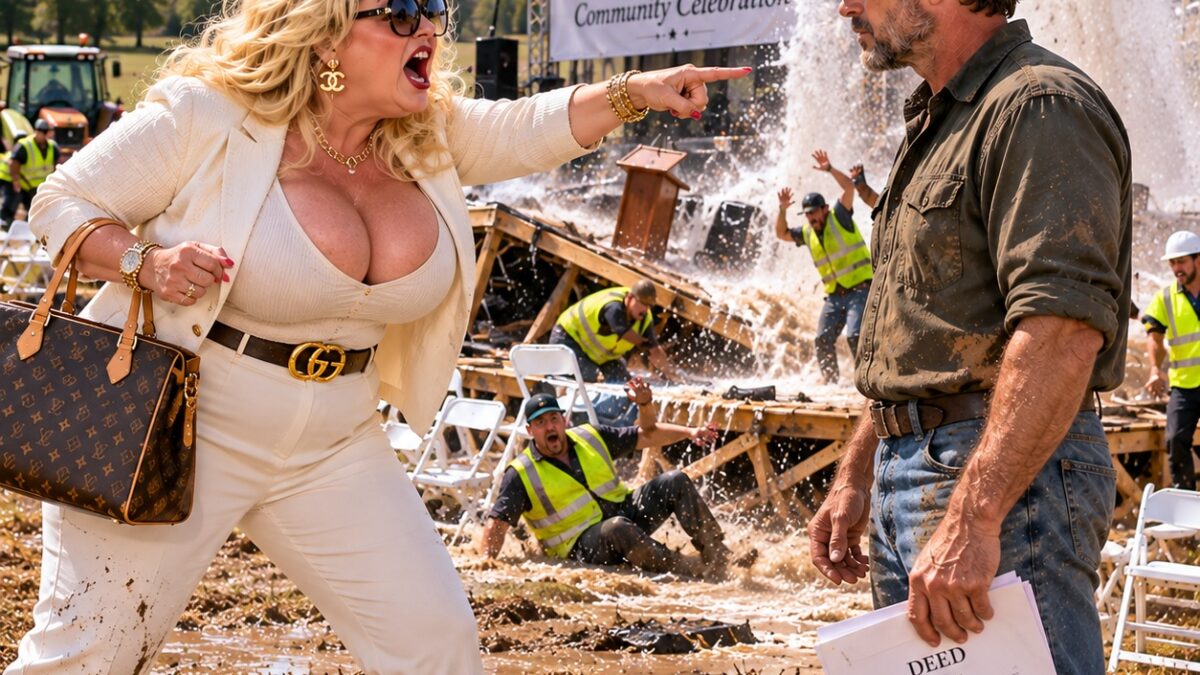
It hit Brenda square in the chest.
The effect was immediate.
Her white linen dress went transparent in two seconds, clinging to her body like wet tissue paper. The gold buckles on her sandals disappeared into mud forming under the plywood. Her three-hour hairstyle collapsed into wet ropes hanging past her shoulders.
Then the mascara went.
Twin black rivers down both cheeks.
Through bronzer.
Through foundation.
The red lipstick smeared sideways across her chin.
Her gold necklace hung crooked.
Her leather planner, the one she carried like a holy text, sat in a puddle at the base of the stage, pages dissolving.
The microphone shrieked with feedback.
Then went silent.
Just like her authority.
The bouncy castle took two overlapping streams, sagged sideways, and collapsed into the wet grass with a long defeated wheeze, like even the inflatable had given up on Brenda’s vision.
Paper plates launched like Frisbees.
Folding chairs skidded across wet grass.
The DJ dove for his equipment.
Food truck operators scrambled under awnings.
Parents scooped up children and ran toward cars.
I sat in my truck on the rise and held the phone steady.
No cheering.
No shouting.
Just recording.
Every second.
Then the county trucks arrived.
Dale Riggsby from Rogers County Code Enforcement stepped out in rubber boots and walked through the soaking field without hurry. Fifty-five, bald, twenty years of telling people their buildings did not meet code. He climbed the stage steps while water still arced overhead.
“Ma’am,” he said, looking at dripping Brenda, “Dale Riggsby, Rogers County Code Enforcement. I need your building permit.”
Her mouth opened.
Closed.
Opened again.
“It’s a temporary stage for a community event.”
“Any structure over two hundred square feet requires a permit. This is two hundred forty. I also see unpermitted electrical work, bare wire without conduit or ground fault protection. Do you have permits?”
“No.”
“This structure violates code. I’m issuing a stop-work order. Cease all use immediately. Seventy-two hours to remove.”
Captain Tanya Reeves from the fire marshal’s office stepped up next.
Compact woman.
Short dark hair.
Polo already speckled with spray.
She had spent fifteen minutes walking the site. Her expression said everything.
“Event permit?”
Brenda blinked water from her lashes.
“We don’t—”
“Fire safety plan?”
“This is just a neighborhood gathering.”
“Evacuation route?”
Silence.
“Fire extinguishers? First aid station? Generator containment? Electrical inspection? Sanitation permit?”
Nothing.
Captain Reeves looked over the field.
“Two hundred people, single access field, no secondary exit, unpermitted wiring, uncontained diesel generator, sanitation units without paperwork, no marked evacuation plan. This event is shut down immediately.”
The crowd had already thinned.
The sprinklers had handled evacuation more efficiently than any order.
People sloshed toward cars carrying wet purses, ruined paper plates, folded chairs, and children who would probably remember that day longer than any face painting could have lasted.
Brenda stood center stage, soaked and silent.
“You can’t do this,” she finally said. “This is our community space.”
Riggsby checked his notes.
“Ma’am, this parcel is private agricultural land. Owner Derek Holloway. Complaint filed by Mr. Holloway.”
Her face went pale.
Not from the water.
From realization.
The farmer she had called a peasant had been building a case while she built a stage.
Deputy Jarvis Boon arrived thirty minutes later.
He issued three citations.
Criminal trespass.
Theft of water from a private agricultural well.
Malicious injury to property for the cut supply line.
He informed Brenda civil action was coming.
She signed each one in silence, wet dress clinging, mascara ruined, gold sandals buried in mud.
The framed poster lay face down in a puddle.
Ridge View Community Green dissolving into wet cardboard.
I met Riggsby at the gate afterward and offered water from my truck.
He flipped through my binder.
“Twenty-two years in this job,” he said. “Never seen a citizen build a case this clean.”
“My father taught me something.”
“What’s that?”
“Fight with paper. Paper doesn’t lose its temper.”
Cleanup took eight days.
The stage came down.
Not by Brenda.
She refused to come near the field after that Saturday.
I hired a crew and billed Ridge View HOA for every hour.
The twenty-two steel poles were pulled. Each hole inspected. Two poles had cracked PVC couplings on the south lateral. The bare wiring was stripped. Generators hauled away. Chairs stacked. Porta-potties removed. The deflated bouncy castle folded into a trailer like a sad metaphor.
The water splice was repaired by a licensed plumber.
Four hundred twenty dollars.
The gravel road was regraded.
Eight hours.
Two loads of crusher run.
Eleven hundred dollars.
The field was reseeded where foot traffic and tire ruts killed grass.
Fourteen hundred dollars in seed and fertilizer.
An afternoon with an aerator borrowed from a neighbor.
Gil filed the civil complaint the following Monday.
Defendants:
Brenda Hargrove individually.
Ridge View Estates HOA.
Travis Hargrove.
Claims:
Trespass.
Property damage.
Theft of water.
Easement violation.
Covenant violation.
Punitive damages.
Total demand: $114,000.
Brenda hired a real property attorney from Tulsa this time, a serious one, not her cousin.
He reviewed the complaint.
Read the binder front to back.
Studied the three recorded covenants.
Then called Brenda into his office.
The conversation lasted forty minutes.
It ended with Brenda crying in the parking lot of a Tulsa law firm, mascara running again, this time without help from any field equipment.
The covenant gave me permanent veto power over every large organized gathering in Ridge View Estates.
Every block party.
Every bake sale.
Every celebration over fifty people.
If this went to trial, the HOA would lose every count. A jury could award punitive damages on top of actual losses. Legal fees alone could bankrupt the association’s reserves.
Settlement came in three weeks.
Eighty-seven thousand dollars.
Brenda personally paid thirty-one thousand from her own accounts.
The HOA’s insurance carrier dropped coverage the next month, citing willful misconduct by board leadership.
Brenda resigned the day the settlement check cleared.
It did not matter.
The next homeowners meeting drew ninety-four households out of one hundred twenty.
The motion to remove her passed unanimously.
Ninety-four to zero.
Not one abstention.
The meeting lasted eleven minutes.
Shortest in Ridge View history.
Three months later, both sides of the property line looked different.
I restored the field.
Replaced the cracked couplings.
Upgraded the irrigation controls to a newer panel.
Then I did something that surprised everyone, including myself.
I built a pavilion.
Not on the South 40.
On the north edge of my property near the tree line, where there was a flat clearing with good shade.
Concrete pad.
Steel-frame roof rated for Oklahoma wind.
Water.
Electricity.
Permitted.
Inspected.
Every wire in conduit.
Dale Riggsby signed off personally.
Four cedar picnic tables.
A stone fire pit.
A hand-routed sign.
Holloway Community Pavilion
Built for Neighbors by a Neighbor
I offered it to Ridge View residents free of charge year-round.
One condition.
A simple written agreement.
The land was private property.
Access was a privilege earned through respect.
Not a right.
Not an entitlement.
Not something that could be renamed on a poster or claimed by petition.
The first gathering was a Fourth of July cookout.
Forty-two families came.
I grilled burgers on a charcoal grill.
Caleb ran the drink cooler with the seriousness of a boy given his first real job.
The new HOA president, Linda Chen, brought sheet cake.
Linda was a retired teacher who had actually read the covenants before taking office, which made her a revolutionary figure in Ridge View.
Kids played tag in the clearing.
Parents sat at cedar tables under the steel roof.
They talked about what kind of neighborhood they wanted to build together—with permission, on the right side of the property line.
Nobody mentioned Brenda’s name.
Nobody called the South 40 a community green.
Nobody taped a flyer to my mailbox ever again.
That evening, I stood at the pavilion edge as the sun dropped behind the tree line. Orange light spread across the pasture. Caleb ran through tall grass with neighborhood kids, catching fireflies and laughing the way twelve-year-olds laugh when the world feels safe for a while.
The South 40 stretched toward the horizon.
Green.
Watered.
Quiet.
Ready for the next cutting.
My father’s field.
My grandfather’s land.
Still standing.
Still producing.
Still mine.
Underground, every sprinkler head sat exactly where Warren Holloway had placed it.
Quiet when not needed.
Ready when called.
That was the lesson he left me.
Power does not always need to shout.
Sometimes it waits beneath the surface, connected to the right pressure, buried exactly where careless people forget to look.
Brenda built a stage because she believed confidence could become ownership if enough people applauded.
My father left me a deed because he knew better.
And when the time came, the loudest woman in Ridge View Estates learned the hard way that stolen land still remembers who owns the water beneath it.