𝗙𝗨𝗟𝗟 𝗦𝗧𝗢𝗥𝗬o:My 14 Year Old Golden Retriever Walked Away While I Lay Dying in the Snow — I Thought He Had Abandoned Me, Until I Learned What He Did Next!
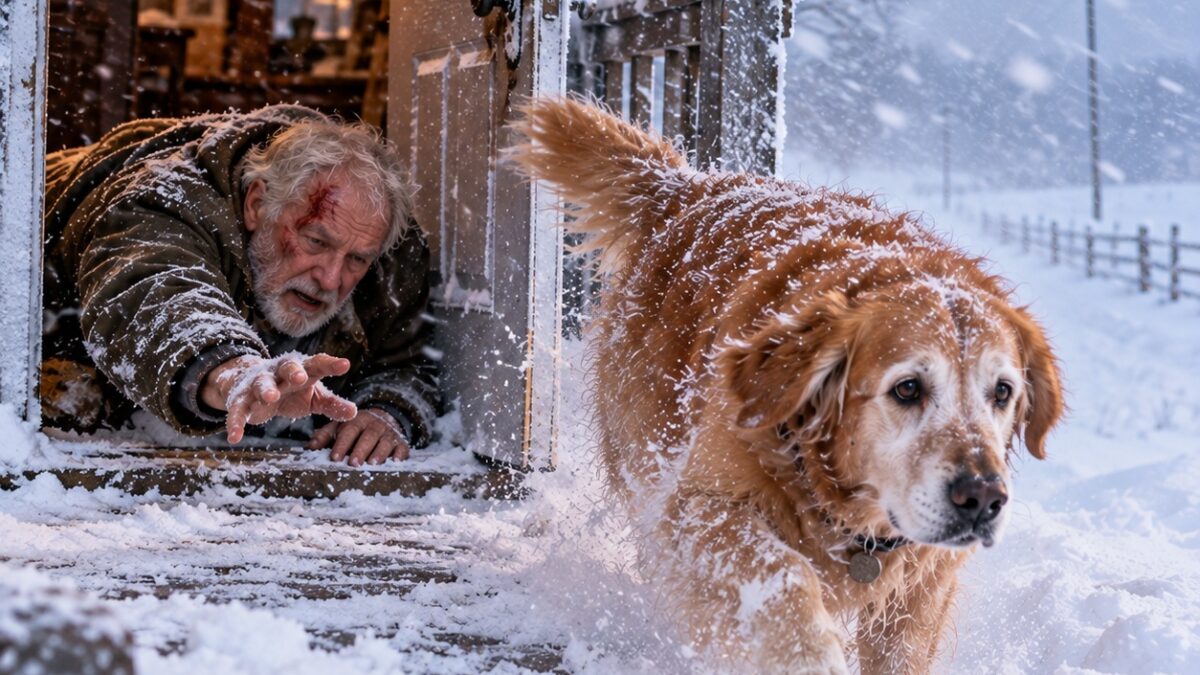
FULL STORY CONTINUATION
I called his name until the wind swallowed it.
“Charlie!”
The golden shape stopped maybe twenty yards away.
Barely visible through the snow.
He looked back.
Even at that distance I could make out the white around his muzzle.
“Come here.”
He did not.
His head turned toward the north road.
Then he disappeared.
I wish I could tell you I immediately understood what he was doing.
I did not.
My first thought was that something had gone wrong inside his old head.
Age.
Cold.
Disorientation.
Maybe he had finally reached the point every dog owner fears, where loyalty and instinct begin losing their argument against time.
“CHARLIE!”
Nothing.
I tried to rise.
Pain exploded from my right hip down my leg.
I fell back.
My breathing came short and hard.
Snow collected across my jacket.
I brushed it away.
Then laughed once.
Not because anything was funny.
Because sometimes the body chooses strange responses when the mind understands the seriousness of a situation.
“Good work, Walter.”
Nobody heard me.
The fence post beside me stood about six feet away.
If I could reach it, maybe I could pull myself upright.
I rolled onto my left side.
The movement made me nauseous.
I waited.
Tried again.
I managed maybe two feet before my hip informed me that another attempt would be punished severely.
So I stopped.
Training matters.
People imagine military training teaches you how not to be afraid.
It does not.
Fear is useful.
Panic is the problem.
Fear says something is wrong.
Panic says do everything at once.
The Corps taught me to reduce problems.
Shelter.
Heat.
Communication.
Mobility.
I had almost none of them.
But not none.
My coat was heavy.
Wool sweater beneath it.
Thermal shirt.
Insulated gloves.
Good boots.
My left leg worked.
My arms worked.
I was sheltered slightly by the shallow depression near the fence.
The worst enemy would be exposure.
That and shock.
I pulled my hood tighter.
Drew my good knee toward me.
Tried to get as much of my body off the snow as possible.
The ground beneath my back was stealing warmth.
I could feel it.
I looked toward where Charlie vanished.
Nothing but white.
“Stupid dog.”
My voice shook.
I was not sure whether I meant him or myself.
Probably both.
Charlie came into my life fourteen years earlier, when neither of us particularly needed the other.
That was what I told people.
The truth was less flattering.
My wife, Ellen, died the previous spring.
Forty-nine years married.
Pancreatic cancer took her in six months.
Six months from complaining about indigestion to a funeral at Saint Luke’s Lutheran with enough flowers to make the sanctuary smell like summer.
Afterward, the house became unbearable.
Not because it was empty.
Because it was full of her.
Her reading glasses beside the bed.
A yellow sweater on a hook.
Three jars of strawberry preserves in the pantry with labels written in her handwriting.
A grocery list on the refrigerator that still included the word cinnamon.
People told me to remove things when I was ready.
I removed nothing.
Instead, I moved around them.
I ate standing at the kitchen counter because sitting across from Ellen’s empty chair made me angry.
I slept on my side of the bed.
I left her slippers underneath it.
My daughter, Laura, came every Sunday from Duluth.
She cooked.
Cleaned.
Talked too much.
I told her I was fine.
She knew I was lying.
One October afternoon, she arrived with a golden retriever puppy.
Eight weeks old.
All paws and ears.
He came through my front door, slid across the hardwood, and urinated beside the umbrella stand.
I stared at him.
Laura said, “His name is Charlie.”
“No.”
“He needs a home.”
“So does every animal at the shelter.”
“He’s yours.”
“No.”
She set a bag of puppy food on the counter.
I pointed at it.
“Take that with you.”
“He’s been sleeping through most of the night.”
“Take him.”
“Vaccinations are scheduled.”
“Laura.”
She looked at me.
Not as a daughter.
As a woman who had spent months watching her father disappear while technically remaining alive.
“Mom would hate what you’re doing.”
That ended the argument.
Not because she won.
Because she cheated.
Charlie stayed.
Temporarily.
Naturally.
He destroyed one slipper.
Ellen’s.
I nearly gave him away for that.
Then I found him asleep with his head on the other slipper.
I sat on the bedroom floor for a long time.
Did not know whether to laugh or cry.
Did both.
Charlie grew into the kind of golden retriever who believed every stranger represented a friend suffering from delayed introduction.
Mail carrier.
UPS driver.
Plumber.
Jehovah’s Witness.
Everyone.
He loved water.
Mud.
Children.
Cheese.
He once swallowed half a dish towel and cost me nine hundred dollars.
I told the veterinarian that at those prices, he should have replaced the whole dog.
Charlie licked my hand.
For fourteen years, he slept beside my bed.
Walked every morning.
Waited at the mudroom door at five o’clock for dinner like he had never eaten before.
Sat beside me on the porch.
Rode in the passenger seat of my truck.
After Laura’s husband died in a logging accident, Charlie lay beside her for an entire afternoon while she cried into his neck.
When my grandson came home from Afghanistan, unable to sleep through the night, Charlie slept outside his bedroom for two weeks without anyone asking.
People call dogs simple.
I have never believed that.
Their needs can be simple.
Their understanding is not.
Charlie knew when somebody was hurting.
He had never been trained for that.
Nobody had to teach him.
Maybe that was why, lying in the snow, I should have trusted him.
Instead, I believed the old dog had left me.
The wind intensified.
Snow began accumulating around my legs.
I used both arms to push some of it away.
My fingers still worked.
Good sign.
My right foot felt wrong.
Not numb.
Painful.
Also a good sign, technically.
I checked my watch.
11:18.
We left the house around 10:35.
Laura expected to call me that evening.
Frank might notice my porch light eventually.
Neither would help soon enough if the temperature kept falling.
A farmhouse sat about two miles north along County Road 6.
The Henderson place.
Paul and Linda.
Middle-aged couple.
Dairy goats.
Two teenage sons.
If Charlie followed the field road, he might eventually reach them.
But why would he?
He had only been there twice.
Once when Paul helped repair my tractor.
Once during a neighborhood barbecue.
Four years earlier.
A dog could not possibly—
I stopped.
Charlie knew that road.
Our morning walks sometimes followed the first half mile before we turned toward the creek.
He knew the direction.
Maybe.
Hope is dangerous in survival situations.
It can keep you going.
It can also make you stop thinking.
So I did not rely on Charlie.
I began planning for the possibility nobody came.
There was a line of spruce maybe fifty yards southeast.
If I could reach it, less wind.
Fifty yards might as well have been fifty miles.
Still, I tried.
I rolled.
Dragged with my elbows.
Pushed using my left heel.
The pain came in waves so severe that my vision narrowed.
Five feet.
Rest.
Another three.
Rest.
Snow entered the cuff of one glove.
I fixed it.
Eight more feet.
Then my hip shifted.
I yelled.
The sound vanished into the storm.
I stopped moving.
My entire body shook.
Not from cold.
Yet.
Shock.
“Okay.”
I spoke aloud because hearing a voice helped.
“Okay.”
I had gone maybe fifteen feet.
The spruce were still too far.
I abandoned that plan.
Sometimes survival means admitting the plan is bad before commitment kills you.
I dug my elbows into the snow.
Created a shallow bank on the windward side.
Pulled my scarf over my face.
Curled as much as the injury allowed.
Then I waited.
Charlie, meanwhile, was doing something I did not see until much later.
Paul Henderson told me the details afterward.
So did Linda.
And their oldest son, Caleb.
I have reconstructed his route from tracks, where people spotted him, and what neighbors later reported.
Charlie left me at approximately 11:05.
He headed north.
Not toward the house.
Toward County Road 6.
That mattered.
Home was closer.
But home was empty.
Maybe Charlie understood that.
Maybe not in words.
But dogs understand patterns.
My truck was gone from the driveway because we had walked.
No other person lived there.
Home meant shelter.
It did not mean help.
The Henderson farm meant people.
The first quarter mile crossed open pasture.
Charlie was fourteen.
His left rear leg had arthritis from the old rabbit incident.
In normal weather, he walked that distance slowly.
That day, he ran.
Not continuously.
Tracks showed that.
Longer stride at first.
Then shorter.
At the drainage ditch, he slipped.
There was a patch of disturbed snow and fur later found against a frozen clump of grass.
He climbed out.
Continued.
He reached the tree line.
Wind protection.
Then followed the old farm lane.
At approximately 11:30, a county plow driver named Steve Mallory saw a golden retriever near the intersection.
Steve told me later he slowed.
Thought Charlie might belong to a nearby house.
The dog was limping badly.
Snow covered his back.
Steve opened the passenger door and called.
Charlie did not approach.
He ran north.
Steve continued because roads were closing fast.
At 11:42, Mrs. Ecklund, who lived near the church road, saw a dog crossing her backyard.
She opened her porch door.
Charlie ignored her.
That was unlike him.
This was a dog who believed humans existed primarily to pet him.
But he was not looking for any human.
He was apparently looking for the right place.
The Henderson farm sat another three-quarters of a mile away.
Charlie knew Paul.
That was my best guess.
Paul had spent six days at my property repairing a collapsed shed roof years earlier.
Charlie adored him because Paul carried jerky.
Maybe memory works that simply.
Person.
Smell.
Place.
Help.
I do not know.
At 12:03, Charlie reached the Henderson driveway.
Linda was inside making soup.
Their youngest son, Nathan, was in the barn.
Paul had gone to check the generator.
They heard barking.
Not normal barking.
Linda described it as “angry and desperate.”
She looked out the window.
Saw Charlie.
At first, she thought it could not be him.
Our house was two miles away.
The storm was worsening.
She opened the mudroom door.
Charlie almost fell inside.
Snow clung to his chest and legs.
His paws were bleeding slightly between the pads.
His bad leg barely held weight.
“Charlie?”
He did not greet her.
No tail wag.
No leaning into her hand.
He turned.
Went back outside.
Barked.
Came in.
Turned.
Barked again.
Linda called Paul.
Paul came around the barn.
“That’s Walt’s dog.”
Charlie ran toward him.
Stopped.
Ran toward the road.
Returned.
Barked.
Paul told me later that he understood immediately.
Not exactly what had happened.
Only that Charlie wanted him to follow.
Paul grabbed his parka.
Linda shouted that he was insane.
Paul shouted back that she married him anyway.
Thirty years together.
Apparently that remained their standard emergency communication.
Nathan came too.
They took the four-wheel-drive farm truck because the road was nearly impassable.
Charlie refused to get in.
They tried.
He backed away.
Barked.
Turned toward the field.
So Paul drove slowly while Charlie ran beside them.
This lasted maybe four hundred yards.
Then Charlie stumbled.
Nathan jumped out.
Lifted him into the rear seat.
Charlie struggled at first.
Nathan held him.
“Show us, boy.”
Paul followed the direction Charlie kept facing.
They reached the section of County Road closest to my lower pasture.
Snowdrifts blocked the gate.
Paul could not drive through.
He and Nathan got out.
Charlie followed.
Or tried.
His rear leg collapsed when he jumped down.
Nathan moved to carry him.
Charlie growled.
Not aggressively.
Frustrated.
Then limped through the snow.
Paul saw the tracks.
One set of human prints almost erased.
One set of dog tracks.
He knew.
They followed.
By then, I had been lying there nearly two hours.
I had stopped feeling my fingers properly.
That frightened me.
The cold did not feel as painful.
That frightened me more.
People think freezing feels progressively worse.
Sometimes it becomes easier.
That is when you are in trouble.
My shaking had slowed.
I knew enough to understand what that meant.
I forced myself to move my arms.
Talk.
Recite things.
Marine Corps birthday.
November 10, 1775.
Tun Tavern.
First commandant Samuel Nicholas.
My rifle serial number from Vietnam.
Still remembered it.
Ellen’s birthday.
April 9.
Laura.
August 12.
My granddaughter Hannah.
December 3.
Charlie.
I laughed weakly.
“October something.”
I had forgotten his exact puppy birthday because the shelter estimated it.
“Sorry, buddy.”
No answer.
For the first time, I thought I might die.
Not eventually.
Everyone eventually.
There in the field.
That afternoon.
The thought arrived quietly.
I found it surprisingly irritating.
Not frightening.
I had things unfinished.
Generator needed servicing.
Laura would have to clean my workshop and complain about every container of bolts.
I had not changed the beneficiary information on one retirement account after Ellen died, though I had told myself to do it for years.
And Charlie.
If he made it home and I did not—
That thought hurt.
I closed my eyes.
“Damn dog.”
Somewhere beyond the wind, I heard something.
Could have been branches.
I opened my eyes.
Nothing.
Then again.
A bark.
My heart kicked.
“Charlie?”
No answer.
I waited.
Another bark.
Closer.
Then a voice.
“WALT!”
I tried to shout.
My mouth barely worked.
“Here!”
Wind took most of it.
“WALT!”
“HERE!”
I raised one arm.
It felt made of concrete.
A dark figure moved through the snow.
Then another.
And ahead of them, low to the ground, came gold.
Charlie.
He reached me first.
Of course he did.
He stumbled the final few feet.
Dropped against my chest.
His whole body shook.
I put one numb hand against his neck.
“You…”
I could not finish.
Paul came running.
“Jesus Christ, Walt.”
“Language.”
He stared at me.
“You’re half frozen with a broken leg and you’re correcting my language?”
“Hip.”
“What?”
“Think it’s my hip.”
“Good to know you’re still annoying.”
Nathan dropped beside me.
They had blankets.
Hand warmers.
Emergency kit.
Paul called 911.
The county rescue truck could not reach the field directly.
Fire department snowmobile team was dispatched.
They covered me as well as they could.
Did not move the injured leg.
Charlie lay pressed against me.
Nathan tried to pull him back so they could wrap another blanket around me.
Charlie growled.
Nathan stopped.
I smiled weakly.
“He outranks you.”
Nathan looked at his father.
Paul said, “At this point, probably.”
The rescue team arrived thirty minutes later.
I remember pieces.
Orange jackets.
A sled.
Someone cutting part of my pant leg.
Oxygen.
Charlie barking when they moved me.
Paul holding his collar.
I remember saying, “Take the dog.”
Somebody said they would.
Then everything blurred.
I woke in a hospital in Duluth.
Bright ceiling.
Dry mouth.
Warmth.
Too much warmth.
Laura sat beside the bed.
Her hair looked terrible.
That meant I had scared her badly.
“You look awful,” I said.
She stood.
For one hopeful second, I thought she might hug me.
Instead, she slapped my shoulder.
Not hard.
“OW.”
“You absolute idiot.”
“There he is,” I said to the nurse.
“Who?”
“My commanding officer.”
Laura started crying.
That ended the humor.
I held her hand.
“I’m sorry.”
“You could have died.”
“I know.”
“No phone.”
“I know.”
“In a blizzard.”
“I know.”
“At seventy-eight.”
“That detail feels unnecessary.”
She laughed through tears.
Then I remembered.
“Charlie.”
Laura became quiet.
My chest tightened.
“Where’s Charlie?”
“He’s alive.”
I closed my eyes.
The relief came physically.
Like something unclenched behind my ribs.
“Where?”
“Veterinary hospital.”
“What happened?”
“Exhaustion. Frostbite on two paws. Strained his bad leg. Dehydrated.”
“Heart?”
“Stable.”
I opened my eyes.
“Stable?”
“Dr. Sanders says he shouldn’t have been able to do what he did.”
I looked toward the window.
Snow still fell lightly outside.
“How far?”
“Just over two miles.”
I knew.
Still, hearing it changed something.
Laura sat again.
“The Hendersons said he led them back.”
“I figured.”
“They tried to get him into the truck.”
“He wouldn’t.”
“Until he fell.”
My eyes burned.
I stared at the blanket.
Laura squeezed my hand.
“Dad.”
“I’m fine.”
“You’re crying.”
“Hospital air.”
“Of course.”
I spent four days there.
Broken hip.
Surgery.
Two screws and a plate.
Physical therapy started almost immediately because apparently modern medicine believes injured old men should be punished before breakfast.
I complained.
The therapist ignored me.
Good woman.
Charlie came home from the veterinary hospital before I did.
Laura took him to her house because I could not manage stairs.
He wore soft bandages on two paws.
Pain medication.
Anti-inflammatory medication.
His old hip injury had flared badly.
Dr. Sanders warned that the two-mile run may have permanently worsened it.
“He’s fourteen, Walter.”
“I know.”
“You need to prepare yourself.”
“I was prepared.”
“No, you weren’t.”
Veterinarians become irritating when they know you.
I spent three weeks in a rehabilitation center.
Charlie was not allowed inside at first.
Policy.
Then someone at the local newspaper ran the story.
RETIRED MARINE RESCUED AFTER AGING DOG RUNS TWO MILES THROUGH BLIZZARD.
Suddenly the rehabilitation facility discovered flexibility in its policy.
Funny how newspapers create medical exceptions.
Laura brought Charlie on a Thursday afternoon.
He walked through the lobby wearing a blue therapeutic boot on one front paw and a support wrap around his rear leg.
Every head turned.
A nurse covered her mouth.
Another patient began clapping.
Then others joined.
Charlie hated applause.
Always had.
He looked mildly offended.
When he saw me, everything else disappeared.
His tail moved.
Not wildly.
Slowly.
His entire back end could no longer tolerate enthusiasm.
I bent forward in the wheelchair.
“Hey, old man.”
Charlie came to me.
Pressed his head into my lap.
I buried both hands in the fur around his neck.
For a long time, I said nothing.
He smelled like shampoo and veterinary clinic.
Underneath, still Charlie.
“I thought you left me.”
His tail tapped the wheelchair.
“I’m sorry.”
I leaned down until my forehead touched his.
“You knew better than I did.”
People around us were crying.
I ignored them.
A Marine deserves privacy during emotional weakness.
Even in a public rehabilitation lobby.
The story spread farther than I expected.
Local television.
State newspaper.
Then national sites.
People called Charlie a hero.
The county sheriff gave him an honorary service medal.
Somebody mailed him a box of expensive dog treats from Oregon.
A school in Iowa sent forty-seven handwritten cards.
One child drew Charlie wearing a cape.
I framed that one.
But attention meant nothing to him.
Food did.
Sleeping near me did.
Walking to the mailbox did.
Life went back to ordinary as soon as I came home.
Except I was using a walker.
And Laura had installed three grab bars in my bathroom without permission.
“This looks like a nursing home.”
“It looks like someone plans to stay alive.”
“Same argument?”
“Yes.”
Charlie adapted to my slower pace.
He was already slow.
For the first time in our lives, we matched perfectly.
Every morning, we walked from the porch to the mailbox.
Maybe a hundred yards round trip.
At first, that was enough to exhaust both of us.
Then farther.
End of the driveway.
Back.
Eventually, around the barn.
Never again through the lower field in winter.
I had learned something.
It only took a fractured hip and national humiliation.
Frank Donnelly came over one afternoon.
He stood on the porch with coffee.
“You know I told you to stay home.”
“Yes.”
“I want that entered into the historical record.”
“I’ll carve it on your tombstone.”
He laughed.
Then looked at Charlie sleeping beside my chair.
“Old dog really ran all that way.”
“So they tell me.”
“You believe he knew what he was doing?”
I looked at him.
“What else would he have been doing?”
Frank shrugged.
“Dogs do strange things.”
“He didn’t run home.”
“No.”
“Didn’t stop at the first house.”
“No.”
“Went to Paul’s.”
“Yeah.”
“Then brought them back.”
Frank sipped coffee.
“Fair.”
I reached down and rested my hand on Charlie’s head.
“I spent most of my life believing loyalty was staying beside somebody.”
Frank looked at me.
“That dog proved me wrong.”
“How?”
“Sometimes loyalty is leaving because staying won’t save them.”
Frank considered that.
“You getting philosophical after surgery?”
“Painkillers.”
“Thought so.”
Spring returned.
Snow melted.
The lower pasture turned brown, then green.
Charlie’s paws healed.
His limp remained worse.
Dr. Sanders said no long walks.
That did not trouble Charlie as much as I expected.
He had apparently retired from rescue operations.
We sat on the porch.
Watched geese.
Argued with squirrels.
Shared crackers despite Laura’s insistence that veterinarians frowned on human snacks.
Charlie turned fifteen in October.
Estimated birthday.
We celebrated anyway.
Laura made a dog-safe cake.
Hannah came with her children.
Frank brought Charlie a steak, which undermined every veterinarian in Minnesota.
Paul and Linda Henderson came.
Nathan too.
Charlie slept through most of the party.
At one point, Paul sat beside me.
“That dog scared ten years off my life.”
“You weren’t the one lying in the snow.”
“No, I was the idiot following a dog through a blizzard.”
“You followed.”
“Couldn’t exactly tell him no.”
I looked across the porch.
Charlie slept beneath Hannah’s chair.
“You saved me too.”
Paul shook his head.
“Dog did.”
“You drove.”
“He found us.”
“You followed him back.”
Paul was quiet.
“Maybe everybody carries one part.”
That sentence stayed.
We like clean hero stories.
One dog saves one man.
Simple.
But Charlie could not lift me.
Paul could not know where I was.
The rescue team could not reach me until someone called.
Laura could not help until she knew.
Everybody carried one part.
Charlie started the chain.
That mattered.
The following winter was easier.
I owned a phone lanyard now.
Laura bought it.
Bright orange.
I hated it.
Wore it every time I stepped outside.
Frank photographed me with it and threatened to submit the picture to the paper.
I threatened him with trespassing charges.
Charlie did not go farther than the mailbox once snow arrived.
Age finally won that argument.
He slept more.
His appetite changed.
Some mornings, he stared at breakfast before eating.
Other mornings, he ate like a puppy.
Dr. Sanders checked his heart.
Slower.
Kidneys showing age.
Arthritis worse.
“Time,” she said.
“I know.”
I did.
This time I truly did.
That did not make me ready.
Nothing does.
One February evening, almost exactly a year after the storm, Charlie did not come to the mudroom for dinner.
I found him asleep beside the woodstove.
Called his name.
His eyes opened.
Tail moved once.
I set the bowl near him.
He sniffed it.
Looked away.
That scared me.
Charlie had once eaten a whole loaf of bread through the plastic bag.
Food refusal was serious diplomacy.
I sat beside him.
My hip complained.
“Don’t start.”
His eyes stayed on me.
“I’m too old to carry you.”
His tail moved again.
I called Dr. Sanders.
She came the next morning.
Listened to his heart.
Checked gums.
Ran bloodwork.
Nothing dramatic.
Everything failing slowly.
“He isn’t in crisis.”
“But?”
“He’s tired.”
I hated the word.
He had earned tired.
The question was how much tired became suffering.
For another two weeks, he still went outside.
Still watched birds.
Still ate bits of chicken.
Then one morning he could not stand without help.
I put a towel beneath his belly.
Lifted.
He tried.
Rear legs folded again.
Charlie looked at me.
There are expressions dogs have that people assign too much meaning to.
I know.
We put our own fears in their eyes.
Our own words.
Our own needs.
But I had lived beside this dog for fifteen years.
I knew when he was asking something.
That morning, he looked tired in a way sleep could not fix.
I called Laura.
Then Dr. Sanders.
Charlie spent his last afternoon on the porch.
March sun.
Temperature just above freezing.
Blanket beneath him.
Laura sat on one side.
I sat on the other.
Frank came briefly.
Paul Henderson too.
Neither stayed.
Good men understand which moments belong to family.
I fed Charlie small pieces of roast chicken.
He ate three.
Refused the fourth.
“Getting picky.”
Laura wiped her eyes.
“Dad.”
“He’s always been spoiled.”
“You spoiled him.”
“Your mother started it.”
That was true.
Ellen had been gone fourteen years.
For one strange second, I imagined her waiting somewhere with her yellow sweater and the slipper Charlie destroyed.
I do not claim to know what happens after death.
Faith and certainty are different things.
But the image helped.
Dr. Sanders arrived near sunset.
She explained everything even though I already knew.
Sedative first.
Then final injection.
No pain.
No fear.
I nodded.
Charlie’s head rested across my left boot.
The same place he had slept as a puppy when Laura first brought him home.
I put my hand behind his ears.
“You remember the snow?”
Laura cried harder.
I smiled.
“You probably remember the steak.”
His tail tapped once.
Maybe coincidence.
I choose not to care.
“You were a good dog.”
That phrase was too small.
Every phrase was too small.
So I tried again.
“You stayed when I needed you.”
My throat tightened.
“And you left when I needed you to.”
Charlie breathed slowly.
I leaned closer.
“You found them.”
His eyes remained on me.
“You came back.”
Dr. Sanders gave the sedative.
His body softened.
Head heavier against my boot.
I stroked the white fur on his muzzle.
“Rest.”
The sun touched the western field.
Gold through bare trees.
Charlie released a long breath.
The final injection came.
Laura held my shoulder.
I held Charlie.
His heart stopped beneath my hand.
No storm.
No emergency.
No heroic run.
Just quiet.
The way most good lives end if we are lucky.
I buried Charlie beside Ellen’s lilac bushes.
Not because Ellen was there.
She was buried in town.
But those lilacs had been hers.
Every May they filled that corner of the yard with purple flowers.
I placed a simple fieldstone.
CHARLIE
LOYAL FRIEND
HE KNEW THE WAY HOME
Laura asked why I chose that line.
“He didn’t come home during the storm.”
“I know.”
“Then what does it mean?”
I looked toward the lower pasture.
The snow was almost gone.
“He knew where home was.”
I tapped my chest.
“And he knew home isn’t always a place.”
Months later, the town council installed a small plaque near the Henderson road.
Nothing elaborate.
CHARLIE’S RUN
IN HONOR OF A FAITHFUL DOG WHO TRAVELED THROUGH THE BLIZZARD TO BRING HELP TO HIS OWNER.
I protested.
They ignored me.
Small towns excel at ignoring old men when planning sentimental gestures.
Every winter, somebody leaves a dog biscuit beneath the plaque.
Children.
Drivers.
Hunters.
I do not know.
The biscuits disappear.
Probably raccoons.
I let people believe something more poetic if they want.
I am eighty now.
Still in the farmhouse.
Hip works well enough.
Phone stays attached to me outside whether I like it or not.
I no longer inspect fences in blizzards.
Growth.
Frank claims that makes me trainable.
I told him he should not confuse survival with obedience.
The house is quieter without Charlie.
But not the same kind of quiet that came after Ellen.
That matters.
When Ellen died, silence felt like everything had been removed.
When Charlie died, silence felt full.
Memories have weight.
I can still hear his nails sometimes.
See him by the stove.
Feel the pressure of his head against my knee.
People ask whether Charlie somehow knew he was saving me.
I cannot answer that scientifically.
Maybe he followed scent.
Maybe he followed routine.
Maybe instinct led him toward people.
Maybe training accumulated from fourteen years of living beside humans taught him that when one person cannot move, you find another.
Or maybe love is its own kind of navigation.
I do not know.
What I know is this.
Charlie was fourteen years old.
His hips hurt.
One rear leg barely worked.
Snow was falling sideways.
The temperature was dropping.
And when I could no longer get myself home, that dog looked at me, understood that staying beside me was not enough, and ran.
Two miles.
Through drifts.
Across roads.
Past houses.
Until he found somebody who could follow him back.
For years, I thought the most loyal thing Charlie ever did was remain beside me after Ellen died.
I was wrong.
The most loyal thing he ever did was leave me when every instinct in him probably wanted to stay.
Because love is not always standing guard beside someone.
Sometimes love looks back once, turns into the storm, and runs for help.