𝗙𝗨𝗟𝗟 𝗦𝗧𝗢𝗥𝗬:My HOA President Stole My Solar Power and Took Me to Court When I Fought Back — She Walked In Smirking, but the Judge’s First Question Made Her Face Go Pale!
FULL STORY CONTINUATION
To understand why Tamson’s theft mattered so much, you have to understand the land first.
My grandfather, Clement Cunningham, came west from Galesburg, Illinois, in the spring of 1923 to take a job with the Atchison, Topeka and Santa Fe Railway. He had been a railroad engineer in Illinois for twelve years before the Santa Fe extended his work toward the New Mexico line. He bought eighteen acres at the northwestern edge of what is now Placitas, sixteen miles north of Albuquerque, on the south slope of the Sandia Mountains.
He paid twelve hundred dollars cash.
I have the receipt.
It is brittle now, tucked inside a protective sleeve in the same fireproof cabinet where my father kept property tax records, signal diagrams, railroad pension papers, and every deed transfer the Cunninghams ever signed.
Clement built the original adobe-and-stone farmhouse himself across the summer of 1924 with help from two railroad co-workers. Family lore says one of them could lay stone like a mason and swear like a brakeman. My grandmother Adelaide arrived that autumn from Illinois with their children, two trunks, a cast-iron stove, and a patience that became legendary mostly because no one understood how else she survived my grandfather.
They had more children in New Mexico.
The youngest was my father, Egan Cunningham, born in the upstairs east bedroom in 1936.
I was born in that same room in March of 1957.
That house has held three generations of Cunningham breath, sickness, argument, coffee, grief, and ordinary mornings. The walls are thick. The floors complain when the weather changes. The east windows catch dawn in a way my wife Sigrid insists should make any reasonable person stop and watch quietly.
Sigrid notices light the way I notice voltage.
That has been one of the better balances of our marriage.
We met in a printmaking class at the University of New Mexico in 1976. I was studying electrical engineering with a minor in physics, already on my way toward becoming the kind of man who could spend an entire Saturday happily modeling inverter behavior and consider it relaxation. Sigrid was a fine arts student, raised in a Norwegian-American Lutheran community in northern Minnesota before her family moved to Albuquerque.
She was slow in that class.
Not slow-minded.
Careful.
She would stand over a plate and study a line for so long I thought, at first, she was afraid to commit. Then I saw the finished print. Nothing wasted. Nothing accidental. Every dark space and every open space doing work.
That was Sigrid.
Still is.
She spent twenty-three years as a senior graphic designer at the New Mexico Museum of Art in Santa Fe, driving the eighty-mile round trip from Placitas three days a week. She did that from 1994 until we retired together in 2017. She had been waiting for me to leave Los Alamos for two years before I finally admitted I was ready.
I retired at sixty.
Thirty-one years at the laboratory.
Two major research lives.
The first was experimental physics, where I worked on Z-pinch fusion energy containment. That work was intellectually demanding in a way that made every other problem feel soft around the edges. It also did not produce a practical fusion reactor in my lifetime, and probably will not produce one in Edith’s professional lifetime either. But it taught me, with painful precision, how electrical systems behave under extreme voltage and current conditions.
The second life was grid integration for renewable energy.
I moved into that work in 2001, when the laboratory opened a new research thrust on photovoltaic system architecture. I spent sixteen years on grid-tie inverter design, voltage stability analysis, small-scale distributed energy systems, and the uncomfortable but necessary work of making clean energy behave inside messy human infrastructure.
That work went places.
Published papers.
Manufacturer adoption.
Design principles that ended up inside ordinary residential solar inverters across the country.
The quiet reward of engineering is that if you do something well enough, eventually strangers benefit from your work without ever knowing your name.
I liked that.
By 2017, I was tired.
Not finished.
Tired.
Sigrid knew before I did. She began using phrases like “when we retire” instead of “if.” She stopped asking whether I wanted to leave and started asking what kind of rack design I had in mind for the solar array.
She understood me.
You do not tell a man like me to rest. You hand him a project that looks like rest from a distance.
We spent that summer sleeping late, drinking coffee on the back porch, and planning the off-grid solar system I had been designing in my head since 1995.
The array sits on roughly one acre of the upper property, south-facing, with a clean angle toward the New Mexico sun. Forty-two monocrystalline panels mounted on a custom welded steel rack I built across the spring of 2018. A central junction box I designed myself. A hybrid inverter selected because I knew the architecture intimately. Four battery units with enough storage to run the household, support normal loads, and preserve surplus capacity for future electric vehicle charging.
That last part was deliberate.
Sigrid and I had been discussing an electric vehicle for years. I believed the engineering had matured enough to justify it. Sigrid believed no current model had an interior she liked enough to see every day. We were, at the time, at an impasse.
So the surplus remained a reserve.
Our reserve.
Not Sandia Vista’s.
Not Tamson Bramble’s.
Not the neighborhood’s sustainability opportunity.
Mine.
I installed the transfer switch in 2019, isolating the system from the public utility. I built the monitoring architecture the same year. A Raspberry Pi 4 in the inverter cabinet, custom sensor boards, hall-effect current sensors, voltage sensors, phase detection, a local database, redundant storage, rolling averages, anomaly detection, and a small cloud backup.
Every fifteen seconds, the system recorded what mattered.
Array generation.
Battery state of charge.
Load draw.
Circuit-level consumption.
Phase.
Voltage.
Current.
Transfer state.
If that sounds excessive, then you are not retired from Los Alamos.
Sigrid called it my little cabinet of truth.
She said it affectionately, though the first time she said it she also sighed, which softened the affection somewhat.
For years, the cabinet did what it was built to do.
It helped me catch a weak battery balance issue. It flagged a pump cycle that had drifted outside its normal window. It gave me peace. A good system does not need to be dramatic. It simply tells the truth until the human finally listens.
Sandia Vista Estates was built south of our property in 2014, on what had been Whitford Ranch. Forty-eight homes arranged around a clubhouse and pool, on lots between half an acre and two acres. The development was marketed to Albuquerque commuters and Santa Fe retirees who wanted mountain views, desert landscaping, and a version of rural life that did not involve repairing anything in the wind.
For several years, they were quiet neighbors.
Quiet is underrated.
Then Tamson and Kendrick Bramble bought Lot 12 in October of 2020.
Their house was on the south row, positioned with a clear line of sight to my solar array. Kendrick was a senior partner at a regional commercial real estate development firm in Albuquerque and a cousin of the developer who had built Sandia Vista. That family connection explained the lot.
Tamson explained everything else.
She arrived from Houston with the polished confidence of a commercial real estate marketer entering a small mountain village she intended to improve through vocabulary. She referred to Placitas as “the village” in a way that made the village sound temporary, like a lifestyle set she had rented for a few years while waiting for something better.
She wore Lululemon to the Placitas café and once told Alina Vargas, the owner, that the coffee was fine but she preferred her Starbucks order from Albuquerque.
Alina, who had been serving coffee to locals long before Tamson discovered adobe walls, nodded and said, “We brew what we brew.”
A week later, a small handwritten sign appeared above the espresso machine.
We brew what we brew.
Tamson did not return.
The café survived.
In November of 2021, Tamson was elected president of the Sandia Vista Estates HOA. She ran on a platform of “elevating brand standards” and “modernizing the community’s sustainability profile.” I remember reading that phrase in the newsletter while sitting at the kitchen table.
Sigrid looked over my shoulder.
“Modernizing what?”
“The community’s sustainability profile.”
“Does the community know it has one?”
“Apparently Tamson discovered it.”
“She sounds exhausting.”
“She has not written to us yet.”
“Give her time.”
Sigrid was right.
Tamson’s first letter arrived in February 2021.
It was printed on Sandia Vista Estates HOA letterhead. It requested that I consider sharing the “apparent excess capacity” of my solar installation through a “community benefit arrangement” that would support Sandia Vista’s sustainability goals.
She did not ask whether I had excess capacity.
She called it apparent.
That word did a lot of work.
To her, the panels were visible, therefore their capacity was available for interpretation. The fact that she could see them from her side of the property line seemed, in her mind, to create a moral claim.
I read the letter on the back porch with Sigrid.
She took it from me and read it again.
“She wants electricity.”
“She wants a community benefit arrangement.”
“She wants electricity.”
“Yes.”
“She should build panels.”
“That is one solution.”
“It is the honest one.”
I wrote Tamson back politely. I explained that my off-grid solar array was designed for my household needs and a future EV charging load. I explained that any sharing arrangement would require regulatory interconnection structures that did not apply to my private isolated system. I explained that private electrical generation is not a community resource.
I sent the reply certified mail.
Sigrid framed the return receipt and hung it in the inverter cabinet hallway.
When I asked why, she said, “Because someday you will be glad I did.”
That is one of the annoying things about careful people.
They are often correct in advance.
Tamson wrote three more times over 2021 and 2022.
Each letter was more polished than the last.
She spoke of responsible regional leadership.
Distributed renewable partnerships.
A future-facing community identity.
I declined each time.
Politely.
Correctly.
With citations to relevant regulatory principles.
At no point did she respond to the substance of my explanation. She treated every refusal like a delay in negotiations rather than a boundary.
That was the first warning.
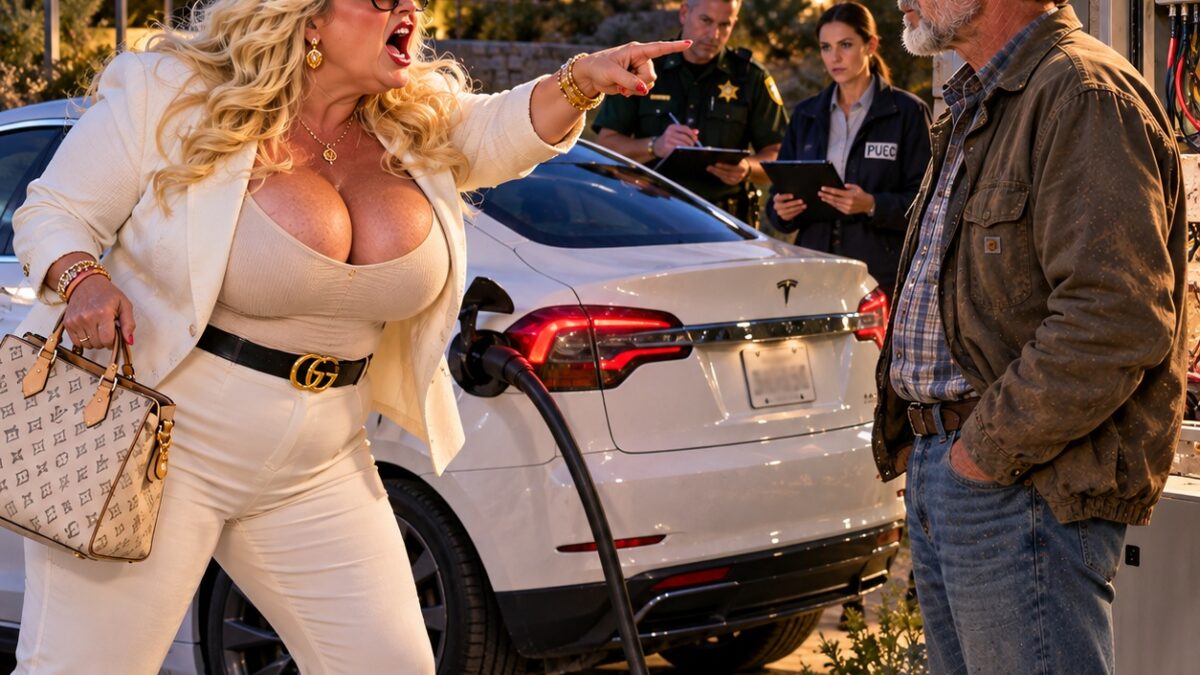
The second warning arrived in May of 2022, in the form of a white Tesla Model S Plaid.
Tamson announced it in the Sandia Vista community newsletter as her sustainable transportation commitment. The photograph showed her leaning against the car in oversized sunglasses, one hand resting on the roof as if the vehicle were a campaign donor. Behind her, the Sandias looked magnificent, which they do regardless of who is trying to use them for branding.
The newsletter said she was committed to charging through renewable sources whenever possible.
It did not say what renewable source she had in mind.
I did not think about it much at the time.
I should have.
The unauthorized draw began in September 2023.
My anomaly detection flagged increased evening discharge in the third week of that month. The load appeared mostly between nine and eleven. Smooth, steady, and persistent. At first, I attributed part of it to the attic ventilation fan Sigrid had insisted on installing upstairs.
The fan explained perhaps twenty percent.
The rest remained.
I checked the obvious things.
Refrigeration.
Well pump.
Lighting.
Studio equipment.
Battery conditioning.
Seasonal load variation.
Nothing explained it.
By mid-October, the load shape was unmistakable.
An electric vehicle.
I sat in the inverter cabinet hallway, laptop open, scrolling through the graphs. Each evening draw felt like a footprint. Same window. Same current behavior. Same hidden hand reaching into my system after dark.
When I called Edith, I expected confirmation.
I still hated hearing it.
“Dad,” she said, after I described the pattern, “there is an unauthorized tap somewhere on your service architecture.”
“I know.”
“No visible connection?”
“None.”
“Then it’s buried.”
“Likely.”
“You need current clamps on every output circuit. Then thermal imaging at night. Then call Marin.”
Marin Halverson worked at the New Mexico Public Service Commission Consumer Protection Division. Edith knew her from New Mexico Tech. Marin had handled small property solar theft cases before. I had not thought my retirement would ever require a regulator, but life has a way of making specialists useful.
I installed the current clamps.
Edith and Ingga drove up the following weekend with a thermal imaging unit borrowed from Sandia. Ingga, who has been Edith’s partner for seven years, is one of the calmest people I know. She brought soup, because she said technical investigations go better when no one is hungry.
This was wise.
We waited for a cold, clear night.
At 11:00 p.m. on November 2, the buried line appeared.
On the thermal image, it ran like a secret with a temperature differential.
From the southwest corner of my service architecture across the property line toward Lot 12.
Tamson’s lot.
Straight.
Active.
Three hundred twenty feet.
Edith adjusted the imaging unit and said, quietly, “There.”
One word.
Enough.
I felt something old and unpleasant move inside my chest.
Not surprise.
Not even anger yet.
Violation.
There is a particular feeling that comes when you discover someone has not simply lied to you, but has physically entered the systems that keep your home alive. The cable was not inside my house, but it felt intimate anyway. It touched the thing I had built for Sigrid and myself. It used the battery reserve I had designed with our future in mind.
Tamson had not stolen from an abstract source.
She had reached into a piece of our life.
The next morning, I called Marin Halverson.
She listened for thirty minutes.
When I finished, she said, “Otto, I am opening a formal investigation file today.”
She also referred the case to the Sandoval County Sheriff for criminal investigation. Electricity theft above the statutory threshold is a felony in New Mexico. The value already documented in my logs was substantial enough. More importantly, the method showed intent.
A hidden buried cable does not happen by misunderstanding.
Before we ended the call, I asked Marin a careful question.
Did I, as the owner and operator of a private off-grid solar array, have any obligation to maintain standard voltage characteristics to an unauthorized recipient while the case proceeded?
Marin paused.
The pause mattered.
Careful people pause before important answers.
Then she explained, in her precise regulatory voice, that I was not a public utility. My private off-grid system did not owe service duties to an unauthorized recipient. My inverter output was my engineering decision, provided I operated lawfully, documented properly, and protected my own authorized household circuits.
She used a phrase I later repeated to Sigrid.
No duty to the thief.
It sounded almost too plain to be law.
But plain things are often where law becomes useful.
That evening, I sat with Sigrid on the back porch.
The sky had gone deep blue above the Sandias. Alena slept near the door. Sigrid held a mug of tea with both hands, the way she does when she is preparing to listen seriously.
I told her everything.
The thermal image.
The cable.
Lot 12.
Marin’s regulatory file.
The sheriff referral.
The possible engineering response.
She did not interrupt.
When I finished, she asked, “Would it harm a person?”
“No.”
“Would it harm our house?”
“No. The household circuits remain isolated and protected.”
“Would Edith verify that?”
“Yes.”
“Would Marin put the regulatory position in writing?”
“I believe so.”
Sigrid looked toward the array.
“And are you doing this because you are angry?”
I was quiet.
She turned toward me.
“Otto.”
“Yes,” I said. “I am angry.”
“I know.”
“But not only angry.”
“That is the part I need to understand.”
I sat with that.
Marriage requires more honesty than court.
“I am angry,” I said. “But I am also responsible for the system. If someone can connect illegally and draw power for months, then the system is vulnerable. If the only response is waiting while the theft continues, then the theft becomes the default operating condition. I do not want to punish recklessly. I want the system to answer truthfully.”
Sigrid listened.
Then she nodded once.
“Get everything in writing. Have Edith model it. Do not improvise.”
“I won’t.”
“And Otto?”
“Yes?”
“If at any point this becomes revenge instead of engineering, stop.”
That sentence stayed with me.
It still does.
Edith returned the next weekend.
We sat at the kitchen table with laptops, coffee, and Sigrid’s cinnamon bread, because Sigrid believes even technical review benefits from food. Edith modeled the proposed diagnostic event against an unauthorized EV charging load. She confirmed the household equipment would be isolated. She confirmed the diagnostic parameters would be captured. She confirmed that the event was consistent with controlled inverter testing.
She also said, “Dad, you understand this will likely damage the car’s onboard charger.”
“Yes.”
“And you understand they will accuse you of sabotage.”
“Yes.”
“And you understand your defense is that the line is unauthorized and the diagnostic activity belongs to your private system.”
“Yes.”
She looked at me.
“You need Marin’s letter before anything happens.”
“I know.”
“Not after.”
“I know.”
“You taught me that documentation after the fact is an apology wearing a necktie.”
I smiled despite myself.
“I did say that.”
“You said it often.”
“Then I was very wise.”
“You were repetitive.”
Both can be true.
Marin provided the regulatory acknowledgement letter before the scheduled test. It stated that my system was a private electrical generation system subject to no public utility duty, that voltage modulation and diagnostic testing were at my engineering discretion, and that no regulatory obligation extended to an unauthorized recipient of my electrical output.
She filed copies with the appropriate offices.
The legal framework was documented.
The engineering framework was documented.
The moral framework still sat with Sigrid for two more days.
On the evening before the test, she came into the inverter cabinet hallway while I was reviewing the checklist.
The hallway is narrow, lined with utility panels, framed documents, and Sigrid’s framed certified-mail receipt from Tamson’s first letter. The inverter cabinet hummed softly, the way healthy equipment does when it is busy and untroubled.
Sigrid stood beside me for a long moment.
Then she said, “Do it.”
I looked at her.
“The engineering is sound,” she said. “The regulatory acknowledgement is sound. The proportionality is sound. The alternative is allowing her to steal for another season while the courts move at their own pace. I will not allow her to steal from us for another season.”
That was Sigrid’s blessing.
Quiet.
Careful.
Final.
The diagnostic event occurred the evening of November 22, 2023, during the same window Tamson’s Tesla usually began drawing from my system.
I will not describe the procedure as instructions.
It was not a household trick.
It was a controlled engineering response designed by a retired professional, reviewed by an independent engineer, acknowledged by a regulator, and logged by a system built to preserve the record.
The important point is simple.
The unauthorized line received output from my private inverter that it had no lawful right to expect, because it had no lawful right to be connected at all.
My system recorded every parameter.
The current clamps recorded the delivery.
The logs synced.
And Tamson’s Tesla recorded enough to condemn itself.
At 9:06 p.m., her mobile app notified her that the vehicle’s charging system had suffered a serious error and required service.
At 9:11, according to later records, Tamson entered her garage, unplugged the charger, tried again, and found the car would not accept charge.
She called Kendrick.
Kendrick called Tesla roadside assistance.
The next morning, a Tesla service technician diagnosed catastrophic failure of the onboard charging electronics. Tesla reviewed the charging history and identified input from an unauthorized or improper power source outside warranty specification.
Warranty denied.
Insurance denied.
Replacement and recalibration cost: roughly sixteen thousand dollars.
That was when Tamson decided she was the victim.
Her civil lawsuit arrived in December.
Malicious electrical sabotage.
Damages.
Repair costs.
Emotional distress.
Sigrid read the complaint at the kitchen table, removed her glasses, and stared silently at the wall.
Then she said, “She stole electricity and is suing because the stolen electricity was not comfortable?”
“That is one interpretation.”
“It is the correct interpretation.”
I could not improve on it.
By December 18, our response was ready.
Eighty-seven pages.
Seven months of inverter data logs showing the unauthorized draw.
Thermal images identifying the buried line.
Current clamp data.
Marin’s regulatory acknowledgement.
Sheriff’s preliminary report.
Engineering documentation.
Edith’s expert statement.
Relevant state statutes.
A chain of evidence so clean it almost looked inevitable.
Evidence rarely feels inevitable while you are gathering it. It feels tedious, repetitive, and occasionally absurd. Then, in court, people call it powerful.
Judge Astrid Bouchard held the pretrial conference on January 8.
Tamson arrived in a tailored white jacket and a face arranged into injured dignity. Kendrick sat beside her, jaw tight. Their attorney carried a thin folder.
My attorney placed our binder on the table with a sound that seemed to change the room.
Judge Bouchard reviewed the filings.
She asked Tamson’s attorney one question.
Did his client have any legal authority to draw electrical power from my private off-grid system without my consent?
The attorney tried to speak around it at first.
Community misunderstanding.
Sustainability context.
Prior communication.
Neighborly expectations.
The judge listened for perhaps ten seconds.
Then she repeated the question.
Did Tamson Bramble have legal authority?
The attorney conceded she did not.
The case ended there in all the ways that mattered.
The judge dismissed Tamson’s civil suit and referred the full incident folder to the Sandoval County Prosecutor’s Office for review of potential criminal charges.
Tamson did not look at me when the judge spoke.
I did not need her to.
The numbers had spoken.
Criminal charges followed.
Felony electricity theft against Tamson, Kendrick, and Wallace.
The investigation widened. Once prosecutors began asking who installed the line and how it had been paid for, they started asking what else Tamson had done under the language of sustainability.
That opened the HOA books.
What they found did not surprise me, but it did anger Sigrid in a way I had rarely seen.
Tamson had been billing Sandia Vista through her personal LLC for “community sustainability consulting” at twenty-two hundred dollars a month.
For twenty-six months.
She had been charging the HOA for sustainability leadership while stealing electricity from my private solar array to charge her own car.
The symmetry was almost architectural.
Tamson took a no contest plea.
State custody.
Probation.
Restitution for the stolen electricity.
Restitution for my legal defense costs.
Restitution tied to HOA financial misconduct.
A permanent ban from serving on any New Mexico community board.
She reported to custody in Grants that May.
Kendrick took a separate plea and filed for divorce later that year.
Wallace’s unlicensed electrical work followed him back to Texas, where his pending licensing application was permanently denied.
The Tesla was sold at salvage auction.
For several weeks after the plea, Sandia Vista was almost silent.
Not peaceful.
Stunned.
There is a difference.
A neighborhood after scandal has the atmosphere of a room where someone broke something valuable and everyone is still looking at the floor for pieces.
Then came the apology visits.
The first was Wendell Bouchard, the previous HOA president, with his wife Renata in her wheelchair. Renata had recovered partial function after her stroke and used a small assistive tablet to communicate.
They sat with Sigrid and me on the porch for two hours.
Wendell held his hat in both hands like a man arriving at church after missing too many Sundays.
“I should have pushed back when she ran,” he said. “I knew she would do something embarrassing. I did not know she would do something criminal.”
Renata typed slowly.
I was horrified. I am sorry I could not help sooner.
Sigrid took her hand.
“You are here now.”
That was enough.
A few weeks later, Edmund Peton-Howerin came to the house. Seventy-two years old, retired University of New Mexico chemistry professor, newly elected president of the Sandia Vista HOA. He brought a casserole and a handwritten apology from the new board.
The apology was better than the casserole.
The casserole was still appreciated.
Edmund sat with us for three hours and spoke plainly. The new board had repealed Tamson’s self-serving bylaws. They had opened the books. They had hired outside accounting help. They had updated policies to make clear that private property outside Sandia Vista boundaries was not a community resource, amenity, opportunity, or sustainability asset.
“We intend to become boring,” Edmund said.
Sigrid smiled.
“Boring is underrated.”
That was the beginning of peace.
Not friendship yet.
Peace.
Friendship takes longer, and should.
We have since had Edmund and his wife Cordelia to dinner four times. He is a good man. Quiet. Careful. Deeply uninterested in branding anything. I consider that a virtue.
The story left Placitas faster than I expected.
The Albuquerque Journal ran a feature in late February. The Santa Fe New Mexican picked it up. Then an engineering magazine wrote about off-grid solar theft protection and called the case an example of private residential energy security meeting regulatory clarity.
That article brought consulting requests.
Ranchers.
Retirees.
Rural homeowners.
Small research sites.
People across the West with private solar systems and long property lines. People who did not want revenge. They wanted records, safeguards, monitoring, and a way to prove what was happening before they found themselves yelling at a neighbor with no evidence.
I accepted some engagements.
Not all.
Sigrid warned me not to retire from retirement.
We made rules.
Fifteen hours a week.
No overnight travel.
No work for anyone who sounded more interested in punishment than protection.
That last rule was Sigrid’s.
A good rule.
The consulting income helped us start the Cunningham Solar Education Foundation, a small New Mexico nonprofit supporting rural high schools with off-grid solar curriculum, training equipment, and student demonstration arrays.
The first grants went out in October.
When the Albuquerque Journal later reported that three students from a Sandoval County program had enrolled in electrical engineering at New Mexico State, Sigrid cried at the kitchen table.
I pretended to study the article.
Then I cried too.
It is one thing to win a dispute.
It is another thing to turn the remains of it into something useful.
Edith and two Sandia colleagues began writing a technical paper documenting the case from the engineering side. Not a revenge story. A formal paper on unauthorized load detection, private off-grid monitoring, regulatory acknowledgement, and documented response.
She invited me to co-author.
I accepted.
We signed the working draft the way we have signed joint engineering notes since she was twelve.
O. Cunningham and E. Cunningham.
Cunningham Engineering Associates.
Sigrid began a printmaking project inspired by solar geometry across the Southwest. Forty large-format intaglio prints. Panel arrays. Shadows. Seasonal angles. The shape of sunlight made visible through ink and pressure.
She titled it The Geometry of Sunlight.
I offered once to explain the technical basis of some of the array shapes.
She thanked me politely and told me she had no need for an electrical engineer to explain her art.
I accepted that ruling.
It was correct.
These days, the unauthorized cable to Lot 12 is gone.
Disconnected.
Capped.
Removed from my service side.
The inverter output sits steady. The battery bank charges and discharges as designed. The household runs quietly. Alena lies on the porch at sunset and watches the panels as if they are alive.
They are fixed mount.
They do not track the sun.
Alena does not care.
Sigrid says the dog is paying her respects to family infrastructure.
Sigrid is usually right.
Sometimes people ask whether I regret what happened to Tamson’s car.
I tell them regret is for accidents.
What happened was not an accident.
It was documented, reviewed, measured, and created by an unauthorized connection she had no right to make.
She looked at forty-two panels on my land and saw an opportunity.
She looked at my battery reserve and saw a community resource.
She looked at my polite refusals and saw delay.
She looked at my quiet and saw weakness.
That was her mistake.
Quiet is not weakness.
Sometimes quiet is a logging system writing down every watt.
Sometimes quiet is a regulator opening a file.
Sometimes quiet is a daughter standing in the cold with a thermal camera.
Sometimes quiet is an old engineer waiting until the evidence is clean enough that no amount of confidence can contaminate it.
Tamson believed electricity was invisible.
It is not.
Electricity leaves traces.
So does arrogance.
So does every person who treats someone else’s work as public property because paying for their own would be inconvenient.
My grandfather built this place with railroad wages and adobe walls.
My father kept it through signals work, thrift, and stubbornness.
I spent thirty-one years learning how power moves, how systems fail, and how truth hides in data until someone cares enough to read it.
Tamson Lockhart Bramble thought she had found free energy.
What she found was a century of Cunninghams, one careful wife, one very precise daughter, and a little cabinet of truth that had been waiting patiently for someone foolish enough to steal from it.