𝗙𝗨𝗟𝗟 𝗦𝗧𝗢𝗥𝗬:I Took Home the Dog Everyone Called Unreachable—Nine Days After I Gave Up, the Shelter Called Me Crying
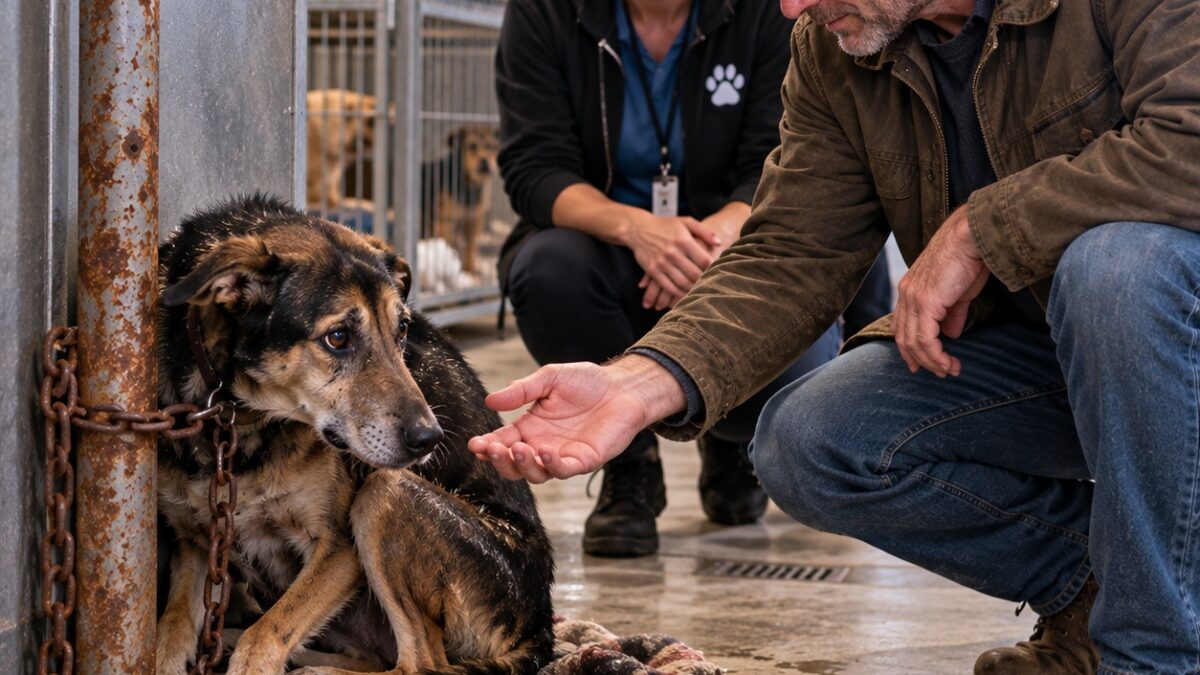
FULL STORY CONTINUATION
I sat down before Grace finished the sentence.
Something in her voice made my knees weak.
“What happened?”
“She isn’t settling.”
My stomach dropped.
“Is she sick?”
“No.”
“Not eating?”
“Some.”
“What is it?”
Grace exhaled.
“At night, she lies at the front entrance.”
I didn’t understand.
“The kennel entrance?”
“No.”
“The building entrance?”
“Yes.”
I stopped breathing.
Grace continued carefully.
“The cameras show her sleeping with her muzzle against the gap under the main door.”
I pressed my fingers to my mouth.
“Why?”
“We think she’s waiting.”
“For what?”
Grace was silent for half a second.
Then:
“For you.”
I couldn’t speak.
Everything I had spent nine days telling myself cracked at once.
Skylar had been frightened in my apartment.
That part was true.
She had hidden.
True.
She had avoided touch.
True.
She had rarely approached.
Also true.
I had taken all of that as evidence that she did not want me.
Grace was telling me something completely different.
“She gets up every morning before the staff arrives,” she said. “When the doors open, she stands immediately.”
I closed my eyes.
“She watches the hallway.”
Tears ran down my face.
“She looks at every person coming in.”
I could barely whisper.
“Grace.”
“I know.”
“I thought she was miserable with me.”
“She was afraid with you.”
“What’s the difference?”
“A lot.”
I listened.
Grace had worked with traumatized dogs for years.
She explained that attachment does not always look like affection.
Not at first.
Some dogs seek closeness.
Others observe from distance.
They memorize footsteps before they ever follow them.
Learn a voice before they respond to it.
Learn a person’s breathing before they risk sleeping near them.
“Skylar knew where you were in the apartment all the time,” Grace said.
I remembered.
Her eyes following me from the corner.
I had thought she was monitoring danger.
Maybe she was.
But I had become part of what she was monitoring.
“She knew your routine,” Grace continued.
“How?”
“When she came back, certain sounds here started making her alert.”
I wiped my face.
“What sounds?”
“Keys.”
I looked at the bowl beside my apartment door where mine sat.
“Footsteps.”
My throat tightened.
“And a woman’s voice in the hallway.”
I started crying harder.
Grace let me.
No motivational speech.
No false comfort.
Just stayed on the line.
Finally I said:
“I hurt her.”
“I don’t think that’s the lesson here.”
“I abandoned her.”
“You made a decision because you believed you were failing her.”
“I was.”
“No.”
Her voice became firmer.
“You were inexperienced.”
“That seems generous.”
“You made the mistake of expecting recovery to look like gratitude.”
That sentence hurt because it was true.
I had not demanded affection consciously.
But underneath all my patience, I had been waiting for proof.
A wag.
A touch.
A sign.
Something that told me my love worked.
Skylar had been doing something much harder.
Learning whether my love would remain even when she gave me nothing back.
And then I left.
“When can I see her?”
“Tomorrow morning.”
“Why not tonight?”
“The building is closing.”
“I’ll wait outside.”
Grace laughed softly through tears.
“First thing tomorrow.”
“I’ll be there.”
I barely slept.
I cleaned nothing.
Prepared nothing.
Did not rearrange the apartment or buy new toys.
For the first time, I wasn’t planning what Skylar should become.
I was simply going to see her.
At 6:42 the next morning, I was parked outside the shelter even though it did not open until seven.
The building windows were dark.
My hands shook on the steering wheel.
At 6:58, a light came on.
Then another.
At seven, Grace unlocked the doors.
I was already standing there.
She looked at my face.
“You didn’t sleep.”
“No.”
“Come on.”
The shelter smelled exactly as I remembered.
Disinfectant.
Wet fur.
Laundry detergent.
Food.
Dogs barking from different wings.
Metal kennel doors.
Before, those sounds had felt chaotic.
That morning, they felt like distance I needed to cross.
Grace led me down a corridor.
“She is in the quiet room.”
“Why?”
“She wasn’t doing well in the kennel row.”
I looked at her.
“Because of me?”
“Because she is Skylar.”
Fair.
We reached a closed door.
Grace stopped.
“She has been sleeping here.”
My hand was already on the handle.
Grace touched my arm.
“Don’t rush.”
I looked at her.
“Let her make the decision.”
I nodded.
Grace stepped away.
“This belongs to you two.”
I opened the door slowly.
Skylar lay directly against the inside threshold.
The moving door made her lift her head.
For a second, nothing happened.
Her body tightened.
Same rigid shoulders.
Same ears.
Same frozen alertness I remembered from my apartment.
My heart sank.
Then her eyes met mine.
Something changed.
Not dramatically.
No bark.
No leap.
No sudden transformation.
Recognition passed through her face so quietly I almost missed it.
Her ears moved forward.
Her head rose.
I stayed still.
“Hi, sweetheart.”
My voice broke.
Skylar stood.
Slowly.
Her legs trembled.
She took one step.
Stopped.
I lowered myself into a crouch.
Hands open.
No reaching.
Another step.
She stopped again.
I wanted to call her.
Didn’t.
Wanted to move closer.
Didn’t.
For once, I understood.
My job was not to close the distance.
My job was to remain safe while she decided whether she could.
Skylar crossed it herself.
One step at a time.
When she reached me, she stretched her neck forward.
Her nose touched my palm.
She smelled my hand for a long time.
Then my wrist.
Sleeve.
I could hear her breathing.
Fast.
Uncertain.
“It’s me.”
Her eyes lifted.
“I came back.”
That was when Skylar did something she had never done at home.
She stepped forward.
Her shoulder touched my knee.
Then her chest.
Then she leaned.
Her entire body pressed against me.
Heavy.
Shaking.
Real.
I didn’t touch her at first.
I was afraid even breathing differently might break the moment.
Skylar lowered her head into my hands.
I started crying.
No sound.
Just tears.
My fingers remained open beneath her jaw.
She exhaled.
Long.
Deep.
A breath that seemed to come from years ago.
Her muscles softened.
Grace was standing somewhere behind me.
I heard her quietly crying too.
I whispered:
“I’m sorry.”
Skylar leaned harder.
“I thought you didn’t want me.”
Her eyes closed.
“I didn’t understand.”
That was our real adoption day.
Not the first one.
The first day, I took possession of paperwork.
That morning, Skylar chose to come toward me.
There is a difference.
Grace sat with me afterward.
Skylar stayed near my legs.
Not touching constantly.
But she did not return to the far corner.
“What happens now?” I asked.
“That depends on you.”
“I want to bring her home.”
Grace smiled.
“I thought you might.”
“But what if I do it wrong again?”
“You will.”
I stared.
She laughed.
“Everyone does things wrong.”
“Comforting.”
“The goal isn’t perfection.”
“What is it?”
“Consistency.”
I looked down at Skylar.
Grace continued.
“Stop asking whether she is becoming a normal dog fast enough.”
That hurt too.
“What should I ask?”
“Does she feel safer today than yesterday?”
I nodded.
“And if the answer is no?”
“Stay steady anyway.”
That afternoon, Skylar came home.
No celebration.
No new bed.
No photographs.
No announcement.
I opened the apartment door.
She stopped at the threshold.
For one terrifying second, I thought she would refuse.
Then she walked inside.
Straight to the same dark corner.
A month earlier, that would have crushed me.
This time I placed her water nearby.
Put food where she could reach it.
Then sat several feet away with a book.
No coaxing.
No “Come here.”
No treats held toward her face.
I read.
Not aloud.
Just turned pages.
Evening light faded.
Skylar watched me.
I occasionally smiled.
That was all.
After almost two hours, she lowered her head.
I whispered:
“You can take as long as you need.”
One ear moved.
“I’ll still be here.”
The promise mattered less than proving it.
So I proved it the next day.
And the next.
Same breakfast time.
Same calm voice.
Same route around the apartment.
Same distance when she needed it.
I stopped thinking of her corner as a failure.
It was safety.
Safety is where healing begins.
Not where it ends.
Skylar ate only after I moved away at first.
Then one morning, I put the bowl down and sat at the kitchen table.
Instead of waiting for me to leave, she stood.
Looked at me.
Walked toward the bowl.
Stopped.
I kept reading.
She took one bite.
Looked up.
I did nothing.
Second bite.
Looked up again.
Nothing.
By the fifth bite, she stopped checking.
I cried into my coffee so quietly she never noticed.
Progress became a collection of almost invisible moments.
A week later, she left the corner while I was reading.
Three steps.
Stopped.
Returned.
Two days after that, she crossed half the living room.
One evening, I heard nails against the floor.
Skylar appeared near my chair.
I held my breath.
She circled once.
Then lay down beside my feet.
Not touching.
Close enough to feel.
I did not move for forty-three minutes.
My leg went numb.
Worth it.
The next night she did it again.
Closer.
Then one day her back touched my shoe.
I smiled at the wall like an idiot.
That became our rhythm.
Skylar controlled distance.
I controlled predictability.
Eventually, curiosity began competing with fear.
A sock disappeared.
I found Skylar in the bedroom holding it.
She froze.
Dropped it immediately.
Her body lowered.
I realized what she expected.
Punishment.
My chest hurt.
I picked up another sock.
Tossed it gently across the floor.
Skylar stared.
“What?”
Nothing.
“Apparently, we steal socks now.”
She looked at the first sock.
Then at me.
Then grabbed it.
One small shake.
Immediately stopped, as though shocked by herself.
I laughed softly.
Her tail moved.
Barely.
But unmistakably.
That evening, I called Grace.
“She wagged.”
Grace screamed.
I pulled the phone away.
“You work with scared dogs. Should you be that loud?”
“I’ve been waiting.”
“So have I.”
“No.”
She became serious.
“You’ve been learning not to.”
She was right.
The tail wag mattered because I hadn’t demanded it.
Another month passed.
Skylar’s personality emerged like something slowly uncovered beneath layers of snow.
She was observant.
Stubborn.
Surprisingly playful.
Terrified of umbrellas.
Suspicious of men wearing hats.
Hated the vacuum cleaner.
Loved cheese.
Liked watching pigeons from the window.
Had absolutely no interest in the expensive toys I bought initially.
Preferred socks.
Especially mine.
She followed me from room to room.
At first from a distance.
Then closer.
I would move to the kitchen.
Thirty seconds later, Skylar appeared in the doorway.
Bathroom.
Skylar outside.
Bedroom.
Skylar at the threshold.
Eventually, she became my shadow.
The first time I touched her forehead deliberately, I asked without words.
Hand low.
Slow.
She watched.
Did not retreat.
My fingers touched the fur between her ears.
Skylar closed her eyes.
I almost stopped because emotion rose so quickly.
Instead, I moved once.
Slow stroke.
Then removed my hand.
Skylar opened her eyes.
She stepped closer.
That was permission.
I touched her again.
Within weeks, forehead scratches became part of evening routine.
She still did not like hands over her back unexpectedly.
I respected that.
People sometimes imagine trust means trauma disappears.
It doesn’t.
Trust means fear no longer makes every decision.
There were setbacks.
A delivery driver dropped a package outside my door.
The bang sent Skylar running to her corner.
She stayed there for three hours.
The old me would have panicked.
The new me made tea.
Sat nearby.
Read.
Eventually, she emerged.
Another time, someone shouted in the hallway.
Skylar shook so hard her teeth clicked.
I sat on the floor.
Not touching.
“I’m here.”
That was all.
Twenty minutes later, she crawled toward me and placed one paw against my leg.
I cried afterward.
Not because she was broken.
Because she was brave.
That became the word I used most.
Not damaged.
Not difficult.
Brave.
Every ordinary action required her to challenge history.
Eating while a human remained nearby.
Sleeping deeply enough not to monitor the room.
Walking through a doorway without knowing what waited beyond it.
Closing her eyes beneath a hand.
These things looked normal from the outside.
For Skylar, they were acts of courage.
I began understanding my own impatience differently.
I had wanted a dramatic rescue because dramatic rescue makes the rescuer feel useful.
Feed.
Love.
Fix.
Receive affection.
Simple.
Trauma does not follow our emotional schedule.
Sometimes love looks like sitting six feet away.
Sometimes helping means doing nothing.
Sometimes the greatest gift you can give a frightened creature is control over the moment.
That lesson changed me outside Skylar too.
I became more patient with people.
Better at silence.
Less likely to fill uncomfortable pauses.
Less certain that helping required advice.
Skylar taught me presence.
A dog who barely moved taught me how to stay.
Months after she returned, she began sleeping on a rug beside my bed.
The first night it happened, I woke at two in the morning.
Dark room.
For a second, I didn’t know why.
Then I heard breathing.
Skylar.
Curled at the foot of the bed.
I smiled in the dark.
The next morning, something warm touched my cheek.
I opened my eyes.
Skylar’s nose.
I jumped slightly.
She jumped backward.
“Sorry.”
I stayed still.
She watched.
Then approached again.
Nose against cheek.
Gone.
That became her morning method.
No alarm clock required.
Some dogs bark.
Skylar conducted facial inspections.
Grace visited several months later.
I worried the shelter smell on her clothing might upset Skylar.
Instead, Skylar stared from across the room.
Grace crouched.
“Hi, beautiful.”
Skylar looked at me.
I said nothing.
She approached Grace carefully.
Sniffed.
Then returned to my side.
Grace’s eyes filled.
“What?”
“She checked with you.”
I smiled.
“She does that.”
Grace sat.
Skylar lay near my chair.
“You know what I remember?”
“What?”
“The first day.”
“So do I.”
“You sat outside her kennel for almost an hour.”
“She barely looked at me.”
“She watched you constantly.”
I frowned.
“You said she didn’t.”
“I said she didn’t look directly.”
Grace smiled.
“Not the same thing.”
That sounded familiar now.
Traumatized animals become experts at gathering information without revealing interest.
Skylar had been learning me from the beginning.
Footsteps.
Voice.
Movement.
Breathing.
Maybe that invisible bond Grace described had started before we left the shelter.
I had simply been looking for the wrong evidence.
Grace scratched Skylar gently beneath the chin after being invited.
“She looks different.”
“Her coat?”
“Her eyes.”
I knew.
The guarded emptiness was gone.
Not entirely.
Certain moments brought it back.
But now something lived alongside fear.
Expectation.
Curiosity.
Attachment.
Hope.
Dr. Bennett, our veterinarian, saw it too.
Skylar had needed medical care after adoption.
Old scars.
Poor nutrition.
Chronic skin irritation.
Nothing dramatic enough to tell us exactly what happened before the shelter.
I was grateful.
I eventually stopped wanting details.
Knowing every cruelty would not help Skylar heal.
Her body already remembered.
My job was not to investigate yesterday.
It was to make today safe.
During one appointment, a metal tray fell.
Skylar panicked.
I crouched.
Didn’t grab.
Didn’t restrain.
She moved behind me.
Behind me.
That mattered.
Months earlier, fear sent her away from every person.
Now fear sent her toward one.
Dr. Bennett noticed.
“She used you as cover.”
I looked down.
Skylar pressed against my leg.
“I guess she did.”
“That is trust.”
I didn’t cry until we reached the car.
I cried a lot that first year.
Happiness surprised tears out of me almost as often as sadness.
The largest change happened on an ordinary afternoon.
No anniversary.
No crisis.
No shelter worker visiting.
I was reading on the couch.
Skylar lay several feet away.
Sunlight across the rug.
At some point she stood.
I assumed she wanted water.
Instead she approached the couch.
Stopped.
Looked at me.
My heart started pounding.
I did nothing.
Skylar placed one front paw on the cushion.
Then another.
Paused.
Climbed up.
The couch was large.
She could have chosen the opposite end.
She didn’t.
Skylar turned once.
Then lowered her body directly against mine.
Her head settled across my lap.
I stopped reading.
My hand hovered.
Waited.
Skylar exhaled.
Eyes closed.
I rested my hand on her shoulder.
No flinch.
No tightening.
Nothing.
Just weight.
Warmth.
Trust.
I looked down at the dog who once believed even kindness might be temporary.
“You did it.”
Her ear moved.
Not I did it.
She did.
That realization mattered.
I had provided food.
Home.
Safety.
Routine.
But I had not pulled her out of fear.
Skylar had crossed that distance herself.
My role was to stay on the other side long enough for her to believe crossing was safe.
That’s what Grace had tried to teach me from the beginning.
I called her later.
“She got on the couch.”
Silence.
Then:
“With you?”
“Yes.”
“Her idea?”
“Yes.”
Grace cried.
So did I.
We had become ridiculous.
The months continued.
Skylar became playful.
Not constantly.
But enough.
Her favorite game involved stealing one sock and waiting for me to notice.
If I approached quickly, she’d drop it.
So I learned to make a show of looking elsewhere.
“Where could my sock possibly be?”
Tail.
“Strange.”
Faster tail.
“Perhaps the washing machine ate it.”
She would emerge carrying the evidence.
Sometimes she made a soft sound that almost resembled a sneeze and growl mixed together.
I called it laughter.
Scientists may disagree.
They weren’t there.
Walking outside took longer.
The apartment itself had become safe.
The world beyond it had not.
At first, Skylar froze at the building entrance.
Cars.
Doors.
Footsteps.
Voices.
I never pulled.
We stood.
Sometimes for ten minutes.
Then went back inside without reaching the sidewalk.
Old me would have called that failure.
New me called it training.
Eventually, one paw crossed.
Then two.
One day we reached the tree by the curb.
I photographed it only after we returned home.
I didn’t want a phone interrupting her accomplishment.
A month later, we walked half a block.
Then one.
Then around the building.
She began smelling grass.
Trees.
Fire hydrants.
The dog world returning.
I watched curiosity replace vigilance inch by inch.
The first time her tail lifted naturally outside, I wanted to tell strangers.
Instead, I told Grace.
Obviously.
Grace had become our unofficial emotional emergency line.
“Tail neutral,” I reported.
“Excellent.”
“She sniffed a mailbox.”
“Revolutionary.”
“You’re mocking me.”
“Never.”
One rainy afternoon, Skylar refused to go outside.
I stood with the umbrella.
She stared at it as though I had opened a portal to hell.
I remembered.
Umbrellas frightened her.
I closed it.
We got wet.
Worth it.
A year later, she still disliked umbrellas.
Healing does not require liking everything.
Neither do humans.
There was a moment around that time when I realized I had stopped introducing Skylar as a rescue.
Someone in the park asked:
“Is she a rescue?”
I automatically said:
“She’s my dog.”
Then realized what I’d done.
Of course she was technically a rescue.
But the word no longer described our relationship.
She wasn’t a project.
Not evidence of my kindness.
Not a sad story I carried around for praise.
She was Skylar.
Stubborn sock thief.
Cheese enthusiast.
Bad weather critic.
Morning nose alarm.
My dog.
One evening, I found the paperwork from the day I returned her.
I had kept it in a drawer.
Why?
Maybe punishment.
I read my own handwriting.
Reason for return:
Unable to adjust. Dog appears persistently distressed in home environment. Concern that adopter lacks experience needed.
I sat on the kitchen floor.
Skylar came over.
She placed her chin on my knee.
“I was so sure.”
Tail moved.
“I thought I was hurting you.”
She looked at the paper.
Probably smelled nothing interesting.
“I almost lost you because I needed your healing to make sense to me.”
Skylar climbed closer.
I tore the paper in half.
Not dramatically.
No declaration.
Just didn’t need it anymore.
My failure had become part of our story.
Not the ending.
That mattered too.
People are frightened of making mistakes in relationships with traumatized animals.
Good.
Care matters.
Professional guidance matters.
But shame can make people disappear.
I disappeared once.
Then I returned.
Skylar let me.
I think about that often.
She was the one with every reason not to trust.
Yet when I came through the shelter door, she gave me another chance.
Slowly.
Trembling.
But she came forward.
Who rescued whom becomes a cliché in animal stories.
I understand why.
It often feels true.
But I hesitate to say Skylar rescued me because that places another responsibility on her.
She didn’t owe me healing.
She didn’t need to fix my loneliness.
She didn’t need to teach me a lesson.
She only needed to be a dog.
I changed because loving her required me to become different.
More patient.
Less demanding.
More comfortable with uncertainty.
That work was mine.
Skylar simply gave me the opportunity.
There were difficult days even after a year.
Fireworks were terrible.
Thunderstorms too.
A maintenance worker entering unexpectedly triggered a setback that lasted almost a week.
She stopped sleeping beside the bed.
Returned to her corner.
Old panic rose in me.
She’s going backward.
Then I remembered.
Recovery is not a staircase.
It loops.
Pauses.
Retreats.
Revisits.
I sat several feet from her.
Book.
Quiet.
No demands.
On the fourth evening, Skylar came out.
On the sixth, she slept near my bed again.
Nothing had been erased.
Trust had simply been tested.
It held.
The first anniversary of her second adoption day mattered more to me than the first.
I didn’t throw a party.
Skylar would have hated that.
I bought cheese.
Grace came over.
We sat quietly in the living room.
Skylar lay between us.
Grace said:
“You know what I thought when I called you?”
“What?”
“That you might say no.”
My stomach tightened.
“Why?”
“Because sometimes people return traumatized dogs and emotionally close the door.”
“I almost did.”
“I know.”
“What would have happened?”
Grace looked at Skylar.
“We would have kept working.”
“And if nobody adopted her?”
“We would have kept working.”
I nodded.
Grace continued.
“But she had already chosen a person.”
I looked down.
Skylar’s head rested on my foot.
“How do you know dogs choose?”
“Behavior.”
“Not poetry?”
“Behavior.”
She smiled.
“She searched for you.”
I still had trouble hearing that without emotion.
Grace added:
“She didn’t know how to ask you to stay when you had her.”
That sentence stayed with me.
Skylar’s silence had not been rejection.
She simply did not have the language I expected.
That’s true of people too.
Some love loudly.
Some reach.
Some speak.
Others remain in the same room because leaving feels too dangerous.
Sometimes attachment is watching your footsteps from a dark corner.
Sometimes trust is eating while you breathe nearby.
Sometimes affection is a sleeping muzzle beneath a door because the person you miss might return through it.
I had been waiting for Skylar to say I love you in a language she hadn’t learned yet.
Once I stopped demanding translation, I began hearing her clearly.
Today, Skylar sleeps beside me as I write.
Late afternoon light comes through the window.
Her dark coat catches gold along the edges.
She is stretched on her side.
Completely exposed.
Belly partly visible.
Legs relaxed.
A dog who once slept curled tight enough to protect every vulnerable part of her body now occupies half the rug like she pays rent.
She does not.
I have discussed this with her.
She remains unmoved.
Sometimes I look at her and remember the shelter room.
Body against the door.
Waiting.
Nine days.
I wish I could go back to the version of myself who drove away after returning her.
I would tell that woman:
You are reading fear as rejection.
You think love is failing because love has not produced visible results.
You think rescue means removing pain quickly.
It doesn’t.
Sometimes rescue means becoming the one predictable thing in a life that has never had one.
Stay.
Be boring.
Be gentle.
Wait.
I cannot change those nine days.
I used to hate them.
Now I understand they taught me something necessary.
I had to lose Skylar temporarily before I understood what she was asking from me.
Not fixing.
Not performance.
Not constant improvement.
Presence.
The saddest part is that Grace had told me from the beginning.
I simply couldn’t hear it yet.
People sometimes ask how long it took Skylar to trust me.
I don’t know how to answer.
Because trust wasn’t one event.
Was it the shelter reunion?
The first meal in my presence?
The first time she slept near my feet?
The first forehead touch?
The sock?
The couch?
The first walk?
The day she hid behind me at the veterinarian instead of running from me?
All of them.
Trust was built like thread.
One strand looks fragile.
Hundreds become something strong enough to hold weight.
That’s what had been happening during those first weeks in my apartment when I thought nothing was happening.
Skylar was memorizing me.
My voice.
My breathing.
How loudly I closed cabinets.
How my footsteps sounded when I approached.
Whether food disappeared.
Whether water returned.
Whether hands respected “no.”
Whether nighttime remained quiet.
Whether morning came without danger.
That is work.
Invisible work.
She was learning me while I was waiting for her to perform healing.
Once I understood that, everything changed.
Not instantly.
Nothing important changed instantly.
That is the point.
The first time Skylar rested her head in my hands at the shelter felt miraculous.
But it wasn’t magic.
It was the result of hundreds of silent observations she had made before I left.
The first time she climbed onto my couch looked sudden.
It wasn’t.
Months of safety preceded it.
The first spontaneous tail wag looked effortless.
It wasn’t.
Years of fear stood behind it.
Healing often becomes visible long after the work begins.
Grace says Skylar changed how the shelter talks to new adopters.
They now spend more time explaining decompression.
Consent.
Distance.
Routine.
They tell people that a dog hiding for days does not necessarily mean the adoption is failing.
They prepare people for quiet.
I like knowing that.
Maybe our mistake became useful.
A new volunteer once asked if Skylar could visit the shelter as a success story.
I laughed.
“Absolutely not.”
Skylar does not owe anybody an inspirational performance.
Grace agreed.
Instead, they use our story without parading her through the building.
That feels right.
Skylar’s world is small by some standards.
Apartment.
Several familiar walking routes.
A quiet park.
Grace.
Dr. Bennett.
A handful of people she trusts.
Mine used to be larger.
Parties.
Crowds.
Spontaneous plans.
Now I prefer her version.
Not because fear should control life forever.
Because safety has value.
Peace has value.
We expand when she’s ready.
Not because somebody thinks a “normal dog” should enjoy a busy café.
Skylar doesn’t know she’s supposed to be normal.
Lucky dog.
One Saturday, we walked through the park and passed a family with a young dog bouncing at the end of the leash.
The puppy lunged playfully.
Skylar froze.
I stepped aside.
Created distance.
The owner apologized.
“No problem.”
Skylar looked at me.
I waited.
Within a minute, she relaxed.
We continued.
A year earlier, that encounter might have ended our walk.
Now it became thirty seconds of uncertainty.
That is progress.
Not fear disappearing.
Recovery becoming possible after fear arrives.
I think humans misunderstand courage in the same way.
Courage isn’t no longer feeling afraid.
Skylar taught me that.
Courage is being afraid and discovering you have choices anyway.
She can retreat.
Pause.
Look at me.
Try again.
Her world is no longer something that only happens to her.
She participates.
Chooses.
That is the freedom I wanted to give her from the first day.
I simply did not understand that I could not hand it over all at once.
Freedom has to feel safe enough to use.
Tonight, I will read in my chair.
Skylar will probably steal a sock.
At some point she will climb onto the couch.
Maybe.
If she doesn’t, nothing is wrong.
That is another thing I learned.
Affection is not attendance.
I do not count touches.
I don’t measure distance anymore.
Skylar doesn’t need to reassure me every day that our bond exists.
The bond became strong the moment I stopped asking her to prove it.
Sometimes she sleeps in the bedroom.
Sometimes living room.
Sometimes, during storms, in her old dark corner.
The corner remains.
I never removed it.
I thought about doing so once.
Grace stopped me.
“Why?”
“So she won’t hide.”
Grace stared at me.
Then I laughed.
“Right.”
Safety means having somewhere to go.
Not forcing someone to stop needing safety.
So the corner stays.
Soft blanket.
Water nearby.
Nobody reaches inside.
It is Skylar’s.
She uses it less now.
But knowing it exists may be one reason she doesn’t need it as often.
That feels like the entire lesson in miniature.
Love is not taking away every escape route so someone has to trust you.
Love is leaving the door open and becoming the place they choose to return to.
Nine days after I returned Skylar, she slept with her nose under a shelter door waiting for me.
Today, she sleeps beside my chair without checking whether I am still there every few minutes.
She knows.
Not because I told her.
Because I stayed.
Sometimes, when morning light comes through the blinds, she stands beside the bed and puts that warm nose against my cheek.
I open my eyes.
There she is.
Tail moving.
Eyes soft.
Waiting for breakfast.
I always smile.
Not because she became the dog I imagined adopting.
She didn’t.
She became Skylar.
And I became the person she needed me to become.
More importantly, I finally understood that neither of us had to earn the other’s love by healing on command.
That first night after bringing her home again, I whispered:
“I won’t abandon you.”
At the time, I thought the promise meant I would never physically take her back to the shelter.
Now I know it meant something larger.
I would not abandon her emotionally when progress became slow.
I would not abandon patience because affection took longer than I hoped.
I would not abandon compassion because trauma was inconvenient.
I would not abandon the frightened version of Skylar in favor of the imaginary easy dog I thought rescue should produce.
I would stay.
And staying changed everything.
People call what happened between us a second chance.
They’re right.
But it wasn’t only Skylar’s.
She got another home.
I got another opportunity to understand love.
Not love as urgency.
Not love as fixing.
Love as endurance.
Love that can sit quietly on a floor for hours without receiving anything back.
Love that does not panic when the creature you adore hides.
Love that understands a trembling step forward may contain more courage than a joyful leap.
Love that waits.
Skylar taught me that slowly.
Exactly the way she needed to.
And maybe that is why the lesson lasted.
I brought her home the first time believing tenderness could erase the past.
I brought her home the second time understanding nothing could erase it.
The past would remain part of her.
Old fear.
Old reflexes.
Memories stored in a body without words.
Our job was not to erase.
We were building something beside it.
New memories.
Food arriving every morning.
A hand that stops when she asks.
A voice that stays calm.
A couch where she can sleep.
A person who returns.
Enough new safety, repeated often enough, that yesterday no longer gets the only vote.
That is what healing became for us.
Not forgetting.
Having another option.
As I finish writing this, the sun is setting.
Skylar is beside me.
Her head rests across my leg.
Her breathing is deep.
One paw twitches in a dream.
Outside, somebody closes a car door.
Once, that sound would have sent her running.
Her ear moves.
That’s all.
I place my hand lightly on her shoulder.
She doesn’t wake.
There was a time when Skylar could not sleep if I shifted in my chair.
Now she dreams beneath my hand.
I can’t imagine a greater expression of trust.
I used to think the beautiful ending would be the day she stopped being afraid.
That day may never come completely.
It doesn’t need to.
This is more beautiful.
She knows fear.
And she knows home.
Both can exist.
But fear is no longer the only thing she believes.
One year ago, I thought I had failed because a traumatized dog did not transform beneath my love.
Today, I understand how arrogant that expectation was.
Skylar didn’t need transformation.
She needed time.
Choice.
Consistency.
Safety.
And somebody willing to stay while she decided whether hope was worth risking again.
She took that risk.
So did I.
Now, every evening, when she settles against me and releases the deep sigh she first gave in that shelter room, I remember the frightened dog sleeping against a locked door for nine nights.
Waiting.
Hoping.
Listening for footsteps she had memorized before I even knew she cared.
And I understand the truth I almost learned too late.
Skylar had never been incapable of love.
She had simply learned that love could disappear.
So I stopped trying to convince her with words.
I stayed long enough to prove it wouldn’t.