𝗙𝗨𝗟𝗟 𝗦𝗧𝗢𝗥𝗬:HOA Queen Stole My Garage for Her Fake Police Fleet and Mocked My Grandfather’s Lock Collection — She Never Expected One Locksmith to Bring Her Entire Empire Crashing Down!
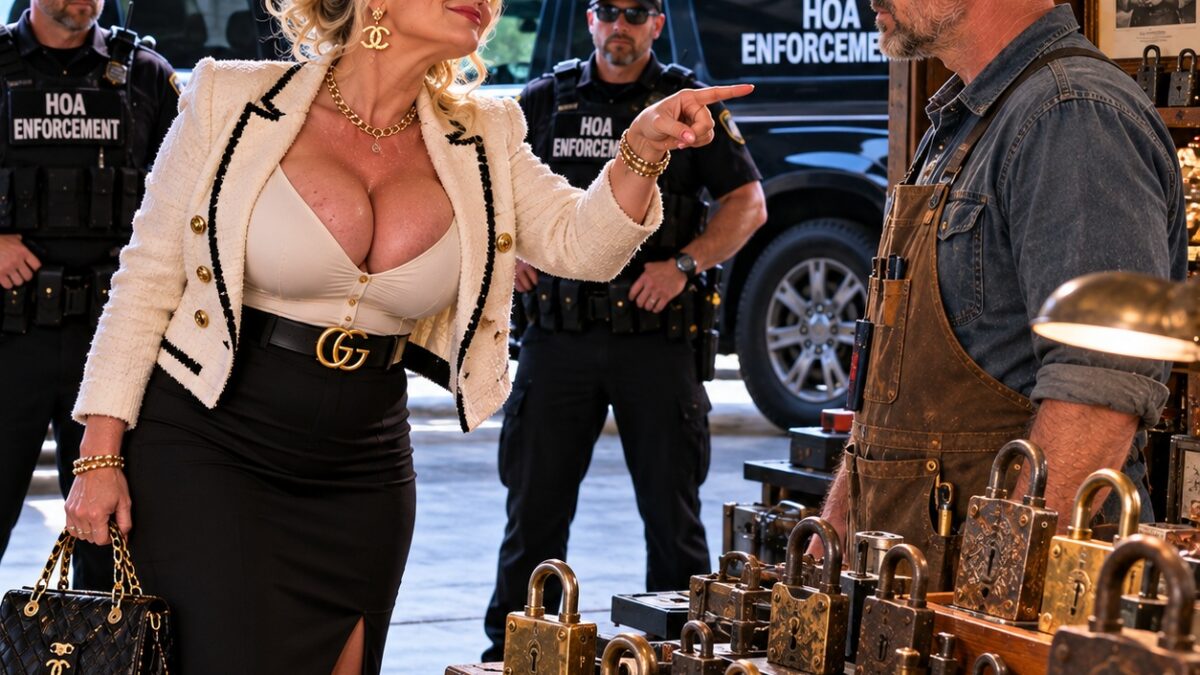
FULL STORY CONTINUATION
My name is Nathan Callaway.
I am forty-eight years old, a certified master locksmith, one of roughly three thousand in the country. That means I can tell you more about the internal mechanics of a Medeco M4 deadbolt than most people can tell you about their marriages.
I consider that a reasonable set of priorities.
I grew up in Dalton, Georgia. My mother worked dispatch for the sheriff’s office, which meant I learned before I could drive that authority without documentation is just noise wearing a uniform. My father repaired industrial equipment. My grandfather, Wallace Callaway, was a railroad locksmith for the Southern line from Chattanooga to Atlanta for twenty-eight years.
Wallace could open a lock by touch in the dark.
Not because he was a magician.
Because he listened.
That was the first thing he taught me when I was twelve and thought a lock was something you forced.
“Pressure reveals character,” he said, placing a brass padlock in my palm. “Too much, and nothing moves. Not enough, and nothing tells you the truth.”
He taught me on that old workbench in my garage, the one my father built later from white oak, the one Denise would stand beside years later and dismiss as junk without knowing three generations of Callaway men had left their fingerprints in its finish.
I apprenticed at eighteen with Earl Jessup, a seventy-one-year-old master locksmith who could open a safe by feel the way a surgeon finds a vein. I earned my credential at twenty-four. After that, I spent eight years maintaining lock systems for the Federal Bureau of Prisons at USP Lee County in Virginia, a high-security penitentiary holding fourteen hundred inmates.
In eight years, not one door opened when it was not supposed to.
That is the closest thing I have to a professional prayer.
A locked door should mean something.
A key should mean something.
Authority should mean something.
My wife, Sarah, is a pediatric occupational therapist with the patience of a saint and the spine of a woman who tells parents the truth when they would rather hear comfort. We have two children. Ethan is sixteen and already better at picking pin tumbler locks than half the apprentices I have trained. Clare is thirteen and once told me locks are boring, which I respect because not everyone needs to understand the thing that protects them.
We moved to Crescent Valley Estates because I was tired.
Not tired of work.
Tired of the noise behind work.
After two decades of prison doors, emergency calls, commercial failures, broken entry repairs, and people standing in front of me saying, “I swear I only locked myself out,” when the frame splinters told another story, I wanted quiet.
Crescent Valley Estates sat at the western edge of the Cherokee National Forest, six miles east of Etowah in Polk County, Tennessee. Ninety-two homes in careful loops at the base of Star Mountain. Fog off the Ocoee Gorge in the mornings. Pine smell. River stone. The kind of place people move to because they have mistaken stillness for peace and do not yet know an HOA can make silence feel surveilled.
For the first five years, Crescent Valley was boring in the best possible way.
The HOA collected two hundred twenty dollars a month, maintained common areas, fixed drainage, sent gentle reminders about trash cans, and debated for three meetings whether the park needed a second set of cornhole boards.
It did.
They bought one.
Democracy functioned.
Then Denise Hargrove moved in.
October 2020.
Thirty-nine years old.
Fresh from Atlanta and a divorce from a cosmetic surgeon whose profession was making beautiful women more beautiful, apparently without preparing him for the experience of living with a woman who believed the world owed her an apology for not being more impressive.
The settlement bought her house outright.
It bought the white Cadillac Escalade.
It bought the Hermès Birkin she set on meeting tables like queens place crowns.
It bought the kind of wardrobe that made people mistake expense for importance.
And it bought enough free time for Denise to discover the most dangerous recreational activity available to someone with too much beauty, too much money, and not enough purpose.
Neighborhood governance.
The first time Denise spoke at an HOA meeting, she arrived seven minutes late. Not late enough to look disorganized. Late enough to announce that her schedule outranked everyone else’s without the indignity of saying it.
Dale Brinson, our board president then, was a retired electrician and the kind of man who believed HOA work should be dull, transparent, and over before supper. He was updating residents on a drainage easement when Denise raised one hand slowly.
“Dale,” she said.
The way she said his name made it sound like a diagnosis.
“I walked the North Loop this morning. I counted eleven violations.”
The room shifted.
She held up her phone like a prosecutor introducing Exhibit A.
The first violation was a neighbor’s garden gnome.
Its crime appeared to be existing.
Within three months, Denise had submitted twenty-two written complaints and sent Dale a fourteen-page email titled Critical Failures and Community Standards Compliance. It included timestamped photos of faded welcome mats, slightly leaning mailbox posts, and trash cans visible three minutes beyond the approved window.
Dale resigned the following Thursday.
The other two board members followed within a month.
A special election drew eleven in-person voters and eighty-six proxy votes collected by Denise door to door with a clipboard, a silk blouse, and a smile that told people agreeing would be easier than having the conversation twice.
Denise won.
She appointed two allies whose primary qualifications were fear and nodding.
And Crescent Valley became hers.
Denise did not just want the HOA presidency.
She wanted the feeling that came with it.
The narcotic rush of telling another human being what to do and watching them do it. The private thrill of walking past porches and knowing every potted plant, every bicycle, every wind chime existed only because she had not yet decided to issue a citation.
Some people want to be loved.
Denise wanted to be obeyed.
And she was beautiful enough, sharp enough, and cruel enough to confuse the two.
The fines were just the overture.
The real performance began when Denise created the Crescent Valley Community Enforcement Officer.
That position did not exist in Tennessee law.
It did not exist in our covenants.
It did not exist in any governance framework filed with the Polk County Register of Deeds.
But it existed in Denise’s imagination, and that was apparently enough for the board she controlled.
The job was built for her nephew, Trent Hargrove.
Trent was twenty-seven and had wanted to wear a badge since he was thirteen, which is adorable at thirteen and diagnostic at twenty-seven when the years between include two restraining orders, a DUI, and multiple failed applications to real departments.
He applied twice to the Polk County Sheriff’s Office.
Rejected both times.
He applied to Chattanooga PD.
Rejected.
He completed a forty-hour private security certification and worked armed guard at a distribution center for four months before being fired for what his supervisor called unnecessary confrontation with delivery personnel.
Corporate language for pointing a flashlight at a FedEx driver and telling him to get on the ground.
By the time Denise took power, Trent was living in her guest room, running out of uniforms to try on.
So she bought him one.
Dark blue tactical shirt with epaulettes.
Cargo pants.
Black duty belt.
Maglite.
Motorola radio.
Leather holster that held nothing but, from the right distance in dim light, looked like it held something important.
The badge was gold-toned, star-shaped, custom ordered from a promotional products website in Raleigh.
Community Enforcement Officer.
Twenty-three dollars and fifty cents plus shipping.
Denise’s Birkin cost twelve thousand dollars.
Her nephew’s entire law enforcement career cost less than lunch.
Then came the car.
A decommissioned Ford Police Interceptor from a county surplus auction, repainted matte black with reflective silver decals reading Crescent Valley Community Enforcement.
Amber light bar.
Not red and blue.
Even Denise understood that line was not worth crossing.
Amber was close enough to scare a retired teacher checking her mailbox at dusk.
Trent had a partner too, Cody Walsh, twenty-five, with three short security jobs behind him and a shopping mall termination letter containing the phrase pattern of unnecessary escalation with civilians.
Together, they became the enforcement division.
Two men in costumes, riding in a fake patrol car, carrying citation pads printed green and white to mimic official Tennessee code enforcement notices.
Each citation had a case number, violation code, fine amount, and bold red warning.
Failure to resolve within 72 hours may result in referral to county enforcement and legal action, including property liens.
County enforcement.
Legal action.
Property liens.
Words chosen like counterfeit paper stock—close enough to pass in dim light, far enough from real to collapse under scrutiny.
But most people do not scrutinize when a uniform is standing on their porch.
They pay.
Because fear does not need to be legitimate.
It only needs to look official.
For fourteen months, the system worked.
I did not know the scope of it at first. I was the quiet guy on the corner lot, running Callaway SecureWorks out of my garage, fixing commercial locks, rekeying medical offices, installing high-security hardware, and living the life I moved to Tennessee to have.
But while I was repairing deadbolts, Denise was choosing targets from her kitchen island with a glass of Sancerre and a MacBook.
The elderly.
Single parents.
Immigrants.
Anyone whose fear of confrontation exceeded their knowledge of their rights.
Willis and Patty Cooper lived at 4712 Crescent Valley Drive. He was seventy-three. She was seventy. Retired teachers who moved to Crescent Valley because it was quiet and their pension could cover it.
Trent cited them three times in two months.
Wind chimes: unapproved auditory installation. $150.
Faded welcome mat: exterior maintenance deficiency. $75.
Fishing boat in the driveway for one weekend: unauthorized oversized vehicle storage. $300.
Each time, Trent arrived in full costume, badge visible, citation pad open like scripture. Patty was home alone the second time and told Willis later that the badge made her feel like she had done something wrong.
That is what badges do.
Real or fake.
And that is why Denise chose one instead of a letter.
Willis paid $525.
Denise used their fear to help fund a spa weekend in Gatlinburg.
Rosa Delgado lived at 4728 Crescent Valley Court. Thirty-six. Certified nursing assistant. Single mother of three. She immigrated from Guatemala in 2015, got her green card in 2018, and built the kind of life that requires a woman to work twelve-hour night shifts so her children can sleep in beds she bought herself.
Trent cited Rosa for toys in the yard.
Basketball hoop.
Children playing outside during supposed quiet hours.
He told her unresolved citations could be referred to county authorities.
Rosa heard county authorities and thought about papers, status, questions, children.
She paid $450 out of money meant for her daughter’s winter coat.
The basketball hoop came down.
Her son asked why he could not use his Christmas present.
Rosa told him it was broken because explaining that a woman whose lipstick cost more than groceries decided children should not play outside is not a sentence any mother should have to construct.
Henry Stokes lived at 4709 Crescent Valley Lane.
Eighty-two.
Widower.
Retired postal worker.
His wife, Eleanor, had died of pancreatic cancer four years before. She kept roses. Climbers. Floribundas. A Peace rose she planted when their youngest graduated. When Henry moved, he brought the roses with him, root balls wrapped in burlap like fragile memories.
Trent cited Henry for unapproved landscaping installations.
Seventy-five dollars per plant.
Twelve bushes.
Nine hundred dollars.
Henry paid four hundred and removed six.
He told me later, sitting on his porch with a glass of sweet tea shaking in his hand, that pulling up Eleanor’s roses felt like losing her a second time.
In fourteen months, Trent and Cody issued 211 citations across sixty-eight households.
Total assessed: $87,000.
Only $31,000 appeared in the HOA books.
The remaining $56,000 flowed into Valley Safety Solutions LLC, registered to Denise Hargrove.
Funded by fear.
Spent on marble counters, Botox appointments, spa weekends, handbags, heels, and the kind of lifestyle that makes cruelty look like entrepreneurship if you photograph it in good light.
I learned all of this later.
But you need to understand it before you understand what kind of woman decided my garage belonged to her.
The day I came home from Knoxville and found three vehicles in my workshop, I did what I always do when I encounter an unexpected obstacle.
I stood still.
I assessed.
Then I started pulling the thread.
The first thing I noticed was the walk-in door.
The deadbolt had been a Medeco M3, high-security, restricted keyway. You do not pick it. You do not bump it. You do not duplicate the key without factory authorization.
But you can cut through the cylinder housing with a four-inch angle grinder in sixty seconds of sparks.
That is what someone had done.
The brass housing lay split on the concrete like a cracked walnut, surrounded by metal shavings that sparkled under fluorescent light like the saddest confetti in Tennessee.
The second thing I noticed was the display cabinet.
The glass front was cracked diagonally through sixty-five years of family history.
Six antique padlocks had fallen from their mounts. The 1892 Yale had a dented shackle. The 1920 Corbin had lost its keyhole cover.
And the Southern Railway switch lock from 1954—my grandfather’s favorite, the one he carried in his coat pocket for thirty years, the one that made me fall in love with locks the way some boys fall in love with baseball—was cracked at the base.
Unrepairable.
Some damage does not break an object.
It breaks the line between you and the person who gave it to you.
There were three vehicles inside.
Trent’s fake Interceptor in bay one.
A lifted Silverado in bay two, angled so badly it had scraped the weather stripping from the overhead door.
Cody’s Ram in bay three, close enough to the display cabinet to explain the cracked glass and fallen locks.
I pulled up the security footage.
Day three of my absence.
10:40 a.m.
Trent backing the Interceptor into bay one while Cody directed him with hand signals like they were landing an aircraft carrier instead of a twenty-three-dollar career.
The Silverado scraping the header.
Cody’s Ram bumping the cabinet.
Then Denise arriving twenty minutes later in the white Escalade.
She stepped into my garage wearing a cream silk Chanel blazer over champagne joggers that cost more than Henry Stokes’s monthly pension. Oversized Dior sunglasses rested in her highlights like a tiara she was temporarily not wearing.
She walked through my workshop as if touring a condemned building she had already purchased.
She picked up one of my grandfather’s chisels, turned it in her manicured fingers like she had found a crumb on her Birkin, then set it on the floor beside a tire track.
After that, she brushed her hands together.
French manicure against French manicure.
Then she walked out without closing the door.
Closing a door is a courtesy.
Denise did not extend courtesies to people she had already decided were beneath her.
I watched the footage twice.
Then I called Sarah.
“Someone broke into my garage,” I said. “Three vehicles inside. Cabinet cracked. Grandpa’s locks are on the floor.”
Four seconds passed.
Sarah’s diagnostic silence weighs more than most people’s paragraphs.
“Who?”
“The HOA president’s nephew. Fake badge. Fake patrol car.”
“Does she know what you do for a living?”
“Nobody here knows what I do. I’m the quiet guy on the corner.”
“Good.”
She said that word the way a person says it when she is already three moves ahead.
“Keep it that way.”
I understood.
Anonymity is a locksmith’s most valuable tool.
I did not need Denise to know I was a certified master locksmith.
I needed her to keep believing I was just a sad little man whose garage she had stolen.
Because nothing is more dangerous to a thief than a quiet man she underestimates.
The next morning, I filed a civilian complaint with the Polk County Sheriff’s Office.
Not as a security professional.
Not as a locksmith.
As a homeowner.
Forced entry.
Trespass.
Property damage.
Video evidence.
Case number.
Then I did my own work.
For three evenings, I walked Crescent Valley in jeans and a ball cap, knocking on doors as a concerned neighbor.
Willis Cooper talked on his porch for thirty-five minutes. He showed me the citations and canceled checks.
“I know that boy isn’t real law,” he said. “I’ve lived long enough to spot a costume. But Patty saw the badge and her blood pressure hit one-sixty. I can’t have that.”
Rosa Delgado opened her door four inches.
She told me about county authorities and additional enforcement. Her hands shook the whole time.
“I have my papers,” she said. “My children were born here. But the man in the uniform made me feel like none of that mattered.”
Henry Stokes cried.
Not about the money.
About Eleanor’s roses.
I visited twenty-one homes.
Sixteen families cited.
Thirteen paid.
Four families had sold and left.
I documented every conversation, every check, every citation number.
This was not governance.
It was predation wearing a badge ordered off the internet and a face that belonged on a magazine cover.
Then I pulled records.
Valley Safety Solutions LLC.
Registered five months after Denise took office.
Sole member: Denise Hargrove.
That LLC was the drain where money vanished between the citation pad and the HOA bank account.
I pulled Trent’s sheriff’s office application records.
Two applications.
Two rejections.
The man wearing the fake badge had twice been told by the very department whose authority he mimicked that he did not meet the standard.
So his aunt, a woman who spent her life believing standards were things other people followed, bought him a badge and called it a career.
Here is where this story becomes different from most HOA nightmares.
I did not confront Denise.
I did not post online.
I did not call the local news.
I did what I had done every working day for twenty-two years.
I changed the locks.
Thursday evening, Trent and Cody parked all three vehicles in my garage at 7:15 for what Denise called overnight security staging.
They walked to Denise’s house for dinner two hundred yards up the street.
Park the vehicles.
Walk away.
Come back in the morning.
Simple.
At 11:30 that night, I walked to my garage with a canvas tool bag.
Inside were three Abloy Protec2 PL362 padlocks, Finnish-engineered, pick resistant, drill resistant, bolt-cutter resistant, the kind of lock that turns cheap tools into bad decisions.
Three hardened steel hasps with carriage bolts.
Smooth dome heads outside.
Nothing to grip.
One Medeco M4 deadbolt with a restricted keyway and patented sidebar mechanism.
Twenty-four feet of case-hardened grade 80 alloy chain rated for 10,000 pounds.
And a portable welder.
By 2:00 a.m., every entry point was sealed.
Welded hinge pins on all three overhead doors.
Chain threaded through roller brackets.
Padlocks at both ends.
The Medeco M4 on the walk-in door.
A lock I had installed on federal facilities.
Carriage bolts through every hasp.
Smooth and flush.
No pry points.
No screw heads.
No weakness accessible from outside.
I had spent eight years securing a federal penitentiary.
That garage was now harder to enter than half the banks in Tennessee.
Total cost: $1,400.
Less than one of Denise’s handbags.
Infinitely more effective.
I went to bed at 2:30 and slept better than I had in two weeks.
Some people use melatonin.
I use Finnish engineering and welded hinge pins.
Friday morning.
6:15 a.m.
Trent Hargrove walked down the hill from Denise’s house carrying keys and a stainless-steel travel mug. The confident stride of a man about to resume pretending to be something he had been told in writing he was not qualified to become.
He reached the walk-in door.
Tried the handle.
Locked.
He stared at the new deadbolt.
Brushed stainless steel.
Clean installation.
A keyway he would not recognize if I drew it for him with crayons and patience.
Then he walked to bay one.
Pulled the overhead door.
Nothing.
Bay two.
Nothing.
Bay three.
Nothing.
Then he saw the chains through the gaps.
Grade 80 alloy.
Dull gray.
Industrial.
The kind of chain you see securing heavy machinery, not residential garages—unless the garage belongs to a man who knows exactly what he is doing.
Then he saw the padlocks.
I know the look that crossed Trent’s face.
I have seen it many times.
It is the confusion of a person encountering real security after a lifetime of believing cheap locks are obstacles. The moment a man realizes the world contains forces he cannot overpower with a fake badge and a loud voice.
Trent yanked the overhead door so hard the steel panel boomed like a kettle drum.
Nothing moved.
He called Cody.
Cody jogged down in sweatpants and a wrinkled T-shirt, looking like the human version of an out-of-service sign.
They both pulled.
Cody tried a random key in the Abloy.
Wrong keyway entirely.
Like trying to start a Ferrari with a house key.
Trent kicked the walk-in door.
The Medeco M4 did not acknowledge the attempt.
Twenty minutes later, Denise’s Escalade pulled in.
She stepped out wearing cream linen joggers and a Brunello Cucinelli cashmere zip-up that cost more than Trent’s badge, uniform, and fake career combined.
Even at six in the morning, Denise Hargrove was not going to be caught looking like a woman with problems.
Problems were for other people.
People whose garages she occupied.
She examined the padlocks like a woman reading a restaurant menu in a language she did not speak, briefly and dismissively confident someone else would translate it into convenience.
Then she walked to my front door and rang the bell.
I opened it holding coffee in the mug Sarah bought me.
Locks Speak Louder Than Words.
Denise did not find it amusing.
“Nathan,” she said.
That smile again.
The one that began at her lips, stopped at her nose, and never reached her eyes.
“I think there has been a misunderstanding about the garage.”
“No misunderstanding, Denise. My property. My garage. My locks.”
Her eyelids tightened.
“Your garage contains community enforcement vehicles.”
“My garage contains three vehicles parked there after your nephew cut through my deadbolt with an angle grinder, damaged my workshop, and cracked a display cabinet holding sixty-five years of my grandfather’s lock collection. Some people would call that breaking and entering. I call it that too.”
The smile froze.
Not like ice.
Like Botox.
Held in position by force rather than feeling.
“The board passed a resolution,” she said. “Section 14.3 authorizes—”
“There is no Section 14.3. I have read the CC&Rs three times. Your resolution was passed by two of seven members, not a quorum. It was not posted for the required notice period. It designates a privately deeded structure as community property, which is not governance. It is theft.”
Her chin lifted.
The reflex of a woman who believed posture could stop a deadbolt from turning.
“You cannot hold our vehicles hostage.”
“I am not holding anything hostage. I am securing my property. What happens to be parked inside is a matter for you and a judge.”
“I will call the police.”
“Please do. I will show them the footage of your nephew cutting through my lock with a power tool. I think they will find it educational.”
She turned with a sharp pivot.
The Escalade door closed with the expensive thud luxury vehicles make when they are carrying someone running out of options faster than outfits.
I sipped my coffee.
The Abloy padlocks gleamed in the morning sun like small gray centuries that had never lost a shift.
An hour later, Deputy Carter Webb arrived.
Young.
Professional.
The careful politeness of a man who already suspects the caller may be the problem.
I showed him the deed.
Building permit.
The non-existent Section 14.3.
Denise’s resolution signed in gold ink, because of course she signed in gold ink.
Then the security footage.
He watched four minutes without speaking.
When it ended, he looked toward the garage.
“Mr. Callaway, I do not see any legal basis for requiring you to open your own garage. The complainant may have significant exposure for trespass, forced entry, and property damage.”
“I am aware.”
He paused.
“What kind of deadbolt was that? The one they cut?”
“Medeco M3 restricted keyway.”
He whistled.
“Those are not cheap.”
“The new one is an M4. Your department would not get through it without a warrant and a cutting torch.”
For the first time, he smiled.
“I will note the complaint is unfounded.”
He left.
The vehicles stayed.
And Denise began the seventy-two-hour education she never wanted and could not withdraw from.
Her next move arrived in an envelope from a general practice attorney in Cleveland, Tennessee.
The letter claimed the HOA intended to file a lien against my property for $2,200 in unpaid citations: the original $600, plus daily penalties Denise had invented using a schedule she wrote herself and approved with a board consisting of herself and Carol Spinks, a woman whose primary talent was agreeing with Denise while her own opinions died quietly in the corner.
The letter also threatened referral to county code enforcement for structural and aesthetic violations.
I read it the way I read a lock.
For what it said.
For what it implied.
For what it revealed about the person who built it.
A lien against property outside HOA jurisdiction.
Citations issued by a man with no legal authority.
A void resolution.
A fake enforcement structure.
Every sentence was a tumbler falling into the wrong position.
I filed the letter.
Evidence.
Denise also filed a complaint with Polk County Code Enforcement alleging my garage was a visual nuisance and unauthorized commercial use.
Code Enforcement Officer Janet Marsh came out, pulled the file, and closed the case in thirty minutes.
Janet was in her fifties, wore sensible boots, and carried a clipboard that meant something—the kind of clipboard that generates reports filed with county records, not the kind Denise carried to produce fear and deposits into a personal LLC.
My lot had a mixed-use designation.
My garage, van, and locksmith equipment were permitted.
Denise had filed a complaint against a locksmith for having locks.
That is the kind of regulatory creativity that happens when a woman whose worldview is built on aesthetics encounters a profession created because beauty has never kept anyone safe.
Then, Sunday night, Trent came back.
Not in uniform.
Jeans.
Hoodie.
11:00 p.m.
Battery-powered angle grinder.
What Trent did not understand about an Abloy Protec2 is that its hardened boron alloy shackle is the same kind of material used in industrial chain and restraints. A battery-powered grinder with a standard cutting disc will heat, scream, spark, and stall before it gets halfway through.
It will also light up a driveway like orange rain.
If you are trying to commit a crime at night, this is a design failure that announces itself to every security camera, insomniac, and neighbor wondering whether the sound is fireworks or felony.
Four cameras captured every second.
Trent hunched over the padlock.
Sparks cascading across concrete.
Disc catching.
Whining.
Catching again.
The padlock not moving.
Not one millimeter.
After fourteen minutes, the battery died with a descending whine that sounded, if you listened carefully, like the last breath of a career that never existed.
Trent kicked the door, threw the grinder into the azalea bushes, and walked back up the hill with his shoulders around his ears.
I downloaded the footage.
Attempted forced entry.
Criminal damage.
Four angles.
4K.
Every lock tells the same story.
Pressure reveals character.
You learn more about a person from how he reacts when a door does not open than from anything he would ever tell you willingly.
Denise reacted to locked doors the way she reacted to everything that did not obey her.
She escalated.
She added pressure.
She sent someone else to do the cutting.
What she did not understand is that pressure is exactly what a good lock is built to absorb.
By Monday morning, the tumblers were in place.
I drove to the Polk County Sheriff’s Office with a folder three inches thick.
They put me across from Sergeant Lyall Henderson, fifty-one, twenty-three years in the department, the kind of investigator who studies a document the way I study a lock cylinder—slowly, completely, looking for the pin that does not belong.
I laid it out.
Garage break-in.
Security footage.
Attempted forced entry.
211 citations across sixty-eight households.
Signed statements from eleven families.
LLC filing.
$87,000 assessed.
$31,000 deposited into HOA accounts.
$56,000 routed through Valley Safety Solutions LLC.
The fake badge.
The uniform.
The Interceptor.
Trent’s two rejected applications to the same sheriff’s office whose authority he had been imitating.
Henderson read for twelve minutes.
Then he looked up.
“You compiled this yourself?”
“I am a locksmith, Sergeant. I spend my career figuring out how systems work and where they fail.”
“This system failed because one woman found the gap between what looks like authority and what is authority.”
“That is exactly it.”
“And her nephew applied to us twice.”
“Rejected both times.”
I slid the records across.
“The man wearing the badge has been told by your department, in writing, that he does not meet the standard. His aunt bought him a badge anyway. Twenty-three dollars and fifty cents from a website in Raleigh.”
Henderson closed the folder.
“I am taking this to the DA.”
District Attorney Laura Whitmore was a former assistant U.S. attorney who left federal service for a rural county and discovered that rural fraud is just urban fraud with worse roads and better scenery.
She listened to Henderson’s briefing like a surgeon listening to a diagnosis while already planning the incision.
“How many families?” she asked.
“Sixty-eight cited,” Henderson said. “Forty-three paid. Four moved.”
“Total?”
“Eighty-seven thousand assessed. Fifty-six through the LLC.”
“And the nephew applied to this department twice?”
“Rejected both times.”
Whitmore pressed her fingertips together.
“I want warrants for criminal impersonation, obtaining property by false pretenses, embezzlement of fiduciary funds, and attempted burglary for the midnight grinder. Serve it before she has time to match her outfit to arraignment.”
Judge Harold Kirby signed the warrants in nine minutes.
Wednesday morning.
6:30.
Three marked Polk County Sheriff’s Office vehicles rolled through the stone entrance columns of Crescent Valley Estates.
The same entrance Trent’s fake Interceptor had passed through four mornings a week.
Only this time, the badges were real.
The uniforms were earned.
The authority was documented.
Sergeant Henderson rode in the lead car.
They stopped at Denise’s house.
4001 Crescent Valley Court.
Denise opened the door in a silk La Perla robe because even when three deputies are on the porch with warrants, Denise Hargrove was not going to be caught in cotton.
But her hair was clipped back.
Her face bare.
No contour.
No Dior.
No La Mer.
No armor.
For the first time since she seized power, Denise looked like a person instead of a production.
And for one brief, devastating moment, she looked like a thirty-nine-year-old woman realizing beauty does not outrank a warrant.
“Denise Hargrove,” Henderson said, “I have a warrant for your arrest on charges of criminal impersonation, obtaining property by false pretenses, and embezzlement of fiduciary funds.”
She straightened.
Chin up.
Shoulders back.
The posture of a woman who believed looking beautiful while being arrested might make handcuffs optional.
“This is a mistake. I am the president of—”
“Ma’am, you will have the opportunity to speak with an attorney.”
“I want to talk to whoever is in charge.”
Henderson did not blink.
“You are looking at him.”
They found citation pads in her home office beside gold pens and a label maker.
Badge receipts from the promotional company.
LLC bank records.
Spa weekends.
Kitchen renovation with Calacatta marble.
Botox.
Louboutin pumps.
Designer purchases mapped cleanly against fraudulent citation deposits.
They found Trent in the guest bedroom, still in boxers, fake badge on the nightstand beside a half-empty Monster Energy and a fitness magazine.
He looked at Henderson’s real badge and said nothing.
For the first time in twenty-seven years, there was no beautiful aunt behind him explaining why the rules did not apply.
Two arrests.
Two sets of handcuffs.
One white Escalade in the driveway with morning dew on the windshield.
And in my garage, three vehicles sitting behind Finnish-engineered padlocks in perfect patient silence.
The vehicles remained there seventy-two hours total before a judge signed a release order.
A deputy supervised removal.
I unlocked each padlock myself.
Three smooth turns.
Three satisfying clicks.
The sound of a system working exactly as designed.
Cody Walsh cooperated with investigators.
His testimony confirmed what my records showed.
Denise designed the operation.
She chose the targets.
She set the fines.
She routed the money.
She told Trent and Cody exactly what phrases to use.
County enforcement.
Legal action.
Property liens.
Words chosen like tension tools to find weakness and apply pressure until something gave.
The charges held.
Criminal impersonation.
Obtaining property by false pretenses.
Embezzlement of fiduciary funds.
Attempted burglary for Trent’s midnight grinder performance.
Denise hired a Chattanooga attorney, a sharp woman in a tailored suit who charged four hundred dollars an hour. The attorney reviewed the evidence for two hours and advised one word.
Plead.
Denise fired her.
The second attorney reviewed the same evidence for three hours and used more words to reach the same place.
Denise kept the second attorney but treated every court appearance like a board meeting, an opportunity to prove beauty and guilt could coexist in the same outfit.
They can.
But judges are less susceptible to cheekbones than HOA voters, and Valentino sunglasses do not qualify as legal arguments no matter what they cost.
Trent pleaded guilty to criminal impersonation and attempted burglary.
Eighteen months probation.
Two hundred hours of community service.
Permanent record.
No real agency would ever consider his application again.
A prohibition he had already been living under, but apparently needed to hear from a judge instead of a sergeant.
Denise’s case took longer.
Her attorney negotiated.
The DA refused to drop the felony fraud count.
In the end, Denise entered a plea to obtaining property by false pretenses and embezzlement tied to the HOA funds. Her criminal impersonation charge was folded into the fraud count because the fake enforcement operation was the instrument of the scheme.
The sentence was not dramatic enough for television.
Real justice often is not.
It came in paperwork, restitution schedules, probation terms, public court records, and the complete destruction of the one thing Denise valued most.
Control.
Three years supervised probation.
Full restitution.
Civil judgment.
Removal from the board.
Permanent bar from serving on any HOA committee or neighborhood governance body in Polk County.
A public apology read aloud at the community center while sixty-one homeowners sat in folding chairs and listened.
She wore a black dress to that meeting.
Tasteful.
Understated.
A mourning outfit for her authority.
She read from the paper with a voice so tight every sentence sounded like it was being dragged through a keyway.
“I acknowledge that the Crescent Valley enforcement program exceeded HOA authority…”
Rosa Delgado sat in the third row with her children.
Willis and Patty Cooper sat beside Henry Stokes.
Henry held one of Eleanor’s re-planted roses in a clay pot at his feet because I had told him to bring it and because Henry had started trusting me by then.
When Denise reached the line about causing harm to residents, her mouth trembled.
Not from remorse.
From humiliation.
There is a difference.
The HOA was reformed in an emergency election attended by sixty-one homeowners, the largest turnout in Crescent Valley history.
Five new board members.
First act: dissolve the enforcement division.
Second: return every fraudulent dollar.
Total restitution from the HOA and Denise’s personal funds: $56,000 across forty-three families.
Willis and Patty got their $525.
Rosa got her $450, and her son got a new basketball hoop installed with a concrete anchor that would not be going anywhere.
Henry got his $400.
I helped him replant the six roses he had pulled out.
I am not a gardener, but I can dig a hole and follow instructions.
Watching an eighty-two-year-old man lower Eleanor’s roses back into the ground was worth every blister.
Denise sold her house eight months later.
At a loss.
Her listing photos carefully avoided the community center, the walking paths, and the garage at 1847 Crescent Valley Drive. Buyers asked about the case anyway. People always do when a property record becomes local legend.
The white Escalade disappeared first.
Then the moving truck.
Then Denise.
She left behind a neighborhood still bruised but breathing.
I donated two hundred hours to Crescent Valley.
Security lighting along walking paths.
Commercial-grade hardware at the community center.
New key control system.
A display board near the mailbox station with one laminated card that reads:
If someone in a uniform claims authority over your property, ask for a government-issued badge number and call the county clerk. If they cannot provide one, they do not have authority. They have a costume.
A costume, no matter how beautiful the person behind it may be, is still a costume.
My grandfather’s cracked Southern Railway switch lock sits in a shadow box on my workshop wall.
I could not fix it.
Some breaks are permanent.
But the other forty-six locks glow behind new tempered glass because I learn from every breach and never leave the same gap open twice.
The garage hums when the overhead doors open.
Three bays.
Three Abloy padlocks.
One Medeco M4 deadbolt that has never been opened by anyone who was not supposed to be there.
Ethan helps me in the workshop now. Clare still thinks locks are boring, but she likes the clicking sound the antique padlocks make when I open them for school groups. Sarah says the whole neighborhood smells less afraid, which is the kind of sentence only a therapist would say and only a husband would understand.
Willis restored the wind chimes.
Rosa’s kids play basketball again.
Henry’s roses are coming back.
And sometimes, late in the afternoon, I stand in the garage with the doors open and watch the light move across my grandfather’s collection.
Brass.
Steel.
Iron.
Scars.
Patina.
Locks are promises.
A cheap lock is a promise you make when you hope nobody tests it.
A good lock is a promise that holds.
A great lock is a promise that holds even when the person trying to break it has a face that could launch a thousand ships and a moral compass that points exclusively toward herself.
Denise thought authority was something she could buy.
A badge from a website.
A uniform from a catalog.
Fear from a citation pad.
Silence from people who had too much to lose.
She thought a Birkin could overrule a deed, a nephew in costume could replace a sheriff, and a smile could unlock anything if she stood close enough while using it.
She was wrong about all of it.
Especially the padlock.
The garage she stole became the lock that destroyed her empire.
And every time that Medeco turns in my hand, I hear my grandfather’s voice again.
Pressure reveals character.
Denise applied pressure.
The lock held.
She did not.