𝗙𝗨𝗟𝗟 𝗦𝗧𝗢𝗥𝗬:HOA Queen Lied to the Sheriff, Tried to Steal 40 Feet of His Land, and Blocked His Driveway — Then One Mistake Brought Her Entire Scheme Crashing Down!
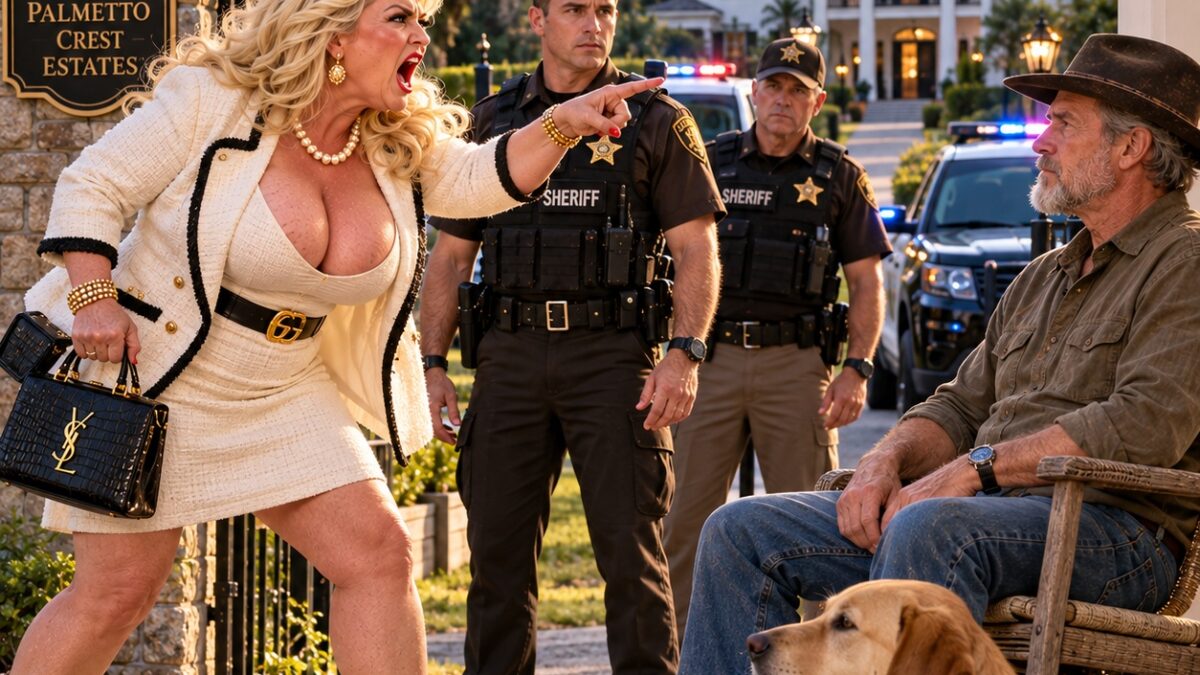
FULL STORY CONTINUATION
I grew up forty minutes north of Whitfield in a cinder block house with a tin roof and a father who drove a propane truck.
My mother taught second grade until her hands shook too badly to write cleanly on the board. We were not poor in the dramatic way people write songs about, but we were poor enough that every unexpected expense changed the temperature in the kitchen. A tire, a dentist bill, a broken water heater, those things sat down at the dinner table with us whether anyone named them or not.
I worked through the University of South Carolina on a Pell Grant and a dishwashing job at a rib shack on Harden Street.
Grease under my nails.
Steam in my face.
Federal criminal justice textbooks open at midnight while my roommate slept.
I did not come from money.
I came from people who got up early and did not trust anyone who needed to tell you how important they were.
A recruiter at a career fair looked me in the eye my senior year and said, “You look like a man who finishes things.”
I never forgot that.
That sentence sent me toward the United States Marshals Service.
Twenty-eight years later, I retired at fifty-six with a federal pension, a box of commendations I never hung on the wall, 267 fugitive apprehensions in my file, zero complaints in my personnel record, and a quiet understanding that I had earned the right to live exactly the way I wanted for the rest of my life.
Whitfield was not a trophy.
It was an ending.
The kind of ending I had pictured during long stakeouts in unmarked sedans, overnight transports where nobody slept, and courtroom details where a man learns to keep his knees from locking because the shift will not end just because his body is tired.
I bought Whitfield because I wanted mornings where the only sound at five o’clock was the river moving and mockingbirds arguing about territory.
I kept two horses.
Duke, a chestnut quarter horse with a calm mind and strong shoulders.
Pearl, an older gray mare with more opinions than most people I had arrested.
I fished the pond on Sunday mornings.
I read history books on the veranda.
I grilled steaks on a cast iron grill I welded myself from scrap steel in the barn.
Captain, my old bird dog, slept wherever he decided the day needed guarding.
For two years, the estate was exactly what I had paid for.
Quiet.
Private.
Mine.
Then Greer Whitman Partners bought 110 acres of old soybean fields along my eastern boundary and built Palmetto Crest Estates in eighteen months.
One hundred twenty-two homes.
Mediterranean-style stucco.
Terracotta roofs.
Three-car garages.
Community pool.
Fitness center.
Wrought iron entrance gate.
A fountain that looked like it belonged outside a casino.
The dues were $480 a month, and the covenants were sixty-two pages long.
Sixty-two pages of rules about mailbox height, fence material, lawn shade, trash cans, holiday decorations, exterior paint colors, and approved landscaping.
Eighteen shades of beige.
One shade of gray called Coastal Whisper.
I watched construction from my veranda the way a man watches weather moving in from the west.
Curious.
Not worried.
My property was separated from the subdivision by a tree line and a hundred yards of unmowed field. I figured people would move in, wave politely, and leave me alone.
That was my first mistake.
Patricia Davenport moved into Palmetto Crest in the first year and became HOA president in the second.
She ran unopposed because she was the only person who wanted the job badly enough to knock on sixty doors and make ambition sound like community service.
She was fifty-three, platinum blonde, always dressed like she was walking into a country club luncheon, and carried a leather-bound planner the size of a hymnal. She checked it constantly, as if the planner contained scripture instead of grass-height violations.
She was also a licensed real estate agent.
That mattered.
Patricia sold nine of the first thirty homes in Palmetto Crest. She served on the architectural review committee that she created. She appointed herself chair of the landscaping subcommittee she invented. She hired her sister’s husband for pool maintenance and her college roommate to manage the HOA’s social media page.
Every committee.
Every vendor.
Every decision.
Patricia.
She was not a neighborhood leader.
She was a franchise owner who happened to live in the building.
The first time I met her, she was standing at my front gate.
I was coming back from town in my dark green F-250 with mud on the fenders and a bag of feed in the bed. Her white BMW X5 was parked at the entrance to the live oak alley, gleaming like it had never been asked to haul anything heavier than a handbag.
She stood on the outside of my wrought iron gate, one hand shading her eyes, peering up the drive like she was appraising the property for a listing.
I stopped the truck and stepped out.
“Help you?”
She smiled wide.
Practiced.
The kind of smile that sells houses to people who confuse polish with trustworthiness.
“Patricia Davenport,” she said. “HOA president, Palmetto Crest Estates.”
She extended her hand over the gate, as if the iron bars between us were merely decorative.
“I’ve been meaning to introduce myself.”
“James Beaumont,” I said. “This is private property.”
Her smile did not disappear.
It thinned.
Just at the edges.
“Of course. I only wanted to welcome you to the neighborhood.”
“I was here first.”
She laughed.
A bright, short sound with no warmth in it.
“Well, then,” she said, “welcome us.”
She handed me a business card through the bars.
“If you ever think about listing this place, I’d love to have the conversation.”
I took the card and looked at it for exactly one second before placing it in the breast pocket of my flannel shirt.
Not because I intended to call.
Because a marshal never throws away a piece of evidence before he knows what the case is.
She drove away in a cloud of oyster-shell dust.
I watched the BMW disappear around the bend.
I did not know Patricia Davenport yet, but I knew the type. I had spent nearly three decades serving warrants on people who believed their authority had no ceiling. People who thought a good suit, a loud voice, or a practiced smile could create reality.
Patricia had the same look in her eyes.
The first letter arrived three weeks later.
Cream-colored envelope.
Gold-embossed Palmetto Crest Estates logo.
A stylized palmetto tree wrapped in a laurel wreath.
Apparently, an HOA in rural South Carolina needed its own coat of arms.
Inside was a single page on heavy cardstock, typed in a serif font working very hard to seem important.
Dear property owner,
Not Dear Mr. Beaumont.
Property owner.
Like my name did not matter.
The letter cited three violations.
Unmaintained vegetation visible from community sightlines.
That meant my live oaks.
Agricultural structures inconsistent with residential aesthetic standards.
That meant my horse barn.
Absence of approved fencing along shared boundary.
That meant the tree line.
The letter demanded corrective action within thirty days or a fine of $250 per day would be assessed.
It was signed:
Patricia Davenport
President, Palmetto Crest Estates Homeowners Association
I read it standing at my kitchen counter with coffee in one hand.
Then I read it again.
I set the coffee down, opened the drawer where I kept property records, and pulled out my deed.
The Whitfield estate was deeded to James Allen Beaumont on October 14, three years earlier. Recorded with the Beaufort County Register of Deeds. Privately held since 1927. Never included in any homeowners association, declaration of covenants, community agreement, or annexation.
Palmetto Crest had been incorporated forty-seven years after Whitfield was built.
My property predated their authority the way the Atlantic predates a swimming pool.
I did not call Patricia.
I did not call a lawyer.
Not yet.
I folded the letter, placed it in a file folder, wrote the date on the tab, and put it in the bottom drawer of my desk.
Two weeks later, a second letter arrived.
Same envelope.
Same gold crest.
Same heavy paper.
This one cited unauthorized commercial activity on residential-adjacent property.
My horses.
Two horses.
Duke and Pearl were described as a “livestock operation” violating Palmetto Crest’s environmental wellness policy.
I had seen many things called wellness in my life.
This was the first time someone applied the word to horse manure from across a tree line.
The letter demanded I relocate the animals within fourteen days.
A week later came the third letter.
Inadequate perimeter lighting contributing to community safety concerns.
Whitfield had twelve exterior lights on timers.
Palmetto Crest’s entrance fountain used more electricity in one night than my entire property used in a week.
The fourth letter told me this was not about violations.
It was about territory.
It arrived in a legal-sized envelope and contained a six-page document titled Voluntary Annexation Agreement.
The agreement proposed that Whitfield be formally incorporated into Palmetto Crest Estates. All covenants, dues, architectural standards, board governance, and assessments would apply. Annual assessment: $5,760. All exterior modifications would require approval from the architectural review committee.
The committee Patricia chaired.
And buried in the middle was the part that mattered most.
I would grant the HOA a permanent easement along the eastern edge of my property for community trail access.
At the bottom of page six, Patricia had already signed.
My line was blank.
Waiting.
I sat on the veranda that evening with the document across my knee and Captain sleeping at my feet.
The river moved slow and dark in the October light. A heron lifted from the far bank and disappeared into the cypress trees without a sound.
I picked up my phone and called Harlan Griggs.
Harlan was a property attorney out of Charleston who had spent thirty years peeling HOAs off private land like barnacles off a hull. I had met him years earlier during a courthouse security matter involving a developer with more money than judgment. Harlan had struck me as the kind of man who could insult you for ten straight minutes and make every sentence admissible.
He answered on the fourth ring.
“Harlan Griggs.”
“Harlan, this is James Beaumont.”
“Marshal Beaumont?”
“Retired.”
“Congratulations. What kind of trouble found you?”
“HOA.”
“Then you are not retired.”
I described the letters, the annexation agreement, Patricia Davenport, and the proposed trail easement.
Harlan listened for four minutes without interrupting.
Then he said, “Mr. Beaumont, that annexation agreement is worth less than the paper it’s printed on. The violation letters are harassment. Keep every single one.”
“I have.”
“I assumed you would.”
Within a week, Harlan filed a formal response with the Palmetto Crest HOA.
Four pages of South Carolina property law, precisely cited and cold enough to lower the temperature in any room Patricia read it in.
The argument was simple.
Whitfield had never been part of any declaration of covenants.
The HOA had zero jurisdiction over a non-member property.
Any further violation notices, fines, or enforcement claims would be treated as harassment.
Patricia did not respond.
She pivoted.
Three days after Harlan’s letter landed, I received a call from Beaufort County Code Enforcement.
A complaint had been filed alleging that my horse barn lacked a stormwater management plan and that runoff from my property was contaminating the shared drainage channel between Whitfield and Palmetto Crest. The complaint also alleged biohazardous waste conditions within five hundred feet of a residential community.
Two horses.
Thirty-eight acres.
A spring-fed pond.
A manure system cleaner than most public park restrooms.
The code enforcement officer was Ray Toombs.
Mid-forties, sun-dark arms, patient expression of a man who spends his days investigating complaints and knows most of them are personal grudges wearing regulation masks.
Ray walked the property with me for an hour and a half.
He inspected the barn.
Checked the manure composting system I had built with cedar walls and a gravel drainage pad.
Walked the drainage channel.
Tested water at three points.
Checked veterinary records, feed storage, pasture rotation, and fencing.
Duke watched him with mild suspicion.
Pearl ignored him completely.
When Ray finished, he stood by his truck and pushed his hat back.
“Mr. Beaumont,” he said, “this is one of the better-maintained equestrian properties I’ve seen in this county, and I’ve seen a lot.”
“Will it clear?”
“I’ll file the report by the end of the week. Between you and me, whoever called this in either has no idea what a horse property looks like or knows exactly what one looks like and filed it anyway to create problems.”
He drove away.
I added the report to the file.
The file moved from the bottom drawer to the second drawer because the bottom drawer was full.
Patricia filed four more complaints over the next three months.
Noise.
Odor.
Fire safety.
Unpermitted structures.
Each complaint triggered an inspection.
Each inspection found nothing.
Each inspector left with some version of the same sentence.
“Your property is fine, Mr. Beaumont. I don’t know who keeps filing these, but they’re wasting everyone’s time.”
The fire safety inspector, a woman named Davis who had been with the county twenty years, pulled me aside after her walkthrough.
“Sir,” she said, “I shouldn’t say this, but whoever is doing this is going to burn through credibility with our office. We are required to respond to every complaint, but we track patterns. This is starting to look targeted.”
I thanked her.
Then I filed a Freedom of Information Act request for all complaints submitted to Beaufort County regarding Whitfield.
The response arrived nine business days later.
Seven complaints in three months.
Every one originated from the same IP address.
The Palmetto Crest Estates HOA office computer.
The computer sitting on Patricia Davenport’s desk.
I printed the response and put it in the file.
Then I closed the drawer gently.
Like a man closing a trap he was not ready to spring.
Meanwhile, Patricia worked the neighborhood.
At the next HOA meeting, she delivered a presentation titled Boundary Concerns: Protecting Our Community Character.
It featured photographs of my property taken from the Palmetto Crest side.
My barn.
My fence line.
My horses.
My front gate.
She described Whitfield as a “non-conforming agricultural holdout” actively depressing property values. That phrase would matter later.
The vote to escalate boundary concerns to the county planning commission passed twenty-eight to eleven.
Most people voted yes because they trusted Patricia.
That is how this kind of thing happens.
Not because every person involved is malicious.
Because most people are busy, polite, and willing to believe the woman at the front of the room has already checked the facts.
Patricia took the campaign public.
She started a neighborhood Facebook group called Protect Palmetto Crest and posted daily updates about the “agricultural threat” next door.
Photos of Duke and Pearl grazing peacefully became captions like:
Is this what you want next to your children’s playground?
Screenshots of county ordinances about livestock were cropped carefully, leaving out the parts showing my property exceeded every setback by a wide margin.
She organized a community safety walk, guiding thirty-seven residents along the Palmetto Crest perimeter and telling them Whitfield was under investigation for health code violations.
It was not.
Every investigation had closed clean.
But Patricia understood something about information warfare.
The accusation travels faster than the correction.
By the time the truth catches up, the damage is already done.
Three families listed their homes that month, citing “agricultural concerns” in their disclosure statements.
Two had never spoken to me.
None had visited Whitfield.
They left because Patricia told them to be afraid.
Fear is the most efficient real estate tool ever invented.
Guess who sold those homes?
Patricia Davenport.
Licensed real estate agent.
Three sales.
Average price around $520,000.
Her commission was just under $47,000.
I learned that from Harlan, who had been quietly pulling MLS records and cross-referencing Patricia’s license number.
“James,” Harlan said over the phone, his voice carrying the controlled anger of a man who has seen fraud before and still refuses to become numb to it, “she’s not just harassing you. She’s monetizing you.”
“Meaning?”
“Every complaint she files, every scare she creates, every family that runs, she collects the commission on the way out.”
He paused.
“You’re not her enemy. You’re her inventory.”
That phrase landed in my chest like a stone dropped into still water.
You’re her inventory.
I asked Harlan to pull everything.
Listings.
Commissions.
MLS descriptions.
Every time she mentioned Whitfield, my trees, my river view, my pasture, or my estate in marketing material.
The answer came back in a week.
In eleven of fourteen Palmetto Crest listings, Patricia had used some version of the phrase:
Estate-adjacent setting with mature tree canopy and pastoral views.
She was selling my live oaks, my pasture, my river, and my privacy as amenities.
The same property she publicly called a nuisance was a premium feature when it helped her close a sale.
She was running the con in both directions.
Scare residents into selling.
Use my land to sell the next buyer.
Collect both ways.
I sat in my study that evening with Captain at my feet and the file drawer open. I spread out the FOIA documents, inspection reports, attorney letters, MLS printouts, complaint records, and photographs.
I looked at them the way I used to look at case boards in the marshal’s office.
Names.
Dates.
Actions.
Motive.
Pattern.
This was not a neighborhood dispute.
It was a scheme.
And Patricia Davenport stood at the center of it.
I called Harlan the next morning.
“I want to file everything. Harassment, defamation, tortious interference, fraud, the commissions, all of it. I want her answering for every letter, every complaint, every dollar she earned by lying about my land.”
Harlan was quiet.
Then he said, “We can file now and win.”
“But?”
“But if you wait, if you let her make one more move, you won’t just win the lawsuit. You’ll end her career.”
I leaned back.
“What kind of move?”
“The kind where she does something so public and so illegal that no judge, no jury, no licensing board, and no HOA board can look away.”
I thought about that.
Then I said, “I can wait.”
Harlan did not have to wait long.
Patricia’s next move arrived wearing a surveyor’s vest and carrying a clipboard.
On a Wednesday morning in late March, I was in the barn brushing Duke when I heard tires crunch on the oyster-shell drive. I walked outside and found a white pickup parked near my east fence line. A man in an orange reflective vest was hammering a wooden stake into the ground about forty feet inside my property line.
I walked over.
“Morning. What are you doing?”
He looked up.
Mid-thirties.
Nervous eyes.
The expression of someone who knows he is standing on unstable ground in more than one sense.
“Survey crew,” he said. “Work order for boundary assessment.”
“Whose work order?”
He handed me a folded sheet.
Palmetto Crest Estates letterhead.
The document described a “community boundary verification project” and directed the crew to establish the correct property line between Palmetto Crest common areas and the adjacent agricultural parcel.
Signed by Patricia Davenport.
President.
The “correct” line on her map ran forty feet west of the actual recorded boundary.
Forty feet of my land, including part of the horse pasture and the eastern edge of the pond, had been marked as Palmetto Crest community green space.
I looked at the stake.
Then the map.
Then the worker.
“Do you have a license?”
He swallowed.
“I’m not the surveyor. I’m the crew.”
“Who signed the plat?”
“Dennis Corley. Corley Land Services.”
I knew the name.
Dennis Corley had done survey work for Greer Whitman Partners, the developer that built Palmetto Crest. Not neutral. Not independent. Not welcome.
I took photographs of the stake, the work order, the truck, the man’s face, and the map.
Then I said calmly, “Pull those stakes. Leave my property. Tell Mr. Corley if he files a plat moving my boundary by a single inch, I’ll have him in front of the South Carolina Board of Registration for Professional Engineers and Land Surveyors before the ink dries.”
The crew left within fifteen minutes.
I called Harlan.
Harlan called the board by lunch.
No authorized survey had been requested or approved for Whitfield. Corley’s boundary assessment had been conducted on private land without owner consent and potentially violated state professional standards.
But the real discovery came two days later when Harlan obtained Palmetto Crest’s financial records through a formal demand under the South Carolina Nonprofit Corporation Act.
Buried in the annual budget was a line item:
Community Boundary Maintenance and Access Improvement.
Each household had been charged $150 per year.
One hundred twenty-two households.
Four years.
$73,200 collected.
There was no boundary infrastructure.
No shared improvement.
No maintenance.
The tree line between Whitfield and Palmetto Crest was a natural growth of live oaks, magnolias, and longleaf pine. Nobody had planted it. Nobody maintained it. Nobody owned it except me.
The money flowed into the HOA’s general operating fund. From there, Harlan traced payments into a discretionary account Patricia controlled.
Over four years, checks totaling $61,000 had been written for administrative services, consultant fees, and community liaison expenses.
Payees?
Patricia.
Her husband.
Her sister.
Harlan laid the documents across his desk like a poker hand.
“Embezzlement,” he said. “Clean. Documented. Four years. Multiple felonies.”
I looked at the numbers.
Seventy-three thousand dollars taken from families who trusted Patricia to manage their neighborhood.
Families who paid dues, attended meetings, signed petitions, voted yes when she told them to.
“Keep building,” I said.
Harlan looked at me.
“She’s not done yet.”
While Harlan built the legal case, I built the physical boundary.
I hired a licensed surveyor named Martha Haynes out of Hilton Head. Sixty-two years old. More low-country properties surveyed than anyone I knew. Reputation for accuracy bordering on religion.
She spent three days at Whitfield with transit equipment and GPS units, marking every corner, every boundary point, every deed line.
When she finished, she handed me a certified plat and boundary report.
My property line was exactly where the 1927 deed said it was.
Forty feet east of Patricia’s fake map.
Martha filed the plat with the Beaufort County Register of Deeds that afternoon.
Then I built the fence.
Not decorative.
Not symbolic.
A fence.
I hired Buddy Phelps, a contractor out of Walterboro who had been building agricultural fencing since Carter was president. He brought a three-man crew and eight hundred linear feet of six-foot welded steel pipe fencing rated for livestock containment. Flat black. Concrete footings eighteen inches deep. Steel posts every twenty feet.
Not an inch over the surveyed line.
Not an inch under.
I also installed cameras.
Eight weatherproof units with infrared capability, motion activation, and cloud backup. Four covered the fence line. Two covered the front gate. One covered the barn. One watched the drive from the main road.
Resolution sharp enough to read a license plate from two hundred feet.
The fence went up in four days.
Patricia watched from the Palmetto Crest side, standing on the HOA walking trail with her leather planner pressed against her chest. She had the look I had seen many times in federal service.
The look of someone watching the room close around them.
She did not speak to me.
That evening, the Protect Palmetto Crest Facebook page exploded with posts about the “prison wall” that had appeared overnight.
Patricia posted a photo of the fence from an angle that made it look menacing.
Caption:
Is this what community looks like?
I did not have Facebook.
I did not need it.
I had cameras.
A surveyor’s plat.
A contractor invoice.
And a litigation file that weighed twelve pounds and kept growing.
Buddy Phelps came by a week later to check tension on the corner posts.
He stood beside me at the fence line, looking at the Palmetto Crest homes gleaming in afternoon sun.
“She’s going to do something stupid,” he said.
I nodded.
“That’s what I’m counting on.”
Her response came in stages.
Stage one was a petition to the Beaufort County Planning Commission asking that my property be rezoned from agricultural to residential. That would effectively prohibit my horses, barn, and current use. She collected seventy-one signatures in two weeks. Most people signed because Patricia told them it would protect home values.
The Planning Commission rejected it in six business days.
The letter was only one paragraph, written in bureaucratic language so polite it almost hid the contempt underneath.
The current agricultural designation is consistent with historical use and existing county land use plans.
Stage two was the blockade.
Whitfield had one public road access: a gravel lane connecting my gate to County Road 9. The first two hundred yards ran along the eastern edge of the Palmetto Crest entrance boulevard. It was not shared land. I had a recorded access easement from 1927 granting Whitfield permanent right-of-way through that corridor.
Patricia had the HOA landscaping crew install three decorative concrete planters directly in the lane.
Each weighed about eight hundred pounds.
Filled with ornamental grasses.
Positioned so a sedan might weave through, but a truck with a horse trailer could not pass.
I came home from a medical appointment in Charleston and found my access lane turned into an obstacle course designed by a woman who measured success by inconvenience.
I did not move the planters.
I called the Beaufort County Sheriff’s Office.
Deputy Cole Mitchell responded.
Cole was thirty-four, built like a middle linebacker, and carried himself with the measured calm of a man who had learned patience from someone demanding.
That someone was me.
Six years earlier, Cole had been a junior deputy assigned to a federal-county joint task force targeting fugitives in the low country. I was the senior deputy marshal running the task force. For eighteen months, Cole worked under me on warrant operations.
I taught him how to clear a building.
How to read body language at a doorway.
How to slow his breathing when the person on the other side had nothing left to lose.
How to remember that authority is not a volume knob.
When Cole applied to the Beaufort County Sheriff’s Office, I wrote his recommendation letter on Marshals Service letterhead.
The sheriff later told him that letter got him hired.
Cole pulled up to the Whitfield gate, saw the planters, and walked the scene for ninety seconds.
He photographed each one.
Measured the gaps.
Confirmed they obstructed my recorded easement.
Then he turned to me.
“Marshal Beaumont,” he said.
He still called me that.
“These need to move. I’ll file the report tonight. If they’re not gone in seventy-two hours, the county removes them and bills the HOA.”
The planters were gone by morning.
Patricia had them moved before sunrise like a thief cleaning up a crime scene in reverse.
But she was not finished.
She was nowhere close.
It happened on a Saturday in June.
I was on the veranda at seven in the evening, the way I was most evenings once the heat broke and river breeze moved through the oaks. Captain slept under the rocking chair. Duke and Pearl stood in the far pasture, silhouettes against a sky turning copper. I had sweet tea on the table and a Robert Caro biography open on my knee.
For the first time in months, I was not thinking about Patricia Davenport.
She was thinking about me.
At 6:53 p.m., Patricia dialed 911.
The call lasted two minutes and forty-seven seconds.
I would later obtain the recording through a FOIA request.
“911, what is your emergency?”
“Yes, my name is Patricia Davenport. I’m the president of the Palmetto Crest Estates Homeowners Association. I need officers at the Whitfield property immediately. There is a man on the property who does not belong here. He may be armed.”
“Can you describe what he is doing?”
“He’s been walking the grounds multiple times this week, and tonight he’s sitting on the porch like he owns the place. I want him removed.”
“Ma’am, is he threatening anyone?”
“He could be armed. He has a dog. The estate has been vacant. The previous owner passed away, and no one has claimed it. This man has no right to be there. Please send someone immediately. I don’t feel safe.”
Every word was a lie.
The estate was not vacant.
The previous owner had not passed away.
I had purchased Whitfield from the Aldrich Whitfield Trust three years earlier.
I was the legal owner.
I was not trespassing.
Patricia knew all of this.
She had met me at the gate.
She had mailed letters to me at this property.
She had filed county complaints naming me as the owner.
She had tried to force me into an annexation agreement.
She had tried to move my boundary.
She had charged her own homeowners money based on my tree line.
And she told dispatch none of it.
What she told them was designed to do one thing.
Bring armed officers onto my property with a story calculated to make them arrive ready for danger.
Two patrol units responded.
Dispatch classified it as possible armed trespass.
Deputies were advised the subject might be armed and the property was believed vacant.
I heard the gravel before I saw the lights.
Two Beaufort County cruisers came up the live oak alley at moderate speed. No sirens, but light bars on, painting the Spanish moss blue and red like a Fourth of July show staged by the wrong department.
Captain lifted his head.
I set down my book and tea.
I stood slowly.
Not fast.
Not alarmed.
The way a man stands when he has spent twenty-eight years on the other side of that exact approach and knows the most important thing he can do in the next ten seconds is nothing sudden.
Two deputies stepped from the first cruiser.
I did not recognize the younger one. Maybe twenty-five. Hand resting near his duty belt with the nervous energy of someone who has not done enough calls to feel calm yet.
The second deputy stepped out from the driver’s side, flashlight in hand.
He swept the beam across the veranda.
The rocking chair.
The tea.
The dog.
Me.
The light stopped on my face.
Deputy Cole Mitchell lowered his flashlight.
His shoulders dropped exactly one inch.
That small shift from tactical posture to recognition only another trained officer would notice.
Then he smiled.
“Good to see you, sir.”
The younger deputy still had his hand near his belt.
Cole gave him a small two-finger gesture, palm flat.
Stand down.
“It’s fine,” Cole said.
Then he climbed the veranda steps like he was arriving for Sunday coffee instead of a priority call.
“Marshal Beaumont,” he said. “You having a quiet evening?”
“I was.”
Cole looked at the book, the tea, Captain, the house, the river beyond the porch.
“Sir, we received a call reporting an armed trespasser at this address. Caller described the property as vacant and the occupant as unauthorized.”
I nodded.
“The caller wouldn’t happen to be a blonde woman in a BMW who lives next door?”
Cole did not answer directly.
Too professional.
But the corner of his mouth moved just enough.
The young deputy stepped forward.
“Sir, can you verify you’re the property owner?”
I reached slowly into the breast pocket of my flannel shirt and pulled out a folded copy of my deed.
I had begun carrying it the same week Patricia’s letters started.
Twenty-eight years in federal law enforcement teaches a man that the best evidence is the kind he can produce in three seconds.
Cole glanced at it.
The young deputy read every line like he was studying for an exam.
When he finished, his expression shifted from suspicion to embarrassment to apology in one breath.
“Sir,” he said, “I’m sorry for the disturbance.”
“Don’t be sorry,” I said. “You did your job. You responded, verified facts, and adjusted. That’s exactly how it’s supposed to work.”
Cole folded his arms and looked toward the driveway.
“Marshal, I’m going to document this as a false report. Caller provided information she knew to be inaccurate.”
“I know.”
“That’s a criminal offense.”
“Section 16-17-722,” I said. “Filing a false police report.”
Cole almost smiled.
“You could’ve let me cite the statute, sir.”
“Old habits.”
Cole wrote his report on the hood of his cruiser while the young deputy stood nearby, still looking slightly shaken by the realization that he had been dispatched to remove a retired chief deputy U.S. marshal from his own porch.
Before Cole left, he returned to the veranda steps. The light bar was off now. The driveway had gone dark again except for porch lamps and fireflies flickering near the trees.
“Sir,” Cole said, “I don’t know what she’s been doing, but I know it didn’t start tonight. Dispatch told me this address has had seven complaints in nine months. Same source. That’s a pattern.”
“It is.”
“You building a case?”
“I built the case six months ago, Cole. Now I’m just letting her add to it.”
He nodded.
He understood.
He had learned that patience from me.
The next morning, I called Harlan.
“She did it,” I said.
“Tell me.”
I told him about the 911 call, the false claim, the vacant property lie, the armed trespass classification, the fact that Patricia knew my name, ownership, address, and status because she had already documented all of them in her own complaints.
Harlan was quiet for eight seconds.
Then he said, “That’s the move. That’s what we were waiting for.”
“File it Monday.”
“I drafted the complaint two months ago,” he said. “I just needed her to give me the last page.”
Harlan filed the civil complaint Monday morning.
Forty-seven pages.
Seven causes of action.
Named defendants: Patricia Davenport individually and in her capacity as HOA president, Todd Davenport, her husband, who sat on the architectural review committee and co-signed fraudulent checks, and Palmetto Crest Estates HOA as an entity.
Harassment through repeated frivolous complaints.
Defamation through false public statements.
Tortious interference with property rights.
Unauthorized survey and trespass.
Real estate fraud through dual misrepresentation in MLS listings.
Embezzlement of HOA funds.
Abuse of process and false police report.
Total damages sought: $1.4 million.
The Beaufort County Sheriff’s Office filed criminal charges the same week.
Filing a false police report.
Misuse of emergency services.
And, after Harlan’s complaint reached the solicitor’s office, additional embezzlement counts tied to the HOA funds.
Patricia was served at her home on a Wednesday afternoon.
The process server later told Harlan she opened the door in a white linen pantsuit, saw the papers, and said, “This is a misunderstanding.”
That had become her refrain.
A misunderstanding.
The letters.
The complaints.
The survey.
The planters.
The money.
The call.
It was not a misunderstanding.
It was a reckoning.
The HOA board held an emergency meeting five days later.
Nora Pemberton, the quiet secretary who had been documenting Patricia’s behavior for years, presented the financial records she had been safeguarding.
Every fraudulent check.
Every phantom budget line.
Every dollar that moved from the community treasury into Patricia’s personal orbit.
The room went silent as 109 homeowners realized they had been robbed by the woman they elected to protect them.
The vote to remove Patricia from the board was unanimous.
109 to zero.
She was not present.
Her attorney had advised against it.
The South Carolina Real Estate Commission suspended her license pending investigation. Harlan’s complaint detailed fourteen transactions where she misrepresented my property as both nuisance and amenity depending on which version paid better.
The civil case settled seven months later.
Patricia’s insurance carrier and the HOA’s directors-and-officers policy paid a significant amount. Patricia personally paid additional money from the sale of her BMW and liquidation of a brokerage account.
The total recovery was $772,000.
The criminal case took longer.
Patricia pleaded no contest to the false police report charge and one embezzlement count. Eighteen months of probation. Two hundred hours of community service. A permanent criminal record that would follow her into every background check for the rest of her life.
She listed her house the week after sentencing.
It sold in forty-one days.
She did not collect the commission.
I donated a portion of the settlement to the Beaufort County Sheriff’s Benevolent Association.
The rest went into a trust for the maintenance of Whitfield.
The live oaks.
The barn.
The spring-fed pond.
The gravel drive.
The house that had waited almost a century for someone who wanted quiet more than status.
Cole Mitchell still stops by on patrol.
He parks at the front gate, walks up the alley, and sits on the veranda while I pour coffee.
We do not talk about Patricia.
We talk about the river.
The horses.
The sheriff’s office.
The way younger deputies still need to learn that authority is not a volume knob.
Captain sleeps under the rocking chair.
Duke stands at the fence.
Pearl ignores everyone.
The mockingbirds argue over territory as if they own the low country and always have.
And the gate stays closed.
Sometimes, when the evening light falls through the live oaks and the Spanish moss moves like smoke, I think about Patricia standing outside that gate the first day with her business card and polished smile.
She saw an estate and thought inventory.
She saw a quiet man and thought weakness.
She saw privacy and thought opportunity.
That was her mistake.
Quiet is not empty.
Quiet can be evidence being gathered.
Quiet can be a deed folded in a shirt pocket.
Quiet can be a former marshal sitting on his porch with twenty-eight years of training and enough patience to let a liar keep talking until the lie becomes a chargeable offense.
Patricia tried to use the law like a weapon against a man she thought did not belong.
In the end, the law did what it is supposed to do.
It asked for proof.
And I had kept every page.