𝗙𝗨𝗟𝗟 𝗦𝗧𝗢𝗥𝗬:HOA Queen Had My Late Wife’s $250,000 Ferrari Crushed and Bragged “Problem Solved” — She Never Knew Who She Had Just Declared War On!
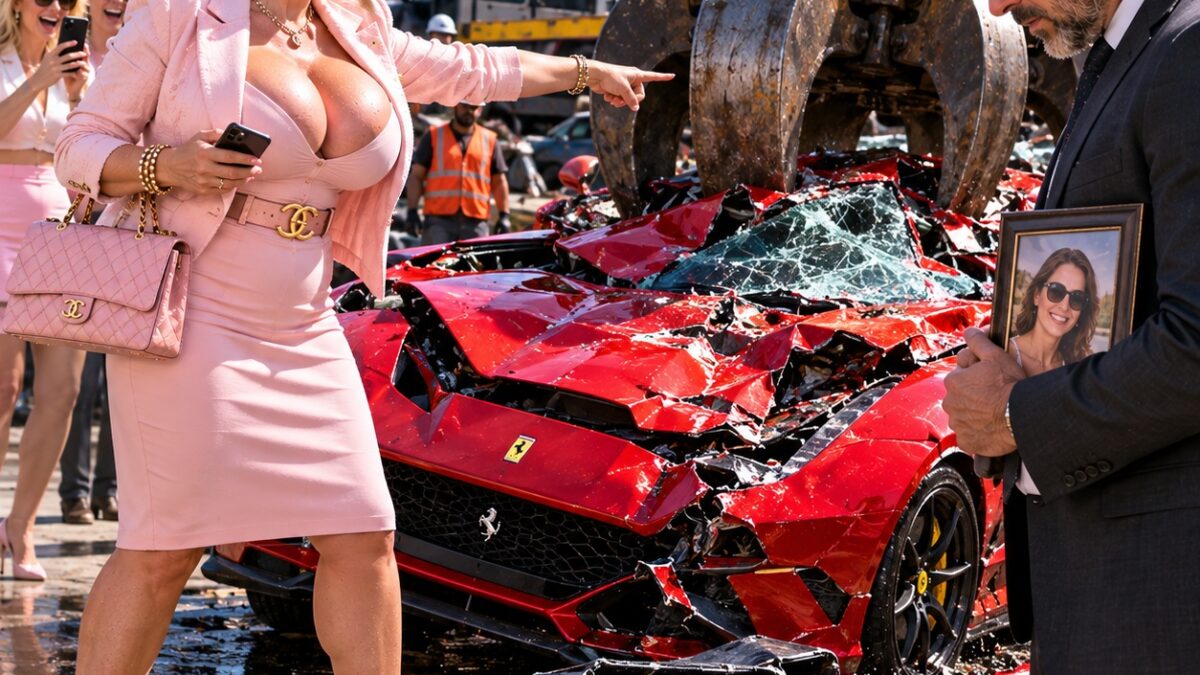
FULL STORY CONTINUATION
My name is Cole Ashford.
For fifteen years, I worked as a deputy U.S. marshal out of the Phoenix field office. Fugitive apprehension. Asset seizure. Witness transport. Surveillance. Warrants. Evidence packages. The kind of work that teaches you exactly how much damage a person can do once they believe rules are things meant for everyone else.
I was good at it.
Too good, probably.
I could track a man through three states by a storage unit payment and a cousin’s burner phone. I could build a packet so clean a prosecutor would smile before the meeting even started. I knew how to let arrogant people keep talking long enough to hang themselves with their own confidence.
But the job takes pieces from you.
Quiet ones.
Pieces that do not show up in photos.
Pieces your wife notices before you do.
Elena noticed everything.
She was my compass. My shelter. The one person who could make me laugh after a twelve-hour manhunt with one look and a glass of wine waiting on the kitchen counter. She had a way of turning ordinary rooms into warm places. She could make strangers feel like they had been expected.
She was diagnosed with ovarian cancer the same month I turned forty.
She fought for fourteen months.
She was thirty-nine when she died.
The Ferrari was her idea from the beginning.
We talked about it for years.
Always red.
Always ridiculous.
Always later.
She would pull up configurations on her phone at dinner and slide it across the table like she was passing classified intelligence.
“When the house is paid off,” she would say.
“When the kids are grown.”
“When we hit fifty.”
“We are getting that car, Cole.”
She said it like a promise.
Like a prayer.
Six months after the funeral, I walked into a dealership in Scottsdale and ordered the Ferrari 812 Competizione.
Rosso Corsa.
Black interior.
Three thousand two hundred miles when it finally came home because I could not stop driving it those first weeks. Not fast. Not recklessly. Just far enough into the desert that the silence felt honest.
I did not negotiate.
I did not test-drive it.
The salesman kept talking about performance, horsepower, exclusivity, collectibility.
I heard none of it.
I sat in the driver’s seat, opened the glove box, and placed Elena’s sunglasses inside.
Tortoiseshell Ray-Bans.
The same pair she wore on Saturdays.
The same pair she pushed into her hair when she read on the patio.
The same pair still carrying the faintest scratch on one lens from the weekend we drove to Sedona and she dropped them on red rock while laughing at something I said.
After I drove the car home, every Sunday morning became a small ritual.
Coffee.
Garage door open.
Ferrari on the driveway.
Elena’s sunglasses hanging from the mirror.
I would sit there, sometimes with the engine off, sometimes just letting it idle for a minute, and tell her about the week.
About the quiet desert.
About the neighbors.
About how hard it was to sleep without hearing her turn pages beside me.
For three weeks, Ironwood Ridge felt peaceful.
Then Brenda Collier arrived in her white Range Rover Velar with the vanity plate BRNDA1 and a golf cart full of witnesses.
Ironwood Ridge Estates sat in Paradise Valley, Arizona, where stucco homes hid behind bougainvillea and iron gates, and people used words like desert harmony to describe neighborhoods that charged monthly dues to regulate the exact shade of decorative gravel around your cactus.
I had moved there eighteen months after Elena died because I needed quiet.
Not sympathy.
Not family hovering.
Not friends who meant well and looked at me like grief was contagious.
Just desert.
Light.
Heat.
Long evenings with Camelback turning copper and violet while the air smelled of sage, creosote, and stone.
Brenda had other ideas.
The $500 fine was only the opening move.
Two days after the first letter, Tom Wyatt knocked on my door with his phone in his hand.
Tom lived across the street. Early forties. Former high school football coach. Built like a vending machine and twice as honest.
“You need to see this, Cole.”
He showed me the Ironwood Ridge HOA Facebook group.
Brenda had posted a photo of my Ferrari taken from the street.
Caption:
Is this what Ironwood Ridge is about? Does this scream family neighborhood to you? Vote below.
Underneath was a poll.
Remove it immediately: forty-seven votes.
Leave him alone: three votes.
Tom scrolled through the voter profiles.
“I checked them,” he said. “Thirty-eight of these accounts were created in the last four days. Same stock photos. Same join dates.”
I almost laughed.
Almost.
“She faked an election over a parking spot.”
Tom did not smile.
“Welcome to Ironwood Ridge.”
The next week brought an official mandate.
I was required to cover the Ferrari with an HOA-approved vehicle cover.
Beige cotton.
Matching the community exterior palette.
Ironwood Ridge crest embroidered on the front.
Available through the HOA office for $665.
I read that part out loud to Edith Palmer while she watered roses across the fence.
Edith was eighty, widowed eleven years, and sharp enough to cut glass without touching it. She had lived in Ironwood Ridge longer than the HOA itself.
“Honey,” she said, setting down her watering can, “that woman made my neighbor paint his mailbox the exact shade of taupe as his house. Measured it with a Sherwin-Williams swatch.”
She looked toward the Ferrari.
“That woman has the soul of a parking meter.”
I paid for the cover too.
Receipt number two.
That same week, Brenda came for Edith.
Edith kept a small stone angel in her front garden. Ten inches tall. Chipped left wing from a hailstorm years back. Her husband Walter bought it the year before he died, and for eleven years it had sat beside her roses through three HOA presidents and two landscaping overhauls.
Nobody had ever said a word.
Then Brenda pulled up on a Thursday afternoon in a Chanel blazer over yoga pants, Cartier Love bracelet catching the light, portfolio tucked under her arm, and Kayla trailing behind with her iPhone already recording.
“Mrs. Palmer,” Brenda said, “garden ornaments are not on the approved aesthetics list. Section four, paragraph nine.”
She clicked her pen.
“I’ll need that removed within seventy-two hours.”
Edith looked at the angel.
Then at Brenda.
“That was Walter’s. He bought it before he passed.”
Brenda tilted her head.
The sympathy face.
“That’s lovely, sweetie. Truly.”
Then she wrote something on the clipboard.
“But rules are rules. Seventy-two hours. Have a blessed day.”
Edith did not argue.
She stood there holding her watering can while the Range Rover pulled away.
Then she sat on her porch step and put her face in her hands.
I walked over with a glass of iced tea and sat beside her.
Did not say much.
There are moments when words only make grief feel observed.
Later, I helped her draft an appeal citing the HOA’s own grandfather clause, Section 12, which exempted fixtures installed before the current board took office.
Brenda rejected it within twenty-four hours.
Three sentences.
Pink font.
The board’s decision is final.
Have a blessed day.
That night, I sat on my back patio while the desert went dark around me.
Camelback faded from copper to violet. Somewhere in the neighborhood, a coyote yipped once and went quiet. The Ferrari sat in the open garage. Edith’s porch was dark. Brenda’s violation letter sat on my counter.
This was not governance.
This was a woman with a Birkin bag and a god complex using a homeowners association as a weapon.
She was not protecting the neighborhood.
She was punishing anyone who did not bow.
I opened my laptop and started a file.
One word at the top.
COLLIER.
Below it, I typed the first note.
No hearings before fines. A.R.S. § 33-1803 requires notice and opportunity to be heard before monetary penalties. Every fine Brenda has issued without due process is voidable.
I closed the laptop.
I was not ready yet.
But I was watching.
And Brenda, as it turned out, was just getting started.
Two weeks later, she called an emergency board meeting.
The clubhouse was standing room only. Sixty residents packed into folding chairs under fluorescent lights while Brenda stood at the front with a wireless clicker and a projection screen.
She dressed for war disguised as community leadership.
Cream blazer.
Gold earrings.
Hair freshly blown out.
The Birkin sitting on the chair beside her like it had its own seat assignment.
“Ladies and gentlemen,” she began, “I’ve called this session to address a growing concern about community aesthetics.”
Click.
My Ferrari filled the screen, photographed from the street and circled in red.
Underneath, in bold italics:
Community aesthetic threat level: high.
A few people shifted in their seats.
Someone coughed.
Brenda kept smiling.
“This is not about one person,” she said. “This is about protecting everyone’s investment.”
Click.
A bar graph appeared showing theoretical property value decline caused by nonconforming vehicles.
No source.
No methodology.
Just red bars going down and an arrow labeled current trajectory.
Then came her proposed rule.
The Exotic Vehicle Display Ordinance.
Any vehicle valued above $100,000 would be prohibited from visible driveway placement between 8:00 a.m. and 8:00 p.m.
Violators would face fines of $1,000 per day, enforceable immediately.
No appeal period.
I sat in the last row and watched her build a law around my grief and gift-wrap it in PowerPoint.
When she opened the floor, I stood.
“Mrs. Collier, the ordinance as written violates Arizona law. The CC&Rs do not authorize the board to create a new vehicle restriction this broad, and state HOA law requires notice and an opportunity to be heard before fines. Selectively targeting one homeowner’s personal property also creates exposure for bad-faith enforcement.”
The room got quiet.
Brenda’s smile did not flicker.
But her hand stopped moving on the clicker.
I should have stopped there.
I did not.
“That car meant something to my wife and me,” I said. “She passed three years ago. It is the last promise I kept to her.”
Something shifted in the room.
A few people looked down.
Tom Wyatt clenched his jaw.
Edith Palmer held her purse strap in both hands.
Even Kayla, standing near the back with her phone, lowered it for half a second.
Brenda let the silence hang.
Then she tilted her head, adjusted her Cartier ring, and gave me the smile that looked like sympathy poured over broken glass.
“Sweetie,” she said, “your wife is gone. A car doesn’t bring her back.”
She said it gently.
That made it worse.
“It is a piece of metal on a driveway,” she continued, “and it is lowering everyone’s property value.”
Then she glanced at the board.
“Park it in the garage, or we’ll park it for you.”
The room froze.
Edith covered her mouth.
Tom’s knuckles went white.
Claire Dunning, a single mother three doors down, stared at the floor like she was afraid to breathe.
Nobody spoke.
I looked at Brenda for three seconds.
Her eyes were steady.
Not heated.
Cold.
The cruelty of someone who had never once been told no by anyone she thought mattered.
I nodded once and walked out.
Behind me, Brenda called the vote.
Four in favor.
One opposed.
Tom.
The ordinance passed.
Fines effective immediately.
I drove home, sat in the Ferrari, and hung Elena’s sunglasses on the mirror like always.
“She said you’re gone,” I whispered. “Like you were just a thing.”
I ran my thumb across the steering wheel.
Italian leather.
Smooth as water.
“She shouldn’t have said that.”
That night, Tom showed up at my door with two beers and something on his mind.
We sat on the patio while the desert cooled down.
“Cole,” he said, “I voted no tonight.”
“I noticed.”
He looked at the bottle in his hands.
“Six months ago, Brenda had my wife’s Lexus towed. Said it was leaking fluid on the pavement. Sarah cried for two days. We never got it back.”
I set down my beer.
“Where did they take it?”
“Desert Tow and Salvage. Out past Mesa.”
Something clicked into place.
Not a suspicion.
A mechanism.
A sound I knew well.
The last tumbler finding its groove.
“Tom,” I said, “how many other cars have disappeared from this neighborhood?”
He thought for a second.
“At least five or six that I know of.”
“I need you to make me a list.”
Tom’s list came three days later, handwritten on yellow legal paper, folded twice, slid under my door before sunrise.
Six vehicles.
Six households.
All towed by Desert Tow and Salvage within three years.
All flagged by the HOA for violations ranging from fluid leak to extended non-movement to unapproved modification.
None returned.
I read each name at my kitchen table.
Tom’s wife’s white Lexus RX 350, two years old, towed in January.
Gene Howell’s blue F-250, owned nineteen years, rebuilt twice, towed while Gene sat in a cardiologist’s waiting room.
Claire Dunning’s silver Honda Civic with a car seat in the back. Claire worked night shifts at the hospital. Brenda had it towed while Claire was on a twelve-hour shift. Claire could not afford the $600 impound fee in time. The car had been processed by the time she pulled the money together.
She had been riding the bus with two little boys for four months.
At six in the morning.
Still in scrubs.
I closed the list.
Poured more coffee.
Then drove to Mesa.
Desert Tow and Salvage sat on a gravel lot off the 202 behind chain-link fence topped with razor wire. A Doberman slept under a rusted awning. The office was a portable trailer with a window unit dripping condensation onto dead weeds.
I had called ahead about my work truck.
Brenda had towed it the week before.
A test, I realized later.
I told them I was coming to pay the impound fee and retrieve it.
Six hundred eighty dollars cash.
They handed me the keys without eye contact.
I signed the paperwork, took my time walking across the lot, and let my eyes sweep the yard the way I used to sweep a room before serving a warrant.
That was when I saw them.
Along the back fence.
Partially covered by tarps.
A white Lexus RX 350.
A blue F-250 with a dented tailgate.
A silver Civic with a faded car seat still visible through the rear window.
And at least eight more vehicles in various stages of decay.
Some stripped.
Some waiting.
Three still had Ironwood Ridge parking stickers on the windshield.
I pulled out my phone.
Photographed every plate.
Every VIN I could read through the glass.
Every sticker.
Thirteen vehicles total.
All from the same neighborhood.
All towed under HOA authorization.
All sitting in the same yard.
For fifteen years with the Marshals, I had built cases against fugitives hiding across state lines, money launderers using shell companies, and a cartel accountant who had buried cash on a horse ranch near Nogales.
This was simpler.
And uglier.
A woman in designer clothes stealing cars from her own neighbors and getting paid for it.
Back home, I ran Desert Tow and Salvage through the state business registry.
Registered agent: Phil Keegan.
Attorney of record: Collier and Associates.
Managing partner: Garrett Collier.
Brenda’s husband.
I leaned back in my chair.
Then I pulled up the HOA financial records I had requested under Arizona’s HOA records inspection statute.
Brenda had stalled for three weeks before the Arizona Department of Real Estate forced compliance.
The records were sloppy.
That told me she had never expected anyone to read them.
Buried in quarterly reports were line items labeled:
Community Beautification Consulting.
Desert Valley Consulting LLC.
Two hundred to five hundred dollars per month.
Every payment matched the date of a tow.
I looked up Desert Valley Consulting.
Registered agent: Garrett Collier.
Same address.
Same man.
Brenda was being paid every time she had a neighbor’s car destroyed.
I cross-referenced Tom’s list, tow dates, HOA records, and consulting payments.
Fourteen vehicles over three years.
Forty-seven thousand dollars in kickbacks routed through Garrett’s shell company.
Fourteen families.
Fourteen cars.
And a woman who smiled while signing the orders.
I saved everything.
Backed it up to three separate cloud drives.
Then I looked through the window at the Ferrari.
Rosso Corsa glowing in the late sun.
She was coming for it.
I knew that as surely as I knew the sun would set behind Camelback.
It was not if.
It was when.
And when she did, every camera I owned would be watching.
I was not ready to move yet.
I had the financial trail and the salvage yard photographs, but I needed someone who could tell me how deep this went.
So I called Hank Lawson.
Former deputy U.S. marshal.
Semi-retired in Tucson.
Twenty years chasing paper trails into prison cells.
I told him everything.
The LLC.
The matching payment dates.
The vehicles at the yard.
The Collier connection.
He did not interrupt.
When I finished, he let silence sit for three seconds.
That was Hank’s tell.
It meant he was connecting dots I had not drawn yet.
“Desert Tow and Salvage has been on an FBI fraud watch list for eight months,” he said.
“For what?”
“Unauthorized towing, falsified disposal records, possible insurance fraud. Nobody has pulled the trigger because the individual amounts are too small to justify manpower.”
“What if it isn’t individual?”
He was quiet.
“Fourteen vehicles,” I said. “Forty-seven thousand in kickbacks through one shell company. HOA president. Husband’s firm. Same tow yard.”
“Then it is not small fraud,” Hank said. “That is organized theft with a conspiracy component.”
I looked at the red binder on my desk.
“You have documentation?” he asked.
“The kind that used to make prosecutors buy me lunch.”
“Who is the HOA president?”
“Brenda Collier.”
“Husband?”
“Garrett Collier. Collier and Associates.”
Hank exhaled through his teeth.
“Garrett Collier sits on the Maricopa County Planning Commission. His firm closed three development deals last year alone. The man has juice, Cole. You go after his wife, your evidence better be airtight.”
“I’m working on it.”
“No,” he said. “You are setting a trap. I can hear it.”
I did not deny it.
That night, I stopped looking at the paperwork like a homeowner and started looking at the people behind it.
Sarah Wyatt, fourth-grade teacher, lost her Lexus because Brenda never returned nine phone calls.
Gene Howell, seventy-three, lost the F-250 he had rebuilt with his own hands.
Claire Dunning lost her only car and spent months dragging two boys onto buses before dawn.
A couple on Mesquite Lane lost a restored Mustang they had bought each other as a wedding gift.
A retired teacher lost a minivan.
A contractor lost a work trailer with twelve thousand dollars in tools.
Fourteen families.
Fourteen cars.
Behind every tow order, the same pink signature on gold-embossed letterhead from the woman who told me my dead wife was gone and the car did not matter.
I closed the folder and looked at the Ferrari through the glass.
My work truck had not been random.
It was a test.
Brenda had towed it to gauge my reaction. I had paid the fee, retrieved it, and said nothing.
In her mind, that meant I was controllable.
Soft.
Like the others.
She was already planning the Ferrari.
I could feel it the way you feel pressure dropping before a desert storm.
Good.
Because I was no longer a homeowner filing complaints.
I was a fifteen-year federal officer building a case against a target who did not know she was being watched.
And she was about to hand me the final evidence.
All I had to do was leave town and let her believe she had won.
For the next two weeks, I built a mouse trap disguised as a driveway.
First, cameras.
Brenda knew about the Ring doorbell. She had already complained twice and filed a violation claiming it was commercial-grade surveillance equipment.
Fine.
Let her focus on that one.
It was the decoy.
I installed three more.
A pinhole camera drilled into the garage trim, angled to cover the driveway and half the street.
A dash cam mounted inside my work truck, pointed outward through the windshield.
A trail camera bolted to the trunk of the palo verde tree at the corner of my lot, tucked behind a branch so it looked like a knot in the bark.
Four angles total.
She knew about one.
The other three fed to a cloud server that backed up every six hours.
Even if she burned the house down, the footage would survive.
Next came the evidence binder.
This was the part I had trained for.
In the Marshals Service, we had a saying:
Evidence does not win cases.
Presentation wins cases.
A sloppy file full of the right documents can lose to a clean file with half the proof. Prosecutors are busy. Make it easy for them to say yes.
I bought a red three-ring binder and divided it into seven tabs.
Tab A: HOA violation history. Every letter, fine, notice, and ordinance.
Tab B: Desert Tow and Salvage records. Business registration, attorney of record, tow invoices, photos.
Tab C: Financial documents. HOA reports, Desert Valley Consulting payments, Garrett Collier’s LLC role.
Tab D: victim statements.
Tab E: camera footage logs with timestamps.
Tab F: Arizona statutes highlighted and annotated.
Tab G: social media.
Every Instagram post.
Every Facebook poll.
Every story highlight from Brenda Collier HOA.
Every page had a timestamp.
Every document had a source note.
Every photograph had chain-of-custody notation.
If a judge picked up any page at random, he would know what it was, where it came from, and why it mattered.
I spent three nights on victim statements alone.
Knocked on fourteen doors.
Eight people gave sworn written statements.
Tom wrote three pages in neat block letters.
Claire Dunning cried while writing hers. I sat at her kitchen table while her boys did homework in the next room and waited until she was ready.
When she finished, she looked up at me.
“I thought no one was ever going to do anything.”
“Someone is,” I said. “I promise.”
Edith Palmer had not lost a car, but she volunteered a statement anyway. Two pages about six years of intimidation, fines for garden ornaments, and a woman who said have a blessed day like it was a threat.
I told Edith it might not be directly relevant.
She told me to include it anyway.
“Judges are people, Cole. They should know what kind of woman they are looking at.”
I included it.
The last step was a phone call.
Maricopa County Sheriff’s Office.
Criminal Investigations Division.
I did not file a report yet.
I asked a process question.
“How quickly can a felony warrant be issued for criminal damage over $25,000 if the evidence supports probable cause?”
“Same day,” the deputy said. “Class 2 felony. We don’t sit on those.”
I thanked him and hung up.
Then I looked at the Ferrari.
Everything was ready.
Every payment.
Every victim.
Every camera.
Every statute.
The only thing missing was the crime itself.
For that, I needed to book a flight to Denver, leave the Ferrari uncovered in the center of my driveway, and wait for Brenda Collier to do what Brenda Collier always did.
I left Monday morning before sunrise.
Four-day consulting job.
I parked the Ferrari in the middle of the driveway, uncovered, gleaming under the streetlight like a dare.
Before locking the front door, I checked all four feeds.
Ring doorbell online.
Pinhole online.
Dash cam online.
Trail camera online.
Cloud backup running.
I stood in the doorway for a second.
The Rosso Corsa paint caught the first gray light of dawn and held it like something alive.
“Watch the house for me, Elena,” I said.
Then I drove to Sky Harbor and boarded the plane.
Day one.
Monday.
10:14 a.m.
My phone buzzed.
Motion alert from the pinhole camera.
I opened the app and watched Brenda’s white Range Rover roll past my house at walking speed. She was in the driver’s seat, window down, gold Hermès phone case raised.
She snapped three photos of the Ferrari.
Twenty minutes later, she posted an Instagram story.
Blurred red car.
Sad-face filter.
Caption:
Some people never learn. #EyesoreAlert
I screenshotted it.
Saved it.
Added it to the cloud folder.
Day two.
Tuesday.
9:47 a.m.
Pinhole camera caught movement again.
Brenda walking up my driveway in a white Lululemon set, Hermès slides, matcha in one hand.
In her other hand was a bright orange sticker.
The kind you see slapped on junked cars at tow yards.
She peeled the backing and pressed it onto the center of the Ferrari’s windshield.
French tips against Italian glass.
Abandoned Vehicle
48-Hour Removal Notice
Ironwood Ridge HOA
Behind her, Kayla stood on the sidewalk filming horizontally.
“That was so satisfying, Auntie B.”
Brenda adjusted her sunglasses.
“That’s what happens when people don’t respect the community, sweetie.”
She stepped back, admired her work like an artist, then left.
I watched it from a hotel room in Denver.
The orange sticker covered the exact place where I could usually see Elena’s sunglasses through the windshield.
I set the phone down.
Picked it up.
Set it down again.
My hands were steady.
Something behind my ribs was not.
The notice was illegal.
Arizona law required more than forty-eight hours before declaring a vehicle abandoned on private residential property. Brenda was not even pretending to follow the rules anymore.
She was simply taking what she wanted.
I did not call.
Did not text.
Did not warn Tom.
I only opened the cloud folder and verified every second had uploaded.
Day three.
Wednesday.
11:22 a.m.
The white flatbed truck came.
Desert Tow and Salvage.
Two men got out. One with a clipboard. One unspooling a winch cable.
Brenda’s Range Rover parked across the street.
She stood beside it, arms folded, Celine sunglasses on her head, watching like a general observing artillery.
Tom Wyatt ran out of his house.
“Hey,” he shouted. “You can’t do that. That car belongs to Cole Ashford. He’s out of town.”
Brenda did not look at him.
“It’s abandoned property, Mr. Wyatt. The HOA has full authority to remove it.”
She examined her nails.
“Maybe worry about your own driveway.”
Tom pulled out his phone and recorded.
Good man.
The chains went around the wheels.
The winch pulled tight.
The Ferrari 812 Competizione—Rosso Corsa, 3,200 miles, Elena’s Ray-Bans in the glove box—dragged up the ramp and onto the flatbed.
The tires scraped against steel.
The front bumper kissed the deck with a sound that made my stomach turn through a phone speaker twelve hundred miles away.
Brenda watched the flatbed leave.
Smoothed her hair.
Then said two words to no one in particular.
“One less eyesore.”
I did not sleep that night.
I sat in the hotel room and watched the tow footage on a loop.
Chains.
Winch.
Tom in socks.
Brenda standing across the street like she was watching a parade.
But I was not grieving.
Not yet.
I was documenting.
Because what happened next was what I had been waiting for.
At 2:15 p.m., Brenda called Desert Tow and Salvage from the parking lot of a nail salon in North Scottsdale.
I know this because phone records showed it later.
She had them on speaker while her French tips were still drying.
“I need that red Ferrari processed today before the owner gets back from whatever little business trip he’s on.”
The yard operator paused.
Phil Keegan.
Forty-six.
Owner of Desert Tow.
The man who had been cashing Brenda’s checks for three years without asking questions he did not want answered.
“Ma’am,” he said, “I need to flag something. This vehicle is a Ferrari 812 Competizione. My guy ran the VIN. It is valued over $250,000. Are you absolutely certain you want to—”
“Did I stutter?”
Her voice did not rise.
It got quieter.
Colder.
The way expensive cruelty sounds when it has never faced consequence.
“It is abandoned junk on community property. I have full HOA authority. Process it now, or I will find a yard that follows instructions and take my business with me.”
Four seconds passed.
Then Keegan said, “Yes, ma’am.”
At 3:08 p.m., the hydraulic crusher at Desert Tow powered on.
The sound started low, a grinding hum that vibrated through concrete and desert dust.
An operator guided the Ferrari onto the compression platform with a forklift.
Rosso Corsa under fluorescent yard lights.
3,200 miles on the odometer.
Not a scratch on the body beyond what the tow had done.
The top plate descended.
The windshield cracked first.
One clean line from corner to corner.
Then a web of fractures spread like something alive trying to escape.
The roof buckled.
The doors compressed.
The hood folded.
The dashboard collapsed into the console.
And somewhere inside that collapsing space, in the glove box, were Elena’s tortoiseshell sunglasses.
The ones she wore on Saturday mornings.
The ones I placed there the day I bought the car.
The last small object of hers I still touched every week.
A quarter-million dollars of engineering, memory, and promise became a cube of twisted metal two feet tall.
At 3:40 p.m., Brenda posted on Instagram.
She had driven back to my house first and photographed the empty driveway from inside her Range Rover.
Caption:
Problem solved. This is what happens when you don’t follow the rules. HOA authority isn’t optional, sweetie. Your neighborhood thanks you. #ByeEyesore #HOAQueen #CommunityFirst #PropertyValuesMatter
Four hundred thirty-two likes by sundown.
Eighty-nine comments.
You’re doing God’s work, Brenda.
This is why we elected you.
Queen behavior.
She heart-reacted every one.
Replied to her favorite:
Just doing my job, babe.
Kayla reposted it to TikTok with glitter.
My aunt is literally the main character.
Neither of them understood what they had done.
They had posted a confession.
Timestamped.
Geotagged.
Archived.
Screenshotted by a man in a Denver hotel room who had spent fifteen years putting people in handcuffs for exactly this kind of arrogance.
I found out the Ferrari had been crushed at 4:12 p.m.
I called Desert Tow.
“I’m calling about a red Ferrari 812 Competizione towed from Ironwood Ridge Estates this morning.”
The voice went flat.
“Sir, that vehicle has been processed per HOA authorization.”
“Processed?”
“Crushed. I’m sorry.”
I held the phone to my ear and looked out at the Denver skyline.
Mountains in the distance still carrying snow.
A world away from the desert where a woman in Lululemon had destroyed my wife’s last promise because she did not like the color.
I thought about Elena’s sunglasses.
The click they made when I hung them from the mirror.
Sunday mornings.
Coffee.
Her laugh.
Then I set the phone down, opened my laptop, and opened the folder marked COLLIER.
Four months of evidence.
Fourteen victims.
Forty-seven thousand dollars in kickbacks.
A quarter-million-dollar felony captured from four angles and celebrated on social media by the woman who did it.
I opened a new email.
Recipient: Maricopa County Sheriff’s Office, Criminal Investigations Division.
Subject: Felony criminal damage — complete evidence package — immediate attention requested.
I did not rush.
Did not shake.
Did not cry.
I attached every file, wrote a two-page summary in the format I had been trained to use, and hit send.
Then I closed the laptop and looked at the mountains.
“She shouldn’t have said what she said about you, Elena.”
The sheriff’s office called me back three hours and fourteen minutes later.
Lieutenant Daniels.
Twenty-two years in law enforcement.
He had read the entire package before picking up the phone.
“Mr. Ashford,” he said, “I want to be transparent. I have processed hundreds of criminal damage reports in my career.”
He paused.
“This is the cleanest evidence package I have ever received from a civilian.”
“It reads like it was built by a federal prosecutor.”
“Fifteen years with the Marshals, sir.”
“That explains it.”
Another pause.
“She posted about it on Instagram?”
“Exhibit G, page fourteen. Screenshot, timestamp, geolocation data.”
I heard him exhale.
“I am issuing the warrant within the hour. Class 2 felony criminal damage, felony theft, fraudulent schemes under A.R.S. § 13-2310, filing false reports. We are drawing a separate warrant for Garrett Collier. Conspiracy and money laundering through the shell LLC.”
“How fast can you serve it?”
“Tonight.”
“Do you know where she will be?”
I did.
Third Wednesday of the month.
Brenda never missed the third Wednesday of the month.
“She will be at the Ironwood Ridge clubhouse,” I said. “She’s hosting the annual HOA Excellence Awards.”
An event Brenda had invented four years earlier for the sole purpose of giving herself a trophy.
She designed the plaque.
Wrote the nomination speech.
Ordered the champagne.
The entire evening was a monument to a woman celebrating the sound of her own name.
I did not fly home.
I did not need to be there.
The cameras had done their job.
The binder had done its job.
Now the Maricopa County Sheriff’s Office would do theirs.
At 7:00 p.m., the Ironwood Ridge clubhouse opened.
Fairy lights between the pillars.
Champagne tower.
Veuve Clicquot, two hundred dollars a bottle, gleaming on linen.
Bossa nova through wireless speakers.
A catered dessert spread charged to the HOA operating budget.
A banner over the entrance read:
Six Years of Community Excellence
Thank You, President Collier
Sixty residents filed in with polite smiles and nervous obligation.
Brenda stood on the low stage at the front of the room.
White off-the-shoulder Reformation dress.
Metallic gold Jimmy Choo sandals.
Bottega Veneta clutch on the podium.
Tiffany pendant at her throat.
Hair in perfect platinum waves.
She held the wooden plaque engraved with her own name in one hand and a microphone in the other.
“Six years ago,” she said, “this neighborhood was a mess.”
She smiled at the crowd.
“Mismatched fences. Ugly driveways. Cars that didn’t belong.”
Light laughter.
“I made Ironwood Ridge what it is today.”
She lifted her chin.
“And just this week, I personally removed an abandoned eyesore that had been dragging down your property values for eighteen months.”
She paused.
“You’re welcome.”
Scattered applause.
She raised her champagne glass.
The plaque caught the fairy lights.
Then the glass door at the back of the clubhouse opened.
Two Maricopa County deputies stepped inside.
Full uniform.
Radios crackling.
Badges catching light.
The bossa nova kept playing for three seconds too long.
Sixty heads turned.
Brenda’s smile held, but her eyes tracked the uniforms across the room like a deer tracking headlights.
The deputies walked down the center aisle.
Past the champagne tower.
Past the dessert table.
Past the banner with her name on it.
They stepped onto the stage.
“Brenda Collier.”
Her mouth opened.
Nothing came out at first.
Then, “Yes?”
“You are under arrest for felony criminal damage, felony theft, and fraudulent schemes. Please put down the items in your hands and turn around.”
The plaque hit the stage face down.
The microphone followed, shrieking feedback through the speakers and killing the music.
The champagne glass slipped from her fingers and shattered on the marble.
Veuve Clicquot splashed across her gold Jimmy Choos.
Deputy Harris brought Brenda’s wrists behind her back.
Cold steel closed around the same wrist wearing the Cartier Tank.
“There must be a mistake,” Brenda said. “Do you know who I am? Call my husband. Garrett Collier built this entire—”
“Ma’am,” the deputy said, “your husband has a separate warrant.”
The room went silent.
Sixty people.
Not one sound.
Then from the back row, a pair of thin, weathered hands began to clap.
Edith Palmer.
Eighty years old.
Slow.
Steady.
Her claps echoed off the clubhouse ceiling like a metronome.
Tom Wyatt joined.
Then Claire Dunning.
Then Gene Howell.
Then the couple from Mesquite Lane.
Then another woman.
Then another.
Then the entire room.
Sixty people applauding as Brenda Collier was walked off the stage she built for herself, through the crowd she terrorized for six years, past the banner with her name on it, and out the glass doors into flashing red and blue lights.
Kayla stood frozen near the dessert table.
Her iPhone was still recording.
Live stream counter: 847 viewers.
For the first time in her life, she had nothing to say.
Brenda did not go home that night.
I watched the footage later.
Every angle.
Every second.
The plaque hitting the floor.
The champagne shattering.
The handcuffs closing.
The slow clap spreading through the room like a wave that had been building for six years.
I watched it three times.
Then I closed the laptop and poured a glass of wine.
Brenda spent her first night in Maricopa County’s Fourth Avenue Jail wearing an orange jumpsuit that matched nothing in her closet.
Her booking photo surfaced by morning.
Smeared mascara.
Flat platinum hair.
One Tiffany earring missing, found later under the podium where she had stood to congratulate herself.
A Reddit thread titled HOA Karen of the Year hit millions of views in days.
Garrett Collier was served the next morning.
Conspiracy.
Money laundering.
Fraudulent schemes.
Within forty-eight hours, his attorney filed emergency asset separation. The man who bankrolled the Hermès bags and champagne towers abandoned his wife with the same speed she used to destroy other people’s property.
Desert Tow and Salvage lost its license within two weeks.
Phil Keegan faced separate charges.
The crusher went silent.
Fourteen residents filed civil claims.
Combined damages reached $1.2 million.
Claire Dunning’s settlement covered a new car, six months of rent, and college accounts for both boys. When I told her the news, she sat at her kitchen table and covered her face.
Her six-year-old walked in and asked why Mommy was crying.
She pulled him into her lap.
“These are the good kind, baby.”
Brenda’s Instagram died last.
The Problem Solved post became Exhibit A.
A defendant celebrating her own felony with hashtags.
Her final post before deactivation said she was taking a break for personal growth and healing.
Thirty-two likes.
Eleven hundred laugh reactions.
Kayla deleted everything, but the arrest livestream had already been reposted thousands of times.
Top comment on the most watched version:
Auntie B doing her thing.
Tom Wyatt was elected HOA president by a vote of 58 to 2.
His first act was dissolving the Exotic Vehicle Display Ordinance.
Second: a new rule requiring unanimous board approval and ten days’ written notice before any vehicle could be towed.
Third: he walked across the street and told Edith Palmer her garden ornament violation had been rescinded.
Edith went inside, came back with Walter’s stone angel, and placed it in the garden.
Then she went back inside and returned with a second angel.
Same size.
Same stone.
This one wore a tiny orange jumpsuit.
She had it custom-made.
I received $312,000 in settlement money.
Some from insurance.
Some from Desert Tow.
Some from the civil claim against Brenda and Garrett Collier.
I used part of it to create the Ironwood Community Legal Defense Fund, offering free legal help to Maricopa County homeowners facing HOA abuse.
I named it after Elena.
She always said the best thing you could do with a win was make sure the next person did not have to fight as hard.
A month later, I walked into the same Scottsdale dealership and ordered another Ferrari 812 Competizione.
Same Rosso Corsa.
Same black interior.
The salesman remembered me.
He did not ask many questions.
Good salesman.
I parked it on the driveway.
No cover.
No apology.
New sunglasses on the dashboard.
Tortoiseshell Ray-Bans.
Same style.
Sunday morning, I sat in the driver’s seat with coffee while Camelback turned copper and violet.
“We got another one, Elena,” I said. “Same color. Same everything.”
I took a sip.
“She shouldn’t have said what she said about you.”
Tom walked past with his dog and waved.
Edith brought lemon bars.
Claire drove by in her new car, honked twice, and her boys waved from the back seat.
Nobody complained about the Ferrari.
And somewhere in the Maricopa County justice system, Brenda Collier sat in a room with no mirror, no Instagram, no Hermès, and no audience, learning for the first time what it feels like when the rules actually apply to her.
The Ferrari she crushed was never just a car.
It was a promise.
It was grief with an engine.
It was the last piece of a dream Elena and I had built together before cancer took every dream that required two people.
Brenda looked at that and saw an eyesore.
She saw something she could tow, crush, post about, and monetize.
That was her mistake.
She thought destroying the car would break me.
But people like Brenda never understand grief.
Grief does not make you weak.
It makes you patient.
It teaches you how to sit in silence, how to count what matters, how to keep breathing while the world does something unforgivable and expects you to continue politely.
For four months, I let Brenda be exactly who she was.
I let her pose.
Let her post.
Let her sign.
Let her speak.
Let her tow.
Let her crush.
Then I handed the evidence to people with real authority.
Not HOA authority.
Not pink-ink authority.
Not the kind that comes with a Birkin bag, a Facebook poll, or a champagne tower charged to the operating budget.
Real authority.
The kind that comes with a warrant.
A badge.
A courtroom.
A record.
And consequences.
Elena used to say that arrogant people eventually confuse silence for permission.
Brenda did.
She mistook my silence for surrender.
It was not surrender.
It was surveillance.