𝗙𝗨𝗟𝗟 𝗦𝗧𝗢𝗥𝗬:HOA Queen Chained My 76 Year Old Veteran Father to His Own Porch and Filmed His Humiliation — She Never Expected What Came Rolling Down Her Street!
FULL STORY CONTINUATION
Mesquite Lane had not always belonged to an HOA.
For most of my childhood, it was six houses on a dead-end road with a shared gravel turnaround and a simple rule everyone understood without needing it printed on copper-stapled cardstock:
Take care of your place, help your neighbor, and do not tell another man how to live on land he owns free and clear.
Then Kendall Ranch to the south was rezoned into Ridgerest Estates, a 380-home master-planned community with a limestone entrance arch, a resort-style pool, monthly dues of $520, and an architectural philosophy that seemed to believe every house should look like it had been designed by the same brochure committee.
The original six homes on Mesquite Lane were annexed into the HOA in 2007 through a boundary expansion vote. None of the original homeowners were properly notified. The vote passed twelve to four because the four who opposed it did not know the meeting had happened.
That was the first fraud.
Victoria Langford became HOA president in February 2021.
Nineteen votes.
Turnout of sixty-seven.
That is how small tyrants take over small governments. Normal people have jobs, children, appointments, bad knees, grief, bills, and gardens to water. People like Victoria have time, hunger, and a closet full of shoes designed to sound important on tile floors.
I need you to picture her.
Because Victoria did not simply walk into a room.
She occupied it.
Forty-four years old and engineered to look twenty-nine, not through good genes, but through relentless cosmetic warfare. Botox. Filler. Brow lift. Skin resurfacing. Hair dyed the punishing ice blonde of a woman who considered warmth a design flaw.
She was five-ten barefoot and six-one in nude patent-leather Christian Louboutin So Kate stilettos, which she wore to board meetings the way a dictator wears medals.
Her Porsche Cayenne Turbo GT was pearl white, $170,000 of German engineering driven almost exclusively to HOA inspections and intimidation rounds. The vanity plate read VICTORIA, hyphenated like a luxury brand no one asked for.
She carried a chalk-leather Bottega Veneta Andiamo bag containing violation notices printed on ivory linen paper with the HOA crest embossed in copper, clear tabbed dividers organized by address, and a Montblanc Meisterstück fountain pen she uncapped with the slow ceremony of a medieval executioner.
Victoria understood something most decent people do not.
A violation notice is not just paper.
It is theater.
And she loved theater.
Her first act as president was a fifty-four-page Community Vision Initiative distributed to every house by courier at HOA expense. Paint colors. Fence materials. Driveway finishes. Landscaping symmetry. Mailbox specifications. Visual cohesion.
Visual cohesion appeared forty-three times.
It was never defined.
That was deliberate.
If she defined it, she would have limited it.
And Victoria Langford would sooner stop breathing than limit the number of things she could punish.
Dad’s first notice arrived March 15.
Five violations.
Fence nonconformity.
Driveway deterioration.
Workshop finish inconsistency.
Unauthorized agricultural activity.
Unmanaged canopy overhang.
The garden became an unauthorized agricultural installation.
The pecan trees became unregulated canopy elements.
The hummingbird feeder became a pest attractant.
Victoria looked at thirty-five years of tomatoes, okra, squash, jalapeños, pecans, and Tuesday hummingbirds planted by a dead woman and tended by the man who loved her, and she saw line items.
My father responded in pencil on a yellow legal pad.
Ma’am, my fence is cedar, built to county code in 1987. My wife planted that garden. The pecan trees are older than your HOA. Thank you for your concern.
Roy Briggs.
Victoria answered in thirty-six hours.
She wrote that community standards did not grandfather sentiment.
She wrote that my mother’s preferences, while charming, were not a legal exemption.
She signed it:
V. Langford, President.
As if anyone on Mesquite Lane might confuse her with some other Victoria Langford terrorizing widowers with vegetable citations.
The fines grew.
Seventy-five dollars a day for the fence.
Fifty for the driveway.
Fifty for the workshop.
Seventy-five for the garden.
Twenty-five for the pecan trees.
Within ninety days, Dad supposedly owed $6,400.
By August, $14,200.
He paid nothing.
He had never owed a debt he did not earn, and he was not about to start with one manufactured by a woman whose hands had never built anything except a violation spreadsheet.
So Victoria moved to complaints.
Electrical.
Septic.
Structural.
Drainage.
Hazardous material storage.
Unauthorized water usage for a garden hose.
Kendall County sent Bobby Fuentes, nineteen years on the job, a man whose belt carried more practical authority than every copper-embossed page Victoria ever printed.
He found zero violations.
“Mr. Briggs,” he told my father, “your wiring is cleaner than half the new construction I inspect.”
A month later, Victoria filed four more complaints.
Zero violations again.
Bobby reportedly wrote in his notes that the complainant appeared to be wasting county resources.
Victoria did not stop.
People like her never interpret correction as information.
They interpret it as resistance.
She filed a lien for $8,900 against a house my father had owned free and clear for thirty-five years.
Then $12,000.
Then more fines.
More letters.
More visits.
Every Tuesday, she drove down Mesquite Lane in the Porsche, heels clicking on gravel, Bottega bag swinging from her elbow, photographing my father’s fence, garden, workshop, trees, feeder, porch sign, driveway, and occasionally my father himself.
She measured tomato cages in $1,500 shoes.
Gene Tully watched from his porch.
“She’s not governing,” he told me. “She’s hunting.”
Then came the police calls.
Noise complaint.
My father was watching Jeopardy at volume twelve, eating Blue Bell ice cream in house slippers.
Suspicious activity.
My father was watering Dorothy’s garden at 5:45 a.m., the same time he had watered it every morning since she died.
Verbal confrontation.
My father had said, “Morning, Mrs. Langford.”
That was the entire confrontation.
According to Gene, Victoria adjusted her Dior sunglasses, looked at my father like he was something unpleasant found under a sink, and said, “Mr. Briggs, I do not need pleasantries. I need compliance.”
Nine minutes later, she called dispatch.
Twelve police calls in nine months.
Not one citation.
Twelve officers arriving at the home of a man who had never broken a law, never raised his voice, never done anything more dangerous than grow vegetables on land he owned since Ronald Reagan was president.
And then she hired Wade Pickens.
Thirty-one years old.
Off-duty Kerr County constable’s deputy.
Six-foot-three, crew cut, wraparound Oakleys he wore even indoors, and the fragile confidence of a man who had discovered that a badge could make people treat insecurity like authority.
Victoria named him Community Patrol Coordinator.
Forty dollars an hour.
Paid from HOA dues.
He drove a matte-black Ford Interceptor with Ridgerest Community Patrol stenciled across the doors in lettering large enough that most residents assumed it was an official county vehicle.
That was the point.
At a board meeting, Victoria introduced him in a cream Chanel jacket and Louboutins.
“I’ve retained Deputy Pickens to ensure the safety and aesthetic integrity of our community,” she announced. “His presence will be most concentrated in areas where compliance has been, shall we say, aspirational.”
She looked directly at Gene Tully when she said it.
Gene later told me she said aspirational like she was spitting out gristle.
Wade drove past my father’s house ten to fourteen times a day.
Photographed him at the mailbox.
Photographed him on the porch.
Photographed him walking to the workshop.
Once, he parked in front of the house for fifty-three minutes with the engine running and the Oakleys fixed on the front door.
My father came outside with two glasses of sweet tea and offered him one.
Wade rolled up the window.
That was when I stopped treating Victoria like an HOA nuisance and started treating her like what she was.
A target.
My name is Colton Briggs.
I spent six years in the United States Army as an 88M motor transport operator, running convoys in Iraq and Afghanistan. Two deployments. Thirty-seven months. Two hundred twelve missions through terrain where the road itself was often the most dangerous part of the day.
I was awarded a Bronze Star for leading a convoy through an ambush outside Kandahar Province.
Seven vehicles.
Fourteen drivers.
Contact from three positions.
Zero casualties.
Not because I was fearless.
Because my father had spent my whole life teaching me that a man who stays calm while everything breaks around him is the man who brings people home.
After the Army, I drove long haul for three years, saved every dollar, and in 2016 bought two used Peterbilt 579s.
By 2023, Briggs Continental Freight ran forty-two trucks across fourteen states from a terminal west of Houston, with sixty-eight employees and an operations manager named Darnell Washington, a retired Army master sergeant who could coordinate a fleet movement faster than most people could plan dinner.
I also had people Victoria never saw coming.
Margot Chen, former federal prosecutor, twelve years at DOJ, now my contracts and compliance counsel.
Derek Hines, former IRS Criminal Investigation, forensic accountant.
Tomas Reyes, former Army CID, fraud and corruption.
When I told them what was happening to my father, we went to work.
Not loudly.
Not emotionally.
Methodically.
Derek pulled HOA financial records.
Tomas tracked vendor connections.
Margot read every covenant, every board minute, every lien filing, every fine schedule, every invoice, every county complaint.
What they found was not bad governance.
It was a scheme.
In two and a half years, Victoria had awarded nine contracts totaling $342,000 to Hill Country Premier Services LLC, a company owned by her cousin Brett Langford.
No website.
No employees.
An operating address that resolved to a UPS mailbox in Fredericksburg.
One contract billed $94,000 for drainage and erosion mitigation that was never started.
Another billed $61,000 for landscape enhancement that amounted to removing healthy live oaks and clearing views near properties Brett had his eye on.
But the real money was real estate.
Victoria and Brett were coordinating a forty-two-unit luxury townhome project called The Overlook at Ridgerest on the six original Mesquite Lane lots.
Three families had already sold below market after harassment campaigns almost identical to my father’s.
The Montoyas.
Fined for a basketball hoop Victoria called an unauthorized recreational installation and Christmas lights she classified as exterior illumination producing visual disharmony.
The Petermans.
Reported repeatedly for a septic system the county cleared twice.
Viola Henderson.
Seventy-nine years old. Retired schoolteacher. Twenty-six years on Mesquite Lane.
Victoria filed a complaint claiming Viola’s wheelchair ramp was an unauthorized structural modification. When Viola’s daughter cited the Fair Housing Act, Victoria smiled and said her actual attorney would respond.
Then she reclassified Viola’s screened porch as a nonconforming entertainment structure and fined her one hundred dollars a day.
Viola sold after eleven months.
Below market.
To a shell LLC controlled by Brett Langford.
Each sale went through one of Brett’s entities.
Each property sold 12 to 23 percent below appraised value.
Each closing earned Victoria a four-percent referral fee deposited into a personal account in Boerne.
Thirty-one thousand dollars in kickbacks for driving three families from their homes.
My father’s lot was one of three remaining.
He was not a resident being governed.
He was an obstacle being removed.
Victoria did not want his garden to match a standard.
She wanted his house to match a site plan.
Derek said it first.
“This isn’t community governance. It’s racketeering in designer shoes.”
We built the case.
Surveillance cameras on Dad’s property captured thirty-nine instances of Victoria photographing his home, four occasions of her touching his mailbox, and multiple visits from Wade beyond any legitimate patrol purpose.
FOIA requests produced twelve police calls, all filed by Victoria, none resulting in citations. Officer notes repeated the same phrases.
No violation observed.
Resident watering garden.
Complainant appears to be using dispatch for civil dispute.
Derek found $72,000 in HOA reserve funds reclassified as administrative consulting fees paid to Victoria through invoices she drafted, approved, and deposited without board authorization.
Margot reviewed the complete file.
Six hundred eighty-four pages.
She looked at me over her reading glasses and said, “This woman thinks the Montblanc pen makes her sophisticated. It just makes her organized.”
Then Victoria filed the restraining order.
Emergency ex parte.
Four incidents of threatening and intimidating behavior.
Incident one: my father said good morning at the mailbox.
Incident two: he asked why live oaks had been removed.
Incident three: he walked his property perimeter.
Incident four: he maintained prolonged and intimidating eye contact while sitting on his porch as she drove past.
Read that again.
My seventy-six-year-old father sat on his own porch and looked at a woman driving past his own house, and she swore to a judge that it constituted intimidation.
The temporary order was granted.
My father was barred from attending HOA meetings, entering common areas, and approaching within two hundred feet of Victoria Langford.
That distance mattered.
Two hundred feet meant my father could not walk to his own mailbox if Victoria parked at the turnaround.
It meant she could create a violation simply by showing up.
It was not protection.
It was a trip wire on wheels.
Margot took one look at the order and said, “This is the flimsiest thing I’ve seen in fourteen years of practice. And I once reviewed a petition from a man who believed his neighbor was threatening him through wind chime patterns.”
She prepared the emergency motion.
The Kerr County District Attorney, Patricia Aguilar, reviewed our file and told Margot, “Give us a week. People like her always do one more thing.”
That was the truest sentence anyone said in that whole case.
Because power is a drug.
And Victoria Langford could not stop reaching for another dose.
On Wednesday, April 16, at 1:47 p.m., I was at the BCF terminal in Katy when my phone rang.
Gene Tully.
“Colton,” he said, voice tight, “you need to get out here right now.”
“What happened?”
“That woman just pulled up to your daddy’s house with the deputy.”
I stood so fast my chair rolled backward.
“Where is Dad?”
“On the porch. In his chair. Coffee in his hand.”
“Is he moving?”
“No.”
“Where’s Victoria?”
“Sidewalk. Phone out. White dress, heels, hair perfect. Looks like she’s accepting an award for ruining people’s lives.”
“I’m three hours out, Gene. Stay on the line. Do not interfere. Do not touch anyone.”
I heard his breath hitch.
“Colton, Wade is walking up the steps.”
“What is he doing?”
“Talking to Roy. Your daddy hasn’t moved. He’s asking what he did wrong.”
Then I heard my father.
Distant, steady, through Gene’s phone.
“Ma’am, I’m sitting on my own porch. I haven’t moved from this chair.”
Then Wade.
“Sir, I need you to stand up. Put your hands behind your back.”
Then Victoria’s voice, bright and theatrical.
“This is the fourth proximity violation this quarter. For the safety and aesthetic integrity of this community, enforcement action is required. Note the time. 1:52 p.m.”
She was timestamping it.
She was filming the humiliation of a combat veteran like an influencer documenting brunch.
Then I heard metal.
Not just cuffs.
A chain.
A link sliding through a gap.
Steel finding steel.
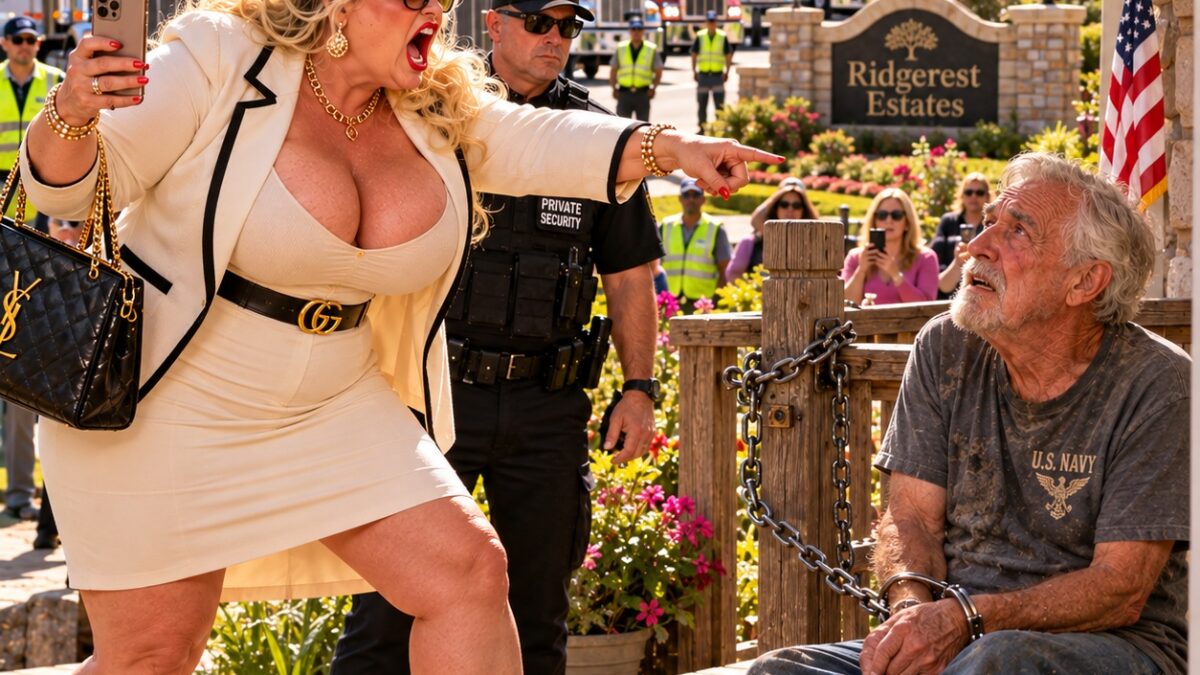
Victoria had told Wade to secure my father to the porch railing.
Not just handcuff him.
Chain him.
To the cedar railing he had milled, sanded, sealed, and bolted to the porch frame in 1987.
The railing my mother leaned against every evening watching hummingbirds.
Wade threaded the handcuff chain through the railing spindle and locked it.
My father, seventy-six years old, Navy veteran, Purple Heart in a cigar tin, thirty-eight years holding a welding torch under pressure, was chained to his own porch like an animal tied to a post.
On property he owned.
In a chair he built.
On concrete he poured.
By a man being paid forty dollars an hour by a woman filming in designer heels.
Gene’s voice cracked.
“Colton, he’s on his knees. Your daddy is on his knees. His coffee spilled. The mug’s on its side. She just adjusted her hair for the camera.”
I closed my eyes once.
Only once.
Then I opened them.
“Gene, listen to me. Do not touch anyone. Keep watching.”
I called Margot.
“They chained my father to his porch railing. Victoria manufactured the proximity. She drove to his house and called it a violation.”
“The restraining order says—”
“She drove to his house, Margot.”
Silence.
Two seconds.
“Motion will be ready before you arrive.”
Then I called Darnell.
“How many trucks in the yard?”
“Thirty-four.”
“Loaded?”
“Twenty-two loaded for tomorrow. Twelve staged.”
“Redirect everything. Kerrville. Mesquite Lane. Now.”
“All thirty-four?”
“All thirty-four. I’m leading.”
I climbed into BCF Unit One, a midnight-blue Peterbilt 579 UltraLoft with Briggs Continental Freight in silver across both doors, and pulled out at the front of a convoy that stretched a quarter mile behind me.
Peterbilts.
Kenworths.
Freightliners.
Dry vans.
Flatbeds.
Tankers.
Empty chassis.
Thirty-four trucks.
My drivers had been briefed in four minutes by Darnell, because that man could organize steel and diesel faster than most people could find their car keys.
I drove west at exactly the speed limit.
Because my father taught me that a man who breaks rules to enforce justice is not enforcing anything.
He is just angry with better excuses.
Gene stayed on the line for three hours.
Three hours.
My father was chained on his own porch for over three hours.
Victoria refreshed her lipstick twice.
Took a selfie with the Porsche in the background.
Sipped Evian.
Scrolled her phone.
Stood twenty feet away from a man on his knees and did not offer him water.
At 4:51 p.m., I turned onto Ranch Road 27.
Seven minutes later, I saw Mesquite Lane.
First, the pearl-white Porsche at the curb.
Then Wade’s black Interceptor.
Then my father on his knees, chained to the porch railing.
Then Victoria Langford standing on the sidewalk, phone in one hand, Evian in the other, platinum hair catching the Hill Country sun, Dior sunglasses pushed onto her head like a tiara for a kingdom of one.
She had dressed for my father’s humiliation the way she dressed for everything.
Like the world was a stage and she was the only actress who mattered.
I pulled Unit One to the mouth of Mesquite Lane and stopped.
Behind me, thirty-three trucks rolled to a halt along Ranch Road 27.
If you have never heard thirty-four diesel engines idling together, understand this:
It is not a polite sound.
It is a low, sustained growl that vibrates under your boots, rattles the ice in a water bottle, and says one thing in a language older than paperwork.
Weight has arrived.
And weight does not negotiate.
Victoria heard it before she understood it.
Her head turned.
The sunglasses slipped slightly from her hair.
For the first time in two and a half years, her mask cracked.
Only a hairline fracture.
But enough.
Then she saw the trucks.
I pulled Unit One across the entrance.
Darnell directed the rest.
Six on Ranch Road 27.
Eight along the access road.
Twelve fanning across the auxiliary street.
Seven filling every remaining legal parking gap near Victoria’s house.
Every truck was legally parked on public road.
Every driver stayed clear of private driveways.
Every hazard light worked.
We did not block emergency access.
We did not violate the law.
But the visual was absolute.
Victoria’s Porsche, vanity plate VICTORIA, sat boxed in behind a fifty-three-foot flatbed carrying twelve thousand pounds of structural steel.
There was nothing in her Bottega bag that could cite it.
No fine schedule.
No covenant.
No Montblanc pen.
No committee.
The trucks did not care about visual cohesion.
They did not care about Louboutins.
They did not care that she was president.
They were simply there.
Enormous.
Diesel-powered.
Indifferent.
The first things in Ridgerest Estates that Victoria could not control.
I stepped down from the cab.
Boots on Texas gravel.
Walked toward the porch.
Calm.
Measured.
Eyes forward.
The pace of a man who has decided the next thing will happen at his speed.
“Wade,” I said. “Remove the chain.”
He looked at me.
Then the trucks.
Then the thirty-three drivers standing beside their rigs, arms folded.
Men and women who spent their lives moving the weight that keeps this country running, now forming a quiet half-circle around a man who had chained an elderly veteran to a railing for forty dollars an hour.
“Remove the chain,” I repeated.
“My name is Colton Briggs. I own Briggs Continental Freight. That is my father. He was sitting on his own porch. He did not move. Ms. Langford drove here and manufactured the proximity she is calling a violation. Four cameras recorded every second. You are operating as private security, not law enforcement. You have no arrest authority. And you chained a seventy-six-year-old combat veteran to a railing he built with his own hands at the direction of a woman currently under investigation by the Kerr County District Attorney for fraud, embezzlement, false police reports, perjury, and conspiracy.”
I said the last part loud enough for every neighbor to hear.
They were already outside.
Gene on his porch, arms crossed, face hard with the satisfaction of a man who had waited for rain through a long drought.
Martha Delgado in bedroom slippers, the woman Victoria had fined $300 for a garden gnome classified as nonapproved exterior ornamentation inconsistent with sculptural guidelines.
Mrs. Henderson’s daughter standing in the driveway of the house Victoria helped steal from her mother.
Quiet faces.
Watching.
Remembering.
Wade removed the chain.
His hands shook.
Not because of me.
Because borrowed authority had finally met consequence.
My father rubbed his wrists.
Red marks ringed the skin that had spent thirty-eight years holding welding torches.
He picked up Dorothy’s coffee mug, the white ceramic one with the faded 798 logo, and set it upright on the step.
Then he stood.
Slowly.
With the dignity of a man who had been knocked down by worse things than handcuffs and stood back up every time.
Margot Chen arrived in a silver Lexus behind the last truck.
Charcoal suit.
Manila envelope.
Stride of a woman who had spent twelve years at DOJ telling criminals exactly what they were.
“Ms. Langford,” she said, “my name is Margot Chen. I represent Mr. Roy Briggs. This envelope contains a civil complaint detailing fraud, embezzlement of $72,000 in HOA reserve funds, twelve false police reports, conspiracy with Hill Country Premier Services and Brett Langford, and perjury. A copy was hand-delivered to the Kerr County District Attorney this morning.”
Victoria reached for her Bottega bag.
Reflex.
A drowning woman reaching for a dock.
But there was no notice in that bag that applied to thirty-four trucks.
No fine schedule for a Peterbilt.
No covenant for a convoy.
No Montblanc pen expensive enough to underline her way out of 684 pages of evidence.
Her mouth opened.
Closed.
Opened again.
For two and a half years, Victoria Langford had buried people under words.
But standing in the street she terrorized, surrounded by trucks, watching the man she chained to a railing stand up and look at her with unbroken steadiness, she could not find one sentence that fit the moment.
“This is a gated community,” she finally sputtered. “You can’t just— I’m the president of—”
“You are the president of nothing, Ms. Langford,” Margot said.
Quiet.
Level.
Absolute.
“Read the complaint. Retain counsel. Do not contact Mr. Briggs.”
Victoria looked at Wade.
Wade was already walking to his Interceptor.
He did not look back.
Forty-dollar-an-hour loyalty evaporates quickly when consequences cost more than forty dollars to survive.
Victoria watched him leave with the face of a woman seeing her last ally row away from a ship she had set on fire herself.
Then she looked at the neighbors.
The neighbors looked back.
No applause.
No shouting.
No dramatic speech.
Just silence.
And that silence was louder than every violation notice she had ever printed.
For two and a half years, Victoria made everyone on Mesquite Lane wait.
Wait for inspectors.
Wait for officers.
Wait for hearings.
Wait for her to decide whether their homes met her standards.
Now Victoria waited.
Her Porsche boxed in behind twelve thousand pounds of steel.
Darnell moved the Peterbilt eventually.
He took his time.
Exactly the amount of time it takes to teach a woman who has never waited for anything that the world does not rearrange itself on her schedule.
Victoria walked to her Porsche.
The Louboutins that had clicked with such authority on every driveway now clicked with the hollow rhythm of retreat.
She fumbled the key fob.
The Porsche chirped.
She sat inside for eleven seconds.
Alone in a $170,000 vehicle.
Holding a bag full of papers that had become evidence.
Then she drove away.
Mesquite Lane exhaled.
My father looked at me.
“Thank you, son.”
“We’re not done, Dad.”
The Kerr County DA filed charges on May 9.
Seven counts.
Three counts of filing false police reports.
Two counts of obtaining property by false pretenses.
One count of embezzlement.
One count of perjury.
Victoria was arrested at her home at 6:45 on a Tuesday morning.
She opened the door in a silk robe and bare feet.
No Dior sunglasses.
No Chanel jacket.
No Bottega bag.
No Montblanc pen.
No ice-blonde precision lob freshly styled into a weapon.
Just a woman with unwashed hair, a coffee stain on her robe, and the expression of someone who had never imagined consequence arriving before makeup.
“Do you know who I am?” she asked.
The deputy said, “Yes, ma’am. That’s why we’re here.”
She was handcuffed in her own foyer, in front of the mirror where she used to check her appearance before leaving to terrorize people.
That morning, the last thing Victoria Langford saw in that mirror was herself in cuffs.
Brett Langford was indicted separately for conspiracy and real estate fraud.
Wade Pickens was suspended without pay and permanently barred from private security work in Kerr County.
The restraining order was dissolved in nine minutes.
Margot played the footage.
Victoria driving to my father’s house.
Parking at his curb.
Walking within twenty feet of his porch.
Ordering Wade to chain him for being too close.
The judge removed his glasses.
“The court regrets this order was issued,” he said. “The petitioner manufactured the contact she cited as a violation. Mr. Briggs, I am sorry.”
My father nodded once.
The same nod he gave at my mother’s funeral.
The Montoyas filed suit.
The Petermans filed suit.
Mrs. Henderson’s daughter filed suit.
Hill Country Premier Services collapsed under subpoenas and bank records.
The Overlook at Ridgerest townhome project died before a shovel ever touched Mesquite Lane.
Gene Tully was elected HOA president unopposed.
His first act was not a vision initiative.
Not a fine schedule.
Not a design standard.
A handwritten letter to every original resident:
Your homes were here first.
Your rights come first.
Welcome back to your street.
Martha Delgado taped hers to her refrigerator.
My father put his in the cigar tin beside the Purple Heart.
I visited him on a Sunday in October.
The garden was immaculate.
Tomatoes staked.
Okra tall.
Pecan trees heavy with nuts.
Brown paper sacks already set on the porch for anyone who wanted them.
Dorothy’s hummingbird feeder was full.
A ruby-throated hummingbird hovered at the glass, wings blurring in the late afternoon sun.
Dad sat in the metal glider, drinking coffee from the 798 mug.
No chain.
No deputy.
No Porsche at the curb.
No Montblanc pen turning grief into a violation.
I sat beside him.
“Garden looks good, Dad.”
He looked out at the rows Dorothy had planted and he had saved.
“Your mother would have wanted it kept up.”
The glider rocked.
A pecan dropped somewhere in the grass.
Mesquite Lane was quiet.
The kind of quiet that does not need an architectural review committee, a community vision initiative, a patrol coordinator, or a woman in Louboutins with a Bottega bag to govern it.
The kind of quiet that exists when people are simply left alone to live in the homes they built, tend the gardens they planted, and sit on their own porches without anyone deciding their presence is a violation.
Victoria tried to turn my father’s dignity into content.
She tried to turn my mother’s garden into a code violation.
She tried to turn six old homes into a luxury development site and call it community improvement.
But she made one mistake.
She believed paper was power.
She forgot about steel.
She forgot about evidence.
She forgot that men like my father may stay quiet for a long time, but they do not stand alone forever.
And on the day she chained Roy Briggs to his own porch, thirty-four trucks came to remind her that some families do not need permission to protect what love left behind.