𝗙𝗨𝗟𝗟 𝗦𝗧𝗢𝗥𝗬:HOA Queen Called My 320 Acre Ranch “Garbage” and Offered Me Just $50,000 — She Had No Idea What Was Buried Beneath the Land She Tried to Steal!
FULL STORY CONTINUATION
My name is Dale Whitfield.
I am fifty-two years old, a veterinarian by profession, a former Army combat medic by training, and a widower by the kind of cruelty life does not explain before it takes what it wants.
I never planned to come back to Haskell County.
After Sarah died, I did not plan much of anything.
Bone cancer took her in fourteen months.
Fourteen months from the diagnosis to the night I held her hand while the monitors went flat and our daughter Lily stood in the hallway with my sister-in-law because she was thirteen and I could not make myself let her watch the last breath.
For three months afterward, I lived inside a house that smelled like Sarah’s shampoo.
I did not sleep right.
I did not eat right.
I went to work at the clinic in Tulsa, treated dogs and horses and cats and one angry macaw, came home, heated food I did not taste, and found Lily sitting at the kitchen table doing homework with a face too controlled for a kid who had just lost her mother.
She needed a father who was present.
Not a ghost with a veterinary license.
Uncle Roy called me in February of 2021.
Not a sympathy call.
Roy Whitfield did not do sympathy.
He did logistics.
“Dale,” he said, “you’re a veterinarian sitting in a city apartment letting a ranch rot.”
“Good morning to you too, Roy.”
“Bring Lily. Come home.”
That was it.
No sermon.
No emotional invitation.
No talk about healing.
Just bring Lily.
Come home.
Home was 320 acres in Haskell County, Oklahoma, rolling tallgrass prairie, blackjack oaks, two stock tanks, Copper Run cutting through limestone, and a ranch house built by a man who valued function over charm.
Limestone foundation.
Cedar siding.
Tin roof.
Wide porch.
Screens that rattled when the wind came hard from the north.
A house that did not care whether anybody admired it.
Roy had run Herefords there for four decades. Kept fences tight, tanks clean, the barn organized with the precision of a man who believed disorder was a moral failing.
He was my mother’s brother.
My parents died in a head-on collision on Highway 9 when I was nine years old. I woke in a hospital bed with stitches above my eyebrow and a world that had emptied itself overnight.
Roy drove to Tulsa, picked me up, put my small bag in the truck, and said, “You’re coming to the ranch. You’ll have chores.”
Not I’m sorry.
Not this will be hard.
You’ll have chores.
Because Roy understood something most adults do not understand.
A child who just lost everything does not need pity first.
He needs purpose.
So I had chores.
Feed before school.
Fence after school.
Vaccinations in spring.
Hay in summer.
Calves in weather.
Roy taught me to mend wire, doctor calves, read clouds, sharpen blades, fix engines, drive a tractor, and keep promises even when nobody was watching.
He never married.
Never traveled.
Never bought a vehicle that cost more than $12,000.
He wore the same Carhartt jacket for nineteen years.
When I was seventeen, I told him I wanted to join the Army.
He was quiet for ten seconds.
Then he said, “Come back.”
I did.
Two tours in Afghanistan.
One in Iraq.
Combat medic.
I came home in 2009 with a Bronze Star, a knee that still clicked before rain, and the certainty that I wanted to spend the rest of my life healing animals instead of humans.
I used the GI Bill and finished my doctorate in veterinary medicine at Oklahoma State.
Married Sarah Mallister in 2012.
Lily was born in 2013.
For a while, life behaved.
Then cancer came.
Then Sarah was gone.
Then Roy called.
So I took Lily home.
We moved onto the ranch in March.
Roy was eighty-one then, slowing down and too stubborn to say so. He had sold the cattle two years earlier because he could no longer manage the herd alone, and the ranch had that quiet feeling of a place waiting for somebody to give it purpose again.
I rebuilt it the way I rebuilt everything after Sarah.
By working until my hands hurt and my mind went quiet.
I bought forty head of Angus.
Fixed fourteen miles of fence.
Replaced the barn roof.
Opened a mobile vet practice covering three counties.
Lily hated it for the first month.
Then she pretended to hate it for two more.
By summer, she knew which gate stuck, which cow would slip a chute if you turned your back, and which creek stones were flat enough to cross after rain. She started sitting in Roy’s old chair without asking. That was when I knew she had decided to stay.
Roy died in his sleep on October 3, 2021.
I found him in the recliner at 6:15 in the morning with a Tom Clancy novel open on his chest and the coffee maker already running because he had set the timer the night before.
Even dead, Roy was organized.
He left me everything.
The ranch.
The house.
The barn.
The cattle equipment.
The mineral rights.
I did not understand the importance of that last phrase then.
His attorney, Janet Crowe, told me at probate, “Your uncle was the most precise client I ever had. Everything is in order.”
Then she paused and looked at me over the top of her glasses.
“Don’t sell the land.”
That was exactly what Roy had told me, more than once.
Don’t sell the land.
At the time, I thought it was sentiment.
Later, I would understand it was instruction.
Stone Ridge Estates sat directly south of our ranch.
It had been built in 2015 on the south half of the old Whitfield homestead. Originally, the whole 640 acres had belonged to Roy’s father, Earl Whitfield, who bought it in 1948. Earl split it decades later: 320 acres to Roy, 320 to Roy’s younger brother Vernon.
Vernon sold his half to a land broker, and in 2012, a developer named Greg Peton turned that surface land into Stone Ridge Estates.
One hundred sixty homes.
Clubhouse.
Community pool.
Limestone entrance wall that cost more per linear foot than Roy’s entire barn.
Stone Ridge sold rural charm to people who wanted country life without dirt, flies, cattle, coyotes, loose gravel, actual darkness, or neighbors whose trucks were used for work instead of image.
Their HOA was governed by Tiffany Beckett.
Tiffany was thirty-eight and looked twenty-seven because she had invested approximately the gross domestic product of a small island into making sure time, gravity, and ordinary facial movement never gained jurisdiction over her.
Her dermatologist in Tulsa saw her every five weeks.
Botox.
Fillers.
Microneedling.
Chemical peels.
Whatever else women like Tiffany call self-care when what they really mean is war.
She was beautiful.
I will not pretend otherwise.
Five-nine in flats she never wore, six feet in heels, hair salon auburn and engineered to move like a shampoo commercial. Eyes the color of aged whiskey, warm when she wanted something, cold when she was told no, and somewhere around fifty-eight degrees the rest of the time.
She wore Tom Ford sunglasses like a dictator wears medals.
Hermès scarves draped with architectural precision.
Chanel blazers that looked like they needed permits.
A Cartier Panthère watch worth $12,800, which she checked mid-conversation not because she cared about the time but because domination, apparently, can be done at the wrist.
She had been HOA president four years, elected unopposed because running against Tiffany Beckett was like standing in front of a hurricane wearing Louboutins.
You could not reason with it.
You could not outrun it.
And if you stayed in its path too long, you lost your mailbox, dignity, and will to live on the same street.
In four years, she issued 218 violation notices.
She fined the Patels $600 because their doormat said Welcome in a font she deemed inconsistent with exterior décor guidelines.
She sent a certified letter to a retired schoolteacher named Helen Briggs because Helen’s wind chimes produced “unapproved ambient noise.”
She told a single father named Marcus Johnson that his daughter’s tire swing was a liability hazard and a visual distraction, then gave him seven days to remove it before the HOA billed him for removal.
Marcus took it down at midnight so his daughter would not see.
The next morning, Tiffany drove past the empty branch and smiled.
That was Tiffany.
Breathtaking.
Merciless.
Immaculately dressed.
And in complete control of 160 families who had mistaken polish for leadership.
She had never, in thirty-eight years of obsessive surface maintenance, thought to look beneath one.
That was going to cost her.
She appeared at my door on April 14, 2022, at 9:15 in the morning.
Her Escalade idled in my drive.
Todd Gresham hovered beside it.
She introduced herself as president of Stone Ridge, even though her authority ended at the development wall and my porch sat on land that had been Whitfield before her current face existed.
“I’ve been meaning to stop by,” she said. “Welcome to the neighborhood.”
She said neighborhood the way a warden says facility.
I said nothing.
Tiffany looked past me at the house Roy had built.
I saw her eyes move.
Tin roof.
Cedar siding.
Gravel drive.
Cattle pastures.
Barn.
Fences.
I watched her calculate ugliness in real time.
“Dale, I’ll be direct,” she said.
I had a feeling direct was not going to mean honest.
“This property is affecting Stone Ridge. Our home values have dropped eleven percent since this ranch became, how do I put this, visible.”
“Visible?”
“The barn. The fencing. The cattle.”
She said cattle the way some people say cockroaches.
“Our residents purchased homes in a planned community. They didn’t buy homes next to”—she gestured with one manicured hand at 320 acres of Whitfield history—“this.”
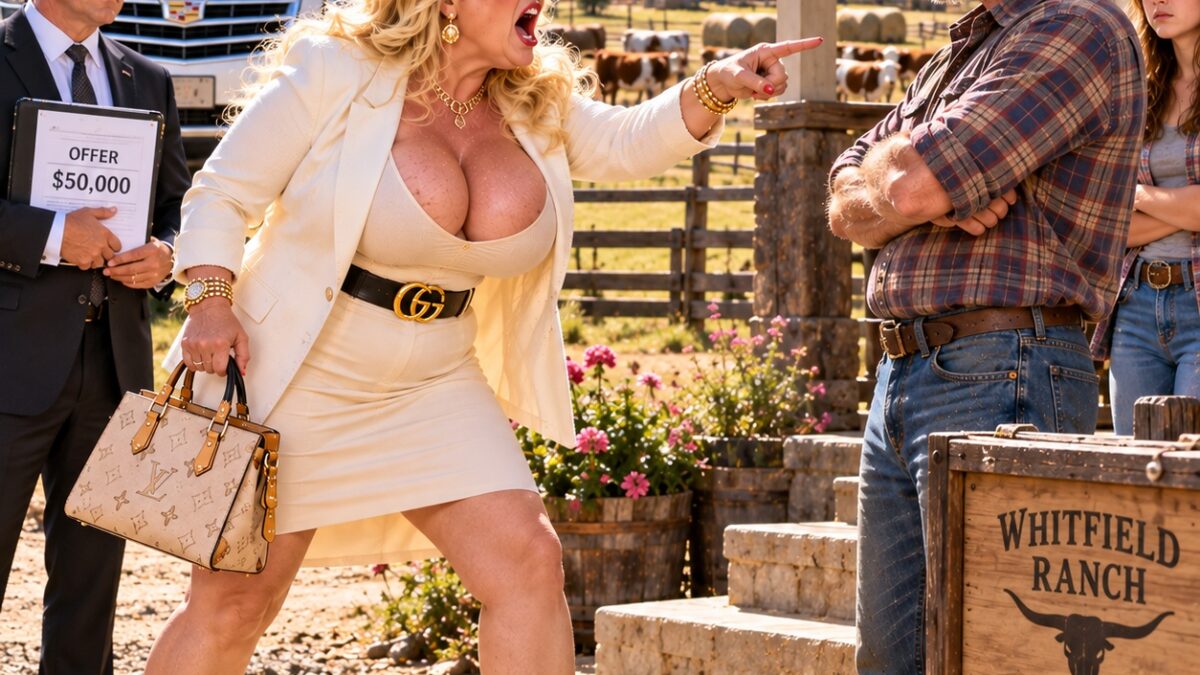
That was when Todd opened the portfolio and presented the $50,000 offer.
That was when Tiffany called my ranch garbage.
That was when I told her no.
That was also when the war began.
Tiffany’s first campaign was bureaucratic.
Within one month, six complaints landed at the Haskell County Code Enforcement Office.
Dust from my gravel road.
Livestock odor.
Visual blight from deteriorating structures.
Potential contamination from agricultural runoff.
Unsafe fencing.
Unpermitted commercial activity because my vet truck occasionally parked in my own driveway.
The inspector was Frank Yazzie, thirty years with the county, patient as winter and twice as hard to impress.
He drove out four times in six weeks.
Walked the fence lines.
Checked the barn.
Measured setbacks.
Tested water from Copper Run.
Inspected my chemical storage, manure management, well cap, and livestock handling area.
He found nothing because there was nothing to find unless breathing cattle and functioning fences had become illegal.
On his fourth visit, Frank sat on my tailgate and drank sweet tea.
“Mr. Whitfield,” he said, “I’ve received more complaints about your ranch in six weeks than I’ve received about the entire south county in six years.”
“They’re all from the same development.”
“I know.”
“They’re all unfounded.”
“I know that too.”
He looked toward Stone Ridge, its limestone wall gleaming in the sun like a monument to the belief that buying a house next to a ranch gives you authority over the ranch.
“The person filing them seems to believe a working ranch existing near a subdivision is itself a violation,” he said.
“It isn’t.”
“No. But she’s not going to stop.”
“No, she isn’t.”
Frank handed me a copy of his report.
“Document everything. Dates, photos, direct contact, county visits, complaints. If this escalates, you’ll want a record.”
So I started a file.
I did not know then that the file would eventually be worth more than Tiffany’s offer, more than her Escalade, more than every Chanel blazer she wore while building it against herself.
Tiffany’s second campaign was social.
She created a Facebook group called Stone Ridge Families for Property Values and posted photos of my ranch taken from angles that made the barn look worse than it was.
Is this what $400K homes should look at?
That was one caption.
Another showed my cattle at the south fence line.
Rural charm should not smell like this.
She collected fifty-two signatures on a petition and presented it at a county commissioners’ meeting wearing a white Dolce & Gabbana blazer, Chanel earrings, and the expression of a woman who believed that a petition plus bone structure equaled public policy.
Commissioner Linda Redcorn heard her out.
Linda was sixty-eight, a rancher’s daughter, three horses, one good coat, and no patience for HOA theatrics.
“Ma’am,” Linda said after Tiffany finished, “the Whitfield ranch has been operating since 1967. Your development has been there since 2015. The ranch was there first.”
Tiffany’s smile tightened.
“Commissioner, I represent 160 families.”
“And that ranch represents fifty-five years of agricultural use in a right-to-farm state. Oklahoma doesn’t rezone working ranches because suburban homeowners discovered rural living involves rural things.”
Tiffany blinked.
“But the aesthetic impact—”
“Ma’am,” Linda said, “the state of Oklahoma does not have an aesthetic statute.”
Then she turned to the clerk.
“Next item.”
That should have been the end of it.
But Tiffany Beckett had never reacted well to being told no by anyone, and certainly not by a woman in twelve-dollar reading glasses who cared nothing for Cartier.
Her third move crossed the line from nuisance into criminal.
In August, without notice, permission, easement, permit, or basic sanity, she hired a contractor to dig a drainage trench along the south boundary of Stone Ridge.
Three feet deep.
Angled deliberately.
Its purpose was to redirect stormwater runoff from the development away from their landscaping and straight onto my south pasture.
The first heavy rain came September 8.
Forty thousand gallons of runoff poured across the fence line, flooded my hay meadow, soaked $1,400 worth of cut hay, and turned the south pasture into mud that smelled like wet asphalt and HOA entitlement.
I documented everything.
Photos.
GPS coordinates.
Water samples.
Contractor tire tracks.
Flow direction.
Damaged hay.
Fence erosion.
I called Janet Crowe, Roy’s attorney, now mine.
“She diverted stormwater onto your property without an easement or permit,” Janet said after I described it.
Her voice went quiet.
Janet’s grandmother had been Cherokee, and Janet had learned patience from one side of her family and where to aim it from law school.
“Photograph the trench,” she said. “Do not touch it. I’m filing.”
That weekend, Lily and I cleaned up flood damage.
Rubber boots.
Mud to the knees.
Ruined hay bales.
Brush piled along Copper Run.
A teenager who had stopped complaining about ranch life and started participating in its defense.
We cleared debris near the south meadow where runoff had cut a fresh path through old root growth and blackjack oak brush.
That was when I found the pipe.
It was buried under six inches of mud, half-hidden by roots and silt.
Steel.
Capped.
Rusted but solid.
Four inches across with a valve assembly that looked professionally installed and deliberately sealed.
For a second, I just stared.
Then Roy’s voice came back from twenty years of memory.
This ground ain’t empty, Dale. Your granddad Earl knew what was down there.
He had said things like that for years.
I dismissed them as old-man mystery.
I was wrong.
I cleared more brush.
The wellhead was intact, capped with a standard blowout-prevention valve painted with rust inhibitor that had somehow survived decades.
Stamped on the casing:
WHITFIELD NO. 1 — 1973
Roy had drilled a well.
I went straight to the barn.
In the back corner sat a foot locker Roy had told me contained old papers. I had never opened it because grief does strange things to a man’s priorities. Sometimes a box is just a box until the land tells you it is time.
I opened it.
Inside were drilling logs from March through June 1973 in Roy’s block handwriting, production reports from the Oklahoma Corporation Commission, soil samples in sealed vials, and a manila envelope marked:
KEEP THE DEED.
Inside that envelope was the original 1948 deed from when Earl Whitfield bought the full 640-acre homestead.
Attached to it was a mineral rights severance executed in 1971.
The severance covered all 640 acres.
The 320 Roy kept.
And the 320 Vernon later sold.
The land under Stone Ridge Estates.
When Vernon sold his surface to a broker, the minerals stayed with the Whitfield family.
All of them.
Roy’s drilling log told the rest.
He hit oil at 840 feet in the Hunton Limestone Formation, a shallow reservoir common in the Anadarko Basin. He produced through the fall of 1973, then capped it when markets collapsed and cattle remained the steadier living.
He had not abandoned the well.
He had preserved it.
Carefully.
Patiently.
Like a man storing a weapon and waiting for someone competent enough to use it.
I called Janet the next morning.
“Did Roy ever mention mineral rights?”
A pause.
“He mentioned them once.”
“And?”
“He said, ‘Make sure Dale gets the minerals. He’ll know what to do when the time is right.’”
“I found the well.”
Another pause.
Longer this time.
“The old well on the south forty?”
“You knew?”
“I knew there was a well. Roy said the formation was still charged. He said you would find someone who knew what to do with it.”
The next call was to Emmett Price.
We had served together in Afghanistan. He had been a combat engineer. I was the medic. After discharge, Emmett earned a geology degree from OU and spent fifteen years evaluating formations for exploration companies.
He could look at a rock and tell you what happened to it 300 million years ago and what it might be worth now.
I sent him the drilling log, soil records, and GPS coordinates.
He drove down that Saturday.
Walked the pasture.
Studied the exposed limestone along Copper Run.
Took fourteen core samples.
Three days later, he called.
“Dale,” he said, “Roy was sitting on a charged formation.”
“In English.”
“The old well tapped the edge of a stratigraphic trap extending south and east. I’m estimating sixty to eighty thousand barrels of recoverable oil, plus several hundred million cubic feet of natural gas.”
“In simpler English.”
“Roughly five million dollars in recoverable value at current prices, maybe more with modern horizontal drilling.”
I sat down in Roy’s chair.
Five million dollars.
Under the ranch Tiffany Beckett called garbage.
Under the hay meadow she flooded.
Under the 320 acres she tried to buy for $50,000.
Under the subdivision whose residents she had convinced I was hurting their property values.
“And the mineral rights?” I asked.
“You own them. All 640 acres. Including under Stone Ridge.”
“Meaning?”
“Meaning you can drill from your ranch and access the formation beneath the development through horizontal boring. Oklahoma law treats the mineral estate as dominant. You don’t need their HOA president’s permission.”
Lily came in carrying tea.
She saw my face.
“What happened?”
“I found Uncle Roy’s well.”
“The oil well?”
I looked at her.
“You knew?”
She sat in Roy’s chair like she owned it.
“He told me before he died. Said there was oil under the ranch and someday you’d understand why he never sold.”
“Why didn’t you tell me?”
“Because Uncle Roy said the land would tell you when it was ready.”
I spent four months doing what Roy would have done.
Quietly.
Methodically.
Without telling anyone whose name appeared on a vanity license plate.
First, Janet verified mineral title.
She pulled every document from the Haskell County Clerk.
The 1948 deed.
The 1971 severance.
Vernon’s surface sale.
Probate transfer.
Tax records.
The chain was clean.
The Whitfield Mineral Estate covered the full 640.
Second, Emmett connected me with Red Mesa Energy, a small Oklahoma exploration company specializing in re-entering old wells.
Their chief engineer, Dr. Maria Santos, reviewed everything.
Maria was a PhD petroleum engineer, the kind of woman who wore steel-toed boots, corrected men with math, and found more wealth before lunch than Tiffany performed on Instagram in a calendar year.
“This formation is textbook,” she said, sitting at my kitchen table with maps spread between coffee mugs. “With modern horizontal techniques, we can drain the main trap from a single pad on your land.”
“No surface access from Stone Ridge?”
“None needed.”
“No permission?”
“Not from the surface owners. You own the mineral estate. We stay within setback, permit properly, and operate from your ranch.”
I signed a lease with Red Mesa in November.
Signing bonus: $1,200 per acre.
$384,000.
Plus a 20 percent royalty.
Tiffany had offered me $50,000 for the whole ranch.
The signing bonus alone was more than seven times her offer.
Red Mesa filed permits with the Oklahoma Corporation Commission for re-entry of Whitfield No. 1 and a new horizontal well targeting the main Hunton reservoir.
The permits were public record.
Tiffany did not know where to look.
Tiffany looked at Gucci.
Cartier.
Her own reflection.
She did not look at mineral deeds.
Meanwhile, she launched her final offensive.
In January, she filed a petition to rezone my property from agricultural to rural residential.
Commissioner Redcorn denied it in eleven minutes.
Tiffany hired an attorney named Kevin Bledsoe, a man whose office furniture cost more than his legal reasoning.
Bledsoe sent Janet a letter arguing my property was functionally abandoned.
Janet’s response was three pages.
The key sentence read:
The Whitfield Ranch has been continuously operated, maintained, and tax-current for fifty-five years, which is approximately fifty-one years longer than Ms. Beckett’s standing as a resident of Haskell County and approximately fifty-four years longer than her standing as an expert on anything that does not come in a bottle, box, or Birkin.
Janet had a gift.
Then Tiffany did something she could not take back.
On February 12, a Saturday morning, I walked outside at 7:15 and found a D4 Caterpillar bulldozer parked on my east fence line.
Forty feet of barbed wire fence Roy had strung in 1976 had been torn out.
Cedar posts snapped.
Wire coiled and thrown into my pasture.
A contractor named Buddy Harland sat in the cab drinking coffee with the relaxed posture of a man who had not yet realized he was the supporting actor in a crime.
“You the property owner?” he asked.
“I am. You’re on my land.”
“Ma’am from the HOA said this fence was on their property line and needed removal. She’s got paperwork.”
“She has nothing. That fence has been there since 1976. It sits on a recorded boundary surveyed by the county.”
Buddy looked uncomfortable.
“She said it was encroaching.”
“Get off my property.”
I called the Haskell County Sheriff.
Deputy Marcus Long arrived fourteen minutes later.
He photographed the fence line, took Buddy’s statement, checked visible survey markers, and looked at me over his notepad.
“Mr. Whitfield, this fence is on your property. This is criminal destruction of property. Who authorized it?”
“According to Mr. Harland,” I said, “the Stone Ridge HOA president.”
I also had trail camera footage.
Forty-three seconds of Tiffany Beckett standing beside the bulldozer at 6:50 a.m., pointing at my fence in yoga pants and a Patagonia vest.
The casual destruction outfit of a woman who had dressed down for a felony the way other women dress down for brunch.
Janet filed the civil complaint.
Trespass.
Destruction of property.
Unauthorized stormwater diversion.
Property damage.
Injunctive relief.
The real damage to Tiffany, though, was not yet legal.
It was narrative.
Every complaint.
Every Facebook post.
Every county inspection.
Every drainage trench.
Every photo.
Every deputy report.
Every second of trail camera footage.
All of it now showed a pattern.
Tiffany Beckett was not protecting property values.
She was bullying a neighboring landowner because he would not sell.
The drill rig arrived March 15, 2023.
Not a Permian Basin giant.
A 62-foot workover rig mounted on a truck chassis.
But on a 320-acre ranch in Haskell County, 62 feet of steel and diesel became the tallest thing between my property and the horizon.
Taller than Tiffany’s heels.
Taller than her opinion of herself.
Red Mesa re-entered Whitfield No. 1 on March 18.
Roy’s casing was still intact.
That said something about Roy’s standards and the difference between things built to last and things built to impress.
The crew found the Hunton at 832 feet, almost exactly where Roy’s drilling log said it would be.
Reservoir pressure was higher than expected.
Fifty years of being capped had let the formation build quietly beneath everyone’s assumptions.
The well came online April 2.
The first production numbers made Maria Santos grin.
I had never seen an engineer grin like that.
Then she handed me the report.
Whitfield No. 1 produced strong enough to put a monthly royalty check in my mailbox that was larger than Tiffany’s offer divided over the entire ranch.
Then Red Mesa spudded Whitfield No. 2.
The horizontal lateral extended south beneath Stone Ridge Estates.
Beneath the clubhouse.
Beneath the pool.
Beneath the fitness center.
Beneath the parking lot where Tiffany’s Escalade sat with TBECKT shining on the plate.
Beneath 160 homes whose owners had no idea the most valuable thing about their development was not the limestone wall, clubhouse, or HOA president’s cheekbones.
It was what Earl Whitfield preserved in a deed seventy-five years earlier.
Combined production exceeded projections.
Red Mesa estimated the reservoir life at fifteen years.
The recoverable value climbed toward $6.2 million.
The monthly royalty checks became steady enough that I started a separate account just to keep Roy’s money from mixing with ordinary bills.
Tiffany found out on day three.
Her Escalade appeared at my gate at 8:40 in the morning.
She sat in the driver’s seat for four full minutes.
The trail camera caught it.
She stared at the rig the way a woman stares at a credit card bill when she knows the charge is real but cannot accept that reality has produced something so inconvenient.
Then she stepped out wearing flats.
Flats.
On Tiffany Beckett.
No Louboutins.
No Jimmy Choos.
No Valentino blazer.
No Birkin dangling from her arm like an exotic hostage.
Gray cardigan.
Jeans.
The outfit of a woman dressed for the end of something.
She walked to the porch where Lily and I sat watching the pumpjack move in the morning sun, slow and steady, nodding like the earth was finally agreeing with something Roy had said fifty years earlier.
“Dale.”
“Tiffany.”
She stood at the bottom step.
Same place where she had called my ranch garbage.
Without the sunglasses and armor, she looked her age.
Not old.
Human.
That somehow made what she had done look uglier.
“I need to talk about the mineral rights,” she said.
“What about them?”
“The oil under our community.”
“What about it?”
“Your uncle kept the minerals when the land was split.”
“He did.”
“All 640 acres?”
“All 640.”
She closed her eyes.
When she opened them, the whiskey-colored eyes she had weaponized for years looked closer to desperation than dominance.
“I’m proposing a partnership.”
“No, you’re not.”
She ignored that.
“The HOA provides surface cooperation. You share revenue. Fifty-fifty.”
I let the pumpjack answer for a moment.
It nodded.
Up.
Down.
Up.
Down.
“Tiffany, you don’t have surface to contribute. The wells are drilled from my ranch. Red Mesa doesn’t need your property.”
“Then a percentage. Twenty. Ten. Something.”
“Why?”
“Because it’s under our homes.”
“You live on the surface. I own the minerals. Those are separate estates under Oklahoma law. The severance was recorded in 1971.”
“I’ll sue.”
“You can try. Your attorney will explain the mineral estate is dominant. The severance is valid. The permits are approved. And while we’re talking about lawsuits, you have a civil complaint pending for trespass, property destruction, and unauthorized stormwater diversion.”
Her mouth tightened.
“I never authorized—”
“I have forty-three seconds of trail camera footage of you standing beside the bulldozer that tore out my fence in yoga pants at 6:50 in the morning.”
Silence.
Loudest thing in Haskell County.
Louder than the rig.
Louder than the pumpjack.
The kind of silence that happens when a woman who has spent years controlling everything discovers she controls nothing.
Finally she said, very quietly, “You’re enjoying this.”
“No,” I said. “Roy would have enjoyed it. I’m just following instructions.”
She looked toward the pumpjack again.
“This will hurt property values.”
“You tried to make my ranch disappear over property values.”
“This is different.”
“It usually is when it happens to you.”
She had nothing for that.
She walked back to her Escalade and drove past Roy’s mailbox, the one she had once tried to have removed as a noncompliant roadside structure.
It was still standing on the cedar post Roy mounted in 1971.
The HOA hired a Tulsa firm called Baker, Collins & Pratt.
Their lobby furniture whispered four hundred dollars an hour.
The firm examined the deed, severance, tax records, corporation commission permits, Red Mesa’s lease, and Janet’s filings.
Their opinion letter was four pages.
It could be summarized in one sentence.
The Whitfield mineral rights were ironclad.
The drilling was lawful.
The HOA had no claim.
Stone Ridge homeowners learned the truth in a meeting Tiffany could not control.
Gary Polk, a retired electrician who would later replace her, stood up and asked why the HOA had spent legal money fighting a mineral deed that predated Stone Ridge by decades.
Tiffany tried to explain.
Words like community interest, surface impact, visual harmony, and property confidence floated around the clubhouse like perfume over rot.
Then Gary asked the question everyone had been avoiding.
“Did you try to buy the ranch for fifty thousand dollars before all this?”
Tiffany froze.
Someone else asked, “Did you know about the mineral rights?”
No answer.
Another homeowner, Helen Briggs, the schoolteacher whose wind chimes Tiffany had attacked, stood and said, “Did you flood his pasture?”
Tiffany looked at the board.
No one helped her.
That is when power starts to die.
Not when the first person turns.
When everyone realizes the room has permission to notice.
The civil suit settled in July.
Tiffany, through Kevin Bledsoe, agreed to remove the drainage trench, repair the fence line at her expense, pay $18,500 in damages, and issue a written acknowledgement that the Whitfield mineral rights were valid and enforceable.
That acknowledgement was recorded at the Haskell County Clerk’s Office.
The same office where Earl Whitfield’s mineral severance had been sitting since 1971, waiting patiently for someone to read it.
Tiffany resigned as HOA president the following week.
The vote to accept her resignation was unanimous.
158 to zero.
Two households did not vote because they were traveling.
Nobody voted to keep her.
Her replacement, Gary Polk, wore cargo shorts to board meetings and believed governance meant fixing the pool pump and leaving people alone.
After Tiffany’s reign, that felt like liberation.
The complaints stopped.
The Facebook group disappeared.
The county stopped receiving urgent reports about cows behaving like cows.
Nobody said the word aesthetic to me again.
The pumpjacks kept running.
Red Mesa began evaluating a third well.
The reservoir performed above projections.
I used the signing bonus the way Roy would have used it.
I rebuilt the barn on the same footprint with a new roof, new wiring, and better drainage.
Replaced fourteen miles of fence.
Expanded the herd to seventy head.
Built a proper hay barn so no unauthorized stormwater or unauthorized HOA president could ruin another cutting.
Then I did something Roy would not have done because Roy never talked about service and I talk about mine.
I built a veterans memorial on the east ridge.
A limestone wall with bronze names of Haskell County residents who served.
Visible from the county road.
Visible from Stone Ridge.
Visible from the porch where Tiffany once stood in Louboutins carrying a Birkin and calling this place garbage.
I funded scholarships too.
Two per year.
Full ride to any Oklahoma state school for Haskell County students who wanted to study agriculture, geology, veterinary medicine, or anything else that involved understanding what lives beneath the surface of things.
And I repaired the county road that ran past both properties, the road Tiffany had driven daily and never contributed one dime toward maintaining.
The county named it Whitfield Road.
There is a green-and-white sign now at the intersection where Tiffany used to turn left without signaling, because signaling, like reading deeds, was apparently optional for people with her cheekbones.
Gary stopped by last fall to buy eggs from the stand Lily set up at the end of the drive.
Five dollars a dozen.
Hand-painted sign.
Honor box.
He looked at the pumpjack, the veterans memorial, the rebuilt fence, and shook his head.
“Most of us never agreed with Tiffany,” he said.
“I appreciate that.”
“She had a blind spot.”
“What blind spot?”
“She could only see the surface.”
I looked toward Stone Ridge, the limestone wall, the neat roofs, the clubhouse roofline beyond the oaks.
Gary continued.
“She looked at property and saw curb appeal. Looked at people and saw clothes, trucks, shoes, bank balances. She never once thought about what was underneath. Not the land. Not the law. Not the people she was pushing around.”
I almost laughed.
No, she never did.
Roy did.
Roy worked roughneck crews for nine years before returning to cattle full-time. He knew oil-bearing rock when he saw it. Bought land people called ordinary and never told a soul what was beneath it.
Gary asked, “Why keep it quiet?”
“Because telling people what you have is how you lose it,” I said. “And because the man who says the least usually knows the most.”
Tiffany spent four years announcing everything.
Her authority.
Her skincare.
Her blazers.
Her Escalade.
Her taste.
Her standards.
Roy announced nothing.
And in the end, the man who announced nothing owned what the woman who announced everything had been standing on.
Lily graduates next year.
She wants to study geology at OU.
She says Uncle Roy whispered to her once that the land was waiting for someone who would listen.
She listened.
Most evenings now, we sit on the porch after chores. The pumpjack moves in the distance. The cattle graze. Copper Run cuts clear over limestone that has been holding oil longer than Stone Ridge, Tiffany Beckett, or anything on her face has existed.
And somewhere beneath the clubhouse, the pool, the fitness center, and the parking spot where the pearl-white Escalade used to idle, oil keeps moving through Whitfield rock into Whitfield wells onto Whitfield royalty checks.
Tiffany called this place garbage.
She was wrong.
Garbage is something people throw away because they do not understand its value.
Roy understood.
Earl understood.
Now Lily understands.
And every time that pumpjack nods above the pasture, it feels like the land answering Tiffany Beckett in the only language she finally learned to respect.
Money.
Quiet money.
Old money.
Whitfield money.
Coming up from the ground she never bothered to look beneath.