𝗙𝗨𝗟𝗟 𝗦𝗧𝗢𝗥𝗬: The Mother Dog Wasn’t for Sale—She Was Bait
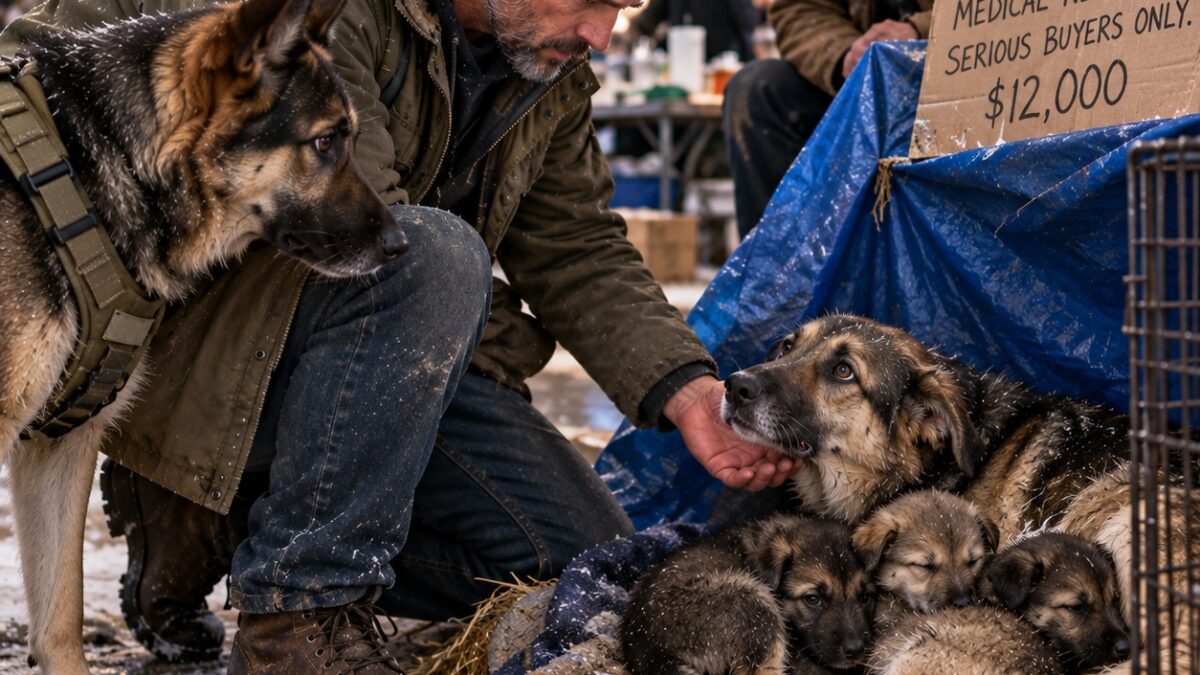
FULL STORY CONTINUATION
Wade began talking before I asked anything.
That was the second wrong thing.
The words came too ready, too shaped by practice.
“She was my sister’s dog,” Wade said. “Lark. My sister passed last spring. I tried to keep them, I did, but the vet says Lark needs medication, pups need boosters, and I’m behind on everything. I got papers. Real papers. I’m not one of those backyard sellers.”
He reached into a clear plastic folder and pulled out invoices, vaccination records, a rescue transfer form, and a laminated tag attached to a dark collar around Lark’s neck. The tag had a printed number and a small logo in one corner.
I took the papers without changing my face.
That was something years in uniform had taught me.
Never let the first answer show on your face.
The documents were clean.
Too clean for the rest of Wade.
The paper edges were sharp, the ink fresh, the signatures neat in a way that felt copied rather than written. There was a clinic name I did not recognize, though it sounded close to one I did. There were dates that might make sense if a man wanted them to. There were stamps, codes, a phone number, and a line about emergency winter transfer fees.
Enough to reassure someone who wanted to be reassured.
Not enough to satisfy someone trained to notice when a story stepped around its own holes.
“That price is high,” I said.
Wade’s shoulders folded inward as if he had been waiting for shame.
“I know. I hate it, but the meds aren’t cheap and I still owe for transport records. If somebody takes them for less, I can’t cover what’s already due. I’m not trying to get rich.”
He looked toward Lark with a softness that almost worked.
“I’m trying not to fail my sister twice.”
There it was.
A sentence placed exactly where it could do the most damage.
I had heard men lie badly and men lie well. Bad lies tried to erase questions. Good lies made the listener feel cruel for asking them.
Vesper stood beside me, ears forward, body quiet but alert.
She did not look at Lark first.
She looked at Wade.
Then past Wade.
I followed that slight shift and saw, near the warehouse door, a woman in a pale gray winter coat speaking into a phone. She was not close enough to be part of the sale. Not openly. Her posture was too clean for the market, her boots too polished for the slush, her dark-blond hair tucked neatly into her collar. Her face was turned just enough for me to see a smooth jawline and an expression without curiosity.
Her eyes moved over Wade.
Then over the plastic folder in my hand.
Then away.
Not a shopper.
Not quite a stranger.
Someone checking that a thing was happening the way it was supposed to happen.
“You run with a rescue group?” I asked.
Wade blinked once too fast.
“Just transport help. Crossline Companion Transport. They help get the paperwork straight. Good people.”
He tapped the folder with his thumb, rubbing the plastic edge in a small nervous rhythm.
“I just need them placed today. Storm’s getting worse. I got nowhere warm enough after tonight.”
I looked back at Lark.
The mother dog shifted, not away from me but over the puppies, making herself into a wall against the draft sliding under the service door.
That movement settled the question in me with a weight I disliked.
I could walk away.
I could call a clinic.
I could say I needed to verify everything first.
That would have been smart, clean, reasonable.
It would also leave Lark in that corner with a man whose grief sounded rehearsed and a woman at the door who watched like a supervisor.
I had been fooled before by someone who knew exactly which part of me still wanted to believe in people. I remembered the old veterans fund, the friendly voice of a man I had once trusted, the slow realization that the money was gone, and the way shame was somehow expected to belong to the victim.
Since then, I had made a habit of caution.
Caution kept me from losing more.
It also kept much of the world at a distance.
But caution, I knew, was not the same as courage.
I looked at Vesper.
Her gaze had moved to Lark now, and there was no urgency in it, no command, only recognition.
One living thing measuring the fear in another and not needing it explained.
“I’ll take them,” I said.
Wade’s relief arrived half a second late, like an actor missing a cue.
“You will? All four? Cash or transfer?”
He asked too quickly, then tried to soften it.
“Sorry. I just—storm and all.”
I paid more than I should have.
I knew that even as I counted it.
The amount felt ugly in my hand, not because I could not afford it, but because it seemed to put a price on the moment Lark had curled around her puppies.
Wade gave me the folder, the collar tag records, and a bag of food with a small packet labeled supplement tucked inside. I noticed the woman in gray had turned slightly away, her phone still at her ear. I could not hear her words, but I saw the smallest movement of her mouth.
A smile that did not reach the eyes.
Getting Lark into the truck took patience.
I did not drag her.
I opened the rear door, laid down an old blanket, and waited in the cutting cold that slipped through the warehouse bay as Wade hovered uselessly nearby. Vesper stood near the truck but did not crowd the mother.
Finally, Lark rose with stiff, careful movements and followed the puppies one by one as I lifted them into the warmth. Her eyes never left my hands. When the last puppy was settled, Lark climbed in after them and placed herself between me and the pups even inside the truck.
I closed the door softly.
Through the snow-streaked glass of the warehouse entrance, I saw the gray-coated woman lower her phone and glance once more toward the vehicle.
On the plastic folder lying on my passenger seat, the logo printed near the corner caught the light.
Crossline Companion Transport.
I looked at it for a breath.
Then I looked at Wade.
The seller stood beneath the warehouse awning with the money already tucked away, his face arranged into sadness that no longer had anyone to perform for.
As I pulled out onto the white road, Wade did not watch like a man saying goodbye to his sister’s dog.
He watched like a man waiting for distance, timing, and the next instruction.
The truck moved into the storm with Vesper upright beside me and four frightened lives breathing in the back.
And I understood, though not yet how deeply, that I had not just bought dogs from a desperate man.
I had stepped into a story someone else had prepared for me.
The road back to Lake Meron had nearly vanished by the time I turned off the county route and followed the narrow track toward my house. Snow swept sideways across the windshield in pale bursts, erasing the tire marks almost as soon as the truck made them.
The frozen lake beyond the black line of pines looked less like water than a blank place the world had forgotten to finish.
I drove slower than I needed to, not because the truck could not handle the road, but because every small shift from the back seat reached me through the rearview mirror.
Lark lifting her head.
One puppy squirming against another.
Vesper turning once to check them, then settling again with the controlled patience that had always made me trust her judgment more than most people’s words.
The mother dog had not made a sound since we left the market.
She did not cry.
Did not fight.
Did not show gratitude in any human-shaped way.
She simply held her body around the three pups as if the truck itself might demand one of them as payment.
I understood that kind of stillness.
Some people mistake silence for calm because they have never seen fear trained to keep quiet.
My house appeared through the snow as a low shape of dark wood and yellow window light beside the frozen fields. The porch roof wore a heavy white edge, and the fence was half buried along the north side where the wind always packed drifts against the rails. It was not a picturesque place in the way outsiders liked to photograph rural winter.
It was practical.
Repaired in layers.
Built to be survived in.
A stack of firewood stood under a tarp near the door. An old canoe leaned upside down against the shed. The wind chime my late mother had once hung by the porch was frozen silent, its thin metal pieces locked together by ice.
I parked close to the steps, left the engine running long enough to warm the cab while I opened the house, then carried the puppies inside first, one at a time, wrapped in an old wool blanket I kept behind the seat.
Lark watched every movement of my hands with such intensity that I found myself moving slower.
Not softer exactly.
More deliberately.
The way I had once moved around soldiers who had woken from nightmares, not knowing where they were.
Inside, the house smelled of cedar smoke, coffee grounds, leather, dog food, and cold air rushing in behind me.
I set the puppies near the wood stove on Vesper’s old brown rug, then stepped back. I did not reach for Lark. I did not tell her it was all right.
Promises sounded cheap when fear had already learned the price of trusting them.
I only opened the door wider and waited.
Vesper stood near the hall, body angled toward the entrance, but gaze lowered, making herself present without challenging the mother.
For a long moment, Lark remained in the truck, framed by the open door and blowing snow, dark tan coat rough along the shoulders, cream streak under the chin catching a little light.
Then one puppy gave a thin, searching whimper from inside the house.
Lark moved.
She crossed the porch low and fast, not fleeing from me, but passing me as if I were weather she had to get through. Once inside, she went straight to the rug, nosed each pup in turn, counted them with her body, then placed herself between them and the room.
I closed the door gently.
Warmth gathered around them slowly.
I fed the stove, laid clean towels near the rug, filled a shallow bowl with water, softened food with broth, and set everything close enough for Lark to reach without forcing her to leave the pups.
The lighter puppy, the weakest one, nosed the air and shook in small bursts. The darker pup pushed under Lark’s front leg. The gray-brown one with the folded ear looked toward Vesper, then tucked its face away as if embarrassed by its own curiosity.
Lark did not eat first.
She sniffed the bowl, glanced at me, then pushed it with her muzzle toward the pups, though they were too young to do much with it.
That small gesture tightened something in my chest.
Not because it was dramatic.
Because it was exact.
Hunger had not defeated her instinct.
Exhaustion had not defeated her order of love.
I pulled a kitchen chair back and sat several feet away, elbows on knees, hands loose. I let the room speak instead of me.
The crack of the stove.
The sigh of old boards warming.
The muted wind pressing at the windows.
Vesper’s steady breathing near the doorway.
After a while, Lark lapped water.
After another while, she took one bite of food, then froze when a truck passed on the distant road, tires grinding through snow. Her head snapped toward the front window. Her body tightened over the puppies.
Vesper raised her head, listened, judged the sound harmless, and lowered herself again.
Lark did not.
She watched until the noise faded completely, and even then her eyes moved to the back door, the side window, the hall, the porch shadow under the curtain.
I had seen dogs afraid of strangers, afraid of boots, afraid of raised voices.
Lark’s fear was different.
It was not attached to one thing.
It was attached to entry points, routes, timing, return.
I looked at the dark collar around her neck.
The laminated tag Wade had called a rescue record rested against her chest. A plastic rectangle sealed against weather, printed with a number, a barcode, and the little Crossline logo I had noticed at the market. The collar sat too high and too snug, not enough to choke her, but enough to say it had not been fitted for comfort.
I shifted slightly, only an inch.
Lark’s eyes shot to my hand.
I stopped.
“Not now,” I said quietly, though I was speaking more to myself than to the dog. “I see it.”
Vesper rose then and came to my side.
She did not crowd Lark. She pressed her muzzle gently against my wrist, right where my fingers had begun to curl. It was an old habit between us. When my anger started moving faster than my judgment, Vesper found my hand and reminded me there was still a body in the room that trusted me to remain myself.
I exhaled.
The anger did not leave.
It changed shape.
I gathered Wade’s folder from the counter and took it to the kitchen table.
The documents looked even cleaner under the yellow light above the sink.
North Pines Veterinary Care, the invoice said.
Emergency Maternal Support.
Winter Transfer Assessment.
Vaccine Schedule Pending.
The clinic name bothered me. There was a North Pine Animal Hospital forty miles south, run by a man I had once met at a county fair booth. North Pines, plural, sounded like someone had taken the real name and moved it half a step to the side, far enough to confuse, close enough to reassure.
I dialed the number printed at the top of the invoice.
It rang until an automated voice said the mailbox was full.
I tried again.
Same result.
I searched the county directory on my old laptop, the machine taking its time as wind rattled the window over the sink.
No North Pines Veterinary Care.
No matching address.
The street existed, but the number belonged to a closed tax office in a town two counties away.
I leaned back and rubbed one hand over my jaw.
I was not surprised.
That almost made it worse.
Some part of me had known the lie was there, waiting under the paper.
Knowing did not soften the fact that I had paid it anyway.
Across the room, Lark watched me over the puppies, not with accusation, but with calculation, as if she had learned that a human discovering something could become more dangerous than a human knowing nothing.
I softened my shoulders and turned slightly away, giving her the mercy of not being stared at.
“You didn’t do anything wrong,” I said.
The words sounded strange in the room because I was not sure whether I meant the dog, the pups, or myself.
I checked the rescue transfer form next.
Crossline Companion Transport appeared in small print near the bottom, paired with a slogan about safe passage through winter states. There was no direct phone number, only an email address and a QR code. The code led nowhere when I scanned it, just a blank loading page that never became anything.
That was not incompetence.
That was design.
I remembered the woman in the gray coat at the warehouse door, polished boots in warehouse slush, phone lifted to her ear.
Wade had been the hand extended to take the money.
She had felt like the person counting how often that hand succeeded.
I set the papers aside and unpacked the bag of food Wade had sent with them. The kibble smelled ordinary at first, dry and slightly oily, but tucked beneath the folded top was a small silver packet with a white label.
SUPPLEMENT.
EVENING USE ONLY.
No brand.
No dosage instructions beyond a line printed in block letters.
I opened the packet just enough to smell it.
An odd bittersweet scent rose into the kitchen.
Herbal on the surface.
Chemical underneath.
Sharp in a way that caught at the back of my throat.
Lark reacted before I moved.
She stood so fast one puppy rolled against her hind leg. Her ears flattened. Her breathing changed. She did not come toward the packet. She backed away from it, then circled the puppies, nudging them hard against her belly as if the smell itself had entered the room with hands.
Vesper stepped between me and the rug.
Not defensively against Lark.
Alert now.
Reading the sudden change.
I sealed the packet in a glass jar, twisted the lid tight, and carried it to the top shelf of a cabinet.
Lark kept trembling after it was gone.
That told me more than the label ever could.
Whatever the packet was, it was not simply food.
It belonged to a pattern Lark remembered with her whole body.
I stood under the kitchen light with the false papers on the table, the dead phone number still glowing on my laptop screen, the collar tag resting against Lark’s throat like a locked sentence, and the jarred packet hidden away above the dishes.
Outside, the snow thickened over the yard, covering the truck tracks, softening the fence posts, making the world look clean in the dishonest way winter sometimes does.
Inside, the stove kept burning.
The puppies finally slept.
Vesper returned to her place facing the door.
Lark lowered herself slowly, not relaxed, not safe yet, but tired enough to stop standing guard for one breath.
I did not touch the collar.
I did not call the sheriff yet.
I did not move too quickly.
I only sat at the table and wrote down every wrong thing in order.
Fake clinic.
Dead number.
Crossline.
Gray coat.
Collar tag.
Supplement smell.
Lark’s reaction.
The list looked small on paper.
In my gut, it felt like a line tied around the house from somewhere out in the storm.
Wade Casker had not just sold me a dog.
He had left something behind that knew how to pull her back.
By morning, the storm had loosened its grip just enough for the roads to show themselves again.
Not clearly.
Not kindly.
Just in faint gray grooves between snowbanks where plow blades had passed before dawn and left hard white walls along the shoulders.
I waited until the light grew strong enough to see the fence posts from my kitchen window, then loaded Lark and the three puppies into the truck with the same careful patience I had used the night before. I did not rush the mother dog. I wrapped the puppies in warm towels, placed them in a low crate lined with Vesper’s old blanket, and opened the back door wide enough for Lark to decide for herself whether to follow.
She hesitated at the threshold, eyes moving from my boots to the crate, then to Vesper, who stood in the snow beside the truck without pulling, whining, or crowding her.
That seemed to matter.
Lark climbed in only when the weakest pup gave a small breathy cry. Even then, she kept her body between me and the crate, as if accepting help did not yet mean accepting safety.
Vesper took her place in the front passenger seat, calm but awake, and I drove south toward the only veterinary clinic within reasonable distance of Lake Meron that had earned my trust over the years.
Dr. Nora Bellis kept her practice in a square brick building at the edge of Bitterroot Crossing between a bait shop that closed every winter and a laundromat whose sign flickered even in daylight. The clinic did not look sentimental. No painted paw prints on the windows, no cheerful slogans about fur babies. Just a shoveled ramp, a steel trash bin, a row of hooks for wet coats, and a front desk that smelled faintly of disinfectant, coffee, and animal fear.
Nora liked function better than decoration.
She had treated Vesper twice, once for a torn pad after a fall on lake ice and once for an infection I had caught early only because Vesper trusted me enough to show weakness.
Nora remembered both cases, which was why she opened the side entrance before I even reached the main door.
“Bring the little ones in first,” she said, holding the door against the wind. “Mother can follow if she chooses.”
Nora Bellis was in her mid-fifties, sturdy rather than large, with gray-blue eyes behind narrow glasses and short brown hair silvering at the temples. She wore a dark green veterinary coat over a sweater and had a red wool scarf tucked loosely around her neck, as if someone had once told her to dress warmer and she had obeyed only halfway.
Her voice had no softness added for effect, but animals trusted her more quickly than people did because she never lied with her hands.
She did not reach over Lark’s head.
She did not coo.
She lowered herself beside the crate, let Lark smell the back of her gloved fingers, then checked the puppies one at a time with movements so efficient they seemed almost plain until I noticed how carefully she returned each pup to the exact place Lark expected it to be.
“Undernourished,” Nora said after the first examination. “Dehydrated, but not beyond recovery. No sign they’ve had stable care. The lighter one needs warmth and fluids more than food right now. Too much too quickly, and you’ll make things worse.”
Lark watched every word as though language itself might hold danger.
When Nora shifted her attention to the collar, the mother dog changed. Her muscles locked, the skin around her eyes tightened, the cream streak under her chin trembling with the effort not to move.
Nora stopped before touching the tag.
“That answers one question,” she murmured.
I stood near the metal exam table, arms folded not in impatience but to keep my hands still.
“She reacted the same way at home.”
“Then we don’t force it today.” Nora adjusted her glasses and leaned closer without closing the distance. “A collar like that can wait a few hours if she’s breathing and swallowing. Panic can do damage too.”
She took Wade’s folder from me and carried it to a counter under the bright task light.
The papers that had looked clean in my kitchen looked almost theatrical in Nora’s clinic, where real medical records lived in stacks with coffee rings, scribbled dosage notes, imperfect signatures, and histories too specific to be invented smoothly.
Nora did not gasp when she found the first problem.
She made a small sound through her nose, then uncapped a red pen and circled the clinic name.
“North Pines Veterinary Care,” she read. “There’s a North Pine Animal Hospital down in Kettler County. Singular. Different address. Different license number.”
She circled a vaccine code.
“This format is old. Nobody around here has used this stock in years.”
Another circle.
“Stamp is lifted from a public form. See the edge? Too clean. No pressure variation.”
I watched the red marks multiply.
“So none of it’s real.”
“Some of it came from real documents,” Nora said. “That’s worse. A sloppy fake tells you the liar is lazy. This tells you the liar knows what people look for.”
She turned one page sideways and tapped the bottom corner where Crossline Companion Transport appeared in small print.
“I’ve heard that name.”
I looked up.
“From where?”
Nora removed her glasses and let them hang from the cord at her neck. For the first time since I entered, her blunt confidence thinned into something older and less certain.
“Rumors. Calls that start with, ‘This may sound stupid, but…’ People buying rescue animals out of bad situations. Paying too much because they think they’re helping. Then a few days later, the animal disappears. Sometimes they get a demand for more money. Sometimes they’re told the animal was reclaimed by a prior rescue. Sometimes they’re too embarrassed to finish the story.”
She looked through the window toward the snow piling along the curb.
“Good people hate admitting they were fooled for being good.”
The sentence stayed in the room longer than I wanted it to.
Lark shifted on the blanket, nosing the lighter puppy closer to her chest.
Vesper stood near the door, quiet, amber eyes tracking every movement but never interfering.
I thought of the old veterans fund, the friendly voice, the signed letters, the men who avoided looking at one another afterward because shame had moved faster than anger.
“Who would know more?” I asked.
Nora did not hesitate.
“Mara Ellison. But don’t expect her to kick in a door because we don’t like a folder.”
Deputy Mara Ellison worked out of the sheriff’s office two blocks from the clinic, a narrow building with salt crusted along the entry mats and a flag snapping hard in the wind outside.
I left Lark and the puppies in Nora’s care for fluids, warmth, and observation, but Vesper came with me.
Mara met me in a small interview room that had one window, one table, and a wall heater that clicked too loudly. She was forty-three, with dark hair pulled low at the back of her neck and a face built for weather: steady brow, tired eyes, no wasted expression. Her sheriff’s jacket hung on the chair behind her, but she kept her notebook open before she spoke, as if giving my words a place to land before judging them.
I laid out the folder, the fake records, the dead phone number, the Crossline name, the packet I had sealed in the jar, and the reaction Lark had shown.
Mara listened without interrupting.
That alone made me respect her more than if she had promised outrage.
When I finished, she tapped her pencil once against the notebook.
“I believe something’s wrong.”
“But?” I asked.
“But wrong isn’t a charge.”
She said it gently enough not to insult me and firmly enough not to let me pretend otherwise.
“Right now, we have suspicious documents, a questionable sale, and a dog reacting badly to a collar. That can open inquiry. It cannot prove theft, extortion, or conspiracy.”
I looked at the table.
“So we wait until they hurt another person?”
“No,” Mara said. “We find the people they already hurt.”
She picked up the folder and studied the Crossline logo.
“There’s someone you should meet.”
She took me down the hall to a room used for case overflow, where banker boxes lined the wall and maps were pinned under curling tape. Elliot Rusk stood over one of those maps, marking a route with a yellow pencil. He was fifty-eight, narrow-shouldered in a charcoal wool coat that looked too formal for the building, with thinning silver hair and a trimmed mustache that gave him the air of a retired school principal until his eyes lifted and showed how much he missed nothing.
“Elliot worked with the county prosecutor’s office,” Mara explained. “Mostly on fraud cases that cross town lines without looking dramatic enough to earn attention until the damage was already done.”
He opened a file before I sat down.
Inside were names, dates, photos of dogs, handwritten notes, partial plate numbers, and printed screenshots from websites that no longer existed.
“Crossline has never been charged under that name,” Elliot said, “which is not the same thing as clean.”
His voice was quiet and dry.
“They appear, they broker transport, they vanish, they reappear under a partner group or emergency network. The pattern is emotional urgency, sick animal, dead relative, weather threat, limited time, high fee dressed as rescue cost. Then, in some cases, the animal disappears and a second payment is demanded.”
My jaw tightened.
Vesper, standing beside my chair, leaned lightly against my leg.
“Why hasn’t anyone stopped them?”
Elliot closed the file with two fingers.
“Because fraud built on shame protects itself. People who lose money to greed get angry. People who lose money to compassion often blame themselves first.”
That afternoon, Elliot arranged for me to speak with Ruth Bellamy. Not as a formal witness, not yet, but as someone who might help me understand the shape of the thing I had stepped into.
Ruth lived in a small white house behind the church with bird feeders hanging from the porch and snow packed neatly along the steps as if she shoveled to stay busy.
She was sixty-two, slight, with soft pale eyes and short silver curls tucked under a cream knit cap. When she opened the door, she looked first at Vesper, then at me, and something in her face tightened with recognition before she invited us in.
Her living room smelled of tea, cedar polish, and the kind of loneliness people keep tidy.
On the mantel stood a framed photo of a gray-muzzled spaniel wearing a red collar. Ruth saw me looking at it and touched the pocket of her navy coat. From it she drew a worn leather collar folded small from being held too often.
“His name was Arlo,” she said. “They told me he was old and nobody else wanted to pay for his care.”
Her voice did not break.
That made the story harder to hear.
“I paid more than I should have. I knew it. I told myself it didn’t matter because at least he’d be warm. Four nights later, he was gone from my mudroom. No broken lock. No barking that I heard. A note came after. They said if I wanted him back, I needed to cover emergency transfer costs.”
I asked quietly, “Did you pay?”
Ruth nodded once.
“And still didn’t get him back.”
The room seemed to shrink around the admission.
Shame sat with her like another guest, old and unwelcome.
“I didn’t report it,” she said. “I thought people would ask why I believed them, why I paid, why I let it happen twice.”
Vesper crossed the rug slowly and stopped near Ruth’s chair.
She did not touch the woman, only stood close enough that Ruth could lower her hand if she wished.
After a moment, Ruth did.
Her fingers rested on Vesper’s head, trembling once before going still.
I looked at the collar in Ruth’s other hand and understood with a clarity that made me cold.
The money mattered.
The crime mattered.
The dogs mattered most of all.
But beneath all of it was something more poisonous: a system that stole from people and then made them feel too foolish to ask for help.
By the time I left Ruth’s house, the sky had darkened again and snow had begun to fall in fine, hard grains.
Lark and the puppies were still safe at Nora’s clinic.
No one had come for them.
No demand had arrived.
Nothing had happened yet that Mara could turn into a warrant or Elliot could carry into court.
But I no longer believed I was holding one strange folder from one desperate seller.
I was holding one corner of a net that had been thrown over good people for years.
Somewhere beyond the blowing snow, someone was still holding the other end.
By the third night, Lake Meron had become a white mouth around my house, swallowing sound, distance, and any clear sense of where the road ended. The storm had returned with more patience than violence. Not roaring all at once, but building hour after hour until the pines bent in the dark and the old window glass trembled in its frames.
Snow pressed against the porch steps, climbed the fence rails, filled the shallow tracks left by my boots, and turned the yard into a blank sheet that looked peaceful only to anyone who had never lived through a northern winter.
I knew better.
Winter could hide a broken hinge.
A stalled engine.
A fresh footprint.
A bad decision.
I had spent the day moving carefully between the house, the woodshed, and Nora Bellis’s clinic, bringing Lark and the puppies home only after Nora was satisfied they were warm enough, hydrated enough, and stable enough to sleep in a familiar corner rather than a metal kennel under clinic lights.
Nora had sent instructions written in her blunt red-pen hand.
Small meals.
No forced handling.
Keep the mother calm.
Do not remove the collar yet.
Call if panic remains severe.
Call if the light-colored pup weakens.
I followed every line as if the instructions were orders that mattered.
In truth, they did.
Inside the house, the stove worked hard against the cold, filling the main room with cedar heat and a low orange glow. I had placed Lark’s blankets near the wall where the draft was weakest, not too close to the stove and not too exposed to the room. The three puppies slept in uneven little piles against their mother’s belly, their breathing softer now than it had been the night I brought them home.
Vesper lay six feet away, facing the door, her black-and-silver coat catching the firelight in quiet bands. She had not tried to claim the rug back. She had not pushed for attention. She seemed to understand that for now, the kindest thing she could offer Lark was a boundary that did not move.
I sat in the chair near the kitchen table with Wade’s folder closed beside me and a mug of coffee going cold in my hand.
I should have been tired.
I was tired.
But fatigue was not always enough to make a man sleep when the house felt like it had been tied to something outside.
The false papers, the dead phone number, Crossline, Ruth Bellamy’s folded collar, the sealed jar with the strange supplement packet hidden in the cabinet, all of it moved through my mind without settling.
I had called Mara once after leaving Ruth’s house, not to demand action, but to give her the timeline and Nora’s findings.
Mara had listened, asked precise questions, and told me to document everything.
“If anything changes,” she said, “call me before you act.”
I agreed.
At the time, it had sounded reasonable.
In the middle of the night, reason often has less weight than the thing breathing in your chest.
A truck passed on the far road sometime after midnight, its sound muffled by snow and distance.
Lark lifted her head immediately. Her ears did not rise fully. One still sat a little softer than the other, but her body locked over the pups in the same protective arc I had come to recognize.
Vesper raised her head too, listened, then lowered it again.
The truck moved on.
Nothing followed.
I waited until Lark’s breathing eased, then turned down the lamp near the table. I checked the back door, then the front, then the latch on the mudroom window. I checked the stove. I checked the cabinet where the supplement packet sat sealed in glass.
The jar remained where I had put it.
High on the shelf.
Untouched.
I did not like the fact that I looked twice.
Before heading down the hall, I paused in the doorway of the main room.
One of the puppies, the gray-brown one with the folded ear, had wriggled away from Lark’s belly and ended up near Vesper’s front paws.
Lark saw it.
I saw Lark see it.
For a moment, I expected the mother to pull the pup back with the quick urgency of fear.
Instead, she stayed still.
Her eyes moved from the puppy to Vesper, then to me.
Vesper did not lower her head. She did not sniff the pup. She only remained where she was, steady as a promise no one had spoken aloud.
The puppy slept against the edge of Vesper’s paw, tiny chest rising and falling.
Lark let it happen.
I stood very still because some moments could be broken by wanting too much from them.
It was not trust.
Not fully.
But it was the first shape of it.
I went to bed with that image in my mind, not comfort exactly, but something near enough to make my chest ache.
I slept lightly, the way I had slept for years after leaving the service, never falling so far under that the world could not call me back.
When Vesper woke me, she did not bark.
She stood beside the bed, breath heavy, body rigid, eyes fixed on me with the kind of urgency she reserved for things that were already happening.
I came awake all at once.
No dream.
No confusion.
Just cold running through me before my feet touched the floor.
“What?” I whispered, already reaching for the pants folded on the chair.
Vesper turned toward the hall, stopped, looked back.
Not panic.
Direction.
I followed her into the main room.
The stove had burned low, leaving the house in a dim red-brown dark. At first, my eyes went to the rug because that was where the shape of the room should have been.
Lark’s curved body.
Three puppies.
Vesper’s empty place beside the door.
Instead, I saw the blanket dragged half off the rug, the water bowl tipped but not shattered, one towel twisted near the threshold to the mudroom.
No barking.
No broken glass.
No overturned furniture.
No signs of a fight.
The back door stood open by two inches.
Just enough for the storm to breathe into the house.
Snow dusted the threshold in a narrow white tongue.
Lark was gone.
The puppies were gone.
I did not move for one full second.
The mind, when struck in the right place, can become strangely formal. It presents facts before feeling, as if facts might build a wall in time.
Door open.
Rug disturbed.
No blood.
No broken latch visible.
No animals in room.
Vesper beside me, alive, alert, ashamed of nothing yet looking as if she had failed anyway.
Then feeling arrived.
Not rage first.
Not even fear.
A hollow drop, like stepping down where a stair should be and finding empty air.
I crossed to the door, crouched, and touched the latch.
It had not been smashed.
The metal was cold and wet. The wood around it showed a faint scrape near the strike plate, too fine to notice unless a man was looking for an entry that wanted to pretend it had not happened.
Outside, wind threw snow across the porch so hard that tracks would not last more than minutes.
Still, Vesper pushed past me onto the boards, nose low, body tense.
I grabbed my coat from the hook and followed.
The storm hit my face like thrown sand. In the cone of my flashlight, the yard appeared and vanished in pieces. Woodpile. Porch rail. Buried steps. The dark line of fence beyond.
Vesper moved to the left side of the porch, then stopped near the back corner where I kept a covered bin for salt and kindling. There, half-buried in fresh snow, lay the silver supplement packet.
Open.
Empty.
The smell rose even through the cold.
Bittersweet chemical under the false herbal note, wrong in a way I now understood before I could name it.
Vesper recoiled a fraction, then forced herself closer, not because she wanted to, but because the scent mattered.
I lifted the packet with two fingers and felt my stomach turn.
Someone had taken it from the cabinet.
Or someone had brought another.
The difference mattered for later.
In the moment, both possibilities led to the same truth.
The smell had been used like a command.
Not for me.
For Lark.
I saw it then, not as a complete picture, but as a cruel outline.
A door eased open.
A familiar scent released into the storm.
Lark, exhausted, half-trusting, hearing or smelling something that belonged to the old pattern, not running away from safety but being pulled through the part of her fear that still obeyed before it understood.
The thought hurt worse than if she had simply escaped.
I had promised nothing aloud, but I had built warmth, placed bowls, lowered my hands, guarded the room, and somewhere beneath all that, I had believed the house could mean safe.
I had not known the danger had come inside with them in a paper bag.
“I’m sorry,” I said into the storm.
The words were torn apart by the wind before they reached anything living.
I searched until my fingers ached and the flashlight beam shook in my hand, but the snow gave back almost nothing.
A partial drag mark near the porch edge.
One boot print under the eave, already filling.
A smear of dark slush where a vehicle might have idled beyond the fence line, hidden from the road by pines.
Not enough.
Not nearly enough.
By dawn, the storm had thinned into a gray, exhausted snowfall.
I had not slept again.
I had photographed the latch, the rug, the packet, the porch, the faint mark near the fence. I placed the empty supplement wrapper inside a freezer bag because anger could wait, but evidence could not.
Vesper stayed close, quieter than usual, her eyes returning again and again to the rug as if counting the missing shapes.
I stepped outside to check the woodshed before calling Mara, and that was when I saw the envelope.
It had been wedged into a crack between two boards of the old kindling box, protected from the worst of the snow by the overhang.
Plain white.
No stamp.
No writing on the front.
I took it inside before opening it because my hands were too cold to trust.
Inside was a printed photograph, grainy and dark, but clear enough.
Lark lay in the back of a van, the three puppies against her belly. Her eyes were open. The lighter pup’s head rested near her front leg.
They were alive.
On the back, written in black block letters, were seven words and a place.
12,000. LAKE MERON DOCK. ALONE.
No phone number.
No signature.
No demand dressed as explanation.
Just a price and an instruction, as if compassion had become an invoice again.
I stood at the table while the stove clicked, and the house felt suddenly too large around the empty rug.
The part of me that had once kicked doors in, that had once trusted speed and force because hesitation could get people killed, rose hard and immediate.
I knew the dock.
I knew the back roads.
I could be there before noon if the plows held.
My keys were already on the counter.
Vesper stepped between me and the door.
She did not snarl.
She did not bark.
She placed herself there with her chest square, amber eyes locked on mine, and held me the way she had held me through nightmares, through grief, through the old humiliation of being made a fool by a trusted man.
She was not stopping me from saving Lark.
I understood that after one breath.
Then another.
She was stopping me from becoming exactly what the note wanted.
One wounded man, alone, carrying money into a storm.
My hand shook once.
Then steadied.
I picked up my phone and called Mara Ellison.
When she answered, her voice rough with early morning sleep, I said only, “They came for them.”
Then I looked at the photograph on the table, at the empty rug by the stove, and at Vesper standing guard over the last good piece of my judgment.
“And I’m not going alone.”
Mara arrived at my house before the county plow reached the lake road.
She came in an unmarked dark SUV with ice locked around the wheel wells and a thermos of coffee she did not drink. By then, I had photographed everything twice, bagged the supplement packet, sealed the envelope in a plastic sleeve, and written the time I found it on a strip of tape across the front.
The old part of me, the part that had learned to make order out of aftermath, had taken over because it was easier than standing in the room and looking at the empty rug.
Vesper stayed near that rug as if the absence itself needed guarding.
Mara did not waste time with comfort she could not make true.
She stepped inside, took in the open space, the door, the table, my face, and the dog waiting by the hearth, then said, “Show me where.”
I showed her the latch, the scrape, the porch corner where the packet had been found, the woodshed crack where the envelope had waited under the overhang.
Mara listened the way she had in the interview room, but here, her stillness carried more weight.
This was no longer suspicion or paperwork.
Someone had entered a man’s home, taken living animals, and left a ransom demand.
She crouched by the back door, gloved fingers hovering over the scrape without touching it.
“Clean entry,” she said. “Not perfect, but clean enough for a storm night.”
“They knew the house.”
“Or they knew the dog.”
That hurt because it was true.
Within an hour, Elliot Rusk was at the kitchen table with his old leather case open beside Wade’s folder. He looked too formal for the room in his charcoal wool coat and stiff collar, but snow melted off his shoes like it did off anyone else’s, and the red in his eyes suggested he had slept even less than I had.
Sheriff Amos Trent arrived last, driving himself in a marked county truck despite the road conditions. Amos was in his early sixties, heavy through the shoulders, with a weathered face, white brows, and the slow movements of a man who had been underestimated by younger criminals for decades.
He removed his hat at the door, not out of ceremony, but because he had the old rural habit of respecting a house where something bad had happened.
“Mara says we’re not chasing ghosts anymore,” he said.
I placed the photograph on the table.
Lark’s eyes looked out from the van’s darkness with the flat terror of an animal trying not to use up the last of its strength.
Amos looked at it for a long time, then set both hands on the chair back in front of him.
“No,” he said. “We’re not.”
The first argument was not about whether to act.
It was about how.
I wanted the answer to be simple.
Take the money.
Go to Lake Meron Dock.
Get Lark and the puppies.
Put cuffs on anyone who came near me.
Elliot made that sound as childish as it felt in my blood.
“If they sent a demand, they expect desperation,” Elliot said. “If you appear too controlled, they may move the animals or change terms. If police appear too early, they scatter. If we grab one runner without recorded intent, the people above him cut loose and start again under a different name.”
I stood by the sink, arms tight across my chest.
“So I pretend they have me.”
“No,” Mara said. “You let them believe what they already believe—that compassion makes a man predictable.”
The words settled heavily.
I hated how accurate they were.
I had spent years teaching myself not to be led by anger or pity.
Yet here I was, exactly where the note wanted me.
Tired.
Ashamed.
Furious.
Ready to carry money into a storm.
Vesper left the rug and came to stand beside me, pressing her shoulder against my leg.
Not enough to interrupt.
Enough to anchor.
Elliot explained what they needed in plain terms.
The payment would be real enough to convince, but every bill would be marked and recorded. I would wear a small recorder under the inside layer of my coat with the microphone threaded near the collar seam where wind might not ruin everything. Mara would run the immediate field operation. Amos would coordinate the outer perimeter and keep dispatch clean, limiting radio traffic because scanners were easy to buy and gossip traveled faster than patrol cars in a small county.
The lake dock had weak cell reception, almost no cameras, and too many ways for a vehicle to disappear behind fishing shacks, old cabins, and snowmobile trails.
That was why the extortionists had chosen it.
But Mara had worked a fatal rollover there five winters earlier, and she knew a service road that ran behind an abandoned ranger station on the north side. If officers came in from the county route, they would be seen. If they came through the ranger station, they might get close enough to watch without forcing the exchange too soon.
“Might,” I said. “That’s the word I don’t like.”
“It’s the honest word,” Amos replied. “Any other word would be decoration.”
The plan needed one more piece before it stopped being theory.
Mara sent a deputy to pull traffic camera fragments from the plowed junctions, but it was Auto Klein who brought the first useful thing.
Auto ran the only garage in Bitterroot Crossing that stayed open even when half the town stopped driving. He arrived in coveralls under a heavy blue shop coat, a burnt-orange beanie pulled low, grease still dark along the cracks of his large hands despite the cold.
He looked like a man assembled from engine blocks and stubbornness.
He had known me in the distant way practical men knew one another. A nod at the parts counter. A borrowed tow chain returned cleaned and coiled. Not many words.
Now he stepped into the sheriff’s office later that afternoon carrying three printed stills from his garage security camera and a tire catalog folded open to a marked page.
“White van came by yesterday,” Auto said, dropping the stills on Mara’s desk. “Plates didn’t match the registration frame. Somebody swapped them, but they didn’t bother with the tires.”
Mara leaned over the images.
I stood behind her, feeling the day narrowing toward the lake.
The stills were grainy, full of blowing snow and garage light, but the van shape was clear enough.
“How do you know it matters?” Amos asked.
Auto pointed to the rear wheel.
“That tread, not common here. Commercial winter tire, stud pattern on the outer shoulder, but one rear tire’s worn uneven. Leaves a skip mark every few rotations on packed snow.”
He turned the catalog around.
“I saw the same skip outside my south pump before it filled in.”
Elliot’s mouth tightened in something almost like satisfaction.
“Can you put that in a statement?”
Auto shrugged.
“I can put it in English if that’s what you mean.”
The clue did not prove Lark was inside the van.
It did something nearly as important.
It narrowed what Mara’s team should watch for around the dock.
A white cargo van.
Altered plates.
Distinctive rear tread.
Likely route through the old lake road.
The operation began to take shape around that image.
Marked bills were prepared in a plain canvas bank pouch, then placed inside an older duffel so it looked like what I might actually grab in a hurry. Elliot recorded serial numbers and photographed the bundles. Mara tested the recorder twice under my coat while the wind hissed against the sheriff’s office windows.
“You don’t have to get to a confession like a movie,” she told me. “Do not push them into proving everything at once. Confirm the animals. Confirm they took them. Confirm the money is for their return. If you sense they’re about to leave, you let them leave long enough for us to move on the van. You do not play hero.”
“That last part sounds personal.”
Mara looked at me.
“It was.”
I almost smiled, but the feeling could not make it all the way through.
Across the room, Elliot slid the photograph of Lark into a file, then paused.
“There’s one more thing,” he said. “If this is Crossline, or someone operating through Crossline, the person who comes may not be Wade. Wade is useful because he looks desperate. The person collecting may look reasonable, professional, even kind.”
I thought of the woman in the pale gray coat at the market.
Polished boots in warehouse slush.
Phone lifted to her ear.
“I saw someone,” I said. “At the sale. Woman. Gray coat. Watching.”
Elliot’s eyes sharpened.
“Then don’t assume the cruelest person there will look cruel.”
I looked down at my hands.
They had fixed engines, held weapons, carried wounded men, lifted three cold puppies from a truck.
Now they were being asked to shake slightly in the right way, to hand over money while the people who had violated my home believed I was still alone inside my own shame.
That was the hardest part.
Not the danger.
Not the cold.
The performance of helplessness.
The lie I had to wear over my anger like another coat.
When I returned home to prepare, Vesper followed me from room to room. She watched me load the recorder batteries, check the old duffel, change into heavier layers, and stand for a long time beside the rug where Lark had last allowed one puppy to sleep near her paw.
I knelt there once.
Not praying exactly.
Not in any clean way.
I touched the edge of the blanket.
“I should have seen it,” I said.
Vesper lowered her head until her forehead touched my shoulder.
I closed my eyes.
“I know,” I whispered. “That doesn’t help.”
But it did.
A little.
Not because it changed what had happened, but because Vesper did not ask me to be less ashamed before she stayed.
Mara had been clear.
Vesper was not a police dog and would not be used as one.
I had agreed.
Still, leaving her behind was never going to happen.
The compromise was strict.
Vesper could ride with me and remain inside the truck unless Mara gave permission, or unless my life was in immediate danger.
“She is not a weapon,” Mara had said over the phone.
“No,” I answered, looking at Vesper’s amber eyes in the hallway. “She’s the reason I don’t become one.”
Late afternoon dimmed early under the storm clouds as I drove toward Lake Meron Dock. The money sat in the old duffel on the passenger floor, close enough that the people watching would see it when I opened the door. Vesper sat in the rear seat, silent, ears forward, every part of her reading the road and the man in front of her.
The lake appeared through the pines as a vast pale field, broken by dark posts, half-buried boats, and the skeletal shape of the dock stretching into white emptiness. Somewhere beyond the tree line, Mara, Amos, Elliot, and men I could not see were moving into positions that depended on timing, weather, restraint, and criminals believing good people were too ashamed to be careful.
I parked where the note had told me to park.
For a moment, I did not get out.
I watched snow curl across the hood. I listened to Vesper breathe behind me. I placed one hand on the duffel and the other over the hidden recorder beneath my coat.
Courage, I was beginning to understand, was not always the first step forward.
Sometimes it was sitting still long enough for the truth to arrive with witnesses.
The dock at Lake Meron looked less like a place for boats than a scar left open in the snow.
I sat in the truck with the engine running low, watching wind drag loose white sheets across the frozen lake until the world ahead of me seemed to move even when nothing living crossed it. The old duffel sat on the passenger floor, heavy with marked bills, and the recorder beneath my coat felt small against my chest, almost foolishly small for the weight being asked of it.
Somewhere beyond the tree line, Mara Ellison and her team were in position.
Somewhere behind the abandoned ranger station, Sheriff Amos Trent was holding the outer perimeter.
Elliot Rusk was not a field man, but I knew he would be close enough to listen when the recording came through clean or failed in the wind.
None of that made the waiting easier.
Vesper sat in the back seat, ears forward, body still, amber eyes fixed through the windshield. She had not whined once.
That was almost worse.
It meant she understood the danger was real and obedience, for now, was part of protecting me.
My hand rested on the steering wheel.
I could feel the old pull in my muscles, the blunt desire to step out, find the van, break open every door in sight, and take back what had been stolen.
But that was exactly the man the note had expected.
One wounded man.
Alone.
Predictable.
I breathed once, slow enough to hurt, and opened the truck door.
The cold came in like a hand across my mouth.
I lifted the duffel, stepped onto packed snow, and walked toward the bait shed near the dock, leaving the driver’s door partly open the way Mara had told me to.
Not carelessness.
Signal.
I had taken only six steps when Wade Casker appeared from behind the shed, hunched against the wind in the same brown work jacket and black beanie he had worn at the market. Out here, away from the crowd and the blue tarp and the rehearsed sadness, Wade looked smaller but not more honest. His eyes kept flicking past me to the truck, then toward the white cargo van half hidden beyond the shed where snow had drifted up around the tires.
I saw the van before I let myself appear to see it.
White body.
Dirt along the lower panels.
Rear tire slightly mismatched in its wear.
Auto Klein had been right.
“You brought it,” Wade called, voice thin in the wind.
I held up the duffel.
“Where are they?”
Wade rubbed his hands together though he wore gloves.
“You’ll get them. Just do what you were told.”
I took one step closer, stopping where the dock posts formed a broken line beside me.
“I want to see them.”
Wade gave a quick laugh with no humor in it.
“You don’t get to make demands now.”
“They’re alive?”
“The lot’s fine.”
I felt the word like a thumb pressed into a bruise.
The lot.
Not Lark.
Not the mother.
Not the pups.
A lot.
Inventory.
I kept my face in the shape Mara needed it to hold.
“I paid you once.”
“You paid for transfer,” Wade said, and the phrase came out too practiced. “This is different.”
“You broke into my house.”
Wade’s mouth twitched.
“House was open enough.”
My fingers tightened around the duffel handle.
I saw Mara’s warning in my mind as clearly as if she stood in front of me.
Confirm the animals.
Confirm the taking.
Confirm the money.
Do not play hero.
I let my shoulders sag a little, not in surrender but in performance.
“I just want them back.”
Wade’s eyes flicked again to the van.
This time, the side door opened.
The woman who stepped out did not look like someone who belonged behind a bait shed in a snowstorm.
Eden Cross wore a pale gray winter coat with a high collar, black boots that had no business being that clean, and gloves fitted close to her hands. Dark-blond hair rested neatly against her collar, and a small metal pin on her lapel caught the gray light. She moved carefully over the snow, not because she feared slipping, but because she disliked looking uncontrolled.
I recognized her from the market before she said a word.
The phone.
The polished stillness.
The watching.
Wade did not look at her like a partner.
He looked at her like a man waiting to be corrected.
“Mr. Ashford,” Eden said, and her voice was softer than the storm deserved. “I wish this had not become unpleasant.”
I turned toward her fully.
“You took my dogs.”
“No,” Eden said. “You interrupted a process you didn’t understand.”
“Wade explained there were costs attached.”
She glanced at the duffel.
“People like you often want the feeling of rescue without respecting the structure that makes rescue possible.”
It was so cleanly said that for half a second I understood how she had survived this long.
Eden did not sound like a thief.
She sounded like someone from behind a desk, someone with forms and policies and a practiced disappointment in other people’s ignorance.
She made cruelty wear administrative language.
“Structure?” I asked. “You mean selling them, taking them back, then charging again?”
Eden’s eyes sharpened, but her mouth remained calm.
“You are reducing a complicated network to something ugly because you’re embarrassed.”
There it was.
The real weapon.
Not the van.
Not Wade.
Shame.
I thought of Ruth Bellamy in her tidy living room, the old collar folded in her hand like a wound.
I let my gaze drop to the snow, allowed Eden to believe the word had landed where she meant it to.
“Maybe I am embarrassed,” I said. “Maybe I was stupid.”
Eden stepped closer, just outside easy reach.
“Not stupid. Emotional. There’s a difference, though the result is often the same.”
Behind me, inside the truck, Vesper shifted.
It was subtle.
A change in breath more than movement, but I heard it.
Then I heard something else.
A faint sound from the van, nearly buried under the wind.
A low, strained whine.
Lark.
Vesper’s body pressed toward the rear window. Her head aligned directly with the van now. Not Wade. Not Eden. The source of that sound.
She did not bark.
She did not throw herself against the glass.
She held the location with the quiet certainty I trusted.
Lark and the puppies were close.
Alive.
“Let me see them,” I said, pushing my voice toward desperation. “You’ll get your money. Just open the van.”
Eden looked at Wade, and he moved to the side door. He slid it open only a foot.
It was enough.
I saw darkness.
A blanket.
The pale flicker of Lark’s cream throat marking.
The small shapes pressed against her body.
Lark lifted her head but did not rise. Her eyes found me across the distance, and the force of staying still nearly split me open.
I did not move.
I counted one breath.
Two.
Wade slid the door almost closed again.
“Now pay,” he said.
I did not hand over the duffel yet.
“How many times?”
Eden’s face changed by a fraction.
“Excuse me?”
“How many people have you done this to?”
I let bitterness color my voice, but not strength.
“You sell the dog, take it back. Tell people it’s their fault for not paying enough. How many?”
Wade shifted.
“Give the money, man.”
Eden lifted one gloved hand to silence him without looking.
She had made a mistake already.
She believed she was still speaking to the ashamed man she had designed.
“People misunderstand ownership,” she said. “They pay an initial placement fee and assume that gives them moral authority, but animals in emergency transfer remain under network oversight until obligations are met.”
“So Ruth Bellamy misunderstood too?” I asked.
Eden’s eyes went still.
Wade looked at her then, fear flashing across his face.
The name had done what I hoped.
It made the past step into the present.
Eden recovered quickly, but not fully.
“I don’t discuss prior placements.”
“Arlo never came back to her.”
“Some animals are moved when homes become non-compliant.”
I heard the recorder under my coat become, in my mind, the loudest thing on the lake.
I pressed harder, risking the line but needing one more piece.
“And Lark? You moved her from my house because I was non-compliant?”
Eden smiled now.
Small.
Cold.
“Lark was retrieved because you interfered with a managed transfer and failed to settle remaining costs. The puppies go where they can produce the best recovery value. It is not personal, Mr. Ashford. It’s logistics.”
For one second, the lake, the wind, Wade, the van—everything narrowed to the word produce.
I nearly stepped forward.
Nearly.
Vesper made one low sound from the truck.
Not a bark.
A warning pressed through her chest.
It brought me back.
I raised the duffel.
“Then take it.”
Eden extended her hand.
That was when the shout came from the far side of the shed.
One of Eden’s men, half hidden near the van’s rear, had seen movement in the trees.
“Cops!”
The careful shape of the scene broke at once.
Wade spun toward the lake. Eden grabbed the duffel strap, then let go when I did not release it. Mara’s voice cut through the wind from the left, amplified by command rather than volume.
“Sheriff’s office. Hands where I can see them.”
Officers came from the ranger station side, dark shapes moving through snow between the pines. Amos’s truck lights flashed beyond the bait shed, blocking the access road.
Wade ran.
Not toward the van.
Not toward Eden.
Toward the open white of the shoreline where fishing shacks stood like broken teeth in the storm.
I turned, opened the rear truck door, and gave one clean command.
“Vesper. Out. Stay.”
Vesper launched from the truck and landed in the snow, but she did not chase wildly. She cut three strides across Wade’s path and stopped, square and silent, black-and-silver body planted between him and the lake.
Wade skidded, arms windmilling, suddenly faced not with an attacking dog but with a wall of living discipline that did not blink.
The pause cost him everything.
Amos and another deputy reached him before he could recover, taking him down into the snow without ceremony.
Eden did not run.
That almost made her more frightening.
She stood with her gloved hands raised, eyes moving from Mara to me to the duffel, as if recalculating which part of the story might still be controlled.
Mara cuffed her herself.
“Eden Cross,” Mara said, breath white in the air, “you’re under arrest.”
“For what?” Eden asked, and even then her voice remained nearly even.
Elliot stepped from behind Amos’s truck, recorder receiver in hand, snow gathering on his formal coat.
“We can start with extortion,” he said, “then discuss fraud, burglary, conspiracy, and transport records.”
For the first time, Eden looked less polished.
Not broken.
Interrupted.
Mara moved to the van.
I followed only when she nodded.
Inside, the air smelled of damp blanket, fear, and old plastic. Lark lay curled around the three puppies, trembling so hard her collar tag tapped lightly against the floor. The lighter puppy was alive, tucked against her chest. The dark one wriggled weakly. The gray-brown pup lifted its folded ear and made a sound no larger than a breath.
I did not reach in fast.
I crouched at the open door, letting Lark see my hands, letting her count me, letting the storm and shouting fall away behind us.
Vesper came to my side and stood just outside the van, calm again, her duty complete.
Lark’s eyes moved from me to Vesper.
Slowly, painfully, she lowered her head over the puppies.
Not surrender.
Recognition.
Mara’s voice softened behind me.
“We’ve got them.”
I looked at Lark, at the three small bodies pressed against her, and at the marked duffel lying in the snow beside Eden Cross’s footprints.
The trap had closed.
But the thing Eden had damaged in people would not be fixed by handcuffs alone.
Bitterroot Crossing did not celebrate the arrests with cheers, banners, or the clean satisfaction people sometimes imagine justice will bring.
The morning after Eden Cross and Wade Casker were taken in, the town looked almost exactly as it had before. Snow stacked against storefronts, tire chains clattered down Main Street, coffee steam fogged the windows of the diner, and plows scraped slow lines through the white.
Yet something had shifted under the surface.
News traveled the way winter news always traveled in a small place. Not loudly at first, but through lowered voices at gas pumps, phone calls between kitchens, a mechanic stepping out of a garage to tell a mail carrier, a woman in the pharmacy line saying she thought she had seen that white van before.
By noon, Mara Ellison’s office had received more calls than it had in the previous month.
Some people called angry.
Some called shaking.
Some called and hung up before giving their names.
Elliot Rusk spent the day moving between the sheriff’s office and the county prosecutor’s building with folders under one arm and a phone pressed to his ear, trying to turn fear into statements and statements into something that could survive a courtroom.
It became clear quickly that Eden Cross was not connected only to one ransom demand at Lake Meron.
There were transfer records in different names, temporary websites that had vanished, partial payments routed through small accounts, and stories from neighboring counties that sounded too similar to be coincidence.
But clarity did not bring comfort.
Not every dog could be found.
Not every payment could be traced.
Not every person was ready to admit what had happened.
That was the part I had not expected to hurt so much.
I had thought, foolishly, that once Eden was in handcuffs, the weight in the room might lift.
Instead, the weight changed shape.
It became older, wider, and full of voices that had been quiet for too long.
Ruth Bellamy was the first to walk into the sheriff’s office and ask to make her statement on record. She came wearing her navy coat and cream knit hat, holding Arlo’s old leather collar in both hands as if it were something fragile and official.
I was there when she arrived, standing near the wall with Vesper beside me, waiting for Mara to finish reviewing the evidence from the van.
Ruth saw me and stopped just inside the doorway.
For a second, the old shame returned to her face, that reflexive apology victims sometimes wear before anyone accuses them.
Then she straightened.
Not much.
Enough.
“I don’t want to whisper it anymore,” she said.
Mara did not rush her.
She led Ruth into the interview room, brought water, turned on the recorder, and let the woman speak in her own order.
Ruth spoke of Arlo, of the story she had believed, of the money she had paid, of the night he disappeared, of the second demand, and of the silence afterward.
She did not make herself sound noble.
She did not make herself sound foolish.
She sounded like a person telling the truth after carrying it alone until it had become heavier than the crime itself.
When she finished, I asked if she wanted me to step outside.
Ruth shook her head.
“No,” she said, looking at me through tired, pale eyes. “You stay. I think I can say this because you were fooled too.”
That sentence followed me for the rest of the day.
Not because it insulted me.
Because it freed something I had not known was trapped.
Later, when two more victims came in—an older truck dispatcher named Hal, who had paid emergency transport fees for a hound he never saw again, and a retired nurse named May Calhoun, who arrived with her husband Ellis, both of them embarrassed and angry in equal measure—I did not stand apart like a man untouched by the thing being described.
I stood with them.
I told them what had happened at the market, how I had noticed the false edges and still paid because Lark and the puppies were cold, because waiting felt like its own kind of harm, because compassion under pressure could be turned against even a careful man.
“I was military police,” I said quietly when Hal muttered that he should have known better himself. “I knew enough to be suspicious. I still handed over the money.”
The room went still.
I looked at Ruth, at Hal, at May and Ellis, at Mara standing near the door with her notebook lowered.
“Wanting to believe a living thing can still be saved is not stupidity,” I said. “The crime is not that we cared. The crime is that they built a trap around caring.”
No one applauded.
No one needed to.
Ruth set Arlo’s collar on the table between us, and for the first time it did not look like proof of her shame.
It looked like evidence.
Lark’s recovery did not follow the clean pace of a happy ending.
Nora released her back to my house after checking her lungs, hydration, and stress response, but the mother dog came through the door as if every threshold might change its mind. She kept the puppies close for days. When a van passed on the distant road, she rose before the sound reached human ears, body curved over them, eyes wide and hard.
When I moved toward the cabinet where I had once hidden the supplement packet, Lark watched my hands until I stepped away.
I did not take offense.
Trust, I understood now, was not a door that opened once and stayed open.
Sometimes it was a latch lifted a fraction at a time, lowered again by memory, then lifted once more because someone waited instead of forcing it.
Vesper seemed to know this without needing to learn it.
She did not crowd Lark after the return. She lay near the doorway as before, but now when one of the puppies wandered too close, Vesper let it sniff her paw, then looked away as if pretending not to notice.
The gray-brown pup with the folded ear was the boldest.
The dark pup was the first to bark in its sleep.
The lighter pup remained fragile, and I checked its breathing more often than I admitted.
Lark saw every check.
Slowly, she stopped flinching at them.
Days became a week.
The storm loosened, then returned in smaller waves.
Mara called twice with updates she was careful not to overpromise. Eden’s charges were expanding, but the process would be long. Wade had begun talking, not from remorse but from fear, naming storage lots, drivers, and temporary accounts. Elliot believed the case might reach beyond Minnesota.
That should have felt like victory.
It did not.
It felt like a map of damage.
One afternoon, Nora came to my house carrying medical supplies and left with the dark puppy tucked carefully in a carrier beside her. Not as a transaction. Not as a rescue rushed for sentiment. The pup had grown steady enough, and Nora had decided, in her blunt way, that her clinic apartment had been too quiet for too long.
“I’m not naming him until he proves who he is,” she told me, then looked down at the puppy chewing the edge of her glove. “Though he’s making an argument for Trouble.”
A few days later, May and Ellis Calhoun visited after Mara completed the proper checks. They were in their late sixties, both slow from winter and careful from loss, but when the lighter puppy crawled into the space between Ellis’s boots and fell asleep there, May covered her mouth with one hand.
Ellis did not speak for a long while.
Then he said, “We won’t try to replace what they took.”
I nodded.
“Good.”
Ellis looked at me.
“We’ll just give this one a life.”
That was enough.
The third puppy, the gray-brown one, stayed with Lark for the time being. I refused to make grief look tidy by separating them all at once.
Lark had lost control over too much already.
The guide came together on Nora’s exam table after hours because no one wanted to call it a committee, and no one wanted to wait for a county program that might arrive too late.
Mara brought case notes with identifying details removed.
Elliot brought language that would not create legal confusion.
Nora brought examples of real and fake veterinary forms.
I brought the plastic collar tag, the photograph from the envelope, and the sealed supplement packet as warnings.
Ruth brought Arlo’s collar and, without being asked, a sentence for the first page.
If someone makes you feel ashamed for asking questions, stop the transfer.
They called it the Safe Winter Rescue Transfer Guide.
It explained how to verify clinics, how to check rescue groups, how to recognize false urgency, how to avoid cash pressure, how to photograph documents, how to report suspicious transporters, and how to understand that compassion did not require surrendering judgment.
Copies appeared first at Nora’s clinic, then at the feed store, the church basement, Auto’s garage, the sheriff’s office, and the winter market warehouse where Wade had first staged his grief.
I pinned one near the same back corner where the blue tarp had hung.
I stood there for a moment after doing it, Vesper beside me, watching shoppers pass without knowing how close the place had come to swallowing another good person’s trust.
The sign did not feel like justice.
It felt like a fence.
Not enough to stop every storm.
Enough to mark a boundary.
Spring came slowly to Lake Meron, not as warmth at first, but as sound.
Water under snowbanks.
Ice groaning at the edges of the lake.
A drip from the roof that became steady enough to name.
The puppies grew into legs too long for their bodies and ears that could not decide what kind of dogs they meant to be. Nora named the dark one Trouble despite swearing she would not. May and Ellis called the light one Sparrow because, May said, any creature that small and stubborn deserved a bird’s name. The gray-brown pup stayed with Lark and me long enough that the question stopped being whether he was leaving and became what name the house had already given him.
I called him Flint.
Because he was small, hard to discourage, and always starting something.
Lark remained cautious.
She never became the kind of dog who threw herself into joy without checking the room first. But she began to sleep with her head down instead of lifted. She began to eat before the puppies had finished every bite. One morning, I came out to find her lying three feet from Vesper, not touching, not guarded, simply sharing the same patch of early sunlight like two soldiers who had decided silence could hold more peace than words.
I stood in the doorway and did not move.
Vesper opened one amber eye.
Lark did not.
That was how I knew it mattered.
The case against Eden Cross did not give the county a simple ending. Cases rarely do. There were hearings, continuances, additional charges, statements that contradicted one another, and evidence that led to places where no dog could be recovered. Some money was traced. Some was not. Wade testified to save himself as much as he could. Eden’s attorneys tried to turn every victim’s compassion into bad judgment and every fake form into a misunderstanding of rescue protocol.
But there were too many voices now.
Ruth.
Hal.
May and Ellis.
Others who had whispered first and then spoken clearly once they realized the shame did not belong to them.
Mara told me once, months later, that the first conviction would likely be only one part of a larger case. Elliot said Crossline had not been a company so much as a costume rack, different names for the same cruelty.
I asked whether that meant we had not stopped it.
He looked at me over his glasses.
“It means you helped pull one mask off. That matters.”
I was still learning how to accept sentences like that.
The old veterans fund scam had left a place in me where trust went carefully, if it went at all. For years, I had believed the lesson was simple: never let need speak louder than evidence. Never believe a story because you wanted the world to be decent. Never hand anyone the part of you that still wanted to help.
But Lark had taught me the flaw in that thinking.
Caution could protect a man from being fooled.
It could also leave him standing at a safe distance while something innocent froze.
The answer was not to stop caring.
The answer was to care with witnesses.
With questions.
With records.
With people willing to stand in the same storm and say, out loud, that kindness did not make a man weak.
One evening, after the lake ice had begun breaking in blue-gray slabs near the shore, I sat on the porch with Vesper lying at my feet, Lark stretched near the door, and Flint attacking a stick with more courage than strategy.
The wind chime my mother had hung years ago finally moved again.
It made a thin silver sound.
Not beautiful exactly.
Familiar.
I looked at Vesper.
“You were right,” I said.
Her ears shifted, but she did not lift her head.
“I was about to go alone.”
She gave the softest exhale, as if that had been obvious.
Inside, Lark rose and went to check on Flint, who had gotten the stick wedged between two porch boards and was blaming the world. Vesper watched her go, calm and alert, the way she had watched from the beginning.
One living thing measuring the fear in another.
Not needing it explained.
I thought of the market, the blue tarp, Wade’s rehearsed grief, Eden’s polished voice, Ruth holding Arlo’s collar, Mara’s steady notebook, Nora’s red pen, Auto’s tire print, Amos blocking the road, Elliot naming the crime carefully enough for a courtroom to understand it.
I thought of the envelope on my table and the note that had told me to come alone.
That was the real lie behind all of it.
Alone.
That was how people like Eden won.
They found the places where good people were ashamed, frightened, exhausted, or too careful to ask for help. They turned compassion into a private transaction, then made the victim believe silence was the price of having cared.
But Lark had not been saved because I was brave enough alone.
She had been saved because Vesper stopped me at the door.
Because Mara listened.
Because Elliot remembered patterns.
Because Ruth finally spoke.
Because people who had been fooled stood beside one another and stopped whispering.
Flint freed the stick at last, tripped over his own feet, and rolled into Lark’s side. Lark lowered her head, inspected him, then gave one soft, corrective nudge.
Vesper watched the whole thing with the grave patience of a dog who had decided her household was strange but manageable.
I sat there until the sky turned violet over Lake Meron and the last light held on the snow patches under the pines.
My house was no longer as quiet as it had been.
There were extra bowls near the door, paw prints on the floor I kept meaning to mop, a stack of safe-transfer guides on the kitchen table, and three different people who now believed they could stop by without warning if they had a new lead, a form to review, or an animal that needed a temporary warm place.
I had not planned for any of it.
Maybe that was why it mattered.
For years, I had thought trust was something a man restored by finding the exact moment it had broken and repairing it alone.
I was wrong.
Trust came back the way spring came to northern Minnesota.
Not all at once.
Not cleanly.
First as a sound under the ice.
Then as water moving where everything had seemed locked.
Then as a dog sleeping with her head down because someone had finally stayed long enough to be believed.
I reached down and rested one hand on Vesper’s shoulder.
Across the porch, Lark looked at me, then at Flint, then back toward the lake road.
She was still watchful.
So was I.
Some parts of us would probably remain that way.
But when the next truck passed far off beyond the trees, Lark lifted her head, listened, and then lowered it again.
That small choice felt larger than any verdict.
The world had not become safe.
But this house had become a place where fear did not get the last command.
And for the first time in a long time, I understood that being fooled for caring did not mean I had been weak.
It meant someone had mistaken my compassion for a door they could enter without consequence.
They were wrong.
This time, when the storm came for what was helpless, it found a mother dog, three puppies, one old shepherd, and a man who finally knew that saving something did not mean going alone.
It meant making sure the truth came with witnesses.